Received: July 26, 2019 Revised: October 16, 2019 Accepted: October 17, 2019
development for dental hygiene degree programs in Korea
Kyeong-Hee Lee ・Yoon-Young Choi ・ Eun-Seo Jung Department of Dental Hygiene, Shinhan University
Corresponding Author: Eun-Seo Jung, Department of Dental Hygiene, Shinhan University, 95 Hoam-ro, Uijeongbu, Gyeonggi-do, 11644, Korea. Tel: +82-31-870-3450, Fax: +82-31-870-3459, E-mail:
[email protected]
ABSTRACT
Objectives: The objective of this study was to examine the current state of dementia-related education for dental hygiene degree programs in Korea, as well as to develop a dementia- related curriculum for dental hygiene programs suitable for the social characteristics of Korea.
Methods: The study was conducted between April and November 2018. First, the current state of dementia-related education for dental hygiene programs in colleges throughout Korea and dementia-related education for other health care-related fields were investigated. Based on the initial findings, the basic content of the preliminary curriculum was constructed. Second, based on the opinion of the dementia-related curriculum development committee comprising 10 professors of dental hygiene, the operations of dementia-related courses and relevant details were constructed. Third, these operations and relevant details were assessed and revised based on focus-group interviews. Fourth, the dementia-related curriculum was developed based on the study findings and literature review. Results: The name of the course in the developed curriculum was set as “Elderly Dental Hygiene and Practicum.” The course was established as a “major elective,” and was offered as two units with two instructional sessions of two hours each. The learning goal for this course was acquiring the methods for understanding and managing the characteristics of the elderly. A consensus was reached regarding conducting the theoretical and practical lessons on some of the dementia-related content. The dementia- related curriculum comprised 10 “required contents” which is to be conducted over three weeks of theoretical lessons and two weeks of practical lessons. Conclusions: With the growing elderly population, the development and operation of the curriculum for geriatric oral health interventions are warranted in dental hygiene education. However, continued discussions and improvements are needed on the extent of educational content, considering various dementia- related symptoms and general geriatric systemic diseases.
Key Words: Curriculum, Dementia, Dental hygiene education, Development,
Education
Introduction
Dementia affects brain function; its causes are unclear, and it is not cured. The disease is characterized by loss of various bodily functions, including memory. Because patients with dementia experience difficulties with managing activities of daily living by themselves, they require various medical services and assistance from others [1]. The elderly population in Korea with dementia was estimated to be around 570,000 in 2013, accounting for 9.4% of the total elderly population [2]. The number is expected to increase to 1.01 million by 2024, and as a result, caring for elderly with dementia has emerged as a major health care concern [2]. Dementia is no longer an individual problem, and the Dementia Control Act was legislated by the government in order to reduce individual pain and suffering as well as societal burden [3]. According to the articles 1 and 3 of the Dementia Control Act, national and local governments should actively put in efforts to prevent dementia and provide proper medical service for dementia patients by implementing and supporting dementia management projects, and also offer programs such as dementia research projects, dementia examination projects, and family support projects for dementia patients [4]. Accordingly, the Korean government implemented various national level measures, including the announcement of the “National Responsibility System for Dementia” in 2017, further expansion of the long-term care insurance system for the elderly, and establishment of dementia centers nationwide [5,6].
Among various problems that patients with dementia, many problems are related to oral health.
Patients with dementia experience difficulties with oral hygiene care and are vulnerable to various oral diseases, such as dental caries and periodontal diseases, while there are many patients with dementia who suffer because of this [7,8]. However, oral health approach related to dementia till date has not been up to par and despite many existing articles and studies emphasizing the association between dementia and poor oral health [9-12], there is still a lack of interest and countermeasures on this matter.
Dental professionals providing oral health care to patients with dementia must understand the characteristics of patients with dementia and have the skill to effectively communicate with the patients, while also needing detailed strategy for coping with behavioral disorders [13]. However, current education on patient care for those with dementia mostly focusses on nursing professionals, while education for dental professionals is still lacking [14]. Despite the fact that dental hygienists can make the biggest contributions to providing professional oral health to patients with dementia [15], they are still unprepared. If dementia-related education is not properly provided in the undergraduate programs, it can lead to lack of appropriate knowledge and will negatively affect elderly with dementia [16].
Therefore, dental hygiene degree programs must provide systematic education that contain proper
knowledge and positive attitude towards dementia, which would allow the students to grow into
professionals, who can provide oral health intervention to patients with dementia. However, in a study
was conducted in 2012 on the standard curriculum for dental hygiene in Korea [17], dementia was not
discussed in detail. Currently, although some of the subjects covering geriatric health are offered,
dementia-related education is not being offered properly in the dental hygiene degree program in
Korea [18,19], and there are no clear legal regulations on related work. Moreover, previous studies reported high educational needs for dementia among professors and students of dental hygiene and dental hygienists [18,19]. The present study aimed to investigate the current state of dementia-related education for dental hygiene degree programs in Korea and dementia-related education for other health care-related majors to derive at the current problems in dementia-related education and to develop a dementia-related curriculum through consultation and assessment by an expert panel.
Methods
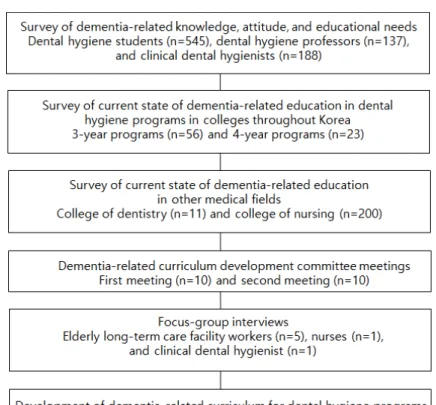
The present study was conducted between April and November of 2018 with the approval of the institutional review board (SHIRB-201804-HR-061-02) of the Shinhan University, and the procedures are as shown below <Fig. 1>.
1. Basic content of preliminary curriculum
First, a preliminary study was conducted to survey dementia-related knowledge, attitude, and educational needs in dental hygiene students (n=545); professors of dental hygiene (n=137); and clinical dental hygienists (n=188) [18,19]. Subsequently, the current state of dementia-related education in dental hygiene colleges throughout Korea and dementia-related education for other health care-related fields were surveyed. Based on the study results, the basic content for the preliminary curriculum was constructed.
2. Formation of a curriculum development committee
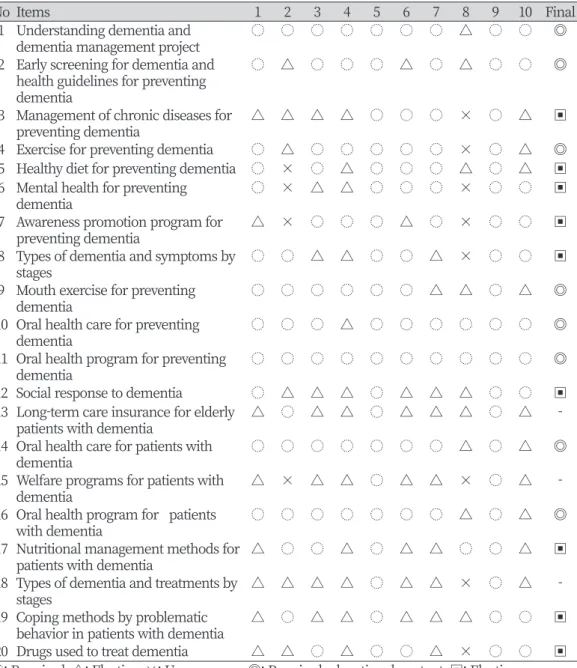
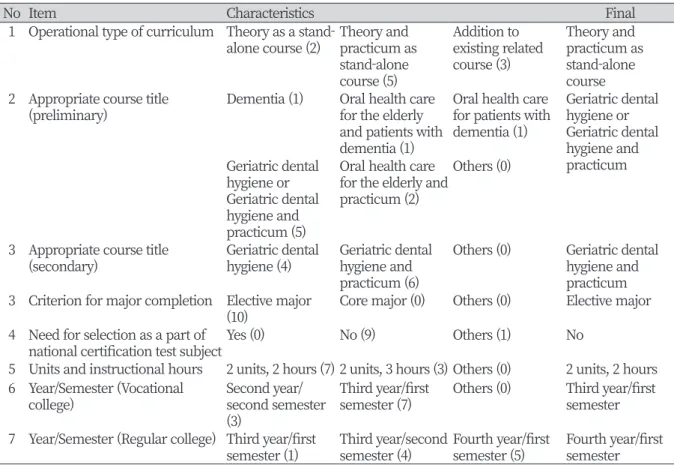
A dementia-related curriculum development committee consisting of 10 professors of dental hygiene who are active members of Korean Dental Hygienists Association, Korean Association of Dental Hygiene Professors, and Korean Society of Dental Hygiene was formed. In the present study, the members of the curriculum development committee played a role as decision-makers based on the authority given to make decision on the operation and details of the dementia-related courses. The selection of the details of dementia courses was based on items contained in the 2009 Seoul Metropolitan City Dementia Management Project Educational Resource Book (Citizen’s Dementia Prevention Education) [20], which were decided through content validity assessment conducted by the committee members. The researchers played the role of intervening in the curriculum development committee meetings, logging the details of the meetings, and compiling and organizing the opinions derived. The curriculum development committee meetings were held twice. The contents from the first meeting were reviewed and re-discussed, after which, the operation and details of dementia-related courses were constructed.
3. Expert panel assessment
The operation and details of the developed dementia-related courses were assessed and revised
based on focus-group interviews with workers in elderly long-term care facilities, nurses, and clinical
dental hygienists. For the staff of nursing homes, directors and care workers taking care of elderly with dementia at nursing homes and home care facilities located in Seoul-si and Gyeonggi-do were selected.
A nursing professor currently teaching at a university was selected as a nursing specialist, and a clinical dental hygienist with 25 years of work experience was also selected for the study. The focus group interview was conducted twice, and the objectives, study methods, and recording of interviews were fully explained to the participants before the interview. Each interview took about 2 hours, and the focus group interview was conducted in a lecture room at the researcher’s university. The interviews were recorded after getting consents from the participants. After the 1
stinterview, there cordings were transcribed and summarized for data analysis, and the contents for the 2
ndinterview were designed based on this analysis.
4. Development of dementia-related curriculum
Opinions derived from the curriculum development committee and expert panel assessment results were used to develop the dementia-related curriculum for dental hygiene.
Results
1. Current state of dementia-related education in dental hygiene degree programs
Fig. 1. Procedure of curriculum development
A review of the current state of dementia-related education in dental hygiene degree programs found that out of 56 3-year and 23 4-year dental hygiene degree programs, not a single school offered a major course with the term “dementia” in the course description. One school had a general education course with the term “dementia,” which was “elderly health and dementia.”
The number of schools with courses that included content on geriatric and systemic diseases and special patient care, which have a relatively high association with dementia was 10 3-year (17.9%) and 4 4-year (17.4%) schools <Table 1>. The course names appeared as geriatric dentistry, geriatric health care, and geriatric oral health care, while only 1 3-year and 1 4-year schools included practical lessons.
The number of units and instructional hours of related courses were mostly 2 units and 2 hours, respectively, and the courses were being offered mostly during the third year in vocational colleges (3- year program) and fourth year in regular colleges (4-year program).
2. Current state of dementia-related education in other fields
1) College of dentistry
A review of the current state of dementia-related education in colleges of dentistry found that among 11 colleges of dentistry throughout Korea, 10 colleges allowed access to their curriculum. Among these 10 colleges, there were no schools that offered any major, elective, or general education courses that contained the term “dementia.” Moreover, dementia-related courses being offered were as shown below <Table 2>.
Related course names appeared mostly as geriatric dentistry and understanding of systemic diseases.
Most of the courses were 1-unit courses, which were often classified as core major courses. The courses Table 1. Current state of dementia-related courses offered in oral hygiene programs throughout Korea
Type No Course title Units Time Year Semester Remarks
3-year program 1 Geriatric dentistry 2 2 3 2 Elective major 2 Geriatric health care 2 2 3 2 Elective major 3 Geriatric oral health care 2 2 3 1 Elective major 4 Geriatric oral health care
and practicum 3 3 3 2 Elective major
5 Specialized geriatric oral
health care 2 3 2 2 Elective major
6 Disabilities and
gerontology 2 2 3 2 Elective major
7 Gerontology and special
patient oral health care 2 2 3 2 Elective major
8 Geriatric dentistry 2 2 3 1 Elective major
9 Geriatric oral care 2 2 3 2 Elective major
10 Geriatric dental care 2 2 2 2 Elective major 4-year program 1 Geriatric dentistry 2 2 4 2 Elective major
2 Geriatric dental hygiene
and practicum 2 3 4 1 Elective major
3 Specialized dentistry 2 2 4 1 Elective major
4 Geriatric health care 2 2 3 2 Elective major
were being offered at various stages of the program, from the first semester of first year to second semester of fourth year.
2) College of nursing
A review of the current state of dementia-related education in colleges of nursing found that among 200 or more colleges of nursing currently in Korea, there was no school that offered any major or elective courses that contained the term “dementia.” Furthermore, while there were differences between colleges on related courses offered, education on dementia or Alzheimer’s disease was being offered, 1 session each, in adult nursing or psychiatric nursing (core major courses) or geriatric dentistry (elective major course). Moreover, colleges that were designated as leading colleges for overcoming dementia were offering such courses as 1-unit required general education courses.
3. Dementia-related curriculum development committee
1) Educational content
The educational content derived by the curriculum development committee was as shown in <Table 3>.
Table 2. Current state of dementia-related courses offered in college of dentistry throughout Korea No Related course title Units Lecture hours Year Semester Remarks
1 Geriatric dentistry 1 1 3 1 Elective major
Dentistry for the elderly and
disabled 1 1 2 2 Elective major
Understanding of systemic diseases 1 1 2 2 Core major
2 Geriatric dentistry 1 1 4 1 Elective major
Systemic diseases 7 7 2 1 Core major
3 Geriatric dentistry 0.5 0.5 4 1 Elective major
Dentistry and systemic diseases 1 0.5 0.5 3 2 Core major Dentistry and systemic diseases 2 1 1 3 2 Core major
4 Geriatric dentistry 1 1 3 2 Core major
Diagnosis and treatment of systemic
diseases 1 1 2 2 Core major
5 Geriatric dentistry 1 4 1 Core major
Dentistry for the disabled 1 3 2 Core major
6 Geriatric dentistry 1 1 3 2 Elective major
Biology of aging 1 1 2 1 Elective major
Understanding of systemic diseases 2 2 3 1 Core major 7 Clinical oral and maxillofacial
pathology 1 4 2 Core major
Dental treatment for patients with
systemic disease 2 2 2 Core major
8 Geriatric dentistry 1 1 3 2 Core major
9 Geriatric dentistry 0.5 1 4 2 Core major
Systemic diseases and dental
treatment 0.5 1 1 2 Core major
10 No access - - - - -
11 Problem based learning
*- - - - -
*