212
JOURNAL OF KOREAN FOREST SOCIETY
독립영양방식 액체대량배양 시스템하에서 배양한 체세포배 유래 음나무 기내묘의 생장과 광합성
박소영*·문흥규·김용욱
국립산림과학원 산림생명공학과
The Photoautotrophic Culture System Promotes Photosynthesis and Growth of Somatic Embryo-derived Plantlets of
Kalopanax septemlobus
So-Young Park * , Heung-Kyu Moon, Yong-Wook Kim
Division of Forest biotechnology, Korea Forest Research Institute, Suwon 441-847, Korea 요 약: 당이 첨가되지 않은 액체배지를 이용한 광독립영양법은 기내배양시 대량배양에 많은 장점이 있다 . 본 논문 에서는 광독립영양배양 시스템을 이용하여 체세포배발생을 경유해 대량증식 된 음나무의 대량생산 시스템을 보고하 고자 한다 . 이를 위해 체세포배에서 발아한 음나무 기내묘는 3 가지 배양 방식 , 즉 30 gL
−1당이 첨가된 1/2MS 고체
배지에서 배양한 종속영양 배양 ( 무처리구 ), 당이 첨가되지 않은 1/2MS 고체배지에서 배양 , 그리고 당이 첨가되지 않
은 1/2MS 액체배지에서 강제환기를 시켜준 독립영양 배양하에서 4 주간 배양되었다 . 순화전 각 배양환경하에서 자란
식물체들의 엽면적 , 광합성량 , 엽록소함량 , 생장량 등을 조사하였다 . 그 결과 독립영양하에서 생장한 유식물체의 생 장이 가장 좋았으며 엽록소 함량 및 순광합성량도 대조구에 비해 월등히 증가하였다 . 독립영양배양 시스템하에서 생
장한 식물체들은 이후 토양에서 100% 순화되었다 . 본 결과에서 배양 마지막 단계에 당이 첨가되지 않은 액체배지 에 배양하는 독립영양배양 방식이 기내배양묘의 순화율을 증가시키고 기외 활착율을 높임으로서 체세포배 유래 음 나무의 대량생산에 효율적인 것으로 나타났다 .
Abstract: A photoautotrophic micropropagation methodology in liquid culture medium has a number of advantages for large-scale propagation of plants. This paper describes an improved system for the mass propagation via somatic embryogenesis of the medicinal plant Kalopanax septemlobus Nakai. Somatic embryo-derived young plantlets of K. septemlobus were cultured either under heterotrophic conditions with sucrose on half-strength MS medium with 30 gL
−1sucrose, under heterotrophic conditions without sucrose, or under photoautotrophic conditions (MS liquid medium without sucrose under forced aeration) for four weeks before transferring the plantlets for acclimatization. Plantlets grown under photoautotrophic conditions had more leaves, higher chlorophyll content, a higher net photosynthetic rate (NPR), and a higher survival rate. The results indicate that the photoautotrophic conditions with a forced ventilation system are effective in enhancing the growth of plantlets and the rate of net photosynthesis. The plantlets grown under photoautotrophic conditions had a high survival rate (92%) upon ex vitro transplantation. Our study shows that autotrophically produced plantlets acclimatize better and sooner upon ex vitro transplantation than conventionally cultured plants.
Key words : Kalopanax, photoautotrophic culture, acclimatization, photosynthesis
서 론
기내배양에 있어 액체배양법의 장점중 하나는 다량의 기내배양체를 한 번에 다루어 대량배양이 가능하게 규모 화 할 수 있다는 점이다 . 액체배양의 이러한 점을 이용한
기내배양묘의 대량생산은 초본성 화훼류와 같이 비교적 배양이 쉬운 초본류 (Ziv, 1989; 1995; Park et al ., 2000;
Paek et al , 2001) 에서 시작되어 최근 들어 사과나무
(Chakrabarthy et al ., 2005), 유칼리나무 (McAlister et al ., 2005) 와 섬오갈피나무 (Park et al ., 2005) 등의 목본류에서 도 보고되고 있다 . 이러한 액체대량배양의 또 다른 장점
은 무균상태를 유지하기 위해 외부와 격리된 일반적인 배
*Corresponding author
E-mail: [email protected]
양방식과 달리 가스 , 배지교환 등 기내 미세환경을 자유 로이 조절할 수 있다는 점이다 .
지난 이십 여 년 동안 배양용기내로 CO
2주입 등 가스 교환을 통해 식물의 생장발달을 도모할 수 있는 배양시스 템이 고안되어 왔다 (Kozai, 1991a; 1991b). 배지내 당 농 도 감소 , 광도와 CO
2증가와 같은 방법은 기내배양 중인 식물체의 광합성 효율을 극대화 할 수 있는 방법으로 알 려져 왔다 (Kozai, 1991b; Lian et al ., 2002). 이러한 배양 방식 , 혹은 배양시스템은 식물체가 기내에서도 스스로 광 합성에 의해 생장할 수 있게 함으로 광독립영양 배양
(photoautotrophic culture) 이라고 불린다 (Kozai, 1991a). 이 러한 광독립영양 배양의 장점은 강제환기에 의한 낮은 상
대습도를 유지하고 배지내 sucrose 와 같은 당원을 첨가하
지 않아 오염율이 현저히 낮다는 점이다 . 또한 이렇게 광 독립영양배양 하에서 생산된 식물체는 이미 낮은 습도에 서 스스로 독립영양하므로 토양 식재시 별도로 순화단계 가 필요가 없다는 장점이 있다 (Kozai, 1991a; b; Ziv, 1995; Lian et al ., 2002; Zobayed et al ., 2004).
본 연구에서는 임목류 기내배양시 광독립영양 배양의
효율을 시험하기 위해 체세포배 유래의 음나무 ( Kalopanax
septemlobus Nakai) 소식물체를 재료로 당이 첨가된 고체 배지에서 배양하는 기존의 배양방식 ( 종속영양 ) 과 당이 첨
가되지 않은 액체배지에서 대량배양 ( 독립영양 ) 한 식물체
의 순화와 광합성효율을 비교함으로서 개선된 배양방식 을 제시하고자 하였다 .
재료 및 방법
1. 식물재료 및 배양방식
배발생 캘러스는 2007 년 화성 팔탄 지역의 음나무 ( 수령
약 50 년 ) 에서 채취한 미숙종자로부터 유도하였다 . 배발생
캘러스는 Moon 등 (2006) 의 방법에 따라 체세포배 유도와
성숙 단계를 거쳐 발아배지에서 3 주 정도 배양한 후 본엽 1 매 정도 유식물체로 발달시켰고 , 길이 1.5 cm, 본엽 1 매 정도가 되었을 때 본 실험의 재료로 이용하였다 . 순화에 미치는 배양방식과 영양방식의 영향을 구명하기 위해 식 물체는 각각 세 종류의 배양방식에 따라 배양되었다 : (1)
당이 첨가된 고체배지 ( 기존 배양방식 , 완전종속영양 , Semi- solid culture, SS), (2) 당이 첨가되지 않은 무당 고체배지
( 변형된 무당종속영양 , Semi-solid culture without sucrose, NSS), 이 두 배양시스템을 위해 400 mL polypropylene 배
양용기에 100 mL 배지를 분주하여 배양용기당 각각 10 개
씩의 식물체를 배양하였다 . 이때 배지는 30 gL
−1의 sucrose
가 처리에 따라 첨가되거나 제거된 1/2 MS(Murashige and Skoog, 1962) 배지를 사용하였다 . (3) 독립영양배양을 위해
별도로 제작한 아크릴배양 시스템 (Figure 1) 에 간헐적으 로 무당 액체배지를 일정간격으로 주입하고 강제환기를 시켰다 ( 광독립영양배양 , Temporary immersion culture without sucros, LL). 이 시스템을 위해 30 개의 체세포배 유래 식물체를 고압증기멸균 한 퍼라이트가 담긴 플라스 틱 플러그 트레이에 무균식재 한 다음 투명 아크릴 상자
(60 cm L×20 cm W×30 cm H) 에 넣고 무균 상태를 유지 하면서 배양하였다 . 이때 아크릴 상자에는 타이머를 이용 해 1 일 1 회 15 분 동안 1/2 MS 액체배지가 공급되도록 하 였다 . 또한 강제 환기를 위해 필터 (0.2-µm filter) 를 통과해
멸균된 공기를 펌프 (Dawkwang Inc, Seoul, Republic of Korea) 를 이용해 2,500 mL/min 속도로 주입하였다 .
이 세 종류의 배양시스템은 25±1°C 가 유지되는 배양실 에서 4 주간 진행되었고 이때 광량은 40 µmol m
−2s
−1광량 자속밀도 (16 시간 광주기 ) 로 유지되었다 . 배양 4 주 후 , 잎 Figure 1. Temporary immersion culture (LL) used in the present experiment.
Table 1. Description of culture conditions in three culture systems.
Semi-solid culture
(SS) Semi-solid culture
without sucrose (NSS) Temporary immersion culture without sucrose (LL)
Gelling type Semi-solid
zSemi-solid Liquid
Aeration Closed Closed Forced aeration
Sucrose 30 g/L - -
Culture scale (vessel) 400 mL 400 mL 10L
Culture type Heterotropic Modified heterotropic Autotropic
z
Medium was solidified with 2.5 g/L gelrite in SS and NSS.
수 , 엽면적 , 엽장 , 근장 등 식물체 생장량이 측정되었으며 ,
광합성량 , 엽록소함량 등을 분석한 후 식물체들을 토양에
식재하였다 .
2. 순광합성량 및 엽록소함량 분석
배양 4 주 후 , 각 배양 방식에 따라 생장한 식물체의 Net CO
2uptake 는 광합성측정장치 LI-6400(LI-COR, Lincoln, Nebraska, USA) 을 이용해 측정하였다 . 엽록소 함량 분석 은 Lichtenthaler(1987) 의 방법에 따라 각 개체에서 약 0.5
g 정도의 잎을 채취하여 80%(v/v) 의 차가운 아세톤에 넣
어 48 시간 동안 암상태에서 추출한 다음 각각 663.2, 646.8, 그리고 470 nm 에서 흡광도를 분석하였다 . 각 흡광
도를 Lichtenthaler(1987) 의 방법에 따라 계산하여 총 엽록 소 함량 , 엽록소 a, b, 카로티노이드 함량을 구하였다 .
3. 기공관찰
기공관찰을 위해 각 배양시스템하에서 자란 식물체의 잎을 채취하여 고정액 (FAA; formalin:acetic acid:absolute alcohol) 에 넣고 acridine orange(0.02%, pH 3.8) 로 1 분간 형광염색한 후 형광현미경 (Leica DMR, Wetzler, Germany)
하에서 기공 발달을 관찰하였다 .
4. 순화
각 배양방식으로 4 주간 배양된 식물체들은 수확하여 흐 르는 물로 흔들어 뿌리에 묻은 배지를 씻어내고 , 피트모 스와 퍼라이트가 혼합 된 순화용토 (1:1, v/v) 가 담긴 플라 스틱 트레이 (50 cm×30 cm) 에 식재되었다 . 순화상은 광량 자속밀도가 40 µ mol m
−2s
−1(16 시간 명 /8 시간 암 ) 로 유지되
는 생장상에서 4 주간 유지되었고 , 4 주 후 살아있는 개체 를 대상으로 순화율을 기록하였다 .
결과 및 고찰
배양 4 주 후 세 가지의 각기 다른 배양환경 하에서 생 장한 식물체로부터 엽면적 , 근장 등 생장량을 조사하였다 .
주기적 (1 일 1 회 , 15 분 ) 으로 무당배지를 공급하면서 동시
에 강제환기 시킨 처리구 (LL 처리구 , 광독립영양 ) 에서 식 물체는 엽병장이 기존의 배양방법 하에서 생장한 식물체 의 약 4.5 배 (5.8 cm), 엽면적은 약 8.7 배 (26 cm
2) 로 생장이 월등이 우수하였다 (Table 2). 같은 고체배지 조건하에서 당 첨가유무만 달리한 경우 역시 당이 첨가되지 않은 고
체배지 (NSS 처리구 ) 에서 엽병장 , 엽면적 등 지상부 생장
이 모두 우수하였다 .
기내 대량증식 체계 확립을 위해 증식조건이 확립된 식 물체는 그 다음 단계로 생장을 극대화시키기 위해 이상적 인 배양환경의 확립이 필요하다 . 배양환경은 기내배양중 인 식물체의 생장과 함께 생리적 발달에도 중요한 영향을
미친다 (Ziv, 1995). 그중 잎은 기내배양에서 수분스트레스
에 의해 가장 직접적인 영향을 받으며 기외 순화시 생존 을 결정짓는 가장 중요한 생장요소중 하나이다 . 본 연구 에서 당의 첨가유무만 달리 하였을 때 지상부 생장이 다 소 향상하는 정도였으나 강제환기를 통해 배양용기내 CO
2를 공급한 광독립영양 배양시스템하에서 음나무 식물체 는 엽면적 , 엽병장 , 엽수 등에 있어서 월등한 생장을 보여
주었다 . 이는 강제환기를 통해 음나무 기내배양묘가 광독 립영양 형태로 영양방식이 전환되어 스스로 광합성을 원 활히 함을 간접적으로 드러내주는 결과라고 하겠다 . 광독 립영양 배양방식은 감자 (Nakayama et al ., 1991) 와 Limonium (Lian et al ., 2002) 의 기내배양시에도 각각의 배
양묘 생장을 확연히 촉진시킨 바 있다 .
일반적으로 기내배양 식물체의 잎은 일반 환경하에서 자란 식물과는 달리 그 구조와 생리가 독특하다 . 기내배 양체의 잎은 일반식물에 비해 엽육세포 간극이 넓고 엽육 조직의 분화가 덜 이루어져 있으며 표피에 큐티클층이 얇 고 정상적인 기능을 하지 못하는 기공이 크게 발달해 있 다 (Wetzstein and Sommer, 1982; Donnely et al ., 1985;
Smith et al ., 1986). Lian 등 (2002) 은 종속영양 하에서 생장 한 식물체에서 기공밀도가 높고 광독립영양 배양하에서 자 란 식물체의 잎에서 오히려 기공밀도가 낮았다고 하였다 .
본 음나무의 결과에서도 이와 유사하게 광독립영양하에서 자란 식물체 잎의 생장은 확연히 우수한 반면 기공밀도는 오히려 낮은 것이 관찰 되었다 (Table 2, Figure 2).
Table 2. Growth parameters of K. septemlobus plantlets as affected by heterotrophic and photoautotrophic conditions after 4 weeks of culture.
Culture method Petiole length
(cm) Leaves no
(per plantlet) Leaf area
(cm
2) Stomata density
(per m
2) Root length (cm)
SS
y(Heterotrophic Culture) 1.3 b 2.4 b 3.0 c 9.9 b 10.6 a
zNSS
x(Heterotrophic without sucrose) 2.0 b 2.7 b 5.2 b 11.6 a 9.3 b
LL
w(Photoautotrophic Culture) 5.8 a 4.7 a 26.2 a 8.1 c 8.5 b
z
Mean values represented by different letters within the columns differ significantly according to Duncan's multiple range test at P< 0.05
y
Semi-solid cultures with sucrose
x
Semi-solid cultures without sucrose
w
Temporary immersion culture without sucrose and with forced aeration
엽록소 함량에 있어서는 무당 고체배지 (NSS) 에서 자란 식물체와 광독립영양 배양하 (LL) 에서 생장한 식물체의 엽
록소 a 와 b, 그리고 총 엽록소 함량이 당 첨가 처리구 (SS)
에 비해 높았다 (Figure 3). 당을 첨가하지 않은 배지에서
광합성능과 직접적인 관련이 있는 엽록소 함량이 증가되 었다는 것은 역시 기내 배양중인 식물체의 광합성 효율이 증가할 것이라는 간접적인 증거이기도 하다 ( 종속영양 배
양시 총 엽록소 함량 0.48 mg g
−1FW, 독립영양배양시
0.55 mg g
−1FW). 이러한 해석은 순광합성량 분석에서 입
증되었다 (Figure 4). 당이 첨가된 반고체배지에서 자란 식
물체의 순광합성량이 약 2.6 µmol CO
2m
−2s
−1정도인데 반 해 무당 반고체배지에서는 3.3 µmol CO
2m
−2s
−1, 무당 액 체배지에서는 3.9 µmol CO
2m
−2s
−1로 기존배양법에 비해 광합성량이 각각 113%, 150% 증가함을 알 수 있었다
Figure 2. Plantlets and micrographs of K. septemlobus grown under different cultural conditions for four weeks. A-C, Plantlets grown on semi-solid culture with sugar (A) and micrograph of pealed epidermal leaf showing stoma and its frequency (B and C). D-F, Plantlets grown on semi-solid cultures without sugar (D) and micrograph of pealed epidermal leaf showing stoma and its frequency (E and F). G-I, Plantlets grown in immersion culture without sugar and with forced aeration (G) and micrograph of pealed epidermal leaf showing stoma and its frequency (H and I). Scale bars=50 µm.
Figure 3. Chlorophyll content in the leaves of K. septemlobus plantlets grown under different culture systems for four weeks. SS: Semi-solid culture with sugar, NSS: semi-solid culture without sugar, LL: temporary immersion culture without sugar and with forced aeration.
Figure 4. Net photosynthesis rate of K. septemlobus plantlets grown under different culture systems for four weeks. SS:
Semi-solid culture with sugar, NSS: semi-solid culture
without sugar, LL: temporary immersion culture without
sugar and with forced aeration. Different letters indicate
significant differences between means at P < 0.05 (DMRT).
(Figure 4).
무당 고체배지에서 총 엽록소함량이 가장 높았으나 광 합성량은 강제순환 시킨 액체배지에서 높았는데 이는 밀 폐된 배양용기의 특성상 배양중인 배양용기내의 공기는 낮은 CO
2와 O
2농도 , 높은 습도로 인해 배양중인 식물체 가 낮은 순광합성량을 갖게 된 것으로 추측된다 . 강제 환 기시킨 배양용기에서 식물체는 광합성에 유효한 CO
2가 공급됨으로 인해 자연환경 하에서와 같이 정상적으로 광 합성을 하는 것이 가능하게 되는 것이다 (Zobayed et al .,
2004). 이 결과는 본 연구실에서 땃두릅나무를 대상으로
실시한 연구결과와 같은 경향을 나타내어 독립영양배양 시스템이 기내배양 식물의 생장과 광합성을 증가시킨다 는 주장을 뒷받침 한다고 하겠다 ( 자료 미제시 ).
대부분의 기내 증식중인 식물체는 탄소원으로 배지내 첨가 된 당을 이용한다 . 그러나 이러한 종속영양 상태에 서 식물체의 발달은 특히 광합성에 있어 제한을 받고 순 화시에도 점차적으로 자연환경에 노출시켜야 하는 단점 이 있다 . 이 과정에서 많은 식물체가 순화에 실패하기도 한다 . 이러한 의미에서 독립영양 환경하에서 생장한 기내
배양묘는 자연상태에서 자란 식물처럼 건전한 발달이 이 루어지고 순화과정에서 발생하는 식물체의 손실을 줄이 는 방법이라고 하겠다 (Kozai, 1991a; Pospisilova et al ., 1992). 그러나 이와는 상반되게 Debergh(1991) 와 De Riek
등 (1991) 은 순화시 적절한 처리만 해준다면 광독립영양이
식물순화를 위해 필요치 않다고 한 바 있어 광독립영양 배양의 유효성 여부를 판단하기 위해서는 여러 종의 식물 에서 다양한 실험과 이를 바탕으로 한 경제성 분석 등이 이루어져야 하겠다 .
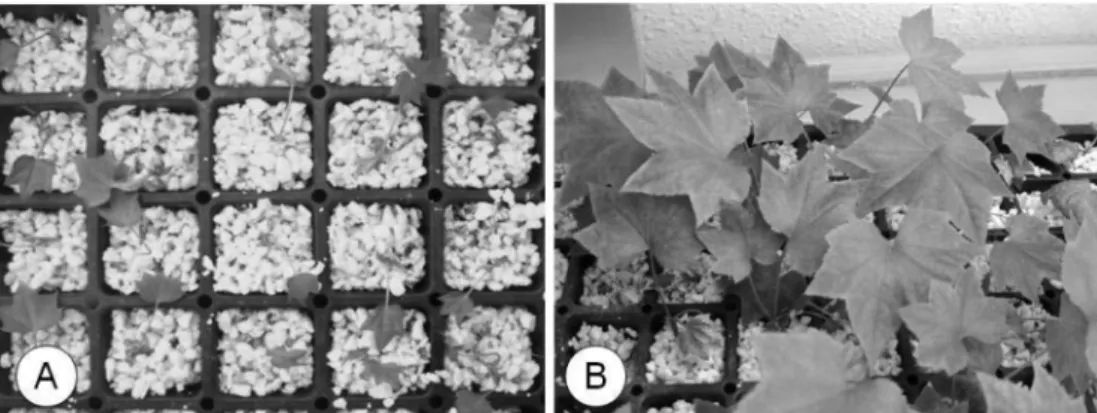
본 연구에서 광독립영양하에서 자란 식물체들 (Figure 5)
은 토양에서 100% 생존하여 종속영양하에서 자란 식물체
의 생존율 89% 보다 순화율에 있어 112% 증가되었다
(Figure 6). 독립영양하에서 자란 대부분의 식물체들은 기
존배양법으로 생산한 식물체에 비해 기외 식재 후 새잎
출현이 빨랐다 . Zobayad 등 (2004) 은 독립영양 환경하에서 배양한 식물체들은 토양에 옮기고 난 후에도 크게 생리적 변화 , 즉 스트레스가 적어 순화율이 증가한다고 하였다 .
본 연구결과는 당을 첨가하지 않은 무당 액체배지에서 강제환기를 시키는 것과 같이 기내배양시 배양환경을 최 적화함으로서 생장과 광합성을 극대화 할 수 있음을 보여 준다 . 또한 광독립영양배양 방식은 기내배양중인 식물체 잎의 발달과 독립영양을 가능하게 함으로서 순화율을 높 이고 기외 식재시 빠른 생장을 도모하는데 가장 적합한 배양방식으로 생각된다 .
인용문헌
1. Connolly, J.D. and Hill, R.A. 2000. Triterpenoids. Natu- ral Product Reports 17: 463-482.
2. Debergh, P.C. 1991. Acclimatizationtechnique of plants from in vitro. Acta Horticulturae 289: 291-300.
3. De Riek, J., Van Clemput, O. and Debergh, P.C. 1991.
Carbon metabolism of micropropagated Rosa multiflora L.
In Vitro Cellular and Developmental Biology-Plant 27:
Figure 5. Plantlets grown under temporary immersion culture system with forced aeration and in sugar-free medium, A. Plantlets after one week in culture, B. Plantlets after four weeks of culture.
Figure 6. Survival of K. septemlobus plantlets (grown under different culture systems) upon ex vitro transplantation. SS:
Semi-solid culture with sugar, NSS: semi-solid culture without
sugar, LL: immersion culture without sugar and with forced
aeration.
57-63.
4. Donnelly, D.J., Vidaver, W.E. and Lee, K.Y. 1985. The anatomy of tissue cultured red raspberry prior to an after transfer to soil. Plant Cell, Tissue and Organ Culture 4:
43-50.
5. Fu, L.K. 1992. China plant red data book rare and endan- gered plants. Vol. 1, pp. 741, Science Press, Beijing, China.
6. Kozai, T. 1991a. Photoautotrophic miropropagation. In Vitro Cellular and Developmental Biology-Plant 27: 47- 7. Kozai, T. 1991b. Controlled environment in conventional 51.
and automated micropropagation. In: I.K. Vasil (ed.), Cell Culture and Somatic Cell Genetics of Plants, pp. 213-230, Academic Press, New York, USA.
8. Lee, S.W., Kim, Y.M., Kim, W.W. and Chung, J.M. 2002.
Genetic variation of ISSR markers in the natural popula- tions of a rare and endangered tree species, Oplopanax elatus in Korea. Journal of Korean Forest Society 91:
565-573.
9. Lian, M.L., Murhty, H.N. and Paek, K.Y. 2002. Culture method and photosynthetic photon flux affect photosyn- thesis, growth and survival of Limonium ‘Misty Blue’ in vitro. Scientia Horticulture 95: 239-249.
10. Lichtenthaler, H.K. 1987. Chlorophyll and carotenoids: pig- ments of photosynthetic biomembranes. Methods Enzymol- ogy 148: 350-382.
11. Moon, H.K., Kim, J., Park, S.Y., Kim, Y.W. and Kang, H.D. 2006. Somatic embryogenesis and plantlet forma- tion from a rare and endangered tree species, Oplopanax elatus . Journal of Plant Biology 49: 320-325.
12. Murashige, T. and Skoog, F. 1962. A revised medium for rapid growth a bioassays with tobacco tissue cultures.
Physiologia Plantarum 15:473-497.
13. Nakayama, M., Kozai, T. and Watanabe, K. 1991. Effect of the presence/absence of sugar in the medium and natu- ral/forced ventilation on the net photosynthetic rates of
potato explants in vitro. Plant Tissue Culture Letter 8:
105-109.
14. Pospsilova, J., Solarovam, J. and Catsky, J. 1992. Photo- synthetic responses to stress during in vitro cultivation.
Photosyntetica 26: 3-18.
15. Smith, M.A.L., Palta, J.P. and McCown, B.H. 1986. Com- parative anatomy and physiology of micro-cultured, seed- ling and greenhouse grown Asian white birch. Journal of the American Society for Horticultural Science 111: 437- 16. Wang, G.S., Chen, Y.P., Xu, J.D., Murayama, T. and Shoji, J. 442.
1996. Isolation and structure elucidation of cirenosenos- ides O and P from the leaves of Oplopanax elatus Nakai.
Yao Xue Xue Bao 31: 940-944.
17. Wang, G.S., Xu, J., Murayama, T. and Shoji, J. 1997. Iso- lationand structure elucidation of cirensenosides Q and R.
Zhongoouo Zhong Yao Za Zhi 22:101-103.
18. Wetzstein, H.Y. and Sommer, H.E. 1982. Leaf anatomy of tissue cultured Liquidambar styraciflua (Hammamelidaceae) during acclimatization. American Journal of Botany 69:
1579-1586.
19. Ziv, M. 1989. Enhanced shoot and cormlet proliferation in liquid cultured gladiolus buds by growth retardants. Plant Cell, Tissue and Organ Culture 17: 101-110.
20. Ziv, M. 1995. In vitro acclimatization. In: J. Aitken-Christie, T. Kozai, M. Lila Smith (eds.), Automation and Environ- mental Control in Plant Tissue Culture, P. 493-516, Klu- wer Academic Publishers, Dordrecht, The Netherlands.
21. Zobayd, S.M.A., Afreen, F., Xiao, Y. and Kozai, T. 2004.
Recent advancement in research on photoautotrophic micropropagation using large culture vessels with forced ventilation. In Vitro Cellular and Developmental Biology- Plant 40: 450-458.
(2011년 2월 14일 접수; 2011년 3월 21일 채택)