http://dx.doi.org/10.12925/jkocs.2015.32.1.40
Highly flexible dielectric composite based on passivated single-wall carbon nanotubes (SWNTs)
Hyeon-Taek JeongㆍYong-Ryeol Kim✝
Department of Chemical Engineering, Daejin University, Pocheon, 487-711, Korea (Received February 23, 2015; Revised February 15, 2015; Accepted March 25, 2015)
Abstract : Single-walled carbon nanotubes (SWNTs) was modified with various length of linear alkyl chains and passivated to form dielectric filler. The modified SWNTs embedded into epoxy matrix to fabricate a flexible composite with high dielectric constant. The dielectric behavior of the composite was significantly changed with various alkyl chain length(n) of pyrene. The dielectric constant of the epoxy/SWNTs composite significantly increased with respect to increase in length of alkyl chain at the frequency range from 10 to 105Hz (n=12and18).We also found that the passivated epoxy/SWNTs composite with high dielectric constant presented low dielectric loss. The resulted dielectric performances corresponded to de-bundling of nanotubes and their distribution behavior in the matrix in terms of tail length of alkyl pyrene in the passivation layer.
Keywords : Single-walled carbon nanotubes (SWNTs), alkyl pyrene, passivation, dielectric constant
1. Introduction
The development of polymer-based composites have been employing fillers with high electrical conductivity to obtain a novel material with high dielectric constant and excellent flexibility as well as processibility for the embedded-capacitor technology[1-3]. The common method to achieve high dielectric constant is used ceramic powders with high dielectric constant into the polymer to form various types of composite[4]. However, the composite with high ceramic particulate loading could be lost their outstanding flexibility and processibility. In addition, high
✝Corresponding author (E-mail: [email protected])
ceramic particulate loading to the composite may lead to low electrical and mechanical properties are inevitably obtained[5]. Therefore, it is very attractive to use organic particles[6-8] or conductive fillers such as, nano-sized metal or carbon nanotubes (CNTs)[9,10]. Especially, the addition of conductive fillers to the polymer to increase dielectric constant of insulating polymer should be controlled to obtain a uniformly dispersed nanocomposite with a low concentration of filler under the percolation threshold. The mentioned conductive fillers are potential candidates to secure high dielectric constant with a low concentration of filler under the percolation threshold. However, CNTs and metal particles could not make it possible to be applied in the embedded-capacitor technology due to their large dielectric loss
with low dispersability in the matrix.
Despite the remarkable properties of CNTs [11], its realistic application in the polymer nanocomposites have been hindered by poor dispersability due to their high van der Waals attraction between individual nanotubes leads to large bundles and ropes. To date, non-covalent side wall functionalization of the CNTs has been investigating to increase dispersability without change of the electronic structure of CNTs. One of the modification method without defect on the CNTs surface wall is to use aromatic molecules such as porphyrin[12,13], pyrene[14-16], and anthracene [17] derivatives. The adsorption of the aromatic molecules is assumed to take place in a coplanar geometry with π-π stacking in analogy with the CNTs surface [18]. In this report, we have investigated the modified single-walled carbon nanotubes (SWNTs) with various length of linear alkyl chains of pyrene to form dielectric filler. The modified SWNTs embedded into epoxy matrix to fabricate a flexible composite with high dielectric constant and the composite exhibited high dielectric constant with the low dielectric loss.
2. Experimental
2.1. Matrials
SWNTs [Carbon Nanotechnologies Inc (Houston, TX)] produced by the HiPCO [19]
process was used after the purification as follows; the metallic oxides like catalyst were removed from pristine SWNTs via acid treatment. Approximately 200 mg of SWNTs was refluxed in 40 ㎖L 5 M nitric acid for 5 h at 130 °C, and then was filtered on a 0.2
㎛m thick polytetrafluoroethylene (PTFE)- coated polypropylene filter and rinsed with deionized water for neutralization. The SWNTs was retreated by the same procedure, and freeze-dried to obtain 70 wt% yield. The dried samples were further heat-treated in air at
400 °C for 10 min to remove the amorphous carboneous materials. 1-aminopyrene (Aldrich) and butyryl chloride (Aldrich) of extra pure grade were used as received. Lauryl chloride and stearyl chloride were synthesized from the lauric acid (Aldrich) and stearic acid (Tokyo Kasei), respectively. The excess amount of thionyl chloride in pyridine solution removed by hot filtration – recrystallization with toluene.
2.2. Synthesis of N-(pyrene-1-yl) butyramide (PyC4)
A solution of 1-aminopyrene (0.5 g, 2.30 mmol), triethylamine (0.938 ㎖, 6.90 mmol) in anhydrous THF (60 ㎖) was prepared, and butyryl chloride (0.48 ㎖, 4.60 mmol) was added to the solution. The orange-colored suspension was stirred at room temperature for 6 hours. After completion of the process, which was determined using thin-layer chromatography (TLC) with ethylacetate/
n-hexane (1/1) mixture then the solvent was removed on a rotary evaporator. The sample was dissolved in chloroform, after then the solution was washed with water several times and dried with anhydrous MgSO4. The product was purified by recrystallization, and then filtration and drying at 30 °C vacuum oven for overnight (yield, 98%).
2.3. N-(pyren-1-yl) dodecanamide (PyC12) It was synthesized from 1-aminopyrene (0.5 g, 2.30 mmol) and lauryl chloride (1.09 ㎖, 4.60 mmol) as described above (yield, 95%).
2.4. N-(pyren-1-yl) octadecanamide (PyC18)
It was synthesized from 1-aminopyrene (0.5 g, 2.30 mmol) and stearyl chloride (1.35 ㎖, 4.60 mmol) as described above (yield, 91%).
2.5. Preparation of PyC4, PyC12 or PyC18-SWNTs suspensions
The synthesized PyC4 (10.7 ㎎) was dissolved in 10 ㎖ DMF solvent, resulting in a
highly transparent solution with 10 mM concentration. For the preparation of PyC4-SWNT suspension, 1 mg SWNTs and 10 ㎖ PyC4/DMF solution (10 mM) were added to a vial and sonicated in a ultrasonic bath (Elma Transsonic TI-H-5) for 24 hrs at 45 kHz. The neat SWNTs/DMF suspension as a reference sample was prepared by sonication of 1 mg purified SWNTs and 10 ㎖ DMF suspension. PyC12- and PyC18-SWNTs suspensions were also prepared under the same procedure.
2.6. Epoxy/SWNTs composite film
The procedure for preparing various SWNTs/epoxy composites is as follows. 2 ㎖ of PyCn(n=4, 12, 18)-SWNTs/DMF suspension (or neat SWNTs/DMF suspension as a reference sample) was dispersed in 5 g urethane-modified epoxy (UME-305, Kukdo Chemical). After then, 0.1 g polyamide crosslinker (G-0331, Kukdo Chemical) was dropped into the mixture and stirred vigorously. Finally, the mixture was cast onto a flat slide glass, which treated with PTFE in advance. The solvent was allowed to evaporate at ambient temperature under vacuum for 3 hrs. Another slide glass (also treated by PTFE release agent) was used as a cover. The mixture was cured at 80 °C for 3 hrs and post-cured at 100 °C for additional 1 hr.
The samples were cut to slabs with 1 cm height and 2.5 cm width. The film thickness was 0.18 mm - 0.20 mm.
2.7. Characterizations
Atomic force microscopy (AFM) was performed by Nanoscope ІІІ (Digital Instruments/Veeco Metrology Group). AFM images were obtained in tapping mode with RTESP model Si/N tips. 1cm x 1cm silicon wafers used for spin coating of the solution were soaked in a boiling solution of sulfuric acid and hydrogen peroxide (3 : 1 by volume, Piranha solution) for 1 hr, followed by rinsing with distilled water and drying under nitrogen
atmosphere. A small drop of a PyCn (n=4, 12, 18)-SWNTs/DMF suspension (or neat SWNTs/DMF suspension) was placed on the substrate and spin-coated at 2000 rpm for 60 s, followed by AFM investigation.
TEM images were obtained using a JEOL 3000F transmission electron microscope. The accelerating voltage was 300 kV. One drop of PyCn-SWNTs (n=4,12,18) suspension (or neat SWNTs/DMF suspension) was placed on a carbon coated grid. Samples were used after drying at room temperature for overnight.
UV-vis-near IR spectra was obtained using a Jasco V-570 spectrophotometer. Samples were prepared to achieve the desired concentration of ca. 7 μg/㎖ through dilution with pure DMF solvent due to previous reports indicated that scattering on SWNTs dispersions is negligible at concentration of 10 μg/㎖ in DMF [20].
Rheolograph-Solid (Toyo Seiki) was used to measure dielectric constant in a frequency range from 10 to 105 Hz at room temperature. Test samples were fabricated as a film with 2.5 cm long, 1 cm wide and 0.18 - 0.20 mm thick. Gold was evaporated as electrode on the center of both surfaces of the films.
3. Result and discussion
3.1. Passivation of SWNTs with pyrene of alkyl tails
SWNTs held by strong, short-range intertube attraction is inevitably to form ropes and bundles. Ultrasonication method is efficient to exfoliate of the CNTs bundle to individual tubes. This instantaneous exfoliation of CNTs can be stabilized by absorption of alkyl pyrenes, which interact with nanotube side walls by π-π stacking[21], and the alkyl tail of the pyrene can interact with solvent sufficiently to overcome the large intertube van der Waals interaction energy. Therefore, CNTs aggregation is possibly prevented by
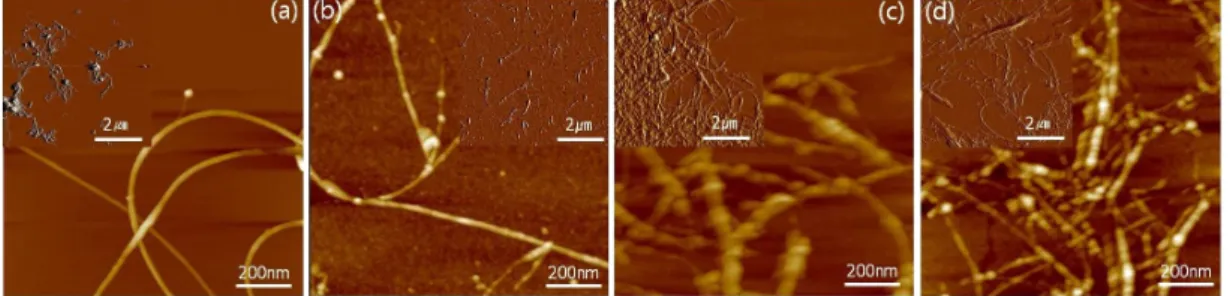
Fig. 1. AFM images of SWNTs recovered from the dispersions of various SWNTs in DMF; (a) neat SWNTs, (b) with PyC4 modification, (c) with PyC12 modification and (d) with PyC18 modification.
introducing of a relatively weak repulsion at a large distance between the tubes[22], such as the steric repulsion among the tails of alkyl pyrenes. The treatment of SWNTs in DMF using PyC12 and PyC18 resulted in long and individual nanotubes of extensive exfoliation, while the dispersion of SWNTs in PyC4/DMF solution maintained large bundle of SWNTs.
The AFM images of the SWNTs with various alkyl chain length of the pyrene presented in Figure 1.
PyC12- and PyC18-SWNTs clearly presented a large population of highly exfoliated SWNTs along with nodular morphology on each nanotube. In the case of PyC4, the length of alky chain was too short to overcome the intertube attraction, indicating that short chain of the pyrene had no effect on the exfoliation of nanotubes. This prominent change of nanotube de-bundling by long alkyl tail of pyrene is also supported by transmission electron microscopy investigation (Figure 2), which showed that the simple dispersion of neat SWNTs bundle was transformed to the high density network structure of the thin bundles and individual nanotubes via passivation by PyC12.
Fig. 2. TEM images of (a) the neat SWNTs and (b) PyC12-SWNTs.
Fig. 3. 1H-NMR spectra (300 MHz, DMSO) in the range of 8.0-8.4 ppm for solutions of PyC12 and PyC12-SWNTs.
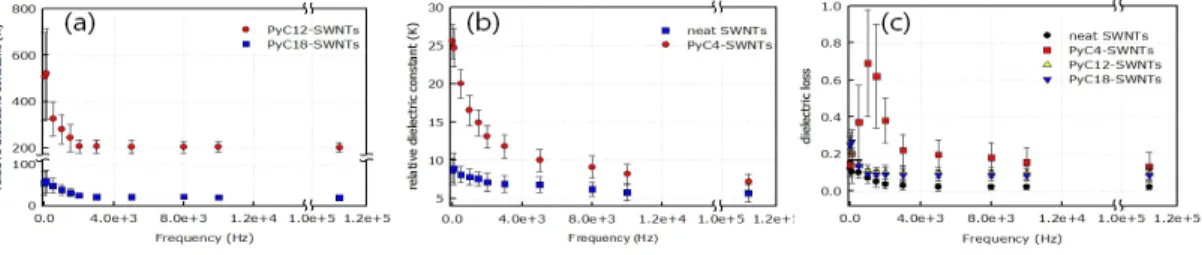
Fig. 4. The dielectric behaviors of the various epoxy/SWNTs composites as a function of frequency; dielectric constant changes of (a) PyC12-SWNTs and PyC18-SWNTs embedded composites, (b) neat SWNTs and PyC4-SWNTs embedded composites, (c) dielectric loss of the composites.
The PyC12-SWNTs solution was spectroscopically examined to characterize the interactions between PyC12 and SWNTs. In FT-NMR spectra shown in Figure 3. We found the down-shift peaks at 8.32 - 8.33 and 8.295 of PyC12 to 8.31 and 8.29, respectively. The chemical shifts to the higher field for the pyrene-protons in the PyC12 with SWNTs compared to those for the PyC12 without SWNTs is due to the ring current effect in the pyrene p- system, which is the direct evident showing the interaction between the nanotube sidewall and the pyrene chromophore in dispersion.
3.2. Dielectric behavior of epoxy composite containing SWNTs passivated with alkyl pyrene
In order to increase the dielectric constant of a polymer, it has been suggested that the carefully controlled addition of CNTs to polymer, which could provide a uniformly dispersed CNTs in the matrix with a low concentration of nanotubes under the percolation threshold, where the nanotube composites could have a high dielectric constant [23]. The urethane-modified epoxy is used as a polymer matrix due to their good mechanical property with its processibility, and applied the epoxy resin to form a composite with various concentration of SWNTs as dielectric filler. The dielectric constant of the
neat urethane-modified epoxy is ca. 5 at 1 kHz at room temperature. Figure 4 showed the dielectric behaviors of the various epoxy/SWNTs composites as a function of frequency at room temperature.
As expected from the copious amount of CNTs (0.004wt%) involved, the epoxy composite with neat SWNTs showed negligible change in dielectric constant, of which value was ca. 7 at 1 KHz, and low dielectric loss was also found. Although the neat SWNTs is generally expected to induce a very large dielectric loss due to the electrically conductive nature, we thought that amount of CNTs under percolation threshold had no effect on improvement of dielectric constant and behavior.
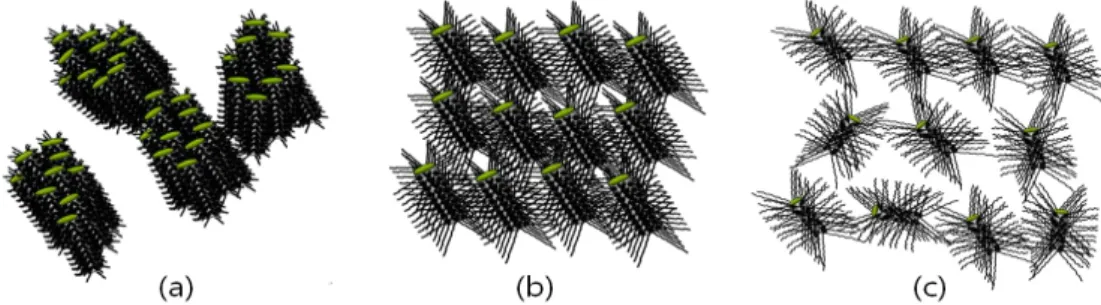
The modified SWNTs with PyC4 was embedded into epoxy and characterized by AFM measurement, the wrap-around coating on SWNTs by PyC4 was not completed thus, the passivation of conductive nanotubes was inevitably limited to increase dielectric constant with very large dielectric loss. The increase of dielectric loss for the composites is possibly due to the effect of the electrically conductive SWNTs. As suggested in Fig. 5. 1 (a), the presence of PyC4 on the nanotubes could provide better compatibility with matrix than that of the neat SWNTs, resulting in partially a conductive path to provide large dielectric loss with increase in dielectric constant.
Fig. 5. Speculative modeling of the SWNTs dispersion in the composite matrix; (a) with PyC4 modification, (b) with PyC12 modification and (c) with PyC18 modification.
On the other hand, the PyC12-SWNTs embedded epoxy composite showed a dramatic jump in dielectric constant higher than 200 at 1 kHz at room temperature. Also, we could find that the dielectric loss was highly suppressed compared with the case of PyC4-SWNTs.
In the case of PyC18 with longer chain than that of PyC12, the dielectric constant was dropped to approximately 20 at 1 kHz, while the dielectric loss was comparable to that of the PyC12-SWNTs/epoxy composite. The passivation and dispersion of nanotubes treated by PyC18 are likely to be similar to those of PyC12, as found in the AFM investigation; the much longer alkyl tail might be hindered association of nanotubes, and induce a random dispersion of nanotubes in the matrix. In fact, the increase randomness of SWNTs distribution would prevent from the formation of well-aligned minicapacitor networks in the composites, failing to retain a dielectric constant as high as that of PyC12. It should be also noted that the high dielectric constant of PyC12-SWNTs/epoxy composite was achieved with only 0.004 wt% PyC12-SWNTs concentration, which is much lower amount than those of the previous reports. For example, the dielectric constants of CNTs/poly(vinylidenefluride-trifluoroethylene-hl orofluoroethylene)composites measured at 100 Hz has been reported to be 63, 74, and 102 with the contents of CNTs as 0.5, 1.0, and
2.0 wt%, respectively. The high dielectric constant of the epoxy/SWNTs composite without large dielectric loss can be successfully achieved via simple organic passivation of nanotubes. The reason of the significant change of dielectric behavior in terms of alkyl chain length in the passivation layer is possibly that the alkyl chains of pyrene moieties which wrapped to cylindrical nanotubes and play an important role to construct a minicapacitor networks in the composite, as presented in Scheme 1.
4. Conclusion
The adsorption of pyrene of long alkyl chain on SWNTs provides high solubility and stability of SWNTs in organic solvent. The long alkyl chain of the pyrene leads to prevent aggregation by introducing of a relatively weak repulsion at a large distance between the SWNTs, such as the steric repulsion among the tails. The alkyl pyrene-modified SWNTs are composed of individual tubes or small bundles in DMF solvent. Based on the alkyl pyrene-modified SWNT, we also obtained a flexible polymer composite with high dielectric constant (K>100) and very low dielectric loss based on the alkyl pyrene-modified SWNTs.
We believe that this kind of polymer composite with high dielectric performances
would have potential possibility to extend their applications.
References
1. Yang Rao, C. P. W., “Material characterization of a high-dielectric- constant polymer-ceramic composite for embedded capacitor for RF applications”, Journal of Applied Polymer Science, 92, 2228 (2004).
2. Popielarz, R.; Chiang, C. K.; Nozaki, R.;
Obrzut, J., “Dielectric Properties of Polymer/Ferroelectric Ceramic Composites
from 100 Hz to 10 GHz”,
Macromolecules, 34, 5910 (2001).
3. Swapan K. Bhattacharya, R. R. T., “Next generation integral passives: materials, processes, and integration of resistors and capacitors on PWB substrates”, Journal of Materials Science:Materials in Electronics, 11, 253 (2000).
4. Y. Bai, Z.-Y. C., V. Bharti, H. S. Xu, and Q. M. Zhang, “High-dielectric-constant ceramic-powder polymer composites”, Appl. Phys. Lett, 76, 3804 (2000).
5. Lan Wang, Z.-M. D., “Carbon nanotube composites with high dielectric constant at low percolation threshold”, Appl. Phys.
Lett., 87, 042903 (2005).
6. Q. M. Zhang, H. L., Martin Poh, Feng Xia, Z.-Y. Cheng, Haisheng Xu, Cheng Huang, “An all-organic composite actuator material with a high dielectric constant”, Nature, 419, 284 (2002).
7. Jing-Wen Wang, Q.-D. S., Chang-Zheng Yang, Qi-Ming Zhang, “High Dielectric Constant Composite of P(VDF-TrFE) with Grafted Copper Phthalocyanine Oligomer”, Macromolecules, 37, 2294 (2004).
8. Cheng Huang, Q. M. Z., Ji Su “High- dielectric-constant all-polymer percolative composites”, Appl. Phys. Lett., 82, 3502 (2003).
9. J. K. W. Sandler, J. E. K., I. A. Kinloch,
M. S. P. Shaffer, A. H. Windle,
“Ultra-low electrical percolation threshold in carbon-nanotube-epoxy composites”, Polymer, 44, 5893 (2003).
10. B. E. Kilbride, J. N. C., J. Fraysse, P.
Fournet, M. Cadek, A. Drury, S. Hutzler, S. Roth, W. J. Blau “Experimental observation of scaling laws for alternating current and direct current conductivity in polymer-carbon nanotube composite thin films”, Journal of Applied Physics, 92, 4024 (2002).
11. Mildred S. Dresselhaus, G. D., Phaedon Avouris, “Carbon Nanotubes: Synehesis, Structure, Properties, and Applications”, Springer-Verlag Berlin Heidelberg NewYork: Berlin, 80 (2001).
12. Li, H.; Zhou, B.; Lin, Y.; Gu, L.; Wang, W.; Fernando, K. A. S.; Kumar, S.;
Allard, L. F.; Sun, Y. P., “Selective Interactions of Porphyrins with Semiconducting Single-Walled Carbon Nanotubes”, J.Am. Chem. Soc., 126, 1014 (2004).
13. Dirk M. Guldi, G. M. A. R. N. J. N. T.
M. P., “Integrating Single-Wall Carbon Nanotubes into Donor-Acceptor Nanohybrids”, Angewandte Chemie International Edition, 43, 5526 (2004).
14. Chen, R. J.; Zhang, Y.; Wang, D.; Dai, H., “Noncovalent Sidewall Functionalization of Single-Walled Carbon Nanotubes for Protein Immobilization”, J.Am. Chem. Soc, 123, 3838 (.2001).
15. Ehli, C.; Rahman, G. M. A.; Jux, N.;
Balbinot, D.; Guldi, D. M.; Paolucci, F.;
Marcaccio, M.; Paolucci, D.;
Melle-Franco, M.; Zerbetto, F.;
Campidelli, S.; Prato, M., “Interactions in Single Wall Carbon Nanotubes/Pyrene/
Porphyrin Nanohybrids”, J.Am.Chem.Soc., 128, 11222 (2006).
16. Paloniemi, H.; Aaritalo, T.; Laiho, T.;
Liuke, H.; Kocharova, N.; Haapakka, K.;
Terzi, F.; Seeber, R.; Lukkari, J.,
“Water-Soluble Full-Length Single-Wall
Carbon Nanotube Polyelectrolytes:
Preparation and Characterization”, J.Phys.Chem.B, 109, 8634 (2005).
17. Zhang, J.; Lee, J. K.; Wu, Y.; Murray, R.
W., “Photoluminescence and Electronic Interaction of Anthracene Derivatives Adsorbed on Sidewalls of Single-Walled Carbon Nanotubes”, NanoLett., 3, 403 (2003).
18. S. G. Stepanian, V. A. K., A. Yu Glamazda, U. Dettlaff-Weglikowska, L.
Adamowicz, “Combined Raman scattering and ab initio investigation of the interaction between pyrene and carbon SWNT”, Molecular Physics, 101, 2609 (2003).
19. Itkis, M. E.; Perea, D. E.; Niyogi, S.;
Rickard, S. M.; Hamon, M. A.; Hu, H.;
Zhao, B.; Haddon, R. C., “Purity Evaluation of As-Prepared Single-Walled Carbon Nanotube Soot by Use of Solution-Phase Near-IR Spectroscopy”, Nano Lett, 3, 309 (2003).
20. Shvartzman-Cohen, R.; Levi-Kalisman, Y.; Nativ-Roth, E.; Yerushalmi-Rozen, R.,
“Generic Approach for Dispersing Single-Walled Carbon Nanotubes: The Strength of a Weak Interaction”, Langmuir, 20, 6085 (2004).
21. Naotoshi Nakashima, Y. T., Hiroto Murakami, “Water-Soluble Single-Walled Carbon Nanotubes via Noncovalent Sidewall-Functionalization with a Pyrene-Carrying Ammonium Ion”, Chemistry Letters, 31, 638 (2002).
22. Zorbas, V.; Ortiz-Acevedo, A.; Dalton, A.
B.; Yoshida, M. M.; Dieckmann, G. R.;
Draper, R. K.; Baughman, R. H.;
Jose-Yacaman, M.; Musselman, I. H.,
“Preparation and Characterization of Individual Peptide-Wrapped Single-Walled Carbon Nanotubes”, J.Am. Chem. Soc., 126, 7222 (2004).
23. Glatkowski, P. J., Arthur, D. J. US patent, US2003/0008123 (2003).