
ISSN 2288-1069 (Online)
http://dx.doi.org/10.12925/jkocs.2014.31.4.703
로스팅 조건이 삼백초, 인진쑥, 산조인, 당귀, 작약 및 천궁을 첨가한 한방차의 벤조피렌 변화에 미치는 영향
장재선
*․최정윤
**․오성천
✝*가천대학교 식품영양학과, **대원대학교 뷰티스타일리스트과, 대원대학교 제약식품계열✝ (2014년 11월 20일 접수; 2014년 12월 15일 수정; 2014년 12월 17일 채택)
Influences of Roasting Conditions to Herbal Tea Containing Saururus chinensis , Artemisia capillarisin , Zizyphus vulgaris , Angelica gigas , Paeoniae radix and Cnidium officinale on Its
Benzo[α]pyrene Changes
Jae-Seon Jang*․Jeong-Yun Choi**․Sung-Cheon Oh✝
*
Dept. of Food & Nutrition, Gachon University, Incheon 406-799, Korea
**
Dept. of Beauty Stylist, Daewon University College, Jecheon, 390-702, Korea
✝
Dept. of Food & Pharmacy, Daewon University College, Jecheon 390-702, Korea (Received November 20, 2014; Revised December 15, 2014; Accepted December 17, 2014)
요 약 : 한방차의 roasting 온도를 80~140℃ 범위로 하여 성분 변화를 분석한 결과, 온도의 상승에 따라 수분함량이 감소하고 일부 탄화가 발생하며 조 회분 함량이 소폭 상승하였고, 조 지방 및 조단백 질 함량은 소폭 감소하였다.
한방차의 고형분 용출율은 0.15~0.32%(w/w)를 나타내었는데, roasting 온도가 상승할수록 감소하는 경향을 나타내었다. 처리온도가 80~110℃구간에서는 큰 변화를 나타내지 않은 반면 110~140℃구간에 서는 고형분 용출율이 급격히 감소하였다. 온도가 상승할수록 용출율이 감소하는 것은 내부 조직이 치밀 하여 상대적으로 용출이 어렵기 때문이다.
벤조피렌 함량은 0.29~0.51ppb으로 온도가 높을수록 B(α)P함량이 증가하였다. 처리온도와 원재료에 따라 B(α)P 함량에 차이가 발생하며, 내부온도는 약 200℃정도지만 roaster 표면의 실제 온도는 약 2,000℃에 이르는데 표면과 접촉한 부분에서 B(α)P가 생성된다. B(α)P는 주로 음식을 조리, 가공할 때 식품의 주성분인 탄수화물, 단백질, 지방 등이 열분해 되어 생성되는 것으로 생각된다.
주제어 : 로스팅, 한방차, 벤조피렌, 고형분용출율
Abstract : The following is the study result of herbal tea roasted at different temperatures between 80~140℃. Depending on treatment temperature the water content decreased, some carbonization occurred and crude ash content relatively increased. Also crude protein and crude fat decreased little.
✝
Corresponding author (E-mail: [email protected])
Solid elution rate of herbal tea showed 0.15~0.32%(w/w) and the rate of solid elution decreased with higher roasting temperature. There was no big change in 80~110℃ treatment section but the solid elution decreased rapidly in 110~140℃ section. The reason for decreasing solid elution rate at higher treatment temperature is because the compact inner tissue makes elution difficult.
Benzopyrene content (0.29~0.51ppb) showed a tendency to increase with higher treating temperature. From this result, the B(α)P content differed depending on the treatment temperature and raw materials. In case of roasting, the actual inside temperature is around 200℃ but since the surface temperature of the roaster reaches around 2,000℃ some portion of B(α)P content was presumed to be produced from the area that came in contact with this surface. When the processing which is a main component of food carbohydrate, protein, fat reason despite serve heat treatment as a whole is to be detected even though the B(α)P in this way is considered to be.
Keywords
:roasting, herbal tea, benzo[α]pyrene, solid elution rate
1. 서 론
벤조피렌(Benzo[a]pyrene, B[α]P)은 300~60 0℃ 사이의 온도에서 화석연료나 식물 등의 유기 물이 불완전 연소하여 생성되는 다환방향족탄화 수소로 인체에 각종 암과 돌연변이를 일으키는 환경호르몬으로 자동차배기가스, 담배연기 등이 주 오염원이며, 환경오염으로 인해 농산물, 어패 류 등 조리 가공하지 않은 식품에도 존재한다 [1-6]. 식품의 조리, 가공 시 식품의 주성분인 탄 수화물, 지질, 단백질 등의 분해에 의해서 생성되 도 한다[7-8].
한방차에 사용된 삼백초(
Saururus chinensis
)에 는 항산화 효능[9]. 항균활성[10], 혈압강하 및 모세혈관 강화 작용[11], 항염증 활성[12], 이뇨, 해독, 위장병, 간염, 황달에 효과가 있다고[13] 보 고되고 있다.인진쑥(
Artemisia capillarisin
)은 간 보호 효과 [14], 항암 효과[15-16], 항돌연변이 효과[17], 혈압강하작용, 고혈당증의 치료효과[18] 등이 보 고되고 있다.산조인(
Zizyphus vulgaris
)은 소화완화, 강장, 항알레르기, 간 보호작용 및 대장암 같은 성인병예방효과[19]가 있으며, 생리활성 성분은
saponin, flavonoid, 비타민 A, B2, C, 칼슘, 인 및 철로 구성되어 있다.
당귀(
Angelica gigas
)는 decursin, decursinol, imperatorin, nodakenin, nodakenetin 등과 같은 쿠마린 계열의 물질[20]로, 항당뇨 효과[21], 항 암[22], 항염증[23] 및 항산화[24] 효과에 대해보고된 바 있다.
작약(
Paeoniae radix
)은 한방에서 염증, 진통 및 진경의 목적으로 이용되어 왔으며 주성 분으 로는 paeoniflorin, albiflorin, triterpenoids, tannin, β-sitosterol, paeonol, paeonin 등이 함 유되어 있고[25], 면역조절작용[26], 항염증[27], 항 알러지[28], 항응고작용[29]과 항혈전작용[30]등이 있는 것으로 보고되었다.
천궁(
Cnidium officinale
)은 한방에서 소염진통 작용[31], 항산화 작용[32], 혈소판응집 억제활성 [33] 및 고혈압, 근육마비, 협심증, 근육마비, 신 경통 등에 효과가 있는 것[34]으로 보고되었다.직화 처리를 하는 한방차의 경우 볶음공정에서 고온 노출과 연기로 인하여 benzo(α)pyrene[B (α)P]의 발생 우려가 크기 때문에 유해성 문제가 대두되고 있다.
본 연구는 국내산 삼백초, 인진쑥, 산조인, 당 귀, 작약 및 천궁을 첨가한 한방차를 개발하고 적절한 로스팅 조건을 최적화하여 B(α)P이 감소 된 안전한 한방차를 제조하는 조건을 찾은 결과 이다.
2. 실험재료 및 방법
2.1. 실험재료 및 시약한약재는 충청북도 제천에서 2013년 수확한 것으로 건조, 포장된 상태로 구매한 후 냉동 보 관하여 사용하였다. 분석에 사용한 시약은 특급 HPLC용으로 B(α)P 표준품은 benzo(α)pyrene
standard(Wako Pure Chemical Ind., Ltd.)를 구 입하여 냉장 보관하여 사용하였다.
2.2. 한방차 및 벤조피렌 함량 측정용 시료의 조제
한방차의 재료는 로스팅 전에 입자를 가공 선 별하여 삼백초(
Saururus chinensis
) 및 산조인 (Zizyphus vulgaris
)을 각각 16%씩, 당귀 (Angelica gigas
), 작약(Paeoniae radix
), 천궁 (Cnidium officinale
), 인진쑥(Artemisia capillarisin
)은 각각 17%씩 혼합하여 제조하였으 며 로스팅 처리 온도조건을 80℃, 95℃, 110℃, 125℃, 140℃로 나누어 다르게 하고 20분간 가 열 후 제조된 한방차를 실험에 사용하였다.B(α)P 함량측정을 위한 시료의 전처리로 분쇄 한 한방차 시료 각 50g에 ethyl ether 500ml를 가하고 12시간 동안 일체의 열처리 없이 기름 성 분을 추출하였다. Ethyl ether 추출물을 진공 감압 농축하여 얻어진 기름성분을 시료로 사용하였다.
2.3. 분석시료의 추출 및 정제
시료유 10 g을 정량하고 n-hexane 100ml를 녹 여 분액깔때기에 옮기고 N,N-dimethylformamide -water(9:1,
v/v
) 50ml을 넣어 격하게 흔들어 섞 은 후 정치하여 N,N-dimethylformamide-water 층을 다른 분액깔때기에 옮겼다. n-Hexane 층에 N,N-dimethylformamide-water 25ml씩을 넣고 위 의 과정을 2회 반복하여 N,N-dimethylformamide -water 층을 위의 분액깔때기에 합하였다.이층을 1% sodium sulfate용액 100ml로 희석한 후 n-hexane 50ml를 넣고 격하게 흔들어 섞은 후 정치하여 n-hexane 층을 분액깔때기에 옮겼다.
N , N - d i m e t h y l f o r m a m i d e - w a t e r 층 에 n-hexane 35ml씩을 넣고 위와 같이 2회 반복 하여 n-hexane 층을 위의 분액깔때기에 합하였 다. 여기에 물 40ml씩을 넣고 격하게 흔들어 섞 은 후 정치하여 물 층을 버리는 조작을 2회 반복 하였다. n-Hexane 층을 무수 황산나트륨을 넣은 1PS여과지로 여과하였다. 다시 n-hexane 20ml로 분액깔때기를 씻고 이 액으로 여과지의 잔류물을 씻는 조작을 2회 반복하여 여과하였다. 여액을 합쳐 40℃이하의 수욕 상에서 감압하여 약 2ml 로 농축하였다.
활성화시킨 Sep-Pak Florisil cartridge에 추출 용액을 1ml/min의 속도로 가하고 n-hexane 10ml와 n-hexane/dichloromethane(3:1,
v/v
) 8ml로 용출시켜 전량을 40℃이하의 수욕 상에서 질 소가스 하에 거의 날려 보낸 후 잔사를 acetonitrile에 녹여 전량을 10ml로 하여 이를 0.45㎛의 membrane filter로 여과하여 시험 용액 으로 하였다.
2.4. 이화학적 특성의 분석
일반성분은 A.O.A.C.법[35]에 의해 측정하였 다. 즉 수분함량은 상압가열 건조법, 조단백질의 정량은 semimicro-Kjeldahl법, 조지방의 정량은 Soxhlet추출법, 회분의 정량은 직접 회화법으로 측정하였다.
2.5. 고형분용출율
일반 음용 방법과 동일하게 각각의 차를 뜨거 운 물에 담가 고유성분을 용출시킨 후 이를 시료 로 하여 위의 수분함량 정량법을 이용하여 수분 함량을 측정하였다. 전체 100에서 얻어진 수분함 량을 빼 이를 고형분 용출량으로 환산하였다.
2.6. Benzo(α)pyrene 함량의 정량
시료용액 50㎕를 형광검출기를 내장한 HPLC (Agilent Technologies, 1200Series, Germany)에 주입하고, acetonitrile-water(80:20,
w
/w
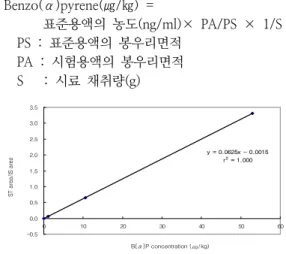
) 혼합용 매를 이동상으로 하여 1.0ml/min의 속도로 검출 기 파장 294㎚, 형광 파장 404㎚에서 분석하였 다. 이 때, B(α)P의 양을 산출하기 위한 표준곡 선은 Fig. 1과 같이 작성하였으며, 계산은 아래 식으로 하였다.Benzo(α)pyrene(㎍/㎏) =
표준용액의 농도(ng/ml)× PA/PS × 1/S PS : 표준용액의 봉우리면적
PA : 시험용액의 봉우리면적 S : 시료 채취량(g)
y = 0.0625x - 0.0015 r2 = 1.000
-0.5 0.0 0.5 1.0 1.5 2.0 2.5 3.0 3.5
0 10 20 30 40 50 60
B[a ]P concentration (㎍/kg)
ST area/IS area
Fig. 1. Standard curve of benzo(α)pyrene by HPLC.
Roasting temperature (℃) Moisture (%)1) F
80 1.68±0.03
317.371(0.000)*
95 1.52±0.02
110 1.36±0.02
125
140 1.14±0.02
1.08±0.03 Values are mean±SD. Values are mean of triplicates 1)Percentages of wet weight basis. * p<0.05
Table 1. The changes of moisture content in herbal tea affected by roasting temperature
Roasting temperature (℃) Crude ash (%)1) F
80 18.71±0.01
61.789(0.000)*
95 18.73±0.01
110 18.76±0.02
125 140
18.81±0.01 18.83±0.01 Values are mean±SD. Values are mean of triplicates 1)Percentages of wet weight basis. * p<0.05
Table 2. The changes of crude ash content in herbal tea affected by roasting temperature 2.7. 통계처리
본 연구에서 얻어진 데이터는 SPSS package for Windows(Version 10.0)를 이용하여 분석하 였다. 상호간에 일부의 편차가 발생하여 모두 3 회 반복 실험을 행한 후 그 범위를 평균±표준편 차로써 나타냈으며 ANOVA 분석을 통한 유의성 검정을 하였다.
3. 결과 및 고찰
3.1. Roasting 온도 차이에 따른 한방차의 수분 함량 변화
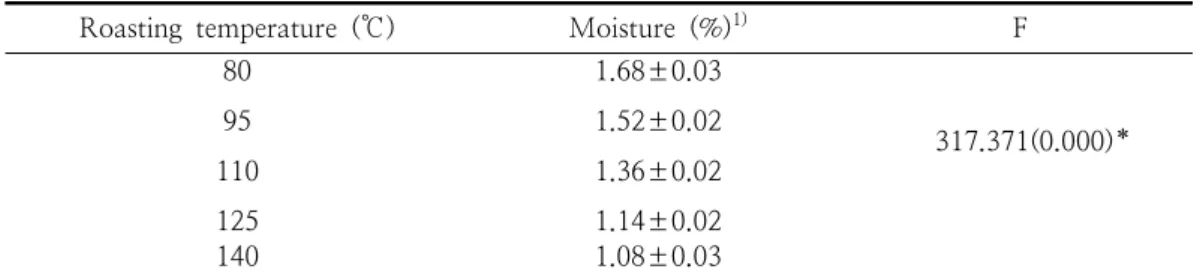
Roasting 온도 차이에 따른 한방차의 수분함량 변화는 Table1과 같이 처리온도가 상승함에 따라 감소하였으며 온도변화에 따라 통계적으로 유의 한 차이가 있었다(p<0.05).
3.2. Roasting 온도 차이에 따른 한방차의 조회분 함량 변화
Roasting 온도 차이에 따른 한방차의 조회분
함량 변화는 Table 2와 같이 처리온도가 상승함 에 일부 탄화가 발생하여 상대적으로 상승하는 소폭의 변화가 있었으며 온도변화에 따라 통계적 으로 유의한 차이가 없었다(p>0.05).
3.3. Roasting 온도 차이에 따른 한방차의 조지방 함량 변화
Roasting 온도 차이에 따른 한방차의 조지방 함량 변화는 Table 3과 같이 거의 변화가 없는 것으로 나타났으나 온도변화에 따라 통계적으로 유의한 차이가 있었다(p<0.05).
3.4. Roasting 온도 차이에 따른 한방차의 조단백질 함량 변화
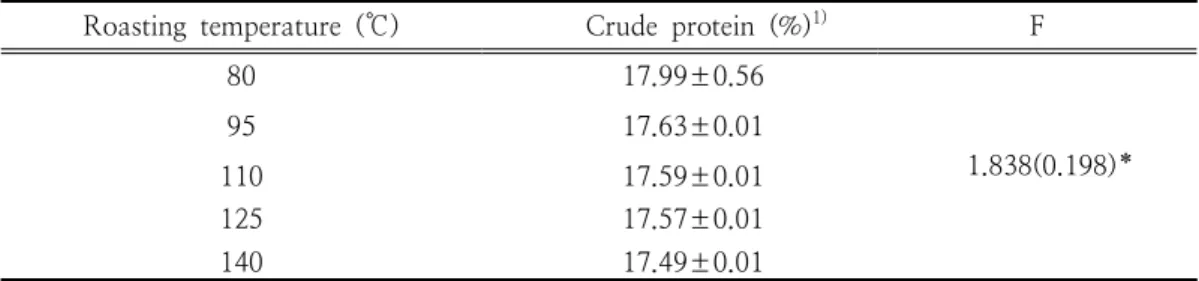
Roasting 온도 차이에 따른 한방차의 조단백질 함량 변화는 Table4와 같이 거의 변화가 없는 것 으로 나타났으며 온도변화에 따라 통계적으로 유 의한 차이가 있었다(p<0.05).
Roasting temperature (℃) Solid elution rate(%,w/w)1) F
80 0.32±0.01
216.227(0.000)*
95 0.28±0.01
110 0.26±0.01
125 140
0.18±0.01 0.15±0.01 Values are mean±SD. Values are mean of triplicates 1)Percentages of wet weight basis. * p<0.05
Table 5. The changes of solid elution rate in herbal tea affected by roasting temperature Table 3. The changes of crude fat content in herbal tea affected by roasting temperature
Roasting temperature (℃) Crude fat (%)1) F
80 6.13±0.01
145.478(0.000)*
95 6.03±0.01
110 6.01±0.01
125 140
5.94±0.02 5.91±0.02 Values are mean±SD. Values are mean of triplicates 1)Percentages of wet weight basis. * p<0.05
Table 4. The changes of crude protein content in herbal tea affected by roasting temperature Roasting temperature (℃) Crude protein (%)1) F
80 17.99±0.56
1.838(0.198)*
95 17.63±0.01
110 17.59±0.01
125 140
17.57±0.01 17.49±0.01 Values are mean±SD. Values are mean of triplicates 1)Percentages of wet weight basis. * p>0.05
3.5. Roasting 온도 차이에 따른 한방차의 고형분 용출율 변화
Roasting 온도 차이에 따른 한방차의 고형분
용출율 변화는 Table 5와 같이
0.15~0.32%(w/w)를 나타내었는데, 처리온도가 80~110℃ 범위에서는 큰 변화를 나타내지 않은 반면 110~140℃에서는 고형분 용출율이 감소하 였다. Roasting 온도가 상승할수록 고형분 용출 율이 감소하는 경향을 나타내었으며 온도변화에
따라 통계적으로 유의한 차이가 있었다(p<0.05).
이러한 현상은 내부 조직이 치밀하여 상대적으로 용출이 어렵기 때문이며 고형분의 용출은 식품 원 재료의 성분이 물리적인 힘에 의해 상호 결합 이 없어짐으로서 고형분의 용출이 용이해지기 때 문인 것으로 생각된다[36].
Roasting temperature (℃) Benzo(α)pyrene(㎍/㎏) F
80 0.29±0.01
155.341(0.000)*
95 0.30±0.01
110 0.33±0.01
125 140
0.37±0.01 0.51±0.01 Values are mean±SD. Values are mean of triplicates
Table 6. The changes of Benzo(α)pyrene content in herbal tea affected by roasting temperature 3.6. Roasting 온도 차이에 따른 한방차의
B(α)P함량 변화
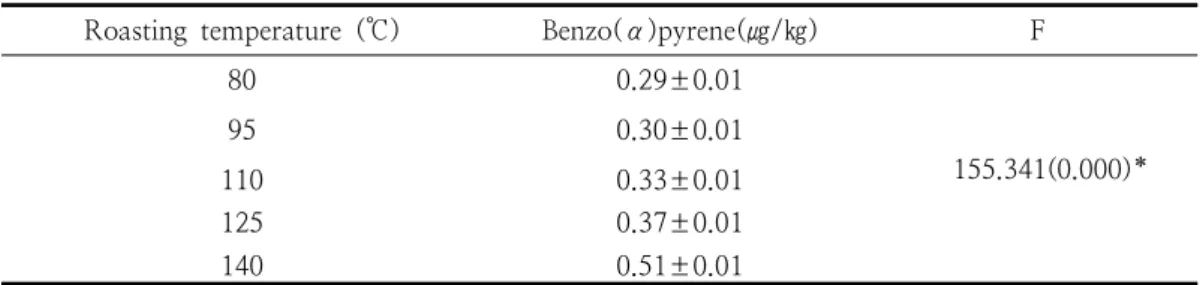
Roasting 온도 차이에 따른 한방차의 B(α)P함 량 변화는 0.29~0.51ppb으로 Table 6과 같다.
B(α)P함량이 온도가 상승할수록 증가하는 경향 을 보였으며 온도 변화에 따라 통계적으로 유의 한 차이가 있었다(p<0.05).
처리온도와 원재료에 따라 B(α)P 함량에 차이 가 발생하며, 내부온도는 약 200℃ 정도지만 roaster 표면의 실제 온도는 약 2,000℃에 이르므 로 표면과 접촉한 부분에서 B(α)P가 생성되는 것으로 보인다. B(α)P는 주로 음식을 조리, 가공 할 때 식품의 주성분인 탄수화물, 단백질, 지방 등이 열분해 되어 생성되는 것으로 보고되고 있 다[37].
4. 결 론
한방차의 roasting 온도를 80~140℃ 범위로 하 여 성분 변화를 분석한 결과, 온도의 상승에 따 라 수분함량이 감소하고 일부 탄화가 발생하며 조 회분 함량이 소폭 상승하였고, 조 지방 및 조 단백질 함량은 소폭 감소하였다.
한방차의 고형분 용출율은 0.15~0.32%(w/w) 를 나타내었는데, roasting 온도가 상승할수록 감 소하는 경향을 나타내었다. 처리온도가 80~11 0℃구간에서는 큰 변화를 나타내지 않은 반면 110~140℃구간에서는 고형분 용출율이 급격히 감소하였다. 온도가 상승할수록 용출율이 감소하 는 것은 내부 조직이 치밀하여 상대적으로 용출 이 어렵기 때문이다.
벤조피렌 함량은 0.29~0.51ppb으로 온도가 높 을수록 B(α)P함량이 증가하였다. 처리온도와 원
재료에 따라 B(α)P 함량에 차이가 발생하며, 내 부온도는 약 200℃정도지만 roaster 표면의 실제 온도는 약 2,000℃에 이르는데 표면과 접촉한 부 분에서 B(α)P가 생성된다. B(α)P는 주로 음식을 조리, 가공할 때 식품의 주성분인 탄수화물, 단백 질, 지방 등이 열분해 되어 생성되는 것으로 생 각된다.
References
1. D. J. Kim, K. S. Seug, D. W. Kim, S. R.
Ko and C. C. Chang, Antioxidative effects of red ginseng saponins on para-quot induced oxidative stress.
J Ginseng Res
28:5-10 (2004).2. C. K. Lee, Y. N. Han, N. Y. Kim and J.
W. Choi, The therapeutic effects of Korea red ginseng on carbone tetrachloride and galactosamine induced hepatoxicity in rats.
J Ginseng Res
27:11-16 (2003).3. K. S. Sung, C. Chun, Y. H. Kwon and C.
C. Chang, Effects of red ginseng components administration on glutathione and lipid peroxidation levels in mice. liver.
J Ginseng Res
24:176-182 (2000).4. MCR Camargo, MCF Toledo, Polycyclic aromatic hydrocarbons in Brazilian vegetables and fruits.
Food Control
14:49-53 (2003).5. S. Tao, Y. H. Cui, F. L. Xu, B. G. Li, J.
Cao, W. X. Liu, G. Schmitt, X. J. Wang, W. R. Shen, B. P. Qing and R. Sun, Polycyclic aromatic hydrocarbons in
agricultural soil and vegetables from Tianjin.
Sci Total Environ
. 320:11-24 (2004).6. S. Hu, N. S. Oh and S. Y. Kim and H.
Lee, Determining of polycyclic aromatic hydrocarbons in domestic vegetables and fruits.
Anal Sci Technol
. 19:415-421 (2006).7. Y. B. Song, Y. S. Kwak, K. H. Park and S. K. Chang, Effects of total saponin from red ginseng on activities of antioxidant enzyme in pregnant rats.
J Ginseng Res
26:139-144 (2002).8. Agency for toxic substances disease registry(ATSDR), Toxicological profile for polycyclic aromatic hydrocarbons(PAHs). U.
S. Department of Health and Human Services, Public Health Service, Atlanta, GA, USA(1995).
9. W. S. Lee, Y. I. Back, J. R. Kim, K. H.
Cho, D. E. Sok and T. S. Jeong, Antioxidant activities of a new lignan and a neolignan from
Saururus chinensis
.Bioorg Med Chem Lett
14:5623-5628 (2004).10. M. S. Koh, Antimicrobial activity of
Saururus chinensis
Bail extract.J Korean Soc Food Sci Nutr
33:1098-1105 (2004).11. T. Leighton, C. Ginther, L. Fluss, W. K.
Harter, J. Cansado and V. Notario, Molecular characterization of quercetin and quercetin glycosides in allium vegetable.
ACS Symposium Series 507, American Chemical Society, Washington, DC, USA.
220-238 (1992).
12. H. J. Yoo, H. J. Kang, H. J. Jung, K.
Kim, C. J. Lim and E. H. Park, Anti-inflammatory, anti-angiogenic and anti-nociceptive activities of
Saururus chinensis
.J Ethnopharmcol
120:282-286 (2008).13. I. S. Lee, S. G. Lee and H. S. Kim, Preparation and Quality Characteristics of Yogurt Added with
Saururus chinensis
Bail.J Korean Soc Food Sci Nutr
31:411-416 (2002).14. E. K. Kim, Y. X. Jin, Y. S. Yoo, E. J.
Jung, J. Y. Lee and C. K. Chung, Effect of
Artemisia capillaris
andPaecilomyces japonica
on the reduction of hepatotoxicity and lipid metabolism induced by ethanol.J Korean Soc Food Sci Nutr
38:1016-1023 (2009).15. Y. K. Hwang, D. C. Kim, W. I. Hwang and Y. B. Han, Inhibitory effect of
Artemisia princeps
Pampan extract on growth of cancer cell lines.Korean J Nutr
31:799-808 (1998).16. M. K. Lee, G. P. Choi, L. H. Ryu, G. Y.
Lee, C. Y. Yu and H. Y. Lee, Enhanced immune activity and cytotoxicity of
Artemisia capillaris
Thunb. extract against human cell lines.Korean J Medicinal Crop Sci
12:36-42 (2004)17. J. O. Kim, Y. S. Kim, J. H. Lee, S. H.
Lee, S. H. Moon and G. Y. Park, Antimutagenic effect of the major volatile components identified from mugwort leaves.
J Korean Soci Food Nutr
21:308-313 (1992).18. H. A. Twaij and A. A. Al-Badr, Hypoglycemic activity of
Artemisia herba alba
.J Ethnopharmacol
24:123-126 (1988).19. Y. K. Rhee, D. H. Kim and M. J. Han.
Inhibitory effect of
Zizyphi fructus
on β -glucuronidase and tryptophanase of human intestinal bacteria.Kor J
.Food Sci
.Technol
. 30:199-205(1998).20. S. S. Choi, K. J. Han, H. K. Lee, E. J.
Han and H. W. Suh, Antinociceptive profiles of crude extract from roots of
Angelica gigas
Nakai various pain models.Biol
.Pharm. Bull
. 26:1283 (of angelan isolated from 2003).21. H. M. Kim, J. S. Kang, S. K. Park, K.
Lee, J. Y. Kim, Y. J. Kim J. T. Hong, Y.
Kim and S. B. Han, Antidiabetic activity
Angelica gigas
Nakai,Arch
.Pharm
.Res
., 31:1489(2008).22. K. W. Park, Choi, M. Y. Shon, I. Y.
Jeong, K. S. Kang, S. T. Lee, K. H. Shin
and K. I. Seo. Cytotoxic effects of decursin from
Angelica gigas
Nakai in human cancer cells.J
.Korean Soc
.Food Sci
.Nutr
. 36:1385-1390 (2007).23. S. Shin, J. H. Jeon, D. Park, J. Y. Jang, S.
S. Joo, B. Y. Hwang, S. Y. Choe and Y.
B. Kim. Anti-inflammatory effects of and ethanol extract of
Angelica gigas
in a carrageenan airpouch inflammation model.Exp
.Anim
. 58:431-436 (2009).24. S. A. Kang, J. A. Han, K. H. Jang and R.
W. Choue. DPPH radical scavenger activity and antioxidant effects of
Angelica gigas
.J
.Korean Soc
.Food Sci
.Nutr
. 33:1112-1118 (2004).25. S. J. Kim, J. H. Park, S. Y. Choi, K. H.
Son and K. U. Kim. Isolation and identification of biological activity compounds from leaves and stem of
P
.lactiflora
Pallas.Korean J
.Medicinal Crop Sci
. 15:6-11 (2007).26. W. S. Wei, Y. Q. Wang and S. Y. Wang, Immunoregulatory effects of total glucosides of paeony root in mice.
Chin
.Pharmacol
.Bull
. 3:148-152(1987).27. J. Yamahara, T. Yamada, H. Kimura, T.
Sawada, H. Fujimmura. Biologically active principales of crude drug II. Anti-allergic principles in “Sheseiryu-To” anti- inflammatory properties of paeoniflorin and its derivatives.
J
.Pharmaco- dynamics
. 5:921-929 (1982).28. M. X. Hong, W. Wei, Y. J. Xiao, C. Yan and Z. Lei. Effects and mechanisms of total glucosides of paeony on adjuvant arthritis in rat.
J
.Ethnopharmacol
. 109:442-448 (2007).29. H. Ishida, M. Tsuji, K. Tsuji and T.
Kosuge, Studies on active substances in herbs used for Oketsu in Chinese Medicine. VI. On the anticoagulative principle on
Paeoniae Radix
.Chem
.Pharm
.Bull
. 35:849-852 (1987).30. J. Ye, H. Duan, X. Yang, W. Yan and X.
Zheng, Anti-thrombosis effect of paeoniflorin evaluated in a photochemical reaction thrombosis model in
vivo
.Planta Med
. 67:766-767 (2001).31. S. K. Cho, O. I. Kwon and C. J. Kim.
Anti-inflammatory and analgesic activities of the extracts and fractions of
Cnidii rhizoma
,Kor J Pharmacogn
27:282-287 (1996).32. J. H. Lee, H. S. Choi, M. S. Chung and M. S. Lee. Volatile flavor components and free radical scavenging activity of
Cnidium officinale
.Korean J Food Sci Technol
. 33:330-338 (2002).33. L Zang, J. R. Du, J. Wang, D. K. Yu, Y.
S, Chen, Y. He and C. Y. Wang.
Z-ligustilide extracted from
Radix Angelica Sinensis
decreased platelet aggregation induced by ADPex vivo
and arterio-venous shunt thrombosisin vivo
in rats.Yakugaku Zasshi
129:855-859 (2009).34. J. G. Lee, Y. J. Kwon, H. J. Chang, O.
C. Kim and J. Y. Park, Studies on the volitile compounds of
Cnidium officinale
.J
.Korean Society Tabacco Sci
. 16:20-25 (1994).35. Association of Official Analytic al Chemists. Official Methods of Analysis of the Association of Official Analytical Chemists. 3rded. (1980).
36. S. C. Oh. The Changes of Benzo[α]pyrene in Herbal Teas Containing
Astragalus membranaceus
,Schizandra chinensis
,Liriope platyphylla
andPlatycodon grandiflorum
which are Affected by the Puffing Conditions.Kor J
.Food &
Nutrition
. 27:75-79 (2014).37. D. J. Tilgner. Food in a carcinogenic environment.
![Changes in Solid Elution Rate and Benzo[${\alpha}$]pyrene During Puffing Temperature of Herbal Tea Containing Angelica gigas, Paeoniae radix, Cnidium officinale, Saururus chinensis, Artemisia capillarisin and Zizyphus vulgaris](data:image/gif;base64,R0lGODlhAQABAIAAAP///wAAACH5BAEAAAAALAAAAAABAAEAAAICRAEAOw==)