• 검색 결과가 없습니다.

Development and Effect of a Geriatric Nursing Convergence Education Program for Nursing Students

N/A
N/A
Protected

Academic year: 2021

Share "Development and Effect of a Geriatric Nursing Convergence Education Program for Nursing Students"

Copied!
10
0
0

로드 중.... (전체 텍스트 보기)

전체 글

(1)

Development and Effect of a Geriatric Nursing Convergence Education Program for Nursing Students

Ji-Woon Ko 1 , Ji-Won Yang 2* , Mi-Young Chung 1 , Sun-Kyung Cha 1

1

Professor, Department of Nursing Science, Sunmoon University

2

Professor, Department of Nursing, Kyungil University

간호대학생을 위한 노인간호 융합교육프로그램의 개발 및 효과

고지운 1 , 양지원 2* , 정미영 1 , 차선경 1

1
선문대학교 간호학과 교수,

2

경일대학교 간호학과 교수

Abstract This study was conducted to understand the effects on the attitude toward the elderly, willingness to geriatric nursing practice, and global competencies by developing a geriatric-nursing convergence education program. This program that combines the theory of elderly care and practical education and applies it to nursing students. This is a nonequivalent control group pretest–posttest design. The study participants consisted of 19 in a control group and 17 in an experimental group. They were the second-year of the nursing students in A city, Chungcheongnam-do. This program, including character building, elderly care competence, global competence, and community contribution, was held for 80 hours from August 28, 2017 to December 8, 2017. The experimental group compared to the control group, attitude toward the elderly (Z =-.46, p =.66), willingness to geriatric nursing practice (Z

=-.64, p =.53), global competence (Z =-1.08, p =.29) showed no statistically significant difference. As a result of this study, it is suggested to develop and implement a convergence education program that nursing students can form positive attitudes toward the elderly and interact directly with the elderly.

Key Words : Geriatric nursing care, Convergence education, Attitudes, Nursing practice, Global competence

요 약 본 연구는 노인 돌봄에 대한 이론과 실습교육이 융합된 노인간호 교육프로그램을 개발하고 간호학생에게 적용 하여 노인에 대한 태도, 간호실천 의지 및 글로벌 역량에 미치는 효과를 파악하기 위해 시행되었다. 비동등성 대조군 전·후 유사 실험 연구로 연구대상자는 충청남도 A시 소재의 간호학과 2학년 학생으로 실험군 17명 대조군 19명이었 다. 인성함양, 역량개발, 글로벌 역량개발, 지역공헌을 포함한 노인간호 융합교육프로그램은 2017년 8월 28일부터 2017년 12월 8일까지 80시간 동안 진행 되었다. 프로그램을 적용받은 실험군은 대조군과 비교하여 노인에 대한 태도 (Z=-.46, p =.66), 노인 간호 실천(Z=-.64, p =.53), 글로벌 역량(Z=-1.08, p =.29)에서 통계적으로 유의한 차이를 보이 지 않았다. 하지만 본 연구를 통해 간호대학생들에게 효과적인 노인간호교육을 제공하기 위하여 간호대학생들은 다양 한 환경에서 노인과의 경험이 필요함을 제언한다. 또한 노인간호에 대한 바람직한 태도 형성을 위하여 교과목 간 융합 과 연계 및 노인과의 직접적인 상호작용 할 수 있는 실습 등 다양한 분야의 교육 프로그램의 개발이 필요하다.

주제어 : 노인간호, 융합교육, 노인에 태도, 노인간호실천, 글로벌 역량

*Corresponding Author : Ji-Won Yang([email protected]) Received March 3, 2020

Accepted May 20, 2020 Revised April 21, 2020

Published May 28, 2020

(2)

1. Introduction 1.1 Introduction

The population over 65 years of age in Korea accounted for 13.2% of the total population;

Korea may be a superaged society by 2030 [1].

The challenge presented by an increasing elderly population is addressing the disease and health problems of seniors. Therefore, it is necessary to expand various social support systems, such as ensuring a comfortable and energetic retirement life and expanding elder care services in local communities. In view of these trends, it is important to understand the needs of elders and to work with professionals in the health-welfare integrated-service model to design services that meet individual needs [2,3]. Therefore, nursing care education to address the needs of elder should be configured to offer practical skills through theory and practice on the promotion of elder health, cognitive improvement, and the development of exercise and nutrition programs based on positive attitudes toward elders.

In developed countries, to provide the best nursing care for seniors in accordance with the growth of the elderly population, the contents of nursing education on elders is systematically strengthened in the university undergraduate curriculum, thereby preparing appropriately [4].

However, to date, nursing education in Korea has focused on solving the physical and mental health problems of the elderly [5], which has been insufficient in providing elder-care services that integrate the welfare and health of seniors.

According to Baik et al. [5], they suggested core competencies and standard curriculum for efficient and reasonable settlement of elderly nursing education in the undergraduate curriculum. This ensures that students need to be prepared to have the right perception and attitude toward aging and apply programs to elderly people to promote their functional,

physical and mental well-being. The health problems of the elderly in the world are a problem, and it is thought that the role of the geriatric nursing professionals in the global society is important. Therefore, there is a need to develop and apply programs to promote nursing students' positive attitudes toward the elderly and to enhance their ability to practice nursing for the elderly.

In previous studies, geriatric-nursing education programs had a positive effect on attitudes toward elders and the performance of nursing by nursing students [6,7]. Researchers indicated the importance of instilling interests and positive attitudes through experiences with seniors as well as education to improve expertise and skills [6–8]. Therefore, for this study, we developed a geriatric-nursing convergence education program that combines theories and practical education for elder care. In addition, we applied this program to nursing students to examine the effects on attitudes toward elders, nursing students’ willingness to geriatric nursing practice, and global competence.

1.2 Purposes

The purpose of this study is as follows.

First, examine the effects of the geriatric nursing convergence education program on attitudes toward elders of nursing students.

Second, examine the effects of the geriatric nursing convergence education program on willingness to geriatric nursing practice of nursing students.

Third, examine the effects of the geriatric nursing convergence education program on the global competence of nursing students.

2. Methods

2.1 Study design

(3)

Groups Pretest Geriatric nursing convergence education

program(80 hours) Posttest

Experimental

group(n=17) 1. Baseline characteristics 2. Attitudes toward the elderly 3. Willingness to geriatric nursing

practice 4. Global competence

⦁ Character building

(well dying and well living program)

⦁ Elderly care competence (geriatric nursing care)

⦁ Global competence

(global communication program)

⦁ Community contribution (well-aging care program)

1. Attitudes toward the elderly 2. Willingness to geriatric nursing

practice 3. Global competence Control

group(n=19) -

Fig. 1. Research design

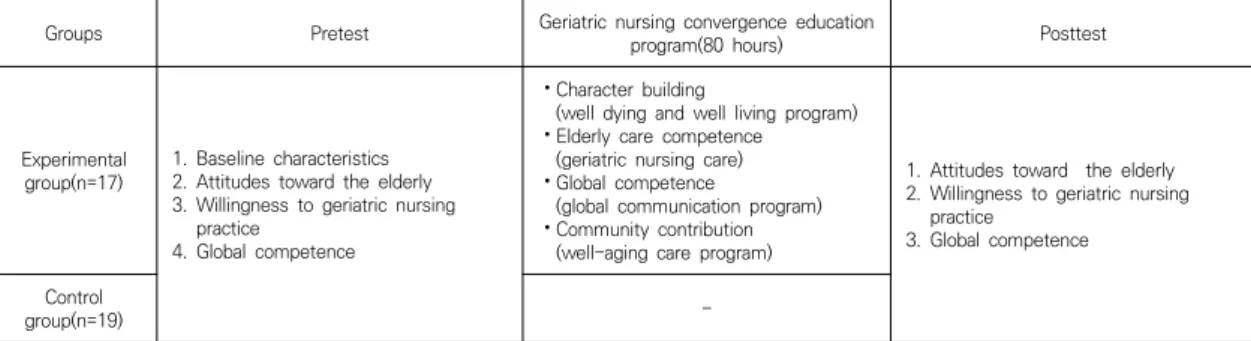
For this study, we used a nonequivalent control group pretest–posttest design to examine the effects on attitudes toward elders, nursing students’

willingness to geriatric nursing practice, and global competence after applying the geriatric-nursing -convergence-education program to nursing students (As shown in Fig. 1).

2.2 Study participants

The research participants were second-year nursing students in A city, Chungcheongnam-do.

We calculated the number of participants according to the formula used when trying to see the difference between two groups with Cohen's formula [9]. In this study, the minimum sample size required for two groups with a significance level of .05, statistical power of 0.8, and effect size of 0.5, was 17. For this study, we recruited 50 students in anticipation of dropout. We randomly assigned 25 to the experimental group and 25 to the control group. The experimental group ended with 17, as eight student dropped out due to personal reasons. A total of 19 controls were included. Six students dropped out due to nonsubmission.

The research was conducted as a baseline survey, program operation, and poststudy survey from August 18 to December 18, 2017. The baseline data-collection period for this study was from August 18 to 28, 2017. For the experimental group, the geriatric-nursing-convergence-education program was conducted for 14 weeks(80hrs) from

August 28 to December 8, 2017, and the poststudy survey was conducted from December 8 to 18, 2017, after the completion of the geriatric nursing convergence education program. The researchers prepared structured questionnaires for both groups. The pre and post study surveys were conducted by a separately trained investigator to exclude the effect of treatment by providers of the elderly education program.

2.3 Ethical considerations

This study was conducted after deliberation by the Institutional Review Board at S University (IRB NO: 201709-047-2). Potential participants received research instructions and provided those who expressed their intention to participate provided written consent. We explained that there would be no disadvantage from withdrawing during the program and emphasized that the collected data would be used for research purposes. We provided a snack and a souvenir for participants each time they participated in the program.

2.4 Intervention: Geriatric nursing convergence education program

The geriatric nursing convergence education

program (Global Silver Care Manager training/80

hours) used in this study was developed based on

literature related to nursing practice competence

(4)

with elders and advice from nursing professionals. The curriculum was developed on the basis of 19 core competencies required for undergraduate geriatric nursing at the American Association of Colleges of Nursing [10], nine areas of education that should be included in the core curriculum of geriatric nursing in the National Gerontological Nursing Association [11]

and 13 core competencies to be achieved in the education of geriatric nursing suggested by the Korean Gerontological Nursing Society [5].

Researchers derived the main contents of elderly nursing education for undergraduate students by reviewing the educational areas and core competencies presented above and reviewing related literature. This was an understanding of aging, establishment of professional attitudes toward the elderly, ethical issues of elderly care, health conditions of the elderly, efficient communication methods with the elderly, program development centered on community resources, and senior care with different cultural backgrounds. Detailed education contents were prepared according to the derived contents.

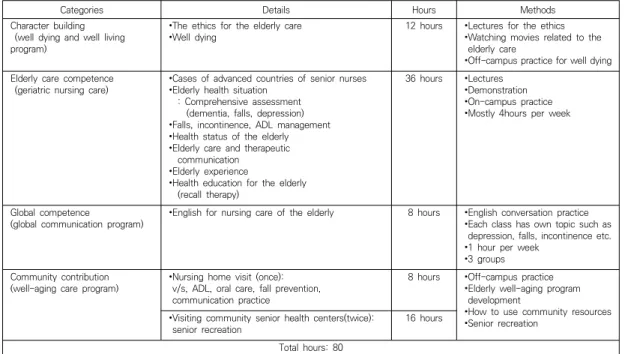
Based on the detailed training contents, it was divided into four areas and classified related programs for each area to constitute an 80-hour education program. The 80-hour program is equivalent to half of the 160-hour education program for geriatric nurse practitioners, which was set in consideration of the academic status and reality of the department. In order to review the contents of the developed program and the feasibility of the 80-hour training period, three advisors from domestic or international geriatric nurse practitioners and two working-level officials from community nursing homes were consulted. It consists of 12 hours of character building (well-dying and well-living program), 36 hours of elderly care competence (geriatric nursing care), 8 hours of the global competence program (global communication program) and 24 hours of community contribution (a well aging

care program), respectively.

A character building program fosters good and ethical standards for humans by maintaining ethics for elder-care professionals. The elderly care competence program provides theoretical education and practice to enhance the development of elders’ health, cognitive improvement, exercise program and so on, enabling nursing students to acquire advanced knowledge on senior care and apply it to their practice. Global competence program is designed to develop practical English language knowledge for nursing care and communication skills with seniors. The community contribution program is a community-based program designed to help people understand the relationship among local community organizations through nursing home visits and the operation of community senior health centers as well as to provide sharing experiences through community-based volunteer activities (as shown in Table 1).

The program was operated as an extracurricular activity and was operated in various ways such as lectures, audio-visual materials, 1:1 video chats, demonstrations, and hands-on exercises to induce interest. The details of the elder-education program appears in Table 1.

The program only offered students in experimental group so there was a little chance that students in control group could be exposed this program.

2.5 Outcome measures 2.5.1 Attitude toward elders

Nursing students’ attitude toward elders was

measured with the Korean version of Aging

Semantic Differential Scale [12], translated by

Han [13]. The tool consists of 20 questions and

responses to the Likert-scale 7-point scale for

each question consisting of opposing adjective

pairs. The higher the score (maximum 7 points),

(5)

Table 1. Geriatric nursing convergence education program

Categories Details Hours Methods

Character building (well dying and well living program)

•The ethics for the elderly care

•Well dying 12 hours •Lectures for the ethics

•Watching movies related to the elderly care

•Off-campus practice for well dying Elderly care competence

(geriatric nursing care) •Cases of advanced countries of senior nurses

•Elderly health situation : Comprehensive assessment (dementia, falls, depression)

•Falls, incontinence, ADL management

•Health status of the elderly

•Elderly care and therapeutic communication

•Elderly experience

•Health education for the elderly (recall therapy)

36 hours •Lectures

•Demonstration

•On-campus practice

•Mostly 4hours per week

Global competence

(global communication program) •English for nursing care of the elderly 8 hours •English conversation practice

•Each class has own topic such as depression, falls, incontinence etc.

•1 hour per week

•3 groups Community contribution

(well-aging care program) •Nursing home visit (once):

v/s, ADL, oral care, fall prevention, communication practice

8 hours •Off-campus practice

•Elderly well-aging program development

•How to use community resources

•Senior recreation

•Visiting community senior health centers(twice):

senior recreation 16 hours

Total hours: 80

the more positive the attitude toward elders;

lower scores (1 point) indicate negative attitudes toward elders. In a study by Lim [14], the reliability Cronbach`s α was .82 and the reliability Cronbach`s α in this study was .94.

2.5.2 Willingness to geriatric nursing practice Willingness to geriatric nursing practice refers to actions taken to identify and solve problems to maintain life, health, and well-being in elderly patients [15]. Choi [16] measured direct nursing care for mental, physical, and psychological aspects of nursing care for elders in South Korea.

Higher scores on a scale indicate positive action.

In the study by Choi [16], the reliability Cronbach`s α was .88 and the reliability Cronbach`s α in this study was .95.

2.5.3 Global competence

As a global-competence tool, we used a tool developed by Shin and Noh [17]. This tool consists of 12 items on English literacy, 4 items on self-expression, 4 items on creative thinking,

4 items on cultural openness, 4 items on cultural sensitivity, and 4 items on global activity. Each item uses a Likert-scale with scores ranging from

“not at all” (1) to “very much” (5); higher scores indicate greater global competence. At the time of development, the Cronbach's α was .92 and the Cronbach’s α in this study was .89.

2.6 Data analysis

The collected data were analyzed using the

SPSS/WIN 23.0 program. Homogeneity for the

general characteristics of students’ knowledge of

elders, attitudes toward elders, Willingness to

geriatric nursing practice, and global

competence were analyzed with a chi-square

test, Fisher’s exact test and the Mann–Whitney U

test. The Shapiro–Wilk test confirmed the

normality of the dependent variable, and the

Mann–Whitney U test was used to determine the

difference between the two groups before and

after the nonparametric method.

(6)

Table 2. Homogeneity test of demographic characteristics. (N=36) Characteristics Classification Experimental group (n=17) Control group (n=19)

χ

2

p

n(%) n(%)

Age(year)

19 4(23.5) 2(10.5)

2.938 .40

20 12(70.6) 13(68.4)

21 1(5.8) 2(10.5)

22 0(0.0) 2(10.5)

Sex Male 1(5.9) 2(10.5)

.253 .54

Female 16(94.1) 17(89.5)

Religion

Christianity 3(17.6) 1(5.3)

2.229 .69

Catholic 1(5.9) 1(5.3)

Buddhist 1(5.9) 1(5.3)

None 12(70.6) 15(78.9)

Others 0(0.0) 1(5.3)

Experience living for the

elderly Yes 9(52.9) 11(57.9)

.089 .52

No 8(47.1) 8(42.1)

Volunteer activity experience for the elderly

Yes 14(82.4) 19(100)

3.658 .10

No 3(17.6) 0(0)

Experience with education on the elderly

Yes 10(58.8) 13(68.4)

.549 .40

No 7(41.2) 6(31.6)

Patient care experience for the elderly

Yes 0(0.0) 1(5.3)

.337 .53

No 17(100.0) 18(94.7)

Preferred nursing field

Adult care 4(23.5) 7(36.8)

7.259 .30

Women’s health 1(5.9) 0(0)

Pediatrics 7(41.2) 10(52.6)

Mental health 1(5.9) 1(5.3)

Geriatrics 3(17.6) 0(0)

Community health 0(0.0) 1(5.3)

Other 1(5.9) 0(0)

Ideas about elderly care

Good 13(76.5) 9(47.4)

.074 .07

Bad 4(23.5) 10(52.6)

Doesn’t matter 0(0.0) 0(0)

Other 0(0.0) 0(0)

Interest in the problems of the elderly

Very much 1(5.9) 1(5.3)

3.358 .34

Much 9(52.9) 5(26.3)

Moderate 7(41.2) 12(63.2)

Almost not 0(0.0) 1(5.3)

Not at all 0(0.0) 0(0)

3. Results 3.1 Baseline characteristics

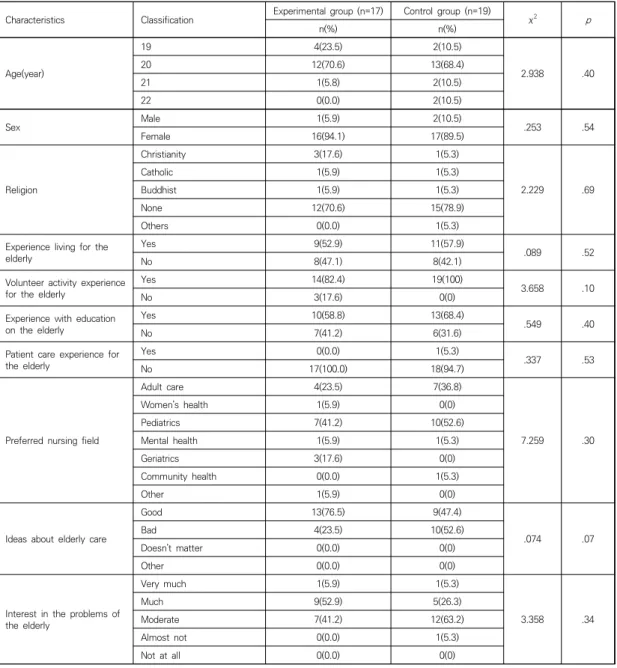
The general characteristics of participants and the results of a prior homogeneity test appear in Table 2 showing age, sex, religion, experience with seniors, volunteer experience with elders, teaching experience related to elders, nursing care for elders, preference for elders, thoughts

on elder care, and interest in elderly care. No significant difference in homogeneity was found.

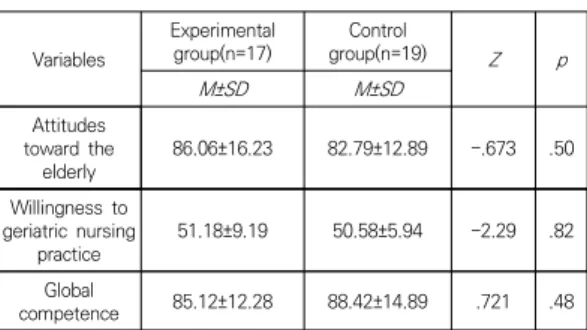
As a result of examining the homogeneity of the

experimental and control groups’ attitudes

toward elders, willingness to geriatric nursing

practice, and global competence, no statistically

significant difference emerged (as shown in

Table 3).

(7)

Variables Experimental

group(n=17) Control

group(n=19) Z p

M±SD M±SD

Attitudes toward the

elderly 86.06±16.23 82.79±12.89 -.673 .50

Willingness to geriatric nursing

practice 51.18±9.19 50.58±5.94 -2.29 .82

Global

competence 85.12±12.28 88.42±14.89 .721 .48

Table 3. Homogeneity test of the Dependent Variables for the Two Groups (N=36)

3.2 Intervention effects

Differences in attitude change about elders, after applying the program, showed no significant difference in the comparison of the two groups from baseline to post test. Also, no significant difference emerged in the comparison between the two groups for pretest and posttest on willingness to geriatric nursing practice.

Finally, the results of the differences before and after the program on global competence showed no significant difference between the experimental and control groups (as shown in Table 4).

Table 4. Comparison of experimental and control effects

Variables Groups Pretest Posttest

Z p

M±SD M±SD

Attitudes toward elders

Experimental 86.00±16.23 85.53±18.95

-.46 .66 Control 82.79±12.89 87.58±13.78

Willingness to geriatric nursing practice

Experimental 51.18±9.19 53.53±6.01

-.64 .53 Control 50.58±5.94 51.84±6.37

Global competence

Experimental 85.12±12.28 92.82±16.00

-1.08 .29 Control 88.42±14.89 86.68±18.40

4. Discussion

The purpose of this study was to develop a education program and to verify its effectiveness in improving attitudes toward elders, nursing students’ willingness to geriatric nursing practice,

and global competence.

The program took place as an extracurricular activity during the semester, with 80 hours of instruction including theory and practice. Even though education hours of this program was less than 160 hours of a geriatric nurse practitioner’s educational program [18], it was considered that it is not insufficient time to achieve the goal of the extracurricular program aimed to improve the characteristics of nursing students and their experiences with elders, changing their attitudes toward elders. Although the timing was appropriate for the goal, the effectiveness of the program requires confirmation through repeated studies.

Changes in attitude toward elders was contrary to the expected result of positive changes in care attitudes of nursing and medical students after the experience with elders [19,20]. This is consistent with the findings of no change in attitudes [6]. Recognition of seniors as a distinct subject relates to the experience of volunteering to work with elders [21]. Research results show that when a nurse visits a nursing home repeatedly, they understand aging, form a positive attitude toward elders, and empathize with elders [22]. Experience over time are required to strengthen positive attitudes toward elders through experiences with elders rather than a single fragmentary approach [6]. The program also included single, short-term interactions with seniors, judged at the time to be insufficient to lead to attitude change.

To induce positive behaviors about elders, the

formation of positive attitudes is important and

timely. This study did not lead to a change in

attitude, which may relate to a lack of change in

the practice of elder care. In addition, as pointed

out in previous studies, quantitative evaluation

needs to be accompanied by qualitative

evaluation [6]. In the case of nursing practice

with elders, accurate measurement can be

applied only to the participants who have

(8)

practiced with elders, rather than the participants who have little experience with elders, who will have difficulty practicing nursing with elders. Last, because no difference emerged in global competence , it seems that some items on the survey should be assessed after 6 months or 1 year of measurement, rather than evaluating immediately after program completion.

Although the geriatric nursing convergence education program for nursing students did not have a statistically significant impact on attitudes toward elders, willingness to geriatric nursing practice, and global competencies has the following importance. First, it is most desirable to include elder-care nursing as an independent mandatory part of the undergraduate curriculum.

It may be difficult that nursing students do not get enough education on geriatric nursing in undergraduate courses due to the impartiality of course management [23]. Therefore, it was realistic and accessible to operate the elderly education program as an extracurricular activity, as in this study.

Second, nursing students are more interested in the problems of elders, and their attitudes and behaviors are more positive when addressing problems. In addition, experiences with seniors improved their interest in elders. Therefore, nursing education programs should be interested in the curriculum that can increase their experience with the elderly [23]. Although the environment for nursing care for elders usually centers on hospitals, the area of nursing care for elders in their homes, nursing homes, and communities will be further expanded. Reflecting this study, the program included interactions with the elderly in nursing homes and community senior centers.

Third, this educational method aimed to form a desirable attitude toward nursing care, the importance of integration and linkage between subjects rather than specific subjects, direct interactions with elders, the use of audio-visual

materials, and the inclusion of critical thinking and discussion processes [3]. The program addressed educational content for nursing elders in each subject area: adult nursing, community nursing, women's health nursing, and mental nursing. Incontinence-related education was taught as part of the women's health nursing course; the psychological nursing course addressed therapeutic communication with elders; and the application of the recreation program for elders was part of the community-nursing course. The program included direct interactions with elders in nursing homes and community senior centers and actively used audio-visual media such as watching movies related to elders.

Fourth, in the study of the current status and development direction of geriatric-nursing education for an undergraduate degree in 2013, more than half of respondents answered that the credits for geriatric nursing were very low or insufficient. Only 31.4% of schools operated geriatric nursing curriculum as a required subject [24].

According to a study reported in 2018 [5], the content of issues and trends, legal and ethical issues, and administrative issues of elderly nursing were strengthened. However, a lack of educational content on legal and ethical issues, administrative issues, elderly nursing research areas, and elderly nursing-service delivery systems persists [5]. In particular, only three colleges address urinary incontinence among elders’ health problems in the geriatric nursing curriculum. This educational program supplements deficiencies in Korean elderly nursing education and includes practical health problems such as falls, depression, and urinary incontinence.

Suggestions resulting from this study follow:

First, it is necessary to repeat the comparison

and the effects of the geriatric nursing

convergence education program. Second, in the

(9)

follow-up study, it is necessary to measure the effect with more practical and accurate measuring tools for participants, such as nursing practice tools and behavioral tools for nursing students working with elders. Third, possible additions to the program content include supplementing interactions with regular and continuous contact, critical thinking, and discussion processes for nursing care.

REFERENCES

[1] Statistics Korea. (2016). Population projections for 2015~2065. Daejeon: Statistics Korea [Online]

http://kostat.go.kr/portal/eng/pressReleases/8/8/inde x.board?bmode=read&bSeq=&aSeq=359108&pageNo=

1&rowNum=10&navCount=10&currPg=&sTarget=title

&sTxt=

[2] M. C. Gebhardt, T. T. Sims & T. A. Bates. (2009) Enhancing geriatric content in a baccalaureate nursing program. Nursing Education Perspectives, 30(4), 245-248.

https://doi.org/10.1043/1536-5026-030.004.0245 [3] H. E. Yeom. (2016). Review of educational strategies

to facilitate desirable attitudes toward gerontological nursing. Journal of the Korea Academia-Industrial Cooperation Society, 17(1), 561-571.

https://doi.org/10.5762/KAIS.2016.17.1.561

[4] W. Garbrah, T. Valimaki, M. Palovaara & P.

Kankkunen. (2017). Nursing curriculums may hinder a career in gerontological nursing: an integrative review. International Journal of Older People Nursing, 12(3), e12152.

https://doi.org/10.1111/opn.12152

[5] S. H. Baik et al (2018). Baccalaureate competencies and curriculum in gerontological nursing. Journal of Korean Gerontological Nursing, 20(2), 76-85.

https://doi.org/10.17079/jkgn.2018.20.2.76

[6] H. S. Jeoung & S. Y. Han. (2012). The effects of an elderly nursing education program on nursing students’ attitude and behavior toward the elderly.

Journal of the Korean Data Analysis Society. 14(3), 1453-1466.

https://doi.org/10.3928/01484834-20070301-05 [7] E. S. Yun. (2008). Study on the curriculum of

gerontological nursing baccalaureate degree programs (BSN) in Korea. Journal of Korean Academy of Nursing, 14(2), 188-194.

https://doi.org/10.5977/JKASNE.2008.14.2.188 [8] B. Williams, M. C. Anderson & R. Day. (2007).

Undergraduate nursing students’ knowledge of and

attitudes toward aging: Comparison of context-based learning and a traditional program. Journal of Nursing Education, 46(3), 115-120.

[9] J. Cohen. (1992). A power primer. Psychological Bulletin, 122, 155-159.

[10] American Association of Colleges of Nursing. (2018).

Recommended baccalaureate competencies and curricular guidelines for the nursing care of older adults. [Internet]. Washington, DC:American Association of Colleges of Nursing [Online]

http://www.aacnnursing.org/Portals/42/AcademicNurs ing/CurriculumGuidelines/AACN-Gero-Competencies -2010.pdf.)

[11] A. S. Luggen & S. Meiner. (2001). NGNA core curriculum for gerontological nursing. 2nd ed. St.

Louis : Mosby.

[12] G. F. Sanders, J. E. Montgomery, J. F. Pittman & C.

Balkwell. (1984). Youth’s attitudes toward the elderly.

Journal of applied gerontology, 3(1), 59-70.

https://doi.org/10.1177/073346488400300107 [13] J. Han. (2003). Undergraduate students´ attitudes

toward elderly. Korea Gerontological Society, 20(3), 115-127.

[14] Y. S. Lim. (2002). Knowledge and attitude toward the elderly of a general hospital nurses. (Unpublished master’s thesis). Environment and Health Chosun University Gwangju, South Korea.

[15] Orem, D. E. (1997). Views of human beings specific to nursing. Nursing Science Quarterly, 10(1), 26-31.

https://doi.org/10.1177/089431849701000110 [16] H. J. Choi. (2002). The research is nurse of knowledge,

attitude and practice for old age patient.

(Unpublished master’s thesis) . Kyung Hee University, Seoul, South Korea.

[17] S. Y. Shin & E. M. Noh. (2013). Development of global competency measuring tool and verification of goodness. Studies in english education, 18(2), 339-359.

[18] H. C. Baek. (2018). Development and evaluation of geriatric visiting nurses’ educational program. Journal of Korean Academic Society of Home Health Care Nursing, 25(3), 240-248.

https://doi.org/10.22705/jkashcn.2018.25.3.240 [19] S. H. Baik. (2007). Nursing students' attitudes toward

the elderly and the application of a senior simulation for changing to a positive attitude. The Journal of Korean Academic Society of Nursing Education, 13(1), 5-12.

[20] P. Varkey, D. S. Chutka & T. G. Lesnick. (2006). The aging game: improving medical students' attitudes toward caring for the elderly. J ournal of the American Medical Directors Association, 7(4), 224-229.

https://doi.org/10.1016/j.jamda.2005.07.009

[21] D. J. Van Dussen & R. R. Weaver. (2009).

Undergraduate students’ perceptions and behaviors

(10)

related to the aged and to aging processes.

Educational Gerontology, 35(4), 342-357.

https://doi.org/10.1080/03601270802612255

[22] E. Schwalbach & S. Kiernan. (2002). Effect of an intergenerational friendly visit program on the attitude of fourth graders toward elders. Educational Gerontology, 28(3), 175-187.

[23] H. S. Jeong. (2012). Need for gerontological nursing education among nursing students. Journal of Korean Academic Society of Home Health Care Nursing, 19(1), 19-27.

[24] O. G. Kim et al. (2013). Gerontological nursing education in BSN programs in South Korea: present status and direction for improvement in the future. Journal of Korean Gerontological Nursing, 15(3), 185-191.

고 지 운(Ji Woon Ko) [정회원]

․ 2002년 8월 : 중앙대학교 간호학과(간 호학석사)

․ 2011년 12월 : University of Iowa College of Nursing (간호학박사)

․ 2012년 9월 ~ 현재 : 선문대학교 간호 학과 부교수

․ 관심분야 : 간호관리, 간호정보

․ E-Mail : [email protected]

양 지 원(Ji-Won Yang) [정회원]

․ 2013년 2월 : 고려대학교 간호학과(간 호학석사)

․ 2018년 8월 : 고려대학교 대학원(간호 학박사)

․ 2019년 3월 ~ 현재 : 경일대학교간호 학과 조교수

․ 관심분야 : 기본간호, 정신건강, 스트레 스

․ E-Mail : [email protected]

정 미 영(Mi-Young Chung) [정회원]

․ 2004년 2월 : 가톨릭대학교 간호대학 (간호학석사)

․ 2010년 8월 : 가톨릭대학교 간호대학 (간호학박사)

․ 2011년 3월 ~ 현재 : 선문대학교 간 호학과 부교수

․ 관심분야 : 여성간호, 청소년 학업적 응, 영적간호, 호스피스, 국제간호, 간호교육

․ E-Mail : [email protected]

차 선 경(Sun-Kyung Cha) [정회원]

․ 2001년 2월 : 고려대학교 대학원(간호 학석사)

․ 2012년 9월 : 고려대학교 대학원(간호 학박사)

․ 2013년 9월 ~ 현재 : 선문대학교 간호 학과 부교수

․ 관심분야 : 정신건강, 의사소통

․ E-Mail : [email protected]

수치

Fig.  1.  Research  design
Table  1.  Geriatric  nursing  convergence  education  program
Table  2.  Homogeneity  test  of  demographic  characteristics.                                                                                            (N=36) Characteristics Classification Experimental  group  (n=17) Control  group  (n=19)
Table 3. Homogeneity test of the Dependent Variables  for  the  Two  Groups                                                       (N=36)

참조

관련 문서

Shin, K. The effects of a communication training program on communication and interpersonal relationships of nursing students. Effect of empathy training program on the. reduction

Abstract The purpose of this study was to identify the relationships among knowledge, attitudes toward caring for the elderly and geriatric nursing practice and

Abstract Purpose: The purpose of this study is to identify the effect of a convergence multicultural nursing education on cultural competence and empathy for

Jho, Effects of core fundamental nursing skills education on self-efficacy, clinical competence and practice satisfaction in nursing students. Journal of Korean Academy

Effect of clinical experiences at a nursing home on nursing students' attitudes toward the elderly, Korean J Gerontol Nurs, 1 (2), 255-262..

Jho, “Effects of Core Fundamental Nursing Skills Education on Self-efficacy, Clinical Competence and Practice Satisfaction in Nursing Students”, Journal of Korean Academy

Jho, "Effects of Core Fundamental Nursing Skills Education on Self-efficacy, Clinical Competence and Practice Satisfaction in Nursing Students", Journal of Korean Academy

Abstract This study was conducted to investigate the effects of nursing professional attitude and employment strategy on graduate nursing students core fundamental nursing