• 검색 결과가 없습니다.

Biodegradable Check Dam and Synthetic Polymer, its Experimental Evaluation for Turbidity Control of Agricultural Drainage Water

N/A
N/A
Protected

Academic year: 2021

Share "Biodegradable Check Dam and Synthetic Polymer, its Experimental Evaluation for Turbidity Control of Agricultural Drainage Water"

Copied!
5
0
0

로드 중.... (전체 텍스트 보기)

전체 글

(1)

Biodegradable Check Dam and Synthetic Polymer, its Experimental Evaluation for Turbidity Control of Agricultural Drainage Water

Minyoung Kim*, Seounghee Kim, Jinoh Kim, Sangbong Lee, Youngjin Kim, and Yongho Cho Department of Agricultural Engineering, National Academy of Agricultural Science, RDA, Suwon,

441-707, Republic of Korea

(Received: September 24 2013, Accepted: November 16 2013)

A drainage ditch is normally a component of drainage networks in farming systems to remove surplus water, but at the same time, it may act as a major conduit of agricultural nonpoint source pollutions such as sediment, nitrogen, phosphorus, and so on. The hybrid turbidity reduction system using biodegradable check dam and synthetic polymer was developed in this study to manage pollutant discharge from agricultural farmlands during rainfall events and/or irrigation periods. The performance of this hybrid system was assessed using a laboratory open channel sized in 10m-length and 0.2m-width. Various check dams using agricultural byproducts (e.g., rice straw, rice husks, coconut fiber and a mixture of rice husks and coconut fiber) were tested and additional physical factors (e.g., channel slope, flowrate, PAM dosage, turbidity level, etc.) affecting on turbidity reduction were applied to assess their performance. A series of lab experiments clearly showed that the hybrid turbidity reduction system could play a significant role as a supplementary of Best Management Practice (BMP). Moreover, the findings of this study could facilitate to develop an advanced BMP for minimizing nonpoint source pollution from agricultural farmlands and ultimately to achieve the sustainable agriculture.

Key words: Hybrid turbidity reduction system, Agricultural nonpoint source pollution, Synthetic polymer, Biodegradable check dam, Open channel

Four byproducts used for a biodegradable check dam (BCD) and their evaluation for turbidity reduction.

1)

*Corresponding author : Phone: +82312901946, Fax: +82312901960, E-mail: [email protected]

§
Acknowledgement: This study was carried out with the support of “Research Program for Agricultural Science & Technology

Development (Project No. 907097032013)”, National Academy of Agricultural Science, Rural Development Administration, Republic

of Korea.

(2)

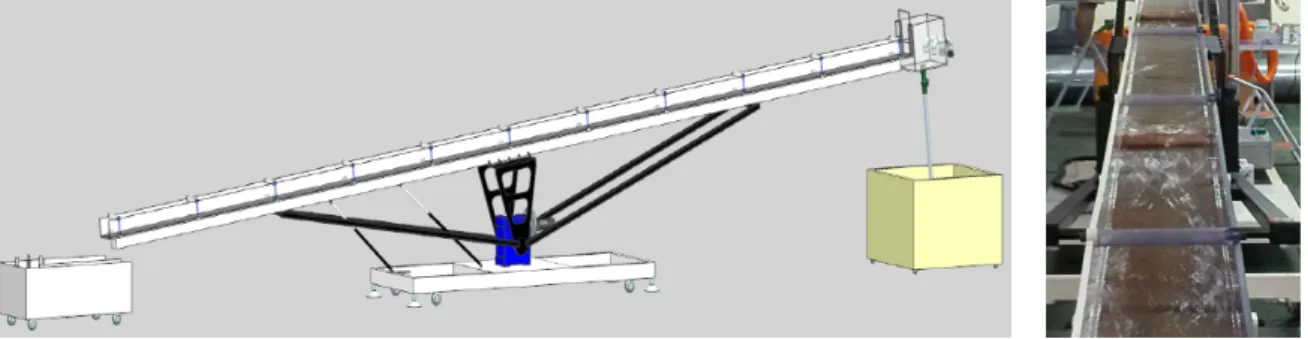
Fig. 1. Artificial open channel experiment with biodegradable check dam (BCD) installed.

Fig. 2. Percentage of turbidity removal depending upon type and dosage of Polyacrylamide (PAM).

Introduction

During wet periods, a drainage ditch (or waterway) plays a role as the transitional zone contributing nonpoint source losses of soil and nutrients (nitrogen, phosphorus and so on) and causing subsequent eutrophication to receiving water bodies (Yang et al., 2008). Previous study by Lee et al. (2012) found that approximately 20~30% of total nutrients was drained into a ditch through excessive irrigation during harrowing a field (Lee et al., 2012).

A check dam is one of the Best Management Practices (BMPs) made of gravel, rock, sandbags, logs or treated lumber (FAO, 1996). However, runoff water full of suspended clays and particulates refuses to settle down due to small size and it is very difficult to filter and remove using a conventional rock check dam. Recent study by Kang et al. (2013) found that alternative check dams constructed out of fiber materials may outperform rock in reducing ditch erosion, and adding polyacrylamide can significantly reduce turbidity (Kang et al., 2013). A design of fiber check dam is affected by many factors, such as size, material, drainage channel, and so on; however, little information is available. Therefore, this study conducted a series of experiments to evaluate the effects of physical and hydraulic conditions on turbidity control and optimally design a wide- use, eco-friendly hybrid turbidity reduction system using a biodegradable check dam (BCD) and a synthetic polymer.

Materials and Methods

Hybrid turbidity reduction system: Biodegradable check dam and synthetic polymer Biodegradable check dams (BCDs) (3~3.5cm diameter and 21~23cm length) are tube- shaped and filled with rice straw, rice husks, coconut fiber and a mixture of coconut fiber and rice husks. BCDs are flexible to fit any ditch cross-section and maintain centerline flow. An anionic synthetic polymer, Magnafloc 336 (Ciba Specialty Chemicals, Korea, now BASF Global) was used and its physiochemical properties are as followings: nontoxic, white granular powder, high molecular weight (10~15 million g·mol

-1

), particle size (98%<1000 μm), bulk density (0.8 g cm

-3

), pH of 1% solution at 25°C (5.5), viscosity at 25°C of 0.5% solution (50 cp) and relative viscosity at 25°C (4.1).

Experimental setup and procedure This study built a rectangular open channel of 1,000 cm long and 20 cm wide to measure the turbidity reduction capacity of inflows in variable gradient (2, 4, 6, 8 and 10 degree) (Fig. 1).

The channel bed was covered with concrete and the walls

of channel were made of plexiglass (acrylic). The unit called

a setting tank was also installed to boost the effective

sedimentation of turbid water (Fig. 1). The settling tank

consisting of two stages was sized 132 cm length, 63 cm

width and 43 cm height, and it was located at the end of

(3)

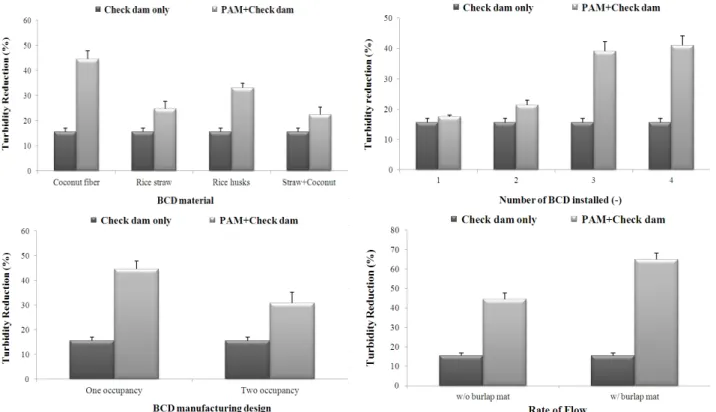
Fig. 3. Response of turbidity readings to a change of biodegradable check dam (BCD)’s physical conditions.

open channel. Each stage was divided by a partition wall with changeable height. Sedimentation followed by coagulation/

flocculation step was expected to occur within a settling tank to remove most of the suspended particles.

A number of BCDs under given conditions were placed prior to the turbid water flowed in. Artificial turbid water, a mixture of water and clay (average particle size of 130 μ m), was pumped from an injection tank (110 × 110 × 77.5 cm, 625 L of capacity) to a channel at controlled discharges. Except for two case of experiment, a change of channel gradient and inflow rate, the rest of experiments were conducted under the same condition (2 degree of channel gradient and 125 L min

-1

of inflow rate).

Factors influencing on turbidity reduction were selected and evaluated, which include, channel gradient (2, 4, 6, 8 and 10 degree), inflow rate (125 and 250 L min

-1

), PAM type (power, emulsion and blok), PAM dosage (50 and 500 mg), a number of BCD installed (one up to four), BCD materials (rice straw, rice husks, coconut fiber and a mixture of rice husks and coconut fiber), BCD manufacturing design (one and two occupancy), a turbidity level of inflow and co-use of burlap mat and settling tank.

Approximately 50 mL-water samples were manually taken from a point just before and after a settling tank at time interval of 50, 90, 120 and 150 seconds after the turbid water started to flow from an outlet of an open channel.

All samples brought to a laboratory were shaken to re-suspend the sediment, and turbidity was measured using a turbidimeter (HACH 2100AN, HACH, CO, USA).

To quantify and compare each performance, the percentage of turbidity reduction, R, for each test was calculated using an Equation (1).

 

 

×  (1)

where T

1

and T

2

are the average turbidity readings (NTU) in region 1 (before a settling tank) and region 2 (after a settling tank), respectively.

Results and Discussion

Effect of polyacrylamide (PAM) on reducing turbidity The material testing for Magnafloc 336 (powder), dissolved Magnafloc 336 (emulsion), and APS 700 Series Floc Logs®

was carried out. In addition, an effect of PAM dosage on turbidity reduction was investigated. A powder-typed PAM showed about 53% better turbidity removal than emulsion- and block-typed PAMs. Obviously enough, as a PAM dosage increased, more reduction of turbidity reading was observed (Fig. 3). Interestingly, the effect of PAM on turbidity reduction was not infinite, and the separate test showed that the logarithmic relation between PAM dosage and turbidity reduction existed (data not shown).

Variable BCDs, their influencing factors on turbidity

reduction A timely collected sample was analyzed and the

(4)

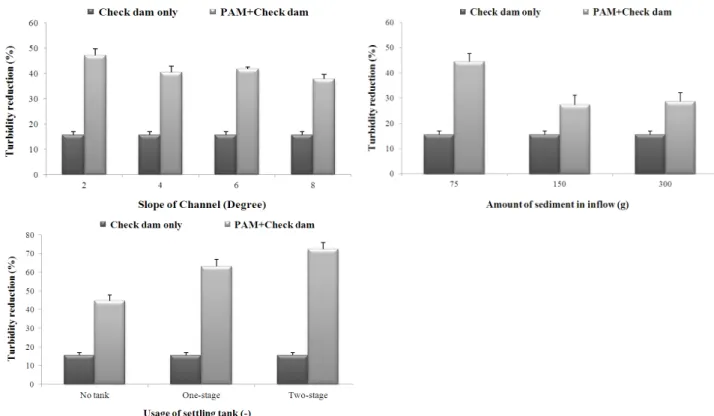
Fig. 4. Effect on physical and hydraulic conditions on turbidity reduction.

result showed that as a number of BCD installed increased, the effect also increased. Interestingly, a number of BCD installed was not in direct proportion to their performance of turbidity reduction.

The effect of one or double occupancy of BCDs as well as a simultaneous use of burlap mat was investigated.

One BCD itself and two BCDs attached each other, the performance test showed that only single use of BCD showed the better result, which can be explained by the fact that the application rate of PAM on a single BCD was higher than the one on double BCDs. In addition, a simultaneous use of burlap mat enhanced to capture flocculated particles on it and eventually more sediment removal.

Effect of physical and hydraulic conditions of open channel An increase of channel gradient diminished the effect of turbidity reduction due to high water velocity and less reaction time between PAM and suspended particles.

Simulated turbid flows (125 vs. 250 L min

-1

) with a fixed concentration of sediment were introduced to a channel for 10 minutes. As flow increased, the sediment removal efficiency was decreased.

PAM-treated particles were usually filtered through a BCD and/or adsorbed by a BCD. But since a diameter of BCD is not large, there was a limit to remove all flocculated particles. Additional use of settling tank along with a hybrid turbidity reduction system clearly showed better performance to remove flocculated particles, and two-stage settling

tank was better than the one-stage settling tank due to longer setting time.

Conclusions

A series of laboratory experiments using an artificial open channel were conducted to optimally design the hybrid turbidity reduction system, BCD sprinkled with PAM, for controlling agricultural nonpoint source pollutants. Superior performance emerged when a BCD used with PAM. Among various PAM products, powder, emulsion and block, powder worked best followed by emulsion and block. An increase of PAM dosage resulted in high turbidity removal efficiency.

A channel gradient and flow rate had negative effects on turbidity reduction in waters. A number of BCD installed depends upon a level of turbidity and an amount of flow in. The best turbidity reduction result was achieved from three BCD made of coconut fiber and simultaneous uses of burlap mat & settling tank. Overall results clearly showed that the hybrid turbidity reduction system could play a significant role as a supplementary BMP.

The hybrid turbidity reduction system developed in this

study is eco-friendly, easy to install, and no removal after

use. This is expected to save time & effort, and makes

erosion control easy, effective and economical. This hybrid

turbidity reduction system could transform agricultural nonpoint

sources to areas for pollutant retention and control. However,

it should be noted that careful attention should be given

(5)

to the design and installation which results in less sediment in sloped farmlands and discharges with much less turbidity.

References

Food and Agriculture Organization of the United Nations (FAO). 1996. Control of water pollution from agriculture- FAO irrigation and drainage paper 55.

Kang, J., M.M. McCaleb, and R.A. McLaughlin, 2013. Check dam and polyacrylamide performance under simulated storm- water runoff. Journal of Environmental Management 129(15):

593-598.

Lee, S.B., M.Y. Kim, S.H. Kim, and S.H. Yum, 2012. Sediment reduction using activated carbon from paddy fields at the early stage of irrigation. 18th Congress of the Asia and Pacific Division of the International Association for Hydro-Environment Engineering and Research 2012, Aug. 19~23, Jeju Island, Korea.

Yang, X.E., X. Wu, H.L. Hao, and Z.L. He, 2008. Mechanisms and assessment of water eutrophication. J. Zhejiang Univ. Sci.

B. 9(3):197-209.

수치

Fig. 1. Artificial open channel experiment with biodegradable check dam (BCD) installed.
Fig. 3. Response of turbidity readings to a change of biodegradable check dam (BCD)’s physical conditions.
Fig. 4. Effect on physical and hydraulic conditions on turbidity reduction.

참조

관련 문서

Basic aspects of AUTOSAR architecture and methodology Safety mechanisms supported by AUTOSAR.. Technical safety concepts supported by AUTOSAR Relationship to ISO

GDP impact of COVID-19 spread, public health response, and economic policies. Virus spread and public

동결방지 조치를 취하여 등을 사용하여 적절한 우려가 있는 곳은 보온재 드레인 호스 설치시 동결.

[r]

Micro- and nano-sized pores were formed on the surface of the alloy using PEO and anodization methods, and the pore shape change according to the Zr

Measurements items between the maxillary second premolar and the first molar: A, The occlusal plane and reference lines which were above 4, 6, 8 mm from cementoenamel junction

This research further enriches the previous research on the influencing factors of employee organizational commitment and OCB, which help Chinese companies

As was observed in SEM images, the thickness of the selective layer of synthesized membranes in this study was higher than conventional TFC membrane due to the nature of