Introduction
Azospirillum is a free-living, plant-growth promoting bacterium, capable of affecting growth and yield of numerous plant species, many of agronomic and ecological significance. They are isolated from the rhizosphere of many grasses and cereals and even from ornamental crops and their roles on plant growth and yield have been well established (James, 2000; Bashan et al., 2004; Gadagi et al., 2004). Apart as a plant- growth promoting bacteria (PGPB), they are also used in environmental problems such as soil erosion, bioremediation of water etc (reviewed in Bashan et al., 2004). Though, Azospirillum originally considered to be a nitrogen fixing bacteria, their contribution to biological nitrogen fixation has been questioned and in recent decades the stimulatory effect of Azospirillumon plants has been attributed to several factors such as production of phytohormones, facilitating the nutrient uptake etc. The additive hypothesis states that more than one mechanism that operates simultaneously or in
succession when induced in appropriate environmental conditions, results in the observed changes in plant growth due to Azospirillum inoculation (Bashan and Levanony,1990). Despite intensive studies on physiology and molecular biology of these bacteria, the exact mode of action of the bacteria on plants remains yet unclear.
Numerous factors govern the successful establishment of the introduced bacterium in the rhizosphere. The application dose of the inoculum is animportant factor that governs the survivability and establishment of the introduced bacteria that in turn play a role on their plant growth promotion. The inoculation dose for other PGPB has been studied and their effects have been demonstrated (Zheng and He, 1994; Bai et al.,2002). Though numerous studies document the beneficial effects of Azospirillum, the optimization of inoculum dose for Azospirillum is still lagging behind.
Our experiment was designed to study the Azospirillum brasilense strain CW903 dose effects on different plants under pot culture conditions. The effects of A. brasilense strain CW903 inoculation on plant growth and nutrient uptake were also measured at different inoculation dose.
Received : 25 April 2007 Accepted : 5 June 2007
*Corresponding author: Phone : +82432612561, E-mail : [email protected]
Optimization of the Inoculation Dose of Plant-Growth Promoting Bacteria Azospirillum brasilense Strain CW903 Assessed by Tomato,
Red Pepper and Rice under Greenhouse Condition
Munusamy Madhaiyan, Selvaraj Poonguzhali, Woo-Jong Yim, Kyoung-A Kim, Bo-Goo Kang
1, and Tong-Min Sa
*Department of Agricultural Chemistry, Chungbuk National University, Cheongju 361-763, Korea
1
Protected Agricultural Experiment Institute, CBARES, Umseong 369-824, Korea
Inoculation dose of agriculturally important microbes is an important criterion that decides the establishment and hence their effects on plant growth. Effects of the inoculation dose of Azospirillum
brasilense strain CW903 on the growth and nutrient absorption of three different crops, tomato, rice andred pepper were assessed under green house condition. Three different concentrations of A. brasilense strain CW903 (10
5, 10
6and 10
8cfu mL
-1) were applied through seed treatment and through the soil near the root zone (1 mL per plant) at 20 and 30 days after sowing. Positive effects on the growth of tomato, rice and red pepper were found at 10
6and 10
8cfu mL
-1inoculation doses of A. brasilense strain CW903. The inoculation dose of 10
8cfu mL
-1of A. brasilense strain CW903 recorded the best effects on growth parameters like shoot and root length and the absorption of important nutrients.
Key words : Azospirillum brasilense, Nutrient absorption, Plant-growth promoting bacteria, Red pepper, Rice,
Tomato
Materials and Methods
Bacterial strains and culture conditions Azospirillum brasilense strain CW903 originally isolated from Taro rhizosphere(Kim et al., 2005) was cultured on Nfb medium supplemented with 1g NH
4Cl per litre (Baldani and Dobereiner, 1980). Nfb medium contained (g L
-1) DL-Malic acid, 5.0 K
2HPO
4, 0.5; MgSO
4·7H
2O, 0.2; NaCl, 0.1; CaCl
2·2H
2O, 0.02; 2 mL of minor element solution (stock solution of trace metals per 1000 mLconsists of CuSO
4·5H
2O, 0.4; ZnSO
4·7H
2O, 0.12;
H
3BO
3, 1.4; Na
2MoO
4·2H
2O, 1.0; MnSO
4·H
2O, 1.5), 2 mL of bromothymol blue solution (0.5% dissolve in 0.2 N KOH), 4 mL of 1.64% Fe-EDTA, 1 mL of vitamin solution (stock solution of vitamin per 100 mL consists of biotin, 10 mg; and pyridoxol·HCl, 20 mg). The pH was adjusted to 6.8 with 2 N KOH, and the medium was autoclaved at 121˚C for 20 min.
Seed, bacterial inocula and plant growth conditions Pot culture experiments under green house conditions were carried out to test the effects of inoculation of the nitrogen fixing A. brasilense strain CW903 at different concentrations. Sterilization of seeds was achieved through incubation in 70% ethanol, 1 min; 2% NaOCl for 30 sec followed by 5-10 washing steps using sterile distilled water. For the preparation of bacterial inocula, the culture was proliferated in Nfb broth containing NH
4Cl to mid-exponential growth phase (OD
600= 1.2).
The cell pellets obtained by centrifuging at 10,000 ×g (4˚C) for 10 min were washed and resuspended in 30 mM MgSO
4to different dilutions such that they contained 6.65×10
5, 1.8×10
6, and 4.8×10
8cfu mL
-1. The population was estimated by serial dilution and plating of the bacterial aliquots on Nfb media. The seeds were kept imbibed in the bacterial suspension for 6 h at room temperature under shaking (60 rpm). For control, the seeds suspended in 30 mM MgSO
4were used.
Surface disinfected tomato, red pepper and rice seeds either inoculated with bacteria or untreated were sown in plastic pots (top diameter, 100 mm; bottom diameter, 75 mm; height, 85 mm) filled with approximately 250 g of air-dried Wonjo-Mix bed soil (Nong-Kyung Co., Ltd, Jincheon-gun, Chungbuk, Republic of Korea). It contains 65-75% cocoa peat, 15-20% zeolite, 10-15% perlite and macronutrient (mg L
-1) NH
4-N, 150-200; NO
3-N, 100- 150; available P
2O
5, 200-300; pH 5.7 to 7.0; 40±5%
moisture content; and 30±5 kPa water holding capacity.
The pots were held in racks (20 pots per rack)and grown under green house conditions and watered regularly. The treatments were arranged in a completely randomized design with fourreplications per treatment. Bacteria was applied twice at 20 and 30 days after sowing (DAS) through soil inoculation at 1 mL of suspended liquid culture near the root zone. The crop was uprooted at 45 DAS and nutrient analysis was carried out after recording the growth parameters.
Nutrient analysis and population estimation Nitrogen (N) concentration in the plant materials was measured after digestion with sulphuric acid and potassium sulphate using the Kjeldahl Auto1030 analyzer. Concentration of P in roots and shoots was measured according to Jackson (1973) using ammonium metavanadate reagent. Standards were prepared with potassium dihydrogen phosphate (Sigma, USA). The uptake of other nutrients by the plants was measured through inductively coupled plasma optical emission spectroscopy (ICP-OES, Optima 5300DV, Perkin Elmer, USA) analysis after digesting the sample (500 mg)with perchloric acid, sulphuric acid and distilled water (10:1:2) in a hot plate. After digestion, the samples were filtered twice through filter paper (No. 6, Advantec Toyo), the volume was made 100 mL in volumetric flask and a 10 mL sample was used for analysis. Quality Control Standard 21 stock solution (100 µ g mL
-1of 5%
HNO
3/tr.Tart./tr.HF) from PerkinElmer Life and Analytical Sciences (710 Bridge Port Avenue, Shelton, CT 06484, USA) was used. The working solutions were prepared from primary stock solution using deionized distilled water.
The most probable number (MPN) method was used to estimate the Azospirillum population in the rhizosphere soil samples. Ten gram of soil was suspended in 90Lof sterile distilled water and serially diluted. Aliquots of 1 ml were inoculated to test tubes containing Nfb semisolid media. There were three replicates for each dilution.
Seven days after inoculation at 30˚C, the vials were analyzed for the presence or absence of a characteristic pellicle formed on semi-solid N-free media.
Statistical analysis Standard curves were generated
by regression analysis (Excel, Microsoft) for every
enzyme assay. The data were subjected to analysis of
variance and testing of means by Duncan's Multiple
Range Test (DMRT) at P ≤ 0.05 using SAS, Version 9.1
(SAS Institute Inc., 2001).
Results and Discussion
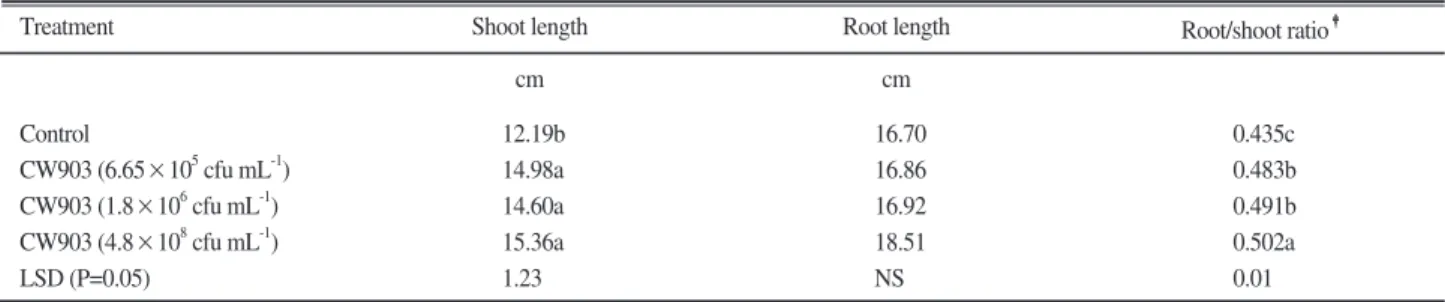
Since its discovery in the mid 1970s Azospirillum has consistently proven to be a very promising PGPB. In several developing and developed countries, Azospirillumis used as the bacterial inoculant of choice, alone or together with other PGPB and vesicular arbuscular mycorrhizal (VAM) fungi, for many crops (Bashan et al., 2004). Besides, Azospirillum also proves to be a promising inoculant to mitigate the stress conditions (Barassi et al.,2006). The inoculation dose is an important factor in agricultural application of microbial inoculants. In this study, the PGPB Azospirillum brasilense strain CW903 (Kim et al., 2005) was used to investigate the optimal dose of inoculation tested with three different crops. The A. brasilensestrain CW903 increased red pepper, tomato, and rice shoot and root length in a dose-dependent manner with an apparent maximum efficiency for bacterial concentration around 10
8cfu mL
-1. In red pepper, application of A.
brasilensestrain CW903 applied at different concentrations increased significantly the shoot length
when compared to uninoculated control, while it had no effect on root length. The rootto shoot ratio increased at all the concentrations and the highest effect was recorded at an inoculation dose of 10
8cfu mL
-1(Table 1). In tomato, the inoculation doses of 10
6and 10
8cfu mL
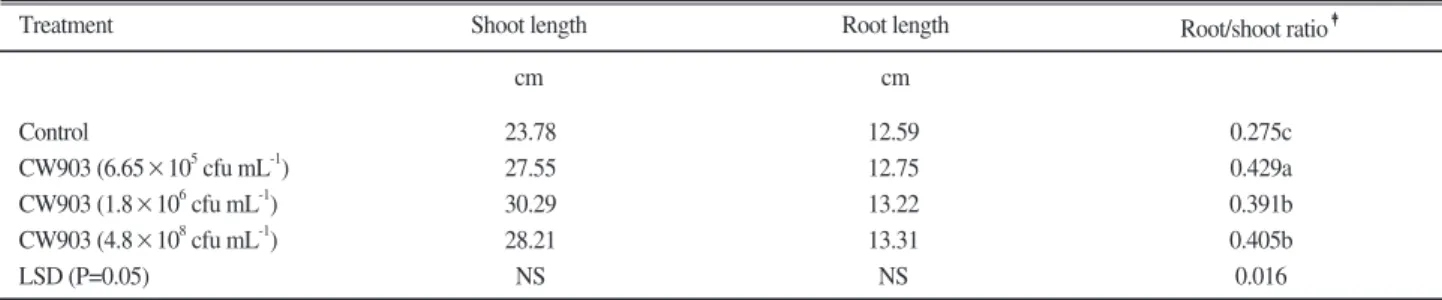
-1cell density significantly increased all the growth parameters measured. Although, no significant differences were observed with in these two inoculation doses, the higher the inoculation dose the greater was the effect observed in shoot, root lengths, stem girth and root to shoot ratio. The stem girth recorded an increase of 6.78 to 20% over the control in the bacterial inoculations (Table 2). In rice, no such significant effects on the root or shoot length could be observed with the inoculation of A. brasilensestrain CW903 at different inoculation doses though the bacterial inoculation increased the root and shoot length. However, the root to shoot ratio increased in the bacterial inoculations with the highest obtained at an inoculation dose of 10
5cfu mL
-1(Table 3). As from the results discussed above, it can be observed that inoculation of A.
brasilense strain CW903 had a growth promoting effect on all the three crops tested. The growth promoting effect was dose dependent and an inoculation dose of 10
8cfu mL
-1was found to be the optimal dose for it recorded the
Treatment
Control
CW903 (6.65×10⁵cfu mL-1) CW903 (1.8×10⁶cfu mL-1) CW903 (4.8×10⁸cfu mL-1) LSD (P=0.05)
"
Data are means four replications obtained at 45 days after sowing. In the same column, significant differences according to LSD at P= 0.05 levels are indicated by different letters.
62.68b 63.93b 74.13a 75.05a 9.17
24.56b 26.42ba 27.45a 27.20a 12.60
18.70b 19.29ba 19.19a 10.44a 11.48
0.15b 0.18a 0.18a 0.19a 0.016 Root/shoot ratio Stem girth
Root length Shoot length
cm cm mm
Table 2. Effects of different inoculation dose of Azospirillum brasilense strain CW903 on the growth parameters of tomato.""
Treatment
Control
CW903 (6.65×10⁵cfu mL-1) CW903 (1.8×10⁶cfu mL-1) CW903 (4.8×10⁸cfu mL-1) LSD (P=0.05)
"
Data are means four replications and observed at 45 days after sowing. In the same column, significant differences according to LSD at P= 0.05 levels are indicated by different letters.
‡The shoot to root ratio was obtained dividing shoot fresh weight by root fresh weight.
12.19b 14.98a 14.60a 15.36a 1.23
16.70 16.86 16.92 18.51 NS
0.435c 0.483b 0.491b 0.502a 0.01 Root/shoot ratio‡ Root length
Shoot length
cm cm
Table 1. Effects of different inoculation dose Azospirillum brasilensestrain CW903 on the shoot and root length and root to shoot ratio of red pepper.""
higher values for most of the parameters tested. Such an optimal concentration on plant growth particularly on root modifications has often been observed for other PGPB-plant interactions (Harari et al., 1988; Larcher et al., 2003).
The effects of A. brasilense strain CW903 varied on the nutrient uptake of the crops studied. In red pepper, the uptake of primary nutrients N, P, and K and secondary nutrients like Ca and Mg increased significantly with bacterial inoculation. However, the effects on different nutrients varied among the inoculation doses used (Table 4). For most nutrients, the inoculation dose 10
8cfu mL
-1recorded the highest nutrient concentration in red pepper and similarly the dose 10
5cfu mL
-1showed no effect when compared to control (Table 4). A. brasilense strain CW903 inoculation to rice recorded similar effects on the
nutrient uptake in rice. Inoculation at a dose 10
8cfu mL
-1recorded the highest concentration or the uptake of N, P, K and other nutrients with the exception of Cu (Table 5).
In tomato the results recorded a different trend. For tomato shoots, in most cases and particularly for N, P, and K the inoculation of A. brasilense strain CW903 produced no enhancements and sometimes lower than the uninoculated control (Table 6). However, the concentration of P, K and other micro nutrients except Fe, increased with the bacterial inoculation though it varied among the inoculation doses. For most of the nutrients analyzed, the inoculation dose 10
6cfu mL
-1proved to be superior to the other concentrations (Table 6). It can be inferred from the above results, in general the inoculation of A. brasilense strain CW903 enhanced the nutrient uptake and the effects varied with the type of crops
Treatment
Control
CW903 (6.65×10⁵cfu mL-1) CW903 (1.8×10⁶cfu mL-1) CW903 (4.8×10⁸cfu mL-1) LSD (P=0.05)
"
Data are means four replications obtained at 45 days after sowing. In the same column, significant differences according to LSD at P= 0.05 levels are indicated by different letters.
23.78 27.55 30.29 28.21 NS
12.59 12.75 13.22 13.31 NS
0.275c 0.429a 0.391b 0.405b 0.016 Root/shoot ratio‡ Root length
Shoot length
cm cm
Table 3. Effects of different inoculation dose of Azospirillum brasilense strain CW903 on the shoot and root length and root to shoot ratio of rice.""
Treatment N P K Ca Mg Mn Zn Cu Fe
% --- mg kg-1--- Control
CW903 (6.65×10⁵cfu mL-1) CW903 (1.8×10⁶cfu mL-1) CW903 (4.8×10⁸cfu mL-1) LSD (P=0.05)
"
Data are means four replications and in the same column, significant differences according to LSD at P= 0.05 levels are indicated by different letters.
1.67b 2.24a 2.05a 2.07a 0.26
496.39c 543.82b 582.62a 558.63ba 128.18
23570c 28064b 33542a 32477a 12282.7
2306b 2572b 3490a 3710a 1635.34
2704b 3472a 3189a 3120a 1395.31
402.68b 422.13b 618.44a 717.99a 131.49
112.34c 114.98c 189.73b 246.22a 119.98
6.89ba 5.86bc 7.34a 5.34c 1.105
793.65cb 848.26b 757.53c 942.78a 188.29 Table 5. Effects of Azospirillum brasilense CW903 inoculation on nutrient uptake in rice.""
Treatment N P K Ca Mg Mn Zn Cu Fe
% --- mg kg-1--- Control
CW903 (6.65×10⁵cfu mL-1) CW903 (1.8×10⁶cfu mL-1) CW903 (4.8×10⁸cfu mL-1) LSD (P=0.05)
"
Data are means four replications and in the same column, significant differences according to LSD at P= 0.05 levels are indicated by different letters.
3.98b 4.67a 4.90a 5.04a 0.48
557.17c 586.52b 614.29a 627.14a 124.69
57060d 66214b 64455c 70539a 1688.5
14519b 13416b 17131a 17644a 1574
6826c 8596b 8623b 9063a 389.92
179.11b 178.41b 195.26a 200.83a 116.41
100.38c 344.56a 265.20b 271.93b 131.87
114.42b 463.8c 114.60b 865.8b 116.09a
1463.8c 1865.8b 1934.6b 1012.5a 1174.69 Table 4. Effects of Azospirillum brasilense CW903 inoculation on nutrient uptake in red pepper.""
studied. For tomato, because of the bulkiness of the plant material the nutrients were analyzed separately for roots and shoots and if it were done for the whole plant as that for rice and red pepper the results could be different.
Hence, it would not be appropriate to conclude that inoculation of A. brasilense strain CW903 is not beneficial for tomato. In recent decades, numerous studies have pointed out that plant growth promotion by Azospirillum would be due to a multitude of effects operating simultaneously or in succession and the most common explanation is the production of phytohormones that alter the metabolism and morphology of the plant yielding better mineral and water absorption (Bashan et al., 2004). In this study also, the plant growth promotion by A. brasilense strainCW903 can be attributed to the increased nutrient uptake. Alternatively, the possibility of plant-growth promotion due to a concerted action of other mechanisms that were not considered in this study could not be ruled out.
For any observed beneficial effect on plants, colonization by the inoculated bacteria is an important factor. The inappropriate root colonization usually resulted in marginal or no effects on plant growth (Benizri et al., 2001). Azospirillum is mostly considered as a rhizosphere soil dweller and hence in this study we estimated the population of Azospirillum in the rhizosphere soil samples by a MPN technique. The presence or absence of the characteristic pellicle formed on semi-solid N-free media was selected as a criterion. In all the crop samples, the bacterial population at an inoculation dose of 10
8cfu mL
-1recorded the highest value (Table 7). The possible explanation of the enhancement of the observed parameters at this particular inoculation dose is that increased colonization or the presence of more number of bacteria in this condition.
Conclusion
It can be inferred from this study that inoculation of A.
Treatment N P K Ca Mg Mn Zn Cu Fe
% --- mg kg-1--- Shoot
Control
CW903 (6.65×10⁵cfu mL-1) CW903 (1.8×10⁶cfu mL-1) CW903 (4.8×10⁸cfu mL-1) LSD (P=0.05)
Root Control
CW903 (6.65×10⁵cfu mL-1) CW903 (1.8×10⁶cfu mL-1) CW903 (4.8×10⁸cfu mL-1) LSD (P=0.05)
"
Data are means four replications and in the same column, significant differences according to LSD at P= 0.05 levels are indicated by different letters.
1.67 1.72 1.71 1.87 NS
589.3a 495.6c 545.2ba 514.2bc 148.73
60561a 52925b 53691b 48262d 13186.3
9866b 8697b 13610a 10942b 2668.1
4691a 3699c 4566a 4286b 1241.43
206.05b 196.35c 130.59d 227.87a 119.099
115.37a 103.42b 190.82c 187.68c 116.93
8.38ba 8.19b 8.70a 8.41ba 0.449
128.93c 154.453b 156.63ba 169.293a 113.16
1.50 1.64 1.49 1.54 NS
539.8b 614.2a 619.1a 620.4a 125.22
23327b 32302a 29999a 26438ba 15894.8
6768c 7057b 7618a 6923cb 1256.66
2953b 2652b 3623a 2856b 347.1
432.66b 486.16a 250.33c 404.16b 145.6
172.25b 272.37a 279.27a 171.61b 119.30
5.86c 8.45ba 8.18b 8.76a 0.34
1127.48 1290.18 1146.29 1363.79 NS Table 6. Effects of Azospirillum brasilenseCW903 inoculation on nutrient uptake in shoot and root of tomato.""
Treatment
Control
CW903 (6.65×10⁵cfu mL-1) CW903 (1.8×10⁶cfu mL-1) CW903 (4.8×10⁸cfu mL-1) LSD (P=0.05)
"
Data are means four replications after 45 days after sowing. In the same column, significant differences according to LSD at P= 0.05 levels are indicated by different letters.
3.43b 3.62b 4.32a 4.46a 0.299
2.86c 3.86b 3.96ba 4.08a 0.179
3.46c 3.72b 4.32a 4.46a 0.171 Red pepper Rice
Tomato
Population of Azospirillum
--- log cfu g-1rhizosphere soil --- Table 7. Population of Azospirillum in the rhizosphere soil of tomato, red pepper and rice.""
brasilense strain CW903 prove beneficial for the crop plants studied increasing the nutrient absorption and the growth parameters. The effective inoculation dose for this strain through seed and soil was in the range of 10
6-10
8cfu mL
-1. The best plant growth and nutrient absorption was found when CW903 10
8cfu mL
-1of A. brasilense strain was applied through seed treatment and through the soil (1 mL per plant) at 20 and 30 days after sowing near the root zone.
Acknowledgements
This work was supported by the research grant from Chungbuk National University 2006. The authors also thank Soo-Jae Park and Sook-Jin Kim for their help and assistance in conducting the pot culture experiments and for analyzing the samples by ICP-OES.
References
Bai, Y., B. Pan, T.C. Charles, and D.L. Smith. 2002. Co-inoculation dose and root zone temperature for plant growth promoting rhizobacteria on soybean [Glycine max (L.) Merr] grown in soil- less media. Soil Biol. Biochem. 34:1953-1957.
Baldani, V.L.D., and J. Döbereiner. 1980. Host-plant specificity in the infection of cereals with Azospirillum spp. Soil Biol. Biochem.
12:433-439.
Barassi, C.A., G. Ayrault, C.M. Creus, R.J. Sueldo, and M.T.
Sobrero. 2006. Seed inoculation with Azospirillum mitigates NaCl effects on lettuce. Sci. Hortic. 109:8-14
Bashan, Y., and Levanony, H. 1990. Current status of Azospirillum
inoculation technology: Azospirillum as a challenge for agriculture.
Can. J. Microbiol. 36:591-608.
Bashan, Y., G. Holguin, and L.E. de-Bashan. 2004. Azospirillum- plant relationships: physiological, molecular, agricultural, and environmental advances (1997 2003). Can. J. Microbiol. 50:521- 577.
Benizri, E., E. Baudoin, and A. Guckert. 2001. Root colonization by inoculated plant growth-promoting rhizobacteria. Biocontrol Sci.
Technol. 11:557-574.
Gadagi, R.S., P.U. Krishnaraj, J.H. Kulkarni, and T.M. Sa. 2004.
The effect of combined Azospirillum inoculation and nitrogen fertilizer on plant growth promotion and yield response of the blanket flower Gaillardia pulchella. Sci. Hortic. 100:323-332.
Harari, A., J. Kigel, and Y. Okon. 1988. Involvement of IAA in the interaction between Azospirillum brasilense and Panicum miliaceum roots. Plant Soil 110:275-282.
Jackson, M.L. 1973. Soil Chemical Analysis. Prentice-Hall of India Pvt. Ltd. New Delhi, India. pp. 54-56.
James, E.K. 2000. Nitrogen fixation in endophytic and associative symbiosis. Field Crops Res. 65:197-209.
Kim, C.W., M.L. Kecskeys, R.J. Deaker, K. Gilchrist, P.B. New, I.R. Kennedy, S.W. Kim, and T.M. Sa. 2005. Wheat root colonization and nitrogenase activity by Azospirillum isolates from crop plants in Korea. Can. J. Microbiol. 51:948-956.
Larcher, M., B. Muller, S. Mantelin, S. Rapior, and J.C. Cleyet- Marel.2003. Early modifications of Brassica napus root system architecture induced by a plant growth-promoting Phyllobacterium strain. New Phytol. 160:119-125.
SAS Institute Inc. (2004) SAS user's guide, version 9.1, SAS Institute Inc., Cary, North Carolina, USA
Zheng, Y., and W. He. 1994. Effects of plant growth promoting bacterium Zhengchanjun on forage production. Grasslands China 4:36-38.
식물생장촉진 미생물을 농업적으로 활용하는데 있어서 미생물의 접종 수준이 근권에서의 원활한 정착과 식물 의 생장촉진 효과를 결정하는데 중요한 기준이 된다. Azospirillum brasilense CW903균주 105, 106 및 108 cfu mL-1 현택액에 토마토, 벼, 고추의 종자를 침지시킨 후 포트에 파종하여 온실에서 재배하였으며 파종 후 20일 과 30일에 1 mL씩 근권토양에 접종하여 각 식물의 생장과 양분흡수를 조사하였다. Azospirillum brasilense CW903 균주 106 및 108 cfu mL-1 현택액을 처리하였을 때 식물생장 촉진효과가 나타났으며, 108 cfu mL-1 현택 액을 처리하였을 각 식물의 줄기와 뿌리의 생장 및 양분흡수가 가장 우수한 것으로 나타났다.
온실조건에서 토마토, 고추, 벼를 이용한 식물생장촉진 미생물 Azospirillum brasilense CW903 접종의 최적 조건 평가
무누사미 마두하이안·실바라지 풍굴러리·임우종·김경아·강보구1·사동민* 충북대학교 농화학과, 1음성시설농업시험장