Carbon dioxide is one of important environmental factors that affect on growth and morphogenesis of Basidiomycetes. Excess CO2 inhibits the fruiting;
especially fruit body development, and sometimes generates abnormal fruit bodies in Basidiomycetes (Tschierpe, 1959; Niederpruem, 1963; Tschierpe and Sinden, 1964; Taber, 1966; Long and Jacobs, 1974;
Kinugawa et. al., 1986, 1994). On the contrary, primordium formation of Sphaerobolus stellatus is inhibited when CO2 is eliminated from air(Ingold and Nawarz, 1967). Hintikka and Korhonen(1970) found that vegetative growth of lignicolous basidiomycetes was markedly stimulated under higher CO2concentration while that of litter inhabiting basidiomycetes was suppressed severely in proportion to the increment of CO2concentration.
In vitro culture under the ventilation and light irradiation, the colonies of Ganoderma lucidum form atypical fruiting structure(AFS) bearing basidiospores without the basidiocarp formation and fruit body primordium(FBP)(Shin and Seo, 1988; Seo et al., 1995). In AFS forming isolates, the colonies of G.
lucidum formed AFS on the agar media. Basidia differentiated directly from generative hyphae on the
outside of AFS. According to light response, G.
lucidum isolates are divided into three groups; AFS- forming isolates, FBP forming isolates and chlamydospore forming isolates without fruiting on the agar media(Seo et al., 1995). For the FBP formation, only light irradiation is essential, but for AFS formation both light irradiation and ventilation are required(Seo et al., 1995). It has been well known in commercial cultivation that the fruit body formation of G. lucidum is inhibited even under weak semi-anaerobic condition.
A major factor that reflects the inhibitive effect by bad ventilation has not been clarified in G. lucidum although excess CO2 is speculated to be a major inhibitive factor.
Thus the present study is conducted to examine the effect of carbon dioxide on the mycelial expansion and AFS and FBP formation of G. lucidum, a white rot fungus, to elucidate the major inhibitive factor under bad ventilation.
The dikaryon isolates of G. lucidum used in this study are listed in Table 1. Two isolates, Gl-009 and Gl-012, and two isolates, Gl-010 and Gl-020 were
Journal of Mushroom Science and Production Vol. 2, No 2, p45-48 June 2004
Copyright ⓒ 2004 by The Korean Society of Mushroom Science Printed in S. KOREA
Effect of concentrated carbon dioxide exposure on the mycelial growth and fruit body initiation of Ganoderma lucidum.
Geon Sik Seo1)* and Akira Suzuki2)
1)Korea National Agricultural College, Bongdam, Hwasung, Kyonggi 445-893, Korea
2)Department of Biology, Faculty of Education, Chiba University, 1-33 Yayoi-Cho, Inage-Ku, Chiba 263-8522, Japa
1)한국농업전문학교, 2)千葉大學敎育學部
ABSTRACT : The effect of CO2concentration (500, 3,000, 6,000㎕㎕//ℓℓ) on the mycelial growth and fruit body primordium formation of Ganoderma lucidum on nutrient agar medium was examined. Optimum CO2concentration for vegetative growth was above 3,000㎕㎕//ℓℓ. Fruit body initiation was accelerated at higher than 3,000㎕㎕//ℓℓ CO2exposure but the maximum number and size of primordia, and primordium color were not influenced by CO2concentrations. Whereas each atypical fruiting structure forming stock culture showed different fruiting time under each concentration of CO2exposure.
KEYWORDS : Ganoderma lucidum, CO2concentration, mycelial growth, fruit body initiation
*Corresponding author: <[email protected]>
used as FBP and AFS forming isolate, respectively (Seo et al., 1995). Isolate Gl-015 that forms AFS even under dark condition was isolated from white fruit body(Seo et al., 1995).
All isolates were cultured and maintained on a nutritionally complete agar medium (CM) as reported previously(Seo et al., 1995). Mycelial disks(6 mm in diameter) were placed in 90 mm plastic Petri dishes containing about 30ml of CM, and were incubated at 27
±1℃ for 20 days under light and ventilated condition.
As light source, white fluorescent lamp(FL 20 SD, Matsushita) was employed. The light intensity of fluorescent lamps was adjusted to about 500 to 1,000 lux by controlling the distance between lamps and the Petri dishes. The relative humidity was adjusted at 80
±5% and CO2levels in the air of growth cabinets were maintained about 550, 3,000 and 6,000 ㎕/ℓ, respectively.
Oxygen concentrations in all growth cabinets were maintained at about 20% until end of experiments. To examine the effect of concentrated CO2 on mycelial growth, diameter of colony was measured by 10 days of inoculation. In each experiment, ten or fifteen replicates were applied for each CO2exposure.
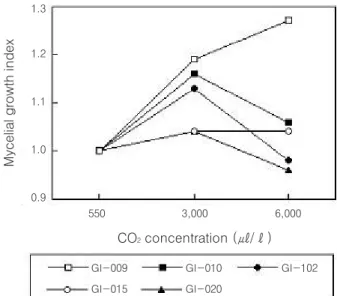
The CO2 optimum for vegetative growth of stock cultures G1-010, G1-012 and G1-020 was 3,000 ㎕/ℓ.
Whereas, that for vegetative growth of stock cultures G1-009 and G1-015 was higher than 6,000 ㎕/ℓ (Fig. 1).
Hintikka and Korhonen (1970) found that vegetative growth of lignicolous basidiomycetes was markedly stimulated at around 10% CO2but that of soil- and litter- inhabiting fungi was suppressed in proportion to the increment of CO2concentration of atmosphere (0.03%).
Mycelial expansion rates of Flammulina velutipes, Pleurotus ostreatus, Pholiota nameko, and Hypsizygus marmoreus have no significant difference between 600 ㎕/ℓ and 6,000 ㎕/ℓ CO2 exposure(Kinugawa et al., 1986).
This suggests that the CO2optimum for vegetative growth G. lucidum is very low comparing with those of other wood rotting fungi. There may be an inverse relationship between vegetative growth and fruiting in fungi. The obtained data, however, indicate that this relationship cannot be always observed in G. lucidum(Fig. 1; Table 2).
한국버섯학회지 2(2) 2004
46
Fig. 1. Effect of different concentration of CO2exposure on mycelial growth of G. lucidum.
All cultures were incubated under light condition for 10 d on complete medium(CM; 2% glucose, 0.2%
yeast extract, 0.2% peptone, 0.0046% KH2PO4, 0.01% KH2PO4, 0.005% MgSO4·7H2O). All cultures were replicated 10 times. The light intensity was adjusted to about 500 to 1,000 lux. Mycelial growth index = mycelial growth rate of the control/mycelial growth rate on the CO2enriched conditions.
1.3
1.2
1.1
1.0
0.9
550 3,000 6,000
GI-009 GI-015
GI-010 GI-020
GI-102
CO2concentration (㎕/ℓ)
Mycelial growth index
Table 1. Isolates of G. lucidum used in this experiment Isolate Morphogenesis on
agar media1) Sources Collected country
Gl-009 FBP-forming Wild fruit body Japan
Gl-010 AFS-forming Cultivated fruit body Korea
Gl-012 FBP-forming Wild fruit body Japan
Gl-015 AFS-forming White fruit body Korea
Gl-020 AFS-forming Wild fruit body, TMI-50087 Japan
1)Mophogenesis on agar media were confirmed by Seo et al., (1995), AFS; Atypical fruiting structure bearing the basidiospores, FBP;
Fruit body primordium.
When G. lucidum cultured under semi anaerobic condition, i. e., cultured in the Petri dish double sealed with Para film(American National Can), the mycelial growth was accelerated. This stimulation may base on the gaseous environments such as decrease of O2 concentration, and increase of air humidity and various volatile substances, and not be caused merely by the increment of CO2 concentration. FBP forming stock cultures formed FBP earlier under the higher CO2 concentration than atmospheric condition(Table 2).
No significant difference was observed on the number, size and color of FBP among different CO2 concentrations(Table 2). AFS formation of stock culture G1-015 was not influenced under among different CO2concentrations (Table 2). AFS formation of stock culture G1-020 decreased with the increment of CO2 concentration (Table 2). Stock culture G1- 010 formed primordia at 3,000 and 6,000 ㎕/ℓ CO2 exposure, not at 550 ㎕/ℓ CO2exposure(Table 2). In previous study(Seo et al., 1995), the AFS formation of G. lucidum was inhibited but the mycelial growth was rather accelerated by preventing aeration, i. e., cultivation in the Petri dish double-sealed with Para film. The difference in the results between present research and previous one suggests that this may be derived from excess CO2accompanying other gaseous environments, and this can not be caused merely by the increment of CO2concentration.
Fruiting of G. lucidum also greatly affected by light and CO2 level in cultivation house(Hemmi and Tanaka, 1936; Stamet, 1993). It has been observed that a long stipe and a small pileus, so called antler type fruit body were formed in aeration prevented artificial cultivation of G. lucidum, but has not been confirmed that whether those abnormal fruit bodies derived from higher CO2 level or genetic backgrounds. In many basidiomycetes,
stipe elongation and inhibition of pileus development by higher level of CO2 exposure have been also reported(Taber, 1966; Kinugawa et al., 1994). FBP forming isolates formed FBP earlier under the higher CO2 levels than atmospheric condition (Table 2).
However, no significant differences were observed on the number, size and color of FBP among different CO2 levels. In previous study (Seo et al., 1995), the AFS formation of G. lucidum was inhibited by preventing aeration, while the mycelial growth was rather accelerated. Whereas, the FBPs were formed regardless of aeration. These results might that higher concentration of CO2 does not affect fruit body primordium initiation and stipe elongation. AFS- forming isolates, Gl-010 and Gl-015 did not show significant differences on the AFS formation among different CO2levels. However, the exposure of higher concentration of CO2inhibited AFS formation in isolate Gl-020. Although we have disregard for effect of oxygen concentration(in this experiment maintained about 20%) in the growth cabinet, high concentrated CO2 is effective for induction of fruit body primodium, but not AFS formation including sporulation of G.
lucidum.
In conclusion, G. lucidum is very sensitive to excess CO2 than other wood rotting fungi that have been examined and it shows somewhat similar tendency in the reaction to CO2 concentration with litter and soil inhabiting fungi.
Hemmi, T. and Tanaka, I. 1936. Experiments for developing sporophores of Ganoderma japonicum. Bot. and Zoo. 4:
13-23. (in Japanese.)
Hintikka, V. 1982. The colonisation of litter and wood by basidiomycetes in Finnish forests. In: "Decomposer 47
이산화탄소 농도가 영지버섯균의 균사생장과 자실체원기 유도에 미치는 영향
Table 2. Effect of different concentration of CO2(㎕/ℓ) exposure on the formation of AFS and FBP of G. lucidum1) Isolate AFS formation at different CO2
concentration (㎕/ℓ)
FBP formation at different CO2
concentration (㎕/ℓ)
550 3,000 6,000 550 3,000 6,000
Gl-009 - - - - ++ ++
Gl-012 - - - + ++ +++
Gl-010 - + + - - -
Gl-020 +++ ++ + - - -
Gl-015 +++ +++ +++ - - -
1)All cultures were incubated under light condition for 20 d. -; only vegetative growth, +; 10~39% forming (AFS- or FBP-forming Petri-dish / total replicate X 100), ++; 40~69% forming, +++; 70~100% forming.
basidiomycetes," (ed. by Frankland, J. C. et al.), pp. 227- 239. Cambridge Univ. Press, London.
Hintikka, V. and Korhonen, K. (1970). Effect of carbon dioxide on the growth of lignicolous and soil-inhabiting Hymenomycetes. Communicationes Instituti Forestalis Fenniae, 62:5, 1-29.
Ingold, C. T. and Nawaz, M. 1967. Carbon dioxide and fruiting in Sphaerobolus. Ann. Bot. (N. S.) 31: 351-357.
Kinugawa, K. Takamatsu, Y. Suzuki, A. Tanaka, K. and Kondo, N. 1986. Effect of concentrated carbon dioxide on the fruiting of several cultivated basidiomycetes. Trans.
mycol. Soc. Japan. 27: 327-340. (In Japanese.)
Kinugawa, K. Suzuki, A. Takamatsu, Y. Kato, M. and Tanaka, K. 1994. Effect of concentrated carbon dioxide on the fruiting of several cultivated basidiomycetes (II).
Mycoscience. 35: 345-352.
Long, P. E. and Jacobs, L. 1974. Aseptic fruiting of the cultivated mushroom Agaricus bisporus. Trans. Br. Mycol.
Soc. 63: 99-107.
Niederpruem, D. J. 1963. Role of carbon dioxide in the control of fruiting of Schizophyllum commune. J. of Bacteriol. 85: 1300-1308.
Seo, G. S., Shin, G. C., Otani, H., Kodama, M. and Kohmoto, K. 1995. Formation of atypical fruiting structures in Ganoderma lucidum isolates on a nutrition agar media. Mycoscience. 36: 1-7.
Shin, G. C. and Seo, G. S. 1988. Formation of the nonbasidiocarpous basidiospore of Ganoderma lucidum.
Kor. J. Mycol. 16: 230-234. (In Korean.)
Stamets, P. 1993. The polypore mushrooms of the genera Ganoderma, Grifola and Polyporus. In: "Growing gourmet and medical mushrooms". pp. 351-369. Ten Speed Press, Berkely, California.
Taber, W. A. 1966. Morphogenesis in basidiomycetes. In:
"The Fungi," (ed. by Ainsworth, G. C. and Sussman, A.
S.) Vol. 2, pp. 387-412. Academic Press, New York.
Tschierpe, H. J. 1959. Der Einfluss von Kohlendioxyd auf die Fruchtkorperbildung und die Fruchtkorperform des Kulturchampignons. Mush. Sci. 4: 235-250.
Tschierpe, H. J. and Sinden. 1964. Weitere Untersuchungen uer die Bedeutung von Kohlendioxyd fur die Fructifikation des Kulturchampignons, Agaricus campestris var. bisporus (L) Lge. Arch. Mikrobiol. 49: 405- 425.
한국버섯학회지 2(2) 2004
48