261 This is an Open-Access article distributed under the terms of the Creative Commons Attribution Non-Commercial License (http://
creativecommons.org/licenses/by-nc/3.0) which permits unrestricted non-commercial use, distribution, and reproduction in any medium, provided the original work is properly cited.
J. Mushrooms 2019 December, 17(4):261-267 http://dx.doi.org/10.14480/JM.2019.17.4.261 Print ISSN 1738-0294, Online ISSN 2288-8853
© The Korean Society of Mushroom Science
*Corresponding author E-mail : [email protected] Tel : +82-55-751-3397 Received December 6, 2019 Revised December 19, 2019 Accepted December 23, 2019
먹이원에 따른 흰점박이꽃무지(Protaetia brevitarsis) 유충의 항산화활성
김혜수
1· 박현영
1· 권현숙
2· 이상호
3· 하준
3· 이상원
1· 조수정
1*
1경남과학기술대학교 제약공학과
2한국한의약진흥원
3농업회사법인 도다움
Variations in antioxidant activity in Protaetia brevitarsis larvae depending on the feeding source
Hye Soo Kim
1, Hyun-Young Park
1, Hyun-Sook Kwon
2, Sang-Ho Lee
3, Jun Ha
3, Sang-Won Lee
1, and Soo-Jeong Cho
1*
1Department of Pharmaceutical Engineering, Gyeongnam National University of Science and Technology, 33 Dongjin-ro, Jinju 52725, Korea
2National Institute of Korean Medicine Development, Gyeongsan 38540, Korea
3Agricultural Corporation Company Dodaum, 55 Dongin-ro, Jinju 52725, Korea
ABSTRACT: The objective of this study was to evaluate the antioxidant activity of extracts of Protaetia brevitarsis larvae fed on fermented oak sawdust (FOS) or spent mushroom substrates (SMS, Pleurotus eryngii). Total polyphenol content was 32% higher in extracts of larvae fed on SMS (P. eryngii) (75.33±0.43 mg GAE/g) than in extracts of larvae fed on FOS (57.02±1.73 mg GAE/g).
The flavonoid content of extracts of larvae grown on FOS and SMS (P. eryngii) was 24.6±0.28 mg/g and 25.4±0.75 mg/g, respectively. DPPH radical scavenging activity increased in an extract concentration-dependent manner, and the DPPH radical scavenging capacity of the extract of larvae produced on SMS (P. eryngii) was higher than that of the larvae produced on FOS.
The reducing power of the larval extracts produced on FOS and SMS (P. eryngii) increased in an extract concentration-dependent manner, but there was no significant difference between them. The extract of larvae fed on SMS (P. eryngii) (66.55±0.99 uM TE/
g) had a higher oxygen radical absorbance capacity (ORAC) than extracts of larvae grown on FOS (76.32±0.48 uM TE/g). The effect of larval extracts on cell proliferation was investigated using a WST-1 (4-[3-(4-iodophenyl)-2-(4-nitrophenyl)-2H-5-tetrazolio]- 1,3-benzene disulfonate) assay on RAW 264.7 cells. When cells were treated with larval extracts produced on FOS and SMS (P.
eryngii) at concentrations of 0, 2, 4, 8, 16, 32, 40, and 64 mg/ml, RAW 264.7 cells proliferated at 90% or more. Therefore, larval extracts produced on FOS and SMS (P. eryngii) were not toxic to RAW 264.7 cells.
KEYWORDS: Antioxidant, DPPH radical scavenging activity, ORAC value, Protaetia brevitarsis larvae, Spent mushroom substrates
서 론
산소는 인체 내 에너지를 만드는 과정에서 필수불가결 한 분자이만 인체의 대사과정에서 발생되는 활성 산소종 (reactive oxygen species, ROS)은 불안정한 산소 화합물 로써 반응성이 큰 특징이 있으며, 생체 내 대사과정의 부 산물로 연속적으로 반응할 뿐만 아니라 과도하게 발생된 활성산소종은 산화적 스트레스를 유발한다(Droge, 2001;
Kim et al., 2013). 방어체계와 산화적 스트레스의 균형이 깨지면 과도하게 생성된 활성산소는 세포들의 산화적 손 상을 유발할 뿐만 아니라 염증반응의 신호전달계와 연결 되어 암, 치매, 당뇨병, 류마티스 관절염과 같은 퇴행성
질환이나 노화를 촉진한다고 알려져 있다(Halliewell and Gutterridge, 1990; Verckei et al., 1992; Aitken et al., 1993; Baublis et al., 2000; Kim et al., 2013). 최근 들어 이러한 유해 활성산소나 자유 라디칼을 제거함으로써 질 병을 예방하거나 치료하려는 시도가 활발해지고 있으며 활성산소종에 따른 생체 불균형의 조절을 위해 항산화제 의 소비가 증가하는 추세이다(Aburjai and Natsheh, 2003; Kim et al., 2013).
현재까지의 천연물유래 식·의약품 소재에 관한 연구는 주로 한약재를 중심으로 식물자원에 관한 연구가 많이 진 행되었지만 최근들어 곤충의 다양성과 활용성이 재인식됨 에 따라 곤충자원의 식·의약품 소재화에 관한 연구들이 활발하게 이루어지고 있다(Bukkens, 1996). 식용곤충은 단백질 및 비타민, 불포화지방산 등 다양한 영양소를 포 함하고 있고 번식력이 좋아 유엔식량 농업기구(Food and Agriculture Organization of the United Nations) 등은 미 래 식량난을 해결할 대안으로 곤충자원을 주목하고 있으 며 애완·학습용, 천적, 꽃의 수정을 돕는 화분매개, 관광상 품 및 바이오 소재 등으로 사용되면서 새로운 농업소득으 로 각광받고 있다(Yoon et al., 2007). 우리나라에서는 오 래전부터 식·약용으로 사용되어온 누에(Bombyx mori) 유 충과 번데기, 백강잠, 벼메뚜기(Oxya chinensis sinuosa) 등 3종과 최근 식품의약품안전처에 식품으로 등록된 쌍별 귀뚜라미(Gryllus bimaculatus), 갈색거저리 유충(Tenebrio molitor), 장수풍뎅이 유충(Allomyrina dichotoma), 흰점박이 꽃무지 유충(Protaetia brevitarsis seulensis) 등 총 7종의 곤충이 일반식품으로 등록되어 있다(Lee et al., 2018). 그 중 딱정벌레목(Coleoptera) 꽃무지과(Cetoniidae)에 속하는 흰점박이꽃무지(White-spotted flower chafer)는 전체 길 이가 약 17-24 mm 정도의 식식성(植食性) 곤충으로서 알 및 유충, 번데기, 성충의 시기를 거치는 완전변태를 하며 유충은 ‘굼벵이’ 또는 ‘제조(Protaetia brevitarsis)’라 부른다 (Kim and Kang, 2005; Kim and Kang, 2006). 한방에서 흰점박이꽃무지 유충은 파혈행어(破血行瘀), 산결소종(散 結消腫), 청혈해독(淸血解毒) 등의 효능이 있어 통풍(痛風), 어혈협통(瘀血脇痛), 그리고 단독(丹毒) 등의 질병 치료에 효과가 있고(Lee et al., 2001), 동의보감에서는 ‘간에서 비롯되는 질병, 즉 간암, 간경화, 간염, 누적된 피로의 해 소 등을 포함하여 월경불순, 시력 감퇴, 백내장, 금창, 산 후풍, 악성종기, 구내염, 파상풍 및 중풍 등의 성인병 치 료에 효과가 있다'고 기록되어 있다(Kang et al., 2000;
Lee et al., 2001; Cho et al., 2003). 최근에는 흰점박이꽃 et al., 2001), 식중독균 및 중금속 등 유해물질에 대한 안 전성(Chung et al., 2013), 흰점박이꽃무지의 사료자원에 관한 연구(Lee et al., 2018), 먹이원에 따른 흰점박이꽃무 지의 품질 및 항산화 활성(Choi et al., 2019) 등에 관한 연구가 보고되고 있다.
본 연구에서는 참나무톱밥과 큰느타리수확후배지를 각
각 식이한 흰점박이꽃무지 유충 추출물의 항산화 활성을 조사하여 흰점박이꽃무지 유충의 사료자원으로써 큰느타 리수확후배지의 이용 가능성과 기능성 식품원료로써 흰점 박이꽃무지 유충의 이용 가능성을 제시하고자 한다.
재료 및 방법
흰점박이꽃무지 유충 추출물의 제조
본 실험에 사용한 흰점박이꽃무지 유충은 참나무톱밥과 큰느타리수확후배지를 각각 식이한 흰점박이꽃무지 유충 으로 농업회사법인 도다움(경남 진주시 명석면 소재)에서 제공받아 사용하였다. 흰점박이꽃무지 유충은 흐르는 물 에 3회 세척한 다음 물기를 제거하고 건조기에서 약 72시 간 동안 건조하였다. 건조된 흰점박이꽃무지 유충은 분쇄 기로 분쇄하여 에탄올(1:4=v/v)에 침지한 후 3회 반복 추 출하였고 추출물은 Watman filter paper (No. 2)로 여과한 다음 회전감압농축기(Eyela, Tokyo Rikakikai Co., Tokyo, Japan)로 감압농축하였으며 참나무톱밥과 큰느타리수확후 배지를 각각 식이한 흰점박이꽃무지 유충 조추출물의 수 율은 각각 46.3%(w/v)와 48.6%(w/v)였다.
총 폴리페놀 함량 측정
흰점박이꽃무지 유충 추출물의 총 폴리페놀 함량은 항 산화물질에 의해 Folin-Ciocalteu regent가 환원되어 몰리 브덴이 청색으로 발색되는 원리를 이용한 Singleton (1981)의 방법에 따라 측정하였다. 흰점박이꽃무지 유충 추출물 100 ul에 2% sodium carbonate (Na2CO3) 용액 2 ml을 첨가한 후 3분 동안 방치한 다음 50% Folin- Ciocalteu regent 100 ul를 첨가하였다. 혼합액은 상온에서 30분 동안 반응시킨 후 720 nm에서 흡광도를 측정하였다.
흰점박이꽃무지 유충 추출물의 총 폴리페놀 함량은 gallic acid (Sigma aldrich, USA)를 표준물질로 사용하여 작성 한 검량선을 이용하여 측정하였다.
총 플라보노이드 함량 측정
흰점박이꽃무지 유충 추출물의 총 플라보노이드 함량은 Zhishen et al. (1998)의 colorimetric assay법으로 측정하 였다. 흰점박이꽃무지 유충 추출물 1 ml에 증류수 4 ml를 첨가한 다음 5분 동안 반응시킨 후 5% sodium nitrate (NaNO2) 용액 0.3 ml과 10% aluminium nitrate (Al(NO3)3
·9H2O) 용액 3 ml를 첨가하였다. 혼합액을 6분 동안 반응 시킨 다음 1 M sodium hydroxide (NaOH) 용액 2 ml을 첨가한 후 증류수로 반응액의 양을 10 ml로 정량하였다.
안정화된 혼합액은 510 nm에서 흡광도를 측정하였다. 흰 점박이꽃무지 유충 추출물의 총 플라보노이드 함량은 quercetin (Sigma aldrich, USA)을 표준물질로 사용하여 작성한 검량선을 이용하여 측정하였다.
DPPH 라디칼소거 활성
흰점박이꽃무지 유충 추출물의 2,2-diphenyl-1- picrylhydrazyl (DPPH) 라디칼소거 활성은 짙은 보라색을 띄는 안정한 라디칼인 DPPH가 항산화 물질의 전자공여 능에 의해 수소 혹은 전자를 받아 탈색되는 원리를 이용 한 Blois (1958)의 방법에 따라 측정하였다. 흰점박이꽃무 지 유충 추출물 50 ul에 0.15 mM DPPH (Sigma aldrich, USA)를 200 ul 첨가한 후 37oC에서 30분 동안 반응시킨 다음 분광광도계(Softmax M5, Molecular devices, USA) 를 이용하여 517 nm에서 흡광도를 측정하였다. 양성 대 조구는 ascorbic acid (Sigma aldrich, USA)를 사용하였 으며 DPPH 라디칼소거 활성(%)은 시료첨가구와 대조구 사이의 흡광도 차이를 백분율로 나타내었다.
DPPH 라디컬소거 활성(%)
= [(대조구 흡광도-시료첨가구 흡광도) /대조구 흡광도]×100
흰점박이꽃무지 유충 추출물의 환원력 측정
흰점박이꽃무지 유충 추출물의 환원력은 Jin와 Fook (2009)의 방법에 따라 측정하였다. 흰점박이꽃무지 유충 추출물 1 ml에 0.2 M phosphate buffer (pH 6.6) 2.5 ml와 1% potassium ferricyanide 2.5 ml을 가하여 50oC에서 20분 간 반응시킨 후 냉각시켰다. 반응액에 10% trichloroacetic acid (TCA) 2.5 ml를 가하여 3,000 rpm에서 10분 동안 원심분리하였다. 상등액 1 ml을 취하여 증류수 3 ml과 0.1% ferric chloride 1 ml을 혼합한 후 10분 동안 방치한 다음 UV/VIS-spectrophotometer로 700 nm에서 흡광도를 측정하였다. 환원력은 시료 용액 첨가군의 흡광도와 무첨 가군의 흡광도 차이로 나타내었다.
Oxygen radical absorbance capacity (ORAC) 측정 Peroxyl 라디칼 소거능을 나타내는 oxygen radical absorbance capacity (ORAC)는 peroxyl 라디칼의 생성과 소멸에 의한 fluorescent의 감소율을 측정하는 Cao et al.
(1993)의 방법에 따라 측정하였다. 흰점박이꽃무지 유충 추출물 10 ul에 300 mM 2,2'-azobis (2-amidino-propane) dihydrochloride (AAPH, Sigma-aldrich Chemical Co., St. Louis, MO, USA) 용액 20 ul와 250 nM fluorescein (Sigma-aldrich Chemical Co., St. Louis, MO, USA) 용 액 2.7 ml를 첨가한 다음 multi-mode microplate reader를 이용하여 485 nm (excitation wavelength)와 535 nm (emission wavelength)에서 1시간 동안 2분마다 형광을 측정하였다. 흰점박이꽃무지 유충 추출물의 ORAC 지수 는 Trolox (Sigma-aldrich Chemical Co., St. Louis, MO, USA)를 표준물질로 사용하여 작성한 검량선을 이용하여 구하였다.
세포독성
흰점박이꽃무지 유충 추출물의 세포독성은 수용성인 tetrazolium salt WST-1 (4-[3-(4-iodophenyl)-2-(4-nitrophenyl)- 2H-5-tetrazolio]-1,3-benzene disulphonate, Biovison, USA)이 RAW 264.7 세포 내 미토콘드리아의 dehydrogenase 와 반응하여 붉은색의 formazan으로 변하는 반응을 이용 하여 확인하였다(Francoeur and Assalian, 1996). RAW 264.7 세포는 한국세포주은행(Korean Cell Line Bank, KCLB 10092)으로부터 분양받아 사용하였고 10% fetal bovine serum (FBS, GIBCO, Rockvile, MD, USA)과 1%의 penicillin-streptomycin (Lonza Walkersville, Inc., Walkersville, MD, USA)이 첨가된 Dulbecco's modified eagle medium (DMEM, GIBCO) 배지에서 37oC, 5%
CO2 조건으로 3일 동안 배양하였다. 흰점박이꽃무지 유충 추출물은 DMSO (dimethyl sulfoxide)에 녹인 후 0.2 um membrane filter (Sartorius, USA)로 여과하여 사용하였다.
96-well plate에서 3일 동안 배양된 RAW 264.7 세포에 흰점박이꽃무지 유충 추출물을 0, 2, 4, 8, 16, 32, 64 mg/
ml의 농도로 첨가한 후 24시간 동안 37oC, 5% CO2 조건 으로 배양하였으며 배양액에 tetrazolium salt WST-1 용 액을 첨가한 다음 37oC에서 4시간 동안 배양한 후 450 nm에서 흡광도를 측정하였다. 양성 대조구는 0.04%
adenosine을 사용하였다.
통계처리
모든 실험은 5회 이상 반복실험을 수행하여 얻어진 결 과이며 실험결과의 평균값과 표준오차는 SAS (Statistical analysissystem, USA) program을 사용하여 구하였고 Duncan’s 다중검정법으로 p<0.05 수준에서 통계적 유의 성 검정을 실시하였다.
결과 및 고찰
흰점박이꽃무지 유충 추출물의 총 폴리페놀 및 플라보 노이드 함량
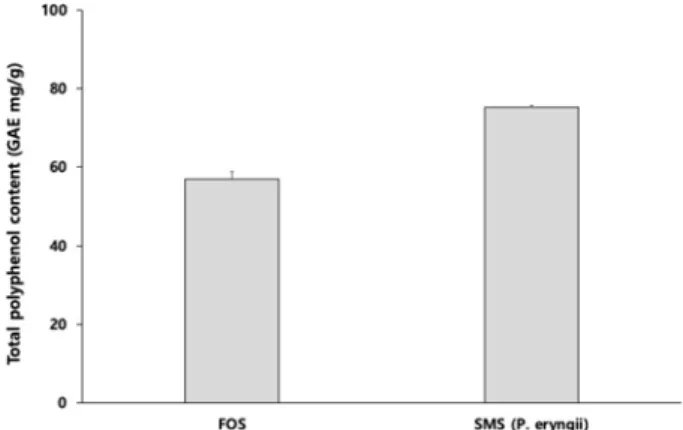
참나무톱밥과 큰느타리버섯수확후배지를 각각 식이한 흰점박이꽃무지 유충의 총 폴리페놀 함량은 Fig. 1에 나 타내었다. 곤충의 외부 외표피층에는 지질체에서 합성되 는 폴리페놀을 다량 함유한 다가 페놀층이 존재하며(Choi et al., 2019) 다양한 구조와 분자량을 가지고 있는 페놀성 화합물인 폴리페놀은 phenolic hydroxyl (-OH)기가 단백 질과 같은 거대분자와 결합하여 항산화 및 항암, 항균 등 의 다양한 생리활성을 나타낸다(Rice-Evans et al., 1997).
참나무톱밥과 큰느타리버섯수확후배지를 각각 식이한 흰점 박이꽃무지 유충의 총 폴리페놀 함량은 각각 57.02±1.73 mg GAE/g과 75.33±0.43 mg GAE/g으로 참나무톱밥을 식이한 흰점박이꽃무지 유충 추출물에 비해 큰느타리버섯 수확후배지을 식이한 흰점박이꽃무지 유충 추출물의 폴리
페놀 함량이 더 높게 나타났다(Fig. 1). 흰점박이꽃무지 유충의 가공 전 먹이 종류에 따른 영양성분 변화에 관한 Noh et al.(2015)의 보고에서는 흰점박이꽃무지 유충의 절식군과 다양한 대체 먹이를 급여한 군 사이에서 페놀함 량의 유의적 차이가 존재한다고 보고하였지만 산양삼을 급여한 흰점박이꽃무지 유충의 품질 및 항산화 활성 평가 에 관한 Choi et al.(2019)의 보고에서는 일반 흰점박이꽃 무지 유충과 산양삼을 급여한 흰점박이꽃무지 유충 사이 에서 페놀함량의 유의적 차이는 없었다고 보고하였다. 따 라서 다양한 대체 먹이 급여에 따른 흰점박이꽃무지 유충 의 페놀함량에 관한 추가적인 연구가 필요하다.
플라본 구조의 노란색 식물 색소를 총칭하는 플라보노 이드는 안토시아닌, 플라보놀, 플라본, 카테킨, 플라바논 등 으로 구성되어 있으며 그 구조에 따라 항산화, 에스트로겐, 항암 효과 등 다양한 생리활성을 나타내며(Middleton and Kandaswami, 1994; Kim et al., 2010; Choi et al., 2013;
Kim et al., 2013). 참나무톱밥과 큰느타리버섯수확후배지 를 각각 식이한 흰점박이꽃무지 유충 추출물의 플라보노 이드 함량은 각각 24.6±0.28 mg/g과 25.4±0.75 mg/g으로 두 시료간에 유의적 차이가 나타나지는 않았다(Fig. 2).
흰점박이꽃무지 유충의 가공 전 먹이 종류에 따른 영양성 분 변화에 관한 Noh et al.(2015)의 보고에서는 쌀겨와 호 박 식이군의 플라보노이드 함량이 다른 식이군에 비해 높 게 나타났다.
흰점박이꽃무지 유충 추출물의 DPPH 라디칼소거 활성 참나무톱밥과 큰느타리버섯수확후배지를 각각 식이한 흰점박이꽃무지 유충 추출물의 항산화 활성은 DPPH에 의한 라디칼소거 활성을 측정하여 확인하였다(Fig. 3).
DPPH 라디칼은 항산화물질이 수소 원자나 전자를 공여
할 수 있는 능력을 평가할 때 사용되며 항산화 물질은 자 유라디칼에 전자를 공여하여 라디칼의 공유결합을 증가시 키는 전자공여능이 높을수록 인체 내에서 활성산소에 의 한 노화를 효과적으로 억제할 수 있다(Cha, 2009). 참나 무톱밥과 큰느타리버섯수확후배지를 각각 식이한 흰점박 이꽃무지 유충 추출물의 DPPH 라디칼 소거능은 추출물 의 농도가 증가할수록 증가하는 경향을 나타내었다. 참나 무톱밥을 식이한 흰점박이꽃무지 유충에 비해 큰느타리버 섯수확후배지를 식이한 흰점박이꽃무지 유충 추출물의 DPPH 라디칼 소거능이 우수하였으며 32 mg/ml 이상의 농도에서는 두 시료 간의 유의적 차이가 나타나지 않았다.
흰점박이꽃무지 유충의 가공 전 먹이 종류에 따른 영양성 분 변화에 관한 Noh et al.(2015)의 보고에서는 쌀겨 식이 Fig. 1. Total polyphenolic contents of Protaetia brevitarsis
larvae extracts dietary with fermented oak sawdust (FOS) and spent mushroom substrates (SMS, P. eryngii). Values are expressed as mean±SD (n=3), Values with different superscript letters are significantly different at p<0.05 by Duncan’s multiple range test.
Fig. 2. Total flavonoid contents of Protaetia brevitarsis larvae extracts dietary with fermented oak sawdust (FOS) and spent mushroom substrates (SMS, P. eryngii). Values are expressed as mean±SD (n=3), Values with different superscript letters are significantly different at p<0.05 by Duncan’s multiple range test.
Fig. 3. DPPH-radical scavenging activity of Protaetia brevitarsis larvae extracts dietary with fermented oak sawdust (FOS) and spent mushroom substrates (SMS, P. eryngii).
Values are expressed as mean±SD (n=3), Values with different superscript letters are significantly different at p<0.05 by Duncan’s multiple range test.
군의 DPPH 라디칼 소거활성이 다른 식이군에 비해 높게 나타났으며 배변기간 동안 먹이에 따라 DPPH 라디칼 소 거활성이 차이가 있다고 보고하였다. Park et al.(2005)은 약용곤충 추출물 라이브러리를 이용한 항산화 활성의 초 고속 검색에 관한 보고에서 약용곤충의 종류에 따라 항산 화활성에 차이가 있다고 보고하였다.
흰점박이꽃무지 유충 추출물의 환원력
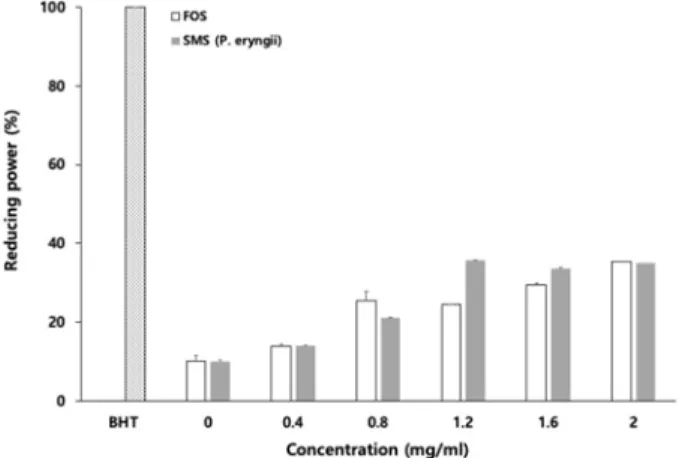
환원력은 산화를 일으킨 후 반응을 정지시키고 FeCl3를 첨가하여 Fe3+이 Fe2+로 환원되는 반응을 이용한 것으로 이때 Fe2+의 농도로 시료의 환원력을 측정할 수 있으며, 흡광도 수치 그 자체로 환원력을 나타내므로 환원력이 우 수할수록 흡광도 수치가 크며 진하게 발색되는 것으로 알 려져 있다(Chung, 2010). 참나무톱밥과 큰느타리버섯수확 후배지를 각각 식이한 흰점박이꽃무지 유충 추출물의 농 도별 환원력은 Fig. 4와 같이 시료 추출물의 농도가 높을 수록 환원력은 증가하였으나 시료 간의 유의적인 차이는 보이지 않았다.
흰점박이꽃무지 유충 추출물의 Oxygen radical absorbance capacity (ORAC)
수소전자의 전달이론을 바탕으로 radical chain breaking antioxidant capacity를 측정하는 ORAC 지수는 친수성 및 소수성 성분 모두에 반응하기 때문에 응용범위가 넓다는 장점을 가지고 있다(Makato, 1986; Matsuzawa et al., 1998; Kim et al., 2016). 참나무톱밥과 큰느타리버섯수확 후배지를 각각 식이한 흰점박이꽃무지 추출물의 ORAC 지수는 Trolox equivalents (TE)로 구했으며 Fig. 5와 같 다. 참나무톱밥과 큰느타리버섯수확후배지를 각각 식이한
흰점박이꽃무지 추출물의 ORAC 지수는 각각 66.55
±0.99 uM TE/g과 76.32±0.48 uM TE/g로 참나무톱밥을 식이한 흰점박이꽃무지 유충 추출물에 비해 큰느타리버섯 수확후배지를 식이한 흰점박이꽃무지 추출물의 ORAC 지수가 높게 나타났다(Fig. 5).
RAW 264.7 세포에 대한 흰점박이꽃무지 유충 추출물의 세포독성
RAW 264.7 세포에 대한 흰점박이꽃무지 추출물의 세 포 독성은 RAW 264.7 세포에 2-64 mg/ml의 농도로 추 출물을 처리한 다음 WST-1 assay를 이용하여 조사하였다.
참나무톱밥 식이 흰점박이꽃무지 유충과 큰느타리버섯수 확후배지 식이 흰점박이꽃무지 추출물을 각각 0, 2, 4, 8, 16, 32, 64 mg/ml의 농도로 처리하였을 때 RAW 264.7 세포는 90% 이상의 생존율을 나타내었으므로 참나무톱밥 과 큰느타리버섯수확후배지를 각각 식이한 흰점박이꽃무 지 추출물은 RAW 264.7 세포에 독성을 나타내지 않는 것으로 판단된다(Fig. 6).
적 요
본 연구에서는 기능성 식품원료로써 흰점박이꽃무지 유 충의 이용 가능성과 흰점박이꽃무지 유충 사료자원으로써 큰느타리버섯수확후배지의 이용 가능성을 조사하기 위해서 참나무톱밥과 큰느타리수확후배지를 각각 식이한 흰점박이 꽃무지 유충 추출물의 항산화 활성을 비교하였다. 참나무톱 밥과 큰느타리수확후배지를 각각 식이한 흰점박이꽃무지 유충 추출물의 총 폴리페놀 함량은 각각 57.02±1.73 mg GAE/g과 75.33±0.43 mg GAE/g이었고 플라보노이드 함 량은 각각 24.6±0.28 mg/g과 25.4±0.75 mg/g이었다.
Fig. 4. Reducing power of Protaetia brevitarsis larvae extracts dietary with fermented oak sawdust (FOS) and spent mushroom substrates (SMS, P. eryngii). Values are expressed as mean±SD (n=5), values with different superscript letters are significantly different at p<0.05 by Duncan’s multiple range test.
Fig. 5. Oxygen radical absorbance capacity (ORAC) values of Protaetia brevitarsis larvae extracts dietary with fermented oak sawdust (FOS) and spent mushroom substrates (SMS, P.
eryngii). Values are expressed as mean±SD (n=5), values with different superscript letters are significantly different at p<0.05 by Duncan’s multiple range test.
DPPH에 의한 라디칼소거 활성은 추출물의 농도가 증가 할수록 증가하는 경향을 나타내었으나 참나무톱밥을 식이 한 흰점박이꽃무지 유충에 비해 큰느타리버섯수확후배지 를 식이한 흰점박이꽃무지 유충 추출물의 DPPH 라디칼 소거능이 우수하였으며 32 mg/ml 이상의 농도에서는 두 시료 간의 유의적 차이가 나타나지 않았다. 참나무톱밥과 큰느타리버섯수확후배지를 각각 식이한 흰점박이꽃무지 유충 추출물의 농도별 환원력도 추출물의 농도가 높을수 록 환원력은 증가하였으나 시료 간의 유의적인 차이는 보 이지 않았다. 참나무톱밥과 큰느타리버섯수확후배지를 식 이한 흰점박이꽃무지 유충 추출물의 ORAC 지수는 각각 66.55±0.99 uM TE/g과 76.32±0.48 uM TE/g로 참나무톱 밥을 식이한 흰점박이꽃무지 유충 추출물에 비해 큰느타 리버섯수확후배지를 식이한 흰점박이꽃무지 유충 추출물 의 ORAC 지수가 높게 나타났다. 참나무톱밥과 큰느타리 버섯수확후배지를 각각 식이한 흰점박이꽃무지 유충 추출 물을 각각 0, 2, 4, 8, 16, 32, 64 mg/ml의 농도로 처리하 였을 때 RAW 264.7 세포는 90% 이상의 생존율을 나타 내었으므로 참나무톱밥과 큰느타리버섯수확후배지를 각 각 식이한 흰점박이꽃무지 유충 추출물은 RAW 264.7 세 포에 독성을 나타내지 않는 것으로 판단된다.
감사의 글
본 연구는 농림부 농수산식품기술기획평가원(IPET)의 2018년도 고부가가치식품개발사업(과제번호 118088-1)에 의하여 수행된 결과의 일부이며 이에 감사드립니다.
REFERENCES
Aburjai T, Natsheh FM. 2003. Plants used in cosmetics. Phytother Res 17: 987-1000.
Aitken RJ, Bukingham D, Harkiss D. 1993. Use of xanthine oxidase free radical generating system to investigate the cytotoxic effect of reactive oxygen species on human spermatozoa. J Reprod Fertil 97: 441-450.
Baublis AJ, Lu C, Clydesdale FM, Decker EA. 2000. Potential of wheat-based breakfast cereals as a source of dietary antioxidants. J Am Coll Nutr 19: 308S-311S.
Blois MS. 1958. Antioxidant determination by the use of a stable free radical. Nature 181: 1199-1200.
Bukkens SGF. 1996. The nutritional value of edible insects. Ecol Food Nutr 36: 287-319.
Cao G, Alessio HM, Cutler RG. 1993. Oxygen-radical absorbance capacity assay for antioxidants. Free Radic Biol Med 14: 303- 311.
Cha JY. 2009. Functional components and biological activities of marketing black garlic. MS Thesis. Gyeongsang National University, Jinju, Korea.
Cho DH, Cho YM, Lee JI. 2003. Fruitbody formation of Cordyceps militaris in Allomyrina dichotoma Linnaeus. Korean J Plant Res 16: 1-7.
Choi KH, Nam HH, Choo BJ. 2013. Effect of five Korean native Taraxacum on antioxidant activity and nitric oxide production inhibitory activity. Korean J Med Crop Sci 21:
191-196.
Choi MH, Kim KH, Yook HS. 2019. Antioxidant activity and quality evaluation of the larvae of Protaetia brevitarsis after feeding with Korean Panax ginseng. J Korean Soc Food Sci Nutr 48: 403-409.
Chung HJ. 2010. Antioxidative activities of different part extracts of Physalis alkekengi var. francheti (Winter Cherry). Korean J Food Preserv 17: 867-873.
Chung MY, Hwang JS, Goo TW, Yun EY. 2013. Analysis of general composition and harmful material of Protaetia brevitarsis. J Life Sci 23: 664-668.
Droge W. 2001. Free radicals in the physiological control of cell function. Physiol Rev 82: 47-951.
Francoeur AM, Assalian A. 1996. Microcat: A novel cell proliferation and cytotoxicity assay based on WST-1.
Biochemica 3: 19-25.
Halliewell B, Gutterridge JM. 1990. Roles of free radicals and catalytic metal ions in human disease: an overview. In S.
Fleischer, & L. Packer, (ed.), Methods in Enzymology, Academic Press, New York, USA.
Hwang SY, Lee YG, Hwang SG, Lim HB, Kim YI, Jang KH, Byng HJ, Lee DW, Lee HC. 2001. Subchronic toxicity of Protaetia brevitarsis in rats. Kor Ori Med Physiol Pathol 15: 703-707.
Jin YW, Fook YC. 2009. Antioxidant properties of selected tropical wild edible mushrooms. J Food Compos Anal 22:
269-277.
Kang IJ, Kim HK, Chung CK, Kim SJ, Oh D. 2000. Effects of Protaetia orientalis (Gory et Perchlon) larva on the lipid metabolism in ethanol administered rats. J Korean Soc Food Sci Nutr 29: 479-484.
Kim DJ, Oh SK, Yoon MR, Chun AR, Hong HC, Lee JS, Kim YK.
2010. Antioxidant compounds and antioxidant activities of Fig. 6. Effects of Protaetia brevitarsis larvae extracts dietary
with fermented oak sawdust (FOS) and spent mushroom substrates (SMS, P. eryngii) on cell proliferation in RAW 264.7 cell. The RAW 264.7 cell was incubated for 24 hr in DMEM media with different concentration of FOS and SMS (P. eryngii) extract. The cell proliferation was determined using WST-1 assay. Values are expressed as mean±SD (n=3), Values with different superscript letters are significantly different at p<0.05 by Duncan’s multiple range test.
the 70% ethanol extracts from brown and milled rice by cultivar. J Korean Soc Food Sci Nutr 39: 467-473.
Kim HG, Kang KH. 2005. Bionomical characteristic of Protaetia brevitarsis. Korean J Appl Entomol 44: 139-144.
Kim HG, Kang KH. 2006. Imago’s flight and larval activities of Protaetia brevitarsis (Coleoptera: Scarabaedia) and Allomyrina dichotoma (Coleoptera: Dynastinae). Korean J Appl Entomol 45: 139-143.
Kim SC, Kwon HS, Kim CH, Kim HS, Lee CY, Cho SJ. 2016.
Comparison of Antioxidant Activities of Pileus and Stipe from White Beech Mushrooms (Hypsizygus marmoreus). J Life Sci 26: 928-935.
Lee HC, Hwang SY, Hwang SG, Jeon BH, Lee DW. 2001. Acute toxicity of Protaetia brevitarsis homogenate in rats. Kor Ori Med Physiol Pathol 15: 543-547.?
Lee SU, Kim JW, Bae SM, Hwang YH, Lee BJ, Honh KP, Park CG. 2018. Evaluation of spent mushroom substrates as food for white-spotted flower chafer, Protaetia brevitarsis seulensis (Cleoptera: Cetoniidae). Korean J Appl Entomol 57: 97-104.
Makato O. 1986. Studies on products of browning reaction:
antioxidative activities of products of browning reaction prepared from glucosamine. Jap J Nutr 44: 307-315.
Matsuzawa T, Sano M, Tomita I, Saitoh H, Ohkawa M, Ikekawa T. 1998. Studies on antioxidants of Hypsizygus marmoreus. II.
Effects of Hypsizygus marmoreus for antioxidants activities of
tumor-bearing mice. Yakugaku Zasshi 118: 476-481.
Middleton E, Kandaswami C. 1994. Potential health-promoting properties of citrus flavonoids. Food Technol 48: 115-119.
Noh CW, Jeon SH, Son D, Cho YS, Lee BJ. 2015. Changes of nutritive component with before processing feeding type for larva of Protaetia brevitarsis. J Korean Soc Int Agric 27: 675- 681.
Park JY, Heo JC, An SM, Yun EY, Han SM, Hwang JS, Kang SW, Yun CY, Lee SH. 2005. High throughput-compatible screening of anti-oxidative substances by insect extract library. Korean J Food Preserv 12: 482-488.
Rice-Evans C, Miller N, Paganga G. 1997. Antioxidant properties of phenolic compounds. Trends Plant Sci 2: 152-159.
Singleton VL. 1981. Naturally occurring food toxicants: phenolic substances of plant origin common in foods. Adv Food Res 27: 149-242.
Verckei A, Toncsev H, Feher J, Hajdu E. 1992. Relationship between the extent of coronary artery disease and indicators of free radical activity. Clin Cardiol 15: 706-707.
Yoon WJ, Lee JA, Kim JY, Kim SB, Park SY. 2007. Antioxidant activity and physiological function of the Anomala albopilosa extracts. J Korean Soc Food Sci Nutr 36: 670-677.
Zhishen J, Mengcheng T, Jianming W. 1998. The determination of flavonoid contents in mulberry and their scavenging effects on superoxide radicals. Food Chem 64: 555-559.