1. INTRODUCTION
Image contrast enhancement methods are wide- ly used in many fields, such as medical imaging, satellite imaging, consumer electronics, digital TV, digital cameras, and so forth. Many methods have been introduced for image enhancement, among which histogram equalization is the most com- monly used due to its effectiveness and simplicity.
Global histogram equalization (GHE) transforms the result image to ensure a uniform distribution of gray levels [1]. This method flattens and stretches the dynamic range of the image’s histo- gram, which results in overall contrast improve- ment [2-6]. Essentially, GHE maps the gray levels in the enhanced image through a transformation function that depends on the distribution of gray
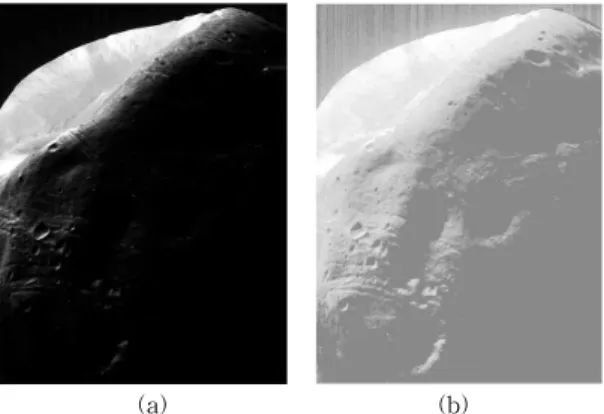
levels in the input image. This transformation function stretches the contrast of the high histo- gram region and compresses the contrast of the low histogram region. GHE achieves com- paratively better performance on almost all types of image [7]. However, it changes the original im- age’s brightness, while reducing the quality of the original image and in some cases causes a washout effect (Fig. 1).
To overcome the washout effect, brightness- preserving extensions of GHE have been devel- oped, such as brightness-preserving bi-histogram equalization (BBHE) [8], dualistic sub-image his- togram equalization (DSIHE) [9], and minimum mean brightness error bi-histogram equalization (MMBEBHE) [10]. These methods partition the histogram of the original image into sub-histo-
A Novel Filtered Bi-Histogram Equalization Method
Nyamlkhagva Sengee
†, Heung-Kook Choi
††ABSTRACT
Here, we present a new framework for histogram equalization in which both local and global contrasts are enhanced using neighborhood metrics. When checking neighborhood information, filters can simultaneously improve image quality. Filters are chosen depending on image properties, such as noise removal and smoothing. Our experimental results confirmed that this does not increase the computational cost because the filtering process is done by our proposed arrangement of making the histogram while checking neighborhood metrics simultaneously. If the two methods, i.e., histogram equalization and filtering, are performed sequentially, the first method uses the original image data and next method uses the data altered by the first. With combined histogram equalization and filtering, the original data can be used for both methods. The proposed method is fully automated and any spatial neighborhood filter type and size can be used. Our experiments confirmed that the proposed method is more effective than other similar techniques reported previously.
Key words: Bi-histogram Equalization, Neighborhood Metric, Contrast Enhancement, Flat Histogram
※ Corresponding Author : Heung Kook Choi, Address:
(621-749) Injero 197, Gimhae, Gyeongnam, Korea , TEL : +82-55-320-3437, FAX : +82-55-322-3107, E-mail : [email protected]
Receipt date : Oct. 6, 2013, Revision date : Apr. 10, 2015 Approval date : Apr. 30, 2015
†
Dept. of Information and Computer Science, National University of Mongolia, Mongolia
(E-mail : [email protected])
††