친환경 유기 농자재의 고추 탄저병(Colletotrichum acutatum) 병원균의 생장 억제 효과
곽영기1·김일섭1·조명철2·이성찬2·김수2*
1강원대학교, 2국립원예특작과학원
Growth Inhibition Effect of Environment-friendly Farm Materials in Colletotrichum acutatum In Vitro
Young-Ki Kwak1, Il-Seop Kim1, Myeong-Cheoul Cho2, Seong-Chan Lee2, and Su Kim2*
1Kangwon National University, Chuncheon 200-701, Korea
2National Institute of Horticultural & Herbal Science, Rural Development Administration, Suwon 441-440, Korea
Abstract. Inhibition effects on spore germination and mycelia growth for pepper anthracnose fungi (Col- lectricum acutatum) were investigated in vitro using eco-friendly agricultural materials as well as eco- friendly pesticides. The inhibition effect on mycelia growth of anthracnose fungi is the highest when the anthracnose mycelia were treated with a pesticide (commercial name: Koreayeok) that contains a mixture of Bacillus subtilis and Panibacillus polymyxa, resulting in 100% inhibition of the mycelia growth. Mean- while, the range of 20~40% inhibition effects on the growth of anthracnose mycelia was observed with other commercial agricultural materials. The significant inhibition effects on spore formation of anthracnose fun- gus were shown in vitro with two water dispersible pesticides containing sulfur [BTB (100%) and Sul- furStar (95.1%)], Koreayeok (95.0%), Borstar (99.0%) containing Bordeaux mixture, and Jihabudea-KM containing Psedomonas spp. (96.1%), respectively. Taken from these in vitro results of inhibiting of the spore germination and mycelia growth together, Koreayeok is the most effective on control of pepper anthra- cnose disease in vitro. In addition, two water dispersible pesticides containing sulfur (BTB and SulfurStar) and Borstar (99.0%) containing Bordeaux mixture are also significantly applicable to prevent pepper plants from anthracnose disease in vitro. It remains to be determined whether the selected eco-friendly agricultural materials in effective control of anthracnose in vitro can be used to control pepper anthracnose in field.
Key words : anthracnose fungi, Bacillus subtilis, Bordeaux mixture, mycelia growth Sulfur, Panibacillus polymyxa
서 론
고추(Capsichum annuum)는 장기간 재배하는 특성 으로 인하여 병해충에 의한 생산량 감소와 품질저하가 많은 작물이다(Cho et al., 2005). 그 중 역병은 저항 성 품종의 보급으로 피해가 감소하고 있어 가장 심각 한 피해를 주는 병해는 탄저병이다(Jee et al., 2010).
무농약이나 유기농 재배농가에서는 탄저병의 포장 발 병율이 90%를 넘어 수확을 거의 하지 못하는 경우도
있다(Kwon and Lee, 2002). 따라서 2000년 이후 역 병 저항성 품종의 보급으로 피해가 경감되고 있는 예 (Jee et al., 2010)와 같이 병해관리는 저항성 품종을 재배하는 것이 시간과 노력, 환경친화적인 면에서 가장 효과적이라고 할 수 있다. 그러나 세계적으로 가장 많 이 재배하고 있는 C. annuum 종 내에서는 아직 저 항성 유전자원이 발견되지 않고 있다(Kim et al., 2010). 근연종인 C. baccatum에서 저항성이 가장 강 한 것으로 보고되고 있으나(AVRDC, 1999; Berke et al., 1999; Hadden et al., 1989), 후대진전의 문제점 으로 저항성 유전자의 도입에 어려움이 있다(Kim et
al., 2010). 따라서 약제에 의한 방제가 주로 이루어지
*Corresponding author: [email protected]
*Received January 30, 2012; Revised February 16, 2012;
*Accepted February 23, 2012
고 있다. 현재 약제방제는 친환경방제와 화학농약을 이용하는 방법으로 나눌 수 있다. 그 중 화학농약은 생태파괴와 같은 문제점(Yin, 2007)과 Colletotrichum autatum의 약제에 대한 내성 등으로 인하여 방제에 어려움이 있다(Kim et al., 2008). 또한 치료를 위한 방제 보다는 예방적인 방제가 강조 병해관리체계에서 지속적인 화학농약의 처리가 요구되고 있다. 따라서 계속적인 방제가 이루어져야 하는 현재의 방제 방법과 관련하여 고추 탄저병의 환경친화적 방제를 위해 친환 경 방제제를 사용하는 것이 가장 적당한 대책이라고 할 수 있다. 국내에서는 친환경육성법에 따라 2011년 10월 현재 1363종이 고시되어 있다(RDA, 2011). 이 들 중 병해방제용 제제는 170종이며, 미생물제제는 47종으로 Bacillus속 미생물이 22종이며, Bacillus속 미생물 제제 중 Bacillus subtilis는 15종이 이용되고 있다. 그 외 유황제는 20종, 식물추출물제 40종, 광물 질을 비롯한 제제가 37종으로 고시되어 있다. 병해 별로 살펴보면 흰가루병이 65종으로 가장 많고 고추 탄저병을 대상으로 하는 제제는 7종이 고시되어 고추 탄저병의 심각한 피해에 비하여 사용 가능한 제제는 미미하다. 제제의 검정방법에 대해서 Choi et al.
(2006)은 13종 농약원제의 고추 탄저병 살균효과 실 험에서 in vitro 살균 활성인 포자 발아 억제효과와 균사생장 억제효과는 각각 in vivo 살균 활성의 예방
효과와 치료효과와 관련이 있다고 하였다. 따라서 본 연구는 12종 친환경 유기농자재의 포자 발아 억제, 균사생장억제를 기내에서 검정하여 고추 탄저병 방제 에 효과적인 주성분을 선발하여 친환경 방제제 개발과 방제 시 제제 선택을 위한 기초 자료로 활용하고자 한다.
재료 및 방법
1. 병원균 및 친환경 유기농자재
친환경방제제의 고추 탄저병 병원균에 대한 생장억 제 효과를 검정하기 위해 사용한 병원균은 농촌진흥청 국립원예특작학원 원예특작환경과의 Colletotrichum acutatum isolate 11-194를 이용하였다. 실험에 사용한 균주는 감자한천배지(PDA; Difco, USA)에 접종하여
28oC에서 10일간 배양 후 접종원으로 사용하였다. 고
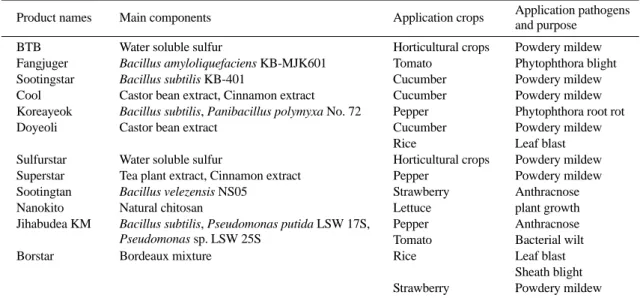
추 탄저병 생장억제에 효과적인 주성분을 선발하기 위 해 공시한 친환경 제제는 수용성 유기황제2종(‘BTB’,
‘황스타’)과 B.subtilis와 다른 길항균 혼용제 2종(‘고려 역’, ‘지하부대 KM’), 피마자추출물(‘도열이’), 피마자 추출물과 계피추출물혼용 (‘쿨’), 차나무추출물과 계피 추출물 혼용(‘슈퍼스타’), Bacillus속 2종(‘팡주거’, ‘슈 팅탄’), B. subtilis 단용(‘슈팅탄’), 보르도액(‘보르스타’), 키토산제(‘나노키토’)이다(Table 1).
Table 1. The list of 12 environment-friendly farm materials in this study.
Product names Main components Application crops Application pathogens
and purpose
BTB Water soluble sulfur Horticultural crops Powdery mildew
Fangjuger Bacillus amyloliquefaciens KB-MJK601 Tomato Phytophthora blight
Sootingstar Bacillus subtilis KB-401 Cucumber Powdery mildew
Cool Castor bean extract, Cinnamon extract Cucumber Powdery mildew
Koreayeok Bacillus subtilis, Panibacillus polymyxa No. 72 Pepper Phytophthora root rot
Doyeoli Castor bean extract Cucumber Powdery mildew
Rice Leaf blast
Sulfurstar Water soluble sulfur Horticultural crops Powdery mildew
Superstar Tea plant extract, Cinnamon extract Pepper Powdery mildew
Sootingtan Bacillus velezensis NS05 Strawberry Anthracnose
Nanokito Natural chitosan Lettuce plant growth
Jihabudea KM Bacillus subtilis, Pseudomonas putida LSW 17S, Pseudomonas sp. LSW 25S
Pepper Anthracnose
Tomato Bacterial wilt
Borstar Bordeaux mixture Rice Leaf blast
Sheath blight Strawberry Powdery mildew This table is contents that suggested a manufacturing company.
2. 균사생장 억제효과 기내 검정
평판배지 상에서 균사생장억제 효과를 검정하기 위 한 배지조제는 멸균한 PDA를 50~60oC로 식힌 다음, 각 자재의 권장 희석배수에 따라 50ml BD Falcon conical tube(USA)에서 혼합하여 90 × 15mm petri dish(SPL life science, Korea)에 분주하였다. 배양한 균주의 선단부위를 5mm cork borer를 이용하여 자른 다음 제제가 혼합된 배지 중앙에 치상하였다. 실험은 각각의 제제 당 3반복으로 실시하고, 28oC에서 10일 경과 후 균사의 직경을 측정하였다. 균사생장억제율은 Choi et al.(2006)의 연구와 같이 제제를 처리하지 않 은 PDA 배지에서 자란 탄저병 균사의 직경에 대한 제제의 균사직경의 비율을 계산하였으며 다음과 같다.
균사생장억제율(%) = (1 − 처리구의 균사직경/무처리구 의 균사직경) × 100
3. 포자발아 억제효과 기내검정
친환경제제의 고추 탄저병 포자발아 억제 효과를 검 정하기 위해 PDA 배지에서 수거한 포자를 제제별 권 장 희석배수에 최종 농도: 1 × 10⁴conidia/ml로 하여 희석하였다. 대조구는 멸균수를 이용하였다. 포자현탁 액은 멸균한 hole slide glass에 각각 50µl씩 분주하 였다. 실험은 제제 당 3반복으로 실시하였고, hole slide glass를 습도가 유지되는 상자에 넣어 28oC 항 온기에서 24시간 포자발아를 유도하였다. 포자발아 조 사는 Choi et al.(2006)의 방법에 따라 광학현미경 하 에서 발아관의 길이가 포자 장경의 1/2 이상인 것을 발아한 것으로 간주하여 반복별 100개의 포자에 대한 발아 유무를 조사하였다. 포자발아 억제율 계산은 제제 를 처리하지 않은 처리의 발아율에 대한 제제의 발아
율의 비율을 계산하였으며 다음과 같다. 포자발아억제 율(%) = (1 − 처리구의 발아율/무처리구의 발아율) × 100
결과 및 고찰
1. 균사생장 억제효과 기내검정
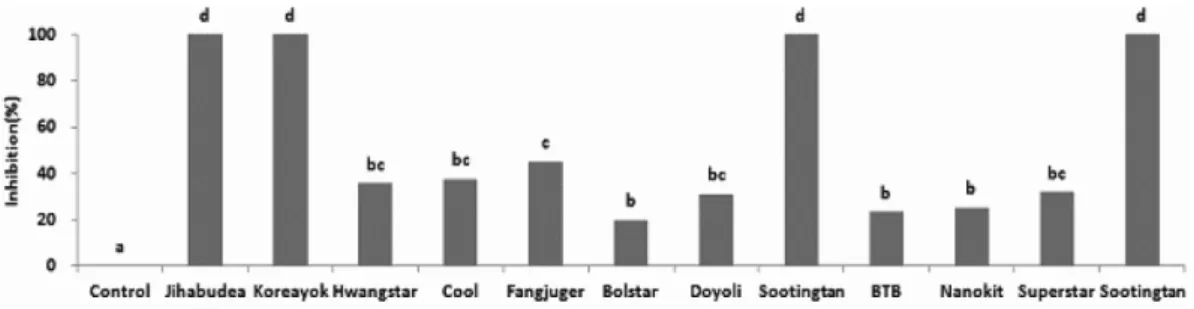
친환경 유기농자재를 이용하여 고추 탄저병균의 균 사생장억제 효과를 검정하였다. 그 결과 Fig. 1에서와 같이 ‘고려역’, ‘슈팅탄’, ‘슈팅스타³’, ‘지하부대 KM’
이 모두 100%의 균사생장억제효과를 나타내었다. 그 외 제제인 유황제(‘BTB’, ‘황스타’), 식물추출물(‘쿨’,
‘도열이’, ‘슈퍼스타’), 보르도액(‘보르스타’) 20~40%의 범위에서 균사생장 억제효과를 나타내었다. 제제의 성 분별로 보면 Bacillus subtilis를 주성분으로 한 제제들 (‘고려역’, ‘슈팅탄’, ‘슈팅스타’, ‘지하부대 KM’)이 고추 탄저병균의 균사생장억제에 효과적인 것으로 나타났으 며, ‘지하부대 KM’은 Bacillus subtilis, Pseudomonas putida, Pseudomonas sp.의 혼용제로 Bacillus subtilis 만 이용한 제제의 결과와 동일한 결과를 보였다. 한편 동일한 Bacillus속 미생물인 Bacillus amyloliquefaciens
KB-MJK601(‘팡주거’)는 토마토의 잎마름병에 대한 제
제로 고추 탄저병균의 균사생장억제효과는 50%로 Bacillus subtilis종에 비해 낮은 균사생장 억제율을 보 였다.
Bacillus subtilis와 같은 유용미생물은 용균작용, 항생 작용, 경쟁적 길항작용을 포함한 어떠한 작용들에 의하 여 식물병원균의 생장을 억제한다(Watanabe et al., 1990; Leoffler et al., 1986; Paulitz et al., 1991). 그 리고 균사생장효과의 기내 검정은 제제의 치료효과에
Fig. 1. Inhibitory effect of various environment-friendly farm materials against mycelial growth of Colletotrichum acutatum.
5% level by DMRT.
대한 가능성을 검정하는 방법(Choi et al., 2006)으로 본 연구에서 공시한 제제들만으로 단정 할 수는 없으나 Lee et al.(2011)은 Bacillus subtilis S54 균주가 고추 탄저병과 역병을 in vitro와 in vivo 조건에서 모두 병 원균을 억제하는 것으로 보고하였다. 고시된 47종의 미 생물제제 중에 B. subtilis는 15종이 흰가루병, 역병, 잎 곰팡이 등의 곰팡이 병의 생장 억제에 효과적인 것을
알 수 있다. 따라서 Bacillus subtilis는 고추 탄저병균 의 균사 생장 억제의 효과적인 길항 미생물로 인정되었 다. 다음으로 길항 미생물을 선발하기 위해 일반적으로 대치배양방법(Yoshida et al., 2001)을 사용하고 있으나, 기성제품에 대한 평가는 본 연구에서 사용한 배지 내에 제제를 포함한 방법에 의한 병원균의 균사생장 억제효 과를 판단하기에 충분하리라고 생각한다.
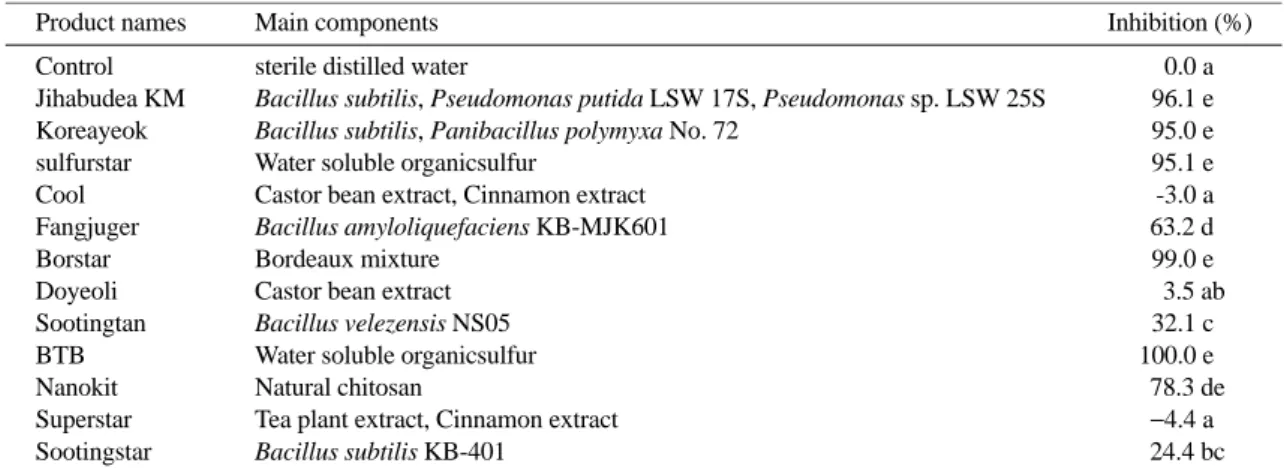
Table 2. Spore germination inhibition of C. acutatum against 12 environment-friendly farm materials.
Product names Main components Inhibition (%)
Control sterile distilled water 0.0 ac
Jihabudea KM Bacillus subtilis, Pseudomonas putida LSW 17S, Pseudomonas sp. LSW 25S 96.1 ec
Koreayeok Bacillus subtilis, Panibacillus polymyxa No. 72 95.0 ec
sulfurstar Water soluble organicsulfur 95.1 ec
Cool Castor bean extract, Cinnamon extract -3.0 ac
Fangjuger Bacillus amyloliquefaciens KB-MJK601 63.2 dc
Borstar Bordeaux mixture 99.0 ec
Doyeoli Castor bean extract 3.5 ab
Sootingtan Bacillus velezensis NS05 32.1 cc
BTB Water soluble organicsulfur 100.0 ec
Nanokit Natural chitosan 78.3 de
Superstar Tea plant extract, Cinnamon extract −4.4 ac
Sootingstar Bacillus subtilis KB-401 24.4 bc
5% level by DMRT.
Fig. 2. Inhibition of spore germination of C. acutatum against 12 environment-friendly farm materials (Control; DW, Koreayeok; A, Nanokit; B, Doyeoli; C, Borstar; D, Sootingstar; E, Sootingtan; F, Superstar; G, Jihabudea KM; H, Cool; I, Fangjuger; J, sulfurstar; K and BTB; L).
2. 포자발아 억제효과 기내검정
C. acutatum은 분생포자나 균사조각, 흡착기 등의 다양한 형태로 식물조직 속에서 수년간 생존하며, 전파 와 침입의 가장 중요한 1차 전염원은 분생포자로 알려 져 있다(Nair et al., 1983) 따라서 포자발아 억제는 고추 탄저병 방제에 중요한 요소이다. 포자발아억제는 BTB(100%), ‘황스타’(95.1%), ‘고려역’(95.0%), ‘보르 스타’(99.0%), ‘지하부대 KM’(96.1%)이 효과적인 것 으로 나타났다. 이들 제제는 수용성 유기황(BTB, 황스 타), 보르도액(보르스타), Bacillus subtilis, Panibacillus polymyxa 혼용제(‘고려역’), Bacillus subtilis, Pseu- domonas putida, Pseudomonas sp. 혼용(‘지하부대 KM’)제이다(Table 2 and Fig. 2). 식물추출물제제인
‘도열이’(피마자추출물), ‘쿨’(피마자추출물, 계피추출물),
‘슈퍼스타’(차나무추출물, 계피추출물)는 각각 3.5%,
−3.0%, −4.4%로 낮은 효과를 보였다. ‘쿨’과 ‘슈퍼스 타’는 멸균수의 발아율보다 높게 나타나 포자발아를 조장하는 것으로 나타났다. 한편 Bacillus subtilis를 주성분으로 하는 제제가 균사생장 억제에는 상당한 효과를 보이지만 ‘슈팅탄’(32.1%)과 ‘슈팅스타’(24.4%) 는 Bacillus subtilis, Paenibacillus polymyxa 혼용제 (‘고려역’)와 Bacillus subtilis, Pseudomonas putida, Pseudomonas sp. 혼용(‘지하부대 KM’)제에 비해 상 당히 낮은 포자 발아 억제율을 보였다. Bacillus속을
주성분으로 하는 ‘팡주거’(Bacillus amyloliquefaciens) 는 78.3%의 다소 높은 포자 발아 억제효과를 보였다.
다음으로 포자발아 억제 실험 중 부착기가 형성된 제 제는 ‘슈퍼스타’, ‘지하부대 KM’, ‘나노키토’, ‘쿨’,
‘팡주거’, ‘슈팅탄’, ‘슈팅스타’가 관찰되었으며, 발아한 포자가 있는 제제 중에서는 ‘고려역’, ‘도열이’, ‘보르 스타’, ‘황스타’는 부착기가 관찰되지 않았다(Fig. 3).
따라서 고추 탄저병 발아억제에 효과적인 제제로는 수용성유기황제(‘BTB’, ‘황스타’), Bacillus subtilis, Panibacillus polymyxa 혼용제(‘고려역’)로 나타났다.
3. 고추 탄저병 친환경방제 자재 선택
본 연구의 결과, Bacillus subtilis는 고추 탄저병균 의 균사 생장 억제의 효과적인 길항 미생물로 나타났 으며, 수용성유황제(‘BTB’, ‘황스타’), Bacillus subtilis Paenibacillus polymyxa 혼용제(‘고려역’)는 포자발아 억제와 부착기 형성 억제에 효과적인 것으로 나타났다.
Bacillus속 세균은 식물을 위한 생물농약을 개발에 많이
이용되고 있다(Pérez-García et al., 2011). 그 이유는 항균활성의 가능성이 있는 다양한 2차 대사산물을 생산 하기 때문이다(Krebs et al., 1998; Romero et al., 2007b; Wulff et al., 2002). Bacillus subtilis는 Iturin- like Lipopeptides를 생산하며 박과의 흰가루병과 Xanthomonas campestris pv. cucurbitae, Pectobacterium Fig. 3. Appresorium formation of C. acutatum against environment-friendly farm materials. (DW: Control, A; Superstar, B:
Jihabudea KM, C: Nanokit, D: Cool, E: Fangjuger, F: Sootingtan, G: Sootingstar).
carotovorum subsp. carotovorum에 대하여 항균활성을 나타낸다(Zeriouhet et al., 2011). Son et al.(2009)은 Paenibacillus polymyxa가 토마토의 Meloidogyne incognita와 Fusarium oxysporum f. sp. Lycopersici 의 생장억제효과가 있는 것으로 보고하였고, Haggag와 Timmusk(2007)는 땅콩의 Aspergillus niger에 의한 crown rot을 억제하는 것으로 보고하였다. Paenibacillus polymyxa가 Bacillus subtilis와 혼용된 제제가 균사생 장억제, 포자발아억제, 부착기형성억제에 효과적인 것 으로 나타나 Bacillus subtilis 단용인 제제의 낮은 억 제 효과를 보완하는 것으로 생각되었다. 하지만 Paenibacillus polymyxa의 단용처리 효과를 확인하여 야 혼용에 의한 시너지 효과인지, Paenibacillus polymyxa의 억제효과에 의한 것인지를 파악할 수 있 을 것이다. Pseudomonas속 세균은 생물학적 방제에 일반적으로 이용되며, 항생물질, 세포벽분해효소 생산, induced systemic resistance 등을 통해 식물 병원균의 생장을 저해하는 것으로 알려져 있다(Winding et al., 2004). 대표적으로 생산하는 항생물질은 2,4-diacetyl- phloroglucinol, pyoluteorin, pyrrolnitrin, phenazine- 1-carboxyclic acid 등이 생산되어, 생물적 방제에 이 용하고 있다(Raaijmakers et al., 1997). Seo et al.
(2008)은 Pseudomonas putida P84를 동정하여 토마토 풋마름병의 억제에 대하여 보고하였다. Vidhyasekaran et al.(1997)은 제형화 되지 않은 Psudomonas속의 생존 기간이 짧다고 하였으며, Seo et al.(2008)은 Pseudomonas putida P84 균주 처리의 경우 약 2주 후부터 방제효과가 떨어지기 시작하였다고 하였다. 식 물 병원균의 생장 억제는 기내 검정의 결과는 농약을 대신할 정도의 효과를 보이고 있지만 직접적인 방제에 서 기내에서의 효과를 보이지는 않고 있어 제형화 기 술 개발 등의 연구가 필요하다. 따라서 본 연구의 결 과 균사생장 억제와 포자 발아억제, 부착기 형성억제 결과를 고려하여 고추 탄저병 방제에 적용 가능한 친 환경 방제제는 Bacillus subtilis, Panibacillus polymyxa 혼용제(‘고려역’)가 가장 효과적인 것으로 판단되었으 며, 예방을 전제로 한 방제의 경우 유황 수화제, 보르 도액을 주성분으로 하는 제제를 적용 가능할 것으로 생각된다.
현재까지 고추 탄저병 방제는 화학농약에 의한 일관 된 방제를 실시한 것이 사실이다. 그러나 화학농약의
경우도 고추 탄저병을 방제하기 위해 예방이나 발병초 기를 강조하고 있다(Choi et al., 2006). 따라서 고추 탄저병의 방제는 지속적인 살포가 필요함으로 친환경 제제의 이용은 가장 합리적인 방법이라고 할 수 있다.
적 요
친환경 유기농자재를 이용하여 고추 탄저병균의 포 자 발아, 균사생장 억제효과를 기내에서 조사하였다.
그 결과 균사생장 억제효과 기내검정. 탄저병의 균사생 장 억제 효과는 Bacillus subtilis를 주성분으로 하는 제제가 100%의 억제효과를 보였으며, 그 외의 제제는
20~40%의 범위에서 억제효과를 나타내었다. 포자발아
억제효과는 유황 수화제 2종(‘BTB’, ‘황스타’)이 각각 100%, 95.1%, ‘고려역’(95.0%), ‘보르스타’(99.0%),
‘지하부대 KM’(96.1%) 순으로 나타났다. 균사생장 억 제와 포자 발아억제, 부착기 형성억제 결과를 고려하여 고추 탄저병 방제에 적용 가능한 친환경 방제제는 Bacillus subtilis, Panibacillus polymyxa 혼용제(‘고려 역’)가 가장 효과적인 것으로 판단되었으며, 예방을 전 제로 한 방제의 경우 유황 수화제, 보르도액을 주성분 으로 하는 제제가 적용 가능할 것으로 생각된다. 본 연구에서 선택된 제제는 고추 포장에서 탄저병 방제 효과가 최종적으로 인정되면 차후 고추 탄저병 방제에 이용될 것으로 사료된다.
주제어 : 균사생장, 보르도액, 유황, 탄저병균, Bacillus subtilis, Panibacillus polymyxa
인 용 문 헌
1. AVRDC. 1999. Off-season tomato, pepper and egg- plant.: AVRDC 1998. Progress Report. Taiwan.
2. Berke, T., L.L. Black, and C.A. Liu. 1999. Breeding for anthracnose and Phytophthora resistance in hot pepper (Capsicum annuum). J. Kor. Capsicum Res.
Coop. 5:1-15.
3. Cho, M.C., Y. Chae, Y.S. Cho, K.D. Ko, Y.A. Shin, D.H. Kim, and J.W. Jung. 2005. The result of new pepper varieties evaluation at farmer’s field. Korean J.
Hort. Sci. Technol. 23:38.
4. Choi, Y.H., H.T. Kim, J.C. Kim, K.S. Jang, K.Y. Cho, and G.J. Choi. 2006. In vitro antifungal activities of 13 fungicides against pepper anthracnose fungi. The Kor.
J. of Pesticide Sci. 10:36-42.
5. Hadden, J.F. and L.L. Black. 1989. Anthracnose of pepper caused by Colletotrichum spp. proceeding of the international symposium on integrated manage- ment practices: Tomato and pepper production in the tropics; Taiwan: Asian Vegetable Research and Devel- opment Centre. 189-199.
6. Haggag, W.M. and S. Timmusk. 2007. Colonization of peanut roots by biofilm-forming Paenibacillus poly- myxa initiates biocontrol against crown rot disease.
Journal of Applied Microbiology 104:961-969.
7. Jee, H.J., S.S. Shin, J.H. Lee, W.I. Kim, S.J. Hong, and Y.K. Kim. 2010. Conidial disperse of the pepper anthracnose fungus Colletotrichum acutatum and its density on infected fruits. Res. Plant Dis. 16:101-105.
8. Kim, S., K.T. Kim, D.H. Kim, E.Y. Yang, M.C. Cho, A. Jamal, Y. Chae, D.H. Pae, D.G. Oh, and J.K.
Hwang. 2010. Identification of quantitative trait loci associated with anthracnose resistance in chili pepper (Capsicum spp.). Kor. J. Hort. Sci. Technol. 28:1014- 1024.
9. Krebs, B., B. Höding, S. Kübart, M.A. Workie, H.
Junge, G. Schmiedeknecht, R. Grosch, H. Bochow, and M. Hevesi. 1998. Use of Bacillus subtilis as biological control agent. I. Activities and characterisation of Bacillus subtilis strains. J. Plant Dis. Prot. 105:181- 197.
10. Kwon, C.S. and S.G. Lee. 2002. Occurrence and eco- logical characteristics of red pepper anthracnose. Res.
Plant Dis. 8:120-123
11. Lee, G.W., M.J. Kim, J.S. Park, J.C. Chae, B.Y. Soh, J.E. Ju, and K.J. Lee. 2011. biological control of Phy- tophthora blight and anthracnose disease in red-pep- per using Bacillus subtilis S54. Res. Plant Dis. 17:86- 89.
12. Leoffler, W., J.S. Tschen, N. Venittanakom, M. Kugler, E. Knorpp, T.F. Hsieh, and T.G. Wu. 1986. Antifungal effects of bacilysin and fengycin from Bacillus subti- lis F-29-3: a comparison with activaties of other Bacil- lus antibiotics. J. Phytopathol. 115:204-213.
13. Paulitz, T.C. and J.E. Loper. 1991. Lack of a role for fluorescent siderophore production in the biological control of Phythium damping-off of cucumber by a strain of Pseudomonas putida. Phytopathology 81:
930-935.
14. Pérez-García, A., D. Romero, and A. de Vicente. 2011.
Plant protection and growth stimulation by microor- ganisms: Biotechnological applications of Bacilli in agriculture. Curr. Opin. Biotechnol. 22:187-193.
15. Raaijmakers, J.M., D.M. Weller, and L.S. Thomashow.
1997. Frequency of antibiotic-producing Pseudomonas
spp. In natural environments. Appl. Environ. Micro- biol. 63: 881-887.
16. RDA. 2011. Information of agricultural materials.
http://www.rda.go.kr/matEnvofood Detail.do.
17. Romero, D., A. de Vicente, R.H. Rakotoalay, S.E.
Dufour, J.-W. Veening, A. Arrebola, F.M. Cazorla, O.P. Kuipers, M. Paquot, and A. Pérez-García. 2007.
The iturin and fengycin families of lipopeptides are key factors in antagonism of Bacillus subtilis toward Podosphaera fusca. MPMI. 20:430-440.
18. Seo, S.T., J.H. Park, K.H. Kim, S.H. Lee, E.S. Oh, and S.C. Shin. 2008. Suppression of bacterial Wilt in tomato plant using Pseudomonas putida P84. Res.
Plant Dis. 14:32-36.
19. Son, S.H., Z. Khan, S.G. Kim, and Y.H. Kim. 2009.
Plant growth-promoting rhizobacteria, Paenibacillus polymyxa and Paenibacillus lentimorbus suppress dis- ease complex caused by root-knot nematode and fusar- ium wilt fungus. Journal of Applied Microbiology 107(2):524-532.
20. Vidhyasekaran, P., K. Sethuraman, K. Rajappan, and K. Vasumath. 1997. Powder formulations of Pseudomo- nas fluorescens to control pigeonpea wilt. Biol. Con- trol 8:166-171.
21. Watanabe, T., W. Oyanagi, K. Suzuki, and H. Tanaka.
1990. Chitinase system of Bacillus circulans WL-12 and importance of chitinase A1 in chitin degradation.
J. Bacteriol. 172:4017-4022.
22. Winding, A., S.J. Binnerup, and H. Pritchard. 2004.
Non-target effects of bacterial biological control agents suppressing root pathogenic fungi. FEMS Microbiol.
Ecol. 47:129-141.
23. Wulff, E.G., C.M. Mguni, K. Mansfeld-Giese, J. Fels, M. Lübeck, and J. Hockenhull. 2002. Biochemical and molecular characterization of Bacillus amyloliquefa- ciens, B. subtilis and B. pumilus isolates with distinct antagonistic potential against Xanthomonas campes- tris pv. campestris. Plant Pathol. 51:574-584.
24. Yin, J.F., W.H. Zhang, J.Q. Li, Y.H. Li, H.L. Hou, and X.Y. Zhou. 2007. Screening and antagonistic mecha- nism of biocontrol agents against Phytophthora blight of pepper. Acta Phytopathologica Sinica. 37:88-94.
25. Yoshida, S., S. Hiradate, T. Tsukamoto, K. Hatakeda, and A. Shirata. 2001. Antimicrobial activity of culture filtrate of Bacillus amyloliquefaciens RC-2 isolated from mulberry leaves. Phytopathology 91:181-187.
26. Zeriouh, H., D. Romero, L. García-Gutiérrez, F.M.
Cazorla, A. de Vicente, and A. Pérez-García. 2011.The Iturin-like Lipopeptides are essential components in the biological control arsenal of Bacillus subtilis against bacterial diseases of Cucurbits. MPMI 24:1540-1552.