1. 서 론
오스테나이트계 스테인리스강은 고온, 고압 등 가혹 한 환경에서의 우수한 내식성과 기계적 성질로 석유, 화학, 원자력 등 다양한 산업에서 널리 사용되고 있다
1) . 레이저 용접은 고속의 용접 속도와 짧은 공정 주기 로 생산성 향상, 열 영향부 및 열 변형 최소화를 확보 할 수 있어, 열팽창 계수가 크고 열 전도도가 비교적 낮은 오스테나이트계 스테인리스강의 용접 프로세스로 선호되고 있다 2-4) . 하지만 오스테나이트계 스테인리스
강의 용접 시에는 고온균열 (특히 응고균열) 이 빈번하 게 발생하므로 응고균열 발생 여부에 따라 용접부의 건 전성이 좌우될 수 있다 5) . 응고균열 은 소재의 야금학적 인자 (화학조성, 응고온도범위, 미세조직 등) 와 용접 시 응고 수축 및 열 팽창에 의한 열변형의 상호 작용에 의해 액상과 고상이 공존하는 mushy zone (고액공존 영역) 에서 발생한다. 응고균열 민감도는 균열이 발생 하는 임계 변형 값과 온도범위 (solidification brittle temperature range, BTR) 로 구성되는 고온 연성곡 선으로 정량 평가 되어 왔으며, 용접 기술의 발전으로 강의 화학 성분 및 종류에 따른 응고균열 민감도의 변
오스테나이트계 스테인리스강 레이저 용접부의 응고균열 거동 (Part 1)
-
레이저 용접용Varestraint
시험 시스템을 이용한 응고균열 민감도 평가-
천은준
*, †
․이수진*
․서 정*
․강남현**
․Kazuyoshi Saida***
* 한국기계연구원 부산레이저기술지원센터
** 부산대학교 재료공학부
*** Division of Materials and Manufacturing Science, Osaka University
Solidification Cracking Behavior in Austenitic Stainless Steel Laser Welds (Part 1)
- Evaluation of Solidification Cracking Susceptibility by Laser Beam Welding Varestraint Test -
Eun-Joon Chun*,
†, Su-Jin Lee*, Jeong Suh*, Namhyun Kang** and Kazuyoshi Saida****Busan Laser Application Support Center, Korea Institute of Machinery and Materials (KIMM), Busan 46744, Korea
**Department of Materials Science and Engineering, Pusan National University, Busan 46241, Korea
***Division of Materials and Manufacturing Science, Osaka University, Osaka 565-0871, Japan
†Corresponding author : [email protected]
(Received August 8, 2016 ; Revised September 12, 2016 ; Accepted October 5, 2016)
Abstract
In order to quantitatively evaluate the solidification cracking susceptibility in laser welds of three types of austenitic stainless steels (type 310: A mode, type 316-A: AF mode, type 316-B: FA mode solidifications), the laser beam welding (LBW) transverse-Varestraint tests consisted of multi-mode fiber laser, welding robot and hydraulic pressure system were performed. As the welding speed increased from 1.67 to 40.0 mm/s, the solidification brittle temperature range (BTR) of laser welds for type 316 stainless steels enlarged (316-A:
from 37 to 46 K, 316-B: from 14 to 40 K), while the BTR for type 310 stainless steel reduced from 146 to 120 K. In other words, it founds that solidification cracking susceptibility could not be simply mitigated through application of LBW process, and the BTR variation behavior is quite different upon solidification mode of austenitic stainless steels.
Key Words : Laser beam welding, Solidification cracking susceptibility, Varestraint test
ISSN 2466-2232
Online ISSN 2466-2100
화 및 균열 발생의 대응 기술들은 대부분 밝혀져 있다 5,6) . 스테인리스강의 응고는 오스테나이트 단상 (A 모드), 오스테나이트-δ 페라이트 (AF 모드) 및 δ 페라이트-오 스테나이트 2상 응고 (FA 모드), δ 페라이트 단상 (F 모드) 의 4가지 응고모드로 구별 될 수 있고, 응고모드 에 따라 응고 조직의 구성상 및 형태, 응고편석 거동 등이 상이하다 7-10) . 아크 용접부를 중심으로 수행된 다 양한 연구는 오스테나이트계 스테인리스강 용접부의 응 고균열 민감도는 상기의 응고모드에 의해 크게 좌우되 는 것으로 보고하고 있다. 하지만, 레이저 용접은 최소 1000 K/s 이상의 급속 응고 거동을 가진다. 오스테나 이트계 스테인리스강은 페라이트 초정 응고에서 오스테 나이트 단상 응고로 변하는 응고모드 천이 (FA → AF
→ A 모드) 가 발생할 뿐 아니라, 합금 원소 편석 거동 의 변화 및 비평형상 정출 등 타 금속 재료 대비 한층 더 복잡한 응고 거동을 수반한다 11) . 상대적으로 용접 속도가 느린 아크 용접부에서의 응고균열 민감도 평가 결과를 토대로 레이저 용접부의 균열 민감도를 판단하 기는 어려울 것으로 예상되나, 오스테나이트계 스테인 리스강의 레이저 용접부의 응고균열 민감도 평가 사례 는 매우 드문 실정이다. 스테인리스강을 포함한 Al 및 Ni 합금 등 다양한 소재의 레이저 용접부에서 고온균열 이 발생하는 사례는 다수 보고되고 있으나, 이들 중 대 부분은 균열이 발생하지 않는 용접 조건의 선정을 통해 용접부의 건전성 만을 개선 하고 있으며, 응고균열 발 생에 대한 연성 곡선의 실측 등 균열 민감도 평가를 통 한 균열 발생의 근본적 제어까지는 이어지지 못하고 있다
12-16) . 이러한 이유로, hot deformation rate, preload- ing tensile, controlled tensile weldability 시험들 을 통해 레이저 용접부의 응고균열 민감도를 평가한 사 례들이 일부 존재하지만, 시험 방법의 특성상 균열이 용접부 내부에 발생하는 등 균열 민감도를 절대적으로 평가하는 데에는 한계점이 존재한다 17-20) . X. Wang et al. 21) , K. Saida et al. 22) , K. Kadoi et al. 23) 은 AA6013 과 STS310 레이저 용접부 응고균열 발생에 대한 고온 연성 곡선을 평가하였으나, X. Wang et al. 21) , K. Saida et al. 22) 의 연구는 열 유동 및 응고 해석을 이용한 계산 결과로써 실측을 통한 해석 결과의
검증은 이루어지지 않은 실정이다. K. Kadoi et al. 23) 은 U-type hot cracking 시험을 통해 고온 연성 곡선 을 평가 하였으나, 균열 발생 임계 변형값 만이 고려 되었고, 용접 조건 변화에 따른 균열 발생 민감도의 비 교 분석 및 제어 메커니즘의 야금학적 고찰까지는 미치 지 못하고 있다. Varestraint 균열 시험은 용접 중 외 부 변형을 가해 용접 비드 표면에 인위적으로 균열을 발생 시킴으로써 피 용접 소재의 고온균열 민감도 (고 온 연성 곡선)를 평가하는 방법으로, 평가 결과의 재현 성이 우수하고, 시험 절차가 비교적 용이해 아크 용접부 의 고온균열 민감도를 평가하는 데에 범용적인 시험법으로 사용되어 왔다 24) . 하지만, Varestraint 시험을 레이저 용접에 적용 할 경우, 레이저 용접부의 냉각 속도의 실 측이 상당히 곤란한 점 등의 이유들로 현재까지 평가 결과에 대한 보고 사례가 없다.
본 연구에서는 저자가 기 개발한 레이저 용접용 Varest- raint 시험 시스템 25) 을 통해 오스테나이트계 스테인리 스강 레이저 용접부의 응고균열 민감도를 평가하였다.
응고모드에 따라 응고균열 민감도가 상이한 점에 착안 하여, 3종의 스테인리스강을 선정해 응고모드와 용접 조건에 따른 BTR 변화 거동을 비교 평가하였다.
2. 사용 재료 및 실험 방법 2.1 사용 재료
레이저 용접부의 응고균열 민감도를 평가하기 위해 응고모드가 상이한 3 종의 오스테나이트계 스테인리스 강, 즉 1 종의 STS310 (A 모드) 및 2 종의 STS316 (AF 및 FA 모드) 을 사용하였다. Table 1 은 각각의 화학 조성을 나타낸다. 편의상 STS310 은 310, AF 모드의 STS316 은 316-A, FA 모드의 STS316 은 316-B 강으로 명명한다. 특히, 316-A 및 316-B 강 은 용접 부의 고온 노출 시 δ 페라이트상 내의 제 2상 석출 및 응고균열 민감도의 최적화를 위해 Cr eq /Ni eq
값을 1.60 (316-A) 및 1.73 (316-B) 로 하여 조성 선정을 실시 하였다 26) . 더불어 본 조성은 응고 속도의 증가에 따라 FA → AF→ A 모드의 응고모드 천이를
Materials C Mn Si S P Cr Ni Mo Fe
Type 310
(A mode) 0.050 0.81 0.69 0.0010 0.021 24.88 19.18 - Bal.
Type 316-A
(AF mode) 0.0085 0.79 0.44 0.0009 0.023 17.56 12.02 2.15 Bal.
Type 316-B
(FA mode) 0.0050 1.50 0.47 0.0010 0.029 18.51 11.50 2.28 Bal.
Table 1 Chemical composition of materials used
발생 시킬 수 있다 26) . 참고로 310 강의 Cr eq /Ni eq 값 은 1.22 이다.
2.2 레이저 용접을 이용한 Varestraint 시험
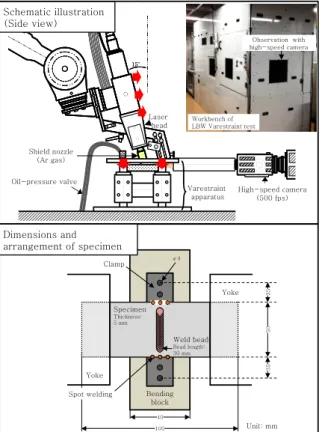
Fig. 1 은 레이저 용접 (laser beam welding: LBW) 을 이용한 Varestraint 시험 시스템의 모식도를 나타 낸다. 본 시스템은 최대 출력 6.0 kW 급 멀티모드 파 이버 레이저 발진기 (IPG, YLS-6000), 용접용 다관 절 로봇 및 Varestraint 시험용 유압 프레스 장비로 구성된다. 평가 결과의 산포 최소화를 위해 전기적 구 동 신호 프로그램을 구축하여 레이저 발진, 로봇 및 유 압 프레스 장비 등, 시험 과정에 있어서의 각 동작이 밀리 초 단위로 독립 제어 가능한 구성을 취하였다. 더 불어, 초고속 카메라 관측 기법을 도입해 시험 과정 중 동작간 발생하는 미세 시간 오차를 측정해 기 구축한 프로그램에 반영함으로써, 레이저 발진부터 Varestraint 유압 프레스에 이르는 과정까지 전 구간 시간적 동기화 가 가능하도록 하였다. 응고균열 민감도는 응고 속도에 큰 영향을 받게 되는 점을 고려해 용접 시작 및 종료 구간에서도 등가속 운동 가능한 로봇 구동 및 레이저 발진 조건을 설정 하였다. Fig. 1 은 Varestraint 시 험기의 유압 프레스 장비에 시험편이 배치된 모식도 및 시험편의 치수도 함께 나타내고 있다. 시험편 양 끝단
의 상부에 유압을 가하는 요크 (yoke) 를 배치하였고, 용접 진행 방향과 수직 방향으로 변형을 가하는 trans- verse-Varestraint 시험 방식을 사용하였다. 시험편은 가로 100 mm, 세로 50 mm, 두께 5 mm 크기의 판 재를 사용하였다. Table 2는 LBW Varestraint 시험 조건을 나타내고 있다. 용접 속도는 20.0, 40.0 mm/s 의 2 종을 사용하였고, 각 용접 속도에서의 레이저 출력 은 2.0, 2.5 kW 으로 하였다. 각 용접 속도에서 비드 길이는 30 mm 로 동일하게 설정 하였다. 비드 표면의 산화를 방지하기 위해 아르곤 (Ar) 을 보호가스로 사용 하였다. Varestraint 시험의 유압 프레스 변형률은 0.25~
4.00%의 범위를 사용 하였고, 시험 후 비드 표면의 균 열 발생 양상은 주사 전자 현미경 (scanning electron microscope: SEM) 으로 관찰하였다. 발생한 균열의 길이를 온도 범위로 환산하기 위해 직경 0.6 mm 텅스텐 열전대를 사용하여 레이저 용접부의 냉각속도를 채취 하였다. 본 시스템의 개발 및 시험 과정에 관한 자세한 내용은 저자의 선행 연구 결과를 참조 바란다 25) .
2.3 아크 용접을 이용한 Varestraint 시험
LBW Varestraint 시험 결과와의 비교 분석을 위해 가스 텅스텐 아크 용접 (gas tungsten arc welding:
GTAW) 을 이용한 Varestraint 시험을 실시하였다. Table 3 은 GTAW Varestraint 시험 조건을 나타낸다. 시험편 은 LBW Varestraint 시험과 동일한 크기를 사용 하 였다. 용접 속도는 1.67 mm/s, 아크 전압 및 전류는 14 V, 120 A 를 각각 사용하였다. 시험 후 균열 발생 양상은 SEM 으로 관찰하였고, 균열 길이를 온도 범위 로 환산하고자 열전대를 이용해 용접 응고시의 냉각 속 도를 채취 하였다.
Laser head
15°15°
15°
Varestraint apparatus Oil-pressure valve
Shield nozzle (Ar gas)
Workbench of LBW Varestraint test
Observation with high-speed camera
Schematic illustration (Side view)
High-speed camera (500 fps)
Yoke Clamp
Yoke
Bending block
40 100
φ4
503535
Unit: mm Spot welding
Specimen
Thickness:5 mm
Weld bead
Bead length:30 mm
Dimensions and arrangement of specimen
Fig. 1 Schematic illustration of laser beam welding (LBW)
transverse-varestraint testTesting parameters Values
Oscillator Multi-mode fiber laser (IPG, YLS-6000) Welding speed (mm/s) 20.0 40.0
Laser power (kW) 2.0 2.5
Heat input (kJ/cm) 100 50
Defocus distance (mm) 0
Beam radius (mm) 0.4
Beam irradiation angle (°) 15
Shield gas Argon (99.99% purity)
Gas flow rate (l/min) 50
Augmented strain (%) 0.15 ~ 4.00
Bent rate (mm/s) 335
Table 2 Conditions for laser beam welding (LBW) trans-
verse-Varestraint test3. 응고모드 및 용접 속도에 따른 응고균열 민감도 변화
3.1 레이저 용접부의 응고균열
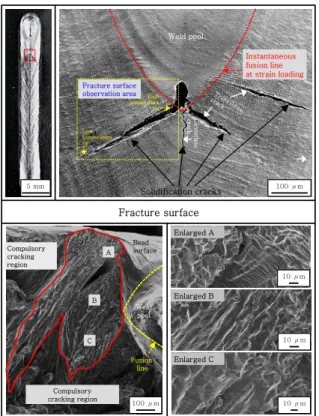
Fig. 2, 3 은 용접 속도 20.0 mm/s 에서 310 및 316-B 스테인리스강의 LBW Varestraint 시험 후 비 드 표면의 균열 발생 양상을 나타내고 있다. 발생한 균
열은 두 강종 모두 용접 방향과 평행하게 형성된 균열 (centerline crack) 과 덴드라이트 성장방향과 평행한 균열 (transverse crack) 으로 구별된다. 최대 길이를 가지는 균열에 대해 파면 관찰을 실시한 결과를 Fig.
2, 3 에 함께 나타내고 있다. 두 강종의 파면 모두 덴드 라이트 형상의 액막이 관여한 양상을 띠고 있어, 발생한 균열은 응고 과정에 형성된 응고균열 로 판단되었다.
이러한 응고균열 발생 양상은 316-A 강 또한 동일한 결과임을 확인하였다. Fig. 4 는 용접 속도 20.0 mm/s 에서 310 강 (Fig. 4(a)) 과 316-B 강 (Fig. 4(b)) 에 대해 부가 변형률에 따른 발생 균열 개수, 길이 및 온 도 범위 변화를 나타낸 결과이다. 균열 길이는 crack (균열 발생부), back-fill (균열 발생후 융액 재충진부), blank (균열 미 발생부) 로 구별하여 정량화 하였다.
특히, 냉각 속도의 상이함을 고려해 molten pool 내부 의 균열은 균열 길이에서 제외함과 동시에 초고속 카메 라로 측정한 Varestraint 시험에서의 요크 (yoke) 낙 하 시간을 잠재적인 균열 길이로써 추가 보정하였다.
균열 길이 정량화에 대한 자세한 내용은 저자의 선행연 구 결과를 참조하기 바란다 25) . 두 강종 모두 변형률이 증가할수록 균열 개수, 길이 및 발생 온도 범위가 증가 함을 알 수 있다. 각 변형률에서의 최대 균열 온도 범
Testing parameters Values
Electrode 2% cerium-tungsten
Welding speed (mm/s) 1.67
Arc current (A) 120 (DC)
Arc voltage (V) 14
Heat input (kJ/cm) 600
Arc length (mm) 2
Torch radius (mm) 2
Torch direction Perpendicular to coupon Shield gas Argon gas (99.99% purity)
Gas flow rate (l/min) 15
Augmented strain (%) 0.15 ~ 4.00
Bend rate (mm/s) 335
Table 3 Conditions for gas tungsten arc welding (GTAW)
transverse-Varestraint test5 mm 5 mm
Weld pool
Instantaneous fusion line at strain loading
Solidification cracks
100 μm100 μmLow temperature tip
High temperature tip Fracture surface observation area
100 μm 100 μm
10 μm 10 μm
10 μm 10 μm
10 μm 10 μm
Enlarged A
Enlarged B
Enlarged C
Compulsory cracking region
A
C B
Weld pool
Fusion line Bead surface
Fracture surface
Compulsory cracking region
Centerlinecrack
Transv erse crack
Fig. 2 Solidification cracking appearance and fracture
surface after laser beam welding (LBW) trans- verse-Varestraint test (welding speed: 20.0 mm/s) for type 310 stainless steel weld metal5 mm 5 mm 5 mm
Molten pool
Solidification cracks
Instantaneousfusion line
100 μm 100 μm
10 μm 10 μm Enlarged A
10 μm 10 μm Enlarged B
A
B Molten pool
100 μm 100 μm
Centerline 5 mm
5 mm
Compulsory cracking region Compulsory
cracking region
Fracture surface
Fracture surface observation area
Fig. 3 Solidification cracking appearance and fracture
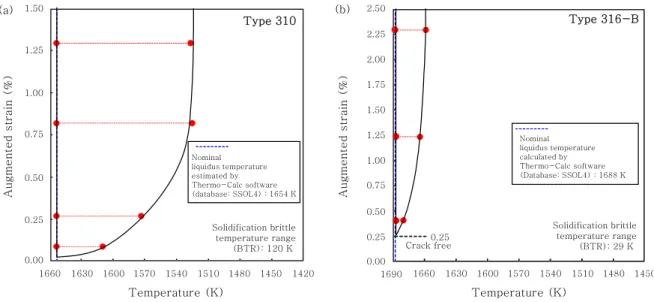
surface after laser beam welding (LBW) trans- verse-Varestraint test (welding speed: 20.0 mm/s) for type 316-B stainless steel weld metal위를 이용해 응고균열 발생에 대한 연성곡선을 평가하 였고, 레이저 용접부에서의 BTR 을 도출할 수 있었다.
Fig. 5 는 310 (Fig. 5(a)) 과 316-B 강 (Fig. 5(b)) 에 대한 연성 곡선 평가 결과를 나타낸다. 용접 속도 20.0 mm/s 레이저 용접부에서의 BTR 은 310 강이 120 K, 316-B 강은 29 K 으로, 310 강이 316-B 에 비해 응고균열 민감도가 높은 것을 의미한다.
3.2 용접 속도에 따른 BTR 변화
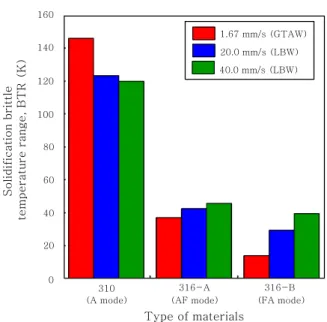
Fig. 6 은 310, 316-A 및 316-B 강의 용접 속도 에 따른 BTR 변화 거동을 나타내고 있으며, 본 그림은 용접 속도 1.67 mm/s 의 GTAW Varestraint 시험 결
과도 포함하고 있다. 용접 속도가 1.67 mm/s (GTAW) 에 서 40.0 mm/s (LBW) 로 증가할 수록, A 모드 310강 의 BTR 은 146 K 에서 120 K 로 감소하였다. 즉, 고속의 레이저 용접을 적용함으로써 26 K 의 BTR 감 소에 상응하는 응고균열 민감도 저하가 확인 되었다.
반대로 2 종의 316 강은 용접 속도가 증가함에 따라 BTR 이 증가하여, 레이저 용접을 적용함으로써 응고균 열 민감도는 상승하는 것을 알 수 있었다. AF 모드 316-A 강은 37 K 에서 46 K (9 K 증가), FA 모드 316-B 강은 14 K 에서 40 K (26 K 증가) 로 BTR 이 증가하여, 용접 속도에 따른 BTR 증가 폭은 동일한 316 계 스테인리스강 이더라도 응고모드에 따라 상이
0.25 0.83 1.64
8 12 18
Fusion line
Number of cracks Augmented strain (%)
Dis tance fr o m fu sion li ne (μm )
(a)
2.44 3.45
38 36
Fusion line
Number of cracks Augmented strain (%)
D istanc e fro m fusio n line ( μ m)
Crack Back-fill Blank Crack Back-fill Blank Crack Crack Back-fill Back-fill Blank Blank
Type 316-B
0.41
1 0
200
400
600
800
1000
1200
Type 310
Crack Back-fill Blank Crack Back-fill Blank Crack Crack Back-fill Back-fill Blank Blank 0
200
400
600
800
1000
1200
(b)
Fig. 4 Quantitative analysis of solidification cracking susceptibility measured from laser beam welding (LBW) trans-
verse-Varestraint test (welding speed: 20.0 mm/s) for (a) type 310, (b) type 316-B stainless steel weld metalsAu g m en te d s tr a in (% )
Temperature (K)
Nominal liquidus temperature estimated by Thermo-Calc software (database: SSOL4) : 1654 K
Solidification brittle temperature range (BTR): 120 K
Type 310
Solidification brittle temperature range (BTR): 29 K
Au g m en te d s tr a in (% )
Temperature (K)
Nominal liquidus temperature calculated by Thermo-Calc software (Database: SSOL4) : 1688 K
Type 316-B
1.50
1.25
1.00
0.75
0.50
0.25
0.00
1660 1630 1600 1570 1540 1510 1480 1450 1420 1690 1660 1630 1600 1570 1540 1510 1480 1450 2.50
2.25
2.00
1.75
1.50
1.25
1.00
0.75
0.50
0.25
0.00
(a) (b)
Crack free 0.25
Fig. 5 High temperature ductility curves for solidification cracking measured from laser beam welding (LBW) trans-
verse-Varestraint test (welding speed: 20.0 mm/s) for (a) type 310 and (b) type 316-B stainless steel weld metals한 것을 알 수 있었다. 본 결과는 레이저 용접의 적용 이 응고균열 민감도를 항상 억제 시키는 것은 아니며, 오스테나이트계 스테인리스강의 경우 응고모드에 따라 고속의 레이저 용접 적용이 응고균열 발생을 촉진 시킬 수 있음을 시사하고 있다.
4. 결 론
기 개발한 LBW Varestraint 시험을 통해 응고모드 가 상이한 3종의 오스테나이트계 스테인리스강 (310:
A 모드, 316-A: AF 모드, 316-B: FA 모드) 용접부 의 응고균열 민감도를 평가하였다. 아래는 연구 결과를 요약한다.
1) 레이저 발진기, 용접용 로봇 및 Varestraint 시 험용 유압 프레스 장비의 각 동작이 밀리 초 단위로 독립 제어 가능한 구성을 취한, 레이저 용접용 Varestraint 시험 시스템을 통해 오스테나이트계 스테인리스강 레이 저 용접부의 응고균열 민감도 평가가 가능하였다.
2) 1.67 mm/s (GTAW) 에서 40.0 mm/s (LBW) 의 용접 속도 증가는, A 모드 응고의 310 스테인리스 강 BTR 을 146 K 에서 120 K 로 감소시켰다. 즉, 고속의 레이저 용접을 적용함으로써 26 K 의 BTR 감 소에 상응하는 응고균열 민감도 저하가 확인 되었다.
3) 316-A 및 316-B 스테인리스강은 용접 속도가 증가함에 따라 BTR 도 증가하여, 고속의 레이저 용접 을 적용함으로써 응고균열 민감도는 상승하는 결과를 얻었다. 특히, AF 모드의 316-A 강은 37 K 에서 46 K (9 K 증가), FA 모드 316-B강은 14 K 에서 40 K
(26 K 증가) 로, 용접 속도에 따른 BTR 의 증가 폭 은 응고모드에 따라 상이 하였다.
후 기
The present study includes results from a “Core R&D program for commercialization of the fast breeder reactor by utilizing Monju” entrusted to the University of Fukui by the Ministry of Education, Culture, Sports, Science and Technology of Japan (MEXT).
References
1. K. H. Lo et al., Recent Developments in Stainless Steels, Mater. Sci. Eng. R, 65 (4-6) (2009), 39-104 2. S. Katayama, Handbook of Laser Welding Technologies,
Woodhead Publishing (2013), 3-16
3. E. J. Chun et al., Effect of Sodium on Repair Weldability of SUS316FR for a Fast Breeder Reactor, Welding
International, 30 (2) (2016), 79-90
4. C. Fang et al., Thermal Analysis of Laser Welding for ITER Correction Coil Case, Fusion Eng. Des., 100 (2015), 357-363
5. J. C. Lippold and W. F. Savage, Solidification of Austenitic Stainless Steel Weldments (Part 3) -The Effect of Solidification Behavior on Hot Cracking Susceptibility-, Weld. J., 61 (12) (1982), 388s-396s
6. N. Kang, Development of Alloy Design and Welding Technology for Austenitic Stainless Steel, Journal of
KWJS, 28 (1) (2010),10-14 (in Korean)
7. H. Inoue et al., Solidification and Transformation Behavior of Austenitic Stainless Steel Weld Metals Solidified as Primary Austenite-Study of Solidification and Subsequent Transformation of Cr-Ni Stainless Steel Weld Metals (1st Report)-, Welding International, 11 (11) (1997), 876-887
8. H. Inoue et al., Solidification and Transformation Be- havior of Austenitic Stainless Steel Weld Metals Soli- dified as Primary Ferrite-Study of Solidification and Subsequent Transformation of Cr-Ni Stainless Steel Weld Metals (2nd Report)-, Welding International, 11 (12) (1997), 937-949
9. H. Inoue et al., Epitaxial Growth and Phase Formation of Austenitic Stainless Steel Weld Metals Near Fusion Boundaries–Study of Solidification and Transformation of Cr-Ni Stainless Steel Weld Metals (3rd Report)-,
Welding International, 12 (3) (1997), 195-206
10. H. Inoue et al., Solidification and Transformation Behavior of Cr-Ni Stainless Steel Weld Metals with Ferritic Single Phase Solidification Mode - Study of Solidification and Transformation of Cr-Ni Stainless Steel Weld Metals (4th report)-, Welding International, 12 (3) (1998), 282-296
11. S. Fukumoto and W. Kurz, The δ to γ Transition in
1.67 mm/s (GTAW) 20.0 mm/s (LBW) 40.0 mm/s (LBW)
S o lidif ication br ittle temperat u re ran ge, BT R (K)
Type of materials
(A mode) (AF mode) (FA mode)
160
140
120
100
80
60
40
20
0 310 316-A 316-B
Fig. 6 Variation of solidification brittle temperature range
(BTR) in accordance with welding speed for type 310, 316-A and 316-B stainless steel weld metalsFe-Cr-Ni Alloys during Laser Treatment. ISIJ Int., 37 (7) (1997), 677-684
12. M. Bermejo et al., Towards a Map of Solidification Cracking Risk in Laser Welding of Austenitic Stainless Steels, Phys. Procedia, 78 (2015) 230-239
13. M. Sheikhi et al., Prediction of Solidification Cracking in Pulsed Laser Welding of 2024 Aluminum Alloy,
Acta Mater., 82 (1) (2015), 491-502
14. P. Witzendorff et al., Using Pulse Shaping to Control Temporal Strain Development and Solidification Cracking in Pulsed Laser Welding of 6082 Aluminum Alloys, J. Mater. Process Tech., 225 (2015), 162-169 15. B. H. Kim et al., A Study to Improve Weld Strength of
Al 6k21-T4 Alloy by using Laser Weaving Method,
Journal of KWJS, 27 (4) (2009), 49-53 (in Korean)
16. Y. Chen et al., Characterization of Heat Affected ZoneLiquation Cracking in Laser Additive Manufacturing of Inconel 718, Mater. Design, 90 (15) (2016), 586- 594
17. K. Nishimoto and H. Mori, Hot Cracking Susceptibility in Laser Weld Metal of High Nitrogen Stainless Steel,
Sci. Technol. Adv. Mat., 5 (1-2) (2004), 231-240
18. P. Weng et al., Study on Solidification Cracking ofLaser Dissimilar Welded Joints by using Observation and Numerical Simulation, Welding in the World, 54 (9) (2010), 257-266
19. K. Shinozaki et al., Effect of Grain Size on Solidification Cracking Susceptibility of Type 347 Stainless Steel during Laser Welding, Transactions of JWRI, 39 (2) (2010), 136-138
20. V. Quiroz et al., Investigation of the Hot Cracking Susceptibility of Laser Welds with the Controlled Tensile Weldability Test, The Journal of Strain Analysis for
Engineering Design, 47 (2012), 587-599
21. X. Wang et al., Micro-Scale Model Based Study of Solidification Cracking Formation Mechanism in Al Fiber Laser Welds, J. Mater. Process Tech., 231 (2016), 18-26
22. K. Saida et al., Prediction of Solidification Cracking in Laser Welds of Type 310 Stainless Steels, Quarterly
Journal of Japan Welding Society, 31 (2) (2013), 157-166
23. K. Kadoi et al., The Effect of Welding Conditions onSolidification Cracking Susceptibility of Type 310S Stainless Steel during Laser Welding using an In-situ Observation Technique, Welding in the World, 57 (3) (2013), 383-390
24. W. F. Savage and C. D. Lundin, The Varestraint Test,
Weld. J., 44 (10) (1965), 433s-442s
25. E. J. Chun et al., Development of Laser Beam Welding Transverse-Varestraint Test for Assessment of Solidification Cracking Susceptibility in Laser Welds, Met. Mater.
Int., 21 (3) (2015), 543-553
26. S. Kou, Welding Metallurgy (second edition), A John