http://dx.doi.org/10.7841/ksbbj.2014.29.6.399 ISSN 1225-7117 / eISSN 2288-8268
Production of Polyhydroxybutyrate from Crude Glycerol and Spent Coffee Grounds Extract by Bacillus cereus Isolated from Sewage Treatment Plant
Gi Na Lee
1, So Young Choi
2, Jonguk Na
1*, HaJin Youn
2, and Yu-Sin Jang
2*
Received: 14 October 2014 / Accepted: 30 November 2014
© 2014 The Korean Society for Biotechnology and Bioengineering
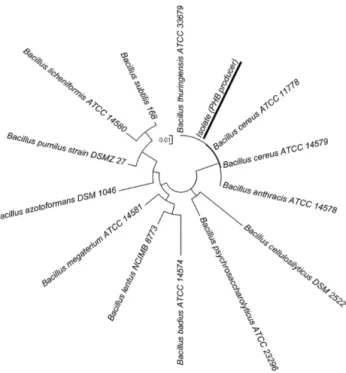
Abstract: Production of biodegradable polymer polyhydro- xyalkanoates (PHAs) from industrial wastes exhibits several advantages such as recycle of waste and the production of high valuable products. To this end, this study aimed at isolat- ing from the sewage treatment plant a PHA producing bacte- rium capable of utilizing wastes generated from biodiesel and food industries. A Bacillus cereus strain capable of producing poly(3-hydroxybutyrate) [P(3HB)] was isolated, which was followed by confirmation of P(3HB) accumulation by gas- chromatographic analyses. Then, the effects of nutrient limita- tion on P(3HB) production by B. cereus was first examined.
Cells cultured in a minimal medium under the limitation of nit- rogen, potassium and sulfur suggested that nitrogen limitation allows the highest P(3HB) accumulation. Next, production of P(3HB) was examined from both waste of biodiesel produc- tion (crude glycerol) and waste from food industry (spent cof- fee grounds). Cells cultured in nitrogen-limited minimal medium supplemented crude glycerol and waste spent coffee grounds extract accumulated P(3HB) to the contents of 2.4%
and 1.0% of DCW. This is the first report demonstrating the capability of B. cereus to produce P(3HB) from waste raw materials such as crude glycerol and spent coffee grounds.
Keywords: Polyhydroxyalkanoates, Crude glycerol, Spent cof- fee ground, Industrial waste, Sewage treatment plant
1. INTRODUCTION
Polyhydroxyalkanoates (PHAs) are microbial polyesters which are intracellularly accumulated as distinct granules as carbon storage material usually when growth is limited in the presence of excess carbon source. PHAs are biodegradable polymers having properties similar to petroleum-based plastics, and thus have potential to replace fossil oil-based plastics [1]. However, its production cost is still relatively high, which can be signifi- cantly reduced if inexpensive substrates, and in particular waste raw materials, can be used as substrates [2-4].
Biodiesel production coproduces large amounts of glycerol as a waste. About 1 kg of a crude glycerol is generated in the production of 10 kg of biodiesel [5, 6]. Such waste glycerol has attracted much attention for the production of various biopro- ducts including acrolein, 1,3-propanediol, butanol, hydrogen and PHAs, both biologically and catalytically [7-11]. Coffee is one of the most popular beverages in the world, thus huge amount of waste are released. Annual global production of coffee is estimated to be about 16 billion pounds [12]. Raw coffee beans contain carbohydrates as well as some oil. The amount of total carbohydrates is about 60% of coffee [13]. Recently, the waste spent coffee grounds, which contain about 15% of oil, have been examined for biodiesel production through catalytic transesteri- fication [12].
Many bacterial species present in sewage sludge have a poten- tial to produce PHAs, because of rich nutrients introduced in the waste stream. Indeed, PHA producing microorganisms have been isolated from the sewage sludge [14]. In addition, the bac- terial species found in sewage sludge seem to be able to utilize a variety of carbon substrates due to the varying influx of nutri- ents in the waste stream. In this study, it was aimed to isolate a PHA producer capable of utilizing wastes including crude gly-
1
Korean Minjok Leadership Academy, Hoengseong 225-823, Korea Tel: +82-33-343-1115, Fax: +82-33-342-8660
e-mail: [email protected]
2
Department of Chemical and Biomolecular Engineering (BK21 plus program), BioProcess Engineering Research Center, KAIST, Daejeon 305-701, Korea
Tel: +82-42-350-8814, Fax: +82-42-350-8800 e-mail: [email protected]
연구논문