2족 보행로봇의 안정된 걸음걸이를 위한 지능제어 알고리즘의 실시간 실현에 관한 연구
A study on The Real-Time Implementation of Intelligent Control Algorithm for Biped Robot Stable Locomotion
노연 후 콩1, 이우송2
Huu-Cong Nguyen, Woo-Song Lee
<Abstract>
In this paper, it is presented a learning controller for repetitive walking control of biped walking robot. We propose the iterative learning control algorithm which can learn periodic nonlinear load change ocuured due to the walking period through the intelligent control, not calculating the complex dynamics of walking robot. The learning control scheme consists of a feedforward learning rule and linear feedback control input for stabilization of learning system. The feasibility of intelligent control to biped robotic motion is shown via dynamic simulation with 25-DOF biped walking robot.
Keywords : Fresh air load reduction system, Underground pit, Geothermal energy
1. 정회원, 교신저자 ㈜미쉐린타이어 베트남 2. 정회원, 교신저자, 성산암데코
1. Corresponding Author, Michelin Tire co., Ltd.
2. Corresponding Author, SungSanamdeco co., Ltd.
1. INTRODUCTION
In the control of biped walking robot, the element which makes the joint control of the robot difficult is that the load and friction which inflicts to the joint are changed very largely according to the walking period[5-6].
If we apply the general linear controller such as linear PID feedback controller to the joint control of the robot, it is very difficult that we find the gain value which stabilizes the entire gait because the error at each step of walking is different. Therefore in this paper, we propose the intelligent control algorithm which can learn periodic nonlinear load change ocuured according to the walking period through the iterative learning, not calculating the complex dynamics of walking robot. Although this algorithm has a similar structure to the other learning control method, it has a difference in the learnig method. The learning method in this paper calculates the feedforward actuator torque using the feedback error element and calculates the control input using the updated learning element according to the increase of each learning step. This learning control algorithm is flexible and simple in the application because it doesn't need exact robot dynamics. It is robust to unknown disturbances because it doesn't need the acceleration factor weak to the noise, and it has a performance which adapts to the dynamic system parameter.
The research on biped walking robot is
classified in two parts according to the purpose. First, it is the study on the pure control of biped walking robot. And second, it is the study on the stabilization of gait.
And the trajectory generation of each joint which the robot doesn't fall down and can do walk stably is also important problem, so the various study on the generation method of reference trajectory has been progressed[1-4].
In this paper, we apply this iterative learning control method to the biped walking robot which has 25 joints body[7-10]. And we verify the stabilization of the proposed controller by performing the tracking task of the 12-DOF biped robot to the refernece trajectory. And we verify the convergence of the position and velocity error according to the progress of learning. We evaluate that the proposed controller is more robust to the parameter uncertainty and disturbance comparing to the existing linear controller.
2. CONTROLLER CONFIGURATION
Dynamic equation of n-DOF robot manipulator is as follows.
(1)
where
∈
is a generalized coordinate
vector of robot joint.
∈
× is an
inertia matrix which is positive-definite and
∈
is a vector which represents centripetal force and coriolis force. And
∈
∈
∈
represent gravity and friction, unknown repetitive fixed disturbance which size is finite, input torque vector to the robot respectively.
The learning control algorithm is a control method which finds a desired control input through continuous iterative action to overcome the difficulty of control according to the disturbance caused by the dynamics which is not modelled. Therefore Repetitive learning control algorithm decreases a trajectory tracking error in proportion to the increase of learning times. On i-th iterative learning to follow
, linearizing the robot system equation (1), we can obtain the following linear time-invariant system equation.
(2)
where each variable is defined as follows.
≡
≡
≡
≡
For the robot system to track the desired trajectory, we constitute a control law as follows.
(3)
(4)
where
is the
-th iterative control input torque,
is the control input torque of general PI controller where has feedback gain
is the renewed feedforward control input at every learning step by learning rule.
By adding the eq. (4) to the system eq.
(2), we can obtain the error equation as follows.
(5)
where
,
,
are the position, velocity, acceleration error variables respectively.
In the eq. (5) the parameter
which controls error dynamics exists in the restricted region. And by increasing the feedback gain, the size of the region which the error exists can be controlled within small range.
But in real application, it is impossible to increase the feedback gain infinitely because the driving torque of the robot is limited.
Generally such linear feedback controller is
not suitable in the case that the system has
a modelling error or nonlinear factor. Thus to
assist the performance limit of such linear
feedback controller, we use the feedforward
control input
. Then the tracking error may converge to 0 as the iteration is carried out even if the feedback gain is not large.
The control method of realized learning controller is as follows. First the value of K, L is selected to have a large positive value as much as the error dynamics following to tracking trajectory is stable. Second,
is renewed using the learning rule which
is converged to nonlinear term
. In the initial step of learning,
is defined to 0.
By renewing
, the learning rule which is converged to nonlinear term
which has an unknown value is as follows.
(6)
where
is a positive constant value which called training factor, and must have the value of
to guarantee the convergence of
.
The contents of learning rule is to find the unknown desired input torque
in the feedback torque factor
which is used to renew
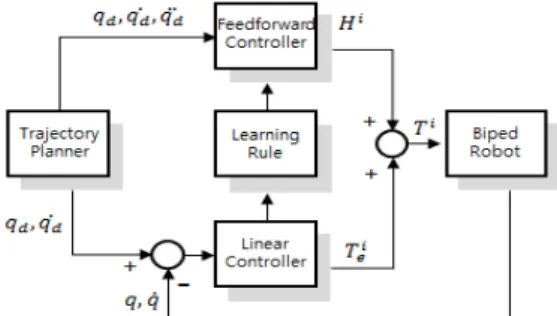
. Fig. 1 shows the control structure of realized learning controller.
Fig. 1 The structure of control scheme of robot
In Fig. 1, the trajectory planner makes the desired trajectory, and the linear PD controller which has fixed gain guarantees the control stability of the system into the constant error limit. And the feedforward controller makes that the system error converges to 0 by renewing the feedforward torque factor
.
3. Performance tests
The biped robot model considered in this paper is a 12-DOF model. In Fig. 2, this robot model has 3-DOF hip, 2-DOF knee and 2-DOF ankle in each leg, therefore it has 20 joints and 1 body entirely. It has an effect that improve the stability in the entire robot motion by setting up similar to a real model through increasing the mass of hip and knee parts of this robot. The trajectory of the robot is obtained by solving the forward kinematics at each joint assuming that the velocity of the hip and junction point in the fixed leg and moving leg is constant. The walking period of the robot is set up in order of deploy, swing, heel contact, support.
3.1 Experiment and Results
To verify the performance of the iterative
learning controller having the proposed
structure, we compare and analyze the
tracking performance of the iterative learning controller at the 1st learnjng and 10th learning to the biped walking robot.
Fig. 2 Structure of biped robot
The control parameter of the iterative learning controller applied in the simulation is in the Table 1. It is not easy to compute the dynamics of the biped walking robot because the number of DOF is many and the robot is a complicated system. In this paper, we used "SD/Fast" as a dynamics simulation program to solve this problem.
Table 1 Control parameters of iterative learning controller
value explanation
250 proportional gain
150 integral gain
0.72 learning rate constant
∆
0.005
[sec] sampling time
(a) iteration (b)iteration
(c)iteration (d)iteration
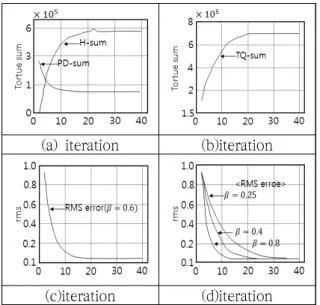
Fig. 3 Plots of torque sum and RMS error versusiteration number
In Fig.3 we see the executed trajectory tracking results of the biped walking robot by using the supporting leg to the right leg and the swing leg to the left leg.
In the experimental results, we can see
that the iterative learning controller at the
10th learnjng is more excellent in the
performance and is more less in the position
tracking error than the iterative learning
controller at the 1st learnjng. In Fig.3(a), at
the initial stage the control input of linear
controller has a great part of torque sum,
but oppositely the control input of learning
controller forms more part of torque sum
according to the progress of learning. In
Fig.3(b), we can see the sum of the entire
control input according to the progress of
learning. In Fig.3(c), we can see that theRMS
value of the entire joint decreases according
to the increase of learning frequency. And it
seems that the trajectory error converges according to the increase of learning.
In Fig.3(d), the RMS error is changed according to the learning rate constant
. And we confirmed the walking figure of the biped walking robot through inputting the true trajectory of iterative learning controller at the 10th learning and 10th learning in the 3-D moving image of biped walking robot.
4. CONCLUSION
we proposed a learning controller for repetitive locomotion control of biped walking robot. The control algorithm is a iterative learning control algorithm which can learn periodic nonlinear load change occurred according to the walking period through the iterative learning, not calculating the complex dynamics of walking robot. To verify the performance of the proposed iterative learning controller, we illustrated this control method to the biped walking robot which has 25 joints and performed the tracking task of the biped robot to the desired trajectory.
As a result, we verified the stabilization of the proposed controller and the convergence of the position and velocity error according to the progress of learning. And we evaluated that the proposed controller is more robust to the parameter uncertainty and disturbance comparing to the existing linear controller.
REFERENCES
[1] G. Tevatia and S. Schaal,“Inverse kinematics for humanoid robots,“ Proc. of IEEE Int. Conf.
on Robotics and Automation, pp.294-299, 2000.
[2] C. L. Shih, et al., "Trajectory Synthesis and physical admissibility for a biped robot during the single-support phase," Proc. of IEEE Int.
Conf. on Robotics and Automation, pp.1646-1652, 1990.
[3] H. Takeuchi,“Development of MEL HORSE,”
Proc. of IEEE Int. Conf. on Robotics and Automation, pp. 3165-3171, 2001.
[4] M.Yagi,“Synthesis of control strategies for planar biped robot locomotion in the presence of disturbances,“ Univ. of Winconshin-Madisan Robotics Lab. Tech. Report, no. RL-97002, 1997.
[5] Y. W. Sung, S-Y Yi, “A miniature humanoid robot that can walk up and down stairs,“ Proc.
of the 32nd ISR, pp.1463-1468, 2001.
[6] T. Morita, et al, “Design and control of mobile manipulation system for human symbiotic humanoid : Hadaly-2,“ Proc. of IEEE Int.
Conf. on Robotics and Automation, pp.
1315-1320, 1998.
[7] J. Furusho and A. Sano, “Sensor-based control of nine-link biped,“ Int. Journal of Robotics Research, vol. 9, no 2, pp. 62-82, 1990.
[8] J. Pratt, P. Dilworth and G. Pratt, “Virtual model control of a bipedal walking robot,“
Proc. of IEEE Int. Conf. on Robotics and Automation, pp. 193-198, 1997.
[9] W. Ilg, et al, “Adaptive periodic movement control for the four legged walking machine BISAM : Dynamic walk of a biped,“ Proc. of IEEE Int. Conf. on Robotics and Automation, pp. 2354-2359, 1999.
[10] S. Kajita and K. Tani, “Adaptive gait control of biped robot based on realtime sensing of the ground profile,“ Proc. of IEEE Int. Conf.
on Robotics and Automation, pp. 570-577, 1996.
(접수:2015.09.23., 수정:2015.10.22., 게재확정:2015.10.28.)