− 45 − http://dx.doi.org/10.5720/kjcn.2013.18.1.45
일부 여대생의 활동에너지 소비패턴, 활동계수, 기초대사량 및 에너지 소비량 평가
박 윤 지·김 정 희†
서울여자대학교 자연과학대학 식품영양학과
Assessment of Physical Activity Pattern, Activity Coefficient, Basal Metabolic Rate and Daily Energy Expenditure in Female University Students
Yoonji Park, Jung Hee Kim
†Department of Food and Nutrition, College of Natural Sciences, Seoul Women's University, Seoul, Korea
Abstract
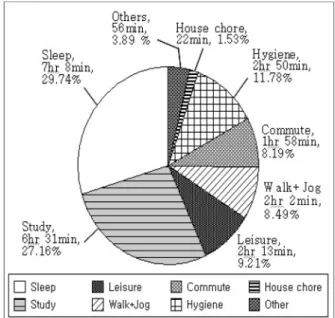
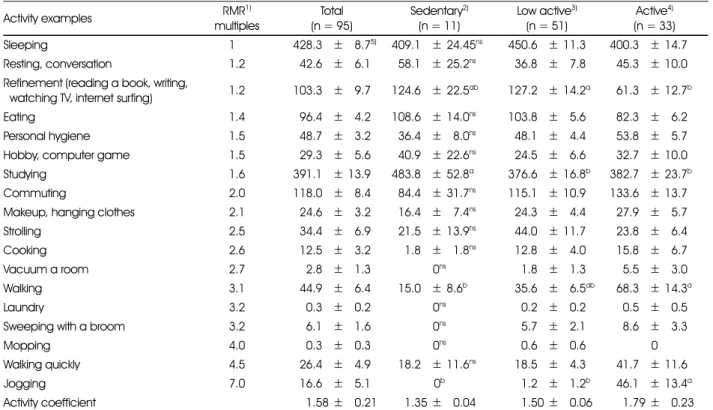
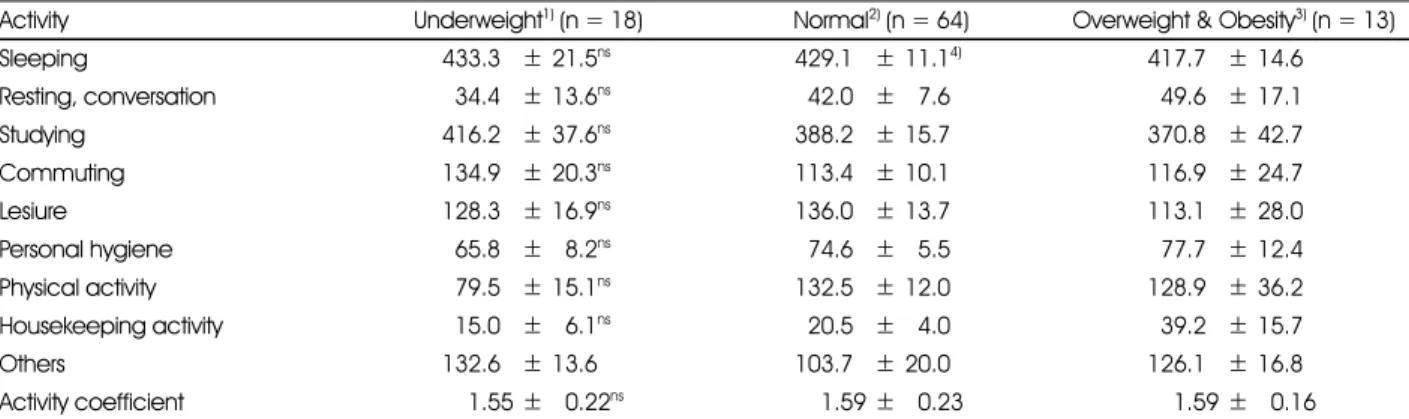
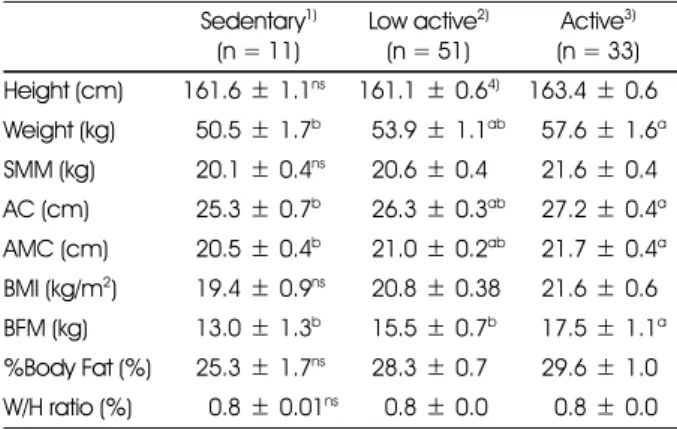
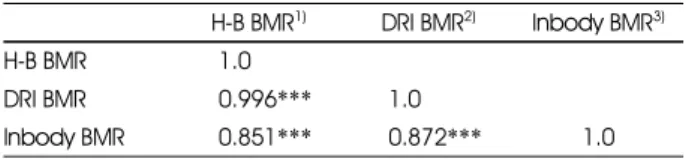
This study was conducted to investigate the physical activity pattern, activity coefficient, basal metabolic rate and energy expenditure of female university students. One-day activity diaries were collected from 95 female university students in Seoul. Body composition was measured by Inbody 720. Subjects spent 7 hr 8 min on sleeping, 6 hr 31 min on studying, 2 hr 50 min on physiological activity, 2 hr 3 min on leisure, 2 hr 2 min on walking and jogging, 1 hr 58 min on commuting and 22 min on house chores. The activity coefficient of these subjects was 1.58. The comparison of body composition of subjects according to PAL showed that body weight, body fat mass, arm circumference and arm muscle circumference of physically active group were significantly higher than those of the sedentary group. BMR calculated by Harris-Benedict (H- B) formula and DRI formula and BMR measured by Inbody 720 was 1375 kcal, 1306 kcal and 1209 kcal, respectively.
Total energy expenditure (TEE) examined by one-day activity diaries and calculated by H-B formula and estimated energy requirement (EER) formula in DRI was 2102.1 kcal, 2184.4 kcal, and 2164.5 kcal, respectively. The Pearson correlation coefficient between TEE examined by one-day activity diaries and H-B TEE was 0.795 (p < 0.001) while that between TEE examined and DRI EER was 0.604 (p < 0.001). Overall data indicated that female university students seemed to be less active. Therefore it is recommended that universities develop good exercise programs for their students. Further studies are needed to generate more meaningful results with a larger sample size and using machine attached to the body, which are able to detect physical activity more accurately. ( Korean J Community Nutr 18(1) : 45~54, 2013)
KEY WORDS : physical activity pattern·body composition·activity coefficient·female university students
—————————————————————————
서 론
—————————————————————————
최근 우리나라의 경제성장은 국민 소득의 증가와 생활수 준의 향상을 가져왔고 아울러 산업화로 인하여 인간의 노동 력을 점차 기계로 바꾸면서 자연스럽게 일상생활에서 신체 활동의 기회가 줄어들게 되었다. 반면 식생활은 점점 서구화 되어갈 뿐만 아니라 빠르고 간편한 식품을 선호함에 따라 고 열량·저영양 식품의 섭취가 증가하게 되어 에너지 불균형 이 초래되었고, 이로써 과체중이나 비만의 인구가 증가하게 되었다(Parrish 1970; Lee 등 1991).
비만은 고혈압, 심혈관 질환, 뇌졸중, 제2형 당뇨병 등의 만 성질환을 유발하는 원인으로 작용할 뿐 아니라, 삶의 질에 부 정적 영향을 끼치는 것으로 현대사회에서 해결해야 할 중요
접수일: 2013년 1월 31일 접수수정일: 2013년 2월 13일 수정 채택일: 2013년 2월 13일 채택
*This study was supported by a grant of the Institute of Natural Sciences at Seoul Women's University in 2011
†Corresponding author: Jung Hee Kim, Department of Food and Nutrition, College of Natural Sciences, Seoul Women's University, 623 Hwarangno Nowon-gu, Seoul 139-774, Korea
Tel: (02) 970-5646, Fax: (02) 976-4049 E-mail: [email protected]
This is an Open-Access article distributed under the terms of the Creative Commons Attribution Non-Commercial License(http://
creativecommons.org/licenses/by-nc/3.0) which permits unrestricted non-commercial use, distribution, and reproduction in any medium, provided the original work is properly cited.