Color cosmetics such as mascara, eye shadow and eyeliner are used extensively
+
Corresponding author: Jeonghee Kim, Tel. +82-63-850-6898, Fax+82-63-850-7301 E-mail: [email protected]
This paper was supported by wonkwang university in 2013
world-wide to highlight and emphasized the eyes. Specially, eyeliner is commonly used as a daily make up routine to define the eye or create the look of a wider or smaller eye. It can
Comparison of Heavy Metal Contents in Eyeliner Products - Focused on Domestic and Foreign Cosmetic Brands-
Kee-Young Lee
*
Jeong-hee Kim․
+
Dept. of Beauty Design, Woosong College
*
Dept. of Beauty Design, Wonkwang University
Abstract
Heavy metal ingredients of eyeliner product could cause side effect ranging from simple irritation, keratitis, corneal epithelium inflammation, eyelid dermatitis and dry eye symptoms have been reported. This study was conducted in order to prepare fundamental data for acceptable quality level heavy metal ingredients in the domestic and foreign cosmetic brand eyeliner products and to assess theirs the heavy metal concentrations. We measured the concentration of 5 heavy metals in 10 eyeliner products using ICP/MS-LC. According to the results, the average metal concentrations were as follows.; In case of domestic eyeliner products, 289.4 ppm for aluminium(Al), 304 ppm for manganese(Mn), 44 ppm for nickel(Ni), 0.58 ppm for arsenic(As) and 0.35 ppm for lead(Pb). In case of Foreign eyeliner products, 11337.8 ppm for aluminium(Al), 1678.8 ppm for manganese(Mn), 74.2 ppm for nickel(Ni), 1 ppm for arsenic(As) and 0.8 ppm for lead(Pb). Foreign products contained higher amounts of the two elements(Pb, As) compared to domestic ones. Also, greater concentrations of arsenic(As) were detected from waterproof products than non-waterproof ones. In conclusion, for safety reasons we suggested the amounts of heavy metals from the domestic and foreign eyeliner products. This finding will be helpful to provide the fundamental data which is standard of toxicological heavy metals acceptable on eyeliner products.
Key words : Eyeliner, Heavy metal, Color cosmetic, Safety
(2)
be placed in various parts of the eye to create different looks. The primary purpose is to make the lashes look lush, but it also draws attention to the eye and can enhance or even change the eye's shape. For this reason, eyeliner is more and more used by women to make their eyes more attractive before a party or for an important meeting. Eyeliner are an important form of adornment for women in modern society. When women do make up with eyeliner, most are applied away from the ocular surface but some may exist precariously close to the lid margin or even inside of the lid.
Adverse reactions to these eyeliner, ranging from simple irritation, keratitis, corneal epithelium inflammation, eyelid dermatitis and dry eye symptoms have been reported(Adeela & Charles, 2012).
As mentioned previously, the desire to create fashionable eye line make-up must be balanced with the need to insure that safety issues have been addressed. The chemical composition of eyeliner is complex. It's mainly components are pigment(Iron Oxides, Titanium Dioxide, Carbon Black, etc), extender(cyclopentasiloxane, Isododecane, Cyclohexasiloxane, Talc, silica etc), binder(Ceresin, Disteardimonium Hectorite, lecithin, polyethylene etc), and other additives. A variety of chemicals especially heavy metals used in eyeliner as ingredients has different health effects(Rajagopal et al., 2015). A group, heavy metals like arsenic(As), cadmium(Cd), chromium(Cr), nickel(Ni), lead(Pb), cobalt(Co), copper(Cu), and zinc(Zn) can cause adverse effect. Zoe(2001) reported that cosmetic ingredients are causing eyelid allergic contact. In case of eye area coloring agents, Iron oxides titanium dioxide(alone, or combined with mica), copper, aluminum, silver powder, chrome oxide, iron blue bismuth mica were allowed in the
United States. Also the toxicological properties of lead, arsenic, cadmium, mercury and antimony are described below and impurity limits derived for products in Canada. The considerations and approach to impurity limits for cosmetics; below lead 10 ppm, arsenic 3 ppm, cadmium 3 ppm, antimony 5 ppm, these levels are based on cosmetic products sampled in Canada. In Korea, Ministry of Food and Drug Safety regulates that heavy metal impurity concentrations in cosmetic products are seen to be technically avoidable when they exceed the following limits: below lead 20 ppm, arsenic 10 ppm.
Eyeliner product on the market have formulated the heavy metals which are unavoidable. In spite of the awareness and exposure on the adverse effects of heavy metal on cosmetic products, previous research related eyeliner is little and still in its fancy. Therefore, the use of simple and accurate methods for monitoring heavy metals has an importance among the color cosmetic researchers. We measured the concentration of 5 heavy metals in 10 eyeliner products(5 domestic cosmetic brands and 5 foreign cosmetic brands) using ICP/MS-LCW. This research article will help disseminate awareness among the consumer not to place in the market on eyeliner product. We suggest the kind and amounts of heavy metals from the eyeliner products in terms of safety.
II. Material and Method
1. Material
The 10 products of gel type eyeliner were
purchased from the market. We selected the
products which consisted of 5 domestic and 5
(3)
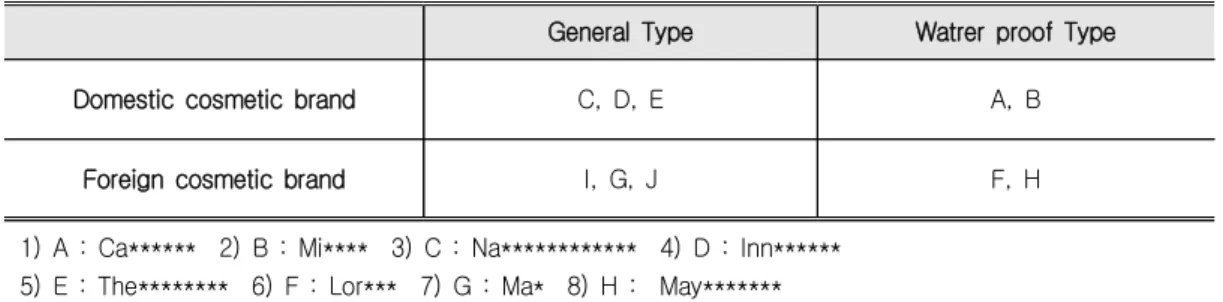
Table 1. Characteristic of Eyeliner Products
General TypeWatrer proof Type
Domestic cosmetic brand C, D, E A, B
Foreign cosmetic brand I, G, J F, H
1) A : Ca****** 2) B : Mi**** 3) C : Na************ 4) D : Inn******
5) E : The******** 6) F : Lor*** 7) G : Ma* 8) H : May*******
9) I : Bo******** 10) J : To******
foreign products considering that awareness, price and popularity. Domestic products were A to E. and F to J were foreign ones<Table 1>.
10 eyeliner products were classified general type and water proof type by characteristic.
2. Method
The samples were diluted with water to 1/1600. 100 mg of samples were digested with 3 mL of 70% nitric acid and 3 mL of 98%
sulfuric acid using microwaves 20 minutes at 200 ℃ temperature. To analyze the amount of heavy metals, we used inductively coupled plasma mass spectrometer (ICP/MS-LC, Nexion 300x, Perkin Elmer, USA). We measured the amounts of heavy metals from samples using curve of standard solutions. An analytical estimation test was performed for 5 elements such as aluminium(Al), manganese(Mn), nickel(Ni), arsenic(As) and lead(Pb).
3. Data Analysis
All statistical produres were conducted using the SPSS statistical package(version 17.0 program). Data were analyzed the descriptive statistics, mean, standard deviation and t-test.
III. Results and Discussion
The result from heavy metals of commercially available domestic and foreign eyeliner components, typically displayed heavy metal measurements are aluminum (AL), a manganese(Mn), nicke(Ni), arsenic(As), lead(Pb), it is as of <Table2>.
All 10 samples did not exceed the range of a predetermined current limit of heavy metal lead 20 ppm, non-small 10 ppm and lead and arsenic was found to contain a very small amount compared with the limit.
In the eyeliner on the market, available aluminum of heavy metals contains up to at most 19321 ppm, at least 139 ppm compared to nickel, manganese, in particular F, H, J has a lot of product contents than in other products.
All these products was long lasting and no smearing on marketing.
In manganese content, G products is the
highest as 4,446 ppm, then I products are
following as 1,715 ppm. In the lead content, the
eyeliner is the most than the pack, whitening
creams, massage creams, cleansing creams, lip
liner and it showed a high value compared to
the other products to 8.3 ppm in the domestic
appliance of nine products in the study of
(4)
Baik(2005). But recently lead content was greatly reduced compared to the past with less than 1ppm, arsenic was detected in less than 2 ppm in the study of Choi(2014).
Nickel appears the average 59.10 ppm, it has a difference to exhibit a slightly higher content than the results reported by 0.830 ± 0.991 ㎍ /g in the study of Choi(2014). According to his research, in eight kinds of heavy metals(lead, cadmium, arsenic, chromium, antimony, nickel, copper and cobalt) eyeliner represents the highest metal concentrations of chromium and nickel has been reported as the chrome 1.424 /g, lead 0.765 ± 0.723 /g, arsenic 0.027 ±
㎍ ㎍
0.036 ㎍ /g in the color cosmetic.
SampleAlMnNiAsPb
Domesticcosmetic brand
A¹⁾ 686 363 39 0.800 0.384
B²⁾ 139 207 21 0.624 0.272
C³⁾ 167 493 95 0.512 0.288
D⁴⁾ 229 207 35 0.448 0.320
E⁵⁾ 226 250 30 0.512 0.512
Foreigncosmetic brand
F⁶⁾ 17,973 935 40 1 1
G⁷⁾ 950 4,446 120 1 0.704
H⁸⁾ 17,462 355 53 2 1
I⁹⁾ 803 1,715 121 0.512 0.304
J¹⁰⁾ 19,321 943 37 0.512 1
1) A : Ca****** 2) B : Mi**** 3) C : Na************ 4) D : Inn******
5) E : The******** 6) F : Lor*** 7) G : Ma* 8) H : May*******
9) I : Bo******** 10) J : To******
Table 2. Heavy metal composition levels in eyeliner products (unit: ppm) The color cosmetics contains heavy metals due to the addition of the dye or pigment, it leads to contact dermatitis. In the case of eye cosmetics such as eyeliner, by applying directly to the eye mucosa, the risk of heavy metal absorption can be greater than any other product.
It was already made a number of
manufacturing management for heavy metals in
Food and Drug Safety regulations and its
contents gradually decreases, but Aluminum,
manganese, nickel has not defined present
cosmetic safety limit. Aluminum may cause
irritation when exposed to the skin, eyes and in
the cases of manganese, chronic poisoning can
(5)
give headaches, fatigue, etc. These heavy metals are contained in lipstick (aluminum 2,521
85,670 ppm, manganese 0.30 8.11 ppm) as
∼ ∼
well as eyeliner(Women's Environmental Network, 2014). The pigment content is detected at the highest concentrations relative to other heavy metals in a high color cosmetic, it is considered that this administration standard is to be provided.
To assess comparative analysis, foreign products contained higher amounts of the two elements compared to domestic ones. In case of domestic eyeliner products, 289.4 ppm for aluminium(Al), 304 ppm for manganese(Mn), 44 ppm for nickel(Ni), 0.58 ppm for arsenic(As) and 0.35 ppm for lead(Pb). In case of Foreign eyeliner products, 11337.8 ppm for aluminium(Al), 1678.8 ppm for manganese(Mn), 74.2 ppm for nickel(Ni), 1 ppm for arsenic(As) and 0.8 ppm for lead(Pb).
Figure. 1. Concentrations of Heavy Metals Contained in Eyeliner Sold on the Market
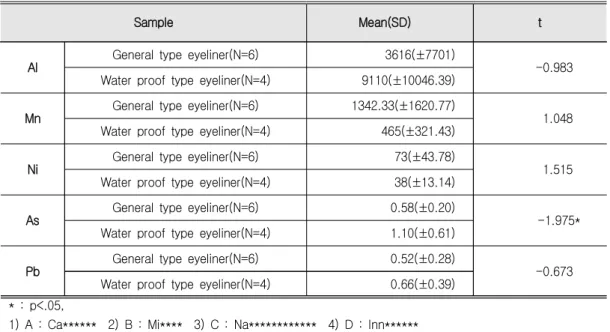
Also 10 eyeliner products were classified general type and water proof type by characteristic<Table 4>. To assess comparative analysis, water proof products contained higher amounts of aluminium, arsenic compared to non-water proof ones. There were a lot of manganese and nickel concentrations in eyeliner products of general type.
In case of general type, 3616 ppm for aluminium(Al), 1342.33 ppm for manganese(Mn), 73 ppm for nickel(Ni), 0.58 ppm for arsenic(As) and 0.52 ppm for lead(Pb). In case of water proof type, 9110 ppm for aluminium(Al), 465 ppm for manganese(Mn), 38 ppm for nickel(Ni), 1.10 ppm for arsenic(As) and 0.66 ppm for lead(Pb).
For the aluminum and manganese which were
included most in the eyeliner, waterproof type was
contain a lot of aluminum. It was found that the
aluminum associated water proof and long lasting
(6)
Table 3. Comparison of Heavy Metal Concentrations in Domestic & Foreign Brand Eyeliner Products (unit: ppm)
1) A : Ca****** 2) B : Mi**** 3) C : Na************ 4) D : Inn******
5) E : The******** 6) F : Lor*** 7) G : Ma* 8) H : May*******
9) I : Bo******** 10) J : To******
Table 4. Comparison of Heavy Metal Concentration in General & Water Proof Type Eyeliner Products (unit: ppm)
SampleMean(SD)t
Al General type eyeliner(N=6) 3616(±7701)
-0.983 Water proof type eyeliner(N=4) 9110(±10046.39)
Mn General type eyeliner(N=6) 1342.33(±1620.77)
1.048 Water proof type eyeliner(N=4) 465(±321.43)
Ni General type eyeliner(N=6) 73(±43.78)
1.515
Water proof type eyeliner(N=4) 38(±13.14)
As General type eyeliner(N=6) 0.58(±0.20)
-1.975*
Water proof type eyeliner(N=4) 1.10(±0.61)
Pb General type eyeliner(N=6) 0.52(±0.28)
-0.673 Water proof type eyeliner(N=4) 0.66(±0.39)
* : p<.05,
1) A : Ca****** 2) B : Mi**** 3) C : Na************ 4) D : Inn******
5) E : The******** 6) F : Lor*** 7) G : Ma* 8) H : May*******
(7)
IV. Conclusion
This research on the investigation of presence of heavy metals in eyeliner products focused on domestic and foreign cosmetic brand. The contents of arsenic(As) and lead(Pb) were under blow the limit of permissible amounts.
However, foreign products contained higher amounts of the two elements compared to domestic ones. In addition, greater concentrations of arsenic(As) were detected from waterproof products than non-waterproof ones. The data generated will create awareness about risks associated with indiscriminate use of heavy metals items used in the manufacture of color cosmetics. The adverse effects of heavy metals in eye cosmetic, eyeliner have become an active area of research in the field of beauty chemical and manufacturing industries. This research is important for the evaluation and characterization of sources of standard in heavy metal permission.
References
Adeela, M., Charles, C. (2012). Transport and interaction of cosmetic product material within the ocular surface: Beauty and the beastly symptoms of toxic tears. Contact Lens &
Anterior Eye, 35(10), 24-259.
Al-Ashban, R. M., Aslam, M., Shah, A. H.
(2004). Kohl (surma): A toxic traditional eye cosmetic study in Saudi Arabia. Public Health, 118(4), 292-8
Al-Hazzaa, S. A., Krahn, P. M. (1995). Kohl: A hazardous eyeliner. International Ophthalmology, 19(2), 83-8
Alkhawajah, A. M. (1992). Alkohl use in Saudi Arabia: Extent of use and possible lead
Al-Saleh, I., Nester, M., DeVol, E., Shinwari N., Al-Shahria, S. (1999). Determinants of blood lead levels in Saudi Arabian schoolgirls, International Journal of Occupational and Environmental Health, 5(2), 107-14
Chae man, C., Young sook, H., Ae sook, P., Hyun jung, K., Jung hun, K. (2014). A Study on Heavy Metal Concentrations of Color Cosmetics in Korea Market, Journal of the society of cosmetic scientists of Korea, 40(3), pp.269-278
Dengxin, L., Guolong, G., Fanling, M., Chong, J.
(2007). Preparation of nano-iron oxide red pigment powders by use of cyanided tailings, Journal Of Hazardous Materials, 155(1), 369-377
FDC legislation. (2011). Assurance of Cosmetics Among Europe, USA and Republic of Korea, 6(1) 19-28
Hardy, A. D., Walton, R. I., Myers, K. A., Vaishnav, R. (2006). Availability and chemical composition of traditional eye cosmetics ("kohls" used in the United Arab Emirates of Dubai, Sharjah, Ajman, Umm Al-Quwain, Ras Al-Khaimah, and Fujairah, Journal of Cosmetic Science, 57(2), 107-125
Health Canada Natural Health Products Directorate. (2007) Evidence For Quality Of Finished Natural Health Products.
Hyeon Ju, L., Jung Soon, Y., Ju Young L.
(2006). A Study on Heavy metal Concentration in Color painting cosmetics, Jounal of The Korean Society of cosmetology, 12(1), 57-65 Im-gu, P. (2008). A Study on the Naturalistic
Cosmetics Purchasing Behavior and Attitudes
According to Women's LOHAS Lifestyle,
Journal of fashion business, 12(1), 63-75
Jallad, K. N., Hedderich, H. G. (2005).
(8)
Characterization of a hazardous eyeliner (kohl) by confocal Raman microscopy, Jounal of Hazard Mater, 24(1-3), 236-40
Mojdehi, G. M., Gurtner, J. (1996), Childhood lead poisoning through kohl, American Journal of Public Health, 86(4), 587-8
Nir, A., Tamir, A., Zelnik, N., Iancu, T. C.
(1992). "Is eye cosmetic a source of lead poisoning?", Journal of Medical Science, 28(7), 417-21
Parry, C., Eaton, J. (1991), Kohl: A lead-hazardous eye makeup from the Third World to the First World, Environmental Health Perspectives, 94, 121-123
Rajagopal, M., Alagunambi, R., Nanjan, V.
(2015). ICP-OES investigation of heavy metal concents in cosmetic products, Jounal of Pahamacy Research, 9(1), 27-30
Ruiz, M. A, Clares, B, Morales, M. E, Cazalla, S., Gallardo, V. (2007). Preparation and stability of cosmetic formulations with an anti-aging peptide, Journal of Cosmetic Science, 58(2), 157-171
Seon-a, B. (2005). Study on hazard heavy metal contents in cosmetics, Korean Journal of Aesthetic Society, 3(1), 163-176
So-jin, K., Young-hwan, P., Hea-jung, L., Jae-ho, L., Tae-soo, R. (2009). A study of minimizing heavy metal content in metal complex dye development, Journal of fashion business, 13(5), 55-65
Sun-ok, H., Koh-mi, C., Chun-sim, K. (2005).
The Optical illusion Effect of Lne Applied to Eyebrow Make-up, Journal of fashion business, 9(9), 28-39
Women's Environmental Network. (2014). Survey Report on the heavy metals contained in lipstick ‘Fatal Lipstick’
Zoe, D. R. (2001). Special consideration in eye cosmetics, Clinics in dermatology, 19(4), 424-430