파킨슨병에 대한 국내 한의학 관련 실험 연구 동향
주환수, 유옥철, 한 창, 양규진*, 이성엽
†
, 문혜연†
자생한방병원 한방신경정신과, 침구과*, 한방부인과
†A Review on Experimental Studies of Parkinson's Disease in Korean Medical Journals
Hwan Soo Joo, Ok Cheol Yu, Chang Han, Kyu Jin Yang*, Sung Yub Lee † , Hye Yeon Moon †
Departments of Oriental Neuropsychiatry, *Acupuncture and Moxibustion,
†Oriental Obsterics and Gynecology, Jaseng Hospital of Korean Medicine
Received: July 10, 2017 Revised: August 16, 2017 Accepted: August 29, 2017
Objectives: The purpose of this study is to review experimental studies of Parkinson's Disease in Korean medical journals, which have been published since 1990.
Methods: Experimental studies related to Parkinson's disease published in Korean medical journals, registered with Korea research foundation, were searched. Articles were grouped into journal of pub- lication, subject, and publication year. Experimental study subjects and models were analysed.
Results and Conclusions: Twenty-two articles about experimental studies of Parkinson's Disease in Korean medical journals were included in our review. There were 13 articles in which herbs were used for treatment, 4 articles in which bee venom was used for treatment, 4 articles in which acupuncture was used for treatment, and 1 article in which pharmacopuncture was used for treatment. Most of the studies used experimental models of MPTP-induced Parkinson's disease and MTT assay was used to an- alyse cell toxicity and cell viability. Pole test, rotarod test, Morris water maze test, and forced swimming test were commonly used to analyse MPTP-induced behavioral deficits in animals. Analysis on ex- perimental studies of Parkinson's disease was categorized into the subjects of dopaminergic cell pro- tective effect, cell-apoptosis protectiveness, anti-inflammatory effect, and anti-oxidative effect.
Key Words: Parkinson's disease, Experimental study, Korean medicine, Herbal medicine, Acupuncture, Pharmacopuncture.
Correspondence to Hwan Soo Joo Department of Oriental Neuropsychiatry, Jaseng Hospital of Korean Medicine, 858 Unju-ro, Gangnam-gu, Seoul, Korea.
Tel: +82-2-3218-2493 Fax: +82-2-3445-6644 E-mail: [email protected]
Copyright © 2017 by The Korean Society of Oriental Neuropsychiatry. All rights reserved.
CC
This is an open access article distributed under the terms of the Creative Commons Attribution Non-Commercial License (http://creativecommons.org/licenses/by-nc/4.0) which
permits unrestricted non-commercial use, distribution, and reproduction in any medium, provided the original work is properly cited.
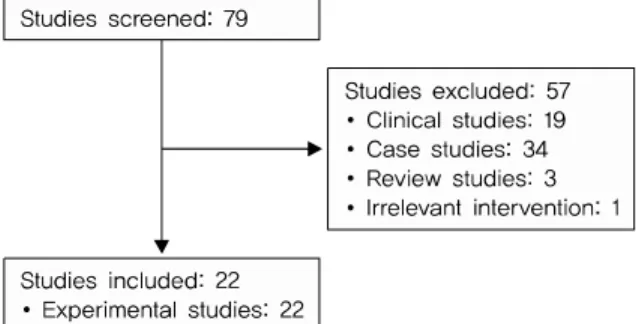
Fig. 1. Flow Diagram Prefered Reporting Items for Review.
I. 서론
파킨슨병은 뇌흑질(substantia nigra) 부위의 도파민 신 경이 사멸하여 선조체(striatum)로 연결되는 흑질-선조체 도파민성 신경계(nigrostriatal dopaminergic system)의 신 경 전달에 장애가 나타나 그 기능이 소실되어 나타나는 질 병으로 알츠하이머 병 다음으로 높은 유병율을 보이는 퇴행 성 뇌질환으로 일반적인 증상으로는 서동(bradykinesia), 근경직의 증가(rigidity), 안정 떨림(rest tremor), 행동의 동 결(freezing), 자세의 변화(postural change), 비정상적인 자세 반사(abnormal postural reflex) 등이 나타난다1).
파킨슨병은 치매, 중풍과 더불어 노인 3대 질환으로 꼽힌 다. 2011년도부터 2013년도 건강보험심사평가원 질병, 행위 통계에 따르면 파킨슨병은 70∼80대 노인뿐 아니라 40∼50 대 중, 장년층에서도 발병비율이 높아지고 있으며 국내에서 파킨슨병으로 진료를 받는 환자 수는 연평균 약 9%씩 증가 하여 2013년 기준 80,002명이다2). 이런 추세로 볼 때 2040년 에는 파킨슨병이 알츠하이머 병과 더불어 신장암, 악성 흑색 종, 대장암, 폐암 등보다 사망률이 더 높을 것으로 추정된다3).
현재 파킨슨병의 치료는 Levodopa 복용이 일반적이나, 병세가 진행된 파킨슨 병 환자들에게서는 치료의 한계를 보 이고, 장기간 투여시 레보도파 치료와 연관된 부작용이 흔 하게 나타난다. 또한 운동 완서와 강직에는 효과적이지만 진전에 대해서는 별로 효과가 없어, 최근에는 amantadine 이나 MAO-B 억제제(monoamine oxidase B inhibitor), 항 콜린제 및 COMT 억제제(catechol-O-methyltransferase inhibitor) 등의 진전 및 이상 운동 등의 보조 치료제를 함께 쓰고 있다4).
파킨슨병은 한의학적으로 震顫, 痓, 痙, 瘈瘲, 攣과 中風 의 偏枯, 癱瘓, 中腑證의 범주에 속한다고 할 수있다5). 한의 학에서 전증에 대한 최초 언급은 <素問, 至眞要大論>6)에 서 “諸風掉眩 皆屬於肝” “諸暴强直 皆屬於風”이라 하여 파 킨슨병의 주요 증상 중 하나인 진전, 관절 경화, 서동증을 기술한 이래로, 파킨슨병과 유사한 증상을 진전(震顫), 치 (痓), 경(痙), 계종(瘈瘲), 연(攣), 중풍(中風) 등 다양한 표현 으로 서술하였다. 고대 및 현대 문헌을 종합하여 고찰해봤 을 때 파킨슨병의 한의학적인 공통적인 병인은 주로 풍(風), 화(火), 담(痰), 어(瘀), 허(虛)이고, 임상유형은 간신음허(肝 腎陰虛), 기혈양허(氣血兩虛), 담열내저(痰熱內阻), 기체혈
어(氣滯血瘀)로 분류할 수 있으며 장부로는 간(肝), 비(脾), 신(腎), 심(心)과 밀접한 관계가 있다7).
최근 파킨슨병에 대한 연구가 동서양을 막론하고 활발하 게 진행되며 한약재의 신약 개발의 가능성도 높아지고 있지 만 그 치료는 아직 한계가 있으며 부작용이 적으며 효과적 인 새로운 치료방법이 필요하다. 이에 기존의 한의학계에 발표된 학술지와 논문들 중 파킨슨병에 대한 실험 연구를 검토하여, 그동안의 파킨슨병 연구를 고찰하고자 한다.
II. 연구 및 자료조사 방법
1. 자료 조사 방법
1990년 1월부터 2016년 12월까지 발간된 한국연구재단 등재 학술지인 대한한의학회지, 동의신경정신과학회지, 동 의생리병리학회지, 대한침구의학회지, 대한한방내과학회지, 대한경락경혈학회지, 사상체질의학회지, 한방재활의학과학 회지, 대한한방소아과학회지, 대한본초학회지, 대한한방부인 과학회지, 대한예방한의학회지, 대한한의학방제학회지, 대한 약침학회지, Journal of Acupuncture & Meridian Studies를 검색하여 파킨슨병에 관련된 실험 논문을 고찰하였다. 검색 제시어는 “파킨슨, 파킨슨병, Parkinson, Parkinson’s dis- ease”로 한정하였으며, 파킨슨병에 대한 국내 한의학 관련 실험 연구 총 79건의 논문 중 제목과 초록을 통해 파킨슨병에 관한 한의학적 주제가 아니거나 실험 연구 논문이 아닌 57건 의 경우 배제하였고, 이에 따라 학회지에 발표된 실험 논문 총 22편의 파킨슨병 관련 논문을 대상으로 하였다(Fig. 1).
2. 연구 방법
먼저 학회별 파킨슨병 실험 연구 논문 발표 현황, 주제별
Fig. 3. The number of articles about experimental study of parkinson's disease by subjects.
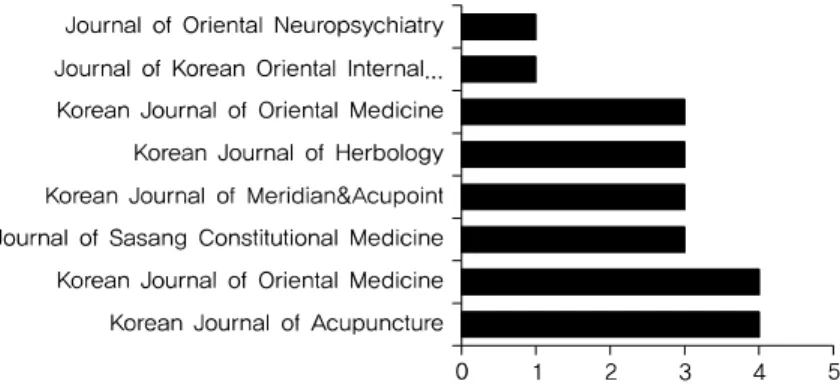
Fig. 2. The number of articles about experimental study of parkinson's disease in Korean medi- cine journals.
파킨슨병 실험 연구 논문 발표 현황, 연도별 파킨슨병 실험 연구 논문 발표 현황 등으로 구분하여 자료를 분석하였다.
또한 현재까지 발표된 실험 연구를 중심으로 한약 단미제를 통한 연구, 복합 처방을 통한 연구, 그리고 기타 한의학적 치료로 나누어 고찰하고, 실험 모델에 따라 분석하여 파킨 슨병 병태 모델 유형, 실험 동물의 행동실험 유형으로 분류 하였으며, 실험 목적에 따라 세포 손상 및 사멸, 항염증, 도 파민성 신경세포 보호, 항산화 효과에 관한 실험으로 분류 하여 고찰하였다.
III. 본론 및 고찰
1. 연구 자료 분류
1) 학회별 파킨슨병 실험 연구 논문 발표 현황
연구 조사된 파킨슨병 관련 실험 논문은 총 22편이었으 며, 대한침구의학회지 4편, 대한한의학회지 4편, 사상체질의학회지 3편, 대한경락경혈학회지 3편, 대한본초학회지 3 편, 대한한방내과학회지 3편, 동의생리병리학회지 1편, 동 의신경정신과학회지 1편이 있었다(Fig. 2).
2) 주제별 파킨슨병 실험 연구 논문 발표 현황
현재까지 발표된 파킨슨병 실험 연구는 단미제 관련 실험 연구가 7편, 복합 처방 관련 실험 연구가 6편으로 한약제 관련된 연구 논문이 전체의 약 56%의 비중을 차지하고 있었 다. 이외에도 봉독약침 관련 실험연구 4편, 침 자극 실험 연구 4편, 자하거 약침 관련 실험연구 1편이 있었다(Fig. 3).3) 연도별 파킨슨병 실험 연구 논문 발표 현황
한의학회 내 파킨슨병에 관한 연구 논문 발표는 1999년 부터 본격적으로 시행되었다. 1999년에 1편, 2002년 1편, 2004년 2편, 2005년 2편, 2006년 1편, 2007년 1편, 2008 년 2편, 2009년 4편, 2010년 2편, 2012년 1편, 2013년 3 편, 2014년 4편, 2015년 2편으로 파킨슨병에 관한 실험 연Table 2. The Experimental Studies about Parkinson's Disease treated with Complex of Herbs (Herbal Medicine)
Author Year Model type Intervention Conclusion
Jung-Wook Lee
15)2009 In vivo PD-1 PD-1 is able to protect dopaminergic neurons from MPTP-induced neuronal injury with anti-apoptotic activity being one of the possible mechanisms.
In-Ja Kim
16)2012 In vivo Sohaphwangwon Neuroprotective Effect of Sohaphwangwon essential oil is mediated by the expression of brain-derived neurotropic factor (BDNF).
Hee-Ju Kim
17)2013 In vitro Modified Yeoldahanso-tang (MYH)
Modified Yeoldahanso-tang (MYH) can enhance the induction of autophagy through key regulator AMPK, mTOR, and Beclin-1.
Ga-Yeon Go
18)2014 In vivo/
in vitro
Hyangsayangwi-tang (HY) HY prevents MPTP-induced loss of serotonin, hippocampus and TH-ir cell
Chan Woo
19)2014 In vitro Sosokmyoung-tang Sosokmyoung-tang exerts neuroprotective effects on human neuroblastoma SH-SY5Y cells by MPTP-induced dopaminergic neurodegeneration.
Ga-Yeon Go
20)2015 In vivo/
in vitro
Modified Yuldahanso-tang (MYH)
Neuroprotective effect of MYH is mediated by the increase in Dopamin, TH-ir cell, Hippocampus and Serotonin.
Table 1. The Experimental Studies about Parkinson's Disease treated with Single Herb
Author Year Model type Intervention Conclusion
Ho-Cheol Kim
8)1999 In vitro Gastrodiae Rhizoma Gastrodiae Rhizoma has no neuroprotective effect on the cytotoxicity induced by MPP
+in dopaminergic cell culture.
Ki-heon Chae
9)2005 In vitro PaeoniaeRadixExtract Paeoniae Radix may exert a protective effect against MPP
+-induced apoptosis in SK-N-MC Neuroblastoma Cells
Kap-Duk Lee
10)2008 In vivo Celastrol It may be possible to use celastrol for the prevention of nigral degenerative disorders including parkinson's disease, caused by exposure to toxic substances.
Young-seok Jung
11)2009 In vitro Phellodendri Cortex Neuroprotective potentials of Phellodendri Cortex extract against MPP
+-induced apoptosis can be at least partially described to its anti-apoptotic effects in PC-12cells.
Hyo Geun Kim
12)2013 In vivo Chrysanthemum boreale extract
Anti-parkinsonism effect of Chrysanthemum boreale is possibly due to the antioxidative effects at mid brain in MPTP-induced animal model.
Sung Hoon Kim
13)2013 In vivo/
in vitro
Cyperi Rhizoma Cyperi Rhizoma extracts shows anti-parkinsonian effect by protecting dopaminergic neurons against MPP+/MPTP toxicities through anti-inflammatory actions.
Gunhyuk Park
14)2014 In vivo/
in vitro
Thuja orientalis leaves extract
Thuja orientalis leaves extract showed anti-parkinsonian effect by protection of dopaminergic neurons against MPTP toxicity through anti-inflammatory actions
구가 지속적으로 진행되고 있었다.
2. 실험연구
본 연구의 22편 논문을 주제별로 단미제, 복합처방, 기타 한의학적 치료로 분류하였다.
1) 단미제 중심의 파킨슨병 실험 연구 현황
현재까지 총 7편의 단미제 연구가 이루어졌으며 대부분 1-methyl-4-phenyl-1,2,3,6-tetrahydropyridine (MPTP), 1-methyl-4-phenylpyridinium (MPP+) 독성 물 질로 유도된 파킨슨병 병태 모델 연구 형태를 취하고 있었
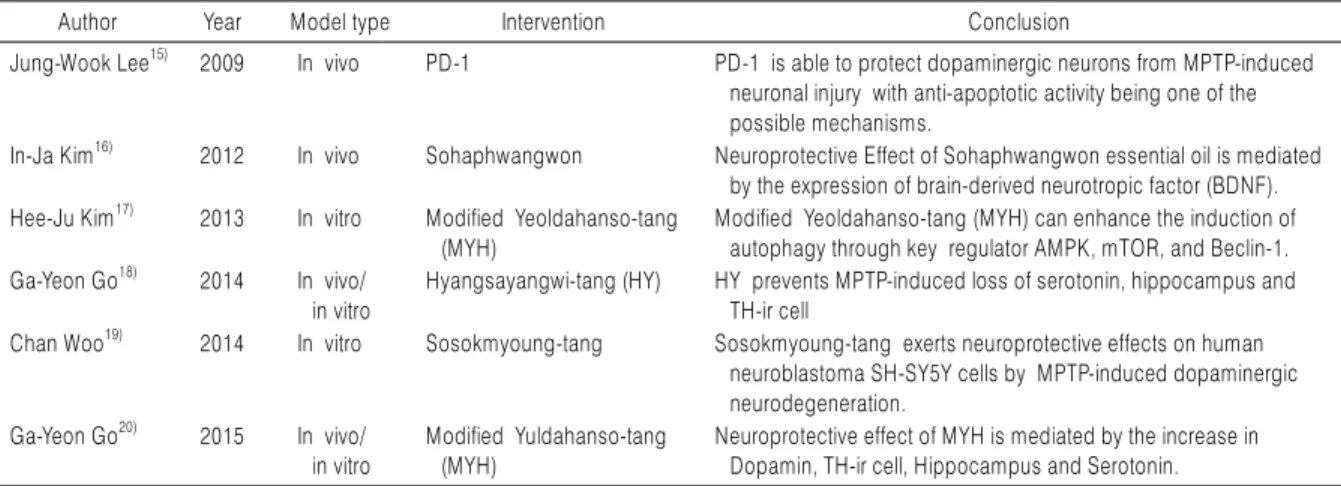
다. 파킨슨병 연구에 사용된 단미제는 모두 다른 총 7종으로 세포 손상 및 사멸, 염증 억제, 항산화 등 다방면에서 연구되 었다(Table 1).
2) 복합처방 중심의 파킨슨병 실험 연구 현황
현재까지 총 6편의 복합처방 중심의 파킨슨병 실험 연구 가 이루어졌으며 대부분 MPTP, MPP+, 독성 물질로 유도된 파킨슨병 병태 모델 연구 형태를 취하고 있었다. 파킨슨병 연구에 사용된 복합 처방은 모두 다른 총 6종이었으며 세포 손상 및 사멸, 염증 억제, 항산화 등 다방면에서 연구되었다 (Table 2).Table 3. The Experimental Studies about Parkinson's Disease treated with Other Korean Medicine Treatment
Author Year Model type Intervention Conclusion
Yeung-Kee Kim
21)2005 In vivo Acupuncture Acupuncture treatment at ST36 acupoint significantly inhibited rotational asymmetry in rats with PD and also protected against 6-OHDA-induced nigrostriatal dopaminergic neuronal loss.
Seung-Tae Kim
22)2006 In vivo Acupuncture The number of TH-positive neurons of Liver+ group was significantly increased compared to that of MPTP group in the SN. That of Liver- group was also increased more than MPTP group, but not significantly.
Jeong-Yeon Hwang
23)2007 In vivo Acupuncture Acupuncture showed the effect of inhibition of microglial activation in the rat model of Parkinson's disease through the CD11b immunohistochemistry.
Kim Chan-young
24)2009 In vivo Bee Venom Dose dependent of Bee venom at BL23 inhibited MPTP-induced neuronal loss of TH-IR neurons and microglial activation in the SNpc of a mouse of PD model.
Park Won
25)2010 In vivo Bee Venom Bee venom acupuncture inhibited MPTP-induced neuronal loss of tyrosine hydroxylase(TH)-positive neurons and suppressed microglial activation in MAC-1, iNOS and HSP-70 expression. Furthermore, BVA prevented MPTP-induced apoptosis of DA neurons via caspase-3 inhibition.
Jun Hyung-joon
26)2010 In vivo Bee Venom BVA inhibited apoptosis by inhibiting caspase and reducing NO production by decreasing iNOS expression, preventing MPTP-induced cell death of dopaminergic neurons.
Kwang-rok Bae
27)2010 In vivo Bee Venom Sweet bee venom lowered caspase-3 activity in MPP+ induced cellsthus has a protective effect on SH-SY5Y cells from apoptotic cell death.
Hyung Joon Jun
28)2015 In vivo/
in vitro
Hominis Placenta Herbal Acupuncture
Treatment of HP prevented cell loss and protected neurites against MPP+
toxicity. In vivo treatment of HP herbal acupuncture did not show significant changes on dopaminergic cells and fibers in substantia nigra and the striatum.
Hyungjun Jeon
29)2015 In vivo Acupuncture Acupuncture stimulation at GB34 can inhibit MPTP-induced dopaminergic neuronal death and alleviate the Akt phosphorylation in the SN.
3) 기타 한의학적 치료의 파킨슨병 실험 연구 현황
한약재를 제외한 기타 치료에 대한 실험 연구는 총 10편 으로 대부분 MPTP, MPP+, 6-OHDA 독성 물질로 유도된 파킨슨병 병태 모델 연구형태를 취하고 있었다. 파킨슨병 연구에 사용된 기타 치료에 관한 연구는 봉독약침 관련 실 험연구 4편, 침 자극 실험 연구 4편, 자하거 약침 관련 실험 연구 1편, 운동 효과 실험 연구 1편으로 도파민 신경세포 보호, 세포 손상 및 사멸, 염증 억제, 항산화 등 다방면에서 연구되었다(Table 3).3. 주요 실험 모델 분석
한의학 분야에서 파킨슨병에 대한 실험적 연구 논문을 고찰하여 보면 대한침구의학회지, 사상체질의학회지, 대한 한의학회지, 대한본초학회지, 대한경락경혈학회지 등 기초 및 임상 한의학 분야 모두에서 광범위하게 연구가 진행되고 있었으며 실험 기법도 점차 다양해짐을 알 수 있다. 주로 파킨슨병 병태모델을 이용한 실험용 동물 모델에 대한 신경
세포 연구와 유전자에 대한 연구로 활성화 되고 있다. 기존 의 단일 처방과 복합 처방 등이 폭넓게 활용되고 있으며, 봉독약침과 경혈 침자극, 운동요법 등을 이용한 연구 등의 임상보고가 증가하였으며, 뇌신경세포의 독성이나 파킨슨 병 병태모델과 생화학적 병리산물에 대한 연구도 이루어지 고 있다. 파킨슨병에 대한 연구를 주된 병태 모델 유발 기전 에 관한 고찰, 실험용 동물의 기억, 인지, 학습 등 행동실험 에 관한 고찰, 그리고 파킨슨병 실험 연구 목적에 따른 연구 특성에 대한 고찰로 크게 분류하여 고찰하였다.
1) 파킨슨병을 유발하는 독성에 관한 기전 및 고찰 (1) 파킨슨병을 유발하는 독성
전체 23편의 논문 중 20편의 논문이 MPTP로 인해 유발 된 파킨슨병의 병태 모델에 관한 실험 연구였다. 파킨슨병 에 관한 연구는 주로 사후 뇌 조직도 이용하고 있지만, 다양 한 연구에 한계가 있어 강력한 산화작용으로 독성을 유발하 는 6-hydroxydopamine (6-OHDA)나 사립체 효소억제제 로 알려진 MPTP를 주사하여 만든 파킨슨병 모델을 실험에
사용해 왔다30). 즉, 파킨슨병의 동물모델로는 toxin model 들로 환경적인 요인들이 파킨슨병에 기여하므로 neuro- toxin 중에 도파민 신경의 퇴행을 유발하는 MPTP, 6-OHDA 및 rotenone 등이 가장 널리 사용되고 있으며, 그 외에 paraquat 등이 MPP+와 구조적 유사성 때문에 사 용되고 있다31,32).
(2) 세포 활성도 및 세포 독성 측정(MTT assay)
총 6편의 논문에서 세포 독성과 생존율을 알아보기 위해 MTT assay 실험이 진행되었다. MTT assay는 탈수소 효소작 용에 의하여 노란색의 수용성 기질인 MTT tetrazolum을 청 자색을 띄는 비수용성의 MTT formazan으로 환원시키는 세 포의 능력을 이용하는 검사법이다. 세포생존율(Cell Viability,%)은 정상군의 값을 control로 하고 이때의 optical density (O.D.) 값을 세포의 생존도가 100%라고 정의하고, 나머지 군 의 측정한 O.D. 값을 상대치로 환산을 하여 값을 얻었다16).
2) 파킨슨병 모델 실험용 동물의 행동실험에 관한 고찰 (1) Pole test&Rotarod test
본 연구 중 5편에서 pole test, 4편에서 rotarod test가 시행되었다. Pole test에서 생쥐가 막대 꼭대기를 180° 돌아 서 생쥐의 머리가 완전히 아래로 내려오는 시간을 ‘time to turn’, 생쥐가 꼭대기를 180° 돌아서 내려와 네 다리가 땅에 닿을 때까지 걸리는 시간을 ‘time for locomotion activity’
(Time for LA)로 표기하여 측정한다. 무운동성과 경직반응 에 대한 영향을 알아보기 위한 운동실험인 Pole test는 앞발 의 정교한 근육조절 기능을 조사할 수 있으며, 흑질-선조체 도파민성 신경계의 이상 여부를 가장 민감하게 알 수 있는 행동실험으로 알려져 있다33). Rotarod test는 회전 전봉 위 에 실험용 생쥐를 올려놓고 회전속도를 견디는 시간을 측정 해 운동 기능 감퇴 정도를 판단하는 행동실험으로 알려져 있다34). 주로 MPTP 유발 모델에서 운동능력이 현저히 저하 되어 time to turn과 time for LA의 증가 및 총 운동거리 (movement distance)의 감소를 확인함으로서 서동이 야기 됨을 알 수 있다.
(2) Morris water maze test
Morris water maze test란 파킨슨병 질환의 증상중 하나 인 인지 장애, 기억력 저하의 증상 개선에는 어떠한 효과를 끼치는지 알아보기 위한 행동 실험으로 총 2편의 연구에서 시행되었다. Morris water maze test는 일정 기간 동안
mouse를 Morris water maze내 위치한 platform에 찾아갈 수 있도록 훈련을 시킨 다음, 얼마간의 헤매는 시간과 거리 가 걸려서 platform까지 가는지 그 수치를 측정하는 실험이 다20). 그 결과 시간이나 거리를 측정해 유의성을 관찰하는 것인데, 헤맨 시간의 단축이 뜻하는 것은 파킨슨병으로 인 해 떨어진 인지 기능 및 기억력 저하를 유발하는데 유의하 다는 것을 의미한다.
(3) Forced swimming test
Forced swimming test가 2편의 연구에서 진행되었다.
강제 수영 검사는 다른 말로 절망행동검사라고 불리며 약물 개발시의 항 우울 효과를 검색하는 기본적인 행동 관찰 실 험으로 알려져 있다. 강제로 실험용 동물을 물에 빠뜨려 시 간이 흐를수록 점점 동물이 얼굴을 포함한 상체의 일부분만 수면 뒤로 드러낸 채 몸의 균형을 유지하기 위하여 약간의 움직임만을 나타낼 뿐 물 위에 단순 떠있는 상태인 부동 자 세를 보이는 시간을 측정하는 방법이다. 파킨슨병에 걸리게 되면 정신과적 증상이 흔히 동반된다고 알려져 있다. 기질 적인 변화가 원인이 되거나 혹은 신체 변화에 따른 감정 변 화에 의한 것으로 추정되며 그 중 우울감이 대표적인 증상 이다. 연구 결과에 따르면 파킨슨병에서 우울 증상의 동반 빈도는 약 40∼70%에 달한다고 보고되고 있다35).
3) 파킨슨병에 관한 실험 연구 목적에 대한 특성 분류
및 고찰
파킨슨병은 뇌흑질 부위의 도파민 신경이 사멸하여 선조 체로 연결되는 흑질-선조체 도파민성 신경계의 신경 전달에 장애가 나타나는 질환이다3). 이 때 여러가지 병리학적 요소 가 중요한 역할을 하게 되는데 mitochondrial dysfunction, excitotoxicity, impared protein degradation, inflam- matory processes, oxidative stress 그리고 apoptosis가
그것이다36,37). 이에 파킨슨병을 유발한 실험 모델에 관한 연
구를 실험 목적에 따라 대표적으로 도파민 신경세포 보호효 과, 세포 사멸에 대한 신경세포 보호효과, 세포에 대한 항염 증 효과, 산화적 손상에 대한 항산화 효과로 분류하고 고찰 하였다.
(1) 도파민 신경세포 보호효과
Parkinson’s disease에서 흑질 변성은 이들 신경 세포들 이 도파민성이며 도파민성 신경섬유들은 미상핵과 피각을 통해 치밀한 신경망을 형성하고 있는 신선조체에 주로 투사
된다. 선조체 도파민의 소실은 흑질 내의 신경세포 소실의 정도에 비례하며 사후 검사 상 Parkinson’s disease에서 흑 질 변성은 정상적인 검은 색소의 소실에 근거한다38). 흑질 선조체 경로 퇴행 정도를 측정하기 위해 태아중뇌를 적출한 후 substantianigra (SN)과 Striatum을 분리하고 Western blot법을 이용하여 Tyrosine hydroxylase (TH), Brain-de- rived neurotrophic factor (BDNF) 등의 단백질을 정량화 하여 각 단백질의 발현 정도를 측정하며, 도파민수송체 (dopamine transporter, DAT) 발현 정도를 측정하는 방법 도 주로 사용되었다.
총 14편의 논문에서 도파민 신경세포의 보호효과와 관련 하여 TH positive 발현을 면역조직화학염색법을 통해 시행 되었다. 이는 조직의 변성 정도를 알기 위해 태아중뇌세포 와 뇌 조직의 선조체 및 흑질 부분에 TH positive cell을 염색하여 도파민성 신경세포 소실 정도를 관찰하는 방법으 로, 일반적으로 MPTP 독성 유발된 모델에서는 TH positive 도파민 세포가 감소한다21). TH는 도파민 생합성 관련 신경 에 포함되어 있는 tyrosine으로부터 dopamine과 epi- nephrine을 합성하는 과정의 전반적인 속도조절을 담당하 는 것으로 알려져 있다39). 이러한 TH는 포유동물의 중추신 경계에서 hypothalamus, midbrain, brainstem, olfactory bulb 등의 특정부위에서만 제한적으로 발현되기 때문에 높 은 조직 특이성을 나타낸다. 특히 도파민 신경세포의 분화 가 적절히 일어나지 못하거나 여러 원인으로 인한 중뇌 도 파민 신경세포의 사멸 후 재생과정에서의 적절한 TH 유전 자의 발현 조절이 일어나지 않는 것이 파킨슨병의 병리적 원인으로 밝혀졌다. 이에 따라 이러한 유전자의 유도 발현 이 파킨슨병의 예방 또는 치료에 있어서 매우 중요한 역할 을 할 것으로 추정된다.
면역조직화학법을 이용하여 흑질에서의 단백질 발현을 분석했을 때 일반적으로 MPTP 처리 군의 흑질에서 BDNF 단백질 발현이 정상군보다 낮게 나오는 것으로 확인된다16). BDNF는 Neurotrophin 4/5 (NT-4/5)와 구조적으로 연관 되어 있으며, 이들은 세포질 내 tyrosine kinase domain을 활성화하여 신경성장작용을 나타낸다. 이러한 신경성장인 자들은 중추 및 말초 신경계 신경세포의 발달과 유지에 필 수적인 역할을 하며, 발생동안의 고사(apoptosis)를 억제하 고 신경세포의 성장을 촉진하는 역할을 한다40).
도파민수송체(DAT)는 축색돌기에서 방출된 도파민을 다
시 신경세포내로 재흡수하는 역할을 하는 구조물로, 발현량 이 감소하게 되면 도파민의 재흡수가 어려워짐으로 인해 도 파민성신경전달의 장애가 발생하게 된다. 실험군에서 도파 민수송체의 발현량이 회복된다면 이는 MPTP로 인한 선조 체 내 축색돌기의 파괴를 억제하고, 아울러 도파민의 재흡 수를 정상화함으로써 도파민성신경세포의 기능을 유지시키 고 운동 기능을 회복시키는 것으로 판단할 수 있다29).
(2) 세포 사멸에 대한 신경세포 보호효과
파킨슨병에 관련한 총 8편의 실험 연구 논문에서 세포 사멸에 관하여 조사하였다. 세포 사멸에 관한 신경세포의 보호효과를 관찰하기 위해 주로 Anti-apoptotic 유전자인 bcl-2의 발현과 pro-apoptotic 유전자인 bax의 발현에 대 해 세포 손상에 의해 증가되는 bax/bcl-2비율을 억제하는 방법이 모색된다. 또한 caspase-3 enzyme의 활성으로 세 포사멸로부터의 세포보호 효과 측정 및 Protein kinase B (PKB or AKT), extracellular signal–regulated kinases (ERK) enzyme을 측정하여 세포의 신경보호효과의 기전을 알아볼 수 있다.
세포 사멸 과정의 초기 단계에서의 세포 생존은 우선적으 로 bcl-2 family의 pro-apoptosis 단백질과 anti-apopto- sis 단백질 간의 균형에 달려 있으며, bax/bcl-2의 비는 bax와 bcl-2 각각의 농도 보다 세포사멸의 좋은 예측 인자 가 된다. 또한 bax/bcl-2의 비가 감소한다는 것은 cyto- chrome c의 분비와 caspase-3의 활성이 억제되었다는 것 을 의미한다41). 즉, caspase-3의 활성화를 통해 Poly (ADP- ribose) polymerase (PARP) cleavage가 일어나면 세포 사 멸의 신호가 세포막으로부터 bcl-2 family의 세포 사멸 유 도 분자인 bax를 통해 미토콘드리아로부터 cytochrome c 를 방출시킴으로써 세포사멸을 가속화 시키게 된다42).
AKT, ERK enzyme을 측정에 관해 알기 위해서 cell sur- vival pathway에 대한 이해가 있어야한다. PI3K-AKT kin- ase pathway가 그 핵심인데 AKT가 그 central player가 된다. AKT는 forkhead transcription factor를 인산화시켜 death-promoting genes을 전사(transcription)시키는 것 을 억제하고, Bad를 인산화 시켜 14-3-3 protein과 결합하 게 하여 Bcl2/Bcl-XL가 미토콘드리아에서 Bax와 Bak의 death-promoting action을 하는 것을 억제하게하며, p53 의 apoptotic action을 억제하고, caspase-9 activity도 억 제한다. AKT는 또한 IκB의 degradation를 촉진하여 NF-
κB-mediated transcriptional activation이 잘 일어나게 해서 apoptosis를 억제한다. 그리고 ERK는 AKT와 함께 Bad를 인산화시켜 14-3-3 protein과 결합하게 하여 Bcl2/Bcl-XL가 미토콘드리아에서 Bax와 Bak의 death- promoting action을 하는 것을 억제하게 한다. 이러한 기전 으로 AKT와 ERK가 cell survival pathway의 중요한 en- zyme이 된다43,44).
(3) 세포에 대한 항염증 효과
파킨슨병 모델에서 항염증 효과에 대한 연구는 총 5편으 로 파킨슨병 유발 독성으로 인한 모델의 신경염증반응에 대 해 NO생성량, TNF-α 및 면역조직화학을 통해 흑색질 주 변 신경 아교 세포의 활성화를 관찰하여 뇌염증 억제효과 및 항파킨슨병 효과를 연구한다. 파킨슨병의 원인 중 신경 염증45) 등이 거론되고 있는데, 특히 유전적 요인이나 환경적 독소로 인해 신경손상이 일어나면 신경염증 세포인 미세 아 교 세포(microglia) 등이 활성화되어 cytokine을 생성하는 기전으로 뇌신경세포사멸을 촉진한다고 알려져 있다45). MPTP 독성에 단회 노출된 경우에도 흑질과 선조체의 미세 아교 세포가 활성화되며46) NO/inducible nitric oxide syn- thase 이외에도 tumor necrosis factor-alpha (TNF-α), interleukin-1beta (IL-1β), IL-6 등의 사이토카인을 생성 하여 파킨슨병의 염증매개반응을 활성화하여 신경세포의 사멸을 유도한다47). 파킨슨병 세포와 동물 모델에서 TNF signaling을 저해한 결과 도파민 세포의 사멸이 감소되며48), TNF 수용체가 결핍되는 형질전환쥐에서는 MPTP 투여독성 에 대한 저항성이 있다49)는 보고를 통해 파킨슨병 모델에서 신경염증반응을 억제하면 세포사멸을 억제할 수 있다는 것 을 알 수 있으며, 항염증 작용이 있는 약물이 파킨슨병에 응용 될 수 있음을 시사하는 바이다.
(4) 손상에 대한 항산화 효과
본 연구에서는 총 3편의 논문에서 파킨슨병의 산화적 손 상에 대한 항산화 효과를 주제로 다뤘다. MPTP 세포 독성 대사에 관여하는 효소인 총 monoamine oxidase (MAO)의 활성을 대뇌, 중뇌 및 소뇌에서 관찰, superoxide dismutase (SOD), catalase 및 glutathione peroxidase (GPx)의 활성 을 관찰하는 방법, 세포내 활성산소종(reactive oxygen species, ROS)에 대한 측정과 뇌 조직 중 지질과산화물 (Lipid peroxide)함량의 측정이 중요한 지표로 작용하였다.
MAO는 미토콘드리아 외막에 존재하는 통합 단백질로서
MAO-A와 MAO-B type이 있다. 특히 생체 내에서 MAO-B 의 활성 증가는 MPTP의 대사를 촉진하여 신경독성을 지닌 MPP+의 축적을 증가시킨다50). 현재까지 MPTP의 신경독 성을 완화시킨다고 알려진 것은 Vitamine E, allopurinol, seleniurn, selegiline, centrophenoxine 등이 있으며, 주 로 활성산소 소거 능력에 의해 도파민성 신경세포의 파괴를 완화하거나, 생체 내에서의 MAO-B inhibitor로 작용하여 MPTP 대사를 저해시키는 기전으로 파킨슨병의 치료에 활 용되고 있다51,52).
SOD는 xenobiotics로 인하여 생성된 superoxide anion 을 H2O2로 전화시키는 효소로 생체 내 해독 과정에 관여하 는 효소 중 하나이다. 세포는 superoxide radicals (O2−)에 과도하게 노출되면 SOD의 활성이 증가한다. 실제로 흰쥐를 거의 치사량에 가까운 농도의 산소에 노출시킨 경우, 폐 조 직의 Mn-SOD와 Cu-SOD의 활성이 증가된다고 보고되었
다53,54). Catalase는 체내에서 지방의 자동 산화 및 유기물의
산화로 생기는 H2O2를 H2O와 O2로 분해하여 무독화시키는 radical scavenging peroxidase enzyme으군 활성산소를 물로 변환시켜 체외로 배설시키며, GPx는 catalase와 비슷 한 역할을 하여 glutathione을 매개체로 하여 과산화수소를 물과 산소로 분해시키고 활성산소로부터 세포를 보호하는 데 중뇌에서 catalase와 GPx의 활성 또한 SOD의 활성화와 유사한 결과를 관찰할 수 있다55,56).
정상적인 세포들은 호흡과정 동안 다양한 활성산소종(O2−, H2O2, OH- 등)을 내지만 이는 세포 자체가 갖고 있는 항산 화시스템(GSH, SOD, catalase 등)에 의해 조절되지만 다양 한 자극에 의해 과량의 활성산소종(reactive oxygen spe- cies, ROS)이 발현되었을 경우에는 활성산소종이 세포 자체 에 해로운 신호전달의 시발점이 되어 결국 세포사멸로 이어 지게 되고, 분자생물학적 변화와 세포 손상을 일으킨다19). 과량의 활성산소종은 세포막의 인지질을 자극하여 지질 과 산화(lipid peroxidation) 반응을 유도하여 세포막을 파괴 하는 한편, DNA 손상을 유도한다. 이것을 oxidative stress 라고 하는데 이에 대한 보호효과를 확인하기 위해 활성산소 종의 하나인 hydrogen peroxide및 hydroxyl radical 계열 을 검출하기 위해 DCF-DA 염색법을 통해 세포 변화를 분 석하며, 세포 내 또 다른 활성산소종인 superoxide anion (O2−)을 관찰하기 위해서는 특이적으로 반응하는 DHE를 이용한다19).
4. 분석에 포함된 한의학적 처치에 대한 고찰
22편의 파킨슨병에 대한 국내 한의학 실험 연구에서는 주로 세포손상에 대한 보호효과, 항염증, 항산화, 도파민 신 경세포 보호효과에 관한 연구가 진행되었다. 세포 손상 및 사멸에 대한 보호효과에는 한약 단미로 황백, 작약과 복합 제인 소속명탕, PD-1, 그리고 고분자성분제거 봉침, 봉침 (신수혈 BL23)이 효과적이었다. 항염증 효과에 대해서는 한 약 단미로 측백엽, 향부자가 있었고 봉침(신수혈 BL23), 봉 침(신수혈 BL23, 현종혈 GB39, 곡지혈 LI11)이 효과적이었 다. 항산화 효과에 관해서 한약 단미로 산국이 있었으며 복 합제로 소속명탕, 그리고 침(태충 LR3, 양릉천 GB 34)가 효과적이었다. 도파민 신경세포 보호에 대해 효과적인 한약 단미로 측백엽, celastrol, 천마, 향부자가 있었고 복합제로 소합향원, 열다한소탕, 향사양위탕이 있었고, 봉침(신수혈 BL23, 현종혈 GB39, 곡지혈 LI11)과 봉침(신수혈 BL23)이 효과적이었으며 경혈 침자극으로는 양릉천혈(GB 34)와 태 충(LR3), 양릉천(GB 34), 그리고 간경보사(肝經補瀉)가 효 과적이었다.본 연구는 주로 파킨슨병 병태모델을 이용한 세포 및 실 험용 동물 모델에 대한 신경세포 연구와 유전자에 대한 연 구가 진행되었다. 한의학적인 치료 방법을 이용한 단일 처 방, 복합 처방, 침, 경혈, 봉약침 등에 관현 연구가 진행되었 으나 그 연구 결과가 아직 미미한 상태여서 한의학적 임상 적용에 대한 한계가 있다. 또한 실제 임상에서 주로 처방되 고 효과가 입증된 약물들에 대해 실험에서 그 치료 기전 등 이 입증되고 이것이 임상에서 활용, 검증될 수 있는 피드백 시스템이 매우 필요하다. 노령화되는 현대 사회에서 파킨슨 병은 의료성장산업과 생명공학산업으로서 부가가치가 있 다. 이에 한의학적 치료에 관한 연구 및 활용할 수 있는 방안 에 대해 진단-치료 기술에 대한 지적 재산권 등의 보유와 다양한 특허 출원 및 그에 대한 지원 등이 필요하며, 한의학 과 더불어 인간의 뇌에 관련된 여러 의약학의 전문가들이 협조를 통해 다방면에서 연구를 진행해야 할 것이다.
IV. 결론
1990년 1월부터 2016년 12월까지 발간된 한의학 관련 한국연구재단 등재 학술지에 게재된 논문들 중 파킨슨병에
대한 실험적 연구를 검토하여 다음 결론을 얻었다.
1. 현재까지 한의학회에서 연구 조사된 파킨슨병 관련 실 험 논문은 총 22편이었으며, 대한한의학회지와 대한침구의학 회지에서 각 4편씩 가장 많은 수의 연구가 이루어지고 있었고, 총 8개의 다른 한의학회지에서 파킨슨병 연구를 하였다.
2. 파킨슨병의 한의학적 접근에 관한 22편의 실험적 연 구 중 단미제 관련 연구가 7편, 복합 처방 관련 연구가 6편 으로 한약제에 관한 연구 논문이 59%의 비중을 차지했으며, 그 외에도 봉독약침, 약침, 침자극 등을 이용하여 세포 손상 및 사멸, 염증 억제, 항산화 등 다방면의 연구가 이루어졌다.
3. 22편의 실험 논문 대부분 MPTP, MPP+, 독성 물질 로 유도된 파킨슨병 병태 모델 연구 형태를 취하고 있으며, 많은 연구에서 세포 독성과 생존율을 알아보기 위해 MTT assay 실험이 진행되었다.
4. 파킨슨병 모델 실험용 동물의 행동실험은 pole test, rotarod test, morris water maze test, forced swimming test가 주로 시행되었다.
5. 파킨슨병에 관한 실험 연구 목적은 크게 도파민 신경세 포 보호효과에 관한 연구, 세포 사멸에 대한 신경세포 보호 효과에 관한 연구, 세포에 대한 항염증 효과에 관한 연구, 산 화적 손상에 대한 항산화 효과에 관한 연구로 나눌 수 있다.
REFERENCES
1. Dauer W, Przedborski S. Parkinson’s disease: mecha- nisms and models. Neuron. 2003;39:889-909.
2. Ahn SA. Direct medical costs for patients with parkinson's disease : based on national patients sample for the na- tional health insurance claims data. Graduate School of Sungkyunkwan University Master's thesis. 2014:14.
3. Hubert H. Updates in the medical management of Parkinson's disease. Medical grand rounds. cleveland clinic journal of medicine. 2012;79(1):28-35.
4. Oh MK, Kim TY, Kim DJ, Shin HS. A Case Report of Dyskinesia in Lower Limbs caused by Parkinson's Disease Diagnosed as Shinjeonghyuson. J Int Korean Med. 2007;28(4):919-28.
5. Kim, W.K., Kim, L.H., Jang, I.S. A Review Study of Scalp Acupuncture for Parkinson’s Disease in China. J. of Oriental Neuropsychiatry. 2011;22(4):11-20.
6. Park Sang Min, Lee Sang Hun, In Chang Sig, Kang Mi Gyeong, Jang Dae Il, Kang Seong Gil, Lee Yun Ho.
Literature review on Parkinson’s disease in Oriental medicine. Journal of Korean Acupuncture and Moxibustion Society. 2004;21(1):202-10.
7. Jeong BJ, Kim JW, Kim BY, Woo SH, Na YJ, Shim HJ, Lee WH, Lee JY, Seo HS, Kim YH. A case of tremor in Parkinson's disease treated with Korean medicine. J Int Korean Med. 2006;27(4):954-60.
8. Ho-Cheol Kim, Bok-Nam Lee, Yong-Sik Kim, Sang-In Lee. Neuroprotective Effect of Gastrodiae Rhizoma on Dopaminergic Neuronal Cell Death in Parkinson's disease. Kor. J. Herbology. 1999;14:103-9.
9. Ki-heon Chae, Yun-Kyung Song, Hyung-Ho Lim. The Protective Effect of Paeoniae Radix Extract against 1-methyl-4-Phenylpyridium-induced Apoptosis on SK-N-MC Neuroblastoma Cells. Korean Journal of Oriental Medicine. 2005;26:74-86.
10. Kap-Duk Lee, Kwang-Jin Kim, Yong-Ki Park. Protective Effects of Celastrol, the Triterpenoid Component of Celastrus Orbiculatus, on Dopaminergic Neuronal Cells in 1-methyl-4-phenyl-1,2,3,6-tetrahydropyridine-lesioned Parkinson's Disease Rats. J Korean Oriental Med.
2008;29(4):94-103.
11. Young-seok Jung, Hye-mi Jung, Un-kyo Seo. Neuropro- tective Effect of Methanol Extract of Phellodendri Cortex Against 1-methyl-4-phenylpyridinium-induced Apoptosis in PC-12 Cells. Korean J. Orient.Int. Med. 2009;30(1):
51-63.
12. Hyo Geun Kim, Yeomoon Sim, Myung Sook Oh. Anti-par- kinsonian effect of Cyperi Rhizoma via inhibition of neuro- inflammatory action. Kor. J. Herbology. 2013;28(5):21-8.
13. Sung Hoon Kim, Jongwon Choi. Antioxidant Activity of Water Extract of Chrysanthemum boreale against MPTP- induced Mice Models. Korean J. Oriental Physiology &
Pathology. 2013;27(1):49-56.
14. Gunhyuk Park, Hyo Geun Kim, Mi sun Ju, Ae-Jung Kim, Myung Sook Oh. Thuja orientalis leaves extract protects dopaminergic neurons against MPTP-induced neuro- toxicity via inhibiting inflammatory action. Kor. J. Herbo- logy. 2014;29(3):27-33.
15. Jung-Wook Lee, Hye-Mi Jung, Un-Kyo Seo. Neuropro- tective Effect of PD-1 Extract in MPTP-lesioned Mouse Model of Parkinson's Disease. J Korean Oriental Med.
2009;30(4):79-92.
16. In-Ja Kim, Jihyun Lee, KyooJu Song, Byung-Soo Koo, Geun-Woo Kim. Neuroprotective Effect of Sohaphwangwon essential oil in a Parkinson's disease mouse model. J of Oriental Neuropsychiatry. 2012;23(1):129-45.
17. Hee-Ju Kim, Na-Young Bae, Moon-Hee Jang, Hyun-Ok Yang, Taek-Won Ahn. Autophagy inducing Effect of modi- fied Yeoldahanso-tang(MYH) and its related Proteins in SH-SY5Y cells. J Sasang Constitut Med. 2013;25(3):208-17.
18. Ga-Yeon Go, Yun-Hee Kim, Taek-Won Ahn. Neuroprotec- tive Effects of Hyangsayangwi-tang in MPTP-induced Mouse Model of Parkinson's Disease. J Sasang Constitut Med. 2014;26(2):165-79.
19. Chan Woo, Ju-yeon You, Chul-yong Jang, Hyo-rin Kim, Yong-jeen Shin, A-ji Moon, Sun-ho Shin. Protective
Effects of Sosokmyoung-tang Against Parkinson's Model in Human Neuroblastoma SH-SY5Y cells. J. Int. Korean Med. 2014;35(3):298-308.
20. Ga-Yeon Go, Yoon-Ha Kim, Taek-Won Ahn. Neuroprotec- tive Effects of Modified Yuldahanso-tang(MYH) in a Parkinson's Disease Mouse Model. J Sasang Constitut Med. 2015;27(2):270-87.
21. Yeung-Kee Kim, Yun-Kyung Song, Hyung-Ho Lim. Effect of Acupuncture on 6-Hydroxydopamine-induced Nigro- striatal Dopaminergic Neuonal Cell Death in Rats. Korean Journal of Oriental Medicine. 2005;26(4):98-107.
22. Seung-Tae Kim, Hi-Joon Park, Youn-Byong Chae, Yun-Jung Kim, Min-Jung Kang, Mi-Young Jung, Joo-Ho Chung, Dae-Hyun Hahm, Sang-Jae Lee, Hye-Jung Lee.
Acupuncture at Liver Meridian Protects the Dopaminer- gic Neuronal Damage in the 1-methyl-4-phenyl-1,2,3,6- tetrahydropyridine-induced Parkinson's Disease Mouse Model. The Korean Journal of Meridian & Acupoint.
2006;23(4):169-76.
23. Jeong-Yeon Hwang, Il-Hwan Choi, Jae-Hyun Park, Jun-Mo Kang, Hi-Joon Park, Sabina Lim. Acupuncture in- hibits microglial activation in the rat model of Parkinson's disease. The Korean Journal of Meridian & Acupoint.
2007;24(1):131-44.
24. Kim Chan-young, Lee Jae-dong, Lee Sang-hoon, Koh Hyung-kyun. Anti-inflammatory Effect of Bee Venom Acupuncture at Sinsu(BL23) in a MPTP Mouse Model of Parkinson Disease. The Journal of Korean Acupuncture
& Moxibustion Society. 2009;26(4):49-58.
25. Park Won, Kim Jae-kyu, Kim Jong-in, Choi Do-young, Koh Hyung-kyun. Neuroprotective and Anti-inflammatory effects of Bee Venom Acupuncture on MPTP-induced Mouse. The Journal of Korean Acupuncture & Moxibustion Society. 2010;27(3):105-16.
26. Jun Hyung-joon, Kim Yong-suk. Dose-dependent Effects of Bee Venom Acupuncture on MPTP-induced Mouse Model of Parkinson's Disease. The Journal of Korean Acupuncture & Moxibustion Society. 2010;27(5):59-68.
27. Kwang-rok Bae, Ah-reum Doo, Seung-nam Kim, Ji-yeon Park, Hi-joon Park, Hye-jung Lee, Ki-rok Kwon.
Neuroprotective Effects of Bee Venom, which Removes High Molecular Elements against MPP+-induced Human Neuroblastoma SH-SY5Y Cell Death. Korean J.
Orient.Int. Med. 2010;31(2):254-63.
28. Hyung Joon Jun, Sang Soo Nam, Young Suk Kim.
Neuroprotection of Dopaminergic Neurons by Hominis Placenta Herbal Acupuncture in in vitro and in vivo Models of Parkinson's Disease Induced by MPP+/MPTP Toxicity. The Acupuncture. 2015;32(1):23-36.
29. Hyungjun Jeon, Tae-Won Yoo, Dongsoo Kim, Sunoh Kwon, Seungtae Kim. Neuroprotective Mechanism of Acupuncture at GB34 for Dopaminergic Neurons in the Striatum of a Parkinson's Disease Mouse Model. Korean Journal of Acupuncture. 2015;32(3):108-15.
30. Smeyne RJ, Jackson-Lewis V. The MPTP model of Parkinson's disease. Brain Res Mol Brain Res. 2005;
134(1):57-66.
31. Nicklas WJ, Vyas I, Heikkila RE. Inhibition of NADH-linked oxidation in brain mitochondria by 1-methyl-4-phenyl- pyridine, a metabolite of the neurotoxin, 1-methyl-4-phenyl- 1,2,5,6-tetrahydropyridine. Life Sci. 1985;36(26): 2503-8.
32. Liu HQ, Zhang WY, Luo XT, Ye Y, Zhu XZ. Paeoniflorin at- tenuates neuro-inflammation and dopaminergic neuro- degeneration in the MPTP model of Parkinson's disease by activation of adenosine A1 receptor. Br J Pharmacol.
2006;148:314-25.
33. Sedelis M, Hofele K, Auburger GW, Morgan S, Huston JP, Schwarting RK. MPTP susceptibility in the mouse: behav- ioral, neurochemical, and histological analysis of gender and strain differences. Behav Genet. 2000;30:171-82.
34. Park G, Park YJ, Yang HO, Oh MS. Ropinirole protects against 1-methyl-4-phenyl-1,2,3,6-tetrahydropyridine (MPTP)-induced neurotoxicity in mice via anti-apoptotic mechanism. Pharmacol Biochem Be. 2013;104:163-8.
35. Cummings JL. Depression in Parkinson’s disease: a review. Am J Psychiatry 1992;149:443-54.
36. Boris Feger, Andreas Leng, Anna Mura, Bastian Heng Joram Feldon. Genetic ablation of tumor necrosis fac- tor-alpha(TNF-a) and pharmacolofical inhibition of TNF- synthesis attenuates MPTP toxicity in mouse striatum Journal of Neurochemistry. 2004;89:822-33.
37. Yacoubian TA, Standaert DG. Targets for neuroprotection in Parkinson's disease. Biochim Bopphys Acta. 2008;
1792(7):676-87.
38. The CIBA collection of medical illustrations. CIBA collection. Volume 1, PART II NERVOUS SYSTEM. 2nd ed. Seoul:Chongdam. 2000:155.
39. Messripour, M. and Clark, J. B. : Tyrosine hydroxylase ac- tivity in rat brain synaptosomes : Direct mesurement us- ing high performance liquid chromatography. J. Neuro- chem. 1982;38(4):1139-43.
40. Barbacid M. Neurotrophic factors and their receptors, Curr Opin Cell Biol 1995;7:148-55.
41. Gross A. McDonnell JM, Korsmeyer SJ. BCL-2 family members and the mitochondria in apoptosis. Genes Dev.
1999;13:1899-911.
42. Chang SH, Phelps PC, Berezesberger IK, Ebersberger ML Jr, Trump BF. Studies on the mechanisms and kinetics of apoptosis-induced by microinjection of cytochrome c in rat kidney tubule epithelial cells(NRK-52E). AM J Pathol. 2000;156:637-49.
43. Dudek H. Datta SR, Franke TF, Birnbaum MJ, Yao R, Cooper GM, Segal RA, Kaplan DR, Greengerg ME.
Regulation of neuronal survival by the serine-threonine protein kinase Akt. Science. 1997;275:661-5.
44. Stanciu M, DeFranco DB. Prolonged nuclear retention of activated ERK promotes cell death generated by oxida- tive toxicity or proteasome inhibition in a neuronal cell
line. J Biol Chem. 2002;277:4010-7.
45. Frank-Cannon TC, Alto LT, McAlpine FE, Tansey MG.
Does neuroinflammation fan the flame in neuro- degenerative diseases. Mol Neurodegener. 2009;4:47.
46. Langston JW, Forno LS, Tetrud J, Reeves AG, Kaplan JA, Karluk D. Evidence of active nerve cell degeneration in the substantia nigra of humans years after 1-methyl-4- phenyl-1,2,3,6-tetrahydropyridine exposure. Ann Neurol.
1999;46:598-605.
47. Nagatsu T, Sawada M. Inflammatory process in Parkin- son’s disease: role for cytokines. Curr Pharm Design.
2005;11:999-1016.
48. McCoy, MK, Martinez TN, Ruhn KA, Szymkowski DE, Smith CG, Botterman BR, Tansey KE, Tansey MG.
Blocking soluble tumor necrosis factor signaling with dominant-negative tumor necrosis factor inhibitor attenu- ates loss of dopaminergic neurons in models of Parkinson's disease. J Neurosci. 2006;26:9365-75.
49. Sriram K, Matheson JM, Benkovic SA, Miller DB, Luster MI, O'Callaghan JP. Mice deficient in TNF receptors are protected against dopaminergic neurotoxicity: im - plications for Parkinson's disease. FASEB J. 2002;
16:1474-6.
50. Gao, H., Liu, B., WANQIN ZHANG, W., Hong, J. Critical role of microglial NADPH oxidase-derived free radicals in the in vitro MPTP model of Parkinson’s disease. FASEB J.
2003;17(13):1954-6.
51. Westm B.D., Sheghrue, P.J., Vanko, A.E.H, Ransorn, R.W., Kinney, G.G. Amphetamine-induccd locomotor ac- tivity is reduced in mice following MPTP treatment but not following selegiline/MPTP treatment. PharmacoL Biochm.
Behav 2006;84(1):158-61.
52. Sun, L., Xu, S., Zhou, M., Wang, C., Wu, Y., Chan, P.
Effects of cysteamine on MPTP-induced dopaminergic neurodegeneration in mice. Brain Research. 2010;1335:
74-82.
53. Vozenin-Brotons, M.C., Sivan, V., Gault, N., Renard, C., Geffrotin C., Delanian, S., Lefaix, J.L., Martin, M.
Antifibrotic action of Cu/Zn SOD is mediated by TGF-be- ta1 repression and phenotypic reversion of myofibro- blasts. Free Radic Biol Med. 2001;30(1):30-42.
54. Campana, F., Zervoudis, S., Perdereau, B., Gez, E., Fourquet, A., Badiu, C., Tsakiris, G., Koulaloglou, S.
Topical superoxide dismutase reduces post-irradiation breast cancer fibrosis. J Cell Mol Med. 2004;8(1):109-16.
55. Wood, J.M Decker, H., Hartmann, H., Chavan, B, Rokos, H., Spencer, J.D., Hasse, S., Thornton, M.J., Shalbaf, M.,Paus, R., Schallreuter, K.U. Senile hair graying:
H202-mediated oxidative stress affects human hair color by blunting methionine sulfoxide repair. FASEB J.
2009;23(7):2065-75.
56. Epp, O., Ladenstein, R., Wendel, A. The refined structure of the selenoenzyme glutathione peroxidase at O.2-nm resolution. Eur J Biochem. 1983;133(1):51-69.