
IEG 환경지질연구정보센터
10
0
0
전체 글
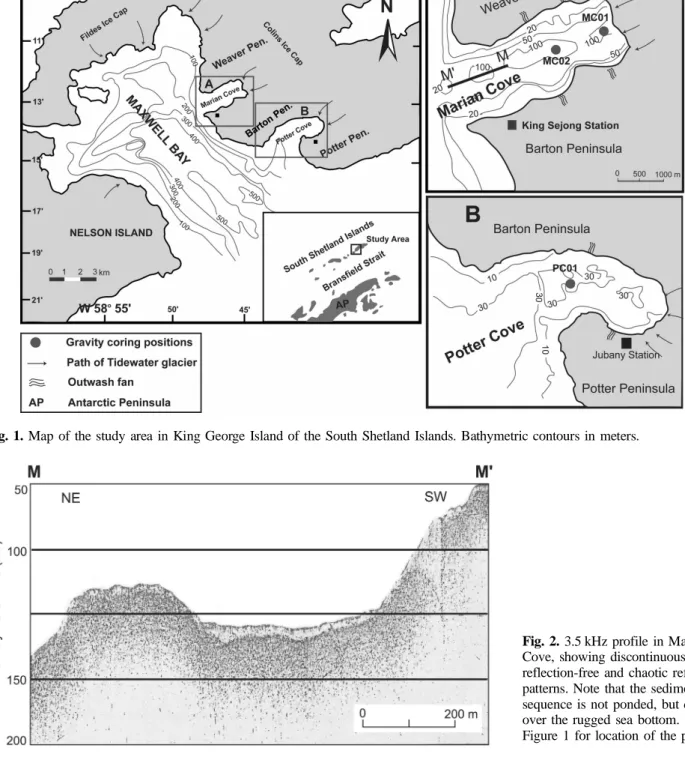
(2) 2. Ho Il Yoon, Kyu-Cheul Yoo, Byong-Kwon Park, Yeadong Kim, Boo-Keun Khim and Cheon-Yun Kang. Fig. 1. Map of the study area in King George Island of the South Shetland Islands. Bathymetric contours in meters.. Fig. 2. 3.5 kHz profile in Marian Cove, showing discontinuous, partly reflection-free and chaotic reflection patterns. Note that the sediment sequence is not ponded, but drapes over the rugged sea bottom. See Figure 1 for location of the profile.. coves during the summer months. Coastal area largely consists of rocky beaches, which are exposed to storm waves entering the coves from Maxwell Bay. Tidewater glaciers and extensive ice walls are mostly confined to the head of the fjords and the surfaces of these glaciers are heavily crevassed and covered by silt-sized volcanic material of eolian origin. Meltwater streams form small outwash fans along the fjord walls of Marian Cove (Fig. 1). At the fjord head freshwater input due to snow and glacial melts not only. dilutes but also causes weak-estuarine circulation (Chang et al., 1995). Marian and Potter coves lie under a relatively warm and humid regime with high precipitation (Reynolds, 1981). The meteorological data recorded at King Sejong Station on King George Island, over the last seven years (1987−1994) show that the average relative humidity is 86% and the maximum average annual air temperature is above 1.4 oC with average annual precipitation of 1169 mm water equiv-.
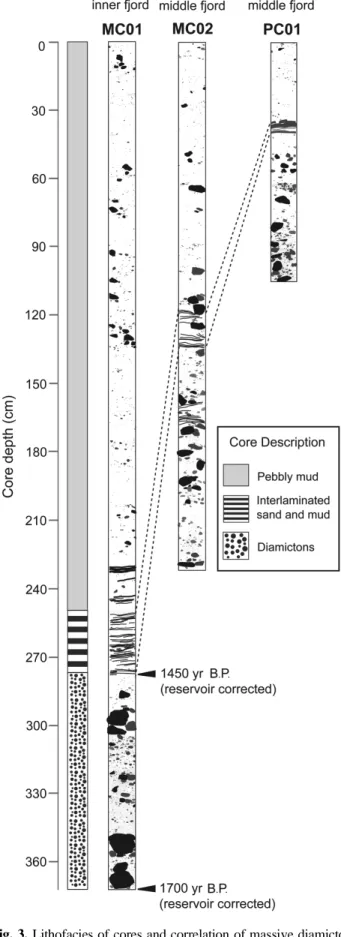
(3) The origin of massive diamicton in Marian and Potter coves, King George Island, West Antarctica. 3. alent (Lee, 1996). This climatic condition leads to a temperate to sub-polar glacial setting, which can be more sensitive to changes in the environmental factors that influence the advance and retreat of glacier margin (Hoskin and Burrell, 1972; Anderson et al., 1980; Park et al., 1998). The study area is ice-free between October and June. Pack ice begins to form in July and from August through October the areas are ice-covered. During the latter part of October ice begins to rapidly break up. Geology of the surrounding landmasses is composed of Upper Jurassic or Lower Tertiary basaltic andesite intruded by diabase and quartz diorite (Adie, 1971; Thomson, 1972; Rex, 1976; Davis, 1982; Smellie et al., 1984). Geomorphological studies on King George Island and its vicinity report that the region has a complex history of glaciation and sealevel change since the late Wisconsin time (John and Sugden, 1971; Clapperton and Sugden, 1982). Deglaciation from the southernmost coast to Fildes Ice Cap of King George Island between 9000 and 5000 yrs B.P. has been suggested (Mäusbacher et al., 1989). Furthermore, palaeoclimatic studies for the late Holocene lake sediment and peat units from the Fildes Peninsula suggest the retreat of ice sheet at about 2000 yrs B.P. and the advances at about 3000 and 1000 yrs B.P. (Tatur and del Valle, 1986; Mäusbacher et al., 1989). These studies have been, however, restricted to terrestrial regime. Adjoining Fildes Peninsula, our study areas of marine regime, Maxwell Bay and adjoining Marian Cove, may hold a more complete record of the ice sheet fluctuations, thereby improving the understanding of the glacial and climatic records over the region. 3. METHODS 3.1. Sediment Sampling Two sediment cores from Marian Cove and one from Potter Cove were obtained using gravity corer (Fig. 1). Among them, the core MC01 from in front of glacier margin in Marian Cove was analyzed sedimentologically, geochemically and micropaleontologically to reconstruct paleoenvironmental changes. The other two cores were visually correlated with core MC01 (Fig. 3) based on lithofacies character. 3.2. Laboratory Analyses Volume magnetic susceptibility (MS) of the core MC01 was determined at 2 cm intervals using a Bartington MS-2B core sensor. Values of MS are expressed as 10-6 in cgs unit. The cores were cut lengthwise in the laboratory; one half was visually described and sliced for X-radiographs, and the other was used for subsampling. Subsamples were taken every 2 cm down the length of the cores to determine grain size, total organic carbon (TOC), and calcium carbonate. Fig. 3. Lithofacies of cores and correlation of massive diamicton units between the three sub-Antarctic fjord systems..
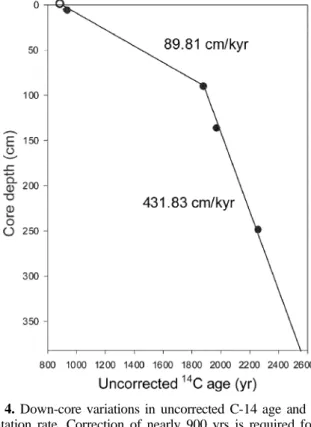
(4) 4. Ho Il Yoon, Kyu-Cheul Yoo, Byong-Kwon Park, Yeadong Kim, Boo-Keun Khim and Cheon-Yun Kang. (CaCO3) contents. Grain size distribution for the −4.0 to 4.0 ø size fractions was determined by dry sieving. Finer fractions (s = 4.0−10.0 ø) were analyzed by a Micrometrics Sedigraph 5000D. The method for computer processing of the raw data is given by Jones et al. (1988) and the classification of sediments followed Folk and Ward’s scheme (1957). Physical sedimentary and biogenic structures were revealed through X-radiographs of 1-cm-thick sediment slabs. Microfossil assemblages, i.e., benthic foraminifers and diatoms, were examined in each sample. Total and carbonate carbons were determined by a Carlo Erba NA-1500 Elemental Analyzer by measuring the CO2 content formed by combustion at 1100oC and treated by hot 10% HCl, respectively (Heath et al., 1977). TOC content was obtained by measuring and calculating the difference between the total carbon and the carbonate carbon. Intact shell or shell fragment from the cores were used for AMS (Accelerator Mass Spectrometer) radiocarbon dates. The dating was performed by Nuclear and Geoscience Laboratory of New Zealand. 4. CHRONOLOGY Four radiocarbon accelerator ages were obtained by radiocarbon analysis of the micro-shells, collected from the four depths of core MC01 (Table 1). The ages range from 923 yrs B.P. at 6 cm depth to 2249 yrs B.P. at 249 cm depth. No age inversions are observed, implying the lack of reworking during deposition. The age-depth model shows that sediment accumulation rates for MC01 varied from 89.81 cm/kyr to 431.83 cm/kyr, indicating a quite high sedimentation rate prior to about 1900 yrs B.P. (Fig. 4). The high sedimentation rate at the lower half of the core may indicate either an increased sedimentation rate due to increased glacier meltwater input, accompanied by large amounts of IRD (iceberg rafted debris), or an increased vertical flux of organic carbon from enhanced surface production. However, the reduced TOC content in the lower half of the core implies that the high sedimentation rate is related to increased terrigenous sedimentation associated with ice-proximal meltwater plume. Reservoir corrections of 900 years are based upon an age of 900 years for a living mollusk taken by a scuba diver at coastal zone in the study area (Table 1 and Fig. 4). Hence, core bottom age extrap-. Fig. 4. Down-core variations in uncorrected C-14 age and sedimentation rate. Correction of nearly 900 yrs is required for the core MC01, on the basis of the age of living marine mollusk collected from coastal area in Marian Cove.. olated from the highest sedimentation rate of 431.83 cm/kyr is 1700 years, and the massive diamicton is estimated to have accumulated between 1450 and 1700 yrs B.P. (Fig. 4). 5. DESCRIPTION OF MASSIVE DIAMICTON FACIES 5.1. Sedimentology and Geochemistry Over 3.5 m of core material was recovered from a core site at the front of the Marian Cove glacier, which is one of the rapidly retreating tidewater glaciers in King George Island (Fig. 1). No evidence for sediment ponding is found, even in small bathymetric depressions (Fig. 2). Sectioned cores were logged sedimentologically and from X-radio-. Table 1. Results of AMS C-14 ages and lithofacies of core MC01. Core depth (cm) 000 (coastal area) 006 090 137 249 a. Age (14C yr B.P.) Uncorrected. Correcteda. 0900±75 0923±55 1881±55 1989±70 2249±65. 0000±75 0023±55 0981±55 1089±70 1349±65. Material. Lithofacies. mollusk micro-shell micro-shell micro-shell micro-shell. Diatomaceous mud Diatomaceous mud Diatomaceous mud Diatomaceous mud Diatomaceous mud. Corrected ages were determined by subtracting the surface age of 900 years in core MC01..
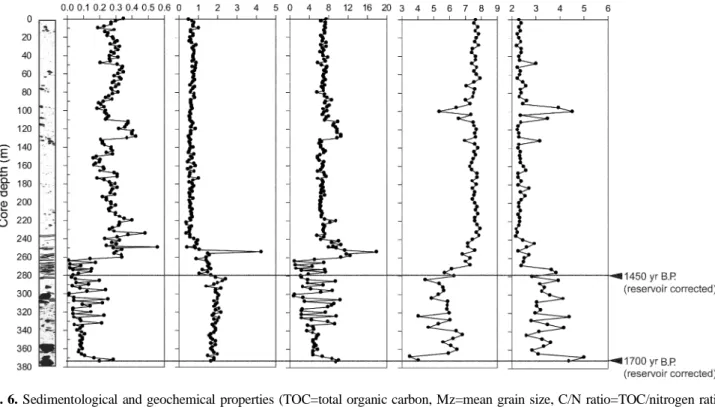
(5) The origin of massive diamicton in Marian and Potter coves, King George Island, West Antarctica. 5. MC01 from Marian Cove (Fig. 3). It consists of light olive grey (5Y 5/2), clast-supported sandy mud lithofacies (Fig. 5). It is massive and structureless, but, in some part, is weakly stratified. Internal stratification on a decimeter scale is defined by subtle variations of clast concentration or size. There is little evidence of soft-sediment deformation in this facies or of intraclasts from underlying beds. The upper contact is generally gradational into the overlying laminated sediments. The clasts are predominantly subangular to subrounded crystalline rocks, ranging from 1 to 4 cm in size, but some volcanic clasts are present. They are commonly striated and faceted and randomly oriented. The matrix is composed of poorly sorted (s = 4.0 to 4.8 ø) muddy sand with mean sizes of 3.5 to 5.5 ø (Fig. 6). TOC content is very low (less than 1%), while CaCO3 contents are relatively high (1−2%) with a negative correlation with TOC (Fig. 6). C/N ratios are lowest, ranging from 1 to 10 (Fig. 6). Microfossils are generally rare with minor occurrence of diatoms, and calcareous benthic foraminifera, but sea-ice related diatoms (Fragilariopsis curta and Fragilariopsis cylindrus) are slightly more abundant in the massive diamicton compared with the overlying units (Fig. 7). 5.2. Diatom Assemblages. Fig. 5. X-radiograph of the core MC01, showing (a) lower part (massive diamicton) and (b) upper part (pebbly mud) of the core.. graphs (Fig. 3). Massive diamicton facies dominate the base of the cores. Laminated sedimentary facies are found only at the top of the diamicton. In more detail, the cores obtained from the study area comprise three lithofacies: (i) the basal part of the cores is made up of massive diamicton; (ii) laminated sediments of alternating fine sand to coarse silt and fine silt to clay make up 4% of the cores; (iii) pebbly mud makes up almost 60% of the total core length. the pebbly mud facies is interpreted to be formed predominantly by the release of IRD, combined with suspension settling of fines derived from glaciofluvial sources (Yoon et al., 1997). The origin of the laminated facies is thought to be by sedimentation from meltwater at times when sediment delivery by icebergs is suppressed by a lack of basal debris zone in the modern tidewater glacier that does not produce large icebergs, and calve at slow rates. This process will be discussed in more detail in a separate publication. Thus, only massive diamicton facies will be discussed in this paper. Massive diamicton accounts for the basal part of the core. Diatom abundances are shown in Fig. 7. Diatom assemblages are dominated by Chaetoceros resting spore (RS, 65−90% of the total). The rest of the assemblage includes taxa such as, F. curta, F. cylindrus, and Navicula glaciei. These species have been grouped as sea-ice taxa since all of them live in the sea ice and/or ice-edge environments (Gersonde, 1986). Another interesting component of the diatom assemblage is Fragilariopsis kerguelensis. This species is a slightly warm-water form, which is more abundant in the circumpolar regions and Scotia Sea than in small bays and fjords in the South Shetland Islands and adjoining Bransfield Strait. Since the large numbers of C. resting spore in the sediment may mask the signal of the rest of the assemblage, we calculated the relative abundances of the rest of diatoms excluding the C. resting spore. In general, the number of diatoms per gram of sediment shows a significant difference in the core MC01 (Fig. 7). The upper part of the core ranges from 10000 to 1000 diatoms per gram, while the lower part (massive diamicton) ranges from 2000 to 500 diatoms per gram. The number of C. resting spore reflects the same pattern to that observed in total diatoms, showing a minimum number of diatom valves of less than 2000 per gram in massive diamicton. However, the relative abundance of sea-ice diatom group shows slightly higher values in massive diamicton than in the upper part of the core (Fig. 7). Sea-ice group, such as F. curta and F. cylindrus shows several peaks in abundance within diamicton facies, reaching maximum values at 295 cm, 310 cm, and 355 cm,.
(6) 6. Ho Il Yoon, Kyu-Cheul Yoo, Byong-Kwon Park, Yeadong Kim, Boo-Keun Khim and Cheon-Yun Kang. Fig. 6. Sedimentological and geochemical properties (TOC=total organic carbon, Mz=mean grain size, C/N ratio=TOC/nitrogen ratio) of the core MC01.. Fig. 7. Diatom assemblages in the core MC01.. respectively (Fig. 7). F. kerguelensis is second dominant species in core MC01. Although its abundance changes are. not parallel to those found for F. curta and F. cylindrus, highest abundances of F. kerguelensis are observed in the.
(7) The origin of massive diamicton in Marian and Potter coves, King George Island, West Antarctica. diamicton facies, showing an average values of 40% (Fig. 7). Thalassiosira antarctica, typical for open water form than in bays and fjords, is rare in massive diamicton while it tends to increase in the upper part of the core MC01 (Fig. 7). 6. ORIGIN AND DEPOSITION OF MASSIVE DIAMICTON Clast-supported diamicton dominates only the basal part of the cores (Fig. 3). This is the most difficult sediment to interpret, primarily because it has inherited characteristics of both marine and glacial processes. The diamicton is massive, clast-supported, and composed of an unsorted mixture of clay, silt, sand and gravel, and shows a gradational contact with overlying laminated unit. It has a polymodal grainsize distribution with high gravel content and lacks organic matter (Fig. 6). These characteristics suggest that the diamict facies originated either as a subglacial till (Anderson et al., 1983, 1991) or as ice-proximal glaciomarine deposits at the grounding line. However, the presence of diatom, the variability in its abundance and the textural heterogeneity (Figs. 6 and 7), an indicator of glaciomarine diamicton (Shevenell et al., 1996; Licht et al., 1996), support a glaciomarine origin of the diamicton by variations in marine productivity and rate of sediment delivery from glacial meltwater. In particular, the variations in pebble abundance within the diamicton facies suggest that the diamicton was deposited in a glaciomarine environment because the flux of ice-rafted material to the sea floor almost certainly varies with time. In contrast, sediment deposited subglacially may be homogenized due to mechanical mixing (e.g., Anderson et al., 1984). Absence of graded sediment and/or intervening or intercalating sandy lenses (turbidite) indicates that this ice-proximal glaciomarine diamicton was not reworked by sediment gravity flows (Eyles, 1990). Rather, the clast-supported diamict facies was deposited probably in front of a fast-flowing outlet glacier that did not have a large ice shelf, but calved a significant number of icebergs (Fig. 9). The presence of a large ice shelf would have prevented measurable fluctuations in primary productivity (recorded as variations in very low TOC and microfossil abundance, as shown in Figs. 6 and 7) because of the absence of sunlight, and resulted in production of debrispoor icebergs (due to basal melting beneath the ice shelf) (Drewry and Cooper, 1981; Jenkins and Doake, 1992). Tidewater glaciers and extensive ice walls, grounded below sea level, do not tend to produce large icebergs, and calve at relatively slower rates (Drewry, 1986; Dowdeswell, 1987). The lack of IRD input from tidewater glacier is demonstrated by the tidewater glacier of the modern Marian Cove, which do not produce large amount of iceberg and/ or IRD, as shown in the core top of X-radiograph where only small amounts of IRD is scattered (Fig. 4). Therefore, the massive diamicton in the study area must have been. 7. deposited by ice rafted sedimentation in ice-proximal zone and/or releasing of debris from basal debris zones of fastflowing outlet glacier, with floating terminal ice tongue when the basal debris-rich glacier was likely to advance to the study area. Four dates obtained from intact shells of MC01 demonstrate that the deposition of massive diamicton in front of the floating ice tongue took place between 1450 and 1700 yrs B.P. (reservoir-corrected) (Table 1 and Fig. 4). Previous study of a lake sediment in King George Island have demonstrated that warm and humid conditions with high precipitation prevailed in the study area between 1400 and 1800 yrs B.P., and increased the size of penguin populations, which is closely related with climatic conditions. Glacial advance in warm period has been reported by Domack et al. (1991) in East Antarctica. They explain that glacial advance during the mid-Holocene warm would be possible under a cold polar climate because warming will at first induce an increase in precipitation (snowfall) rather than ablation. If such speculation is correct, the core sites in Marian and Potter coves might have experienced relatively long periods of sea-ice margin and, therefore, of ice-edge bloom during warm and humid period, as evidenced by the increase of ice-related diatom (i.e., F. curta and F. cylindrus) in the diamicton facies (Fig. 7). Cunningham et al. (1996a, 1996b) used F. curta as a proxy to trace the midHolocene warm period in the Ross Sea. They suggest that sea ice melt and water column stratification probably occurred earlier than cold period in the Ross Sea, as a result of earlier spring warmth. They speculate that earlier ice melt allowed the spring bloom to be dominated by F. curta seeded from the melting sea ice, rather than by non sea-ice taxa. Warming between 1450 and 1700 yrs B.P. (during the deposition of diamicton) would have resulted in the oceanographic change in the study areas. Increases in the abundance of warm water form, F. kerguelensis, in the diamicton (Fig. 7) may be related to intrusion of warm Antarctic Circumpolar Current (ACC) into the study area (Kozlova, 1966; Gersonde and Wefer, 1987; Zielinski and Gersonde, 1997). The influence of ACC is not so strong in modern fjords and bays in the South Shetland Islands, as evidenced from the no increase in abundance of ACC form, F. Kerguelensis (as shown in the upper part of the MC01 in Fig. 7). Therefore, during the deposition of the diamicton the Antarctic Circumpolar flows entering the study area would be more influential, bringing in F. kerguelensis in diamicton facies of the core MC01. Thalassiosira antarctica is an open-ocean form which is more abundant in the Weddell and Scotia seas than in bays and fjords in the South Shetland Islands. Absence of T. antarctica in the massive diamicton can be therefore related to the restriction of the intrusion of cold Weddell and Scotia seawater during deposition of the diamicton facies, as known to be warm period (Fig. 7)..
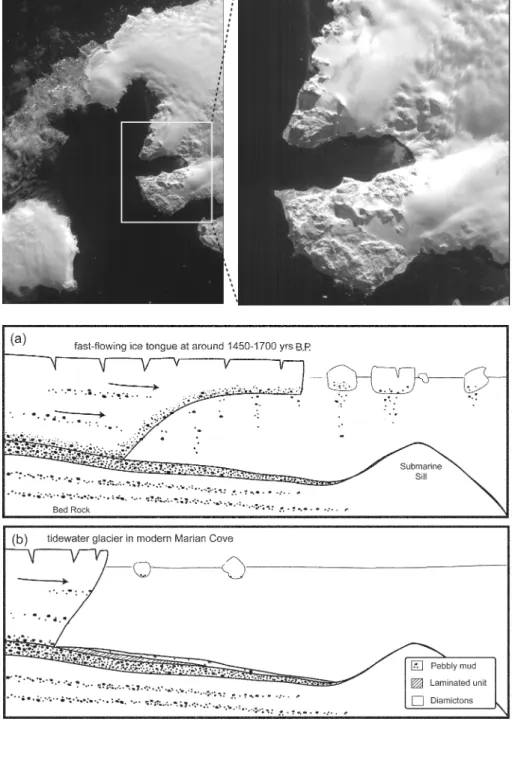
(8) 8. Ho Il Yoon, Kyu-Cheul Yoo, Byong-Kwon Park, Yeadong Kim, Boo-Keun Khim and Cheon-Yun Kang. The absence of both benthic and planktonic foraminifera in diamicton facies (unpublished data) also suggests that meltwater lid was covering the core sites in Marian and Potter coves during much of the warm period. In this setting, CO2 exchange between the ocean and atmosphere could have been restricted. Under these conditions, dissolution of CaCO3 in bottom sediment would have been minimal, as indicated by the higher carbonate contents in the diamicton facies (Fig. 6). 7. ICE SHEET RECONSTRUCTION The available lithofacies and paleontological evidence for. the cores from Marian and Potter coves in the South Shetland Islands suggests that the glaciological regime during deposition of the diamicton around 1450−1700 yrs B.P. was quite different from that of today. Instead of a tidewater glacier, developing only in the fjord head, with a grounding line just below the confluence of Marian and Potter cove glaciers, as seen in satellite imagery (Fig. 8), a floating terminal ice tongue with basal debris zone is envisaged (Fig. 9a). Release of clasts from the basal debris zone of the ice tongue and iceberg rafting are suggested as the processes mainly responsible for the deposition of the massive diamicton facies in the study area. The study area is at present an. Fig. 8. Satellite image of modern Marian Cove, showing the tidewater glacier in the fjord head.. Fig. 9. Schematic model for the deposition of (a) massive diamicton in Marian Cove at around 1450−1700 yrs B.P., and (b) pebbly mud in modern Marian Cove..
(9) The origin of massive diamicton in Marian and Potter coves, King George Island, West Antarctica. area where tidewater glaciers calve at relatively slower rates and are not producing large number of icebergs (Figs. 8 and 9b). During deposition of the massive diamicton, however, the study area was an area where floating ice tongue with basal debris layer was producing icebergs in very large numbers (Fig. 9a). This situation is typical of fast-flowing outlet glaciers, with floating glacier margin, draining the modern Greenland and Antarctic ice sheets. Ice shelves, by contrast, tend to produce icebergs, which are less likely to contain included debris (due to basal melting beneath the ice shelf). Tidewater glaciers and extensive ice walls, grounded below sea level, do not tend to produce large icebergs, and calve at relatively slower rates (Drewry, 1986; Dowdeswell, 1987). The presence of diamicton facies described above in the lower part of the Marian and Potter cove cores may, therefore, be an useful indicator of the former presence of fast-flowing outlet glaciers during warm and humid climatic condition. ACKNOWLEDGEMENTS: This work was supported by a grant from the KORDI Project (PP04106) and from KISTEP Project (Korea-Israel, PN50800 and Korea-Norway, PN50200). We would like to thank Young-Sun Yang and Su-Hyun Im for their helps in order to conduct sedimentological parameter analyses. We thank the crew of the R/V Yuhzmogeologya during cruise KARP 90/91 for their support.. REFERENCES Adie, R.J., 1971, Evolution of volcanism in the Antarctic Peninsula. In: Adie, R.J. (ed.), Antarctic Geology and Geophysics. Oslo, Universitetsforlaget, 137−141. Anderson, J.B., Brake, C.F., Domack, E., Myers, N. and Wright, R., 1983, Development of a polar glacial-marine sedimentation model from Antarctic Quaternary deposits and glaciological information. In: Molnia, B.F. (ed.), Glacial Marine Sedimentation. New York, Plenum, 233−264. Anderson, J.B., Brakes, C.F. and Mayers, N.C., 1984, Sedimentation on the Ross Sea continental shelf, Antarctica. Marine Geology, 57, 295−333. Anderson, J.B., Kennedy, D.S., Smith, M.J. and Domack, E.W., 1991, Sedimentary facies associated with Antarcticas floating ice masses. In: Anderson, J.B., Ashley, G.M. (eds.), Glacial Marine Sedimentation: Paleoclimatic Significance, Boulder, Colorado. Geological Society of America. Special Paper, 261, 1−25. Anderson, J.B., Kurtz, D.D., Domack, E.W. and Balsjaw, K.M., 1980, Glacial and Glacial marine sediments of the Antarctic continental shelf. Journal of Geology, 88, 399−414. Andrews, J.T. and Matsch, C.L., 1983, Glacial marine Sediments and Sedimentation. An Annotated Bibliography: Geo Abstracts Ltd., Norwich, p. 277. Chang, H.D., Park, B.K., Choe, M.Y., Yang, S.R., Yoon, H.I. and Han S.J., 1995, Distribution and dispersal patterns of suspended particulate matters in Maxwell Bay and adjoining coves, South Shetland Islands, Antarctica. In: Park, B.-K. and Lee, S.H. (eds.), The 4th International Symposium on Antarctic Science Geology of the South Shetland Islands. Seoul, Korea, (Abstract). Clapperton, C.M. and Sugden, D.E., 1982, Late Quaternary glacial history of George Sound area, West Antarctica. Quaternary. 9. Research, 18, 243−267. Cunningham, W., Leventer, A. and Domack, E., 1996a, High resolution diatom record of Pleistocene-Holocene marine conditions, Ross Sea, Antarctica. AMQUA, 14th Biennial Meeting, Flagstaff, Arizona, May, 2-20, p. 158. Cunningham, W., Leventer, A. and Domack, E., 1996b, Late Pleistocene-Holocene marine conditions in the western and central Ross Sea, Antarctica: evidence from the diatom record. Geological Society of America, Abstracts with Program, 28, A −426. Davis, R.E.S., 1982. The geology of the Marian Cove areas, King George Island, and a Tertiary age for its supposed Jurassic volcanic rocks. British Antarctic Survey Bulletin, 51, p. 151−165. Domack, E.W., Timothy, A.J. and Nakao, S., 1991, Advance of East Antarctic outlet glaciers during the Hypsithermal: Implications for the volume state of the Antarctic ice sheet under global warming. Geology, 19, 1059−1062. Dowdeswell, J.A., 1987, Processes of glaciomarine sedimentation. Progress in Physical Geography, 11, 52−90. Dreimanis, A., 1988, Tills: their genetic terminology and classification. In: Goldthwait, R.P. and Matsch, C.L. (eds.), Genetic Classification of Glacigenic Deposits. Balkema, Rotterdam, p. 17−83. Drewry, D.J. and Cooper, A.P.R., 1981, Processes and models of Antarctic glaciomarine sedimentation. Annals of Glaciology, 2, 117−122. Drewry, D.J., 1986, Glacial Geologic Processes. Arnold, London, 276p. Eyles, N., 1990, Marine debris flows: Late Precambrian tillites of the Avalonian-Cadomian orogenic belt. Palaeogeography, Palaeoclimatology, and Palaeoecology, 79, 73−98. Eyles, N., Eyles, C.H. and Miall, A.D., 1983, Lithofacies types and vertical profile model; al alternative approach to the description and environmental interpretation of glacial diamict and diamictic sequences. Sedimentology, 30, 393−410. Eyles, C.H., Eyles, N. and Miall, A.D., 1985, Models of glaciomarine sedimentation and their application to the interpretation of ancient glacial sequences. Palaeogeography Palaeoclimatology Palaeoecology, 57, 15−84. Eyles, C.H. and Lagoe, B., 1990, Sedimentation patterns and facies geometries on a temperate glacially-influenced continental shelf: the Yakataga Formation, Middleton Island, Canada. In: Dowdeswell, J.A. and Scourse, J.D. (eds.), Glaciomarine Environments: Processes and Sediments. Special Publication of Geological Society, 53, p. 363−386. Folk, R.L. and Ward, W.C., 1957, Brazos river bars: A study in the significance of grain size parameters. Journal of Sedimentary Petrology, 27, 3−26. Gersonde, R., 1986. Siliceous microorganisms in sea ice and their record in sediments in the southern Weddell Sea (Antarctica). Proceedings of the VIIIth Symposium on Living and Fossil Diatoms, p. 549−566. Gersonde, R. and Wefer, G., 1987, Sedimentation of biogenic siliceous particles in Antarctic waters from the Atlantic sectors. Marine Micropaleontology, 11, 311−332. Hambrey, M.J., Ehrmann, W.U. and Larsen, B., 1991, Cenozoic glacial record of the Prydz Bay continental shelf, East Antarctica. In: Barron, J. and Larsen, B. (eds.), Proceedings of Ocean Drilling Program. Scientific Results, 119, p. 77−131. Heath, G.R., Moore, T.C. and Dauphin, J.P., 1977, Organic carbon in deep-sea sediments. In: Anderson, R.N. and Malahotf, A. (eds.), The Fate of Fossil Fuel CO2 in the Oceans. Plenum Press, New York, p. 605−625..
(10) 10. Ho Il Yoon, Kyu-Cheul Yoo, Byong-Kwon Park, Yeadong Kim, Boo-Keun Khim and Cheon-Yun Kang. Hoskin, C.M. and Burrell, D.C., 1972, Sediment transport and accumulation in a fjord basin, Glacier Bay, Alaska. Journal of Geology, 80, 539−551. Jenkins, A. and Doake, C.S.M., 1992, Ice-ocean interactions on Ronne Ice Shelf, Antarctica. Journal of Geophysical Research, 98, 791− 813. John, B.S. and Sugden, D.E., 1971, Raised marine features and phases of glaciation in the South Shetland Islands. British Antarctic Survey Bulletin, 24, 45−111. Jones, K.P.N., McCave, I.N. and Patel, P.D., 1988, A computer-interfaced sedigraph for modal size analysis of fine-grained sediment. Sedimentology, 35, 163−172. Kozlova, O.G., 1966, Diatoms of the Indian and Pacific Sectors of the Antarctic. Jerusalem: Israel Program for Scientific Translations, 191 p. Lawson, D.E., 1981, Distinguishing characteristics of diamictons at the margin of the Matanuska Glacier, Alaska. Annals of Glaciology, 2, 78−84. Lee, B.Y., 1996, Characteristics and compilation of the meteorological data obtained from King Sejong Station, Antarctica (19881993). Report BSPE 00564-910-7, Korea Ocean Research and Development Institute, Ansan, 388 p. Licht, K.J., Jennings, A.E., Andrews, J.T. and Williams, K.M., 1996, Chronology of late Wisconsin ice retreat from the western Ross Sea, Antarctica. Geology, 24, 223−226. Mäusbacher, R., Muller, J., Munnich, M. and Schmidt, R., 1989, Evolution of postglacial sedimentation in Antarctic lakes (King George Island). Zeitschrift fur Geomorphologie, N.F., 33, 219− 234. Moncrieff, A.C.M. and Hambrey, M.J., 1990, Marginal-marine glacial sedimentation in the late Precambrian succession of East Greenland. In: Dowdeswell, J.A. and Scourse, J.D. (eds.), Glacial Environments: Processes and Sediments. Special Publication of Geological Society, 53, p. 387−410. Park, B.-K., Chang, S.-K., Yoon, H.I. and Chung, H.S., 1998, Recent. retreat of ice cliffs, King George Island, South Shetland Islands, Antarctic Peninsula. Annals of Glaciology, 27, 633−635. Reynolds, J.M., 1981, Distribution of mean annual air temperatures in the Antarctic Peninsula. British Antarctic Survey Bulletin, 54, 123−133. Rex, D.C., 1976, Geochronology in relation to the Stratigraphy of the Antarctic Peninsula. British Antarctic Survey Bulletin, 43, 49− 58. Shevenell, A.E., Domack, E.W. and Kernan, G.M., 1996, Record of Holocene paleoclimate changes along the Antarctic Peninsula: evidence from glacial marine sediments, Lallemand Fjord. In: Banks, M.R. and Brown, M.J. (eds.), Climate succession and glacial history over the past five million years. Royal Society of Tasmania, 130, 55−64. Smellie, J.L., Pankhurst, R.J., Thomson, M.R.A. and Davis, R.E.S., 1984, The geology of South Shetland Islands, VI. Stratigraphy, Geochemistry and Evolution. British Antarctic Survey Bulletin, 87, 1−85. Tatur, A. and del Valle, R., 1986, Badania paleolimnologicne igeomorfologicne na wyspie krola jerzego-Antarktyka zachodnia (1984−1986). Preglad Geologiczny, 11, 621−626. Thomson, M.R.A., 1972, New discoveries of fossils in the Upper Jurassic volcanic group of Adelaide Island. British Antarctic Survey Bulletin, 30, 95−101. Yoon, H.I., Han, M.W., Park, B.-K., Oh, J.-K. and Chang, S.-K., 1997, Glaciomarine sedimentation and paleo-glacial setting of Maxwell Bay and its tributary embayment, Marian Cove, South Shetland Islands, West Antarctica. Marine Geology, 140, 265−282. Zielinski, U. and Gersonde, R., 1997, Diatom distribution in Southern Ocean surface sediments (Atlantic sector): implications for paleoenvironmental reconstructions. Palaeogeography, Palaeoclimatology, Palaeoecology, 129, 213−250. Manuscript received November 24, 2003 Manuscript accepted February 27, 2004.
(11)
수치
+2
관련 문서
