Effect of Tween surfactant components for remediation of toluene-contam- inated groundwater
ABSTRACT: The objectives of this study were to select potentially suitable surfactants that solubilize toluene present as a contami- nant and to determine the effectiveness of toluene removal from groundwater by the selected surfactants. Four different surfac- tants of Tween series were chosen based on surfactant types, tox- icity, HLB (Hydrophilic-Lipophilic Balance), CMC (Critical Micelle Concentration). In the separatory funnel experiments, Tween 20 was not able to solubilize at least 1 mL of toluene and was con- sidered ineffective. Tween 40, Tween 60 and Tween 80 were rela- tively good toluene solubilizers. The highest recovery (98%) of the toluene was obtained using a nonionic surfactant (Tween 60) in the batch experiments. In Tween series surfactant, the trend of ionic strength magnitude in sampled groundwater was closely related with that of recovery rates. The ionic strength of aqueous phase had a strong effect in aqueous activity. The aqueous activity was decrease when ionic strength was increased. The test methods employed may be useful for rapid selection of surfactants and are essential for reducing cost in surfactant-assisted remediation. Also, these selected surfactants are expected to be in practical use for remediation of toluene-contaminated groundwater.
Key words: surfactant, remediation, rapid selection, Tween 60, toluene
1. INTRODUCTION
The contamination of soils and groundwater by benzene, toluene, ethylbenzene, and xylene (BTEX) is an environ- mental concern in industrial areas. Therefore, the removal of BTEX from soils and groundwater becomes increasingly important. Pump-and-treat remediation methods are among the most widely used for clean-up of contaminated ground- water (Martel and Gelinas, 1996; Abrmovitch and Capra- cotta, 2003). However, the traditional remediation method, pump-and-treat, has been shown to be ineffective for reme- diation of groundwater contaminated with hydrophobic organic compounds (HOC) because of their low aqueous solubilities (Lee et al., 2002; Zhong et al., 2003).
Surfactants (surface active agents) may aid in remediation of soil and groundwater contaminated with HOC (Edwards et al., 1994; Cases et al., 2002; Lee et al., 2002). These studies showed that aqueous surfactant solutions significantly enhanced the removal of HOC from soil and groundwater.
Extractive efficiencies of surfactant solution for HOC were
seven to ten times greater than those which could be obtained by flushing with water alone. Surfactants can be used to vastly increase the solubility of the HOC in water and also lower the interfacial tension at the water- HOC interface (Rosen, 1989; Fountain et al., 1991; Cort et al., 2002; Lee et al., 2002).
More than 13,000 surfactants are commercially available (Rosen, 1989), but many are not suitable for HOC-contam- inated soil and groundwater remediation. Some could become potential contaminants in soil or groundwater and might also be expected to influence the behavior of other pollutants. Unsuitable surfactant may cause soil pore clog- ging because they can hydrolyze to form flocs, combine to form micelles, and disperse soil colloids (Rosen, 1989; Lee et al., 2001; Chu and Kwan, 2003).
Abdul et al. (1990) evaluated the suitability of ten sur- factants for washing automatic transmission fluid (ATF) from sand. They measured the surface tension of the sur- factant and also conducted batch tests for solubilization capacity. The most effective surfactant was Witconol SN70 (alkyl polyoxyethylene glycol, a nonionic surfactant). DOSL (diphenyl oxide disulfonates, an anionic surfactant) was also good a surfactant for removal of chlorinated hydrocar- bons in column test and pilot test (Rajput et al., 1994; Desh- pande et al., 1999). In another surfactant selection study, using separatory funnel experiment of solubility, Fountain et al. (1991) evaluated 100 surfactants for washing PCE (tetrachloroethylene) from sand. The most effective surfac- tant was the 1:1 volume mixture of Rexophos 25/27 (anionic) and T-Det N-9.5 (nonionic). These results show that effectiveness of surfactant differs depending on the spe- cific organic contaminant.
Therefore, suitable surfactants for remediation of HOC contaminated soils should decrease the surface tension of the water and must be non-volatile and easily cleaned and recycled (Rosen, 1989; Fountain et al., 1991; Tabuchi et al., 1997; Lee et al., 2002). Also, they must efficiently solubi- lize or mobilize HOC. Suitable surfactants also must be commercially available, inexpensive, and nontoxic (Abdul et al., 1990). Therefore, it is essential to establish rational criteria for selecting surfactant types and doses. The param- eters of surfactant selection used in this study were surfac- Dal-Heui Lee*
Eun-Sik Kim
Ho-Wan Chang}School of Earth and Environmental Sciences, Seoul National University, Seoul 151-747, Korea
*Corresponding author: [email protected]
tant types, toxicity, HLB, CMC, and solubilization effectiveness.
The objectives of this study were to select suitable surfac- tants that solubilize toluene present as a contaminant and to investigate the efficiency of selected surfactants in remov- ing toluene from groundwater.
2. MATERIALS AND METHODS 2.1. Materials
2.1.1. Surfactant selection and chemical selection
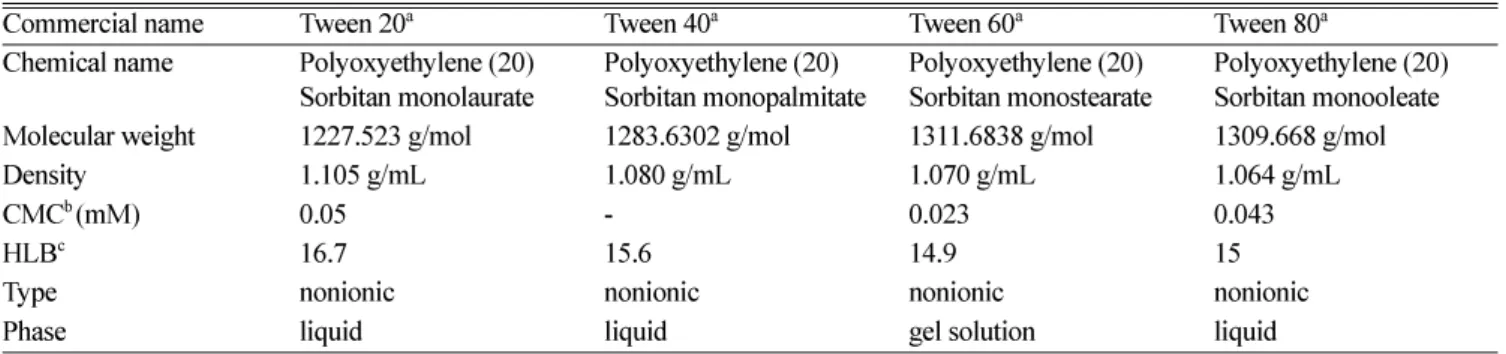
Selected Tween series surfactants were nonionic. The sur- factants were used as received. The surfactants, along with their relevant properties and structure, are listed in Table 1 and Figure 1. Tween series surfactants (Tween20, Tween40, Tween60, Tween80) have been noted for their unfavorable tendency to sorption to aquifer solids, and low CMC. Non- ionic surfactants do not have the group of ionic dissociated
in solution of contaminant materials. Tween20 had 12 car- bons in hydrophobic moiety named “Sorbitan laurate” and Tween40 had 16 carbons in hydrophobic moiety named
“Sorbitan palmitate”. Tween60 and Tween80 each have 18 carbons, but difference showed in their organic saturations (Fig. 1). Their nomenclautures were “Sorbitan stearate” and
“Sorbitan oleate”, respectively. Tween series surfactants were purchased from Yakuri Chemicals, Japan.
Toluene was used as the HOC model, because benzene, toluene, ethyl-benzene, and xylene were probably the most common contaminants of soil and water in industrial area, and they were representative of non-chlorinated solvents.
Toluene (>99.5% purity) were purchased from Merck Chemi- cal, USA. N-hexane was used as a solvent to calibrate a quantitative analysis of gas chromatography. N-hexane was purchased from Mallinckrodt, USA. The characteristics of toluene and n-hexane were shown in Table 2.
Table 1. The characteristics of Tween series surfactant.
Commercial name Tween 20a Tween 40a Tween 60a Tween 80a Chemical name Polyoxyethylene (20)
Sorbitan monolaurate Polyoxyethylene (20)
Sorbitan monopalmitate Polyoxyethylene (20)
Sorbitan monostearate Polyoxyethylene (20) Sorbitan monooleate Molecular weight 1227.523 g/mol 1283.6302 g/mol 1311.6838 g/mol 1309.668 g/mol
Density 1.105 g/mL 1.080 g/mL 1.070 g/mL 1.064 g/mL
CMCb (mM) 0.05 - 0.023 0.043
HLBc 16.7 15.6 14.9 15
Type nonionic nonionic nonionic nonionic
Phase liquid liquid gel solution liquid
aData from MSDS (Material Safety Data Sheets).
bCMC: critical micelle concentration
cHLB: hydrophile-lipolhile balance.
Fig. 1. Chemical structures of test surfactants; (a) Polyoxyethylene (20) sorbitan monolaulate, (b) Polyoxyethylene (20) sorbitan mono- plamitate, (c) Polyoxyethylene (20) sorbitan monostearate, (d) Polyoxyethylene (20) sorbitan monooleate.
2.1.2. Characteristics of test water (deionized water and groundwater)
The separatory funnel experiments used distilled water that distilled with Milli-Q distillation system. The used groundwater for batch experiments originated from three sites: (1) granite groundwater, (2) shale-sandstone ground- water, (3) limestone groundwater. Measured groundwater properties were presented in Table 3.
2.2. Separatory Funnel Experiment
This series of experiments provided a rapid, qualitative, and fairly reliable means of determining which surfactant is a good solubilizer. Therefore, the purpose of the funnel experiment was to rapid decide which surfactant is a good solubilizer. Experimental procedures were as follows; 100 mL of a 4% (v/v) of each aqueous surfactant solution were placed in a 250 mL separatory funnel and an initial 0.5 mL of toluene was added. The funnel was then shaken gently for 30 sec, and left to settle for one hour. Vigorous shaking in a separatory funnel experiment caused the formation of extremely persistent emulsions. If the entire volume of tol- uene has been solubilized another 0.5 mL of toluene was then added and the funnel was shaken again. If any of the first 0.5 mL remained or if an emulsion was present, the funnel was shaken again for 30 sec and then again set aside for one hour. This process continued for six hours, after
which the funnels were left undisturbed for the remainder of the 24-hour period. The experiment ended after 24 hr and the results were recorded. This process was repeated two times for each surfactant.
2.3. Batch Tests
These experiments were conducted to select suitable sur- factants which could solubilize/extract toluene from con- taminated groundwater. The effect of ions of groundwater such as ionic strength and hardness was also considered in batch tests. Both rotary shaker table and centrifugal sepa- rator were used in experiments. Batch experiments with twelve samples were conducted in glass vials (Wheaton) sealed with Teflon films. The 20 mL sample vials were con- taining 4.6 mL of surfactant solution (Tween series surfac- tants), 1.4 mL of contaminants (Toluene) and 14 ml of sampled groundwater. The vials were stirred on a rotary shaker table (100 rpm) at room temperature (23±2°C) for 144 hr.
Organic concentration of aqueous layer was measured for four times at 18, 36, 72, and 144 hr. At selected times, the vials were removed from the shaker table and centrifuged at 10000 rpm for 7 min. Centrifuged samples were transferred into gas tight syringe for analysis by gas chromatography.
2.4. Analytical Methods
Toluene in aqueous samples was extracted by solvent extraction with hexane using standard separatory funnel method 3510 (Lee et al., 2001) and analyzed by gas chro- matography with split/splitless injection system (Hewlett Packard Model 5890 series II). Prior to the analysis of the extracted samples, the response factor and linearity of detection for the internal standard and contaminant were determined. After calculating the response factor, a calibra- tion graph was prepared. The quantitative determination of contaminant concentration was based on these internal stan- dard reference compounds, so that sample peak areas were compared with those of their respective internal standards (ethylbenzene for toluene) (Lee et al., 2001, 2002).
Table 2. The characteristics of test chemicals.
Chemical name Toluene n-hexane Formula C6H5CH3 CH3(CH2)4CH3 Molecular weight (g/mol) 92.14 86.17 Specific gravity (at 20 °C) 0.8669 0.678 Vapor density (g/L) 3.18 2.97
Boiling point (°C) 111 69
Freezing point (°C) -95 -95 Ignition point (°C) 480 225 Solubility (g/100g water) 0.045 0.1
*Data from MSDS.
Table 3. The characteristics of sampled groundwater.
Geology T(°C) pH DOa ECb Ehc (mV) F
(mg/L) Cl (mg/L)
NO3 (mg/L)
SO4 (mg/L)
Alkd (meq) Ba
(mg/L) (mg/Ca
L) (mg/Fe
L) (mg/K
L) (mg/Mg
L) (mg/Na
L) (mg/Si
L) (mg/Sr
L)
Ionic Strength
(mM) Hard- (mg/L)ness Granite 16.7 6.52 4.55 203.4 455.1 0.07 24.27 49.93 8.70 0.47 0.011 23.2 0.015 1.39 4.09 7.64 6.27 0.152 4.63 74.77 Shale-
sandstone 18.1 6.88 2.75 343.2 574.1 0.15 35.19 46.38 4.77 1.78 0.0278 42.8 0.004 1.06 7.06 4.69 5.19 0.172 6.18 135.94 Limestone 15 7.27 2.87 276.5 475.1 0.19 9.13 5.44 6.55 2.41 0.2753 43.9 0.009 4.76 9.06 3.58 3.76 0.268 5.68 146.93
a DO: Dissolved oxygen (mg/L)
b EC: Electrical conductivity, unit: µS/cm.
c Eh: Oxidation-reduction potential.
d Alk: Alkalinity.
3. RESULTS AND DISCUSSION 3.1. Surfactant Types, HLB and CMC
Surfactants can be classified according to the nature of the hydrophilic portion of the molecule: anionic, cationic, nonionic, zwitterionic. Zwitterionic surfactants have both positive and negative charge in the head group. Nonionic surfactants generally have smaller CMC values than ionic surfactants and are known to be good solubilizers of hydro- phobic substances (Adeel and Luthy, 1995; Lee et al., 2001).
Cationic surfactants are often toxic in the mg/L range to a wide variety of aquatic organisms (Sun et al., 1995). Skrtic et al. (1993) found cationic surfactants are unsuitable as extracting agents due to poor extraction efficiency. Gener- ally, cationic surfactants are not selected in remediation works because of toxicity and strong complexion with anionic soil mineral surfaces. Anionic surfactants may form precip- itates with groundwater cations, and thereby cause reduc- tion in soil hydraulic conductivity by blocking pores (Sun et al., 1995).
Each surfactant has an HLB number. This number is use- ful for preliminary surfactant selection (Rosen, 1989; Dei- tsch and Smith, 1995) because maximum solubilization within a given surfactant’s chemical family will occur at a specific HLB number. Two surfactants with different func- tional groups but the same HLB value should show similar solubilities. When a combination of surfactants of different HLB value is used, the HLB number of the mixture is the weighted average of the individual HLB numbers. A high HLB value indicates a large percentage of polar head groups, and a dominantly hydrophilic character. These surfactants will favorably partition into the water phase. If the HLB of the surfactant is too high for the given substrate, however, then stable emulsions do not form because the surfactant does concentrate nearly exclusively in the water phase. For aromatic hydrocarbon contaminants the optimum HLB num- ber is 12-15 (Rosen, 1989). In this study HLB values were obtained from literature reviews, catalogs, and surfactant suppliers. The HLB number of studied surfactant is given in Table 1.
CMC is the aqueous concentration of surfactant at which surface tension of the solution is smallest. The CMC is determined by interpreting a plot of surface tension vs. log surfactant concentration (Rosen, 1989). As the concentra- tion increases, the surface tension decreases until the CMC
is reached. CMC is a significant parameter in solubilization, and mobility of contaminants can be expected to be highest at or above the CMC of the aqueous surfactant solution (Deshpande et al., 1999). A surfactant with a lower CMC value will be more desirable as it can begin to solubilize organic contaminant at lower concentrations with minimal toxic exposure to soil microbes (Huang et al., 2003). Reduc- tion of surface tension in aqueous solutions is a standard test for surface activity. The CMC values of studied surfactants are given in Table 1. Used surfactants were generally clear liquids, non-odorous, readily pourable liquids at room tem- perature, and soluble or miscible in water. Also, selected surfactants are attractive for soil and groundwater remedi- ation as they have low toxicity and favorable biodegrad- ability.
3.2. Separatory Funnel Experiments
In these experiments, it was noted how much toluene was taken into an emulsion-solution until the emulsion-solution reached saturation with toluene (e.g., toluene separated or a heavy emulsion/ toluene phase separated from the rest of the solution). Tween 20 was not able to solubilize at least 1 mL of toluene and was considered ineffective, while those that solubilized more than this amount were given a “pass- ing” grade and then subjected to further screening tech- niques (Table 4). Tween 40, Tween 60, and Tween 80 were relatively good solubilizer for toluene. Also Tween 40 and Tween 60 had no emulsion. These were then used in the following batch experiments.
3.3. Batch Experiments
Each groundwater samples showed the difference in ionic distribution. Batch experiments were conducted to evaluate ionic effect (ionic strength, hardness) of surfactant applica- tion in groundwater. Sample 1 was shallow groundwater from granite and it had high nitrate concentration because it was contaminated by anthropogenic source. Sample 2 was deep groundwater from shale-sandstone and it had much ions. Shale-sandstone was located limestone boundary.
Sample 3 was deep groundwater from limestone. The ion distributions of three samples were shown in Table 3.
Results of batch tests using distilled water were compared to pure water result (Fig. 2). The highest recovery of the tol- uene was 98% using the nonionic surfactant Tween 60
Table 4. The results of separatory funnel experiments.
Trade name or abbreviation Amount toluene added (mL) Estimated amount solubilized Characteristics after 24 hr
Tween 20 1.0 0.5 No foaming
Tween 40 2.5 2.5 Very clear liquid formed
Tween 60 3.0 3.0 Very clear liquid formed
Tween 80 1.5 1.5 Light milky emulsion
(Fig. 2). The most suitable surfactant was Tween 60 based on HLB, CMC, separatory funnel experiment, and batch experiments.
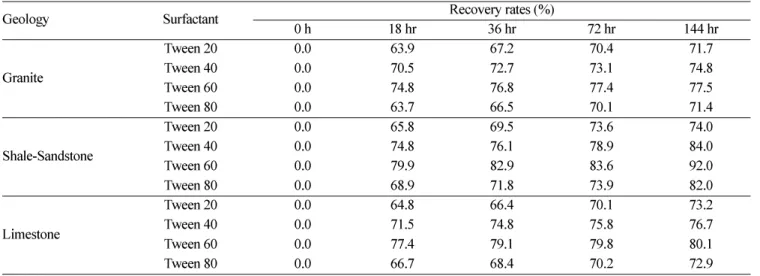
Table 5 presents the variable recovery rate values of batch experiments during 144 hr. We checked sample concentra- tion at 18, 36, 72, and 144 hr in batch experiments. To inter- pretation of the results, we calculated the ionic strength and hardness of groundwater. The results of ionic strength and hardness were shown in Table 3. Ionic strength and hard- ness calculated by following equation:
Ionic strength
Ci=concentration of ionic species, i
Zi=charge of species, i
Hardness CaCO3 mg/L=2.497 [Ca, mg/L]+4.118 [Mg, mg/L]
Sample 2 had the highest ionic strength value (Table 3).
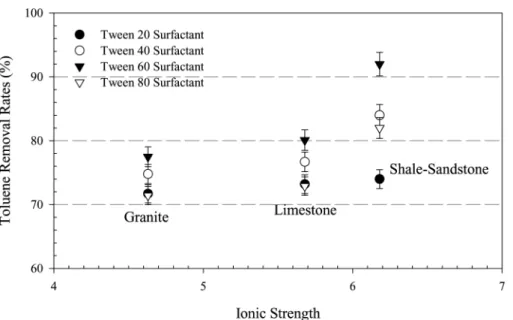
The trend of ionic strength magnitude in sampled ground- water was corresponded with the trends of recovery rates in Tween series surfactant solutions (Fig. 3). Many significant factors to form surfactant micelles were reported: HLB, CMC, temperature, ionic strength, and counter-ion effect, etc. In this batch experiments, considered relative recovery rates in ionic strength of sampled groundwater. Mezzanotte et al. (2003) suggested that nonionic surfactant was not affected by hardness. The micelle formation theory of non- ionic surfactant is that the hydrophilic groups in nonionic surfactant are dissolved into water because they contain oxygen, which is easy to bond with hydrogen in water and is responsible for miscibility (Wang, 2002). The ionic strength of aqueous phase has a strong effect in aqueous activity. The aqueous activity decreased when ionic strength increased. When the aqueous activity decreased, the forma- tion of hydrogen bonding between the water molecules and
µ 1
2---∑i (CiZi2)
=
Fig. 2. Toluene removal rates in batch experiments using distilled water.
Table 5. Removal rates of batch experiments during 144 hr using field groundwater.
Geology Surfactant Recovery rates (%)
0 h 18 hr 36 hr 72 hr 144 hr
Granite
Tween 20 0.0 63.9 67.2 70.4 71.7
Tween 40 0.0 70.5 72.7 73.1 74.8
Tween 60 0.0 74.8 76.8 77.4 77.5
Tween 80 0.0 63.7 66.5 70.1 71.4
Shale-Sandstone
Tween 20 0.0 65.8 69.5 73.6 74.0
Tween 40 0.0 74.8 76.1 78.9 84.0
Tween 60 0.0 79.9 82.9 83.6 92.0
Tween 80 0.0 68.9 71.8 73.9 82.0
Limestone
Tween 20 0.0 64.8 66.4 70.1 73.2
Tween 40 0.0 71.5 74.8 75.8 76.7
Tween 60 0.0 77.4 79.1 79.8 80.1
Tween 80 0.0 66.7 68.4 70.2 72.9
the hydrophilic moiety was weaken, that surfactant solubil- ity increased. The recovery rates in Tween series surfactants showed a similar trend with ionic strength.
4. CONCLUSIONS
In the surfactant pre-selection phase of the investigation, Tween series surfactants were chosen based on surfactant types, toxicity, HLB, and CMC. One surfactant (Tween 60, nonionic) was selected on the basis of separatory funnel and batch experiments. In separatory funnel experiments, degree of saturation of organic carbon in hydrophobic moiety was related to recovery rates. In the batch experiment phase, the highest recovery of the toluene was 98% using the nonionic surfactant (Tween 60). In Tween series surfactant, the trend of ionic strength magnitude in sampled groundwater was corresponded with that of recovery rates. Used test methods for surfactant selection in this study may be useful and are essential for reducing cost and time in surfactant-based remediation. Also, these selected surfactants can be practi- cally used for surfactant-enhanced remediation of toluene contaminated groundwater.
ACKNOWLEDGEMENTS: We would like to thank Dr. Robert D.
Cody of Iowa State University for the discussion about this study.
Authors also express appreciation to the members of the environmen- tal geochemistry laboratory, Seoul National University, Korea. This study was financially supported by the BK21 project, Ministry of Edu- cation, South Korea.
REFERENCES
Abdul, A.S., Gibson, T.L. and Rai, D.N., 1990, Selection of surfac- tants for the removal of petroleum products from shallow sandy aquifers. Ground Water, 28, 920−926.
Abramovitch, R.A. and Capracotta, M., 2003, Remediation of waters
contaminated with pentachlorophenol. Chemosphere, 50, 955−957.
Adeel, Z. and Luthy, R.G., 1995, Sorption and transport kinetics of a nonionic surfactant through an aquifer sediment. Environmental Science and Technology, 29, 1032−1042.
Cases, J.M., Mielczarska, E., Michot, L.J. and Thomas, F., 2002, Ionic surfactants adsorption on heterogeneous surfaces. Comptes Rendus Geosciences, 334, 675−688.
Chu, W. and Kwan, C.Y., 2003, Remediation of contaminated soil by a solvent/surfactant system. Chemosphere, 53, 9−15.
Cort, T.L., Song, M.-S. and Bielefeldt, A.R., 2002, Nonionic surfac- tant effects on pentachlorophenol biodegradation. Water Research, 36, 1253−1261.
Deitsch, J.J. and Smith, J.A., 1995, Effect of Triton X-100 on the rate of trichloroethene desorption from soil to water. Environmental Science and Technology, 29, 1069−1080.
Deshpande, S., Shiau, B.J., Wade, D., Sabatini, D.A. and Harwell, J.H., 1999, Surfactant selection for enhancing ex situ soil wash- ing. Water Research, 33, 351−360.
Edwards, D.A., Liu, Z. and Luthy, R.G., 1994, Experimental data and modeling for surfactant micelles, HOCs, and soil. Journal of Environmental Engineering, 120, 23−41.
Fountain, J.C., Klimek, A., Beikirch, M. and Middleton, T., 1991, The use of surfactants for in-situ extraction of organic pollutants from a contaminated aquifer. Journal of Hazardous Materials, 28, 295−311.
Huang, W., Peng, P., Yu, Z. and Fu, J., 2003, Effects of organic mat- ter heterogeneity on sorption and desorption of organic contami- nants by soils and sediments. Applied Geochemistry, 18, 955−972.
Lee, D.-H., Cody, R.D. and Hoyle, B.L., 2001, Comparison of six surfactants in removing toluene and trichlorobenzene from a sandy soil under laboratory conditions. Can. Geotech. Journal, 38, 1329−1334.
Lee, D.-H., Na, I.-W. and Hwang, K.-Y., 2002, Soil remediation using soil washing system in hydrocarbon contaminated field.
Korea Society of Economic and Environmental Geology, 35, 369−372.
Martel, R. and Gelinas, P.J., 1996, Surfactant solutions developed for NAPL recovery in contaminated aquifers. Ground Water, 34, 143−154.
Mezzanotte, V., Castiglioni, F., Todeschini, R. and Ravan, M., 2003,
Fig. 3. Relation of toluene removal rates by Tween series surfactant solu- tion.
Study on anaerobic and aerobic degradation of different non- ionic surfactants. Bioresource Technology, 87, 87−91.
Rajput, V.S., Higgins, A.J. and Singley, M.E., 1994, Cleaning of exca- vated soil contaminated with hazardous organic compounds by washing. Water Environment Research, 66, 819−827.
Rosen, M.J., 1989, Surfactants and interfacial phenomena. John Wiley & Sons, New York, pp.125−431.
Skrtic, D., Vincekovic, F.N. and Baiscan, J., 1993, Comparison of the effects of anionic and cationic surfactants on the precipitation of cal- cium oxalates. Physical Chemistry Chemical Physics, 97, 114−120.
Sun, S., Inskeep, W.P. and Boyd, S.A., 1995, Sorption of nonionic organic compounds in soil water systems containing a micelle- forming surfactant. Environmental Science and Technology, 29, 903−913.
Tabuchi, K., Kawakami, S., Shiratori, T. and Saitoh, T., 1997, Reme- diation and recycling of the soil contaminated with petroleum hydrocarbon. Journal of the Mining and Materials Processing Institute of Japan, 113, 1115−1120.
Wang, D., 2002, A study of identifying the emulsion type of surfac- tant: Volume balance value. Journal of Colloid and Interface Sci- ence, 247, 389−396.
Zhong, L., Mayer, A.S. and Pope, G.A., 2003, The effects of surfac- tant formulation on nonequilibrium NAPL solubilization. Journal of Contaminant Hydrology, 60, 55−75.
Manuscript received September 24, 2004 Manuscript accepted June 15, 2005