서 론
잉어과(Cyprinidae) 납자루아과(Acheilognathinae) 어류 는 몸이 측편되고 체고가 높은 소형담수어로 담수산 조개 (Bivalves)와 독특한 상호관계를 가진다. 산란기 동안 수컷은 화려한 혼인색을 띠고 살아있는 조개 주위에 세력권을 형성하 며 암컷은 길어진 산란관으로 조개의 출수공에 산란한다. 알 은 난황이 흡수되는 약 1달 동안 조개의 새강(suprabranchial cavity) 안에서 발생이 진행되며 유영이 가능한 자유유영기 에 도달하면 조개 밖으로 나가게 된다(Smith et al., 2004). 이 에 납자루아과 어류는 조개에 산란하기 위한 형태적, 생리학 적, 행동학적 진화양상을 보이고 있다(Oshiumi and Kitamura, 2009).
본 아과 어류는 전 세계에 약 40여종이 보고되어 있고(Arai, 1988) 유럽-지중해 지역의 Rhodeus sericeus, R. amarus, R.
colchicus 3종 외에는 아시아 지역에 주로 분포한다(Damme et al., 2007). 우리나라에는 멸종된 것으로 알려진 서호납줄갱 이 R. hondae를 포함하여 2속 15종이 보고되어 있다(Kim and Park, 2002; Kim and Kim, 2009; Kim et al., 2014).
한강납줄개 R. pseudosericeus는 Arai et al.(2001)가 강원도 횡성군 공근면 금계천에서 채집한 체장 45.5mm의 표본을 기 준으로 신종 기재한 한국고유종이다. 본 종은 주천강(횡성), 흑천(양평), 조종천(청평), 무한천(청양, 예산), 대천천(보령), 금당천(여주) 일대의 유속이 완만한 하천에 제한적으로 서식 하는 것으로 알려져 있으며 하천 개발과 오염으로 인하여 개 체군 축소 및 서식지 감소가 우려되고 있다(ME, 1997~2008;
Kim et al., 2006; Jeon and Suk, 2014). 최근에는 ‘야생생물 보 호 및 관리에 관한 법률’에 근거하여 환경부 멸종위기 II급 어
—235 — http://www.fishkorea.or.kr
남한강 수계 흑천에 서식하는 한강납줄개 Rhodeus pseudosericeus (Pisces: Acheilognathinae)의 산란 특성
김형수·윤정도1·양
현2·최혜승3·이정호
*
국립수산과학원 중앙내수면연구소 내수면양식연구센터, 1국립생태원, 2㈜생물다양성연구소, 3국립수산과학원 남해수산연구소
Reproductive Characteristics of Rhodeus pseudosericeus(Pisces: Acheilognathinae) in the Heukcheon, Namhangang(River), Korea by Hyeong Su Kim, Jeong Do Yoon1, Hyun Yang2, Hye-Sung Choi3 and Jeong-Ho Lee* (Inland Aquaculture Research, National Institute of Fisheries Science, Changwon 51688, Republic of Korea; 1National Institute of Ecology, Seocheon 33657, Republic of Korea; 2Institute of Biodiversity Research, Jeonju 54904, Republic of Korea; 3South sea Fisheries Research Institute, National Institute of Fisheries Science, Yeosu 59780, Republic of Korea)
ABSTRACT Reproductive characteristics of Rhodeus pseudosericeus(Pisces: Acheilognathinae) was investigated at the Heukcheon(River), Yangpyeong-gun, Gyeonggi-do, Korea from January to July in 2012. This fish prefers heavily vegetated stagnant pool with Phragmites japonica and Salix koreensis and area with high proportions of sand and mud. The standard length of the population indicated that 13~22mm group is 0-year old, 30~45mm group is 1-year old, 45~55mm group is 2-year old and 45~70mm group is more than 3-year old(June in 2012). The sex ratio of female to male was 1:0.80.
The spawning season was from March to June with water temperatures in the range 11.0~26.2°C.
The embryos were found with no egg mass in Unio douglasiae sinuolatus and the number of those was 1~22(5.8±5.51). The number of the embryos found in each of the four parts of the mussel gill was 1~9(2.7±2.16) in left outer, 1~2(1.5±0.71) in left outer, 1~5(1.8±1.79) in left outer and 1~22 (5.8±5.51) in left outer.
Key words: Rhodeus pseudosericeus, Heukcheon, bitterling, population ecology, endangered species
* Corresponding author: Jeong-Ho Lee Tel: 82-55-540-2700, Fax: 82-55-546-6292, E-mail: [email protected] ISSN: 1225-8598(Print), 2288-3371(online)
Accepted: october 13, 2017
류로 지정되었고(2012.7.27.), 한국의 멸종위기 야생동식물 적 색자료집에서는 위기종(EN, Endangered)으로 평가되어 보 호대책이 절실히 필요한 종이다(NIBR, 2011). 그러나 본 종 에 대해서는 난발생과 초기생활사(Kim et al., 2006; Suzuki, 2006), 분자생물학적 분석을 통한 계통지리학적 연구(Jeon and Suk, 2014)가 보고되었을 뿐 생물학적 기초연구는 매우 부족하다.
종의 보존 및 복원을 위해서는 생물학적 기초 연구 중 특히 산란 특성에 관한 연구가 매우 중요하며 멸종위기어류의 증식 복원 연구에서도 초기 단계에서는 기초 생물학적 특성에 관한 연구부터 진행되었다(MLTM, 2010; ME, 2010, 2011a). 일본에 서는 납자루아과 어류는 수질오염, 유량의 급격한 변화, 서식 지 단순화 및 단절, 외래종에 의한 포식 등 멸종 위험성이 매 우 높은 분류군으로 구분하여 9종이 멸종위기 야생동식물 적 색 자료집에 기재하고 종 보전을 위한 노력을 진행하고 있다 (Kitamura, 2008).
본 연구는 최근 멸종위기 II급 어류로 지정된 한강납줄개의 개체군 밀도가 높은 흑천 일대에서 산란시기, 연령, 성비, 포란 수, 산란숙주 조개 등 산란 특성에 관한 연구를 수행한 바 종 보전 및 복원을 위한 기초자료로 활용하고자 한다.
재료 및 방법
1. 연구 장소 및 서식지 환경
한강납줄개의 기초 생물학적 조사는 본 종이 주로 서식하 는 경기도 양평군 흑천 일대에서 4개 지점을 선정하여 2012년 1~12월까지 25~30일 사이에 매월 1회 조사하였다. 본 종의 산란 특성에 관한 연구를 시작한 시점에는 법적보호종이 아 니었으나 2012년 7월 멸종위기 II급 어류로 새롭게 고시되어 (2012.7.27) 산란 특성 연구는 1~7월까지만 수행하였다. 채집 은 족대(망목, 3×3mm)와 유인어망(4×4mm)을 사용하였다.
조사지점의 1년 동안 이화학적 요인의 변화를 확인하기 위하 여 2012년 1~12월까지 기온과 수온은 현장에서 오후 12~1 시 사이에 디지털 온도계로 측정하였고 DO, pH, Conductivity, BOD, COD, SS는 물환경정보시스템(http://water.nier.go.kr) 에서 제공하는 수질 측정망 자료를 인용하였다(WAMIS, 2013). 물리적 환경요인인 하폭과 유폭은 디지털거리측정기 (Bushnell Sport 600, USA), 수심은 막대줄자를 이용하여 측정 하였다. 하천형태는 Kani(1944), 하상구조는 Cummins(1962) 의 기준에 따라 분류하였다. 동소출현종 조사는 투망 15회, 족 대 40분, 유인어망 40분을 기준으로 6월과 9월 2차례 실시하 였다. 9월 동소출현종 조사에서 채집된 묵납자루와 한강납줄 개는 현장에서 종 여부만 확인 후 즉시 방류하였으며 종의 동 정과 분류는 Kim and Park(2002)을 따랐다.
2. 연령, 성비, 산란기, 성숙난수
한강납줄개의 연령 추정은 3~7월까지 매달 채집된 모든 개 체를 마취제(MS-222, Sigma-Aldrich, St. Louis, MO, USA)를 이용하여 마취한 후 미성어, 암컷, 수컷으로 구분하였고 체장 (Standard length)을 1/20mm dial caliper로 0.01mm까지 측정 하여 체장빈도분포법(Ricker, 1971)에 따라 분석하였다. 산란 기 추정은 매달 채집된 암컷의 산란관길이/체장의 비율을 월 별로 측정하였고 성숙난이 나오는 기간, 성숙난수, 성숙난을 가진 암컷의 출현 비율은 복부를 압박하여 성숙난이 3개 이상 확인된 경우만 분석하였다.
3. 산란숙주조개 이용
산란과 가장 중요한 관계가 있는 산란숙주조개의 이용 양 상을 확인하기 위해서 2012년 4월에 조사지점 인근 웅덩이에 서 족대를 이용하여 조개를 채집하였고 동정 및 분류는 Kwon et al.(1993)에 따랐다. 흑천에서 서식하는 것으로 알려진 납자 루아과 어류는 줄납자루 A. yamatsutae, 묵납자루 A. signifer, 납지리 A. rhombeus, 한강납줄개 4종으로 기록되어 있으나 (Moon et al., 2010) 본 조사에서 줄납자루의 서식은 확인되지 않았다. 조개 내 산란양상을 분석하기 위해서 산란이 확인된 조개는 알 및 자어를 토출하지 못하도록 현장에서 케이블타이 를 이용하여 묶었고 즉시 10% 포르말린용액에 고정하였다. 실 험실로 이동한 조개는 실체현미경하(Nikon, SMZ-10, Japan) 에서 각장을 측정하고 알의 형태를 확인하여 한강납줄개의 알 및 자어가 놓여진 새엽의 위치 및 개수를 기록하였는데 본 조 사에서는 한강납줄개의 알 및 자어만 확인되었다.
결 과
1. 서식지 환경
본 연구 대상 하천인 흑천은 경기도 양평군 청운면에서 발 원하여 남한강과 합류하며 주로 평야지대를 흐르는 하천으 로 주변에 농경지가 많이 발달되어 있었다. 수변부는 달뿌리 풀 Phragmites japonica과 버드나무 Salix koreensis가 번성하 였으며 모래와 뻘의 비율이 높은 하상구조를 나타냈다. 조사 지점의 각 지점별 하폭, 유폭, 수심, 하상구조를 분석한 결과 는 Table 1과 같다. 산란 생태 연구를 주로 수행한 조사지점 2 는 흑천 중상류부에 해당하였고 하천형은 Aa-Bb형, 하폭은 120~150m, 유폭은 80~120m, 수심은 0.5~1.5m이었다. 조 사지점 아래쪽은 1.0m 높이의 보가 설치되어 있어 물의 흐름 이 느린 정수역이 형성되었다(Fig. 1).
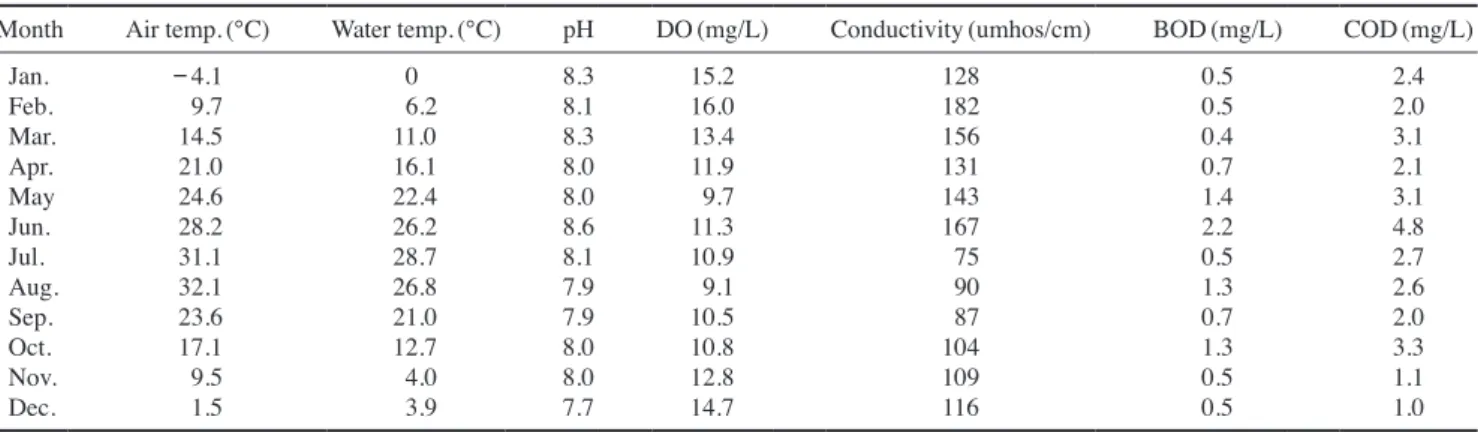
조사기간 동안 기온과 수온은 모두 1월에 -4.1℃, 0℃로 가장 낮았고 기온은 8월에 32.1℃, 수온은 7월에 28.7℃로 가
장 높게 나타났다. 조사기간 동안 조사지점 2의 이화학적 요 인 중 pH는 7.7~8.6, DO는 9.1~15.2mg/L, Conductivity는 75~182umhos/cm, BOD는 0.4~2.2mg/L, COD는 1.0~4.8 mg/L로 연중 높은 용존산소량, 낮은 전기전도도, 중성의 pH를 나타내 양호하였다(Table 2).
2. 동서출현종
조사지점에서 출현한 동소어종을 조사한 결과 모두 3목 7
과 24종 2,290개체로 Table 3과 같다. 출현종의 상대풍부도는 참갈겨니 Zacco koreanus(27.4%), 피라미 Z. platypus(17.5%), 돌고기 Pungtungta herzi(9.4%), 한강납줄개(8.7%), 긴몰개 Squalidus gracilis majimae(8.6%), 배가사리 Microphysogobio longidorsalis(4.1%) 순으로 나타났다. 법적보호종으로는 멸종 위기 II급 어류로 지정된 묵납자루와 한강납줄개가 확인되었 고 한국고유종은 쉬리 Coreoleuciscus splendidus, 긴몰개, 돌 마자 M. yaluensis 등 14종이 확인되어 높은 비율(58.8%)로 한 국고유종이 출현하였다.
3. 연령
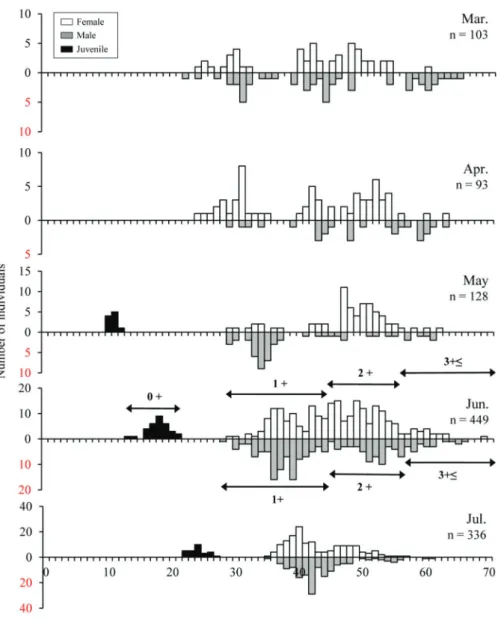
한강납줄개의 연령을 추정하기 위해 체장빈도분포를 분석 한 결과는 Fig. 2와 같다. 2012년 부화한 당년생 치어는 5월 조사에서 처음 채집되었고 체장 10~12mm 범위였다. 6월을 기준으로 연령을 비교한 결과 암컷과 수컷의 체장은 비슷하 였고 체장 13~22mm 군은 당년생, 30~45mm 군은 만 1년생, 45~55mm 군은 만 2년생, 55~70mm 이상 군은 만 3년생 이 상으로 추정되었다. 채집된 개체 중 가장 큰 개체는 수컷 66.7 mm(7.1g), 암컷 69.0mm(7.4g)으로 나타났다.
4. 성비
한강납줄개의 산란기에 암컷은 산란관이 매우 길어지고 수 컷은 주둥이에 추성이 밀집하며 등쪽은 어두운 검은색, 체측 Fig. 1. A map showing the study sites of Rhodeus pseudosericeus in
the Heukcheon(River), Gyeonggi-do, Korea. Dark circles indicate the study sites.
Table 1. The physical characteristics at the study site of Rhodeus pseudosericeus in the Heukcheon(River), Gyeonggi-do, Korea during June and September, 2012
Study sites River width
(m) Water width
(m) Water depth
(m) River type Bottom structure(%)*
B C P G S M
1 50~80 10~50 0.3~1.0 Aa-Bb 5 10 25 25 20 15
2 120~150 80~120 0.5~1.5 Aa-Bb 5 5 10 10 60 10
3 50~100 30~50 0.2~1.5 Aa-Bb 10 20 20 30 15 5
4 120~150 80~100 0.3~2.0 Bb 10 15 20 30 20 5
*Cummins(1962): B(bolder, >256mm), C(cobble, 256~64(mm), P(pebble, 64~16mm), G(gravel, 16~2mm), S(sand, 2~0.1mm), M(mud, 0.1mm<)
Table 2. The chemical characters at the study site 2 of Rhodeus pseudosericeus in the Heukcheon(River), from January to December 2012 Month Air temp.(℃) Water temp.(℃) pH DO(mg/L) Conductivity(umhos/cm) BOD(mg/L) COD(mg/L)
Jan. -4.1 0 8.3 15.2 128 0.5 2.4
Feb. 9.7 6.2 8.1 16.0 182 0.5 2.0
Mar. 14.5 11.0 8.3 13.4 156 0.4 3.1
Apr. 21.0 16.1 8.0 11.9 131 0.7 2.1
May 24.6 22.4 8.0 9.7 143 1.4 3.1
Jun. 28.2 26.2 8.6 11.3 167 2.2 4.8
Jul. 31.1 28.7 8.1 10.9 75 0.5 2.7
Aug. 32.1 26.8 7.9 9.1 90 1.3 2.6
Sep. 23.6 21.0 7.9 10.5 87 0.7 2.0
Oct. 17.1 12.7 8.0 10.8 104 1.3 3.3
Nov. 9.5 4.0 8.0 12.8 109 0.5 1.1
Dec. 1.5 3.9 7.7 14.7 116 0.5 1.0
중앙부는 주황색으로 변하며 체측 파란색 줄무늬가 짙어지는 특징이 나타났다. 산란기 이외에도 당년생을 제외하고는 산란 관 유무로 암수구분이 가능하였다. 조사기간 중 암수가 구별 되는 개체는 암컷이 594개체, 수컷이 474개체가 채집되었고 성비(♀:♂)는 1:0.80로 나타나 유의한 차이를 보였다(Table 4; χ2=13.48, P<0.05).
5. 산란기 및 성숙난수
한강납줄개 암컷의 산란관길이/체장 비율은 3월에 28.4±
20.77%로 가장 높았고 4~5월까지 높게 유지되었으나 6월부 터 감소하기 시작하여 7월에 4.7±4.53%로 가장 낮았다. 채집 된 전체 암컷 중 알이 나오는 개체의 비율은 3월 30.0%, 4월 24.2%, 5월 7.5%, 6월 0.9%였고 수컷의 정액이 확인된 기간 이 3~6월까지인 것으로 미루어 산란기는 3~6월까지로 추정 되었다(Fig. 3). 이 시기 동안 수온은 11.0~26.2℃ 범위이다.
3개 이상의 성숙난이 확인된 암컷은 36개체였고 체장 범 위는 36.9~60.0(48.2±4.91) mm였으며 성숙난수는 5~45 (14.1±7.80)개로 조사되었고 체장의 크기와 알 수는 상관관 계가 낮은 것으로 나타났다(Fig. 4).
6. 산란숙주조개 이용
연구기간 동안 확인된 조개는 석패과 작은말조개 Unio douglasiae sinuolatus 1종이었으며 채집한 작은말조개의 각장 은 41.6~66.6(56.2±7.04) mm 범위였다(n=49). 작은말조개 는 4장의 새엽 중 2장의 외새엽만 보육낭으로 사용하였다. 한 강납줄개의 알은 비점착성으로 조개 내 새강과 새엽에서 모 두 확인되었다. 부화한 자어 머리는 반새(demibranches) 끝 쪽 으로 향해있었고 산란율은 44.9%(n=22)였으며 확인된 알 및 자어수는 1~22(5.8±5.51)개였다. 반새 위치에 따른 알 및 자어수는 왼쪽 외반새 1~9(2.7±2.16)개, 왼쪽 내반새 1~2 Table 3. Fish fauna of cohabitation with Rhodeus pseudosericeus at the each study sites of the Heukcheon(River) from June and September 2012
Species St.1 St.2 St.3 St.4 Total RA(%) Remarks*
Family Cyprinidae
Carassius auratus 28 28 1.22
Rhodeus pseudosericeus 13 160 5 22 200 8.73 E, K
Acheilognathus signifer 15 60 75 3.28 E, K
Acheilognathus rhombeus 10 10 0.44
Pungtungta herzi 35 117 38 25 215 9.39
Coreoleuciscus splendidus 5 6 11 0.48 K
Squalidus gracilis majimae 25 107 35 30 197 8.60 K
Hemibarbus labeo 3 3 0.13
Hemibarbus longirostris 16 21 7 9 53 2.31
Pseudogobio esocinus 20 26 7 9 62 2.71
Microphysogobio yaluensis 5 7 12 0.52 K
Microphysogobio longidorsalis 32 30 32 94 4.10 K
Rhynchocypris oxycephalus 17 33 50 2.18
Zacco koreanus 98 333 110 87 628 27.42 K
Zacco platypus 85 171 77 68 401 17.51
Family Cobitidae
Misgurnus anguillicaudatus 4 8 12 0.52
Iksookimia koreensis 16 28 11 10 65 2.84 K
Koreocobitis naktongensis 3 30 4 37 1.62 K
Family Bagridae
Pseudobagrus koreanus 25 4 2 31 1.35 K
Liobagrus andersoni 1 1 0.04 K
Family Centropomidae
Coreoperaca herzi 6 20 7 6 39 1.70 K
Family Odontobutidae
Odontobutis platycephala 5 11 6 22 0.96 K
Odontobutis interrupta 34 34 1.48 K
Family Gobiidae
Rhinogobius brunneus 1 9 10 0.44
Number of family/species 5/18 5/19 5/15 6/13 7/24
Number of individuals 401 1,222 378 289 2,290 100
*E: Endangered species; K: Korean endemic species, RA: Relative abundance
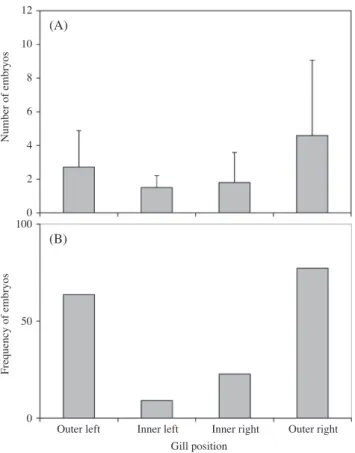
(1.5±0.71)개, 오른쪽 내반새 1~5(1.8±1.79)개, 오른쪽 외반 새 1~22(5.8±5.51)개로 나타났다(Fig. 5).
고 찰
하천에 서식하는 어류는 수환경의 물리, 화학 및 생물학적 특성에 의해서 직간접적으로 영향을 받게 된다(Arthington et al., 2006). 대부분의 납자루아과 어류는 잔잔한 소의 하상이 뻘로 이루어진 수환경에서 주로 서식하는 것으로 알려져 있 으나 본 종은 하천 중·상류의 자갈, 모래 하상을 선호하는 묵 납자루와 서식처가 유사하였다(Kim, 1997; Back and Song, Table 4. The sex ratio of Rhodeus pseudosericeus in the Heukcheon
(River) from January to July 2012
Month Female Male Total Sex ratio
(♂/♀) χ2
(chi-squared)
Jan. 10 15 25 1.50 1.00
Feb. 10 12 22 1.20 0.18
Mar. 50 53 103 1.06 0.09
Apr. 66 27 93 0.41 16.35
May 67 33 100 0.49 11.56
Jun. 232 185 417 0.80 5.30
Jul. 159 149 308 0.94 0.32
Total 594 474 1,068 0.80 13.48
The critical value for χ2 goodness-of-fit test of equal numbers offemales and males(1df) at 95% significance is 3.84.
Fig. 2. Standard length frequency distribution of Rhodeus pseudosericeus in the Heukcheon(River) from March to July 2012.
2005a). 특히 조사지점 2는 하류부에 있는 보로 인하여 물의 흐름이 저하되고 정수역이 형성되었다. 이는 조개에서 나오 는 치어들이 빠른 물살에 떠내려갈 위험성을 낮추고 산란숙주 인 작은말조개가 서식하기 좋은 환경을 형성하며 수변부의 달 뿌리풀 아래쪽으로 은신처를 제공하기 때문으로 본 종의 개 체군이 크게 유지될 수 있는 중요한 요인이 되었다고 생각된 다. 한강납줄개는 묵납자루보다는 제한된 수역에서만 서식하 고 있는데 수온, 유속, 하상구조 등 비생물적 환경이 제한요인 으로 작용하고 있는 것으로 판단된다. 또한 묵납자루는 작은 말조개 뿐 아니라 곳체두드럭조개에도 산란이 가능한 일반종 (generalist)이라고 보고된 바 있어(Kim et al., 2013) 산란숙주 조개에 따른 생물학적 요인까지 제한요인으로 작용할 가능성 이 있으므로 종 보전을 위해서는 이에 대한 연구가 요구된다.
본 지점에서는 2010년과 2011년에 묵납자루의 복원을 위해 각각 1,000마리, 3,000마리를 방류하였다(ME, 2010, 2011a).
본 조사 중 묵납자루는 75개체가 확인되었는데 5월 조사에서 혼인색을 보이는 묵납자루 수컷과 산란관이 길어진 암컷이 확 인되었다. 2017년에도 묵납자루의 서식이 확인되고 있어 방류 한 개체들이 성공적으로 번식하는 것으로 판단된다. 본 지점 은 작은말조개 1종만이 서식하고 있는데 묵납자루와 한강납 줄개의 종 간 경쟁의 가능성도 있을 것으로 예상된다. 이에 묵 납자루 방류지로서 안정적인 복원과 동시에 한강납줄개와의 상호관계에 대해서는 지속적인 모니터링이 진행되어야 할 것 으로 판단된다.
납자루아과 어류의 연령에 대한 보고에서 묵납자루는 체 장 40mm 이하에서 만 1년생, 45~50mm는 만 2년생, 55mm 이상은 만 3년생 이상(Back et al., 2002), 각시붕어 R. uyekii 는 체장 24~29mm에서 만 1년생, 30~35mm군은 만 2년생, 36~39mm는 만 3년생, 40mm 이상은 만 4년생 이상으로 추 정한 바 있다(Kim et al., 2015). 본 조사에서 한강납줄개의 성 숙난이 확인된 최소 크기는 체장 36mm였으며 평균 48mm로 만 2년생 이상에서 산란이 가능한 것으로 판단되어 묵납자루 와 유사한 결과가 나타냈다(Back et al., 2002).
한강납줄개의 산란기는 암컷의 복부를 통해 성숙난과 수컷 의 정액이 확인되는 3~6월로 추정되었는데 산란성기는 성숙 Fig. 3. Monthly change of ovipositor length/standard length of Rho-
deus pseudosericeus in the Heukcheon(River) from January to July 2012. OL: ovipositor length, SL: standard length.
Percent(%)
OL/SL Female with eggs
Jan. Feb. Mar. Apr. May Jun. Jul.
50 40 30 20 10
0
Month
Fig. 4. Number of mature egg(●) of Rhodeus pseudosericeus in the Heukcheon(River) from March to June 2012.
Fecundity
y=0.5965x-14.664 R2=0.1411 n=36
30 40 50 60 70
50 40 30 20 10
0
Standard length(mm)
Fig. 5. Mean(±SD) number(A) and frequency(B) of the embryos of Rhodeus pseudosericeus in the gill of Unio douglasiae sinuolatus in the Heukcheon(River) from April 2012.
Frequency of embryosNumber of embryos
Outer left Inner left Inner right Outer right 100
50
0 12 10 8 6 4 2 0
(A)
(B)
Gill position
난이 나오는 암컷의 비율이 높았던 3~4월로 추정된다. 9~11 월에 산란하는 납지리를 제외하고는 국내 납자루아과 어류의 산란기는 4~7월 사이로 알려져 있는데 본 종은 더 낮은 수 온에서 빠른 시기에 산란을 시작하는 하는 것으로 판단된다 (Uchida, 1939; Song, 1994; Kim, 1997; Back et al., 2003; Kim et al., 2015). A. cygnostigma의 산란 특성에 대한 연구에서 동 소하는 납자루아과 어류가 있을 때와 없을 때는 산란시기에 차 이가 나타날 수 있으며 이는 조개를 두고 종간 경쟁을 감소하 기 위한 적응 전략이라고 보고하였다(Hirai, 1964; Kimtamura, 2005). 한강납줄개는 방류 사업 이전에 묵납자루의 출현 비율 이 매우 적어서 종 간 경쟁을 줄이기 위해 빠른 산란을 시작 하는 것보다는 낮은 수온에서 발생이 진행되는 난의 특성과 빠른 부화를 통한 자치어의 서식지 및 먹이확보 등 생존율을 높이기 위한 방향의 적응양상이 나타나는 것으로 생각된다.
납자루아과 어류의 암컷은 산란기가 되면 산란관이 매우 길 어지기 때문에 호르몬 주사와 같은 인위적 자극 없이 육안으 로 확인하고 복부를 압박해서 성숙란을 채란할 수 있다. 성숙 난수에 관한 보고는 복부압박법을 통해 확인된 바 있으며 납 자루는 85개, 106개, 큰납지리는 123~229개(평균 195), 가시 납지리 A. chankaensis는 평균 304개, 각시붕어는 1~22개(평 균 12.8)로 한강납줄개의 1~45개(평균 13.7)는 적은편에 속 하였다(Suzuki and Jeon, 1989, 1990a, b; Kim et al., 2015). 납 자루아과 어류의 알은 다양한 형태적 적응 양상을 보이고 있 으며 이는 조개 내 새엽에 놓여졌을 때 조기 토출을 방지하고 생존율을 높이기 위한 적응으로 알려져 있다(Aldridge, 1999;
Smith et al., 2004). 납줄개속(Genus Rhodeus) 어류는 다른 속 납자루아과 어류에 비하여 상대적으로 큰 알과 모양을 보이며 익상돌기가 있어 조개 새엽에 더 잘 끼워져 있을 수 있다(Kim et al., 2006). 한강납줄개는 많은 수의 작은 알보다 적은 수의 큰 알을 조개에 나누어 산란하여 알과 자어의 생존율을 높이 기 위한 적응 전략으로 생각된다(Aldridge, 1999).
본 조사지점에서는 작은말조개 1종만이 조사되어 한강납 줄개의 숙주선택성에 대해서는 확인하지 못하였다. 작은말조 개는 2장의 외새엽에만 글로키디움 유생이 있었는데 한강 납줄개의 알 및 자어는 외반새에서 더 많은 수와 빈도로 확 인되었다. 외반새에 산란빈도가 높은 종은 묵납자루와 일본 산 A. longipinnis가 보고된 바 있고 줄납자루와 R. ocellatus kurumeus는 내반새에서 더 높은 산란빈도를 보였다(Song and Kwon, 1994; Back and Song, 2005b; Kitamura, 2006;
Kitamura et al., 2009). 조개의 새엽은 내새엽과 외새엽 그리고 성별에 따라 수공 내 산소포화도 및 물 흐름에 있어 차이가 생긴다(Tankersley and Dimock, 1993a, b; Mills and Reynolds, 2002, 2003). 또한 납자루아과 어류는 조개 유생과 산소를 두 고 경쟁하기 때문에 유생이 있는 새엽보다 유생이 없는 새엽 을 선호한다고 보고된 바 있다(Smith et al., 2004; Kitamura,
2006). Kanoh(2000)는 그룹 산란 동안 조개 새엽 내 산란장소 를 선택할 시간이 부족하기 때문에 조개 유생이 없는 새엽에 산란하지 못한다고 하였다. 그러나 본 조사에서는 유생이 있 는 경우에서도 외반새에서 높은 빈도로 산란되어 있었는데 산 란되는 알이 글로키디움으로 채워진 외반새 안으로 들어갈 수 있는지에 대한 가능성과 외반새에 산란될 경우 조개에 의한 조기 토출율이 낮은지에 대한 행동학적 연구가 필요하다고 생 각된다.
최근 멸종위기어류에 대해 생물학적 기초조사, 유전적 다 양성 분석, 인공증식 기술개발, 분포 조사 등 증식·복원을 위 한 다양한 연구사업이 진행되었다(ME, 2009, 2010, 2011a, b;
MLTM, 2010, 2011). 한강납줄개는 좁은 서식범위, 개체군 밀 도 감소, 서식지 변화, 생물학적 정보부족으로 인하여 종의 서 식에 위험성이 높아지고 있는 실정이다. 특히 본 종은 성숙난 수가 20개 내외로 적으며 조개에 산란하는 생태적 특성을 가 지고 있으므로 종의 증식·보전을 위한 기초연구와 더불어 서 식지 보호 및 인근주민에 적극적인 홍보를 통한 정책지원이 지속되어야 할 것으로 생각된다. 또한 종의 보전을 위해서는 부여청양 지천 미호종개 서식지(천연기념물 제533호)와 같은 적극적인 보호대책도 요구된다
요 약
본 연구는 2012년 1~7월까지 경기도 양평군 흑천 일대에서 한강납줄개의 산란 특성에 관한 연구를 실시하였다. 한강납 줄개는 물의 흐름이 느리고 달뿌리풀과 버드나무의 수생식물 이 많은 곳의 모래와 뻘의 하상구조를 보이는 지점을 선호하 였다. 연령은 6월 기준으로 13~22mm는 당년생, 체장 30~45 mm는 만 1년생, 45~55mm는 만 2년생, 55~70mm 이상군은 만 3년생 이상으로 추정되었다. 조사기간 동안 암수 성비는 1 :0.80로 나타났고 산란기는 3월부터 6월까지로 추정되었다(수 온 11.0~26.2℃). 한강납줄개는 작은말조개 Unio douglasiae sinuolatus에 비점착성 알을 산란하였고 확인된 알 및 및 자 어수는 1~22(5.8±5.51)개였다. 반새 위치에 따른 알 및 자어 수는 왼쪽 외반새 1~9(2.7±2.16)개, 왼쪽 내반새 1~2(1.5±
0.71)개, 오른쪽 내반새 1~5(1.8±1.79)개, 오른쪽 외반새 1~22(5.8±5.51)개로 나타났다.
사 사
이 논문은 2017년도 국립수산과학원 수산시험연구사업 향 어, 메기 품종개량연구(R2017003)의 지원으로 수행된 연구입 니다.
REFERENCES
Aldridge, D.C. 1999. Development of European bitterling in the gills of freshwater mussels. J. Fish Biol., 54: 138-151.
Arai, R. 1988. Fish systematics and cladistics. In: Ichthyology Cur- rents 1988(eds Uyeno, T. and M. Okiyama), Asakura Sho- ten, Tokyo, pp. 4-33.
Arai, R., S.R. Jeon and T. Ueda. 2001. Rhodeus pseudosericeus sp. Nov., a new bitterling from South Korea(Cyprinidae, Acheilognathinae). Ichthyol. Res., 48: 275-282.
Arthington, A.H., S.E. Bunn, N.L. Poff and R.J. Naiman. 2006. The challenge of providing environmental flow rules to sustain river ecosystems. Ecol. Appl., 16: 1311-1318.
Back, H.M. and H.B. Song. 2005a. Habitat selection and environ- mental characters of Acheilognathus signifer. Korean J.
Limnol., 38: 352-360.(in Korean)
Back, H.M. and H.B. Song. 2005b. Spawning in mussel and adapta- tion strategy of Acheilognathus signifer(Cyprinidae: Achei- lognathinae). Korean J. Ichthyol., 17: 105-111.(in Korean) Back, H.M., H.B. Song and O.K. Kwon. 2002. Age and growth of
Korean bitterling, Acheilognathus signifer in upper reaches of the Hongcheon River, Korea. Korean J. Ichthyol., 14:
254-261.(in Korean)
Back, H.M., H.B. Song and O.K. Kwon. 2003. Sexual maturation and the spawning season of the Korean bitterling, Acheilo- gnathus signifer in upper reaches of the Hongcheon River.
Korean J. Ichthyol., 15: 278-288.(in Korean)
Cummins, K.W. 1962. An evaluation of some techniques for the collection and analysis of benthic samples with special on lotic waters. Amer. Midl. Nat., 67: 477-504.
Damme, V.D., N. Bogutskaya, R.C. Hoffimann and C. Smith. 2007.
The introduction of the European bitterling(Rhodeus ama- rus) to west and central Europe. Fish Fish., 8: 79-106.
Hirai, K. 1964. Comparative studies on ecology of four species of bitterlings in the Lake Biwa. Physiol. Ecol. Jpn., 12: 72-81.
(in Japanese)
Jeon, H.B. and H.Y. Suk. 2014. Pseudo but actually genuine: Rhodeus pseudosericeus provides insight into the phylogeographic history of the amur bitterling. Animal Cells Syst., 18: 275- 281.
Kani, T. 1944. Ecology of torrent-inhabiting insects, pp. 171-317.
In: Insect I(Furukawa, J., ed.). Kenkyu-sha, Tokyo.(in Jap- anese)
Kanoh, Y. 2000. Reproductive success associated with territoriality, sneaking, and grouping in male rose bitterlings, Rhodeus ocellatus(Pisces: Cyprinidae). Environ. Biol. Fish., 57: 143- Kim, C.H., E.J. Kang and J.H. Kim. 2006. Development of eggs 154.
and early life history of Korean bitterling, Rhodeus pseudo- sericeus(Acheilognathinae). Korean J. Ichthyol., 18: 266- Kim, D.M., H.B. Jeon and H.Y. Suk. 2014. Tanakia latimarginata, 272.
a new species of bitterling from the Nakdong River, South
Korea(Teleostei: Cyprinidae). Ichthyol. Explor. Freshwa- ters, 25: 59-68.
Kim, H.S. and I.S. Kim. 2009. Acanthorhodeus gracilis, a junior synonym of Acheilognathus chankaensis(Pisces: Cyprini- dae) from Korea. Korean J. Ichthyol., 21: 55-60.
Kim, H.S., H. Yang and J.Y. Park. 2013. Host species preference of Acheilognathus signifer(Pisces: Acheilognathinae) for spawning in freshwater mussels. Korean J. Ichthyol., 25:
208-215.(in Korean)
Kim, H.S., J.G. Ko, W.S. Choi and J.Y. Park. 2015. Population ecology of Korean rose bitterling, Rhodeus uyekii(Pisces:
Acheilognathinae) in the Bongseocheon, Mankyeonggang (river), Korea. Korean J. Ichthyol., 27: 78-85.(in Korean) Kim, I.S. 1997. Illustrated encyclopedia of fauna and flora of Korea.
Vol. 37. Freshwater Fishes. Ministry of Education, Seoul, 629pp.(in Korean)
Kim, I.S. and J.Y. Park. 2002. Freshwater fishes of Korea. Kyohak Publishing, Seoul, 465pp.(in Korean)
Kitamura, J. 2005. Reproductive ecology of the striped bitterling Acheilognathus cyanostigma(Cyprinidae: Acheilognathi- nae). Ichthyol. Res., 53: 216-222.
Kitamura, J. 2006. Adaptive spatial utilization of host mussels by the Japanese rosy bitterling Rhodeus ocellatus kurumeus. J.
Fish Biol., 69: 263-271.
Kitamura, J. 2008. Bitterling fishes(Cyprinidae: Acheilognathinae):
current threats and conservation. Japan J. Ichthyol., 55:
139-144.(in Japanese)
Kitamura, J., J.N. Negishi, M. Nishio, S. Sagawa, J.I. Akino and S.
Aoki. 2009. Host mussel utilization of the Itasenpara bitter- ling(Acheilognathus longipinnis) in the Moo River in Himi, Japan. Ichthyol. Res., 56: 296-300.
Kwon, O.K, G.M. Park and J.S. Lee. 1993. Coloured shells of Korea.
Academy Publishing Company, Seoul, 456pp.(in Korean) ME(Ministry of Environment). 1997-2008. National environment
investigation of freshwater fish. Ministry of Environment, Incheon.(in Korean)
ME(Ministry of Environment). 2009. Development of genetic diversity analysis, culture and ecosystem restoration tech- niques for endangered fish, Iksookimia choii. Ministry of Environment, Incheon, 537pp.(in Korean)
ME(Ministry of Environment). 2010. Study on culture and resto- ration of endangered freshwater fish in the major four river drainages. Institute of biodiversity research, Jeonju, 86pp.
(in Korean)
ME(Ministry of Environment). 2011a. Study on culture and resto- ration of endangered freshwater fish(four species include Liobagrus obesus). Soonchunhyang University, Asan, 359pp.
(in Korean)
ME(Ministry of Environment). 2011b. Development of culture tech- niques and construction of monitoring system for released seed of an endangered fish Koreocobitis naktongensis. Soon- chunhyang University, Asan, 250pp.(in Korean)
Mills, S.C. and J.D. Reynolds. 2002. Mussel ventilation rates as a
proximate cue for host selection by bitterling Rhodeus seri- ceus. Oecologia(Berl), 131: 473-478.
Mills, S.C. and J.D. Reynolds. 2003. The bitterling-mussel inter- action as a test case for co-evolution. J. Fish Biol., 63: 84- 104.
Mills, S.C., M.I. Taylor and J.D. Reynolds. 2005. Benefits and costs to mussels from ejecting bitterling embryos: a test of the evolutionary equilibrium hypothesis. Ani. Behav., 70: 31- MLTM(Ministry of Land, Transport and Maritime Affairs). 2010. 37.
Culture and restoration of endangered species in the major four river drainages. Soonchunhyang University, Asan, 489pp.(in Korean)
MLTM(Ministry of Land, Transport and Maritime Affairs). 2011.
Culture and restoration of endangered species in the major four river drainages(II). Soonchunhyang University, Asan, 363pp.(in Korean)
Moon, W.K., J.H. Han and K.G. An. 2010. Fish fauna and commu- nity analysis in Heuck stream watershed. Korean J. Lim- nol., 43: 69-81.(in Korean)
NIBR(National Institute of Biological Resources). 2011. Red data book of endangered fishes in Korea. National institute of biological resources, Incheon, 202pp.(in Korean)
Oshiumi, C. and J. Kitamura. 2009. The reproductive ecology of the southern red tabira bitterling Acheilognathus tabira jordani in Japan. J. Fish Biol.,75: 655-667.
Ricker, W.E. 1971. Methods for assessment of fish production in freshwater. IBP Hand Book, 3: 112-113.
Smith, C., M. Reichard, P. Jurajda and M. Przybylski. 2004. The reproductive ecology of the European bitterling(Rhodeus sericeus). J. Zool., Lond., 262: 107-124.
Song, H.B. 1994. Ecological studies on the bitterling, Acheilog-
nathus yamatsutae Mori(Cyprinidae) in Korea. Doctoral dissertation, Kangwon National University, 181pp.(in Korean)
Song, H.B. and O.K. Kwon. 1994. Spawning of the bitterling, Acheilognathus yamatsutae(Cyprinidae) into the mussel.
Korean J. Ichthyol., 6: 39-50.(in Korean)
Suzuki, N. and S.R. Jeon. 1989. Development of the bitterling, Acanthorhodeus asmussi(Cyprinidae) with note on minute tubercles on the skin surface. Korean J. Ichthyol., 1: 73-82.
Suzuki, N. and S.R. Jeon. 1990a. Development of the bitterling, Acanthorhodeus(=Acheilognathus) gracilis(Cyprinidae), with a note on minute tubercles on the skin surface. Korean J. Ichthyol., 2: 169-181.
Suzuki, N. and S.R. Jeon. 1990b. Development of the bitterling, Acheilognathus lanceolatus from Ungchonriver. Korean J.
Ichthyol., 2: 77-87.
Suzuki, N. 2006. Egg and larval development of the bitterling Rho- deus pseudosericeus(Cyprinidae). Japan. J. Ichthyol., 53:
47-54.
Tankersley, R.A. and R.V. Dimock. 1993a. The effect of larval brooding on the respiratory physiology of the freshwater unionid mussel Pyganodon cataracta. Am. Mid. Nat., 130:
146-163.
Tankersley, R.A. and R.V. Dimock. 1993b. Endoscopic visualization of the functional morphology of the ctenidia of the unionid mussel Pyganodon cataracta. Can. J. Zool., 71: 811-819.
Uchida, K. 1939. The fishes of Tyôsen(Korea). Part 1. Nematog- nathi and Eventognathi. Bull. Fish. Exp. Sta. Gov. Gener.
Tyôsen. 6, 458pp.(in Japanese)
WAMIS. 2013. Hydro/meteorology, Sokcho Station. Retrieved from http://www.wamis.go.kr. version(12/2013).