• 검색 결과가 없습니다.

KVN SOURCE-FREQUENCY PHASE-REFERENCING OBSERVATION OF 3C 66A AND 3C 66B

N/A
N/A
Protected

Academic year: 2021

Share "KVN SOURCE-FREQUENCY PHASE-REFERENCING OBSERVATION OF 3C 66A AND 3C 66B"

Copied!
3
0
0

로드 중.... (전체 텍스트 보기)

전체 글

(1)

Publications of the Korean Astronomical Society pISSN: 1225-1534

30: 629 ∼ 631, 2015 September eISSN: 2287-6936

2015. The Korean Astronomical Society. All rights reserved. c http://dx.doi.org/10.5303/PKAS.2015.30.2.629

KVN SOURCE-FREQUENCY PHASE-REFERENCING OBSERVATION OF 3C 66A AND 3C 66B Guang-Yao Zhao 1 , Taehyun Jung 1 , Richard Dodson 1,2 , Maria Rioja 1,2 , and Bong Won Sohn 1

1 Korea Astronomy and Space Science Institute, 776 Daedeok-daero, Yuseong, Daejeon 305-348, Korea

2 International Centre for Radio Astronomy Research, M468, The University of Western Australia, 35 Stirling Hwy, Crawley, WA 6009, Australia

E-mail: [email protected]

(Received November 30, 2014; Reviced May 31, 2015; Aaccepted June 30, 2015)

ABSTRACT

In this proceedings, preliminary results of the KVN Source-Frequency Phase-Referencing (SFPR) observation of 3C 66A and 3C 66B are presented. The motivation of this work is to measure the core-shift of these 2 sources and study the temporal evolution of the jet opacity. Two more sources were observed as secondary reference calibrators and each source was observed at 22, 43, and 86 GHz simultaneously.

Our preliminary results show that after using the observations at the lower frequency to calibrate those at the higher frequency of the same source, the residual visibility phases for each source at the higher frequencies became more aligned, and the coherence time became much longer; also, the residual phases for different sources, within 10 degrees angular separations, follow similar trends. After reference to the nearby calibrator, the SFPRed maps were obtained as well as the astrometric measurements, i.e. the combined coreshift. The measurements were found to be affected by structural blending effects because of the large beamsize of KVN, but this can be corrected with higher resolution maps (e.g. KAVA maps).

Key words: Astrometry — radio continuum: galaxies — galaxies: active — galaxy: individual(3C 66A, 3C 66B)— techniques: interferometric

1. MOTIVATION

The radio source 3C 66A (also known as B0219+428) is a well-known BL Lac object at a redshift of 0.33—0.44 (Furniss et al., 2013). 3C 66B (UGC 01841) is a nearby radio galaxy (D=86Mpc, z =0.0213). Both sources are bright at radio wavelengths and, under parsec-scale res- olution, both sources show typical core-jet structures.

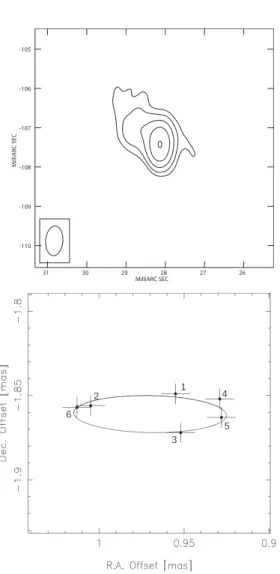
The separation on the sky plane between these two sources is very small, ∼ 6 arcmin, which makes them an ideal pair for phase-referencing observations. Previ- ous VLBA observation results have revealed a possible elliptical orbital motion of the jet core in 3C 66B based on the multi-epoch position measurements obtained by phase-referencing to the core of 3C 66A (See Figure 1). This result once led to the conclusion that a bi- nary SMBH system was at the center of 3C 66B (Sudou et al., 2003). However, this explanation is under debate (e.g. Jenet et al., 2004). Alternative explanations, such as a single BH with jet precession, cannot be ruled out due to the lack of the central SMBH position informa- tion. Furthermore, there might be contributions from the reference source in the measurements because of its variability. In particular, follow-up studies have found apparent inward motions of the innermost components in the jet of 3C 66A which strongly supports the later argument (Zhao et al., 2014; See also Figure 2).

http://pkas.kas.org

Therefore, non-stationarity of the core may exist in both of the two sources, and the reason is not clear.

Detailed follow-up studies are necessary.

2. METHOD AND OBSERVATIONS

We believe that core-shift studies are important to un- derstand the non-stationarity of the cores in 3C 66A&B.

The core-shift effect represents the frequency depen- dence of the absolute position of the core, which is usu- ally r c (ν) ∝ ν −1/k r . With core-shift measurements, we can obtain information about the SMBH position (e.g.

Hada et al. 2011). Subsequent multi-epoch measure- ments will enable us to trace the core motion in 3C 66A and SMBH positions in 3C 66B in order to check if it is orbiting another SMBH. Core-shift measurements will provide other information for the parsec-scale jet as well, such as the magnetic field (e.g. Lobanov 1998).

There are several different ways of measuring core- shifts (e.g. Marcaide & Shapiro, 1984; Kovalev et al., 2008; Kudryavtseva et al., 2011; Rioja & Dodson, 2011;

Pushkarev et al., 2012). The one we use for this work is Source-Frequency phase-referencing (SFPR, Rioja &

Dodson, 2011). The rationale is similar to measur-

ing the relative position between sources with conven-

tional phase-referencing. By doing phase-transfer in the

frequency domain, non-dispersive propagation effects

like tropospheric effects are calibrated and the residual

629

(2)

630 ZHAO ET AL.

Mill iARC SEC

MilliARC SEC

31 30 29 28 27 26

-105

-106

-107

-108

-109

-110

Figure 1. Top: A VLBA map of 3C 66B at K band. The peak flux is 32mJy/beam and contours starts from 3σ level and increase by 2. Bottom: Multi-epoch position measurements of the core in 3C 66B by reference to that in 3C 66A (from Sudou et al., 2003).

phase will contain information on the relative position between frequencies, i.e. the core-shift. Then, by ref- erencing to another source to calibrate the dispersive items of the visibility phase, the residual phase will con- sist of the combined core-shift of the two sources, the target source structure and interpolation errors. This method works well for astrometry at mm wavelengths (e.g. Rioja et al., 2014).

We used the Korean VLBI network (KVN) 1 to carry out our SFPR observations towards 3C 66A and 3C 66B.

The KVN is a dedicated mm-VLBI network. The quasi- optics system adopted by KVN make it very efficient in multi-frequency studies like SFPR.

Our observation started in February 2014. Nearly ev- ery 2 months, we observed 3C 66A and 3C 66B together with two nearby calibrators at 22, 43 and 86 GHz simul- taneously. The observing frequencies were set to have integer ratios in order to avoid 2π ambiguities when do- ing frequency-phase-transfer (FPT). The total observa-

1 http://kvn.kasi.re.kr

2001 0 2001.5 2002 2002.5 2003 2003.5 2004 2004.5 2005 2005.5 2006 0.5

1 1.5 2 2.5 3

Time (Yr)

Separation (mas)

d c b a

Figure 2. Top: A VLBA map of 3C 66A at K band with circular Gaussian models. The peak flux is 421 mJy/beam and contours starts from 3σ level and increase by 2. Bottom:

Proper motions of the jet components at 22 GHz. The inner 2 components shows clear inward motions (from Zhao et al., 2014).

tion time for each epoch is ∼10 hours and the recording bandwidth is 256 MHz (64, 64, and 128 MHz at 22, 43, and 86 GHz, respectively).

3. PRELIMINARY RESULTS OF THE FIRST EPOCH In this section, we show some preliminary results of the first epoch observation which was carried out on Febru- ary 3rd, 2014. The data were correlated by the DiFX Correlator in KASI 2 . The data analysis was done us- ing the NRAO AIPS package. For phase calibration, we first applied the earth orientation parameter (EOP) cor- rection and parallactic angle correction, then the iono- spheric correction was done using the JPLG Total Elec- tron Content (TEC) maps. After these corrections, we fringe-fit on each source at the lower frequency. The so- lution table was first scaled up by the frequency ratio using an external script developed by one of the authors, and copied to the higher frequency data. Then the solu- tions for each source were applied to the visibility data of the same source. Next, we do fringe-fitting of 3C 66A data at the higher frequency and apply the solutions to all sources. Then we image the other sources and measure the position offset on the each map.

3.1. Frequency Phase Transfer

Figure 3 shows examples of the visibility phase at the Tamna-Ulsan baseline after FPT. The non-dispersive

2 http://kjcc.kasi.re.kr

(3)

KVN SFPR OBSERVATION OF 3C 66A & 3C 66B 631 Table 1

Combined core-shift measurements of 3C 66A and 3C 66B (Preliminary)

Freq. pair R.A. DEC

mas. mas

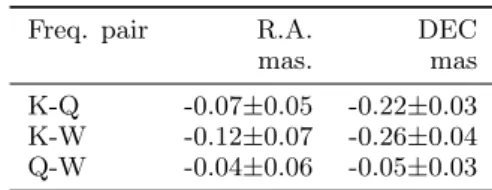
K-Q -0.07±0.05 -0.22±0.03 K-W -0.12±0.07 -0.26±0.04 Q-W -0.04±0.06 -0.05±0.03

items are calibrated by applying the phase solutions at the lower frequency. The visibility phase becomes more aligned so that the coherence time becomes much longer, sometimes hours even at mm-wavelengths, and phases of different sources within 10 degrees follow similar trends.

So the remaining items, i.e. the dispersive effects, can be calibrated by referencing to other sources.

Figure 3. Top: Visibility phase at 43 GHz after FPT from 22GHz at epoch 2014.09. Bottom: Visibility phase at 86 GHz after FPT from 43GHz at epoch 2014.09. The crosses, circles, squares and triangles represent the phases of 3C 66A, 3C 66B, 0159+418 and 0248+430 respectively. The latter two sources are the additional reference sources, one is 4 degrees from 3C 66A&B, the other is about 6 degrees in the opposite direction.

3.2. Maps and Astrometric Mesurements

After FPT and reference to 3C 66A, all the propaga- tion effects are calibrated and we can image the target source at higher frequencies. Two of the SFPRed maps of 3C 66B are shown in Figure 4. The dynamic range of the shown maps are about 30 and 12, respectively and the flux recovery ratios are about 70 and 60 per- cent, respectively. In each map, there is an offset from the center of the image to the peak. That is the astro- metric measurement, i.e. the combined core-shift. The values of the measured core-shift of 3C 66A and 3C 66B at different frequency pairs are shown in Table 1. The errors shown in the table are calculated by half of the projected beamsize divided by the dynamic range of the corresponding map.

Figure 4. Top: SFPRed map of 3C 66B at 43GHz at epoch 2014.09. Reference frequency is 22GHz and reference source is 3C 66A. Bottom: SFPRed map of 3C 66B at 86GHz at epoch 2014.09. Reference frequency is 43 GHz and reference source is 3C 66A.

4. DISCUSSION AND SUMMARY

Our preliminary results show that with simultaneous multi-frequency observations, the coherence time can be significantly enlarged by doing FPT. Ffter FPT and ref- erence to a nearby bright source, high quality SFPRed maps and astrometric measurements can be obtained.

The direction of the measured core-shift at each fre- quency pair is consistent with the combination of the predicted core-shift direction of each source, i.e. along the mean jet axis. However, when comparing our mea- surements with core-shift of other sources at cm wave-

lengths, these measurements seem too large. This indi- cates the measurements are affected by structural blend- ing due to the relatively large beam size of the KVN array. Fortunately this can be overcome by using high- resolution clean models when doing fringe-fitting. Ri- oja et al. (2014) have proved that by doing so, the KVN measurements agrees with the VLBA measure- ments within 1σ level. We have performed KaVA ob- servations of the two sources since April 2014. Data correlation and analysis are on-going. We expect that our future analysis will give reliable measurements and we can fulfill our goals for this project.

ACKNOWLEDGMENTS

We are grateful to the KVN operation team and the KJCC team for their help on the time allocation and correlation.

REFERENCES

Furniss, A., Fumagalli, M., Danforth, C., Williams, D. A.,

& Prochaska, J. X., 2013, On the Redshift of the Very High Energy Blazar 3C 66A, APJ, 766, 35

Hada, K., Doi, A., Kino, M., et al. 2011, An Origin of the Radio Jet in M87 at the Location of the Central Black Hole, Nature, 477, 185

Jenet, F. A., Lommen, A., Larson, S. L., & Wen, L., 2004, Constraining the Properties of Supermassive Black Hole Systems Using Pulsar Timing: Application to 3C 66B, APJ, 606, 799

Kovalev, Y. Y., Lobanov, A. P., Pushkarev, A. B., &

Zensus, J. A., 2008, Opacity in Compact Extragalactic Radio Sources and Its Effect on Astrophysical and Astrometric Studies, A&A, 483, 759

Kudryavtseva, N. A., Gabuzda, D. C., Aller, M. F.,

& Aller, H. D., 2011, A New Method for Estimating Frequency-dependent Core Shifts in Active Galactic Nucleus Jets, MNRAS, 415, 1631

Lobanov, A. P., 1998, Ultracompact Jets in Active Galactic Nuclei, A&A, 330, 79

Marcaide, J. M., & Shapiro, I. I., 1984, VLBI Study of 1038 + 528 A and B - Discovery of Wavelength Dependence of Peak Brightness Location, APJ, 276, 56 Pushkarev, A. B., Hovatta, T., & Kovalev, Y. Y., et al., 2012, MOJAVE: Monitoring of Jets in Active Galactic Nuclei with VLBA Experiments. IX. Nuclear Opacity, A&A, 545, A113

Rioja, M., & Dodson, R. 2011, High-precision Astrometric Millimeter Very Long Baseline Interferometry Using a New Method for Atmospheric Calibration, AJ, 141, 114 Rioja, M., Dodson, R., & Jung, T., et al., 2014, Veri- fication of the Astrometric Performance of the Korean VLBI Network, Using Comparative SFPR Studies with the VLBA at 14/7 mm, AJ, 148, 84

Sudou, H., Iguchi, S., Murata, Y., & Taniguchi, Y., 2003,

Orbital Motion in the Radio Galaxy 3C 66B: Evidence

for a Supermassive Black Hole Binary, Science, 300, 1263

Zhao, G.-Y., Chen, Y., & Shen, Z.-Q., et al. 2014, AJ, in

press

수치

Figure 2. Top: A VLBA map of 3C 66A at K band with circular Gaussian models. The peak flux is 421 mJy/beam and contours starts from 3σ level and increase by 2
Figure 3. Top: Visibility phase at 43 GHz after FPT from 22GHz at epoch 2014.09. Bottom: Visibility phase at 86 GHz after FPT from 43GHz at epoch 2014.09

참조

관련 문서