≫ 총 설 ≪
리튬–청정 에너지 기술의 핵심금속: 1차 및 2차 자원으로부터 리튬 확보를 위한 도전과 기회에 대한 종합적 고찰
Basudev Swain*·김민석**·이찬기*·정경우**·§이재천**
*고등기술연구원 융합소재연구센터, **한국지질자원연구원 광물자원연구본부
Lithium - A Critical Metal for Clean Energy Technologies:
A Comprehensive Review on Challenges and Opportunities for Securing Lithium from Primary and Secondary Resources
Basudev Swain*, Min-seuk Kim**, Chan-Gi Lee*, Kyeong Woo Chung** and
§Jae-chun Lee**
*Materials Science and Chemical Engineering Center, Institute for Advanced Engineering (IAE), Yongin 17180, Korea
**Mineral Resources Research Division, Korea Institute of Geoscience and Mineral Resources (KIGAM), Daejeon 34132, Republic of Korea
요 약
청정에너지에 대한 수요가 증가함에 따라 리튬이온배터리의 소비가 꾸준히 늘어날 것으로 예상된다. 따라서 전세계적으로 리튬 의 안정적 공급이 중요한 문제가 되고 있다. 저품위 광석, 점토, 해수 그리고 폐리튬이온배터리 등과 같은 다양한 자원으로부터 리 튬의 회수를 위한 공정과 기술들이 개발되어져 왔지만, 대부분의 리튬은 간수와 스포듀민 광석으로부터 상업적으로 생산되고 있다.
특히, 휴대폰과 전기자동차(EVs)를 포함한 여러 분야에서 발생하고 있는 사용 후 리튬이온배터리에 대한 재활용 기술들의 상용화 는 많은 잠재력을 가지고 있다. 본 고찰은 폐리튬이온배터리에 대하여 새롭게 개발된 리튬 회수 공정과 더불어 광물과 간수를 이 용하기 위한 상용공정 및 최신 기술들을 소개한다. 아울러 미래의 리튬 공급이 기술적인 관점에서 논의된다. 저품위 광석으로부터 리튬 회수를 위하여 개발되고 있는 최신공정들은 주로 건식+습식 제련에 기반을 둔 접근방법에 초점을 두고 있으며, 단지 몇몇 방 법들만이 안정화 되었다. 리튬이온배터리의 소비(현재 생산되는 리튬의 56%)에 비교하여 리튬의 낮은 재활용율(1% 미만) 때문에 2 차 자원의 처리는 굉장한 기회로서 앞을 내다보는 것일 수 있다. 또한 탄소경제, 환경과 에너지에 대한 우려를 생각해 볼 때, 습식 제련공정이 이러한 이슈를 해결할 수 있을 것이다.
주제어 :
리튬, 염수, 리튬이온전지, 전기자동차, 재활용
Abstract
Due to the increasing demand for clean energy, the consumption of lithium ion batteries (LIBs) is expected to grow steadily.
Therefore, stable supply of lithium is becoming an important issue globally. Commercially, most of lithium is produced from the brine and minerals viz., spodumene, although various processes/technologies have been developed to recover lithium from other resources such as low grade ores, clays, seawaters and waste lithium ion batteries. In particular, commercialization of such recycling technologies for end-of-life LIBs being generated from various sources including mobile phones and electric vehicles
· Received : July 11, 2019 · Revised : August 12, 2019 · Accepted : August 19, 2019
§
Corresponding Author : Jae-chun Lee (E-mail : [email protected])
Mineral Resources Research Division, Korea Institute of Geoscience and Mineral Resources, 124 Gwahak-ro, Yuseong-gu, Daejeon 34132, Korea
ⓒThe Korean Institute of Resources Recycling. All rights reserved. This is an open-access article distributed under the terms of the
Creative Commons Attribution Non-Commercial License (http://creativecommons.org/licenses/by-nc/3.0/), which permits unrestricted
non-commercial use, distribution and reproduction in any medium, provided the original work is properly cited.
(EVs), has a great potential. This review presents the commercial processes and also the emerging technologies for exploiting minerals and brines, besides that of newly developed lithium-recovery-processes for the waste LIBs. In addition, the future lith- ium-supply is discussed from the technical point of view. Amongst the emerging processes being developed for lithium recovery from low-grade ores, focus is mostly on the pyro-cum-hydrometallurgical based approaches, though only a few of such approaches have matured. Because of low recycling rate (<1%) of lithium globally compared to the consumption of lithium ion batteries (56% of lithium produced currently), processing of secondary resources could be foresighted as the grand opportunity.
Considering the carbon economy, environment, and energy concerns, the hydrometallurgical process may potentially resolve the issue.
Key words : lithium, brine, LIBs, EVs, recycling
1. Introduction
The last decades have seen tremendous progress in semiconductor technology which brought to the large- scale production of microelectronic components, that are now relatively inexpensive and used in the manufacturing of popular portable electronic devices, such as cellular phones, laptop computers, and camcorders. To power these electronic devices, communication devices, and convenience equipment, primarily lithium-ion batteries (LIBs) are being used. Lithium primary batteries are presently used for powering sophisticated electronics, while lithium ion secondary batteries dominate the cellular phones and laptop computer areas. The emergence of electric vehicle (EV) like; all-electric vehicles (AEVs) and plug-in hybrid electric vehicles (PHEVs) mainly using the secondary (rechargeable) batteries, adds values in the form of lithium as element1). Accordingly, new electrochemical power source systems, based on high energy density electrode materials, have been developed and commercialized to meet the requirements of the evolving electronic technology in terms of volumetric and gravimetric energy density. This concurrently places the lithium as a critical metal in the supply chain and ultimately straining the production of lithium as well as treating the End-of-life (EOL) LIBs2,3).
Lithium is used not only as battery component and electronic interest, but also as an alloying agent and in the synthesis of organic compounds, and has applications in the nuclear industry. The lithium compounds are consumed in the manufacture of ceramics, glass, and aluminum metal production. Lithium is also used in making synthetic rubber, greases and other lubricants4,5).
Recently, the applications of lithium in certain metallurgical and chemical industries have been rapidly expanding and diversifying. Two new applications which have significant potential are as absorption blankets in nuclear fusion reactors and as a component in the high-energy long shelf-life batteries. Lithium is mixed with other light metals such as aluminum and magnesium to form strong, light-weight alloys. Lithium chloride is one of the most hygroscopic materials known and is used in air conditioning and industrial drying systems (as lithium bromide). Lithium stearate is used as an all-purpose and high-temperature lubricant. Highly purified lithium carbonate is also crucial to treat the manic phase of bipolar disorder and to enhance the effect of other antidepressant medications in patients with recurrent depression. Some lithium, in the form of lithium carbonate or lithium citrate is used as medicine to treat gout (inflammation of joints) and to treat serious mental illness. As a whole, lithium compounds are used in the ceramics and special glass industry, primary aluminum production industry, rocket propellants industry, nuclear industry, pharmaceutical industry, and lubricants and greases industry. The same also used to synthesis of vitamin A, synthesis of organic compounds, silver solders, underwater buoyancy devices, and batteries. The most important lithium compounds produced commercially are lithium carbonate, lithium hydroxide, lithium chloride, lithium bromide, and butyl lithium6,7).
Large LIBs will continue to be needed for powering all-electric and hybrid vehicles, and also for load leveling within solar- and wind-powered electric generation systems.
Future light vehicles will potentially be powered by electric motors with large, lightweight batteries, and
lithium is a particularly desirable metal for use in these batteries because of its high charge-to-weight ratio8,10). From the energy security to carbon footprint, from daily life to industrial growth, from environmental safety to mental health, the lithium is a very important commodity.
The growth of energy demands for portable equipment greatly increases the batteries consumption. Hence the amount of primary and secondary batteries introduced in the global market is also growing, which consequently increases the production of metal-containing hazardous wastes. For this reason, their correct disposal is becoming a pressing environmental issue. The storage capacities of special waste dump sites are limited, and the disposal costs are very high. So, recycling of the major com- ponents of spent cells appears to be beneficial to prevent the environmental pollution and excessive raw material consumption. Therefore, treating the used batteries in order to render them suitable for disposal by means of safe and environmentally compatible operations becomes essential. Obviously now and in the future, the recycling of these batteries will be very important, both from an environmental and an economic point of view. In fact, for the battery industries, it could be very interesting to recover Li and Co materials to recycle in the pro- duction of a new one11). If we consider the expected overall world market evolution of the products and that the average life of the secondary batteries which power them for is about 2 years, one can easily understand how the correct disposal of spent lithium batteries may soon become a serious problem. Consequently, in view of the sustainable management of natural resources and also the environment, and to develop the social life in term of per capita energy consumption scientists, and environmentalist are interested in the recovery of all the valuables contained in the form of pure compounds that are ready to be used in the manufacture of new batteries, thus achieving a ‘true’ recycling of such materials12-14).
2. Lithium a Clean Energy Critical Metal
Distress from the carbon footprint of internal-combustion- powered automobiles, the future concern of fossil fuelshortage, and the quest for renewable energy sources estimated to occupy by the clean energy market. The demand of lithium for clean energy storage and harnessing renewable energy resources technologically irreplaceable is expected to expand exponentially. LIBs market for EV is expected to take market share from internal- combustion-powered vehicles in the near future15). Because of electrochemically active nature with the highest redox potential value and also the highest specific heat capacity of any solid element, the lithium primarily plays a vital role for energy storage, harnessing renewable energy and environmental sustainability16). Out of total worldwide lithium production, distribution of lithium consumption by end-use markets is estimated as: batteries 56%, ceramic and glass 23%, lubricant and grease 6%, polymer 4%, casting and powder 3%, air treatment 2% and other unspecified uses 6%17). For the year 2013 market share of lithium for the rechargeable battery was 29%. During 2013-2018, the lithium consumption for battery increased from 29% to 56% out of total lithium produced world- wide4). Bohlsen has estimated that lithium carbonate or lithium carbonate equivalent could reach 2430 kt for only photo PEV applications and the same could be 2830 kt for whole industry-wide applications by 202518). Significant growth in the use of LIBs has recently been driven by the penetration of the plug-in hybrid (PHEV), electric (EV) and hybrid electric vehicles (HEVs) in the transportation. On the wake of demand and technology, the projected demand could accounts for 86% of lithium share for lithium-ion batteries from the current level of 46%18). Another report is shown in Fig. 1(a) indicated that the demand for lithium carbonate could reach 4226 kt by 202519).
The strategy to decarbonize the transport has signifi- cantly progressed through the breakthrough in battery technology for EVs20). Evolution of LIBs technology has enabled higher battery energy density versus low cost. Li et al. (2017) have reported a 70% reduction in battery cost during 2008-2015 per kWh20). The authors have also reported that with the breakthrough of techno- logies, not only the cost of batteries but also simultaneous battery density would increase from ~ 55 Wh/L to ~ 295 Wh/L. The same report depicted the energy density of
PEV batteries to be at 60 Wh/L in 2008 and it attained 295 Wh/L in 2015, improving by almost 400%21). Ulvestad (2018) has predicted the LIBs cost curve presented in Fig. 1(b)22,23). The U.S. Advanced Battery Consortium’s (USABC) targets for battery packs for electric vehicles are $125/kWh, 235 Wh/kg and 500 Wh/L, by 202020). Major makers like Tesla and GM are targeting to achieve USD 50/kWh by 2022. With the advance of LIBs technology during the last two decades, energy and power density, safety, cost, and cycle life of LIBs have become the desired characteristics of batteries for leading EV manufacturers such as General Motors, Honda, Nissan, Ford, BMW, and BYD. Though some HEVs uses nickel metal hydride batteries, still LIBs are more attractive for plug-in hybrid vehicles and battery electric vehicles (BEVs) due to their attractive characteristics explained above24). Not only the upswing in the production of EVs but also the expected growth in LIB use for grid-
connected battery systems for storing electricity from renewable sources makes the lithium a vital metal for clean energy. A prediction suggests that the market for grid storage was 0.34 GW per year in 2012, which could increase to 6 GW annually from 2017 and then to 40 GW annually in 202225). Global demand of LIBs by market segment forecasted by Bloomberg new energy finance is depicted in Fig. 1(c) (adapted from clean- technica.com). Fig. 1(c) indicates that annual EV energy demand could be 1300 GWh. Fig. 1(d) represents annual sales of batteries for utility-scale storage25). Market Watch, Inc. has estimated that the LIBs market is projected to reach $77.42 billion by 2024, which accounts for 12.5% compound annual growth rate (CAGR) from 2016 to 202426).
In the year 2016 worldwide lithium production was increased by 12% whereas lithium consumption increase was 16% in 2016. In 2016 lithium carbonate price Fig. 1. (a) Projected cost profile of LIBs by 2030 (adapted from reference 22), (b) Projected global LIBs demand by 2030 (adapted from reference 23) (c) LIBs market size by region (adapted from reference 25) and (d) Projected annual sales of batteries for utility-scale storage (adapted from reference 25).
increased more than three folds compared to the previous year only in China. Worldwide lithium price increased by 40 ~ 60% in 201618,27,28). Except the USA, worldwide lithium production in 2018 was increased by 23% to 85,000 tons17). The price instability mostly due to lithium battery supply in China tripled in 2015, as plugged in electric vehicle (PEV) sales surged18). Total global lithium consumption increased by an average of ≈ 7% per year from 2003 through 201329). The lithium consumption for rechargeable batteries increased at an average rate of 25% per year during the same period. Worldwide lithium production was almost the same for the year 2012-13. EU policy report as shown in Fig. 2 has placed lithium as a critical supply chain risk in term of importance to clean energy25). Recently the USGS (2019) has also reported the same trend of various metals, i.e., lithium as a critical metal17,30). The British geological survey places the lithium at relative supply risk index of 6.7 out of 10 scale. Supply, production and estimated future technological trends definitely raise concern over the lithium production. A UNEP status report on recycling rates of metals has indicated that less than 1% of lithium is being recycled, as mentioned above31). Although, researchers and economists have divided opinion on the economic need to recycle and critical supply chain stability of lithium, but to address the circular economy, steady supply chain security, self-reliance, environment safety, environment directive, energy security, resources conservation, futuristic carbon footprint, WEEE (Waste
electrical and electronic equipment) directives and waste crime recycling of LIBs is absolutely essential18,26-28,31,32). Considering the socio-politico-economic scenario, market competition, the following points make lithium a critical metal for clean energy.
(i) Favorable evolution of battery energy density, cost, safety, and cycle life of LIBs over the past decade creating an opportunity for higher demands of LIBs and increasing prices.
(ii) Supply chain scarcity of lithium made it a critical metal.
(iii) The non-existence of lithium recovery through recycling of EOL LIBs.
(iv) Irreplaceability or absence of compatible substitute cost-effective material to lithium.
(v) Lithium supply security has become a topmost priority for LIBs related technology companies in the United States, Asia-pacific, and China27).
3. Recovery of Lithium from Primary Recourses
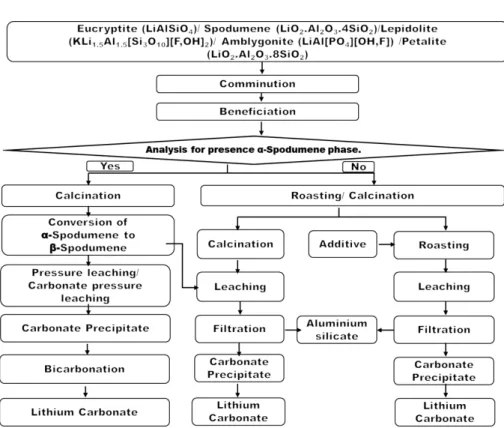
The average lithium content of the earth crust has been estimated at about 0.007%. Lithium does not occur free in nature but is found combined in small amounts in nearly all igneous rocks and in the waters of many mineral springs, and sea water. Globally, lithium produc- tion from minerals accounted for 30% (2012) and brine accounted for 70% which were recovered from the brine33). Out of 145 different pegmatites (lithium minerals), only spodumene, lepidolite, petalite, amblygonite, and eucryptite are commercially exploited34). Because pegmatites i.e., Eucryptite (LiAlSiO4), Spodumene (LiAlSi2O6), Lepidolite [K(Li,Al)3(Al,Si)4O10(F,OH)2], Amblygonite [LiAl(F,OH)PO4] and Petalite (LiAlSi4O10) have 5.51%, 3.73%, 3.58%, 3.44%, and 2.09% of lithium, respectively, they are rich enough and justify for being commercially exploited30,33). Commercial quantities of spodumene are in a special igneous rock deposit that geologists call a pegmatite. The mineral spodumene (LiAlSi2O6), which is often present in extremely coarse-grained igneous rocks (pegmatites), is the most important commercial ore mineral of lithium for commercial production33). Fig. 3 represents a generalized commercial process flowsheet Fig. 2. Supply chain bottleneck of lithium adapted fromreference 25.
applied commonly for lithium recovery from mineral resources33,35,36). As shown in the figure lithium recovery mainly follows the general process like mineral bene- ficiation-pretreatment (roasting/calcination)–leaching and precipitation. Lithium recovery is mainly through precipi- tation using carbonate salt to produce lithium carbonate.
Fig. 3 shows mainly the pyro- and chemical-metallurgy based hybrid processes where the comminution and beneficiation are used to concentrate the ore for the subsequent processing. In comminution and beneficiation, the lithium minerals are separated from the gangue minerals using crushing and grinding for mineral liberation followed generally by the gravity and froth flotation processes used for separation of lithium concentrate37). Lithium concentrate mainly contains α-spodumene, a natural monoclinic silicate which is difficult to leach, is usually converted to a more reactive β-spodumene species in a rotary kiln through 800 ~ 1100oC37,38). As without conversion of α-spodumene to β-spodumene any
subsequent chemical treatment would be ineffective, it is an essential process invariably used in most of the lithium recovery processes from this minerals. Roasting is also an essential process to convert lithium silicate to either Li2O or LiSO4, which canbe easily leached out. Additives like limestone, and/or gypsum is mixed with lithium concentrate and roasted under a set of condi- tions (700 ~ 1000oC). After roasting commonly mineral acid leaching (HCl, H2SO4) or mixed mineral acids (HF+H2SO4) or water leaching process is employed for lithium extraction. Extracted lithium recovered as lithium carbonate (Li2CO3) by precipitation using Na2CO3. Lithium is also recovered as lithium chloride and lithium hydroxide depending upon the process specificity.
Commercially lithium is produced /marketed as lithium carbonate, lithium chloride and lithium hydroxide from various resources like brines and high-grade lithium ores.
Lithium triangle, the region of the Andes Mountains including parts of Argentina, Chile, and Bolivia is the Fig. 3. General flow sheet for production of lithium compounds for minerals. Adapted and generalized from references 33, 35,
and 36.
home for 70% of the world’s lithium resources33). From the brines of lithium triangle, like, brines at Salar de Atacama (Chile) and Salar de Hombre Muerto (Argentina) produce more than 60% lithium salts of the global market, whereas the Salar de Uyuni brine (Bolivia) has not been commercially exploited yet33). Fig. 4 shows a generalized flowsheet for lithium recovery from brine adapted from various reports5,39,40). In general, lithium recovery from brine water involves solar evaporation of raw brine water to ≈ 1 g/L Li followed by removal of magnesium, calcium, boron, and sulfate using a number of precipitation steps using lime and sodium carbonate. After magnesium, calcium, boron and sulfate precipitation, and lithium enrichment followed by lithium precipitation is the common process for lithium production. Production process from either resource uses precipitation process, which is associated with inherent drawbacks like co- precipitation of other metals, compromising high purity, and slow kinetics.
4. Lithium Extraction from Secondary Resources
Considering important current factors like supply chain risk, a bottleneck between supply and demand, rate of recycling, and environmental concern, policies need tobe framed to exploit various batteries in general and LIBs in particular as secondary resource for battery material. As discussed above currently 56% lithium from worldwide production is being used in LIBs and the projected demand could account for 86% of lithium share for the LIB, hence, LIBs can be a very similar resource as the primary ores for lithium. Considering battery life, all EOL LIBs would enter to waste stream and could be an important resource for lithium through urban mining, resources recycling, and valorization. If we compare the projected EOL LIBs to be generated with that of natural resources, it could be more than either resource alone like brine and minerals. Though several LIBs recycling processes have been reported in the literature but lithium recovery from secondary resources are scarce. Currently, around 1% of lithium being recycled, which is quite negligible compared to lithium being used for LIBs and to be used in the future6). Table 1 sum- marizes the battery recycling processes by the various companies all over the world. As can be seen that most of the process focused on the recovery of Co, Ni or other metal values than lithium during the recycling of LIBs41). Another recent report on LIBs recycling market 2018 indicated that almost 20 companies recycled LIBs and estimated that 5 ~ 7% LIBs produced worldwide are Fig. 4. General flow sheet for production of lithium compounds for brine. Adapted and generalized from references 5, 39, and
40.
being recycled41-43). Table 1 clearly indicates that Lithium from LIBs is industrially recovered only by Toxco Inc.
(now retrieval technology Inc.) and BDC Inc. using cryo- milling followed by LiOH recovery in their recycling plants in Canada and USA5). Considering the cost- effectiveness of the process, technological challenges and lower level of lithium content, recovery of lithium have received very marginal attention. Cost in-efficient recovery process of lithium from LIBs is the vital contributing cause for poor attention. As lithium is very
reactive in air or moisture, both the pyrometallurgical process as well as cryo-processes are high energy consuming and adverse the carbon footprint interest of recycling motto. Hence, cost-effective, lower energy intensive, and the greener-recycling processes need to be developed to handle the challenges associated with next-generation lithium demand and conserve the natural resources. All reports clearly indicate to address the supply chain criticality of lithium which is significant for clean energy necessity of the time. Lack of recovery Table 1. Summary of battery recycling process by the various company all over the world (42, 43)
Company Battery Types Process/Technology used Location
Retriev Technologies All type of battery Cyromilling(Li) Pyrometallurgy
Hydrometallurgy Trail, BC, Canada Baltimore OH, USA Salesco Sytems All type of battery Pyrometallurgy Phoenix, AZ, USA OnTo Technology Li-Based Liquid-liquid extraction Bend OR, USA
AERC All type of battery Pyrometallurgy Allentown PA, USA
Hayward CA, USA West Melbourne FL, USA
Dowa All type of battery Pyrometallurgy Japan
Japan Recycle All type battery Pyrometallurgy Osaka, Japan
Sony Corp. & Sumitomo
Metals and Mining Co. All type of battery Pyrometallurgy Japan
XStrata All type of battery Pyrometallurgy + Electrowinning Horne Que, Nikkelverk Nor, Sudbury Ont, Canada
Accurec All type of battery Pyrometallurgy Mulhiem Grenada
DK All type of battery Pyrometallurgy Duisburg, Greece
AEA Technology Li-Based Sutherland, Scotland
Batrec AG Li-Based, Hg Pyrometallurgy Wimmis, CH, Switzerland
AFE Group (Valdi) All type of battery Pyrometallurgy Zurich CH, Switzerland Rogerville, France Citron All type of battery Pyrometallurgy Zurich CH, Switzerland
Rogerville, France Euro Dieuze/SARP All type of battery Hydrometallurgy Lorraine, France
SNAM Cd, Ni, MH, Li Pyrometallurgy Saint Quentin Fallavier, France IPGNA Ent. (Recupyl) All type of battery Hydrometallurgy Grenoble, France
Umicore All type of battery Pyrometallurgy Hydrometallurgy
Electrowinning Hooboken, Belgium SungEel Hitech Li-Based Hydrometallurgy Gunsansandan-ro, Gunsan, Korea Taisen Recycling All type battery Sheng Dao, Anhua Xian, Yiyang Shi,
Hunan Sheng, China
technology and limited necessity for developing process for lithium recovery may be the contributing cause.
Although industrial lithium recovery from batteries in vogue is too limited, several authors have reported the recovery of lithium from such batteries. Kim et al.44) have reported hydrothermal recovery technique for the valorization of lithium from LiCoO2. Authors have renovated LiCoO2 cathode materialand simultaneously separated it from spent LiCoO2 electrodes, Al current collector, electron-conducting carbon, binder, and separator in a single synthetic step using the hydrothermal method in a concentrated LiOH solution at 200oC without any scraping procedures. Träger et al.45) reported two metallurgical recycling process for automotive LIBs, i.e., (i) direct vacuum evaporation of Li followed by recovery of metallic Li by distillation, and (ii) selective entraining gas evaporation of Li followed by recovery of lithium oxide. Zhang et al.46) have reported hydrometallurgical separation and recovery of cobalt followed by lithium from spent secondary LIBs. Zhang et al. have reported; The cobalt was recovered through leaching followed by the solvent extraction process. After the cobalt recovery, the raffinate was concentrated to the saturated solution and Li2CO3 was precipitated through carbonation (using sodium carbonate). The Li2CO3 was recovered after filtration with 80%
efficiency46). Nguyen et al. have reported lithium recovery from the scrubbing solution of spent LIBs sulfate leach liquor. This process was followed by Ni recovery in which lithium was recovered as Li2CO3 from the scrubbing solution using a saturated solution of Li2CO3
at 100oC47). Contestabile et al.12) have reported a laboratory-scale recycling process where mechanically separated active electrode materials were inserted into an isobutyl alcohol/water (i-BuOH/H2O), biphasic system, which allowed for achieving mild oxidation of lithium metal. The lithium was dissolved as LiOH and was then precipitated as Li2CO3 by bubbling CO2 gas through the solution. The same solution by heating lithium was precipitated Li2CO3 significantly as equilibrium shifted to the formation of the carbonate ion (CO3−) which precipitated lithium as Li2CO3. Second stage precipitation of the same process recovers lithium
quantitatively. Lee et al.48) have reported the chemical extraction of lithium from LiCoO2 using oxalic acid.
As mineral acid leaching of LiCoO2 lacks selectivity, where all metals like lithium and cobalt leached create complexity for recovery of pure lithium. Hence, a weak oxalic acid lixiviant could selectively leach lithium efficiently at a low pH range. Quantitative leaching of lithium was reported using oxalic acid where less than 1% of cobalt was leached. The oxalic acid leaching has added advantage, as cobalt leached (less than 1%) could be precipitated as an insoluble CoC2O4. The process is efficient to recover 90% lithium from cathodic battery materials at the optimum condition. After precipitation of cobalt by oxalate, the remaining Li ions in solution can be converted into a carbonate compound by the addition of Na2CO348). Our literature investigation indicated that although numerous investigations have been reported in the literature for LIBs recycling, report regarding lithium recovery is very limited. Hence, the clean energy critical metal lithium recovery from LIBs is both challenging as well as providing an opportunity, and hence needs to be explored in more detail. Considering the scale of operation, economy, environmental aspects, hydrometallurgy could be the potential technology to be explored to address the lithium scarcity issue.
Considering the limited available technology several companies are developing processing methods for the recovery of lithium from various resources as discussed below.
5. Emerging Technologies for Lithium Recovery
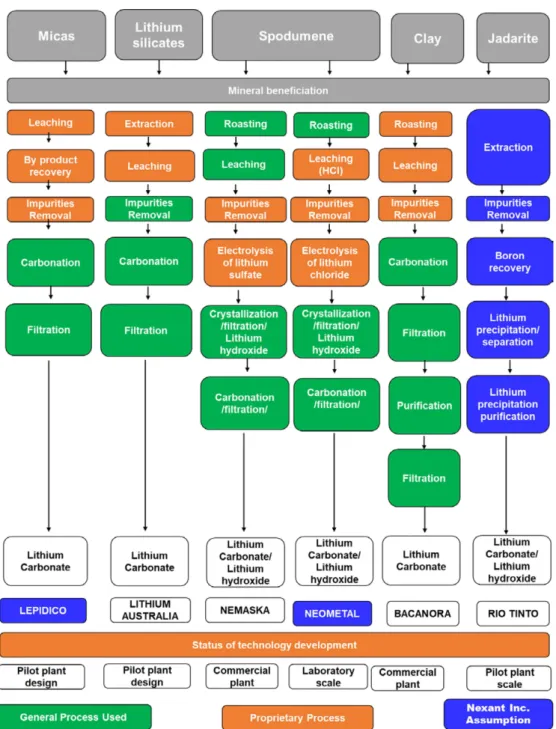
Because demand for lithium has sharply increased and so is the price, considering the supply chain bottleneck of clean energy critical metal, various industries are developing technologies around the world to recover lithium from all possible resources on the industrial scale.Nexant, Inc. has reported emerging technologies developed, which are summarized in Fig. 5 and Fig. 6 for brine and minerals, respectively49). Different companies all over the world like; K-UTEC (K-UTEC AG Salt Techno- logies), Germany, Tenova Advanced Technologies (TAT), Italy, Eramet France, POSCO, Korea, RINCON, Australia,
MGX mineral Inc., Canada, and Standard lithium, Canada are developing potential alternative commercial techno- logies to recover lithium from brine as summarized in Fig. 5. This figure5) also reflects as to whether it is general process already being practiced in industry or proprietary process of the industry. It also indicates the status of the process development in terms of commercial scale or pilot scale. Several companies all over the world are also developing potential alternative/potential com- mercial technologies to recover lithium from mineral resources, as summarized in Fig. 6. Lepidico, Australia, Lithium Australia, and Rio Tinto, Australia are develop- ing processes to recover lithium from Micas, lithium
silicate, and Jadarite, respectively. All such development is based on the combination of the available process along with innovations. Neometals, Australia and Nemaska lithium, Canada is developing process technology for the recovery of lithium from spodumene. Bacanora lithium, United Kingdom is also developing a process for recovery of lithium from the clays. Fig. 6 also indicates the status of the process development in terms of commercial scale or pilot scale from relatively less preferred low-grade lithium-bearing minerals. Both the figures reflect some speculation assumed by Nexant Inc. as those processes are proprietary in nature and are hardly available in the open literature. Interestingly Fig. 5 further indicates that Fig. 5. Emerging lithium extraction technologies from brine, adapted from reference 49.
these developments are mainly dominated by hydrometal- lurgical approach for lithium recovery. Though Fig. 6 reflects the hybrid processes also, but the hydrometallurgy mainly plays a vital role in the lithium recovery. As
processes being developed are industries specific, the emerging technologies once commissioned for production can contribute significantly to address the supply chain bottleneck.
Fig. 6. Emerging lithium extraction technologies from various mineral resources, adapted from reference 49.
6. Challenges and Opportunities
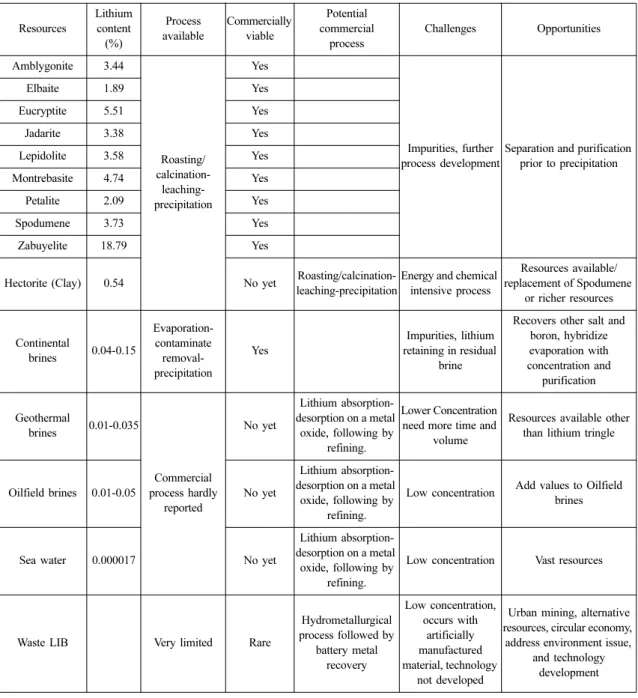
These lithium recovery processes are only beneficial from lithium rich mineral resources and brine resources using the flowcharts processes presented in Figs. 3 and
4, respectively. Unlike the rich mineral resources and brines resources, lithium-bearing clays, oil field brine, geothermal brine, and seawaters are rarely being exploited for commercial production of lithium. From the lithium- bearing clay resources, basically, two different processes
Table 2. Summary of major lithium resources, dominant commercial recovery processes, potential commercial process, challenges and opportunities
Resources Lithium content (%)
Process
available Commercially viable
Potential commercial
process Challenges Opportunities Amblygonite 3.44
Roasting/
calcination- leaching- precipitation
Yes
Impurities, further
process development Separation and purification prior to precipitation
Elbaite 1.89 Yes
Eucryptite 5.51 Yes
Jadarite 3.38 Yes
Lepidolite 3.58 Yes
Montrebasite 4.74 Yes
Petalite 2.09 Yes
Spodumene 3.73 Yes
Zabuyelite 18.79 Yes
Hectorite (Clay) 0.54 No yet Roasting/calcination-
leaching-precipitation Energy and chemical intensive process
Resources available/
replacement of Spodumene or richer resources
Continental
brines 0.04-0.15
Evaporation- contaminate removal- precipitation
Yes Impurities, lithium
retaining in residual brine
Recovers other salt and boron, hybridize evaporation with concentration and
purification Geothermal
brines 0.01-0.035
Commercial process hardly
reported
No yet
Lithium absorption- desorption on a metal
oxide, following by refining.
Lower Concentration need more time and
volume
Resources available other than lithium tringle
Oilfield brines 0.01-0.05 No yet
Lithium absorption- desorption on a metal
oxide, following by refining.
Low concentration Add values to Oilfield brines
Sea water 0.000017 No yet
Lithium absorption- desorption on a metal
oxide, following by refining.
Low concentration Vast resources
Waste LIB Very limited Rare
Hydrometallurgical process followed by
battery metal recovery
Low concentration, occurs with
artificially manufactured material, technology
not developed
Urban mining, alternative resources, circular economy, address environment issue,
and technology
development
viz., (i) mineral beneficiation followed by chlorination, leaching, and carbonation, (ii) mineral beneficiation followed by roasting/calcination, leaching, and carbonation, are used for recovery of lithium. The same has been presented in the flow sheet elsewhere5). But these processes are non-commercial and non-economical from low-grade ores50,51). For commercial exploitation of low- grade ores, alternative techniques like; hydrothermal treatment-acid leaching, acid baking-water leaching, alkaline roasting-water leaching, sulfate roasting-water leaching, chloride roasting-water leaching, and multiple- reagent roasting-water leaching, have been explored.
Despite several efforts by various researchers a cost- effective commercial process for lithium recovery from low-grade ores has hardly been developed52). The hindrance behind the commercialization of clay resources are (i) energy needed to volatilizing, (ii) the acid invested, and (iii) the cost of limestone added to the ore prior to heating37,53-55). For commercial recovery of lithium from brine following factors play the vital role, i.e., (i) availability of the pond ground and suitability of locality for solar evaporation, (ii) concentration of lithium in brine, (iii) ratio of alkaline earth and alkali metals to lithium, and (iv) complexity of phase chemistry5). The brine resources containing lithium can be characterized into three types, (i) Salars (Lake brines) with lithium concentration 200 ~ 7000 mg/L (0.04 ~ 0.15% Li), (ii) geothermal or groundwater brine with lithium concentration 20 ~ 200 mg/L (0.01 ~ 0.035% Li), and (iii) oil and gas field brines with lithium concentration 50 ~ 100 mg/L (0.01 ~ 0.05% Li)56,57). Typically, Salars (Lake brines) takes 18 months for the evaporation process followed by magnesium, calcium, boron and sulfate precipitation, and then lithium carbonation for lithium production.
Hence, the concertation of lithium in geothermal brine to enrich up to the productive level needs longer time.
Similarly, for the oil and gas field brines extremely large volumes are needed and so also the time, that are the challenges adverse to the commercial recovery. Consider- ing LIBs current market, end-of-life of LIBs, and ex- pected overall world market future evolution, recovery of lithium from various waste resources should be a panacea for the environment, economy and energy
securities. Thus achieving lithium recovery through re- cycling technology for these waste materials is both a challenge and an opportunity too12,58). Table 2 summarizes the major lithium resources, dominant commercial recovery processes, potential commercial process, challenges and opportunities.
7. Conclusion
As an alternative to the distress of carbon footprint from internal-combustion-powered automobiles, the quest for renewable energy source is occupied by the clean energy market, which ultimately increases the per capita energy consumption and consequently the use of LIBs.
To address the lithium metal supply chain criticality, it is essential to find the alternative for efficient recovery of lithium from natural recourses such as clays, gas and oil field brines, geothermal brines, and seawater.
As major part (%) of worldwide lithium produced is used for battery manufacture, EOL batteries are an alternative mine for lithium resources. Combination of urban mining, circular economy, and eco-efficient process development needs to be opted to recover lithium from primary resources and secondary resources. In order to ensure a cleaner environment and to support the environ- mental regulations, it is not only the metal recovery from the base batteries but also the lithium metal recovery from waste lithium-cobalt battery is assigned top priority.
Discussion and investigation presented above clearly indicate that the processes followed for the lithium recovery all over the world are very limited. Hence, alternative technologies are needed to recover lithium from various primary resources like clays, gas and oil field brines, geothermal brine and seawater, and also from the secondary resources like batteries. More importantly, as EV technology is progressing, projected EOL EV batteries could be a catastrophe without proper recycling. Hence, metal recovery technology in general and lithium recovery in particular from such wastes become a major challenge. The challenges addressed can proficiently create opportunities for lithium recovery which is a clean energy critical metal.
Acknowledgments
The paper is based on the Basic Research Project of the Korea Institute of Geoscience and Mineral Resources (KIGAM) funded by the Ministry of Science and ICT, Republic of Korea.
Reference
1. Taiebat, M. and Xu, M., 2019 : Synergies of four emerg- ing technologies for accelerated adoption of electric vehicles: Shared mobility, wireless charging, vehicle-to- grid, and vehicle automation, Journal of Cleaner Produc- tion, 230, pp.794-797.
2. Richa, K., Babbitt, C. W., Gaustad, G., and Wang, X., 2014 : A future perspective on lithium-ion battery waste flows from electric vehicles, Resources, Conservation and Recycling, 83, pp.63-76.
3. Grosjean, C., Miranda, P. H., Perrin, M., and Poggi, P., 2012 : Assessment of world lithium resources and con- sequences of their geographic distribution on the expected development of the electric vehicle industry, Renewable and Sustainable Energy Reviews, 16, pp.1735-1744.
4.Swain, B., 2016 : Separation and purification of lithium by solvent extraction and supported liquid membrane, analysis of their mechanism: a review, Journal of Chem- ical Technology & Biotechnology, 91, pp.2549-2562.
5.Swain, B., 2017 : Recovery and recycling of lithium: A review, Separation and Purification Technology, 172, pp.388-403.
6. Kavanagh, L., Keohane, J., Garcia Cabellos, G., Lloyd, A., and Cleary, J., 2018 : Global Lithium Sources–Indus- trial Use and Future in the Electric Vehicle Industry: A Review, Resources, 7.
7. Mohr, S. H., Mudd, G. M., and Giurco, D., 2012 : Lith- ium Resources and Production: Critical Assessment and Global Projections, Minerals, 2, pp.65-84.
8.Brenner, A., 1963 : Electrodeposition of alloys: princi- ples and practice. Academic Press.
9. Hamzaoui, A. H., M'Nif, A., Hammi, H., and Rokbani, R., 2003 : Contribution to the lithium recovery from brine, Desalination, 158, pp.221-224.
10. Goonan, T. G., 2012 : Lithium use in batteries: U.S. Geo- logical Survey Circular 1371, U.S. Geological Survey, Reston, Virginia: 2012.
11.Lupi, C. and Pasquali, M., 2003 : Electrolytic nickel recovery from lithium-ion batteries, Minerals Engineer- ing, 16, pp.537-542.
12. Contestabile, M., Panero, S., and Scrosati, B., 1999 : A laboratory-scale lithium battery recycling process1, Jour- nal of Power Sources, 83, pp.75-78.
13. Contestabile, M., Panero, S., and Scrosati, B., 1999 : A laboratory-scale lithium battery recycling process1This work has been presented as an invited talk at the 4th International Battery Recycling Congress, Hamburg, Germany, 1-3 July, 1998.1, Journal of Power Sources, 83, pp.75-78.
14. Contestabile, M., Panero, S., and Scrosati, B., 2001 : A laboratory-scale lithium-ion battery recycling process, Journal of Power Sources, 92, pp.65-69.
15.Sadoway, D., 1998 : Toward new technologies for the production of lithium, JOM, 50, pp.24-26.
16. Bradley, D. and Jaskula, Brian. 2014 : Lithium–For Har- nessing Renewable Energy: U.S. Geological Survey Fact Sheet 2014-3035, U.S. Geological Survey
17. USGS. 2019 : U.S. Geological Survey, 2019, Mineral commodity summaries 2019: U. S. Geological Survey, U.S. Department of the Interior, U.S. Geological Survey, U.S. Geological Survey, Reston, Virginia
18.Bohlsen, M., 2016 : The Lithium Boom - An Analysis Of Future Demand Vs. Supply. http://seekingalpha.com/
article/3984654-lithium-boom-analysis-future-demand- vs-supply
19. www.statista.com. 2019. Projection of total worldwide lithium demand from 2017 to 2025. https://
www.statista.com/statistics/452025/projected-total- demand-for-lithium-globally/
20. Li, J., Du, Z., Ruther, R. E., AN, S. J., David, L. A., et al., 2017 : Toward Low-Cost, High-Energy Density, and High-Power Density Lithium-Ion Batteries, JOM, 69, pp.1484-1496.
21.AGENCY, I. E. 2016 : Global EV Outlook 2016 Beyond one million electric cars. https://www.iea.org/publica- tions/freepublications/publication/Global_EV_Out- look_2016.pdf
22.Ulvestad, A., 2018 : A Brief Review of Current Lithium Ion Battery Technology and Potential Solid State Battery Technologies. https://arxiv.org/abs/1803.04317
23.Fortuna, C., 2018 : Batteries, Not The Model 3, Are The Real Keys To Tesla’s Future Success. https://cleantech- nica.com/2018/02/12/batteries-not-model-3-real-keys- teslas-future-success/
24. Olivetti, E. A., Ceder, G., Gaustad, G. G., and Fu, X., 2017 : Lithium-Ion Battery Supply Chain Consider- ations: Analysis of Potential Bottlenecks in Critical Met- als, Joule, 1, pp.229-243.
25.Bo Normark, A. F., 2014 : How can batteries support the EU electricity network?
26. http://www.marketwatch.com. 2016. Lithium-ion Battery Market is Projected to Reach US $77. 42 bn in 2024;
Global Industry Analysis, Size, Share, Growth, Trends and Forecast 2016 - 2024: TMR. http://www.market- watch.com/story/lithium-ion-battery-market-is-pro- jected-to-reach-us-7742-bn-in-2024-global-industry- analysis-size-share-growth-trends-and-forecast-2016--- 2024-tmr-2016-09-19
27. Jaskula, B. W., 2017 : U.S. Geological Survey, Mineral Commodity Summaries, January 2017. U.S. Geological Survey, Reston, Virginia: U.S. Geological Survey, U.S.
department of the Interior. pp.100-101.
28. Gagno, G., 2016 : Lithium on the rise. http://www.rock- stone-research.com/index.php/en /news/816-Lithium-on- the-rise
29.Swain, B., 2018 : Cost effective recovery of lithium from lithium ion battery by reverse osmosis and precipitation:
a perspective, Journal of Chemical Technology & Bio- technology, 93, pp.311-319.
30.Schulz, K. J., DeYoung, J. H., Seal, R. R., and Bradley, D. C., 2017 : Critical mineral resources of the United States–Economic and environmental geology and pros- pects for future supply.
31. Graedel, T. E., 2015 : Recycling rates of metals, a status report. http://www.unep.org/resourcepanel/Portals/
24102/PDFs/Metals_Recycling_Rates_110412-1.pdf 32.BGS, N., 2016 : Commodit Profile : Lithium profile.
https://www.bgs.ac.uk/downloads /start.cfm?id=3100 33. Tran, T. and Luong, V. T. , 2015 : Chapter 3 - Lithium
Production Processes. In Lithium Process Chemistry, ed.
A Chagnes, J Światowska:81-124. Amsterdam: Elsevier.
Number of 81-124 pp.
34. Talens Peiró, L., Villalba Méndez, G., and Ayres, R. U., 2013 : Lithium: Sources, Production, Uses, and Recov- ery Outlook, JOM, 65, pp.986-996.
35. F. Margarido, N. V., F. Durão, C. Guimarães, and C. A.
Nogueira, 2014 : Minero-metallurgical processes for lith- ium recovery from pegmatitic ores, Comunicacoes Geo- logicas, 101, pp.795-798.
36.Mast, E., 1989 : Lithium Production from Spodumene.
McGill University, Montreal Canada.
37. F. Margarido, N. Vieceli, F. Durão, C. Guimarães, and Nogueira, C. A., 2014 : Minero-metallurgical processes for lithium recovery from pegmatitic ores Comunicações Geológicas 101, pp.795-798.
38. Peltosaari, O., Tanskanen, P., Heikkinen, E.-P., and Fab- ritius, T., 2015 : α→γ→β-phase transformation of spodu- mene with hybrid microwave and conventional furnaces, Minerals Engineering, 82, pp.54-60.
39. Choubey, P. K., Kim, M.-s., Srivastava, R. R., Lee, J.-c.,
and Lee, J.-Y., 2016 : Advance review on the exploita- tion of the prominent energy-storage element: Lithium.
Part I: From mineral and brine resources, Minerals Engi- neering, 89, pp.119-137.
40. An, J. W., Kang, D. J., Tran, K. T., Kim, M. J., Lim, T., and Tran, T., 2012 : Recovery of lithium from Uyuni salar brine, Hydrometallurgy, 117-118, pp.64-70.
41.De-Leon, S., 2018 : Lithium Ion Battery Recycling Mar- ket 2018.
42. Ellis, T. W. and Mirza, A. H., 2016 : Battery Recycling:
defining the market and identifying the technology required to keep high value materials in the economy and out of the waste dump. http://www.nist.gov/tip/wp/pswp/
upload/245_battery_recycling_defining_the_market.pdf 43.2014. EUROPEAN LI-ION BATTERY ADVANCED
MANUFACTURING FOR ELECTRIC VEHICLES.
https://elibama.files.wordpress.com/2014/10/v-d-batter- ies-recycling1.pdf
44. Kim, D.-S., Sohn, J.-S., Lee, C.-K., Lee, J.-H., Han, K.- S., and Lee, Y.-I., 2004 : Simultaneous separation and renovation of lithium cobalt oxide from the cathode of spent lithium ion rechargeable batteries, Journal of Power Sources, 132, pp.145-149.
45. Träger, T., Friedrich, B., and Weyhe, R., 2015 : Recovery Concept of Value Metals from Automotive Lithium-Ion Batteries, Chemie Ingenieur Technik, 87, pp.1550-1557.
46.Zhang, P., Yokoyama, T., Itabashi, O., Suzuki, T. M., and Inoue, K., 1998 : Hydrometallurgical process for recov- ery of metal values from spent lithium-ion secondary batteries, Hydrometallurgy, 47, pp.259-271.
47. Nguyen, V. T. L., Jae-Chun Jeong, Jinki Kim, Byung-Su Pandey, B. D., 2015 : The Separation and Recovery of Nickel and Lithium from the Sulfate Leach Liquor of Spent Lithium Ion Batteries using PC-88A, Korean Chemical Engineering Research, 53, pp.137-144.
48. C. K. Lee, J. S. S. , and K. I. Rhee, 2014 : Chemical extractin of lithium from LiCoO2 using oxalic acid. Proc.
Global Symposium on recycling , waste treatment and clean technology, REWAS 2004, Madrid, Spain, 1.
49.Nexant-Inc., 2018 : Technoeconomics-Energy & Chem- icals (TECH) TECH 2018S11 Lithium Extraction Tech- nologies. https://www.nexantsubscriptions.com/file/
133644/download?token=dSnzZcCL
50. May, J. T., Witkowsky, D. S., and Seidel, D. C., 1980 : Extracting lithium from clays by roast-leach treatment, Report of Investigation 8432, Dept. of the Interior, Bureau of Mines.
51.Davidson, C. F., 1981 : Recovery of lithium from clay by selective chlorination, Report of Investigation 8523, U.S.
Dept. of the Interior, Bureau of Mines, Pittsburgh, Pa,
USA.
52.Bell, T., 2019 : An Overview of Commercial Lithium Production. https://www.thebalance.com/lithium-produc- tion-2340123.
53. Garrett, D. E., 2004 : Handbook of Lithium and Natural Calcium Chloride. Elsevier Science.
54.Bohner, H. O., Light metals, 1985 : proceedings of the technical sessions sponsored by the TMS Light Metals Committee at the 114th annual meeting, New York, New York, February 24-28, 1985, Warrendale, Pa.: Metallur- gical Society of AIME.
55. Medina, L. and El-Naggar, M. A. A., 1984 : An alter- native method for the recovery of lithium from spodu- mene, MTB, 15, pp.725-726.
56.Teresa Brown, A. W., Naomi Idoine, Gus Gunn, Richard A Shaw, Debbie Raymer. 2016 : Commodity Profile, Lithium profile, British geologicala survey, Keyworth, Nottingham, UK.
57.Saltworks, Lithium Brine Extraction Technologies &
Approaches, https://www.saltworkstech.com/articles/lith- ium-brine-extraction-technologies-and-approaches, June 23, 2019.
58. Xu, J., Thomas, H. R., Francis, R. W., Lum, K. R., Wang, J., and Liang, B., 2008 : A review of processes and technologies for the recycling of lithium-ion second- ary batteries, Journal of Power Sources, 177, pp.512- 527..
Basudev Swain
• Ph.D. from Chungnam National University in Collaboration with KIGAM
• JSPS Post Doc at AIST, Tsukuba
• Visiting faculty at Indiana University, Southeast
김 민 석
• 현재 한국지질자원연구원 광물자원연구본부 책임연구원
• 당 학회지 제13권 5호 참조
이 찬 기
• 일본 큐슈대 물질이공학과 공학박사
• 현재 고등기술연구원 신소재공정센터 수석연구원
• 당 학회지 제26권 4호 참조
정 경 우
• 현재 한국지질자원연구원 광물자원 연구본부 책임연구원
• 당 학회지 제25권 5호 참조
이 재 천