• 검색 결과가 없습니다.

Are Sequential Decision-Making Processes of Tourists and Consumers the Same?

N/A
N/A
Protected

Academic year: 2021

Share "Are Sequential Decision-Making Processes of Tourists and Consumers the Same?"

Copied!
12
0
0

로드 중.... (전체 텍스트 보기)

전체 글

(1)

1. INTRODUCTION

By entering into the post-industrial society, an industrial market began to change from provider-oriented to consumer- oriented production (Johns, 1999). An attention to those con- sumers who have much information about products, as a new arbiter of a market, has continued to increase for many decades and has coupled with a firm’s survival. Also, a wide array of studies on predicting or explaining consumer behavior has been achieved since initial research in consumer behavior has started(Sirgy, 1982).In particular, assumptions on consumer behavior have been discussed over the long period of time within multiple academic groups and have significantly contri- buted to the academic development and practical application

of consumer behavior context(Palmer, 2010).

Together with devoted efforts contributed from other dis- ciplines such as marketing and economics, the tourism con- text has carried out a few studies to identify consumer beha- vior in tourism destinations. A majority of published research in the tourism area, however, have limited to solely an overall decision-making process by tourists or to determinants of individually separated step in a decision-making process (Yoo

& Chon, 2008). A debate about detailed assumptions of a decision-making process in tourism destinations remains either an inattentive or periphery issue in the context. Even though some scholars point to assumptions on analyzing tourist be- havior(Decrop, 1999), as a core issue, others still accept a de- cision making of a tourist as an identical behavior process of Information available at the Culinary Society of Korea (http://www.culinary.re.kr/)

Culinary Science & Hospitality Research

Journal & Article Management System: https://cshr.jams.or.kr/

http://dx.doi.org/10.20878/cshr.2017.23.6.018

Are Sequential Decision-Making Processes of Tourists and Consumers the Same?

Oh-Hyun Jung

Changwon Research Institute, Changwon, Korea

KEYWORDS ABSTRACT

Tourist,

Decision-making process, Sequence,

Non-sequence.

The purposes of this study were to examine if a decision making by a tourist sequentially or hie- rarchically occurs in a tourism destination and to test determinants that have an effect on both a sequential and non-sequential decision making. An instrument for the study was developed with three steps. A total of 420 and 380 questionnaire were collected respectively for the first two round surveys. For the third step, a pilot test was conducted with 30 respondents. And the data analysis utilized SPSS 18.0. A logistic regression analysis with variables of tourism activity and demography was employed to investigate the factors that affect a sequence of decision-making process. As an important result, the higher the age of the tourist in a tourism destination, the more conspicuous the consumption expenditure is made through the sequential decision-making process. Additionally, it is unreasonable to apply the premises and assumptions in extant consumer behavior to tourist behavior. The process of decision making by tourists in tourism areas is driven by either non-sequen- tial or non-hierarchical decision-making process. More discussion and implications were provided.

Corresponding author: Oh-Hyun Jung, Ph.D., Changwon Research Institute, 848, Woni-daero, Seongsan-gu, Changwon 51500, South Korea, Tel.

+82-55-225-7042, Fax. +82-55-225-7059, E-mail: [email protected]

(2)

a regular consumer (Jang & Ra, 2011).

To date back, a study on consumer behavior is traditionally assumed with a sequence or hierarchy of a decision-making process(Simon, 1955). Sequential and hierarchical assumptions from a consumer behavior model that has been invented by Barry and Howard (1990) are explained in the perspective of information process. Too, some of the previous research assume not only that consumers are identical to computers, but that decision-making processes by consumers match data processes by computers (Ha, 2000). However, according to other research that have been carried out in 1990s and 2000s, academic researchers maintain that consumers do not walk through a sequential or hierarchical decision-making process at each single time (Decrop, 1999; Erasmus, Boshoff, & Rou- sseau, 2001; Woodside & Lysonski, 1989). Solomon (1996) claims that all of the individual consumers do establish a limited plan just before their purchase rather than they search for their product information with enough time before pur- chase behavior. Additionally, Srinivasan (1993) asserts that a negative effect that consumers defer their purchase decision is derived by too convoluted information about a product.

Excessive information about a product is at great expense, thereby representing that consumers abandon a plan to pur- chase a product.

Based upon these accomplishments in the context of con- sumer behavior, there is a higher possibility to be unable to rationally have a sequential decision-making process when tourists purchase a product in a tourism destination. Tourists must make many purchase decisions while facing a various deal of either tourism products or activities. At these moments of decision making in a given tourism destination, they are more likely to establish an improvised and limited plan for their purchase than to make a thorough plan with enough time. Particularly, tourists’ decision-making process can be easily changed as the occasion demands because tourists tend to place the importance on their experience involved in tourism activities (Decrop, 1999). This fact leads to an unplanned purchase such as an impulse, a visible, or a compulsive pur- chase derived by many situational factors (Crawfor & Me- lewar, 2003). Under this eccentric tourism case, it is required to identify whether the assumptions of the consumer beha- vior context are identically applied to the premises of the tourist behavior area without an acute criticism.

By identifying if applying assumptions about a decision- making process by a regular consumer to a decision-making

process by a tourist is validated, this research attempts to contribute to empirically understanding a decision-making process of tourist expenditure in a given tourism destination.

Specifically, the purposes of this study are 1) to examine if a decision making by a tourist sequentially or hierarchically occurs in a tourism destination, 2) to find why a non-sequen- tial decision making by a tourist arises, and 3) to test deter- minants that have an effect on both a sequential and non- sequential decision making.

2. LITERATURE REVIEW

Overall, most of the research in the tourism context related to a decision making have been separated in the three per- spectives. First, it is universal that research focus on attitude as an approach from the emotional aspect by a consumer based on the theory of planned behavior or the theory of reasoned action (Um & Crompton, 1992). Second, it is a study of economic and psychological approach that explains the alternative selection process that maximizes the most subjec- tive utility in the alternative selection range under an assump- tion that tourists maximize their utility. In the last, it is an attempt to identify that decision making and choice behavior by tourists are dependent on variously situational cases and environmental factors around tourists (Hogarth, 1987).

The three perspectives in published studies have theore- tically and practically contributed to the useful explanation and prediction of the decision making and choice behavior by tourists .However, previous studies have still restricted to account for either the impromptu or impulsive behavior that occurs in decision-making and selection situations. Also, they show a few limitations in scrupulously dealing with the pre- mises and assumptions of decision making by tourist. This study, therefore, needs to challenge to review the related literature and to identify how the premises and assumptions of a decision-making process in the literature have been taken into account.

2.1. A Decision-Making Process by Consumer

The argument that consumer behavior is changed accor-

ding to decision making process by consumers generally leads

to an agreement in the context of consumer behavior. Some

scholars contend that it is no make-sense to distinguish bet-

ween decision-making processes and provide their objections

accordingly. Typically, Olshavsky and Granbois (1979) find that

(3)

consumers make impromptu decisions based on their needs without considering the decision-making process. Purchase decisions by consumers are made from preference created in childhood, identification with reference group, recommenda- tion by others, or nearly random selection. This argument sounds credible in a few cases, but most scholars underpin the assumption that purchase decisions by consumers go through a decision-making process (Ahn, 2015; Bettman, 1979;

Kim, Bae, & Heo, 2008; Kim & Kim, 2012; Lee, 2003; Wilkie, 1994).

The assumption that purchase decision by consumer in- volves the decision-making process derives from a cognitive perspective. Lachman, Lackman, and Butterfield (1979) main- tain that human cognitive systems are much comparable with computers. Computers save the input information in the memory storage, recall it whenever required, and compute the result through arithmetic operation. Humans also accept information through the five senses, remember it in the brain, and recall it as necessary to make decisions. This cognitive perspective led to revolutionary changes after it has influenced the psychological context. At the same time, it has signifi- cantly contributed to the information processing approach in consumer decision making research.

There are two reasons why information processing approach has been paid attention to researchers in consumer decision making-research(Ha, 2000). First, the information processing approach does not only pay attention to the outcome derived by the decision, but also has more interest in the psycho- logical process leading to the outcome. The expectancy-value approach by Ajzen and Fishbein (1977), which have been presented in the field of consumer behavior research, has re- ceived a great deal of attention due to the convenience of application. However, it has limitations unable to explain specific psychological process in judgment or choice of con- sumers (Bettman, 1979). Because information processing ap- proach overcomes these drawbacks, it receives attention from researchers. Second, the information processing approach appears to be integrated. Bettman(1979) claims that infor- mation processing approach enables to synthetically deal with various processes such as problem recognition, information retrieval, decision making, learning and memory, which are different from other approach methods.

The information processing approach that becomes atten- tive to researchers is because of the fact that the human cog- nitive system is very similar to that of the computer. Humans

cannot achieve the same performance, however, as a com- puter. As an example, Simon (1996) describes limited infor- mation storage capacity and incomplete computation ability as the greatest features of a human information processing system. Due to the limited ability of humans, information processing approach has important premises and assump- tions. To begin with, there is an assumption that human beings tend to accept information selectively because they cannot store all the information like computers. Hogarth (1987) argues that because human beings are exposed to a large amount of information that they cannot handle, they choose either one of the information to be received from the outside or the information to be recalled from long-term memory, or both information. In addition, prior knowledge, expectations, and anticipations play a significant role in selecting external and internal information.

There is another assumption that is sequential information process arises from incomplete computation ability by hu- mans. Because humans cannot deal with amount of infor- mation at the same time, they process information sequen- tially on the whole (Ha, 2000). For sequential information process, Simon (1996) considers that not only information process but also alternatives to decision making are processed in a sequential manner, which can greatly affect decision making. Finally, humans use a simple heuristic rather than an optimized decision that is assumed in the concept of ratio- nality of economics due to limited processing capacity. As a result, he argues limited rationality to make rational decisions within limited information as humans fail to perform perfect computational capabilities.

The assumptions applied in the information processing

approach have had a great influence on research on con-

sumer decision making process. In particular, the assumption

of sequential processing of information and alternatives due

to human limited information processing capability has be-

come a key assumption in the study of decision making

processes. Olshavsky and Granbois (1979) use a variety of ter-

minology to describe the process of decision-making models,

but they have agreed in common that: First, there must be

at least two alternatives, so choice must occur. Second, the

evaluation criteria enable prediction of each alternative out-

come of a consumer's goal or objective. Third, the alternatives

selected are determined according to decision rules or eva-

luation procedures. Fourth, information search through ex-

ternal search and internal search is handled according to

(4)

application of decision rule or evaluation procedure. As a result, most consumer behavior models have included floor charts for consumer decision-making processes.

There is generally a consensus about the existence of de- cision-making processes, but there is a great difference bet- ween scholars in the detailed classification stages. The most widely known EBM (Engel, Blackwell & Miniard) model classi- fies decision making into five stages: problem recognition, information seeking, alternative evaluation, purchase, and post- purchase behavior. On the other hand, there are scholars who classify the decision-making process into three stages and look at behavior before purchase, purchase, and after pur- chase (Davis & Dunn, 2002; Wilkie, 1994). Solomon (1996) sees the decision-making process as a separate process from the purchase situation and the post-purchase evaluation, but the decision-making process is similar to that of Engel in the five steps of problem recognition, information search, alternative evaluation, and product selection, respectively.

2.2. A Critical Approach in Decision-Making Model by Consumer

As the traditional consumer decision - making model is de- veloped and modified, there are other types of criticism exten- sively, apart from the limitation of the theoretical background.

This can be categorized into the assumptions of rational con- sumer decision-making behavior, generalization of decision- making processes, and concern for sub-items as a result of empirical studies on consumer decision-making models. In the 1980s, many researchers began to question the rational ap- proach to consumer decision making. This is because research shows that in the case of a variety of goods, consumers rarely spend time or even perform sequential activities that have been presented as important factors in consumer decision making. Consumers have often been found to have non- conscious behavior in decision-making (Bozinoff, 1982). This means that in fact the consumer decision-making model is attempting to explain the problem of sub-consciousness in a consciously-oriented information paradigm.

In addition, the actual consumer decision-making process may be opportunistic, but unplanned and disorderly when functional and adaptive. An opportunistic approach is not consistent with a structured and rigorous traditional decision- making model. Some researchers conclude that consumers do little or no pre-purchase information search, and they only set up a limited plan before entering the store (Solomon, 1996;

d'Astous, Benesouda, & Gindon, 1989). Solomon (1996) pu- blished a study that suggests that consumers implement a repertoire of consumer decision-making strategies based on product, situation, context, and previous experience. In addi- tion, some researchers suggest that consumers rely on heuris- tics to reach a satisfactory decision rather than to apply analy- tical decision rules to optimize decisions (Solomon, 1996).

d'Astous et al. (1989) developed a study that consumer decisions should be viewed in terms of purchasing dimen- sions, i.e., purchase frequency and purchase importance. They generally accepted the argument that the more important the product is, the more complicated the decision process be- comes, even if it is not a hard-and-fast rule through research.

For example, social, personal, and monetary risks often lead consumers to seek external information search and more prudent decision-making (Du Plessis & Rousseau, 1999; Du Plessis, Rousseau, & Blem, 1991). Therefore, consumers are more cautious about purchasing products that they consider important.

Consumer decision-making models are often criticized as being somewhat ideal. In some cases, consumers are required to take a short planning period in purchasing complex products to reduce the gap between theory and practice (Cox, Granbois, & Summers, 1983). Consumer decision-making mo- dels also affect purchasing behavior due to complexity and the sub-dimensions involved. In addition, Ratchford and Vaughn (1989) suggested that not only sensory desires but also ego gratification and social acceptance are reflected in the con- sumer decision making model. They worried that the role and importance of external factors could be neglected too much, neglecting or minimizing the emotional side in the design of traditional consumer decision-making models.

Attitudes and preferences based on the consumer's pre- vious experience in the constructivist framework are not clearly elucidated, but are driven into the decision-making process.

In particular, consumer goals are often inaccurate in situations

where they are not frequently purchased, and often are built

according to a given situation within the scope of personal

experience. The assumptions made in the hierarchical models

of consumer decision making, that is, choice decisions are

independent, are not always valid as a result of decision pro-

cesses through various stages leading to final decisions. Con-

sumers may or may not make choices based on existing cir-

cumstances (Dhar, 1992). This implies that the influence of in

store search activities in the consumer decision making process

(5)

is certainly greater than the preparedness that occurs before entering the store. Traditional consumer decision models do not clearly explain this possibility. Traditional consumer decision-making models assume that the decision-making pro- cess occurs consecutively or sequentially (Martin & Kiecker, 1990). Most of the serial processing models assume that only one information process occurs at a time, as mentioned in Newell and Simon's theory of problem solving. However, in the actual purchasing situation, various information processes have occurred. Recently, new models in the cognitive science field have tried to parallel the information process to explain the simultaneous decision-making process (Erasmus et al., 2001). According to Srinivasan (1993), consumers may seek education and inspiration to improve their decision-making behavior through extensive information search during de- cision-making. Consumers, however, are adversely affected by excessively large and difficult information, and are denied due to excessive information threatening their self-concept and confidence. Also, the production of information can be time consuming, and information retrieval can have a financial impact, such as cost of information retrieval. Consumers are looking for easier, faster and cheaper prior information bases while reducing risk. As a result, he saw that broad product discovery is not always as sophisticated as the traditional consumer decision model suggests.

Consumer selection processes vary depending on the type, timing, and people involved (Burns & Gentry, 1990). No consumer decision model can fully reflect all purchasing de- cisions or complex consumer decisions. Thus, using consumer decision-making models to refer to or interpret general con- sumer decisions is an oversimplification of the real world. In the real world, consumers often encounter incomplete infor- mation, and most consumer decision-making situations are clearly and clearly described probabilities or simply described situations. This problem makes it almost impossible to make sophisticated, rational decisions like those presented by tra- ditional consumer decision-making models (Burke, 1990). From this point of view, this study is carried out with the question that there is a difference between decision making process and traditional consumer decision making process in tourism activities. The traditional decision-making process is decision- making through continuous or sequential processes, and each step is considered to be an independent choice. However, tourism activities are characterized by the fact that activities are carried out according to planned schedules. Therefore, the

decision process that takes place every moment can be seen as making decisions in various situational contexts rather than through independent choice.

3. METHODOLOGY

3.1. Sampling and Data Collection

To test how a decision-making process by tourists is com- pleted in a tourism destination, those individual tourists who have employed more than two tourism resources and acti- vities were singled out as respondents. From August 19 to 24, 2016, both the first and the second round surveys were conducted with individual tourists in the Jeju Island, Korea.

In the two rental car facilities around the Jeju International airport, the surveys were carried out. The first round survey was performed when tourists rent a car, and the second round survey was undertaken when those tourists who have participated in the first round survey return a car. In order to identify if tourists who completed both the first and the second round survey are identical, both the last four digits of their mobile number and their rental plate number were compared with the surveys. The interviewers constituted the four who have at least once experienced in the tourism field survey. The survey was self-administered, and a convenience sampling method was performed. For the first and the second round survey, a total of 420 and 380 questionnaires were collected, respectively. Of 380 pairs from the first and the second survey, the 280 pairs were employed for the analyses, except for 100 pairs that unanswered or mismatched the first and second round respondents.

3.2. Instrument and Data Analysis

An instrument for the study was developed with three

steps. Items about tourism activity and tourist expenditure

were created by the 2012 Korea National Tourism Survey

Report from the Ministry of Culture, Sports and Tourism. In

the first step, items on the survey were developed and revised

through additional literature review and professional panel

interviews. In the second step using a focus group interview

with seven tourism professionals, the validity for items was

identified. In the last, a final pilot test after two steps was

conducted with 30 respondents. As a result, there is little

arguable issue about the improved survey. The survey com-

prises the three sections including tourism activity, tourist

(6)

expenditure, and demographic information.

The first section asks tourism activity-related items that en- compass length of stay, the number of tourism activities taken, experience or inexperience of visit to the Jeju Island, the number of visit to the Jeju Island, travel companions, the number of travel companions. The second sector regarding tourist expenditure consists of a total of seven items to exa- mine a sequential process by a tourist. These seven questions embrace awareness of problem, the degree of awareness of problem, cause of problem recognition, origin of information search, cause of unsearched information, alternative assess- ment, and cause of non-assessment about alternatives. Of the five step decision-making process which structures problem recognition, search process, evaluating alternatives, selection stage, and evaluation of decision, these questions are asso- ciated with the first three steps. To obtain demographic information for those tourists who visit the Jeju Island, the seven items that involve gender, age, marital status, a number of family members, educational level, monthly income before tax, and residence are asked in the last section.

The collected data was analyzed using the SPSS 18.0 ver- sion program. Frequency analysis was performed to review fundamental statistics such as means, standard deviations, and normal distributions of variables. With respondents who have shown a difference between the first and second survey in their expenditure, whether they adopt a sequential decision- making process was evaluated when their additional expen- diture takes place. As previous research in a decision-making process of a regular consumer that follows awareness of problem, information search, and evaluation of alternatives, the identical assumption that a tourist makes a sequential decision was applied to this study. A logistic regression analysis with variables of tourism activity and demography was employed to investigate the factors that affect a sequence of decision-making process. As variables that are associated with tourism activity that has already tested in the tourism research, length of stay, the number of visit to the Jeju Island, and travel companions were applied (Beerli, Meneses, & Gil, 2007; Nicolau & Más, 2005; Woodside & Lysonski, 1989).

4. RESULTS

4.1. Characteristics of Demographic Information and Tourism Activities

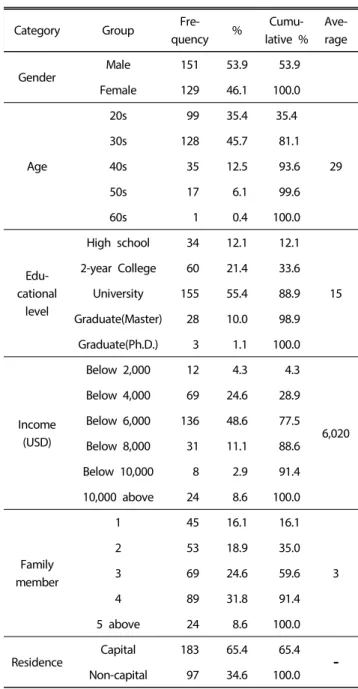
As shown in Table 1, a usable sample size of 280 was

analyzed for the study. A majority of respondents were those individual tourists with 20s (35.4%) and 30s (45.7%), and the average age of respondents is 29 years old. It is found that relatively more young generations visit the Jeju Island than other age groups. Their educational levels were more than a college diploma together with a high level annual income that ranks below USD 6,000. The averages of educational period and monthly household income were 15 years and USD 6,020.

Those visitors who travel the Jeju Island tend to be a higher- income group. Individual tourists’family member constituted three on average, and most respondents responded that their residence was in or around the capital of Seoul, South Korea

Table 1. Demographic information (n=280)

Category Group Fre-

quency % Cumu-

lative % Ave- rage

Gender Male 151 53.9 53.9

Female 129 46.1 100.0

Age

20s 99 35.4 35.4

29

30s 128 45.7 81.1

40s 35 12.5 93.6

50s 17 6.1 99.6

60s 1 0.4 100.0

Edu- cational

level

High school 34 12.1 12.1

15 2-year College 60 21.4 33.6

University 155 55.4 88.9

Graduate(Master) 28 10.0 98.9 Graduate(Ph.D.) 3 1.1 100.0

Income (USD)

Below 2,000 12 4.3 4.3

6,020 Below 4,000 69 24.6 28.9 Below 6,000 136 48.6 77.5 Below 8,000 31 11.1 88.6 Below 10,000 8 2.9 91.4 10,000 above 24 8.6 100.0

Family member

1 45 16.1 16.1

3

2 53 18.9 35.0

3 69 24.6 59.6

4 89 31.8 91.4

5 above 24 8.6 100.0

Residence

Capital 183 65.4 65.4

Non-capital 97 34.6 100.0

(7)

(65.4%).Gender of respondents consisted of 151 (53.9%) males and 129 females (46.1%).

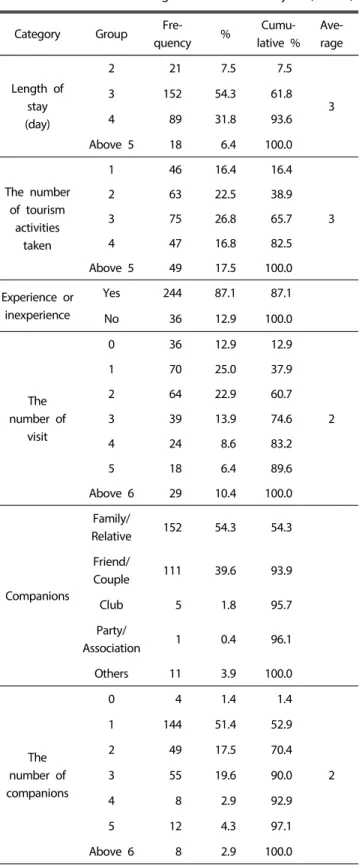
As shown in Table 2, this study analyzed the length of stay, the number of tourism activities taken, experience or inexpe-

Table 2. Features according to tourism activity (n=280)

Category Group Fre-

quency % Cumu-

lative % Ave- rage

Length of stay (day)

2 21 7.5 7.5

3

3 152 54.3 61.8

4 89 31.8 93.6

Above 5 18 6.4 100.0

The number of tourism

activities taken

1 46 16.4 16.4

3

2 63 22.5 38.9

3 75 26.8 65.7

4 47 16.8 82.5

Above 5 49 17.5 100.0

Experience or inexperience

Yes 244 87.1 87.1

No 36 12.9 100.0

The number of

visit

0 36 12.9 12.9

2

1 70 25.0 37.9

2 64 22.9 60.7

3 39 13.9 74.6

4 24 8.6 83.2

5 18 6.4 89.6

Above 6 29 10.4 100.0

Companions

Family/

Relative 152 54.3 54.3

Friend/

Couple 111 39.6 93.9

Club 5 1.8 95.7

Party/

Association 1 0.4 96.1

Others 11 3.9 100.0

The number of companions

0 4 1.4 1.4

2

1 144 51.4 52.9

2 49 17.5 70.4

3 55 19.6 90.0

4 8 2.9 92.9

5 12 4.3 97.1

Above 6 8 2.9 100.0

rience of visit to the Jeju Island, the number of visit to the Jeju Island, companions, and the number of companions to identify the major tourism activities by tourists. Specifically, the length of stay for those individual tourists who visited the Jeju Island presented three days on average from an open- ended question. Because the Jeju Island is geographically iso- lated and separated from the main land of Korea, the period of staying in the Jeju Island appears to be at least three through four days (86.1%). This result is parallel to an outcome of the report by the 2015 Jeju Special Self-governing Provincial Tou- rism Association. The number of tourism activities taken in the Jeju Island showed three averagely (26.8%), and the percen- tage of tourism activities taken more than three revealed 61.1%, which accounts for that those tourists who visit the Jeju Island participate in a variety of tourism activities.

As a result of asking about experience or inexperience of visit to the Jeju Island, the majority of respondents answered that they have experienced to visit the Jeju Island before (87.1%), while others have inexperienced (12.9%). The average of the number of visit to the Jeju Island became two, which leads to an assumption that the Jeju Island is typically considered a revisit tourism destination in Korea. The highest type of companions showed the group of family or relative (54.3%), and the average of the number of companions presented two, which portrays that mostly the type of tourists who visit the Jeju Island seems to consist of two tourists and to be accompanied by family or relative.

4.2. A Decision-Making Process by Tourist

To identify a structure of decision-making process by tou- rist, the three steps of decision-making process that constitute problem recognition, search process, and evaluating alterna- tives were provided out of the five steps. Tourists were classi- fied into sequential group and non-sequential group. Sequen- tial group are those tourists who have performed all three steps of decision-making process, whereas others are labeled as non-sequential group who have not conducted even any one step during their decision-making process. Of a total of 280 respondents, 115 (41%) tourists who have spent addi- tional expense from their tourism activities were analyzed.

From 115 tourists, those tourists who have completely per-

formed the three steps of problem recognition, information

search, and alternative comparison and evaluation were 32

respondents (27.8%), while 83 tourists (72.2%) have skipped

at least a step out of the three stages. Under the case of

(8)

Table 3. Sequential and non-sequential decision making

Group

Steps of decision-making process Step 1:

Problem recognition (%)

Step 2:

Search (%)

Step 3:

Evaluation of alternatives (%)

Sequential 75(65.2) 46(40.0) 32(27.8)

Non-sequential 40(34.8) 69(60.0) 83(72.2)

additional expenditure at a tourism destination, non-sequen- tial decision-making process by tourists took place rather than sequential decision making process. This result provides a clue that an assumption on a sequential decision-making process of previous research in consumer behavior should not apply to a decision-making process by tourists at a tourism des- tination.

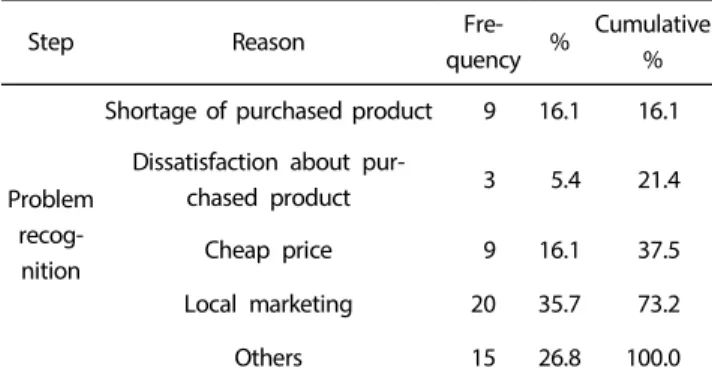
In order to understand non-sequential decision-making pro- cess by the non-sequential group in detail, why the group has missed at least one step out of the three steps in a decision- making process was identified. To begin with, the first stage of the problem recognition in a decision-making process by tourist was analyzed with a frequency analysis. As a result, it was found that the problem recognition by the non-sequen- tial decision-making group was the highest in local marketing (35.7%), followed by others (26.8%), followed by shortage of purchased product during travel (16.1%) and cheap price (16.1%), and followed by dissatisfaction about purchased pro- duct (5.4%),respectively. These results show that the need to purchase in the non-sequential group which is problem re- cognition is driven by local marketing activities such as tourist advertisement, public relation, and discount coupon. Apple- baum (1951) argues that consumers who are exposed to stimuli tend to impulsively purchase some products that are not planned to buy during their shopping in a store. Prion

Table 4. Reason for problem recognition

Step Reason Fre-

quency % Cumulative

%

Problem recog- nition

Shortage of purchased product 9 16.1 16.1 Dissatisfaction about pur-

chased product 3 5.4 21.4

Cheap price 9 16.1 37.5

Local marketing 20 35.7 73.2

Others 15 26.8 100.0

(1991) also sees the reasons for impulse purchase as an un- planned purchase and an exposure to stimulation.

As the analysis of the second stage at a decision-making process, why tourists did not implement the second step of information search was investigated. The highest rate was a lack of information search time (41.1%), indicating that tou- rists feel that they lack time to search for information in the step of a decision-making process at a tourism destination.

This result echoes that Simon (1955 and 1996) argues limited rationality that explains that consumers cannot make their optimal choices due to time constraints and that Srinivasan (1993) explains that information overloading leads to adverse effects. According to this point, in case of expenditure by tourists at a tourism destination where a prompt decision making is required, tourists do not have their confidence of preference due to widespread and ambiguous information, thereby overleaping information search to take a long time for decision.

Finally, the reasons for non-evaluation of alternatives in the decision-making process were investigated. As a result of the frequency analysis, the highest rate presented that it was unnecessary to evaluate alternatives (37.5%), followed by that there was shortage of time (19.6%), followed by that it was unable to evaluate alternatives (17.9%), followed by others (12.5%), followed by lack of information (8.9%), and followed by absence of alternatives (3.6%). These outcomes provide an indication that tourists feel that the step of evaluation of alternatives in the decision-making process is unnecessary at a tourism destination. From the results, attentively it is assumed that tourists are somewhat emotional in the decision-making process and are predictable to have unexpected experiences under a new tourism destination, thereby being determined by their heuristic propensity. Kahneman and Tversky (1979) argue that a heuristic tendency arises under no clear clues when consumers should solve problems or make judgments

Table 5. Reason for non-search for information

Step Reason Fre-

quency % Cumulative

%

Search

Shortage of search time 23 41.1 41.1

Experienced before 4 7.1 48.2

Absence of search method 2 3.6 51.8 Having related information 13 23.2 75.0

Others 14 25.0 100.0

(9)

Table 6. Reason for non-evaluation of alternatives

Step Reason Fre-

quency % Cumulative

%

Evalua- tion of

alter- natives

Shortage of time 11 19.6 19.6

Shortage of information 5 8.9 28.6 Unable to evaluate 10 17.9 46.4 Absence of alternatives 2 3.6 50.0 Unnecessary to evaluate 21 37.5 87.5

Others 7 12.5 100.0

about uncertainties. Likewise, tourists make a simple decision by a wide range of variables such as personal experiences and recent cases rather than their logical algorithms.

4.3. Influential Factors in Decision-Making process by Tourists

In this study, the five categories of decision-making process by tourist were applied to identify the factors affecting the sequential decision-making process. To analyze this, a logistic regression analysis was performed by applying the factors that are income, age, number of visits, and number of companions presented in the previous literature (Jang & Ra, 2011; Davis

& Rigaux, 1974; Um & Crompton, 1992).

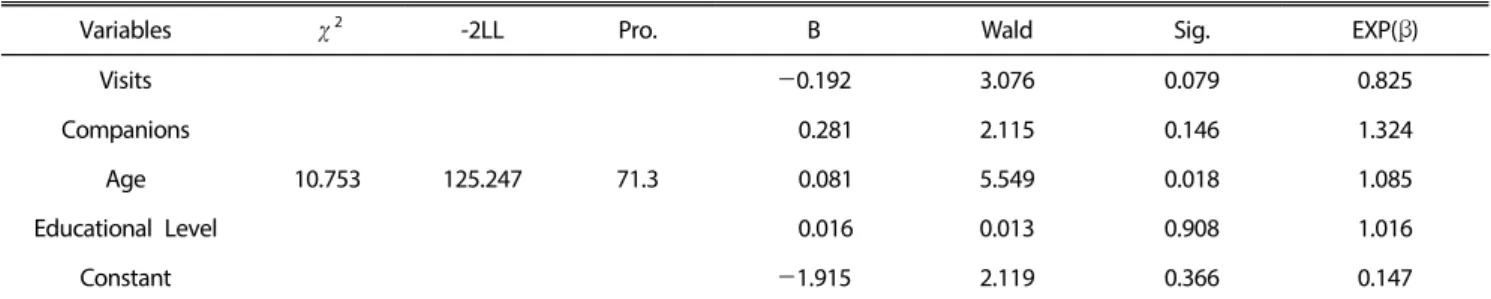
In the results of logistic regression analysis, the values of -2LL and Chi-square (χ

2

) confirming the fit of the model were 125.247 and 10.753 (p<.05), respectively, were significant. The probability that shows the predicted and observed values was 71.3% which is acceptable. As a result of confirming the significance of each independent variable, only the age was 5.549 of Wald, which is significant in the sequence of de- cision-making process at the p<0.05 level. This implies that if the values of the other variables are constant, the increase of 1 unit of age means that the probability of performing the sequential decision-process by tourist increases 1.085 times.

Table 7. Effects of variables on the sequential decision-making process

Variables χ

2

-2LL Pro. B Wald Sig. EXP(β)

Visits

10.753 125.247 71.3

-0.192 3.076 0.079 0.825

Companions 0.281 2.115 0.146 1.324

Age 0.081 5.549 0.018 1.085

Educational Level 0.016 0.013 0.908 1.016

Constant -1.915 2.119 0.366 0.147

That is, the higher the age of the tourist in a tourism destina- tion, the more conspicuous the consumption expenditure is made through the sequential decision-making process.

These results indicate that the higher the age of tourists, the less likely they are to have non-sequential decision-making processes because they have diverse experiences and infor- mation (Lee, 2003; Sproles, Geistfeld, & Badnenhop, 1980).

Consumption expenditures such as impulse buying, overcon- sumption, and obsessive buying are also able to be seen as being affected by age. According to Park, Lyu, Park, and Park (1995) and Huh (2008), the higher the age, the higher the efficiency and the rational choice about the product. Addi- tionally, in the study of d'Astous, Maltais, and Roberge(1990), it is found that tendency of obsessive buying was low as increases the age.

5. DISCUSSION AND CONCLUSIONS

Research in tourist behavior has been influenced by extant

research in consumer behavior, and premises in consumer

behavior has been applied to the same assumptions on tourist

behavior. Most of the researchers who have studied a de-

cision-making process by tourist also conducted their research

under the same assumptions in consumer behavior. However,

tourists are more likely to establish a temporary and limited

purchasing plan than to have a purchase plan with sufficient

time. Particularly, because tourists tend to lean toward their

experience based on tourism activities, they are able to be

unstable in their decision-making processes. There is a high

possibility of impromptu purchase such as impulse, cons-

picuous, and compulsive purchase. Therefore, this study at-

tempted to confirm whether it is appropriate to apply assump-

tions of research in consumer decision-making process to the

tourism context. To this end, it is verified whether the se-

quence or hierarchy of decision-making process which is a

typical assumption of general research in consumer decision-

(10)

making process occurs in the decision making of consumption expenditure by tourist.

As a result, it is invalid that the sequential or hierarchical decision-making process assumed in the consumer behavior was applied to the decision making of consumption expen- diture by tourist. From the empirical results of this study, both sequential and non-sequential decision-making process co- existed. Rather, non-sequential decision -making process oc- curred more frequently. This result can be attributed to the variety seeking of tourist and the sensory specific satiety.

According to Solomon (1996), consumers generally are likely to like new things and to seek diversity in the form of stimuli to reduce their boredom. The pursuit of diversity accounted for the desire to choose a new alternative against the familiar, which influenced the conversion of another product from the preferred product. In addition, Ratner, Kahn, and Kahneman (1999) argue that consumers try new things by tiredness of the senses. The reason why sequential decision-making pro- cess does not occur in tourism destinations is because of un- planned consumption needs generated by local marketing, insufficient information search time, and unnecessariness of alternative and comparative evaluation. This outcome is con- sistent with a finding by Simon (1955, 1996) that addresses the limited ability to make heuristic decisions rather than optimized decisions.

Another conclusion shows that the sequential decision- making process by tourists is affected by age. The higher the age of tourists, the more sequential or hierarchical the de- cision-making process, while the lower the age, the more non- sequential or non-hierarchical. This implies that tourists who have higher age are of the tourist consumer are likely to de- cline their non-sequential decision-making process due to their fruitful experiences and information (Lee, 2003; Sproles et al., 1980). According to Park et al. (1995) and Huh (2008), the higher the age, the higher the efficiency and rational choice of purchased products. Under all analyzed findings and logic, it is unreasonable to apply the premises and assump- tions in extant consumer behavior to tourist behavior. In particular, the process of decision making by tourists in tou- rism areas is driven by either non-sequential or non-hie- rarchical decision-making process. This study makes a contri- bution to the in-depth understanding of the decision-making process of consumption expenditure at tourism destination by reconsidering the uncritical acceptance of research method and viewpoint of previous research in consumer behavior.

There are several drawbacks in this study as other empirical studies commonly have. Future empirical studies should be conducted to identify the determinants of non-sequential decision making because they have limitations that cannot clarify the determinants of non-sequential decision making process.

REFERENCES

Ahn, S. (2015). A study of factors affecting purchase decision and attitude of dieticians regarding environmentally-frien- dly agricultural products in school meals. Culinary Science

& Hospitality Research, 21(4), 192-206.

Ajzen, I., & Fishbein, M. (1977). Attitude-behavior relations: A theoretical analysis and review of empirical research. Psy- chological bulletin, 84(5), 888.

Applebaum, W. (1951). Studying customer behavior in retail stores. The Journal of Marketing, 16(2), 172-178.

Barry, T. E., & Howard, D. J. (1990). A review and critique of the hierarchy of effects in advertising. International Journal of Advertising, 9(2), 121-135.

Beerli, A., Meneses, G. D., & Gil, S. M. (2007). Self-congruity and destination choice. Annals of Tourism Research, 34(3), 571-587.

Bettman, J. (1979). An information processing theory of con- sumer choice. Addison Wesley.

Bozinoff, L. (1982). A script theoretic approach to information processing: An energy conservation application. Advances in consumer research, 9(1), 481-486.

Burke, S. J. (1990). The effects of missing information on de- cision strategy selection. Advances in consumer research, 17, 250-256.

Burns, A. C., & Gentry, J. W. (1990). Toward improving house- hold consumption behavior research: Avoidance of pitfalls in using alternative household data collection procedures.

Advances in Consumer Research, 17, 518-523.

Cox, A., Granbois, D. H., & Summers, J. (1983). Planning, search, certainty and satisfaction among durables buyers: A longitudinal study. Advances in Consumer Research, 10, 394-399.

Crawford, G., & Melewar, T. C. (2003). The importance of im- pulse purchasing behaviour in the international airport environment. Journal of Consumer Behaviour, 3(1), 85-98.

d’Astous, A., Bensouda, I., & Guindon, J. (1989). A reexami-

nation of consumer decision-making for a repeat purchase

(11)

product: Variations in product importance and purchase frequency. Advances in Consumer Research, 16, 433-438.

d'Astous, A., Maltais, J., & Roberge, C. (1990). Compulsive buying tendencies of adolescent consumers. Advances in Consumer Research, 17(1), 306-312.

Davis, H. L., & Rigaux, B. P. (1974). Perception of marital roles in decision processes. Journal of Consumer Research, 1(1), 51-62.

Davis, S. M., & Dunn, M. (2002). Building the brand-driven bu- siness: Operationalize your brand to drive profitable growth.

San Francisco: Josey Bass.

Decrop, A. (1999). Tourist’s decision-making and behavior pro- cesses. Consumer Behavior in Travel and Tourism, 103-133.

Dhar, R. (1992). To choose or not to choose: this is the ques- tion. Advances in Consumer Research, 19, 735-738.

Du Plessis, P. J., & Rousseau, G. G. (1999). Buyer behaviour, A multi cultural approach. Halfway House. International Thom- son: Sigma.

Du Plessis, P. J., Rousseau, G. G., & Blem, N. H. (1991). Consu- mer behaviour. A South African perspective Pretoria:

Sigma.

Erasmus, A. C., Boshoff, E., & Rousseau, G. G. (2001). Consumer decision-making models within the discipline of consumer science: A critical approach. Journal of Family Ecology and Consumer Sciences, 29, 82-90.

Ha, Y. (2000). A critical review of information processing ap- proach to consumer decision making. Journal of Consumer Studies, 11(2), 1-38.

Hogarth, R. M. (1987). Judgment and choice: The psychology of decision. John Wiley & Sons.

Huh, K. (2008). Analysis of consumers' rational purchase beha- vior by the purchase stage and product. Family and Envi- ronment Research, 46(9), 7-19.

Jang, H. & Ra, S. (2011). Tourist behavior. Seoul, Korea: Korea National Open University.

Johns, N. (1999). What is this thing called service?. European Journal of marketing, 33(9/10), 958-974.

Kahneman, D., & Tversky, A. (1979). Prospect theory: An analysis of decision under risk. Econometrica: Journal of the Econometric Society, 47(2), 263-291.

Kim, D., & Kim, Y. (2012). A study on customer perception on a food service company's corporate social responsibility activities. Culinary Science & Hospitality Research, 18(1), 259-271.

Kim, K., Bae, H., & Heo, J. (2008). The effect of lifestyle patterns

on decision for food service purchase making process.

Culinary Science & Hospitality Research, 14(4), 257-268.

Lackman, R., Lackman, J. L., & Butterfield, E. C. (1979). Cognitive psychology and information processing. Hillsdale, NJ.

Lee, J. (2003). A study on integrated brand management based on consumer decision processes. The Korean Jour- nal of Advertising, 14(2), 7-38.

Martin, D., & Kiecker, P. (1990). Parallel processing models of consumer information processing: Their impact on consu- mer research methods. Advances in Consumer Research, 17(1), 443-448.

Nicolau, J. L., & Ma´s, F. J. (2005). Heckit modelling of tourist expenditure: Evidence from Spain. International Journal of Service Industry Management, 16(3/4), 271-293.

Olshavsky, R. W., & Granbois, D. H. (1979). Consumer decision making-fact or fiction?. Journal of Consumer Research, 6(2), 93-100.

Palmer, A. (2010). Customer experience management: A critical review of an emerging idea. Journal of Services Marketing, 24(3), 196-208.

Park, M., Lyu, H., Park, M., & Park, M. (1995). Consumer’s perceived product usage and disposition -Focusing on efficiency of consumption based on resource utilization-.

Journal of Korean Home Management Association, 13(1), 79-87.

Piron, F. (1991). Defining impulse purchasing. Advances in Consumer Research, 18, 509-514.

Ratchford, B. T., & Vaughn, R. (1989). On the relationship between motives and purchase decisions: Some empirical approaches. Advances in Consumer Research, 16, 293-299.

Ratner, R. K., Kahn, B. E., & Kahneman, D. (1999). Choosing less-preferred experiences for the sake of variety. Journal of Consumer Research, 26(1), 1-15.

Simon, H. A. (1955). A behavioral model of rational choice. The Quarterly Journal of Economics, 69(1), 99-118.

Simon, H. A. (1996). The sciences of the atificial. MIT press.

Sirgy, M. J. (1982). Self-concept in consumer behavior: A criti- cal review. Journal of Consumer Research, 9(3), 287-300.

Solomon, M. R. (1996). Consumer behavior. Pearson Education.

Sproles, G. B., Geistfeld, L. V., & Badenhop, S. B. (1980). Types and amounts of information used by efficient consumers.

Journal of Consumer Affairs, 14(1), 37-48.

Srinivasan, N. (1993). Consumer judgments, decisions and fra-

ming dynamics: An informational viewpoint. Advances in

Consumer Research, 20, 288-290.

(12)

Um, S., & Crompton, J. L. (1992). The roles of perceived inhibitors and facilitators in pleasure travel destination decisions. Journal of Travel Research, 30(3), 18-25.

Wilkie, W. L. (1994). Consumer behaviour (3th ed.). John Wiley and Sons: Chichester.

Woodside, A. G., & Lysonski, S. (1989). A general model of traveler destination choice. Journal of Travel Research,

27(4), 8-14.

Yoo, J. J. E., & Chon, K. (2008). Factors affecting convention participation decision-making: Developing a measurement scale. Journal of Travel Research, 47(1), 113-122.

Received:

Accepted:

18 September, 2017

23 September, 2017

수치

Table 1. Demographic information (n=280)
Table 2. Features according to tourism activity (n=280)
Table 5. Reason for non-search for information
Table 7. Effects of variables on the sequential decision-making process

참조

관련 문서

Abstract : This study analyzed the effects of consumers’ characteristic variables on information search and purchase decisions in a decision-making process that validated