• 검색 결과가 없습니다.

Chitosan Stimulates Calcium Uptake and Enhances the Capability of Chinese Cabbage Plant to Resist Soft Rot Disease Caused by Pectobacterium carotovorum ssp. carotovorum

N/A
N/A
Protected

Academic year: 2021

Share "Chitosan Stimulates Calcium Uptake and Enhances the Capability of Chinese Cabbage Plant to Resist Soft Rot Disease Caused by Pectobacterium carotovorum ssp. carotovorum"

Copied!
7
0
0

로드 중.... (전체 텍스트 보기)

전체 글

(1)

Kor. J. Hort. Sci. Technol. 30(2):137-143, 2012 DOI http://dx.doi.org/10.7235/hort.2012.12013

Chitosan Stimulates Calcium Uptake and Enhances the Capability of Chinese Cabbage Plant to Resist Soft Rot Disease Caused by

Pectobacterium carotovorum ssp. carotovorum

Eun-Jung Jang

1

, Eun-Hye Gu

1

, Byoung-Ho Hwang

1,2

, Chan Lee

3

, and Jongkee Kim

1*

1

Department of Integrative Plant Science, Chung-Ang University, Anseong 456-756, Korea

2

Institute of Molecular Plant Sciences, University of Edinburgh, Edinburgh EH9 3JH, UK

3

Department of Food Science and Technology, Chung-Ang University, Anseong 456-756, Korea

Abstract. Chinese cabbage plant was grown hydroponically for 4 weeks in order to examine the temporal relationship of calcium concentration of the nutrient solution with calcium content in the leaf tissue and susceptibility of the tissue to soft rot disease by Pectobacterium carotovorum ssp. carotovorum (Pcc). Calcium concentration from 0.5 to 32.0 mM was maintained for 1 week using Hoagland & Arnon solution. The calcium content of the leaf was proportionally increased to the concentration of the nutrient in the solution (r = 0.912).

In contrast, the severity of soft rot symptom in the young leaves was inversely related with the amount of calcium supplied to the nutrient solution (r = 0.899). Water-soluble chitosan, prepared by hollow fiber filtration (> 100 kDa) was applied into the nutrient solution from 0.0 to 5,000 ppm. The chitosan of 10 ppm was the most effective to promote calcium uptake of the leaf, showing 155% of the control. The same chitosan solution prohibited most soft rot development of the leaf by Pcc, exhibiting only 53% of the control. Among different molecular weight fractions, chitosan fraction obtained from 30-100 kDa molecular weight cut-off promoted calcium uptake the most up to 163% of the control, and reduced the development of soft rot disease recording merely 36% of the control of the leaf tissue. The results obtained in the present study suggest that large scale production of water-soluble chitosan with an optimum molecular weight and its commercial application to Chinese cabbage production will be important to improve yield and quality of the crop.

Additional key words: calcium concentration, disease control, hydroponics, tissue susceptibility, water-soluble chitosan

*Corresponding author: [email protected]

※ Received 18 January 2012; Revised 20 February 2012; Accepted 27 February 2012. This work supported by ‘GRRC’ project of Gyeonggi Provincial Government, Korea.

Introduction

Chinese cabbage is one of the most important vegetable crops in Korea, and is the main components of ‘Kimchi’, which has become popular in the world. During the last several decades, numerous studies have focused on breeding new cultivars suitable for seasonal variations of climate in Korea. Nowadays many cultivars have been introduced that bring high yield, resistance to various diseases, and a good quality. As a result, year-round production of Chinese cabbage has been practically feasible in Korea. However, the cabbage industry still suffers from a pandemic outbreak of a few diseases such as soft rot and clubroot, and physiological disorders including tip-burn.

Bacterial soft rot caused by Pectobacterium carotovorum ssp. carotovorum (Pcc, formerly known as Eriwina carotovora

ssp. carotovora) breaks out frequently through many vegetable crops and is a soil epidemic (Kotoujansky, 1987). The bacteria attacks and penetrates mainly through wounds or natural openings in the plant tissue (Alfano and Collmer, 1996). In addition, soft rot disease proliferates vigorously during handling and storage so that it severely deteriorates the marketability of the fresh produce (Bhat et al., 2010).

It has been widely known for long time that calcium ion has a capacity to prohibit the occurrence of soft rot disease once it is incorporated by the plant tissue (Marschner, 2011;

McGuire and Kelman, 1984; Platero and Tejerina, 1976).

In addition, high calcium content in plant tissues have been

correlated with an increased resistance to diseases (Fritz et

al., 1988; Glenn and Poovaiah, 1990; Platero and Tejerina,

1976; White and Broadley, 2003). Supplying plentiful amount

of calcium to the soil or foliar application to the growing

(2)

Table 1. Nutrient composition formulated for different concentration of calcium to grow Chinese cabbage with hydroponic culture

z

.

Salts Ca

2+

(mM)

0.5 1.0 2.0 4.0 8.0 16.0 32.0

Ca(NO

3

)

2

0.5 1.0 2.0 4.0 4.0 4.0 4.0

NH

4

NO

3

3.5 3.0 2.0 - - - -

CaCl

2

- - - - 4.0 12.0 28.0

z

Hoagland & Arnon solution was employed as a nutrient solution, including 5 mM KNO

3

, 2 mM MgSO

4

7H

2

O, and 1 mM KH

2

PO

4

, respectively.

plant has been a commercial practice to avoid the incidence of the soft rot disease in Chinese cabbage production (Kim and Yeoung, 2004; Lee et al., 2001). In general, calcium moves through xylem in tissue en route the transpiration of water vapor. However, calcium ion is not easily transported even though it is applied into soil as a fertilizer unless the plant actively transpires water from the soil to the atmosphere (Marschner, 2011).

Chitosan is a naturally occurring polysaccharide derived from de-acetylated chitin (Pillai et al., 2009). Polysaccharide chitin and its de-acetylated product, chitosan, have received much attention for their application in agriculture, biomedicine, bioenvironment, and the food industry due to their biocompati- bility, biodegradability, and bioactivity (Pillai et al., 2009).

Chitin is a primary constituent of crustacean shells, insect cuticles, and fungal cell walls. Chitosan is not a component in animal species, but is a major structural biopolymer in the cell walls of fungi, such as Mucor, Absidia, and Rhizopus genera (Aranaz et al., 2009; Pillai et al., 2009). Being ascribed to a polymer of glucosamine in aqueous solution, chitosan is positively charged at pH lower than its pKa (6.4). This will attract anions and form an electrical bridge in nutrient solution. (Aranaz et al., 2009).

The present study was conducted to examine the effect of water-soluble chitosan on calcium uptake of young Chinese cabbage, and subsequent susceptibility of the tissue to soft rot disease caused by Pcc.

Materials and Methods

Plant Materials

Chinese cabbage (‘Norangbom’ Monsanto, Korea) was routinely used and the seeds were germinated at 28°C and transferred into rockwool cube. Then the seedlings were grown in a half strength of Hoagland & Arnon solution in a 3 L plastic container (L 27 × W 22 × D 5 cm), except when the effect of different calcium concentration on soft rot development was examined. Then, after four weeks, young plants were provided with the solution containing chitosan or calcium for one week as described below in detail.

After one week of each treatment, two leaves from the opposite and outmost layer of the seedlings were detached to assay the susceptibility to soft rot by Pcc, and to determine the uptake of cations, i.e., calcium, magnesium, and potassium ions. Each treatment had three replica containers with six seedlings per container that was filled with 6 L of the nutrient solution in volume.

Calcium Treatment

Chinese cabbage plant was grown in a glasshouse by a deep flow culture using a Hoagland & Arnon solution, except that calcium concentration was maintained at 0.5 mM. The nutrient solution was supplied with a half-strength for four weeks and transferred into hydroponic beds containing different concentrations of calcium of 0.5, 1.0, 2.0, 4.0, 8.0, 16.0, and 32.0 mM, respectively for one week. The nutrient solution was adjusted with calcium chloride and/or ammonium nitrate in order to maintain calcium and nitrogen concentration as shown in Table 1. After treatment, the young seedlings were provided with the nutrient solution containing 2.0 mM of calcium until harvest for mineral analysis and soft rot assay.

Chitosan Treatment

Water-soluble chitosan was prepared as reported earlier (Shin et al., 2001). Commercial chitosan (95% de-acetylated) (Kimitus Co. Tokyo, Japan) was hydrolyzed with lipase obtained from Rhizopus japonicus (Nagase Co. Kyoto, Japan).

Hydrolyzed chitosan was fractionated according to their molecular sizes, ranging < 3, 3-10, 10-30, 30-100, and >

100 kDa, respectively, using hollow fiber filtration (Amicon Co. Beverly, Mass). Fractionated chitosan were lyophilized, and kept dry until applied to hydroponic culture.

Chinese cabbage plant was grown in a half-strength of

Hoagland & Arnon solution containing 4.0 mM of calcium

for four weeks and transferred into the nutrient solution

containing chitosan for one week. The concentration of chitosan

(residual fraction obtained from hollow fiber filtration, > 100

kDa) of the nutrient solution was 0.0, 1.0, 10, 100, 500,

1,000, 2,500, and 5,000 ppm, respectively. For the experiment

to elucidate the optimum molecular weight of chitosan

(3)

A

B

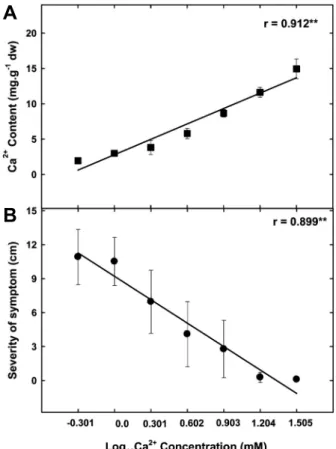
Fig. 1. The effect of calcium concentration in the nutrient solution on calcium uptake (A) and soft rot infection (B) in young Chinese cabbage plant grown hydroponically. **Significant at 1% level.

fraction to be added into the nutrient solution. 100 ppm of each fraction from the filtration as described above was employed and a solution without chitosan was used as a control. After one week of chitosan treatment, the outer leaves were analyzed for calcium content and examined the susceptibility to soft rot disease as described above.

Bacterial Culture

Bacteria Pcc isolated from the infected Chinese cabbage plant was provided form National Institute of Horticultural

& Herbal Science in Suwon, Korea. The bacterial solution was maintained on CPG medium (1.0 g casein, 10 g peptone, 0.5 g glucose per liter). The bacterial suspension culture at 1.0-4.0 × 10

7

colony forming unit per mL (cfu・mL

-1

) was routinely used for inoculation into the plant tissue.

Soft Rot Assay

The susceptibility of the tissue to soft rot disease was determined based on the method reported earlier (Ren et al., 2001) with a few modifications. Outer leaves of the Chinese cabbage plant grown in the nutrient solutions were cut off at the bottom of midrib tissue. Detached leaves were inoculated with 10 μL of the bacterial suspension by piercing midrib tissues at 1.0 cm apart from the cut edge. The leaves then were incubated in a plastic box (36 × 24 × 14 cm) lined with a wet filter paper in a bottom and then placed in a mist-chamber (KG-8407-600.0, Vision, Korea) at 28

± 1.0°C and 90 ± 5% relative humidity for 24 h. At the end of incubation, the severity of symptom was determined by measuring the length of the macerated area in the midrib tissues.

Cation Analysis

Detached leaves were dried at 60°C for 48 h. Powdered tissues then were digested and their cations, calcium, potassium and magnesium content were analyzed by an atomic absorption spectrophotometer as described earlier (Park et al., 2004).

Results and Discussion

Effect of Calcium on Development of Soft Rot Disease from Chinese Cabbage Plant

Hydroponic culture of young Chinese cabbage plant with different concentrations of calcium in the nutrient solution provided a good system to elucidate the temporal relationship between the tissue calcium content and susceptibility of soft rot disease by Pcc to the tissue. Fig. 1 shows the effect of calcium in the nutrient solution on the calcium uptake and on the development of soft rot symptom in the tissue. When calcium was supplied from 0.5 mM to 32.0 mM, of which the concentration of the latter was 8-fold of the 4.0 mM

calcium standard of Hoagland & Arnon solution, the calcium content of the leaf tissue was proportionally increased to the concentration of the nutrient in the solution (r = 0.912).

In addition, the severity of soft rot symptom developed in the young leaves was inversely correlated with the amount of calcium supplied to the nutrient solution (r = 0.899).

Calcium content of the leaf tissue was decreased to 75.1%

of the control in the nutrient solution of 0.5 mM calcium.

However, the soft rot development from the lower calcium supply was significantly enhanced up to 166% of the control (Fig. 1). On the contrary to this, calcium content of the leaf tissue grown with 32.0 mM of calcium was increased sharply reaching to 258% of the control. There was a significant decrease in soft rot symptom in the tissue, concomitantly to the calcium uptake result. The length of the infected area of the leaf tissue grown with 4.0 mM calcium exhibited 4.1 cm in average, whereas less than 0.1 cm of the symptom was developed grown with 32.0 mM of calcium. In the meantime, the growth of young Chinese cabbage plant with 64.0 and 128.0 mM of the nutrient solution was not suitable for the test because CaCl

2

supplemented for high calcium con- centrations was not dissolved completely at these solution (Data not shown).

When calcium concentration in the nutrient solution was

(4)

B A

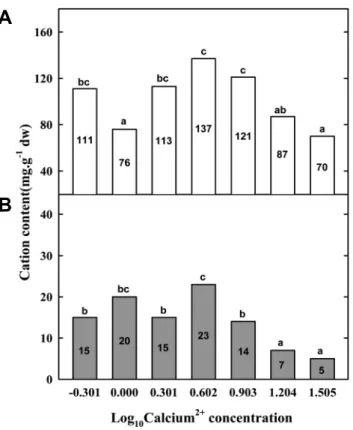
Fig. 2. The effect of calcium concentrations on cation content in young Chinese cabbage plant grown hydroponically. (A) Potassium, (B) Magnesium Mean separation among treatments by DMRT at 5% level.

B A

C

Fig. 3. The effect of chitosan concentration on dry mass (A), calcium content (B), and soft rot infection (C) in young Chinese cabbage plant grown hydroponically. Chitosan fraction from membrane filtration (100 kDa) was dissolved into the nutrient solution for this esperiment. Percent of the control was shown in each histogram, where the control was denoted as 100.

Mean separation for the concentration by DMRT at 5% level.

higher than the standard Hoagland & Arnon solution, the amount of potassium and magnesium in the tissue was notably decreased as shown in Fig. 2. It was interesting to find out that when the lower concentration of calcium than the standard nutrient solution was provided, lesser amount of magnesium and potassium in the leaf tissue was generally accumulated than that of the standard concentration (Fig. 2).

The calcium content of plant tissues affects the occurrence of parasitic disease. First, it is known that calcium is essential for stabilizing the integrity of membranes. When calcium levels are low in tissue, the efflux of low-molecular weight compounds from the cytoplasm into the intercellular space is enhanced (White and Broadley, 2003). Second, most of calcium in tissue exists in cell wall pectin bound to the carboxyl group of polygalacturonate backbone forming ‘egg-box’ like structure (Demarty et al., 1984; Jarvis, 1984). Many parasitic fungi and bacteria invade plant tissue by producing and secreting extracellular cell wall degrading enzymes such as polygalacturonase and pectin lyase, which dissolve the pectin chain in cell walls. The activities of these enzymes were drastically inhibited by calcium (Alfano and Collmer, 1996;

Glenn and Poovaiah, 1990). The susceptibility of plants to infection with such parasites is therefore inversely related to the calcium content of the tissue.

The result obtained in the present study suggests that calcium ion in the leaf tissue of Chinese cabbage plant could prohibit the outbreak of soft rot disease caused by Pcc. Since transport of calcium ion was accompanied by water movement through xylem (Marschner, 2011), supplying calcium into the hydroponic solution could facilitate calcium uptake by the young Chinese cabbage plant, which lends the plant to withstand the bacterial attack. Thus it was of interest to determine if chitosan could stimulate calcium uptake and therein, promote the capacity of the plant to resist the bacterial soft rot by Pcc. It was suggested that water-soluble chitosan stimulates calcium uptake in Chinese cabbage plant.

Effect of Chitosan Concentration on Calcium Uptake and Susceptibility of the Tissue to Soft Rot Disease by Pcc

Fig. 3 shows the effect of chitosan concentration, a residual

fraction from > 100 kDa hollow fiber filtration, in the Hoagland

(5)

A

B

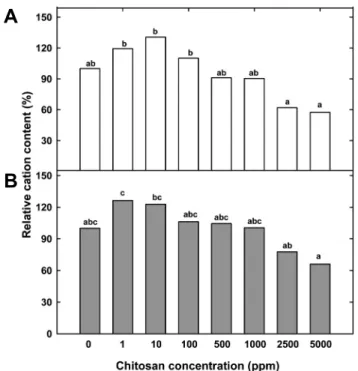
Fig. 4. The effect of chitosan concentrations on cations content in young Chinese cabbage plant grown hydroponically. Percent of the control was shown in each histogram, where the control was denoted as 100. (A) Potassium, (B) Magnessium. * Mean separation for each concentration by DMRT at 5% level.

& Arnon nutrient solution on calcium uptake and development of soft rot disease of the detached leaf from the 4 week-old Chinese cabbage plant. Dry mass production of the leaf tissue was not significantly different among treatments from 0.0 to 1,000 ppm of chitosan. However, the high chitosan concentration such as 2,500 and 5,000 ppm of the nutrient solution signifi- cantly increased the dry mass up to 138% and 168% of control, respectively (Fig. 3A).

Among chitosan concentration tested in the present experiment, 10 ppm of chitosan in the nutrient solution resulted in the highest calcium content of the leaf, showing 155% of the control, followed by 1.0 ppm being 129%. However, higher concentration of chitosan supply more than 500 ppm in the hydroponic solution brought 19 to 53% less calcium uptake in the leaf tissue of Chinese cabbage plant compared to the control (Fig. 3B).

Development of soft rot disease of Chinese cabbage plant was also affected by the concentration of chitosan in the nutrient solution (Fig. 3C). Examining the length of the infected area was convincing and objective measurement of expressing the susceptibility of the tissue to Pcc since the midrib tissue from young Chinese cabbage seedling provides a uniformity and consistency to carry out soft rot assay (Ren et al., 2001).

Among chitosan concentrations tested, 10 ppm of chitosan was the most effective to promote calcium uptake, by 55%

increase compared to the control (Fig. 3B) and subsequently, to prohibit soft rot development by Pcc, exhibiting only 53%

of the control (Fig. 3C). In addition, 1.0 ppm of chitosan was also able to reduce soft rot development of the tissue about 66% of the control. The leaf development of the plant grown at the high chitosan content in the nutrient solution exhibited a severe malformation due to high viscosity so that soft rot assay with the midrib tissue seemed to be impractical and was eliminated (Fig. 3C).

Chitosan of 1.0 and 10 ppm in the hydroponic solution also stimulated the uptake of both potassium and magnesium by the leaf tissue of Chinese cabbage, however, the increment was much less than that of 28% and 22% calcium increase, respectively (Fig. 4). On the other hand, in the higher con- centration of chitosan such as 2,500 and 5,000 ppm, the amount of the two ions of the tissue was much reduced than control although there was no statistical significance.

From the result shown in Figs. 3 and 4, incorporation of 1.0 and 10 ppm of chitosan, obtained from the residual fraction of hollow fiber filtration (> 100 kDa), into the nutrient solution enhanced the uptake of calcium in the leaf tissue of Chinese cabbage plant. Subsequently chitosan promoted the capability of young Chinese cabbage plant to resist to soft rot infection by Pcc.

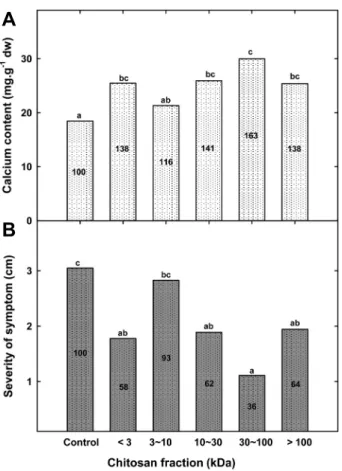
When the different molecular weight of chitosan fractions

obtained by a consecutive fractionation using a hollow fiber filtration was supplied into the nutrient solution, calcium uptake of the leaf tissue was convincingly stimulated with a varying degree depending upon fractions (Fig. 5A). The fraction obtained from 30 kDa molecular weight cut-off increased calcium uptake most, showing 163% of the control.

Calcium uptake from those fractions of smaller than 3 kDa, 10 kDa, and larger than 100 kDa of membrane filtration was also stimulated approximately 140% of the control. The effect of chitosan with different molecular weight on the susceptibility to soft rot disease was even more pronounced (Fig. 5B).

The severity of soft rot disease of the leaf tissue from the chitosan fraction of 30 kDa molecular weight cut-off was reduced most significantly among those fractions, showing merely 36% of the control. The other fractions except 3-10 kDa fraction also resulted in the enhancement of resistance to soft rot infection caused by Pcc.

It is interesting that chitosan stimulates the calcium uptake

in Chinese cabbage plant during hydroponic culture. Chitosan

in the aqueous solution is positively charged at pH lower

than its pKa (6.4) due to its glucosamine group. This cationic

property will bind anions such as NO

-3

and will facilitate

absorption of cations such as Ca

2+

, Mg

2+

, and K

+

of the

nutrient solution by the plant. The pH of the chitosan solution

prepared in the present study was recorded 5.5 ± 0.2 regardless

of their molecular weight (Data not shown).

(6)

A

B

Fig. 5. The effect of chitosan fractions on calcium content (A) and severity of soft rot symptom (B) in young Chinese cabbage plant grown hydroponically. Percent of the control was shown in each histogram, where the control was denoted as 100.

Mean separation of chitosan fraction by DMRT at 5% level.

The previous study on gel permeation chromatography using Shodex GS-320 column (0.5 × 30 cm, Showadenko, Tokyo, Japan) revealed the molecular weight of the membrane fraction of 30-100 kDa being 41 kDa (Shin et al., 2001).

The present study indicated that a substantial amount of increase in calcium absorption by Chinese cabbage plant was achieved using water-soluble chitosan of 41 kDa. This, in turn, enhanced the resistance of the plant to soft rot disease by Pcc.

The effect of water-soluble chitosan on promoting the cabbage tissue to withstand soft rot infection was also manifested with soil-cultured by 0.1% of chitosan fraction of 30-100 kDa. When the chitosan fraction was applied to artificial soil mixture with 4 week-old Chinese cabbage plant, the development soft rot disease from the leaf tissue was reduced to 81.5% of the control (Data not shown). Considering that in a hydroponic system used in the present study chitosan enhanced the capacity of the tissue to resist the soft rot infection by Pcc up to 66% compared to control, the result obtained from the application of chitosan into the soil mixture can be of significance. Further studies will be necessary to

understand the mechanism by which chitosan stimulates uptake of cations, especially calcium ion, from Chinese cabbage plant. Since chitosan is produced via deacetylation of chitin, determination of degree of acetylation of the chitosan fraction 30-100 kDa and its effect on calcium uptake by Chinese cabbage plant will also be important. This will aid a commercial application of chitosan on field production as well as postharvest handling of fresh produces.

Literature Cited

Alfano, J.R. and A. Collmer. 1996. Bacterial pathogens in plants:

life up against the wall. Plant Cell 8:1683-1698.

Aranaz, I., M. Mengíbar, R. Harris, I. Paños, B. Miralles, N. Acosta, G. Galed, and Á. Heras. 2009. Functional characterization of chitin and chitosan. Curr. Chem. Biol. 3:203-230.

Bhat, K.A., S.D. Masood, N.A. Bhat, M.A. Bhat, S.M. Razvi, M.R. Mir, S. Akhtar, N. Wani and M. Habib. 2010. Current status of post harvest soft rot in vegetables: A review. Asian J. Plant Sci. 9:200-208.

Demarty, M., C. Morvan, and M. Thellier. 1984. Calcium and the cell wall. Plant Cell Environ. 7:441-448.

Fritz, V.A., S. Honma, and I. Widders. 1988. Effects of petiole calcium status, petiole location, and plant age on the incidence and progression of soft rot in Chinese cabbage. J. Amer. Soc.

Hort. Sci. 113:56-61.

Glenn, G.M. and B.W. Poovaiah. 1990. Calcium-mediated postharvest changes in texture and cell wall structure and composition in ‘Golden Delicious’ apples. J. Amer. Soc. Hort. Sci. 115:

962-968.

Jarvis, M.C. 1984. Structure and properties of pectin gels in plant cell walls. Plant Cell Environ. 7:153-164.

Kim, B.S. and Y.R. Yeoung. 2004. Suppression of bacterial soft rot on Chinese cabbage by calcium fertilizer treatment. Res.

Plant Dis. 10:82-85.

Kotoujansky, A. 1987. Molecular genetics of pathogenesis by soft-rot Erwinias. Annu. Rev. Phytopathol. 25:405-430.

Lee, S.S., J. Kim, W. Jun, and W.J. Choi. 2001. Development of dihaploid lines resistant to Erwinia carotovora in Chinese cabbage. J. Kor. Soc. Hort. Sci. 42:682-684.

McGuire, R.G. and A. Kelman. 1984. Reduced severity of Erwinia soft rot in potato tubers with increased calcium content.

Phytopathology 74:1250-1256.

Marschner, P. 2011. Marschner’s mineral nutrition of higher plants.

3nd ed. Academic Press, Elsevier, USA. p. 171-189.

Park, S.W., B.H. Hwang, W.Y. Kim, and J. Kim. 2004. Changes in cell wall carbohydrates composition and Ca distribution of Brassica campestris ssp. pekinensis in relation to Erwinia polygalacturonase production during soft rot development. J.

Kor. Soc. Hort. Sci. 45:223-232.

Pillai, C.K.S., W. Paul, and C.P. Sharma. 2009. Chitin and chitosan polymers: Chemistry, solubility and fiber formation. Prog.

Polymer Sci. 34:641-678.

Platero, M. and G. Tejerina. 1976. Calcium nutrition in Phaseolus

vulgaris in relation to its resistance to Erwinia carotovora.

(7)

J. Phytopathol. 85:314-319.

Ren, J., R. Petzoldt, and M.H. Dickson. 2001. Screening and identification of resistance to bacterial soft rot in Brassica rapa. Euphytica 118:271-280.

Shin, S.S., Y.C. Lee, and C. Lee. 2001. The degradation of

chitosan with the aid of lipase from Rhizopus japonicus for the production of soluble chitosan. J. Food Biochem. 25:307-321.

White, P.J. and M.R. Broadley. 2003. Calcium in plants. Ann.

Bot. 92:487-511.

수치

Table 1. Nutrient composition formulated for different concentration of calcium to grow Chinese cabbage with hydroponic culture z
Fig. 1. The effect of calcium concentration in the nutrient solution  on calcium uptake (A) and soft rot infection (B) in young Chinese  cabbage plant grown hydroponically
Fig. 3. The effect of chitosan concentration on dry mass (A),  calcium content (B), and soft rot infection (C) in young Chinese  cabbage plant grown hydroponically
Fig. 4. The effect of chitosan concentrations on cations content  in young Chinese cabbage plant grown hydroponically
+2

참조

관련 문서