Korean J Environ Agric (2012) Online ISSN: 2233-4173 Vol. 31, No. 4, pp. 359-367 http://dx.doi.org/10.5338/KJEA.2012.31.4.359 Print ISSN: 1225-3537
논습지에 도래하는 수조류의 서식지 이용과 개체군 특성
남형규,1 최승혜,1 최유성,2 유정칠1*
1경희대학교 생물학과ㆍ한국조류연구소, 2국립생물자원관 동물자원과
Patterns of Waterbirds Abundance and Habitat Use in Rice Fields
Hyung-Kyu Nam,1 Seung-Hye Choi,1 Yu-Seong Choi2 and Jeong-Chil Yoo1* (1The Korea Institute of Ornithology and Department of Biology, Kyung Hee University, Seoul 130-701, Korea, 2Animal Resource Division, National Institute of Biological Resources, Incheon 404-708, Korea)
Received: 18 October 2012 / Revised: 22 October 2012 / Accepted: 23 October 2012
ⓒ 2012 The Korean Society of Environmental Agriculture
This is an Open-Access article distributed under the terms of the Creative Commons Attribution Non-Commercial License (http://creativecommons.org/licenses/by-nc/3.0) which permits unrestricted non-commercial use, distribution, and reproduction in any medium, provided the original work is properly cited.
*교신저자(Corresponding author),
Phone: +82-2-961-0849; Fax: +82-2-961-0244;
E-mail: [email protected]
359
Abstract
BACKGROUND: As natural wetlands are decreased by increment of human demand, the importance of rice fields as an alternative habitat for waterbirds is well documented.
However, the relationship between waterbirds use and management practice of rice fields has not been fully understood. The present study attempted to understand the changes in temporal abundance of waterbirds and their preference for habitat types in rice fields all year round.
METHODS AND RESULTS: Waterbirds census were conducted in rice fields around Asan bay in Korea during April 2009-March 2010 and April 2011-March 2012. In the bird counts, the locations of the observed birds on a 1/2,500 map were recorded along with the local habitat type (paddy, ditch, levee, road). Thirty five species of waterbirds recorded in the rice fields during the survey period and three major groups (shorebirds, herons, and waterfowls) were characterized according to season and micro-habitat use.
Shorebirds visited a flooded paddy for feeding during their spring migration season (April-May), and herons used the
rice field as feeding sites during their breeding periods (April-October). Most waterfowls were observed in a dry paddy to feed a fallen rice seed and stubs during the winter season (September-March). Waterbird groups selectively used micro-habitats in rice field. Shorebirds and waterfowls mainly preferred at rice paddies, while herons were attracted to most habitat types.
CONCLUSION(S): Rice fields supported various waterbirds all year round and waterbird communities using the rice fields were dramatically changed according to seasonal change of rice field condition.
Key Words: Habitat preference, Micro-habitat, Rice field, Waterbirds
서 론
자연습지는 다양한 야생동물에게 먹이를 제공할 뿐만 아니 라, 번식장소 및 피난처로 이용된다(Mitsch and Gosselink, 2000; Hattori and Mae, 2001). 그러나 인간 활동의 확장에 의해 자연습지의 면적은 전 세계적으로 급격히 감소하고 있다 (Tiner, 1984; Finlayson et al., 1992; Maitland and Morgan, 1997; Fujioka and Yoshida, 2001). 이로 인해 자 연습지를 이용하던 많은 야생동물들이 감소 추세에 있으며, 습 지와 이를 이용하는 야생동물의 보호 관리는 시급한 문제로 대 두되었다. 최근 농업생태계와 관련한 생물다양성 보전의 중요성 Open Access Research Article
이 부각되고 있으며(Benton et al., 2003; Bengtsson et al., 2005; Butler et al., 2009; Gabriel et al., 2010; Winqvist et al., 2011), 그 중 자연습지의 대체서식지로 논습지(rice fields) 에 대한 관심이 커지고 있다(Elphick and Oring, 1998;
Elphick, 2000; Tourenq et al., 2001; Ma et al., 2004).
논습지는 계절에 따라 수생태계와 육상생태계가 반복해서 나타나기 때문에(Fasola and Ruíz, 1996), 수조류를 포함한 다양한 야생동물에게 서식지를 제공한다(Ma et al., 2004;
Gregorio et al, 2011). 수생태계를 형성하는 벼 생육기간의 논습지는 다양한 동물성 먹이가 풍부하여 백로류(herons) 및 도요물떼새류(shorebirds)에게 먹이를 제공하며(Fasola, 1986;
Richardson et al., 2001), 육상생태계가 조성되는 비생육기 에는 두루미류(cranes)와 오리기러기류(waterfowls)가 잔존 하는 볍씨나 그루터기 등을 먹이자원으로 이용 한다(Elphick and Oring, 2002). 이 외에도 논습지는 다양한 형태의 먹이 자원을 수조류에게 제공한다(Stafford et al., 2010). 따라서 점차 줄어드는 자연습지의 대체 기능을 하는 논습지는 수조 류 서식지로서 가치가 더욱 높다(Fasola and Ruíz, 1996;
Elphick, 2000; Maeda, 2001; Czech and Parsons, 2002;
Sánchez-Guzmán et al., 2007; Toral and Figuerola, 2010).
논습지에서 생육하는 벼(Oryza sativa)는 국내에서 가장 많이 재배되는 농작물로서, 재배면적은 전 국토면적의 약 9.8%를 차지한다(농업생산기반 정비사업 통계연보, 2011).
벼 재배는 대부분이 무논(flooded field)의 형태에서 이루어 지며, 안정적인 수심의 유지는 수조류에게 자연습지와 비슷한 환경을 제공하기 때문에 보전방안에 중요한 요인으로 작용한 다. 따라서 국내의 논습지는 수조류 보전에 있어 잠재적으로 높은 가치를 지니고 있다. 그러나 국내 논습지는 1970년대 농 지개량사업으로 인하여 구조적인 변화가 일어났으며, 본답과 그와 연계된 수로와 논둑, 농로를 정비하는 기반조성사업으로 논의 물리적인 변화가 일어났다. 본답과 논둑의 크기는 획일 화 되었고 수로는 콘크리트 구조물로 축조되어 물의 유입과 배출이 신속히 일어나며, 농로 역시 농기계의 접근성과 이동 성을 높이기 위하여 콘크리트로 포장되었다(한국 농업 농촌 100년, 2003). 이로 인하여, 본답과 수로에서 물의 유입과 배 출이 신속하게 일어나 대부분의 본답은 겨울철에 건답화(dry field)되었고, 본답 주변의 농로나 수로의 식생 구조는 단조로 워지거나 분포가 제한되는 특성이 나타났다. 논습지의 구조의 변화는 수조류의 분포와 취식행동에 영향을 미친다(Narusue and Uchida, 1993; Sato and Maruyama, 1996; Lane and Fujioka, 1998). 이는 수조류의 먹이원으로 이용 가능한 저서생물군집의 변화나 취식을 위한 접근성의 변화로 인하여 나타난다(Sato and Maruyama, 1996; Lane and Fujioka, 1998). 따라서 논습지에 서식하는 야생동물의 보전을 위해 논 습지의 물리적 구조 변화가 수조류에게 미치는 영향을 파악 하는 것이 필요하다.
2008년 한국에서 열린 람사총회에서 생물다양성에 대한 논 습지의 중요성과 보전이 강조되었지만, 지금까지 한국에서 논
습지를 이용하는 수조류 연구는 특정 분류군의 행동과 생태연 구에 중심을 두고 수행되어왔을 뿐(Cho and Kim, 2001;
Choi et al., 2007; Yoo et al, 2007, 2008). 논습지를 이용하 는 수조류에 대한 전반적인 평가는 미흡하다. 따라서 본 연구 에서는 논습지를 이용하는 수조류의 현황을 파악하고, 미소서 식지(micro-habitat) 타입에 따른 선호성을 알아보고자 한다.
재료 및 방법 조사지역
본 연구는 한국 중서부 지역에 위치한 충청남도 아산시 둔 포면, 영인면, 인주면 지역의 경작지를 중심으로 수행되었다 (Fig. 1). 이곳은 겨울철 및 봄, 가을의 통과시기에 다양한 수 조류가 이용하는 철새도래지인 아산만, 아산호, 삽교호에 인 접해 있으며(Kwon and Yoo, 2005; Park et al., 2007), 대 부분이 벼를 재배하는 곳이다. 조사지역의 총 면적이 855.2ha 이며, 논생태계 이외에 다른 경관적 요인(산림, 큰 도로, 마을 등)이 인접한 곳은 조사지역에서 배제하였다.
Fig. 1. Location of the study area (grey) around Asan bay in Korea.
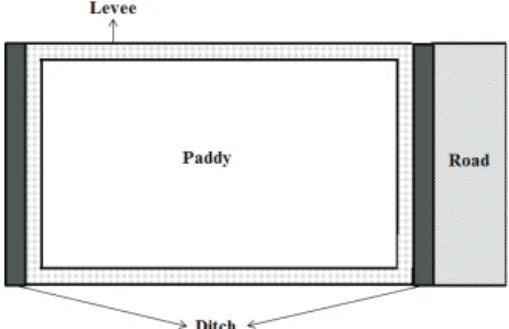
조사지역의 본답의 평균 길이는 약 100m이고 폭이 약 45m이었다. 본답은 논둑에 의해 분리된 형태이며 인접한 곳 에 수로와 농로가 위치해있는 구조로 경지정리사업 이후에 나타난 일반적인 형태를 띠고 있다(Fig. 2). 조사지역은 본답 (92%), 농로(4%), 수로(2%), 논둑(2%)으로 구성되어 있고 조사기간 동안 용도변경은 확인되지 않았다. 벼 생육기간 동 안 일부 논둑과 농로 가장자리에는 콩이나 깨가 재배 되었고, 강아지풀, 토끼풀, 물피 등이 자라고 있었으며, 일부 논둑에서 는 제초작업이 이루어져 있었다.
Fig. 2. Schematic diagram of a typical land use for rice field in the study area.
조류 조사와 서식지 이용 조사
조류 조사는 2009년 4월부터 2010년 3월, 2011년 4월부 터 2012년 3월까지 수행하였다. 조사 횟수는 매월 2회 수행 하였으며, 조사지 내의 농로를 따라 이동하면서 조사지역 내 에 관찰되는 모든 조류의 종과 개체수를 기록하였다. 관찰된 조류는 서식지 타입에 따라 1/2,500 지도에 표기하였으며, 서식지 타입은 본답(rice paddy), 농로(road), 수로(ditch), 논둑(levee)으로 범주화하였다(Fig. 2). 비행이나 전깃줄과 같 은 인공구조물에서 확인된 조류는 분석에서 제외하였으며, 논 습지에서 확인된 조류만을 분석에 이용하였다.
자료 분석
조사 지역의 수조류의 도래 패턴은 매년 유사하였으므로, 두 해간 조사 시기별 개체수를 비교하여 최대개체수를 기준 으로 연중 개체군 변동을 확인하였다. 수조류 분류군(도요물 떼새류, 백로류, 오리기러기류)별 미소서식지 선호성에 관한 분석은 평균 개체수를 이용하여 분석하였다. 대표 수조류의 종 별 미소서식지 이용차이는 개체군 출현 빈도(평균 ± 표준 오차)를 arcsin으로 변환하여 ANOVA를 이용하여 검증하였 고, 유의한 차이가 나타난 경우 Tukey’s Honestly Significant Difference (HSD) test로 그룹 간 사후검증을 실시하였다.
통계분석은 SPSS 17.0을 사용하였다.
결과 및 고찰 수조류 군집의 계절적 도래 특성
조사기간 동안 최대개체수 기준으로 총 35종 25,547개체 의 수조류가 관찰되었으며, 이 중 도요물떼새류가 15종, 백로 류가 9종, 오리기러기류가 9종 등이 관찰되었다(Appendix 1). 논을 이용하는 수조류는 봄철(4월-5월)에 가장 다양한 종 류가 관찰되었으나, 이후 점차 감소하며 겨울철(12월-3월)에 는 일부 종만이 논을 이용하였다(Fig. 3). 그러나 논을 이용하 는 수조류 개체수는 겨울철에 가장 많았으며, 5월초에는 일시 적으로 증가하였으나 그 외 시기에 논을 이용하는 수조류 개 체수는 적었다(Fig. 3).
Fig. 3. Seasonal changes of number of species (solid line) and abundance (white bars) of waterbirds using rice fields around Asan bay in Korea.
Fig. 4. Seasonal change of abundance for three waterbird groups using rice fields around Asan bay in Korea.
논습지는 시기에 따라 담수논(flooded fields)과 건답논 (dry fields)이 주기적으로 형성된다. 이러한 변화는 수조류 분포에 영향을 주며(Maeda, 2001), 수조류 분류군에 따라 논 이용시기와 선호하는 미소서식지에는 차이가 있다(Lourenҫ o and Piersma, 2008; Toral et al., 2011). 본 연구결과 논 을 이용하는 수조류는 분류군에 따라 다른 계절적인 도래패 턴을 보였다(Fig. 4). 즉 벼 생육기간의 논습지는 도요물떼새 류와 백로류가 주로 이용하였고, 휴경기인 겨울에는 오리기러 기류가 취식지로 이용하였다. 특히 대부분의 본답이 건답화되 고, 극히 일부 본답에 담수 논이 조성되는 4월 중하순 경에는 일부 도요물떼새류와 백로류가 밀집하는 것을 관찰 할 수 있 었다. 이는 담수 논이 동물성먹이를 먹는 도요물떼새류와 백 로류에게 중요한 취식지로 작용함을 의미한다. 또한 볍씨를 주로 먹는 오리기러류의 경우 수확 후 짚단이 남아있는 본답 에서 많은 개체수가 도래하는 것을 확인하였다.
본답에 물을 대기 시작하는 4월말은 백로류와 도요물떼새 류가 논습지를 이용하기 시작하는 기간으로 종수와 개체수가 급격하게 증가하였다(Figs. 3 and 4). 이 시기에는 다양한 종 류의 도요물떼새류가 논습지를 이용하였으며, 5월초에 최대 개체수가 관찰되었다(Figs. 4 and 5). 대부분의 도요물떼새 류는 한국을 봄철(4월-5월)과 가을철(8월-10월)에 통과하는 통과철새(passage migrants)로 대부분 서해안의 갯벌 의존 성이 매우 높은 종이지만, 흑꼬리도요(Limosa limosa), 청다 리도요(Tringa nebularia), 알락도요(Tringa glareola), 메 추라기도요(Calidris acuminata) 등은 내륙의 담수습지 및
농경지도 선호하는 종으로 봄철 담수화된 논을 취식지로 자 주 이용한다(Wlodarczyk et al., 2007; Lourenço et al., 2010; Newman and Lindsey, 2011). 그러나 가을철 이동 시기(8월-10월)는 벼가 밀생하고 수확을 위해 건논을 유지함 에 따라 도요물떼새류의 서식지로 적합하지 않는 것으로 조 사되었다. 한편 깝작도요(Actitis hypoleucos)와 꺅도요 (Gallinago gallinago) 등 일부 종은 8월-10월에도 많은 개 체수가 관찰되었다(Fig. 5). 이 경우 꺅도요는 건논 보다는 물 이 고인 본답에 집중되는 경향이 있었으며, 깝작도요는 수로 를 이용하는 빈도가 높았다(Table 1). 따라서 도요물떼새류가 논을 이용하기 위해서는 논의 담수화가 필수적인 것으로 판 단된다. 도요물떼새류가 논습지를 서식지로 이용하는 기간은 다른 수조류에 비해 짧지만, 번식지로 향하는 봄철 이동시기 에 담수 논은 이동에 필요한 에너지를 얻을 수 있는 중간기착 지의 기능을 지닌 중요한 서식지를 제공하고 있다(Lourenҫo and Piersma, 2008).
백로류가 논을 주로 이용하는 시기는 4월부터 10월까지였 으며, 논에 물을 대는 4월말에 개체수가 크게 증가하여 6월초 에 최대개체수가 관찰된 이후 점진적으로 감소하였다(Fig. 4).
백로류는 여름철새(summer visitors)로 한국 전역에서 번식 하며 종에 따라 하천, 저수지, 간석지, 논 등 다양한 형태의 습지를 취식지로 이용한다(Choi et al., 2007; Park et al., 2009). 특히 백로류의 번식시기인 4월-8월은 먹이요구량이 최대에 달하며, 이 시기 논의 담수화는 백로류의 먹이인 다양 한 수서생물의 서식처를 제공함에 따라 백로류의 이용이 높
다(Sato and Maruyama, 1996; Lane and Fujioka, 1998;
Richardson et al., 2001; Pierluissi, 2010). 따라서 4월에서 10월까지 논습지는 육추기 동안 새끼에게 먹이 급여의 장소 로 이용되고 성장한 어린개체에게는 월동지로의 이동에 필요 한 에너지를 획득할 수 있는 취식지 역할을 한다. 대부분의 백로류에 있어 논이 중요한 취식지를 제공하지만, 특히 중백 로(Egretta intermedia)와 황로(Bubulcus ibis)는 다른 백 로류에 비해 논습지를 이용하는 개체수가 현저히 많았다(Fig.
5). 이는 종별 서식지 선호도 차이와 논습지에서 이용할 수
Fig. 5. Seasonal abundance change of major waterbird species in the rice field around Asan bay in Korea.
Group Species Paddy Ditch Levee Road
Shorebirds
Black-tailed Godwit 99.7 ± 0.3a 0.0 ± 0b 0.3 ± 0.3b 0.0 ± 0b
Greenshank 93.8 ± 2.5a 0.0 ± 0b 4.2 ± 2.5b 0.0 ± 0b
Wood Sandpiper 96.3 ± 1.1a 0.7 ± 0.5b 3.0 ± 1.0b 0.0 ± 0c Common Sandpiper 13.6 ± 7.5b 54.5 ± 10.9a 9.1 ± 6.3b 22.7 ± 9.1ab
Common Snipe 100.0 ± 0.0a 0.0 ± 0b 0.0 ± 0b 0.0 ± 0b
Sharp-tailed Sandpiper 87.1 ± 6.1a 0.0 ± 0b 12.9 ± 6.1b 0.0 ± 0b
Herons
Grey Heron 49.6 ± 4.4a 18.8 ± 3.5b 30.1 ± 4.1b 1.6 ± 1.1c Great Egret 72.3 ± 2.3a 17.2 ± 1.9b 9.0 ± 1.4c 1.5 ± 0.6d Intermediate Egret 63.8 ± 1.3a 8.0 ± 0.8c 21.5 ± 1.1b 6.6 ± 0.7c Little Egret 45.8 ± 2.2a 25.0 ± 1.9b 21.4 ± 1.8b 7.8 ± 1.2c Cattle Egret 48.7 ± 1.6a 9.3 ± 0.9d 23.9 ± 1.3b 18.2 ± 1.2c Black-crowned Night Heron 41.5 ± 7.2a 17.0 ± 5.5b 41.5 ± 7.2a 0.0 ± 0b
Waterfowls
Bean Goose 96.3 ± 3.7a 0.0 ± 0b 0.0 ± 0b 3.7 ± 3.7b
White-fronted Goose 98.5 ± 1.5a 0.0 ± 0b 0.0 ± 0b 1.5 ± 1.5b
Mallard 93.3 ± 6.7a 6.7 ± 6.7b 0.0 ± 0b 0.0 ± 0b
Spot-billed Duck 63.0 ± 3.2a 3.1 ± 1.2c 32.0 ± 3.1b 1.8 ± 0.9c Table 1. The frequency (%, mean ± SE) of species using four micro-habitat types in the rice field around Asan bay in Korea. For each species, habitat types with the same letters are not significantly different based on Tukey HSD tests (P>0.05). Mean values for each habitat were calculated based on 48 surveys during 2009-2012
있는 먹이원의 선호도 차이에 따른 결과로 해석된다(Choi et al., 2007). 한편 중백로, 쇠백로(Egretta garzetta), 황로, 해 오라기(Nycticorax nycticorax)는 10월 이후 논을 이용하지 않았는데, 이는 월동지로 이동하였기 때문이며, 중대백로 (Ardea alba)와 왜가리(Ardea cinerea)는 일부 월동개체가 겨울철에 월동하며 논을 휴식지로 이용하였다.
오리기러기류는 큰 무리를 지어 11월부터 3월초까지 논을 취식지로 이용하였다(Fig. 4). 오리기러기류는 대표적인 겨울 철새(winter visitors)로 번식을 마친 개체들이 10월에 도래 하기 시작하여 다음해 3월까지 한국 전역의 습지에서 월동한 다(Park et al., 2007). 이 중 기러기류와 수면성오리류 (dabbling ducks)는 월동기간동안 추수 후 논에 잔존하는 낙곡을 주먹이로 이용하는 종들로 주로 대규모 농경지가 조 성된 지역에 도래한다(Kwon and Yoo, 2005; Yoo et al., 2008). 큰기러기(Anser fabalis)와 쇠기러기(Anser albifrons) 는 본 조사지역의 논을 월동기간동안 지속적으로 이용하는 것이 관찰되었으나, 황오리(Tadorna ferruginea), 청둥오리 (Anas platyrhynchos), 흰뺨검둥오리(Anas poecilorhyncha) 는 월동기간동안 불규칙적으로 관찰되었다(Fig. 5). 이는 기러 기류와 오리류의 먹이활동시간의 차이에 의한 것으로, 기러기 류가 낮 동안 농경지에서 취식활동을 하는 반면, 오리류는 낮 동안은 호수 등에서 휴식을 취하고 야간에 농경지로 이동하 여 취식하는 습성 때문이다(Baldassarre and Bolen, 1994).
따라서 야간의 먹이활동을 고려하면 오리기러기류가 월동기 간동안 논을 취식지로 이용하는 비율은 매우 높다고 할 수 있 다(Stafford et al., 2010).
수조류 군집의 서식지 이용 특성
백로류는 4월부터 6월까지는 주로 본답에서 취식활동을 하였으나, 7월 이후에는 수로, 논둑, 농로를 이용하는 비율이 높아졌다(Fig. 6 and Table 1). 이는 벼의 성장으로 인해 본 답의 접근성이 떨어지기 때문에, 보다 쉽게 먹이를 사냥할 수 있는 곳을 이용하기 때문이다(Fujioka et al., 2001). 미소서 식지 중 본답 다음으로 이용 빈도가 높은 곳은 왜가리, 중백 로, 황로, 해오라기의 경우 논둑이었고, 중대백로와 쇠백로는 수로였다(Table 1). 벼의 성장으로 인해 밀도가 증가하는 시 기에도 중백로와 황로는 다른 백로류에 비해 논습지에 대한 선호성이 매우 높다는 것이 확인되었으며, 논답과 논둑을 주 로 이용하였다(Fig. 6 and Table 1). 중대백로와 쇠백로는 수로 내에서 주로 취식 활동을 하였으며, 중대백로의 경우 주 로 폭이 넓은 수로에서 관찰되었다. 쇠백로와 중대백로가 이 용하는 수로는 대부분이 흙으로 둑을 쌓은 구조이거나 진흙 이 하부에 쌓인 콘크리트 수로였고 수심은 얕은 상태를 유지 하고 있었다. 논둑, 수로, 농로의 면적이 본답에 비해 뚜렷이 작은 것을 감안하면 7월부터 9월까지 기간 동안의 논둑, 수 로, 농로는 Maeda(2001)가 지적하였듯이 백로류에게 상당히 중요한 서식지를 제공하였다.
도요물떼새류와 오리기러기류는 거의 대부분 본답만을 이 용하였다(Fig. 6 and Table 1). 오리기러기류는 수확이 끝난
후 도래하기 시작하고 본답에 잔존하는 낙곡이나 그루터기를 먹이자원으로 이용하는 것으로 보인다(Shimada, 2003). 한 편 흰뺨검둥오리의 경우 논둑을 서식지로 이용하는 빈도가 다른 오리기러류 보다 높게 나타났는데(Table 1), 이는 텃새 개체군이 번식기(벼 생육기간)동안 논둑을 자주 이용하였기 때문이다. 도요물떼새류는 본답에 물을 댈 때 도래하기 시작 하는데, 이는 물이 채워진 논은 갯벌과 비슷한 형태를 띄어 도요물떼새류가 선호하는 서식지로 조성되기 때문이며(Toral et al., 2011), 주로 물댄 논의 바닥층과 수중에 서식하는 저 서무척추동물을 먹이 자원으로 이용한다(Taft and Haig, 2005).
Fig. 6. Monthly change in micro-habitat selection of three waterbird groups in rice fields around Asan bay in Korea (a: shorebirds, b: herons; c: waterfowls).
논은 본답, 수로, 논둑, 농로 등 각기 독특한 형태의 미소 서식지로 구성되어 있으며, 각각의 특성에 따라 수조류의 이 용 특성이 다르게 나타난다(Narusue and Uchida, 1993;
Lane and Fujioka, 1998; Maeda, 2001). 본답은 논을 구성 하는 미소서식지 중에서 가장 넓은 면적을 차지하지만, 관리 방식에 따라 급격한 변화를 수반하여 수생태계와 육상생태계 가 반복적으로 형성되는 대표적인 공간이다. 수로는 본답에 물을 제공하는 동시에 하나의 수생태계를 형성하는 공간이며, 논둑은 본답 사이의 경계를 지어주고, 본답에 벼의 밀도가 높 아져 수조류의 접근성이 떨어지는 시기에는 일정 공간을 안 정적으로 제공해준다(Sato and Maruyama, 1996). 농로는 논둑과 수로의 서식지 기능을 확장시켜 주는 공간이다. 따라
서 본답의 변화에 따라 수로, 논둑, 농로는 상호 보완적으로 작용하여 수조류에게 취식 공간을 제공한다. 논생태계에서 각 각의 미소서식지는 유기적으로 연계되어 있기 때문에, 하나의 미소서식지의 환경변화는 주변의 다른 미소서식지에 서식하 는 생물상에 영향을 줄 수 있다. 예를 들어, Osawa 등(2005) 은 콘크리트 구조물로 축조된 수로 주변의 논둑은 다른 논둑 보다 양서류의 밀도가 현저히 떨어짐을 보고한 바 있다. 또한, 콘크리트 수로는 본답에 영향을 끼쳐 물의 유입과 배출이 빠 르게 일어나 과거에 비해 논의 담수기간이 짧아지게 되어 논 서식지에 서식하는 생물상의 변화를 초래하였다(Sato and Maruyama, 1996; Azuma and Takeuchi, 1999).
논습지는 사라져 가는 자연습지를 대신하여 다양한 수조 류에게 서식지를 제공하기 때문에 논습지의 생태적인 특성과 구조를 파악하는 것은 매우 중요하다. 논습지의 미소서식지는 지역 농업인의 관리방식에 따라 다양한 형태로 존재한다. 본 답은 경작방법에 따라 연중 변화가 크고, 수로는 깊이가 다양 하다. 논둑과 농로 역시 길이와 폭이 다양하여 식생의 구성과 분포가 다르다. 따라서 논의 효율적인 관리를 위해서 미소서 식지 차이와 상호 연관성에 따른 수조류 분포 패턴 특성과 같 은 연구들이 수행되어야 할 것이다. 논습지는 자연습지에 비 해 단기간에 쉽게 변할 수 있는 공간이므로 수조류에게 적합 한 논습지의 구조를 파악하여 수조류에게 이익이 되는 명확 하고 체계적인 관리방안을 모색하는 것이 중요하다.
요 약
본 연구는 논습지를 이용하는 수조류의 서식지 이용과 개 체군 특성을 파악하기 위해 수행되었다. 2009/2010년과 2011/2012년에 걸쳐 아산만 일대의 논을 대상으로 매월 2회 씩 조사를 수행한 결과 총 35종의 수조류가 관찰되었다. 수조 류의 논이용은 분류군에 따라 시기적으로 차이가 있지만, 분 류군에 상관없이 대부분 논을 취식지로 이용하였다. 도요물떼 새류는 봄철이동시기(4월-5월)에 담수화된 본답을 주로 이용 하였다. 백로류는 논을 4월에서 10월까지 이용하였으며, 논의 상태변화에 따라 본답, 논둑, 수로 등을 고루 이용하였다. 논 은 백로류의 번식에 필요한 충분한 먹이를 제공하는 서식지 이다. 오리기러기류는 월동기간(11월-3월)동안 추수 후 떨어 진 낙곡을 취식하기 위해 논을 이용하였다. 결과적으로 주기 적으로 뚜렷한 환경변화를 갖는 논 생태계는 시기에 따라 다 양한 수조류의 서식지를 제공하고 있다.
참고문헌
Azuma, A., Takeuchi, K., 1999. Relationships between population density of frogs and environmental conditions in Yatsu-Habitat, Journal of the Japanese Institute of Landscape Architecture, 62, 573-576 (in Japanese with English abstract).
Baldassarre, G.A., Bolen, E.G., 1994. Waterfowl Ecology
and Management, John Wiley and Sons Inc., New York.
Bengtsson, J., Ahnström, J., Weibull, A.C., 2005. The effects of organic agriculture on biodiversity and abundance: a meta-analysis, Journal of Applied Ecology, 42, 261-269.
Benton, T.G., Vickery, J.A., Wilson, J.D., 2003. Farmland biodiversity: is habitat heterogeneity the key?, Trends in Ecology and Evolution, 18, 182-188.
Butler, S. J., Brooks, D., Feber, R.E., Storkey, J., Vickery, J. A., Norris, K., 2009. A cross-taxonomic index for quantifying the health of farmland biodiversity, Journal of Applied Ecology, 46, 1154-1162.
Cho, S.R., Kim, J.H., 2001. The breeding ecology of Black-winged Stilt in Korea, The Korea Journal of Ornithology, 8, 23-33.
Choi, Y.S., Kwon, I.K., Yoo, J.C., 2007. Foraging habitat preferences of Herons and Egrets, Journal of Ecology and field Biology, 30, 237-244.
Czech, H.A., Parsons, K.C., 2002. Agricultural wetlands and waterbirds: a review. Waterbirds 25(Special Publication 2), 56-65.
Elphick, C.S., Oring, L.W., 1998. Winter management of Californian rice fields for waterbirds. Journal of Applied Ecology, 35, 95-108.
Elphick, C.S., Oring, L.W., 2002. Winter management of Californian rice fields for waterbirds, Journal of Applied Ecology, 35, 95-108.
Elphick, C.S., 2000. Functional equivalency between rice fields and seminatural wetland habitats, Conservation Biology, 14, 181-191.
Fasola, M., Ruíz, M., 1996. The value of rice fields as substitutes for natural wetlands for waterbirds in the Mediterrnean region, Colonial Waterbirds, 19, 122-128.
Fasola, M., 1986. Resource use of foraging herons in agricultural and nonagricultural habitats in Italy, Colonial Waterbirds, 9, 139-148.
Finlayson, C.M., Davidson, N.C., Spiers, A.G., Stevenson, N.J., 1992. Global wetland inventory-current status and future priorities, Marine and Freshwater Research, 50, 717-727.
Fujioka, M,. Armacost J.W., Yoshida, H., Maeda, T., 2001.
Value of fallow farmlands as summer habitats for waterbirds in a Japanese rural area, Ecological Research, 16, 555-567.
Fujioka, M., Yoshida, H., 2001. The potential and problems of agricultural ecosystems for birds in Japan, Global Environmental. Research, 5, 151-161.
Gabriel, D., Sait, S. M., Hodgson, J. A., Schmutz, U., Kunin, W. E., Benton, T. G., 2010. Scale matters: the
impact of organic farming on biodiversity at different spatial scales, Ecology. Letters, 13, 858-869.
Gregorio, M.T., David, A., Javier, B., Jordi, F., 2011. Using landsat images to map habitat availability for waterbirds in rice fields, Ibis. 153, 684-694.
Hattori, A., Mae, S., 2001. Habitat use and diversity of waterbirds in a coastal lagoon around Lake Biwa, Japan.
Ecological. Research, 16, 543-553.
Kwon, Y.S., Yoo, J.C., 2005. A study on the distribution and major habitat of birds in Asanman Bay, South Korea, The Korea Journal of Ornithology, 9, 1-18.
Lane, S.J., Fujioka, M., 1998. The impact of changes in irrigation practices on the distribution of foraging egrets and herons (Ardeidae) in the rice fields of central Japan, Biological. Conservation, 83, 221-230.
Lourenço, P. M., Mandema, F. S., Hooijmeijer, J. C.E.W., Granadeiro, J. P., Piersma, T., 2010. Site selection and resource depletion in black-tailed godwits Limosa l.
limosa eating rice during northward migration, Journal of Animal Ecology, 79, 522-528.
Lourenҫo, P.M., Piersma, T., 2008. Stopover ecology of Black-tailed Godwits Limosa limosa limosa in Portuguese rice fields: a guide on where to feed in winter, Bird Study 55, 194-202.
Ma, Z., Li, B., Zhao, B., King, K., Tang, S., Chen, J., 2004.
Are artificial wetlands good alternatives to natural wetlands for waterbirds?-a case study on Chongming Island, China, Biodiversity Conservation, 13, 333-350.
Maeda, T., 2001. Patterns of bird abundance and habitat use in rice fields of the Kanto Plain, central Japan, Ecological Research, 16, 569-585.
Maitland, P.S., Morgan, N.C., 1997. Conservation management of freshwater habitats, Lakes, Rivers and Wetlands. Chapman & Hall, London.
Mitsch, W.J., Gosselink, J.G., 2000. Wetlands, pp. 571-609, third ed. Johm Wiley & Sons, Inc., New York, USA.
Narusue, M., Uchida, H., 1993. The effect of structural changes of paddy fields on foraging egrets. Strix. 12, 121-130 (in Japanese with English summary).
Newman, M., Lindsey, A., 2011. A ten-year study of shorebirds at the morpeth wastewater treatment work near Maitland in New South Wales, Stilt. 60, 37-45.
Osawa, S., Shimada, M., Katsuno, T., 2005. Environmental factors that regulate the density of Rana porosa porosa on the levees of flatland paddy fields. Journal of Rural Planning Association, 24, 91-102 (in Japanese).
Park, C.Y., Kim, W.Y., Lee, D.P., 2009. Comparison of the characteristics of bird community according to habitat types in rural area of Muan-gun, Jeollanam-do, The
Korea Journal of Ornithology, 16, 81-92.
Park, Y.S., Lee, W.S., Nam, H.K., Lee, K.S., Yoo, J.C., 2007.
Patterning waterbirds occurrences at the western costal area of the Korean peninsula in winter using a self-organizing map, Korean Journal of Environmental Biology, 25, 149-157.
Pierluissi, S., 2010. Breeding waterbirds in rice fields: a global review, Waterbirds 33(Specieal Publication 1), 123-132.
Richardson, A.J., Taylor, I.R., Growns, J.E., 2001. The foraging ecology of egrets in rice fields in Southern New South wales, Australia, Colonial Waterbirds, 24, 255-264.
Sánchez-Guzmán, J.M., Moran, R., Masero, J.A., Corbacho, C., Costillo, E., Villegas, A., Santiago-Quesada, F., 2007.
Identifying new buffer areas for conserving waterbirds in the Mediterranean basin: the importance of the rice fields in Extremadura, Spain, Biodiversity and Conservation, 16, 3333-3344.
Sato, N., Maruyama, N., 1996. Foraging site preference of intermediate egrets Egretta intermedia during the breeding season in the eastern part of the Kanto Plain, Japan. Journal of Yamashina Institute for Ornithology, 28, 19-34.
Shimada, T., 2003. Daily activity pattern and habitat use of Greater White-fronted Geese wintering in Japan: Factors of the population increase, Waterbirds, 25, 371-377.
Stafford, J.D., Kaminski, R.M., Reinecke, K.J., 2010. Avian foods, foraging and habitat conservation in world rice fields, Waterbirds 33(Specieal Publication 1), 133-150.
Taft, O.W., Haig, S.M., 2005. The value of agricultural wetlands as invertebrate resources for wintering shorebirds, Agriculture. Ecosystems and Environment, 94, 17-29.
Tiner, R.W. Jr, 1984. Wetlands of the United States:
Current Status and Recent Trends, US Fish &
Wildlife Servie, Washington D.C.
Toral, G.M., Figuerola, J., 2010. Unraveling the importance of rice fields for waterbird populations in Euripe, Biodiversity and Conservation, 19, 3459-3469.
Toral, G.M., Aragones, D., Bustamante, J., Figuerola, J., 2011. Using landsat images to map habitat availability for waterbirds in rice fields, Ibis, 153, 684-694.
Tourenq, C., Bennets, R.E., Kowalski, H., Vialet, E., Licchesi, J.L., Kayser, Y., Isenmann, P., 2001. Are ricefields a good alternative to natural marshes for waterbird communities in the Camarguq, Southern France? Biological Conservation, 100, 335-343.
Winqvist, C., Bengtsson, J., Aavik, T., Berendse, F.,
Clement, L. W., Eggers, S., Fischer, C., Flohre, A., Geiger, F., Liira, J., Pärt, T., Thies, C., Tscharntke, T., Weisser, W. W., Bommarco, R., 2011. Mixed effects of organic farming and landscape complexity on farmland biodiversity and biological control potential across Europe, Journal of Applied Ecology, 48, 570-579.
Wlodarczyk, R., Minias, P., Karczmarek, K., Janiszewski, T., Kleszcz, A., 2007. Different migration strategies used by two inland wader species during autumn migration, case of Wood Sandpiper Tringa glareola and
Common Snipe Gallinago gallinago. Ornis Fennica, 84, 119-130.
Yoo, S.H., Kim, I.K., Kang, T.H., Cho, H.J., Yu, J.P., Lee, S.W., Lee, H.S., 2008. Wintering bird community in Cheonsu Bay and the relationship with food resources, Korea Journal of Environment and Ecology, 22, 301-308.
Yoo, S.H., Lee, K.S., Yoo, J.C., 2007. Reaction to the vehicle and trade-off between vehicular interruption and food resources of Cranes, Korea Journal of Environment and Ecology, 21, 526-535.
No. Korean name Scientific name Habitat type Activity Paddy Ditch Levee Road Feed Rest Breed
1 큰기러기 Anser fabalis ○ ○ ○ ○
2 쇠기러기 Anser albifrons ○ ○ ○ ○
3 황오리 Tadorna ferruginea ○ ○
4 원앙 Aix galericulata ○ ○ ○ ○
5 청둥오리 Anas platyrhynchos ○ ○ ○
6 흰뺨검둥오리 Anas poecilorhyncha ○ ○ ○ ○ ○ ○ ○
7 고방오리 Anas acuta ○ ○
8 가창오리 Anas formosa ○ ○ ○
9 쇠오리 Anas crecca ○ ○
10 큰덤불해오라기 Ixobrychus eurhythmus ○ ○
11 해오라기 Nycticorax nycticorax ○ ○ ○ ○ ○ ○
12 검은댕기해오라기 Butorides striata ○ ○ ○ ○ ○
13 흰날개해오라기 Ardeola bacchus ○ ○ ○
14 황로 Bubulcus ibis ○ ○ ○ ○ ○ ○ ○
15 왜가리 Ardea cinerea ○ ○ ○ ○ ○ ○ ○
16 중대백로 Ardea alba modesta ○ ○ ○ ○ ○ ○ ○
17 중백로 Egretta intermedia ○ ○ ○ ○ ○ ○ ○
18 쇠백로 Egretta garzetta ○ ○ ○ ○ ○ ○ ○
19 뜸부기 Gallicrex cinerea ○ ○ ○ ○ ○
20 쇠물닭 Gallinula chloropus ○ ○ ○
21 장다리물떼새 Himantopus himantopus ○ ○
22 댕기물떼새 Vanellus vanellus ○ ○
23 검은가슴물떼새 Pluvialis fulva ○ ○
24 꼬마물떼새 Charadrius dubius ○ ○ ○
25 꺅도요 Gallinago gallinago ○ ○ ○
26 흑꼬리도요 Limosa limosa ○ ○ ○ ○
27 쇠부리도요 Numenius minutus ○ ○
28 중부리도요 Numenius phaeopus ○ ○ ○ ○
29 청다리도요 Tringa nebularia ○ ○ ○
30 삑삑도요 Tringa ochropus ○ ○ ○ ○
31 알락도요 Tringa glareola ○ ○ ○ ○ ○
32 깝작도요 Actitis hypoleucos ○ ○ ○ ○ ○ ○
33 좀도요 Calidris ruficollis ○ ○
34 종달도요 Chlidris subminuta ○ ○
35 메추라기도요 Calidris acuminata ○ ○ ○ ○
Appendix 1. List of waterbird species observed in the rice fields around Asan bay in Korea during 2009-2012.