• 검색 결과가 없습니다.

A Study on CFD Analysis to Investigate the Effects of Different Feed Rate into the High Temperature H<sub>2</sub>SO<sub>4</sub> Transferring Pump at Fixed Frequency

N/A
N/A
Protected

Academic year: 2021

Share "A Study on CFD Analysis to Investigate the Effects of Different Feed Rate into the High Temperature H<sub>2</sub>SO<sub>4</sub> Transferring Pump at Fixed Frequency"

Copied!
8
0
0

로드 중.... (전체 텍스트 보기)

전체 글

(1)

Vol. 20, No. 3, pp. 304-311, June 30, 2014, ISSN 1229-3431(Print) / ISSN 2287-3341(Online) http://dx.doi.org/10.7837/kosomes.2014.20.3.304

A Study on CFD Analysis to Investigate the Effects of Different Feed Rate into the High Temperature H 2 SO 4 Transferring Pump at Fixed Frequency

Jung-Sik Choi Jae-Hyuk Choi

Graduate School of Korea Maritime and Ocean University, 727 Taejong-ro, Yeongdo-Gu, Busan 606-791, South Korea

Division of Marine System Engineering, Korea Maritime and Ocean University, 727 Taejong-ro, Yeongdo-Gu, Busan 606-791, South Korea

Abstract : In this study, to apply hydrogen energy to ship engine and to generate effective hydrogen production, we investigated the effects of high temperature H 2 SO 4 feed rate and cooling water rate to pump parts with fixed frequency needed to reciprocate motion and a simulation was conducted at each condition. In the fixed frequency and cooling water inlet flow rate of 0.5 Hz and 3.9 kg/s, we changed the high temperature H 2 SO 4 flow rate to 47.46 kg/s (it is 105 % of 45.2 kg/s), 49.72 kg/s (110 %), and 51.98 kg/s (115 %). Also, at 0.5 Hz and 45.2 kg/s of frequency and high temperature H 2 SO 4

flow, the thermal hydraulic analysis was performed at the condition of 95 % (3.705 kg/s), 90 % (3.51 kg/s), and 85 % (3.315 kg/s). In overall simulation cases, the physical properties of materials are more influential to the temperature increase in the pump part rather than the changes on the feed rate of high temperature H 2 SO 4 and cooling water. A continuous operation of pump was also capable even if the excess feed of high temperature H 2 SO 4 of about 15 % or the less feed of cooling water of about 15 % were performed, respectively. When the increasing feed of high temperature H 2 SO 4 of up to 5 %, 10 %, and 15 % were compared with base flow (45.2 kg/s), the deviation of time period rose to a certain temperature and ranged from 0 to 4.5 s in the same position (same material). In case of cooling water, the deviation of time period rose to a certain temperature and ranged from 0 to 5.9 s according to the decreasing feed changes of cooling water at 5 %, 10 %, and 15 % compared to a base flow (3.9 kg/s). Finally, the additional researches related to the two different materials (Teflon and STS for Pitch and End-plate), which are concerned about the effects of temperature changes to the parts contacting different materials, are needed, and we have a plan to conduct a follow-up study.

Key Words : High efficiency hydrogen production, SI (sulfuric – iodine) Thermochemical cycle, Environmental friendly ship, Transportation pump for high temperature H 2 SO 4 , Fixed frequency

1 1. Introduction

In recent years, the political, social and economic concerns for global warming and climate changes are increasing. According to the NOAA (National Oceanic and Atmospheric Administration, USA), the concentration of carbon dioxide observed from volcano in Hawaii for 50 years was steadily increasing from 320 ppm in 1964 to 398 ppm in February 2014 (NOAA, 2014). Due to the increasing emission of carbon dioxide in the last 100 years, the Earth’s surface temperature has also raised by 0.74 ℃ and the global concerns for sudden climate change has grown (IPCC, 2007). Ships were the exceptions for the regulation of carbon dioxide emission because the ship sailed in the world, so nationality of ship was ambiguous based on political system.

Therefore, the regulation for carbon emission has been delegated to IMO (International Maritime Organization) of the MEPC (Marine

First Author : [email protected], 051-404-4258 Corresponding Author : [email protected], 051-410-4257

Environment Protection Committee). There are many discussions, such as regulatory, estimation and measurement methods of carbon dioxide emission (IMO, 2008; IMO, 2011; Lloyd’s Register, 2012a;

Lloyd’s Register, 2012b; IMO, 2014).

The regulations of greenhouse gases caused by ships were strongly reinforced by IMO, so technology competitions to respond to regulatory were focused by researcher and government. Maritime advanced countries like the European and Japan, focuses on the technology development of green ship, and the Korea government amendments on domestic laws include the making of green ship in accordance with the MARPOL (International Convention for the Prevention of Marine Pollution from Ships) Annex VI. In addition, to be competitive, Korea government invests to the developments of green ship technology (Ministry of Ocean and Fisheries, 2013;

SIMF, 2012).

In the green ship technology, the researches for applying hydrogen energy to ship engine have been particularly interesting.

Two technologies were developed to apply hydrogen energy to

ship technology (Lim et al., 2009; Choi et al., 2010): Hydrogen

(2)

Transferring Pump at Fixed Frequency Fuel Cell Ship takes the momentum by powering the motor-used

electricity produced from hydrogen fuel cell, and Hydrogen Internal Combustion Engine obtains the power by supplying hydrogen or fuel-added hydrogen. Hydrogen fuel cell ship easily responds to various environmental regulations because it has high thermal efficiency, can reduce the fuel cost and has no other emission except water. Second, it was designed to be flexible because it does not required generator for auxiliary power supply. Third, it is an environmentally-friendly power system. It has no pollutants emissions and is high efficiency because it uses a wide flammable limit of hydrogen using hydrogen fuel and other fuel- added hydrogen (Han et al., 2010). As described above, in order to get hydrogen energy that can be source of ship’s main power, effective researches for large quantities of hydrogen production, environmental friendly, economical and safe are needed.

There are technologies used to produce hydrogen: steam reforming methods is almost 90 % of the current methods and CO 2

is discharged during combustion process of natural gas (Oh et al., 2011; Seo et al., 2007). Without the use of fossil energy, nuclear hydrogen can be considered the most practical methods among a number of methods in producing hydrogen. The nuclear hydrogen used high temperature that occurred through VHTR (Very High Temperature gas-cooled Reactor) of more than 900 ℃. There are three methods in using water as the raw material : Thermochemical cycle, high temperature electrolysis methods and mixing methods.

Recently, researches for thermochemical cycles have been active, and sulfur-iodine thermochemical cycle (SI thermochemical cycle) easily promotes enlargement from small device to large and still able to continue operation, were intensively carried out (Chang, 2006).

Fig. 1. Simplified flow-sheet for SI thermochemical water-splitting cycle process with chemical reactions.

Theoretical conversion efficiency of heat-hydrogen in SI cycle is more than 50 % (Gong and Kim, 2011), and sulfur-iodine thermochemical water-splitting cycle process consisted of three reactions as shown as Fig. 1 (a): Bunsen reaction (section Ⅰ), H 2 SO 4 decomposition reaction (section Ⅱ), and HI decomposition reaction (Section Ⅲ). Fig. 1 (b) is presented for each chemical reaction equation. The H 2 SO 4 decomposition reaction takes place in two steps, a non-catalytic thermal decomposition of the acid to form gaseous SO 3 and H 2 O, followed by a catalytic decomposition of the SO 3 to produce the SO 2 and O 2 products (Rodríguez and Parra, 2011). Thus, transportation of high temperature H 2 SO 4 in SI cycle is very important factor to enhance the safety and efficiency of the process.

In this study, we followed-up studies of every previous research (Choi et al., 2011; Choi et al., 2012) that proposed a new design of pump for high temperature H 2 SO 4 in SI thermochemical cycle and investigated thermal-hydraulic characteristics using CFD analysis.

There are two simulation cases: In the fixed frequency and cooling water rate of 0.5 Hz and 3.9 kg/s, we changed the high temperature H 2 SO 4 flow to 47.46 kg/s (it is 105 % of 45.2 kg/s), 49.72 kg/s (110 %), and 51.98 kg/s (115 %). Also, at 0.5 Hz and 45.2 kg/s for frequency and high temperature H 2 SO 4 suction flow, the thermal hydraulic analysis was performed at condition with 95

% (3.705 kg/s), 90 % (3.51 kg/s), and 85 % (3.315 kg/s); These ratio was determined from 3.9 kg/s used in previous studies.

When the technology of nuclear hydrogen is commercialized, these results can be helpfully used in fundamental data for pump transferring high temperature H 2 SO 4.

2. Numerical Methods

2.1 Transferring pump for High temperature H 2 SO 4 In Fig. 2, the dimension of main parts and size for high temperature H 2 SO 4 used CFD analysis were presented. Through 60

mm pipe, the suction and discharge motion of high temperature

H 2 SO 4 were performed depending on the frequency (period (T) =

1/Frequency [Hz]). The cooling water introduced inside bellows

through 10 mm inlet pipe, and it was discharged outside using

outlet pipe (10 mm) after cooling the bellows. The details for

modeling and mesh structure were referred to previous studies

(Choi et al., 2011; Choi et al., 2012), so that was omitted in this

study.

(3)

Fig. 3. Temperature monitoring position of bellows each parts.

Fig. 2. A dimension of high temperature H 2 SO 4 pump section.

2.2 Numerical methods and physical properties

For CFD analysis, a commercial program named FLUENT was used. The PISO pressure-velocity coupling scheme algorithm for discretization of the governing equations, were applied and the Standard κ-ε Turbulence Model and Standard Wall Fn for turbulence model were used. Furthermore, to simulate the actual operating conditions of high temperature H 2 SO 4 transfer pump, we made a dynamic mesh structure using UDFs (User Defined Functions) and controlled movement of bellows according to cycle.

The mass flow rate (kg/s) of high temperature H 2 SO 4 and cooling water were applied at inlet condition, and we assumed that the bellows box was insulated stated.

The density of the Teflon, which was base material consisting of bellows, was ~2.200 × 10 3 (Kg/ ) (http://en.wikipedia.org/wiki /Polytetrafluoroethylene, 2014), the specific heat was 1.500 × 10 3 (J/kg․K), and the thermal conductivity was 2.500 × 10 -1 (W/m․K) (http://www2.dupont.com/Teflon_Industrial/en_US/tech_info/techlit .html, 2014). The density of the STS (stainless steel), which was used as the materials for End-plate of bellows, was 7.800 × 10 3 (Kg/ ), the specific heat was 5.000 × 10 2 (J/kg․K), and the thermal conductivity was 1.500 × 10 1 (W/m․K) (The European Stainless Steel Development Association, 2007). These characteristic values were applied equally for all simulation cases.

2.3 Simulation cases

In previous studies (Choi et al., 2011; Choi et al., 2012), we conducted the simulation to investigate temperature distribution of bellows and end-plate of bellows in a condition of high temperature H 2 SO 4 feed was 45.2 kg/s, the cooling water was 3.9 kg/s, and frequency was 0.1 Hz, 0.5 Hz, and 1.0 Hz. We confirmed that the high temperature H 2 SO 4 pump could be possible to conduct a continuous operation within an operating temperature limit of Teflon. In this study, the 0.5 Hz of frequency, which was

intended to suction/discharge the high temperature H 2 SO 4, was generated twice every second, and was fixed. We investigated the temperature distribution of bellows and end-plate of bellows by changing the feed of high temperature H 2 SO 4 and cooling water.

And, thermal-hydraulic analysis was performed.

In the results of previous studies, the movements of pump at 0.1 Hz and 1.0 Hz were slower or faster than it at 0.5 Hz so the time difference in contacting high temperature H 2 SO 4 and cooling water to bellows/end-plate of bellows was large. But, in case of 0.5 Hz, a constant movement with contacting high temperature H 2 SO 4 and cooling water to bellows/end-plate of bellows was observed. So, in this study, the simulation was conducted in condition of 0.5 Hz frequency. There are two conditions for simulation: feed changes of high temperature H 2 SO 4 and the cooling water. In the fixed frequency and inlet rate for 0.5 Hz and 3.9 kg/s, we changed the high temperature H 2 SO 4 flow to 47.46 kg/s (it is 105 % of 45.2 kg/s), 49.72 kg/s (110 %), and 51.98 kg/s (115 %). Also, at 0.5 Hz and 45.2 kg/s of frequency and high temperature H 2 SO 4 flow, the thermal-hydraulic analysis was performed at condition with 95 % (3.705 kg/s), 90 % (3.51 kg/s), and 85 % (3.315 kg/s); These ratio was determined from 3.9 kg/s used in previous studies.

3. Results and Discussion

3.1 Temperature distribution with different feed rate of high temperature H 2 SO 4 and cooling water

The contraction/expansion of bellows was presented at each

part, such as Neck, Pitch, and End-plate, in Fig. 3. The Neck of

bellows is presented while contacting bellows box with the high

temperature H 2 SO 4 (a), or with the cooling water (b). And, in

Pitch, the temperature distribution of contacting the part was shown

with high temperature H 2 SO 4 (c), or with cooling water (d). In the

(4)

Transferring Pump at Fixed Frequency

Fig. 4. Temperature distribution of contacting part with high temperature H 2 SO 4 at Neck (all simulation cases).

Fig. 6. Temperature distribution of contacting part with high temperature H 2 SO 4 at Pitch (all simulation cases).

Fig. 5. Temperature distribution of contacting part with cooling water at Neck (all simulation cases).

Fig. 7. Temperature distribution of contacting part with cooling water at Pitch (all simulation cases).

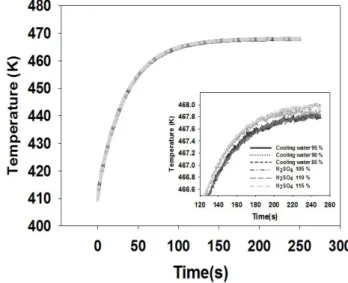
End-plate of bellows, the temperature distribution of contacting /expansion of bellows were presented with cooling water (e) and high temperature H 2 SO 4 (f). For the 250 s in Fig. 4 ~ Fig. 9, the simulations with feed change of high temperature H 2 SO 4 and cooling water were performed and the temperature changes were monitored at each parts as shown as (a) ~ (f) on Fig. 3.

In the Neck, the simulation was conducted and the temperature distribution of the surface contacting with high temperature H 2 SO 4

(Fig. 4) and cooling water (Fig. 5) were presented for 250 s. In all the simulation cases, the temperature of contacting part with high temperature H 2 SO 4 was quickly increased up to 460 K, and then

maintained 467 ± 2 K. In the cooling water cases, the temperature was rapidly increased up to 337 K, and rose to 347 K progressively, and maintained in the range of about 349 ± 2 K. The inflow amount of high temperature H 2 SO 4 and cooling water did not significantly affect the temperature changes of Neck part, and sudden changes of temperature were not observed.

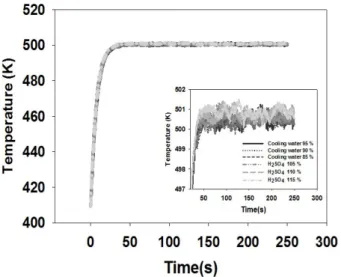
In Fig. 8 and Fig. 9: In the End-plate, the temperature gradient

of bellows contacting with high temperature H 2 SO 4 (Fig. 8) and

cooling water (Fig. 9) was presented for 250 s. The temperature

distributions were presented significantly different trends with the

previous cases for Neck and Pitch parts. In the case of high

(5)

Fig. 8. Temperature distribution of contacting part with high temperature H 2 SO 4 at End-plate (all simulation cases).

Feed rate of high temperature H 2 SO 4

Feed rate of cooling water

~ 337 K ~ 347 K ~ 349 K ~ 460 K ~ 467 K ~ 500 K

(b) (d) (f) (b) (d) (f) (b) (d) (f) (a) (c) (e) (a) (c) (e) (a) (c) (e) 47.46 /s

(45.2 × 10⁵ %) 3.9 /s 48.9 49.6 9.8 111.7 97.5 19.6 249.7 127.9 31.5 68.7 67.9 6.0 249.6 140.3 7.2 - - 34.7 49.72 /s

(45.2 × 110 %) 3.9 /s 48.8 49.7 11.3 109.8 97.9 20.9 249.6 128.4 27.0 68.7 67.8 6.6 249.6 140.3 8.1 - - 34.2 51.98 /s

(45.2 × 115 %) 3.9 /s 48.8 49.6 10.9 109.7 98.3 20.9 249.6 129.9 31.4 68.5 67.5 6.2 249.6 140.3 7.5 - - 34.0 Remark) (a) contacting part with high temperature H 2 SO 4 at Neck. (b) contacting part with cooling water at Neck.

(c) contacting part with high temperature H 2 SO 4 at Pitch. (d) contacting part with cooling water at Pitch.

(e) contacting part with high temperature H 2 SO 4 at End-plate. (f) contacting part with cooling water at End-plate.

Table 1. The time required to increase a certain temperature of changing high temperature H 2 SO 4 feed rate Unit : Second (s)

Fig. 9. Temperature distribution of contacting part with cooling water at End-plate (all simulation cases).

temperature H 2 SO 4 , the temperature was approximately increased to 490 K, and the temperature rapidly rose to 340 K in cooling water case. The high thermal conductivity of STS used in End-plate part was responsible for the temperature distribution. The two different materials for Pitch and End-plate were used to this simulation.

Therefore, the additional researches as separate assessments, which are about the effects of temperature changes to the part contacting different materials, are needed, and we have plans to conduct a follow-up study on it.

3.2 The effects of feed rate changes for high temperature H 2 SO 4

As presented as Table 1, the time required to increase a certain temperature, such as the 337 K, 347 K, and 349 K (i.e., the temperature of contacting part with cooling water), and 460 K, 467

K, and 500 K (i.e., the temperature of contacting part with high temperature H 2 SO 4 ) was shown according to the changes of high temperature H 2 SO 4 feed rate (105 %, 110 %, and 115 % based on 45.2 kg which is base flow) and fixed cooling water (3.9 kg/s).

After simulation, the temperature of contacting part with cooling water in pump increased up to a maximum temperature of 349 K and maintained constant; and the temperature of contacting part with high temperature H 2 SO 4 was increased to a maximum temperature of 500 K and maintained constant. However, we observed that when the time rose to a certain temperature of contacting part with high temperature H 2 SO 4 and cooling water, the physical properties of the material was affected and it is more significant than the position, such as Neck, Pitch, and End-plate. In other words, when the increasing feed of high temperature H 2 SO 4

up to 5 %, 10 %, and 15 % compared with base flow, the deviation

of time period rose to certain temperature had the range from 0 to

(6)

Transferring Pump at Fixed Frequency

Feed rate of cooling water

Feed rate of high temperature

H 2 SO 4

~ 337 K ~ 347 K ~ 349 K ~ 460 K ~ 467 K ~ 500 K

(b) (d) (f) (b) (d) (f) (b) (d) (f) (a) (c) (e) (a) (c) (e) (a) (c) (e) 3.705 /s

(3.9 × 95 %) 45.2 /s 48.8 50.3 11.3 111.8 101.8 22.5 249.7 139.8 33.0 68.8 68.3 6.6 249.7 145.5 8.1 - - 36.9 3.51 /s

(3.9 × 90 %) 45.2 /s 48.9 50.4 10.8 111.8 101.7 20.5 249.7 137.3 29.2 68.8 68.3 6.4 249.7 145.1 7.9 - - 41.1 3.315 /s

(3.9 × 85 %) 45.2 /s 48.9 49.7 11.3 111.7 101.4 21.5 249.7 138.8 27.1 68.8 68.1 6.6 249.7 145.6 8.1 - - 40.4 Remark) (a) contacting part with high temperature H 2 SO 4 at Neck. (b) contacting part with cooling water at Neck.

(c) contacting part with high temperature H 2 SO 4 at Pitch. (d) contacting part with cooling water at Pitch.

(e) contacting part with high temperature H 2 SO 4 at End-plate. (f) contacting part with cooling water at End-plate.

Table 2. The time required to increase a certain temperature of changing cooling water feed rate Unit : Second (s)

4.5 s in the same position (same material). Therefore, through this results, we confirmed that the effects of increasing temperature were not that much even if continues operation was conducted in the condition that the flow of high temperature H 2 SO 4 increased more 15 % than base flow.

3.3 The effects of feed changes for cooling water As presented in Table 2, the time required to increase a certain temperature, such as the 337 K, 347 K, and 349 K (i.e., the temperature of contacting part with cooling water), and 460 K, 467 K, and 500 K (i.e., the temperature of contacting part with high temperature H 2 SO 4 ) was shown according to the changes of cooling water feed (95 %, 90 %, and 85 % based on 3.9 kg/s which is the base flow) and fixed high temperature H 2 SO 4 (45.2 kg/s).

After simulation, the temperature of contacting part with cooling water in pump increased up to a maximum temperature of 349 K and maintained constant, and the temperature of contacting part with high temperature H 2 SO 4 was increased to a maximum temperature of 500 K and maintained constant. According to the decreasing feed changes of cooling water, the deviation of time period rose to certain temperature ranged from 0 to 5.9 s in the same position (same material). In the simulation results, the influence of the temperature distribution to continuous operation was not expected even if inlet rate of the cooling water decreased up to 15 % less than the base flow.

3.4 Improvement of the pump efficiency for high temperature H 2 SO 4 transportation

In the simulation results, continuous operation of pump was still capable even if the excess feed of high temperature H 2 SO 4 of about 15 % or the less feed of cooling water of about 15 % were performed, respectively. Therefore, according to pump condition for

transportation of high temperature H 2 SO 4 , if the inlet rates of high temperature H 2 SO 4 and cooling water were chosen properly, the improvement of pump efficiency was enhanced significantly.

4. Conclusion

In this study, we investigate the effects of the feed rate for high temperature H 2 SO 4 and cooling water to materials consisting of pump for high temperature H 2 SO 4 transportation through the simulation of temperature gradient in condition with fixed frequency at 0.5 Hz, which is period a reciprocating motion of high temperature H 2 SO 4 transportation. The simulation results were presented as follows:

1. In overall simulation cases, the physical properties of materials were more influential to the temperature increase in the pump part rather than the changes in the feed rate of high temperature H 2 SO 4 and cooling water.

2. In the simulation results, continuous operation of pump was still capable, even if the excess feed of high temperature H 2 SO 4 of about 15 % or the less feed of cooling water of about 15 % were performed, respectively.

3. When the increasing feed of high temperature H 2 SO 4 up to 5 %, 10 %, and 15 % was compared with the base flow (45.2 kg/s), the deviation of time period rose to a certain temperature ranging from 0 to 4.5 s in the same position (same material).

4. According to the decreasing feed changes of cooling water,

which is flowed to pump, at 5 %, 10 %, 15 % compared with base

flow (3.9 kg/s), the deviation of time period rose to a certain

(7)

temperature ranging from 0 to 5.9 s in the same position (same material).

5. When the technology of nuclear hydrogen is commerciali -zation, these results can be helpfully used for fundamental data of pump transferring high temperature H 2 SO 4.

6. The realization of high-efficiency and low-cost hydrogen production was helped researches involving hydrogen energy as the ship’s power source.

Acknowledgements

This work was supported by the National Research Foundation of Korea(NRF) grant funded by the Korea government(MSIP) (No.

53154-14).

References

[1] Chang, J. H.(2006), Current Status of Nuclear Hydrogen Development, Journal of Energy Engineering, Vol. 15, No. 2, pp. 127-137.

[2] Choi, J. S., J. H. Choi, J. S. Kim, S. H. Yoon, Y. J. Shin and K. Y. Lee(2011), A CFD Analysis Study on the Thermal Flow of High Temperature Sulfuric Acid Pump for Hydrogen Generation, KOSOMES Autumn Conference, pp. 283-284.

[3] Choi, J. S., J. H. Choi and W. H. Han(2010), The Technology development trends of Hydrogen energy and Application to ship, Proceedings of the 34th KOSME Spring Conference, pp.

391-392.

[4] Choi, J. S., J. O. Mo, S. H. Yoon, J. H. Kim and J. H.

Choi(2012), A Numerical Study on Thermal Flow Characteristics Sulfuric Acid Solution Fixed-quantity Delivery Pump of Sulfur-Iodine Thermochemical Cycle, Proceedings of the 36th KOSME Spring Conference, pp. 273-374.

[5] Gong, G. T. and H. G. Kim(2011), Decomposition of Sulfuric Acid at Pressurized Condition in a Pt-Lined Tubular Reactor, Trans. of the Korean Hydrogen and New Energy Society, Vol. 22, No. 1, pp. 51-59.

[6] Han, W. H., J. S. Choi and J. H. Choi(2010), The Trends of Hydrogen Energy Technology Development and Application to Ship, Journal of the Korean Society of Marine Environment

& Safety, Vol. 16, No. 3, pp. 313-320.

[7] http://en.wikipedia.org/wiki/Polytetrafluoroethylene(2014).

[8] http://www2.dupont.com/Teflon_Industrial/en_US/tech_info/tech lit.html(2014), Properties Handbook, Teflon ® PTFE, DuPont Fluoroproducts, (7/96) 220313D, pp. 1-34.

[9] IMO(2008), PREVENTION OF AIR POLLUTION FROM SHIPS, MEPC 58 th Agenda item 4 (I:\MEPC\58\4-3.doc), pp.

1-6.

[10] IMO(2011), RESOLUTION MEPC.203(62), MEPC 62/24/Add.1 Annex 19, pp. 1-17.

[11] IMO(2014), Market-BasedMeasures, http://www.imo.org/OurWork /Environment/PollutionPrevention/AirPollution/Pages/Market -BasedMeasures.aspx/.

[12] IPCC(2007), Climate Change 2007: Synthesis Report, p. 30.

[13] Lim, T. W., B. L. Kil, J. S. Kim, S. G. Oh, S. K. Park, M.

E. Kim and M. H. Kim(2009), Performance Analysis of Marine Solid Oxide Fuel Cell and Gas Turbine Hybrid Power System (under Conditions of Turbine Cooling and Constant Temperature in Cathode Inlet), Journal of the Korean Society of Marine Engineering, Vol. 33, No. 8, pp. 1107-1115.

[14] Lloyd’s Register(2012a), Implementing the Energy Efficiency Design Index (EEDI), Lloyd’s Register, Version 3.0, pp. 2-18.

[15] Lloyd’s Register(2012b), Ship Energy Efficiency Management Plan (SEEMP), Lloyd’s Register, Version 2.2, pp. 1-12.

[16] Ministry of Ocean and Fisheries(2013), http://www.mof.go.kr /EgovBodoMain_portal_front.do?menu1=3000000&menu2

=3010000&menu3=3010200 (No. 76 of bulletin board).

[17] NOAA(2014), National Oceanic and Atmospheric Administration, ESRL Global Monitoring Division-Global Greenhouse Gas Reference Network, http://www.esrl.noaa.gov/gmd/ccgg/trends/.

[18] Oh, J. S., K. J. Lee, S. H. Kim, S. G. Oh, T. W. Lim, J. S.

Kim, S. K. Park, M. E. Kim and M. H. Kim(2011), Thermodynamic Analysis on Steam Reforming of Hydrocarbons and Alcohols for Fuel Cell System, Journal of the Korean Society of Marine Engineering, Vol. 35, No. 4, pp. 388-396.

[19] Rodríguez, D. G. and L. G. Parra(2011), CONCEPTUAL DESIGN MODEL OF THE SULFUR-IODINE S-I THERMOCHEMICAL WATER SPLITTING PROCESS FOR HYDROGEN PRODUCTION USING NUCLEAR HEAT SOURCE, International Conference on Mathematics and Computational Methods Applied to Nuclear Science and Engineering, pp. 1-10.

[20] Seo, D. J., W. L. Yoon, K. S. Kang and J. W. Kim(2007),

Patent Trend for Hydrogen Production Technology by Steam

Reforming of Natural Gas, Trans. of the Korean Hydrogen

and New Energy Society, Vol. 18, No. 4, pp. 464-480.

(8)

Transferring Pump at Fixed Frequency [21] SIMF(2012), The 6th Seoul International Maritime Forum

(SIMF) program book, pp. 23-35 and 79-126.

[22] The European Stainless Steel Development Association(2007), Stainless Steel: Tables of Technical Properties, Materials and Applications Series, Volume 5, p. 18.

Received : 2014. 04. 10.

Revised : 2014. 05. 02.

Accepted : 2014. 06. 25.

수치

Fig.  1.  Simplified  flow-sheet  for  SI  thermochemical  water-splitting  cycle  process  with  chemical  reactions.
Fig.  3.  Temperature  monitoring  position  of  bellows  each  parts.
Fig.  4.  Temperature  distribution  of  contacting  part  with  high  temperature  H 2 SO 4   at  Neck  (all  simulation  cases).
Fig.  8.  Temperature  distribution  of  contacting  part  with  high  temperature  H 2 SO 4   at  End-plate  (all  simulation  cases).

참조

관련 문서