Print ISSN: 2288-4637 / Online ISSN 2288-4645 doi:10.13106/jafeb.2021.vol8.no5.0761
Investigating Repurchase Intention on Sharia Shares: An Empirical Evidence of the Sharia Stock Market in Indonesia
Thasrif MURHADI
1, Nasir AZIZ
2, Sorayanti UTAMI
3, M. Shabri Abd MAJID
4Received: January 30, 2021 Revised: April 05, 2021 Accepted: April 15, 2021
Abstract
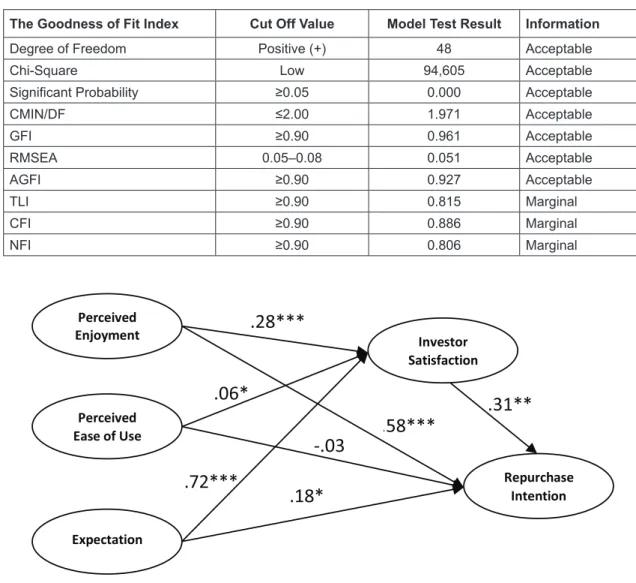
The Islamic capital market in Indonesia is currently developing rapidly marked by the massive growth of sharia stock investors. It is followed by the development of an online sharia trading platform by stock brokerage companies so that investors can transact online sharia shares. From the number of existing stock investors, however, there are still very few Islamic stock investors who repurchase shares after the previous purchase. This really attracted the attention of researchers to investigate the repurchase intention of sharia share in the Indonesia stock market. 415 samples who are Islamic stock investors in the Indonesia stock market have filled out distributed questionnaires. Then, the data was processed using SEM Amos. The results of this study found that perceived enjoyment, perceived ease to use, and expectation have a positive and significant effect on investor satisfaction. Then, perceived enjoyment and expectation have a positive and significant effect on repurchase intention, while perceived ease to use has a negative and insignificant effect on repurchase intention, but has a positive effect through the mediating variable investor satisfaction. Investor satisfaction has a positive and significant effect on repurchase intention, and investor satisfaction is a good mediator for the exogenous variables in this study.
Keywords: Perceived Enjoyment, Perceived Ease to Use, Expectation, Satisfaction, Repurchase Intention JEL Classification Code: C83, M30, M31, M39
Indonesian Ulema Council (DSN-MUI) to support the development of the Islamic capital market in Indonesia.
A major milestone in the history of the Islamic capital market in Indonesia in terms of stock trading occurred in 2011, with the issuance of MUI Fatwa No.80 concerning stock trading. At the time, the Indonesia Sharia Stock Index (ISSI) was launched which can be used as a reference for stock investors in Indonesia to choose Islamic stocks. The Islamic capital market in Indonesia has been developing since that time. This is characterized by the achievement of several international awards from the Global Islamic Finance Award (GIFA) by the Indonesia Stock Exchange from 2016 to 2018. The Islamic capital market is operated with Sharia principles and guidelines. The main sources of Sharia are the Al-Qur’an, Sunnah, Ijma ‘(the consensus of the Ummah), and Qiyas (analogy). According to sharia principles, all types of transactions must be free from usury, gharar (excessive uncertainty or ambiguity created due to lack of information or control in contracts), and maysir (chancy play or speculation). Hearn et al. (2010) stated that since there is limited focus on Islamic finance, the available literature is limited on the roles and principles of the Islamic- compliant stock market.
1
First Author and Corresponding Author. Ph.D. Student, Department of Management, Faculty of Economics and Business, Universitas Syiah Kuala, Indonesia [Postal Address: Jl. Teuku Nyak Arief No.441, Kopelma Darussalam, Syiah Kuala, Banda Aceh, Aceh, 23111, Indonesia] Email: [email protected]
2
Professor, Department of Management, Faculty of Economics and Business, Universitas Syiah Kuala, Indonesia.
Email: [email protected]
3
Senior Lecturer, Department Management, Faculty of Economics and Business, Universitas Syiah Kuala, Indonesia.
4
Professor, Department of Management, Faculty of Economics and Business, Universitas Syiah Kuala, Indonesia.
© Copyright: The Author(s)
This is an Open Access article distributed under the terms of the Creative Commons Attribution Non-Commercial License (https://creativecommons.org/licenses/by-nc/4.0/) which permits unrestricted non-commercial use, distribution, and reproduction in any medium, provided the original work is properly cited.