PGHN
Original Article
Pediatric Cholecystectomy: Clinical Significance of Cases Unrelated to Hematologic Disorders
Hae-Young Kim, Soo-Hong Kim, and Yong-Hoon Cho
Division of Pediatric Surgery, Department of Surgery, Pusan National University School of Medicine, Yangsan, Korea
Purpose: Cholecystectomy is rarely performed in the child and adolescent. However, it is associated with several conditions. This study was conducted to describe the characteristics of pediatric patient who underwent chol- ecystectomy unrelated to hematologic disorders, and then to suggest its clinical significance in management by com- paring a simple and complicated gallbladder disease.
Methods: We reviewed cases of cholecystectomy in pediatric patients (under 18 years old) at a single institution between January 2003 and October 2014. There were 143 cases during the study period and 24 were selected as the subject group.
Results: There were 7 male (29.2%) and 17 female (70.8%) patients. The mean age was 13.1 years old, and 66.6%
of patients were older than 12 years. Mean body weight was 52.7 kg, and body mass index was 21.7 kg/m2, with 41.7% of patients being overweight or obese. We could identify a female predominance and high proportion of over- weight or obesity in a complicated disease. There were also significantly increased levels of aspartate transaminase (AST), alanine transaminase (ALT), alkaline phosphatase (ALP) and bilirubin in this group. Most patients (87.5%) underwent laparoscopic cholecystectomy.
Conclusion: Cholecystectomy for diseases unrelated to hematologic disorders is rarely performed in the child and adolescent. In general, female patients who are overweight or obese, and those older than 12 years old, require laparoscopic cholecystectomy owing to multiple gallstones. This condition has a tendency to show a complicated gallbladder disease and significantly increased levels of AST, ALT, ALP, and bilirubin.
Key Words: Cholecystectomy, Child, Adolescent, Female, Overweight, Obesity
Received:December 26, 2014, Revised:January 20, 2015, Accepted:March 30, 2015
Corresponding author: Yong-Hoon Cho, Division of Pediatric Surgery, Department of Surgery, Pusan National University School of Medicine, Yangsan, Korea. Tel: +82-55-360-2471, Fax: +82-55-360-2124, E-mail: [email protected]
Copyright ⓒ 2015 by The Korean Society of Pediatric Gastroenterology, Hepatology and Nutrition
This is an openaccess article distributed under the terms of the Creative Commons Attribution NonCommercial License (http://creativecommons.org/licenses/by-nc/4.0/) which permits unrestricted noncommercial use, distribution, and reproduction in any medium, provided the original work is properly cited.
INTRODUCTION
Cholecystectomy in children is relatively un- common, despite being one of the most common
surgical procedures in adults [1-3]. However, the number of cholecystectomy in children has in- creased over the past two decades [4-6]. A few stud- ies on Western populations have demonstrated an
increased rate of cholecystectomy in pediatric pa- tients, and the most prevalent cause is a biliary dys- kinesia [7-9]. Nonetheless, symptomatic gallbladder disease is due to gallstone in most pediatric patients.
The predisposing factors for the development of gallstone in pediatric patients differ slightly by age;
prematurity, parenteral nutrition, abdominal sur- gery, or sepsis are factors in infancy, and hemato- logic disorders or obesity are factors in adolescence [10-13]. Among them, pediatric gallstones most fre- quently occurred in patients with hemolytic dis- orders [14,15]. Recently, some reports have in- dicated that the proportion of hemolytic disease has decreased, and that of other conditions without he- molytic disease has increased [4,5], whereas idio- pathic etiology is estimated between 20% and 65%
[15-17].
The estimated prevalence of gallstone in children in Western populations has been reported between 0.1% and 4.0%, but it has been reported as less than 0.13% in Japan [3,17].
In contrast to adult patients, pediatric patients with gallstone present with non-specific abdominal symptoms, and approximately 10-20% of these pa- tients undergo cholecystectomy due to severe symp- toms [18-22].
The current study attempts to describe the charac- teristics of cases undergoing cholecystectomy due to disease unrelated to hematologic disorders in pedia- tric patients, and to suggest its clinical significance for managing it according to two different clinical situations; between a simple and complicated gall- bladder disease.
MATERIALS AND METHODS
Patients
We reviewed cases of cholecystectomy in pediatric patients (under 18 years old) at a single institution between January 2003 and October 2014. There were 143 cases during the study period. We excluded cases of cholecystectomy that were performed during oth- er procedures for choledochal cyst, biliary atresia, and other hepatobiliary diseases, as well as hemato-
logic disorders. Among these cases, 24 patients were selected as the subject group.
Methods
A retrospective study was conducted using pa- tient’s clinical data. We analyzed basic demographic characteristics such as sex, age, body weight, and body mass index (BMI), as well as clinical character- istics such as presented symptoms, preoperative di- agnosis, laboratory and radiologic findings, asso- ciated conditions, and pathologic results. We divided subject as two clinical groups: group A, patients with simple gallbladder disease (ex. simple gallstone or gallbladder polyp) and group B, patients with com- plicated disease (ex. gallstone with choledocholit- hiasis or gallstone pancreatitis, with formation of pericholecystic abscess). Compared two clinical groups according to its clinical characteristics.
Statistical analysis
We performed statistical analysis using Fisher’s exact test for categorical variables and one-way ANOVA for continuous variables using GraphPad Prism 6 (GraphPad Software Inc., San Diego, CA, USA). Statistical significance was determined at p-value <0.05.
RESULTS
Demographic characteristics of patients Among 24 patients, there were 7 male (29.2%) and 17 female (70.8%) patients. Mean age was 13.1 years old and 66.6% were older than 12 years. The mean body weight across all subjects was 52.7 kg, mean BMI was 21.7 kg/m2, and 41.7% of patients were obese or overweight. The proportion of obese and overweight patients was greater in female patients (52.9% in female and 14.3% in male patients).
However there were no significant differences in these characteristics according to gender (Table 1).
Comparisons between two clinical groups There were 15 (62.5%) patients in group A and 9 (37.5%) in group B. Most patients in group A had
Table 1.Demographic Characteristics of Patients
Variable Value p-value
Sex Male Female Male:female Age (y)
Distribution (male/female, y) <3
3–7 8-12 12–18 Body weight (kg) Body mass index (kg/m2) Distribution (male/female) Obese*
Overweight† Normal‡
7 17 1:2.4 4–18 (13.2±4.5)
- 3/1 0/4 4/12 18.2–79.7 (52.7±19.4) 15.4–31.1 (21.7±4.4)
0/4 1/5 6/8
-
0.141
- 0.055
Values are presented as number or range (mean±standard deviation).
*Defined as body mass index percentile >95%, †defined as body mass index percentile 85-95%, ‡defined as body mass index percentile <85%.
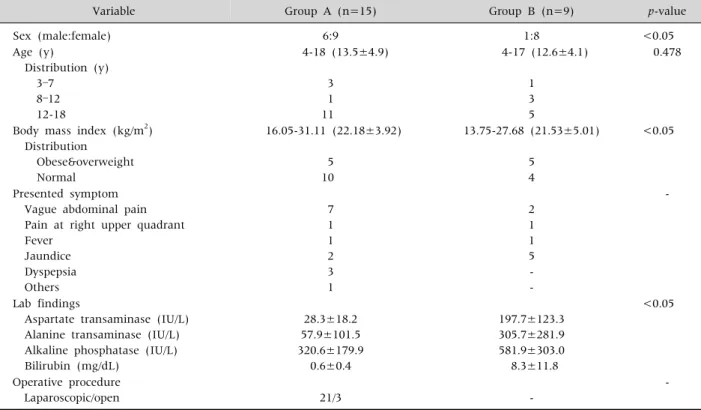
Table 2.Comparison of Demographic and Clinical Characteristics between Two Groups
Variable Group A (n=15) Group B (n=9) p-value
Sex (male:female) 6:9 1:8 <0.05
Age (y)
Distribution (y) 3–7
8–12 12-18
4-18 (13.5±4.9)
3 1 11
4-17 (12.6±4.1)
1 3 5
0.478
Body mass index (kg/m2) Distribution
Obese&overweight Normal
16.05-31.11 (22.18±3.92)
5 10
13.75-27.68 (21.53±5.01)
5 4
<0.05
Presented symptom Vague abdominal pain Pain at right upper quadrant Fever
Jaundice Dyspepsia Others
7 1 1 2 3 1
2 1 1 5 - -
-
Lab findings
Aspartate transaminase (IU/L) Alanine transaminase (IU/L) Alkaline phosphatase (IU/L) Bilirubin (mg/dL)
28.3±18.2 57.9±101.5 320.6±179.9
0.6±0.4
197.7±123.3 305.7±281.9 581.9±303.0 8.3±11.8
<0.05
Operative procedure
Laparoscopic/open 21/3 -
-
Values are presented as number, range (mean±standard deviation), or mean±standard deviation only.
Group A: patients with simple gallbladder disease, group B: patients with complicated disease.
multiple stones, while patients in group B showed a combined choledocholithiasis in 7 patients, a gall- stone pancreatitis in 2 patients. There was a gall- bladder disease not associated with gallstone in each group, a gallbladder polyp and an acalculous peri- cholecystic abscess, respectively.
Composition of female patients was significantly higher in group B than A. There was no significant difference in the distribution of patient with regard- ing to age. Considering a BMI of patients, the pro- portion of overweight or obese patients was sig- nificantly higher in group B than group A (Table 2).
There was a variable presented symptom at admis- sion, a vague abdominal pain was most common in group A and a jaundice in group B. Comparing liver function test between two groups, we identified sig- nificantly increased levels of aspartate transaminase (AST), alanine transaminase (ALT), alkaline phos- phatase (ALP) and bilirubin in group B (Table 2).
Table 3.Pathologic Results of Patients Histologic diagnosis Group A
(n=15)
Group B (n=9) Acute cholecystitis
Chronic cholecystitis
Xantogranulomatous cholecystitis Hyperplastic polyp
1 13 - 1
- 8 1 - Values are presented as number.
Group A: patients with simple gallbladder disease, group B:
patients with complicated disease.
Most patients (87.5%) underwent laparoscopic cholecystectomy. All patients with combined chol- edochalithiasis were managed by endoscopic retro- grade cholangiopncreatography (ERCP) before chol- ecystectomy. There were no postoperative compli- cations.
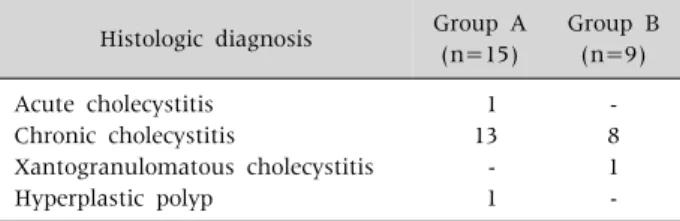
Postoperative diagnosis was confirmed by patho- logic examination as follows: chronic or acute chol- ecystitis (22 cases), hyperplastic polyp (1 case), and xantogranulomatous cholecystitis (1 case) (Table 3).
DISCUSSION
Cholecystectomy is relatively rarely performed in pediatric populations, though it is extremely com- mon in adults. Although we performed 143 chol- ecystectomies during the study period, there were only 24 cases for pure gallbladder problems un- related to hematologic disorders. Recently, many studies have reported the increased prevalence of pe- diatric cholecystectomy due to gallstone disease in Western populations [4-6,23-25].
Our study also demonstrated that most cholecy- stectomies were due to gallstones (22/24, 91.7%). It was more common in female patients (70.8%) and adolescents (66.6%), with a mean age of 13.2 years.
Considering certain risk factors (advanced age and female sex) for gallstone in adults [26], it may be as- sumed that these factors also affect the pediatric patients.
An idiopathic etiology of gallstone in the pediatric population has been proposed as between 20% and 65% [15,24,27,28], and certain predisposing factors
have been suggested as follows: lithogenic inter- ventions in neonatal period, such as long-term pa- renteral nutrition, a progressive increase in pediatric obesity, and recently, liberal use of ultrasonography [29,30]. In this study, we did not evaluate the gall- bladder disease in neonatal cholestasis because most of those cases did not need a surgical management.
Ultrasonography is also widely used for monitoring gastroenterological and genitourinary conditions, and it has resulted in increased detection of asymp- tomatic gallstones, but we did not include those cas- es because it was generally microlithiasis without symptoms not requiring operation.
It is well known that there is an association be- tween obesity and gallstone formation in adults, but this is now gaining recognition in the pediatric pop- ulation [13,31-33]. Relative to adults, it is some diffi- cult to accurately express a childhood obesity as BMI. This has led to inconsistency in result, Mehta et al. [5] reported a series of pediatric cases with 53% of nonhemolytic gallstone cases occurring in overweight or obese children/adolescents, whereas Bogue et al.
[29] reported a series of cases with less than 1%. Our study showed not only a high proportion of obese and overweight patients (41.7%) in a complicated gallbladder disease, but also its significant relation to develop it. Although it is impossible to directly com- pare this proportion with the normal pediatric pop- ulation, we could estimate that there is a relatively high rate of obesity or overweight in non-hemolytic gallstone cases. This problem seems to compound the presence of symptomatic gallstones, especially a complicated disease. Furthermore, considering the mean age at diagnosis, 13.2 years old, the high rate of obesity may also attributable to the rising incidence in that period.
Clinically, the pediatric population does not al- ways present typical biliary colic symptoms, but rather, they often presented variable non-specific symptoms. However, when we examined the initial laboratory findings at admission, there were some differences. The levels of AST, ALT, ALP, and bilir- ubin were significantly higher in the group with complicated disease at admission, especially in cases
accompanied by common bile duct stones. It may be possible that these highly increased levels suggest a combined choledocholithiasis in pediatric popula- tions with gallbladder stones.
Gallstone may be presented by simple cholecystitis or a more complicated case combined with a biliary pancreatitis or choledocholithiasis causing jaundice.
In this study, we could identify a gallstone pan- creatitis in 8.3% and a choledocholithiasis in 29.2%.
Generally, a choledocholithiasis is found in 8-10% of adult patients with cholelithiasis and between 10%
and 15% in pediatric patients with gallstone, and the rate of gallstone pancreatitis has been reported as 7%
[15,29]. However, our study demonstrated higher incidence than those reports did. Although these pa- tients were successfully managed by endoscopic sphincterotomy without complication, when consid- ering a complication rate of 11% accompanied by ERCP in children and a high rate requiring a general anesthesia for procedure [34,35], we should be aware of the possibility that these issues might occur more frequently when encountering or following up gall- stone in pediatric populations. This study also re- vealed that significantly high frequency of compli- cated disease in female and overweight/obese pa- tients, and so it may be suggested as aggravating fac- tors to be considered in pediatric gallbladder disease, especially unrelated to hematologic disorders.
To manage gallbladder disease in pediatric pop- ulations, we performed laparoscopic cholecystectomy in 87.5% of cases and did not observe postoperative complications. Thus, the short-term outcome of chol- ecystectomy in pediatric population seems to be pro- mising, but there may need more long-term draw- backs after removal of the gallbladder.
When comparing the histological results, most cases revealed chronic cholecystitis, but it did not seem to affect clinical characteristics.
There are some limitations in this study. It is result from the experience of single center and has rela- tively small subjects in certain regional area. Because it was retrospective study, could not compare with normal control group also. However considering a rare incidence of gallbladder disease unrelated to the
hemolytic disorders in pediatric population, we feel that it may suggest clinical significance in managing pediatric gallbladder disease unrelated to hemato- logic disorders.
In conclusion, cholecystectomy is rarely performed in pediatric populations. Generally, a simple gall- bladder disease is more common than complicated gallbladder disease unrelated to hematologic disorders.
Female patients who are overweight or obese, or old- er than age 12 years require a laparoscopic chol- ecystectomy owing to multiple gallstones. Especially, the patient with a complicated gallbladder disease, such as a disease combined with choledochalithiasis or a gallstone pancreatitis, has a tendency to show such characteristics, and also significantly increased levels of AST, ALT, ALP, and bilirubin. It is necessary to consider these problems when managing cases of pediatric gallbladder disease, especially a gallstone unrelated to hematologic disorders.
REFERENCES
1. Bailey PV, Connors RH, Tracy TF Jr, Sotelo-Avila C, Lewis JE, Weber TR. Changing spectrum of chol- elithiasis and cholecystitis in infants and children. Am J Surg 1989;158:585-8.
2. Kang JY, Ellis C, Majeed A, Hoare J, Tinto A, Williamson RC, et al. Gallstones--an increasing prob- lem: a study of hospital admissions in England between 1989/1990 and 1999/2000. Aliment Pharmacol Ther 2003;17:561-9.
3. Kratzer W, Mason RA, Kächele V. Prevalence of gall- stones in sonographic surveys worldwide. J Clin Ultrasound 1999;27:1-7.
4. Balaguer EJ, Price MR, Burd RS. National trends in the utilization of cholecystectomy in children. J Surg Res 2006;134:68-73.
5. Mehta S, Lopez ME, Chumpitazi BP, Mazziotti MV, Brandt ML, Fishman DS. Clinical characteristics and risk factors for symptomatic pediatric gallbladder disease. Pediatrics 2012;129:e82-8.
6. Waldhausen JH, Benjamin DR. Cholecystectomy is be- coming an increasingly common operation in children.
Am J Surg 1999;177:364-7.
7. Kaye AJ, Jatla M, Mattei P, Kelly J, Nance ML. Use of laparoscopic cholecystectomy for biliary dyskinesia in the child. J Pediatr Surg 2008;43:1057-9.
8. Hofeldt M, Richmond B, Huffman K, Nestor J, Maxwell D. Laparoscopic cholecystectomy for treatment of bili- ary dyskinesia is safe and effective in the pediatric population. Am Surg 2008;74:1069-72.
9. Al-Homaidhi HS, Sukerek H, Klein M, Tolia V. Biliary dyskinesia in children. Pediatr Surg Int 2002;18:
357-60.
10. Whitington PF, Black DD. Cholelithiasis in premature infants treated with parenteral nutrition and furosemide. J Pediatr 1980;97:647-9.
11. Roslyn JJ, Berquist WE, Pitt HA, Mann LL, Kangarloo H, DenBesten L, et al. Increased risk of gallstones in chil- dren receiving total parenteral nutrition. Pediatrics 1983;71:784-9.
12. Shaffer EA. Epidemiology and risk factors for gallstone disease: has the paradigm changed in the 21st century?
Curr Gastroenterol Rep 2005;7:132-40.
13. Skelton JA, Cook SR, Auinger P, Klein JD, Barlow SE.
Prevalence and trends of severe obesity among US chil- dren and adolescents. Acad Pediatr 2009;9:322-9.
14. Al-Salem AH, Qaisruddin S. The significance of biliary sludge in children with sickle cell disease. Pediatr Surg Int 1998;13:14-6.
15. Wesdorp I, Bosman D, de Graaff A, Aronson D, van der Blij F, Taminiau J. Clinical presentations and predis- posing factors of cholelithiasis and sludge in children.
J Pediatr Gastroenterol Nutr 2000;31:411-7.
16. Palasciano G, Portincasa P, Vinciguerra V, Velardi A, Tardi S, Baldassarre G, et al. Gallstone prevalence and gallbladder volume in children and adolescents: an epi- demiological ultrasonographic survey and relationship to body mass index. Am J Gastroenterol 1989;84:
1378-82.
17. Nomura H, Kashiwagi S, Hayashi J, Kajiyama W, Ikematsu H, Noguchi A, et al. Prevalence of gallstone disease in a general population of Okinawa, Japan. Am J Epidemiol 1988;128:598-605.
18. Angelico F, Del Ben M, Barbato A, Conti R, Urbinati G.
Ten-year incidence and natural history of gallstone dis- ease in a rural population of women in central Italy. The Rome Group for the Epidemiology and Prevention of Cholelithiasis (GREPCO). Ital J Gastroenterol Hepatol 1997;29:249-54.
19. Zubler J, Markowski G, Yale S, Graham R, Rosenthal TC. Natural history of asymptomatic gallstones in fam- ily practice office practices. Arch Fam Med 1998;7:230-3.
20. Attili AF, De Santis A, Capri R, Repice AM, Maselli S.
The natural history of gallstones: the GREPCO ex- perience. The GREPCO Group. Hepatology 1995;21:
655-60.
21. Friedman GD, Raviola CA, Fireman B. Prognosis of gallstones with mild or no symptoms: 25 years of fol- low-up in a health maintenance organization. J Clin Epidemiol 1989;42:127-36.
22. McSherry CK, Ferstenberg H, Calhoun WF, Lahman E, Virshup M. The natural history of diagnosed gallstone disease in symptomatic and asymptomatic patients.
Ann Surg 1985;202:59-63.
23. Miltenburg DM, Schaffer R 3rd, Breslin T, Brandt ML.
Changing indications for pediatric cholecystectomy.
Pediatrics 2000;105:1250-3.
24. Kumar R, Nguyen K, Shun A. Gallstones and common bile duct calculi in infancy and childhood. Aust N Z J Surg 2000;70:188-91.
25. Schweizer P, Lenz MP, Kirschner HJ. Pathogenesis and symptomatology of cholelithiasis in childhood. A pro- spective study. Dig Surg 2000;17:459-67.
26. Everhart JE, Khare M, Hill M, Maurer KR. Prevalence and ethnic differences in gallbladder disease in the United States. Gastroenterology 1999;117:632-9.
27. Henschke CI, Teele RL. Cholelithiasis in children: re- cent observations. J Ultrasound Med 1983;2:481-4.
28. Reif S, Sloven DG, Lebenthal E. Gallstones in children.
Characterization by age, etiology, and outcome. Am J Dis Child 1991;145:105-8.
29. Bogue CO, Murphy AJ, Gerstle JT, Moineddin R, Daneman A. Risk factors, complications, and outcomes of gallstones in children: a single-center review. J Pedi- atr Gastroenterol Nutr 2010;50:303-8.
30. Khoo AK, Cartwright R, Berry S, Davenport M.
Cholecystectomy in English children: evidence of an epidemic (1997-2012). J Pediatr Surg 2014;49:284-8.
31. Holcomb GW Jr, Holcomb GW 3rd. Cholelithiasis in in- fants, children, and adolescents. Pediatr Rev 1990;11:
268-74.
32. Ogden CL, Carroll MD, Curtin LR, McDowell MA, Tabak CJ, Flegal KM. Prevalence of overweight and obesity in the United States, 1999-2004. JAMA 2006;295:1549-55.
33. Luo J, Hu FB. Time trends of obesity in pre-school chil- dren in China from 1989 to 1997. Int J Obes Relat Metab Disord 2002;26:553-8.
34. Varadarajulu S, Wilcox CM, Hawes RH, Cotton PB.
Technical outcomes and complications of ERCP in children. Gastrointest Endosc 2004;60:367-71.
35. Metreweli C, So NM, Chu WC, Lam WW. Magnetic reso- nance cholangiography in children. Br J Radiol 2004;
77:1059-64.