71
청도 반시의 과육과 감꼭지(시체: 木市滯)의 항산화 및 항염증 활성 연구
김희정·박태순·정미송·손준호*
(재)대구경북한방산업진흥원 제품개발팀
Study on the Anti-oxidant and Anti-inflammatory Activities of Sarcocarp and Calyx of Persimmon (Cheongdo Bansi)
Hui-Jeong Kim, Tae-Soon Park, Mi-Song Jung, and Jun-Ho Son*
Product DevelopmentTeam, Daegu Gyeongbuk Institute for Oriental Medicine Industry, Gyeongbuk, 712-260, Republic of Korea
Received February 15, 2011; Accepted May 18, 2011
Biological activities of sarcocarp and calyx of persimmon (Cheongdo Bansi) were investigated. The electron donating ability of the calyx extract was 91% at a 500µg/mL level, which was higher than that of the sarcocarp extract (40%). The superoxide dismutase (SOD)-like activity of calyx extracts was about 22% at a 1,000µg/mL level. During the entire experimental period, there was no cytotoxicity found from sarcocarp and calyx up to 50µg/mL. Our results indicated that sarcocarp and calyx significantly inhibited NO production and iNOS and COX-2 expression accompanied by an attenuation of interleukin (IL)-1β, IL-6, and tumer necrosis factor (TNF)-α formation in human keratinocyte. These results suggest that sarcocarp and calyx of persimmon may have significant effect on inflammatory factors and can be used as potential anti-inflammatory agents.
Key words: anti-inflammatory effect, anti-oxidant effect, cytokines, persimmon, persimmon calyx
서 론
Korea Food Research Institute의 보고(1999)에 의하면 감 (Persimmon)은 학명이 Diospyros kaki Thunb.로 전세계에 걸쳐 널리 분포되어 있는 감나무속 식물로 약 1,000여종이 있는데, 대부분 열대나 아열대 지방에 분포되어 있으며, 온대에 분포되 어 있는 것은 식용으로 많이 이용되어 한국, 중국, 일본을 원 산지로 하고 있다. 성분과 효능으로는 은 폴리페놀성 물질과 비 타민 A와 C성분이 풍부하고 숙취해소와 기침치료 등에 효과가 있으며 특히, 건시는 해소, 토혈, 객혈, 이질 등에 좋다고 민간 과 한방에서 알려져 있다[Hyun 등, 2004]. 또한 과실은 항산화 [Lee 등, 2001], 알콜대사촉진[Kim 등, 2001], 항미생물[Harada 등, 2005], 항돌연변이[Shinmoto 등, 2002], 지질대사 개선 [Gorinstein 등, 1998], 림프백혈병세포 성장억제[Achiwa 등, 1997]. 체온저하[Himbo 등, 2003] 등의 효과를 가지는 것으로 과학적으로 구명되어 건강식품으로 와인[Ann 등, 1999], 퓨레
[Yang과 Lee, 2000], 동결연시[Sung 등, 1999], 식초[Jeong 등, 1998], 주스[Chun 등, 1997], 잼[Kim 등, 1999], 조청[Bae 등, 2001] 등으로 개발되어 있다. 또한 감꼭지는 생약명으로 시체 (枾滯)라고 하며 민간요법에서는 기침과 천식, 만성기관지염 치 료, 딸국질 멈춤, 야뇨증, 혈압강하작용에 효과적이라고 알려져 있다.
현재까지 청도반시에 관한 몇몇 보고가 있었지만 그 수가 많 지 않았고 항염증에 대한 작용기전에 관한 연구는 더욱 미흡한 실정이며, 특히 감꼭지(시체: 木市滯)에 관한 항염증 등의 활성에 관한 연구는 거의 보고되지 않고 있다. 따라서 청도반시 및 그 의 감꼭지의 생리활성 및 항염증 활성을 밝혀냄으로써 감의 부 산물로 사용되지 않는 자원식물의 이용이라는 측면에서 매우 중요한 의미를 지닐 것이다.
염증반응은 감염 또는 조직손상 후에 손상을 이환부위에 제 한시킴으로서 다양한 세포와 사이토카인들이 관여하여 초기 방 어를 제공하는 일련의 과정이다[Marithasan과 Monack, 1986].
대식세포(macrophage)는 선천면역뿐만 아니라 획득면역 등 다 양한 숙주반응에 관여하여 항상성 유지에 관여하는 것으로 알 려져 있으며, 염증반응 시에는 NO와 사이토카인을 생산하여 감 염초기에 생체방어에 중요한 역할을 한다[Higuchi 등, 1990]. 이 과정에서 대식세포와 같은 염증세포들이 활성화되면서 NO와
*Corresponding author
Phone: +82-53-810-0320; Fax: +82-53-801-9896 E-mail: [email protected]
doi:10.3839/jabc.2011.013
prostaglandin (PG), interleukin-1 beta (IL-1β), tumer necrosis factor-alpha (TNF-α) 등 다량의 염증 매개 인자를 분비하게 된 다[Guha와 Mackman, 2001]. 이러한 염증 반응이 지속적으로 또는 과민하게 일러나면 과민성 알러지 질환이나 만성 염증 질 환, 순환기 장애, 암 등과 같은 다양한 질환의 원인을 제공하 게 된다[Gracie 등, 1999].
따라서, 본 연구에서는 청도반시의 감꼭지(시체: 木市滯)와 감 의 과육부분의 항염증 활성을 검토하여 청도반시의 고부가가치 화와 활용성의 증대방안을 강구하고자 연구를 하였다.
재료 및 방법
시료재료. 본 실험에 사용한 감(Persimmon)은 학명이 Diospyros kaki Thunb.로 경북 청도군에서 재배된 청도반시를 구입하여 실험재료로 사용하였다.
시료 추출. 시료의 추출은 시체를 제거한 감 1 kg과 시체 200 g을 시료 중량의 10배 양인 70% 에탄올을 가하여 상온에 서 1주일간 3회 추출한 다음 filter paper (Whatman No. 2)로 여과하였고, 얻어진 여액은 감압 농축하여 감 에탄올 추출물 (472.7 g)과 시체 에탄올 추출물 (29.8 g)을 얻었다.
시약 및 기기. 폴리페놀, 플라보노이드 및 항산화능 측정 실 험에 사용된 시약인 1-1-diphenyl-2-picryl-hydrazyl (DPPH), pyrogallol, tannic acid, quercetin 등은 Sigma Chemical Co.
(St. Louis, MO), 세포배양을 위한 Dulbeco’s Modifide Eagle Medium (DMEM), fetal bovine serum (FBS), streptomycin penicillin, trypsin 250, 0.4% trypan blue stain은 Gibco BRL Co. (Grand Island, New York), 3-[4,5-dimethyl-thiazol-2-yl]- 2,5-diphenyl-tetrazoliumbromide (MTT)는 Sigma Chemical Co.
(St. Louis, MO)에서 구입하여 사용하였다. 항염증 효과에 측정 에 사용된 시약인 lipopolysaccharide (LPS), NP-40, protease inhibitor, ripa buffer, Griess reagent 등은 Sigma Chemical Co.에서, Sodium Dodesyl Sulfate (SDS), Acrylamide, bis- acrylamide는 Bio-rad Co. (Hercules, CA)에서 구입하였다. 1차 항체인 iNOS는 BD Bioscience (SanJose, CA), COX-2는 Cayman (Ann Arbor, MI), β-Actin은 Santa Cruz Biotechnology (Santa Cruz, CA)에서 구입하였다. 2차 항체인 anti-rabbit Ig-G horseradish peroxidase (HRP)-conjugated antibody는 Santa Cruz에서 구입하였다. IL-1 beta, IL-6, TNF- alpha 측정을 위한 Enzyme Linked Immunosorbent Assay (ELISA) kit (Diaclon, Besancon, France)를 사용하였다. 실험에 사용된 기기는 ELISA reader (Tecan, Mönnedorf, Switzerland), UV/VIS spectrophotometer (Hitachi, Tokyo, Japan), rotary vacuum evaporator (Rikakikai Co., Tokyo, Japan), Freeze drier (Ilsin, Gyeonggi-do, Korea), centrifuge (Hitachi), microscope (Olympus, Tokyo, Japan), CO2 incubator (Hanbaek Co., Gyeonggi-do, Korea), Haemacytometer (Marienfeld, Germany) 를 사용하였다.
총 폴리페놀 및 플라보노이드 함량 측정. 총 폴리페놀 함량 은 Folin과 Denis [1912]에 준하여 정량하였다. 감 및 시체 추 출물 100 µL에 Folin-ciocalteu phenol reagent 100 µL를 가하
고 0.75 M Na2CO3 100µL를 가하여 혼합한 후 1시간 실온에 서 방치하고 750 nm에서 흡광도를 측정한 후 표준물질인 tannic acid로 미리 작성한 표준곡선의 흡광도 값과 비교하여 폴리페 놀 함량을 산출하였으며, 총 플라보노이드의 함량은 Woisky 와 Salatino [1998]의 방법을 변형하여 측정하였다. 추출물 시료 1 mg을 증류수 1 mL에 녹인다. 시료 0.5 mL에 2% Ammonium trichloride 에탄올 혼합액을 0.5 mL 넣어준 뒤 실온에서 1시간 방치한다. 420 nm에서 흡광도를 측정한 후 표준물질인 quercetin 으로 미리 작성한 표준곡선의 흡광도 값과 비교하여 플라보노 이드 함량을 측정하였다.
전자공여능 측정. 전자공여능(EDA: electron donating ability) 은 Blois [1958]의 방법을 변형하여 측정하였다. 각 시료용액 2 mL에 0.2 mM의 DPPH 1 mL 넣고 교반한 후 30분간 방치한 다음 517 nm에서 흡광도를 측정하였다. 전자공여능은 시료용액 의 첨가군과 무첨가군의 흡광도 감소율로 나타내었다.
SOD 유사활성 측정. SOD 유사활성은 Marklund와 Marklund [1974]의 방법에 준하여 측정하였다. 각 시료용액 0.2 mL에 tris- HCl 완충용액(50 mM tris+10 mM EDTA, pH 8.5) 2.6 mL와 7.2 mM pyrogallol 0.2 mL를 가하여 25oC에서 10분간 반응시킨 후 1 M HCl 0.1 mL를 가하여 반응을 정지시키고 반응액 중 산화된 pyrogallol의 양을 420 nm에서 흡광도를 측정하였다.
SOD 유사활성은 시료용액의 첨가군과 무첨가군의 흡광도 감소 율로 나타내었다.
세포배양. 각질형성세포(HaCaT)는 한국세포주은행(KCLB)에 서 분양 받았으며, 세포배양을 위해 10% FBS과 1% penicillin- streptomycin을 포함하는 DMEM 배지를 사용하였다. 세포는 37oC, 5% CO2조건에서 배양하였다.
MTT assay에 의한 세포 생존율 측정. 감 및 시체 추출물에 대한 독성 측정은 MTT 측정으로 분석 하였다. 이 방법은 MTT가 formazan으로 전환되는 것을 측정하는 것으로, HaCaT 세포 1×10⁴ cells/mL를 96 well plate에 분주하고 감 및 시체 추출물을 농도별(5, 10, 50, 75, 100 µg/mL)로 24시간 동안 처 리하였다. Well당 20 µL의 MTT용액을 첨가하여 37oC, 5%
CO2 incubator에서 4시간 동안 반응시킨 후, microplate reader 를 이용하여 540 nm에서 흡광도의 변화를 측정하여 대조군에 대한 세포생존율을 백분율로 표시하였다.
NO 생성량 측정. NO의 농도는 배양액 내의 nitrite 농도를 Griess reagent를 이용하여 측정하였다. HaCaT 세포를 DMEM 배지를 이용하여 5×10⁴ cells/mL로 조절한 후 12 well plate에 접종하고, 5% CO2 incubator에서 24시간 전 배양하였다. 세포 에 1 µg/mL의 LPS를 처리하고 1시간 뒤에 5, 10, 25, 50 µg/
mL의 감 및 시체 추출물을 처리하여 24시간 배양하였다. 배양 액의 상층액을 얻은 후 Griess 시약과 반응 시킨 후 ELISA reader로 540 nm에서 흡광도를 측정하여 NO 생성율을 백분율 로 표시하였다.
iNOS, COX-2 단백질 발현 측정. 배양이 끝난 세포를 수집 하여 phosphate buffered saline (PBS)로 세척한 후 100 µL의 lysis buffer을 첨가하여 30분간 lysis 시킨 후 13,000 rpm에서 20분간 원심 분리하여 세포막 성분 등을 제거하였다. 단백질 농 도는 bovine serum albumin (BSA)를 표준화 하여 Bradford
assay를 사용하여 정량화 하였다. 40 µg protein을 10% SDS- PAGE로 분리하여 이를 polyvinylidenedifluoride (PVDF) membrane에 55 V로 90분간 transfer하였다. 그리고 PVDF membrane을 5% skim milk에서 1시간 방치한 뒤 primary antibody에서 4oC에서 overnight하여 준다. 다시 Tris-buffered saline and tween 20 (TBST)로 세 번 세척한뒤 secondary antibody를 상온에서 1시간 반응 시킨 뒤 TBST로 세 번 세척 하고 Amersham ECL western blotting detection reagent (GE Healthcare, Buckinghamshire, UK)와 반응시켜 LAS 4000 chemiluminescence detection system (Fuji, Tokyo, Japan)을 이 용하여 현상 후 분석하였다.
IL-1 beta, IL-6, TNF-alpha 분비량 측정. 세포 배양액 내의 cytokines의 양을 측정하기 위하여 ELISA Kit (Diaclone, Besancon, France)를 이용하여 측정하였다. HaCaT 세포에 10 µg/mL의 LPS를 처리하여 1시간 뒤 감 및 시체 추출물을 농도 별(10, 25, 50 µg/mL) 농도로 처리한 다음 24시간 배양한 후 세포배양액을 얻어 cytokine 측정에 이용하였다. 각각의 cytokine으로 coating된 96 well plate에 배양액 100 µL biotinylated antibody reagent를 처리하여 상온에서 1시간 반응 후 washing buffer로 3회 세척하였다. 100 µL의 streptavidine HRP solution을 각각의 well에 처리하고 30분 반응 시킨 뒤 다 시 washing buffer로 3회 세척하고 di(2-ethylhexyl)-2,4,5,- trimeoxy benzalmalonate (TMB) 기질을 100 µL씩 처리하여 12~15분 반응 시킨 후 100 µL의 H2SO4 stop solution 용액을 처리한 후 ELISA reader로 450 nm에서 흡광도를 측정하였다.
통계처리. 결과 통계처리는 SPSS 10.0을 사용하였으며, 유의 차 검증은 분산분석(ANOVA: analysis of variance)을 한 후 α=0.05 수준에서 Duncan의 다중검증법(DMRT: Duncan’s multiple range test)에 따라 분석하였다.
결과 및 고찰
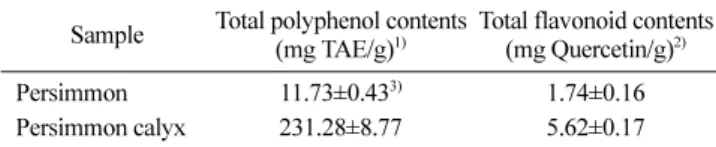
총 폴리페놀 함량과 플라보노이드 함량. 식물계에 널리 분포 되어 있는 2차 대사산물의 하나인 페놀 화합물은 식물체에 특 수한 색깔을 부여하고 다양한 구조와 분자량을 가진다. 이들은 phenolic hydroxyl (OH) 그룹을 가지기 때문에 단백질 또는 효 소, 기타 거대분자들과 결합하는 성질을 가지며 항산화효과 등 의 생리활성 기능을 가진다[Eom 등, 2007]. 본 실험에서는 감 및 시체의 에탄올 추출물에 함유된 총 폴리페놀 화합물의 함량 은 Table 1과 같이 나타내었다. 감 및 시체 에탄올 추출물의 총 폴리페놀 함량은 각각 11.73, 231.28 mg/g으로 나타내었으며, 총 플라보노이드는 1.74, 5.62 mg/g을 나타내어 폴리페놀 함량 에 비해 낮게 나타났으며, 청도반시의 과육 추출물 보다 시체 추출물에서 3배 이상 많은 플라보노이드 화합물이 함유된 것으 로 나타났다. 이는 Lee 등[2005]의 울릉도산 산채류 추출물인 물엉겅퀴 잎과 섬고사리 잎 추출물에서 각각 130.22, 120.69 µg/
mL로 나타내어 시체의 총 플라보노이드 함량이 훨씬 높은 것 을 확인할 수 있었다. 또한, Jo 등[2010]은 장성 대봉감의 부위 별 메탄올 추출물의 페놀 함량을 측정한 결과 씨와 꼭지가 76.47, 73.00 mg Galic acid equivalents (GAE)/g, 과육은 3.00
mg GAE/g으로 과육보다 꼭지의 폴리페놀 함량이 높았다고 보 고하여 본 연구 경향과 일치하였다.
전자공여능 확인. 전자공여능이 phenolic acids와 flavonoids 및 기타 phenol성 물질에 대한 항산화작용의 지표라 하였으며 [Kang 등, 1996], 이러한 물질은 환원력이 큰 것일수록 전자공 여능이 높다고 하였다. 또한, Mahoney와 Graf [1986]은 이러한 전자공여능은 유지의 자동 산화과정중에 생성되는 ROO·, R·, RO·등에 수소 또는 전자를 주는 것으로 환원력이 중요한 작 용을 하지만 항산화제의 일반적인 작용을 전자공여능 만으로 설명할 수는 없다고 하였으며, 항산화물질의 전자공여능을 측 정할 때는 DPPH법이 편리하다고 알려져 있다.
감 및 시체 에탄올 추출물을 이용한 전자공여능 측정은 Fig.
1과 같이 나타내었다. 감 추출물의 경우 1,000 µg/mL에서 48%
의 전자공여능을 나타낸 반면 시체의 경우 500 µg/mL에서 91%
의 전자공여능을 나타내어 대조군인 ascorbic acid와 같은 농도 에서 비교시 유사한 전자공여능을 나타내었다. 이는 와송 메탄 올 추출물의 1,000 µg/mL의 농도에서 88.3%의 전자공여능과 와송 열수 추출물[Choi 등, 2008]의 1,000 µg/mL의 농도에서 60.6%의 전자공여능을 나타낸 결과와 비교하여 시체의 전자공 여능이 우수함을 확인할 수 있었다.
Table 1. Total polyphenol and flavonoid contents of persimmon and persimmon calyx extracts
Sample Total polyphenol contents (mg TAE/g)1)
Total flavonoid contents (mg Quercetin/g)2)
Persimmon 11.73±0.433) 1.74±0.16
Persimmon calyx 231.28±8.77 5.62±0.17
1)Milligrams of total polyphenol content/g of plants based on tannic acid as standard.
2)Milligrams of total flavonoid content/g of plants based on quercetin as standard.
3)Each value is mean±SD (n±3).
Fig. 1. Electron donating ability of extracts from persimmon and persimmon calyx. □: P, Persimmon extracted with ethanol; ▒: PC, Persimmon calyx extracted with ethanol; ■: AC, Ascorbic acid.
Results are means±SD of triplicate data. Values are means of 3 replicates and those with different alphabet letters are significantly different at p<0.05.
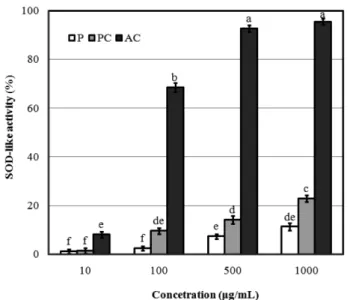
SOD 유사활성 확인. SOD는 항산화 효소로서 세포에 해로 운 환원 산소종을 과산화수소로 전환 시키는 반응(2O2−+2H+→ H2O2+O2)을 촉매하는 효소이며, SOD에 생성된 H2O2는 peroxidase나 catalase에 의하여 무해한 물분자와 산소분자로 전 환되어 산소상해로부터 생체를 보호하는 기능으로 알려져 있다 [Goldberg, 1987]. 감 및 시체 추출물의 SOD 유사활성을 측정 한 결과 Fig. 2와 같이 나타내었다. 감 및 시체 추출물 모두 농 도가 증가함에 따라 유의적으로 SOD 유사활성을 나타내었다.
1,000µg/mL 에서 감 및 시체의 추출물 각각의 활성이 11%와 23% 정도를 나타내었다. 이는 Choi [2003]의 소엽 추출물이
1,000µg/mL에서 25%의 활성을, Lim 등[2004]의 한국산 약용 식물의 SOD 유사활성에서 20% 미만의 SOD 유사활성과 비교 할 때, 시체의 SOD 유사활성이 유사함을 알 수 있었다.
Human keratinocyte cell (HaCaT)의 생존율 확인. 감 및 시체에 의한 human keratinocyte 세포의 생존율을 확인한 결과 Fig. 3과 같이 나타내었다. 감 및 시체의 추출물이 100 µg/mL 에서 각각 93, 94% 이상의 세포생존율을 나타내어 각질형성 세포 독성에 영향을 적게 주는 것으로 나타났다. 세포독성 결 과로부터 시료용액의 농도를 100 µg/mL이하의 농도로 결정하 여 실험을 하였다. 이는 돌나물 추출물을 100 µg/mL 이상 처 리 시 human keratinocyte 세포의 세포생존율이 90% 이하로 나타나는 결과[Sim 등, 2008]와 비교시 감 및 시체의 세포생존 율이 우수함을 확인할 수 있었다.
NO 저해활성 확인. 내독소로 잘 알려진 LPS는 그람 음성균 의 세포외막에 존재하며, Raw264.7 세포와 같은 macrophage 또는 monocyte에서 TNF-α, IL-6, IL-1β와 같은 pro- inflammatory cytokine을 증가시키는 것으로 알려져 있다[Lee 등, 2004]. HaCaT 세포의 NO 생성억제 정도를 측정하기 위하 여 감 및 시체를 농도별로 세포에 처리하여 생성되는 NO량을 측정한 결과 Fig. 4와 같이 나타내었다. LPS를 첨가하지 않은 군에서는 54%의 NO를 생성하였고, LPS와 감 및 시체를 첨가 한 군에서는 시체 추출물이 NO의 생성량을 가장 많이 억제하 였다. 즉, 감 및 시체 추출물 모두 농도 의존적으로 NO의 생 Fig. 2. SOD-like activity of extracts from persimmon and
persimmon calyx. □: P, Persimmon extracted with ethanol; ▒: PC, Persimmon calyx extracted with ethanol; ■: AC, Ascorbic acid.
Results are means±SD of triplicate data. Values are means of 3 replicates and those with different alphabet letters are significantly different at p<0.05.
Fig. 3. Cytotoxicity of human keratinocyte cell (HaCaT) of persimmon and persimmon calyx. ■: P, Persimmon extracted with ethanol; ▒: PC, Persimmon calyx extracted with ethanol. Results are means±SD of triplicate data. Values are means of 3 replicates and those with different alphabet letters are significantly different at p<0.05.
Fig. 4. Effects of extracts from extracts from persimmon and persimmon calyx on the production of NO in keratinocyte cell (HaCaT). (A): Persimmon extracted with ethanol; (B): Persimmon calyx extracted with ethanol. The data represent the mean±SD of three separate experiments. (Significant as compared to control. *p<0.05,
**p<0.01, ***p<0.001).
성을 억제함을 나타내었으며, 50 µg/mL의 농도에서 감의 경우 27%의 NO의 생성을 억제하였으며, 시체의 경우 48% 이상의 높은 NO의 생성을 억제하였다. 이는 Byun 등[2005]의 현삼 메 탄올 추출물과 Kim 등[2004]의 상황 H2O 추출물의 LPS로 유 도된 Raw264.7 세포의 NO 생성 억제능에 미치는 결과와 비교 하여 보면 시체의 NO 생성 억제능이 가장 우수하다는 것을 확 인할 수 있었다.
iNOS, COX-2 단백질의 발현 측정. 동물 세포에서 NO는 neuronal NOS (nNOS), endothelial NOS (eNOS) 그리고 inducible NOS (iNOS) 세가지 형태의 NOS에 의해 합성된다.
nNOS와 eNOS는 세포내에 항상 존재하지만, iNOS는 interferon-γ, LPS 그리고 다양한 염증유도 사이토카인에 노출되 는 경우에만 발현된다[Moncada 등, 1991; Yun 등, 1996]. 자극 에 유도된 iNOS는 오랜 기간 동안 다량의 NO를 생성하게 되 고, 생성된 NO는 guanylyl cyclase의 활성과 동시에 주위 조직 에 세포독성을 나타낸다[Lee 등, 2007; Nishida 등, 2007]. 또 한, COX-2는 정상적인 상태에서는 발현되지 않고 prooxidant나 proinflammatory stimuli transporter associated with antigen processing (TAP), LPS, TNF-α, region of interest (ROI) 등 에 의해 nuclear factor κB (NFκB)의 활성화를 경유하여 생성 되고, 염증 매개물질인 PGE2를 생합성 하는데 관여하여 염증 과 암 등의 각종 퇴행성 질환에 중추적인 역할을 한다[Lee 등, 2003; Surh 등, 2003].
감 및 시체의 추출물이 iNOS 및 COX-2를 저해하는 효과가 있는지 알아보기 위하여 human keratinocyte세포를 이용하여
iNOS protein의 발현 변화를 western blotting으로 확인하였다.
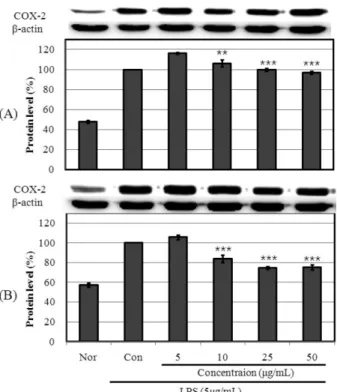
이때 세포의 여러 조건에서도 그 발현정도의 차이가 거의 없는 house keeping gene인 β-actin을 positive control로 사용하였으 며, Fig. 5와 같이 LPS를 처리 하지 않은 Normal 군에서는 iNOS protein 발현이 거의 나타나지 않았지만, LPS를 처리한 군에서는 iNOS protein 발현이 130 kDa에서 상당 수준으로 나 타났으며, 감 및 시체 추출물을 첨가한 군에서는 농도 의존적 으로 유의성 있게 iNOS 발현이 감소함을 나타내었다. 특히 시 체의 경우 50 µg/mL에서 77% 이상의 iNOS 발현을 감소시켰 으며, COX-2의 경우 LPS를 처리하지 않은 정상군에 비해 LPS 를 5 µg/mL 농도로 처리한 대조군에서는 COX-2 protein 발현 이 72 kDa에서 50% 수준으로 나타났다. 감 및 시체 추출물을 첨가한 군에서는 농도 의존적으로 COX-2 발현이 감소하는 경 향을 나타내었지만 모두 큰 효과는 나타나지 않았으며, 시체 50µg/mL 에서 COX-2 발현을 24% 정도로 감소시켜 가장 좋 은 효과를 나타내었다(Fig. 6).
IL-1 beta, IL-6, TNF-alpha 분비량 측정. 염증성 사이토카 인(proinflammatory cytokine)은 염증을 나타내는 중요한 지표이 다. LPS 자극에 의해 생성된 NO는 염증반응을 매개하는 역할 을 하게 되는데 활성화된 세포에서 IL-1β, IL-6, IL-10, TNF-α 와 같은 전염증성 및 염증성 cytokine과 PGE2 등을 생산하게 된다[Hirohashi와 Morrison, 1996; Horwood 등, 2006]. 염증매 개물질이 과량 생산되면, 과도한 면역반응을 야기하게 되고 이 로써 대장염, 췌장염, 류마티스성 관절염, 천식 등의 각종 인체 질환을 악화시키는 원인이 된다[Wang 등, 1995; Matsuda 등, Fig. 6. COX-2 protein expression rate of extracts from persimmon and persimmon calyx on keratinocyte cell (HaCaT). (A):
Persimmon extracted with ethanol; (B): Persimmon calyx extracted with ethanol. The data represent the mean±SD of three separate experiments. (Significant as compared to control. **p<0.01,
***p<0.001).
Fig. 5. iNOS protein expression rate of extracts from persimmon and persimmon calyx on keratinocyte cell (HaCaT). (A):
Persimmon extracted with ethanol; (B): Persimmon calyx extracted with ethanol. The data represent the mean±SD of three separate experiments. (Significant as compared to control. *p<0.05, **p<0.01,
***p<0.001).
Fig. 7. Effect of persimmon extract on the production of cytokines stimulated by LPS. Production of IL-1β (A), IL-6 (B), TNF-α (C) were measured in the medium of HaCaT cells cultured with LPS (5 µg/mL) in the presence or absence of persimmon extract for 24 h. The amount of TNF-α was measured by immunoassay as described in materials and methods. Data represent the mean±SD with three separate experiments. One- way ANOVA was used for comparisons of multiple group means followed by t-test (Significant as compared to control. *p<0.05, **p<0.01).
Fig. 8. Effect of persimmon calyx extract on the production of cytokines stimulated by LPS. Production of IL-1β (A), IL-6 (B), TNF-α (C) were measured in the medium of HaCaT cells cultured with LPS (5 µg/mL) in the presence or absence of persimmon extract for 24 h. The amount of TNF- was measured by immunoassay as described in materials and methods. Data represent the mean±SD with three separate experiments. One- way ANOVA was used for comparisons of multiple group means followed by t-test (Significant as compared to control. *p<0.05, **p<0.01).
2003]. 본 실험에서 LPS는 IL-1β, IL-6, TNF-α의 생성을 증가 시켰으며, 감 및 시체의 의 추출물을 농도별로 처리한 결과 Fig.
7, 8과 같이 IL-6는 감 및 시체 추출물 농도가 50 µg/mL에서 22%, 56%의 생성 억제 효과를 나타내었으며, IL-1β와 TNF-α 는 시체 추출물 50 µg/mL에서 각 30, 51%의 생성억제 효과를 나타내었다.
일반적으로 LPS는 macrophage에 작용하여, 는 IL-1β, IL-6, TNF-α의 생성 분비를 촉진시켜 염증반응을 유도하지만, 감의 시체는 이 세 가지의 cytokine을 유의성 있게 억제하여 염증성 질환에 우의할 것으로 사료되어진다.
초 록
천연 자원은 지금까지도 여러 치료제의 선도물질로서 개발되 어 제약 산업 뿐만 아니라 식품 및 화장품 사업에 소중한 자 원으로 이용되어 왔다. 따라서 본 연구는 청도에서 생산되는 청 도반시를 이용하여 반시의 과육부분과 시체를 이용하여 의약 품, 식품 및 화장품 소재로서 가능성을 찾아보고자 하였다. 전 자공여능을 측정한 결과 시체의 에탄올 추출물은 500 µg/mL에 서 91% 이상의 전자공여능을 나타내어 감 에탄올 추출물 40%
보다 우수 하였고, SOD 유사활성능은 시체의 추출물이 1,000 µg/mL에서 22% 이하의 유사활성능을 나타내었다. 항염증 효과 를 관찰하기 위하여 각질형성세포에 대한 감 및 시체의 세포생 존율을 조사하여 생존율에 영향을 미치지 않는 5, 10, 25, 50 µg/mL농도에서 실험을 진행하였다. HaCaT세포에 LPS를 처리 한 결과, 감의 시체 추출물이 LPS로 유도되어야 할 NO의 생 성량과 iNOS, COX-2의 발현을 크게 저해하였고, 또한 염증성 사이토카인인 IL-1β, IL-6, TNF-α의 생성량도 크게 감소하였 다. 이러한 결과로 보아 감의 시체 추출물은 염증성 질환의 치 료에 활용될 수 있음을 시사한다.
Key words: anti-inflammatory effect, anti-oxidant effect, cytokines, persimmon, persimmon calyx
참고문헌
Achiwa Y, Hibasami H, Katsuzaki H, Imai K, and Komiya T (1997) Inhibitory effects of persimmon (Diospyros kaki) extract and related polyphenol compounds on growth of human lymphoid leukemia cells. Biosci Biotech Biochem 61, 1099-1109.
Ann YG, Pyun JY, Kim SK, and Shim CS (1999) Studies on persimmon wine. Korean J Food Nutr 12, 455-461.
Bae SM, Park KJ, Shin DJ, Hwang YI, and Lee SC (2001) Preparation and characterization of jochung with sweet persimmons. J Korean Soc Agric Chem Biotechnol 44, 88-91.
Blois MS (1958) Antioxidant determination by the use of a stable free radical. Nature 26, 1199-1120.
Byun SH, Yang CH, and Kim SC (2005) Inhibitory effect of Scrophulariae Radix extract on TNF-α, IL-1β, IL-6 and nitric oxide production in lipopolysaccharide activated Raw 164.7 cells.
Kor J Herb 20, 7-16.
Choi EY (2003) A study on the utilization of cosmetics natural
materials using the physiological activities function of Perilla frutescens var. acuta. MS Thesis, Daegu Haany University Daegu, Korea.
Choi SY, Chung MJ, and Sung NJ (2008) Studies on the antioxidative ability of methanol and extracts from Orostachys japonicus A.
Berger according to harvest times. Korean J Food Nutr 21, 157- 164.
Chun YK, Choi HS, and Cha BS (1997) Effect of enzymatic hydrolysis on the physicochemical properties of persimmon juice.
Korean J Food Sci Technol 29, 198-203.
Eom SH, Park HJ, Jin CW, Park SM, Kim MJ, Yu CY, and Cho DH (2007) Changes of antioxidant activity in Juglans mandshrica Maxim. leaves by far infrared irradiation. Korean J Med Crop Sci 15, 266-270.
Folin O and Denis W (1912) On phosphotungastic-phosphomolybdic compounds as color reagents. Biol Chem 12, 239-249.
Goldberg IH (1987) Free radical mechanisms in neocarzinostatin- induced DNA damage. Free Radic Biol Med 3, 41-54.
Gorinstein S, Bartnikowsaka E, Kulasek G, Zemser M, and Trakhtenberg S (1998) Dietary persimmon improves lipid metabolism in rats fed diets containing cholesterol. J Nutr 128, 2023-2027.
Gracie JA, Forsey RJ, Chan WL, Gilmour A, Leung BP, Greer MR, Kennedy K, Carter R, Wei XQ, Xu D, Field M, Foulis A, Liew FY, and Mclnnes IB (1999) A proinflammatory role for IL-18 in rheumatoid arthritis. J Clin Invest 13, 85-94.
Guha M and Mackman N (2001) LPS induction of gene expression in human monocytes. Cell Signal 13, 85-94.
Harada M, Sakagami R, Watanabe T, Onitsuka T, Katoh H, and Nagai A (2005) Antibacterial and deodorizing effect of persimmon tannin. Jpn J Conserv Dent 48, 314-319.
Higuchi M, Hisgahi N, Taki H, and Osawa T (1990) Cytolytic machanism of activated macrophages. Tumor necrosis factor and
L-arginine-dependent mechanism act synergistically as the major cytolytic mechanism of activated macrophages. J Immunol 144, 1425-1431.
Himbo G, Nadamoto T, Fujisawa F, and Fushiki T (2003) Regulation of the peripheral body temperature by foods: A temperature decrease induced by the Japanese persimmon (kaki, Diospyros kaki). Biosci Biotech Biochem 67, 23-28.
Hirohashi N and Morrison DC (1996) Low-dose lipopolysaccharide (LPS) pretreatment of mouse macrophage modulates LPS- dependent interleukin-6 production in vitro. Infect Immun 64, 1011-1015.
Horwood NJ, Page TH, McDaid JP, Palmer CD, Campbell J, Mahon T, Brennan FM, Webster D, and Foxwell BM (2006) Bruton's tyrosine kinase is required for TLR2 and TLR4-induced TNF, but not IL-6, production. J Immunol 176, 3635-3641.
Hyun YH, Koo BS, Song JE, and Kim DS (2004) In Food materials, pp. 152-153, Hyungseul Publish, Daegu, Korea.
Jeong YJ, Lee GD, and Kim KS (1998) Optimization for the fermentation condition of persimmon vinegar using response sulface methodology. Korean J Food Sci Technol 30, 1203-1208.
Jo YH, Park JW, Lee JM, Ahn GH, Park HR, and Lee SC (2010) Antioxidant and anticancer activities of methanol extracts prepared from different parts of Jangseng Daebong persimmon (Diospyros kaki cv. Hachiya). J Korean Soc Food Sci Nutr 39,
500-505.
Kang YH, Park YK, and Lee GD (1996) The nitrite scavenging and electron donating ability of phenolic compounds. Korean J Food Sci Technol 28, 232-239.
Kim JG, Choi HS, Kim WJ, and Oh HI (1999) Physical and sensory characteristics of persimmon jam prepared with enzyme treated persimmon juice. Korean J Soc Food Sci 15, 50-54.
Kim SC, Jung YS, Lee JR, Kim YW, Byun BH, Kwon TK, Suh SI, Byun SH, and Kwon YK (2004) Inhibition effect of Phellinus lgniarius water extract on TNF-α, IL-1β, IL-6 and nitric oxide production in lipopolysaccharide activated Raw164.7 cells.
Korean J Orient Physiol Pathol 18, 880-886.
Kim SG, Lee YC, Suh KG, and Choi HS (2001) Acetaldehyde dehydrogenase activator from persimmon and its processed foods.
J Korean Soc Food Sci Nutr 30, 954-958.
Lee AK, Sung SH, Kim YC, and Kim SG (2003) Inhibition of lipopolysaccaride-inducible nitric oxide synthase, TNF-alpha and COX-2 expression by sauchinone effects on I-kappaBalpha phosphorylation, C/EBP and AP-1 activation. Br J Pharmacol 139, 11-20.
Lee ES, Ju HK, Moon TC, Lee E, Jang Y, Lee SH, Son JK, Baek SH, and Chang HW (2004) Inhibition of nitric oxide and tumor necrosis factor-α (TNF-α) production by propenone compound through blockade of nuclear factor (NF)-κB activation in cultured murine macrophage. Biol Pharm Bull 27, 617-620.
Lee SO, Lee HJ, Yu MH, Im HG, and Lee IS (2005) Total polyphenol contents and antioxidant activities of methanol extracts from vegetables produced in Ullung Island. Korean J Food Sci Technol 37, 233-240.
Lee TH, Kwak HB, Kim HH, Lee ZH, Chung DJ, Beak NI, and Kim J (2007) Methanol extracts of stewartia koreana inhibit cyclooxygenase-2 (COX-2) and inducible nitric oxide synthase (iNOS) gene expression by blocking NF-kappa B transactivation in LPS-activated RAW264.7 cell. Mol Cells 23, 398-404.
Lee YC, Sa YS, Jeong CS, Suh KG, and Choi HS (2001) Anticoagulating activity of persimmon and its processes foods. J Korean Soc Food Sci Nutr 30, 949-953.
Lim JD, Yu CY, Kim MJ, Yun SJ, Lee SJ, Kim NY, and Chung IM (2004) Comparison of SOD ctivity and phenolic compound contents in various Korean medicinal plants. Korean J Med Crop Sci 12, 191-202.
Mahoney JR and Graf E (1986) Role of alpha-tocopherol, ascorbic acid citric acid and EDTA as oxidants in model system. J Food Sci 51, 1293-1296.
Marithasan S and Monack DM (2007) Inflammasome adaptors and sensor: Intracelluar regulators of infection and inflammation. Nat Rev Immunol 7, 31-40.
Marklund S and Marklund G (1974) Involvement of superoxide anion radical in the oxidation of pyrogallol and a convenient assay for superoxide dismmutase. Eur J Biochem 47, 468-474.
Matsuda H, Morikawa T, Ando S, Toguchida I, and Yoshikawa M (2003) Structural rwquirements of flavonoids for nitric oxide production inhibitory activity and mechanism of action.
Bioorganic Med Chem 11, 1995-2000.
Moncada S, Palmer RM, and Higgs EA (1991) Nitric oxide:
Physiology, pathophysiology and pharmacology. Pharmacol Rev 43, 109-142.
Nishida TY, Fu HY, Hayashi Y, Asahi K, Eguchi H, Tsuji S, Tsuji M, Hayashi N, and Kawano S (2007) Geranylgeranylacetone induces cyclooxygenase-2 expression in cultured rat gastric epithelial cells through NF-kappa B. Dig Dis Sci 52, 1890-1892.
Shinmoto H, Kimura T, Yamagishi K, and Suzuki M (2002).
Antimutagenicity of fruit extract on Trp-P2 induced mutagenicity of Salmonella typhimurium TA98. J Jpn Soc Food Sci Tech 49, 203-206.
Sim GS, Kim JH, Lee BC, Lee DH, Lee GS, and Pyo HB (2008) Inhibitory Effects on Melanin Production in B16 Melanoma Cells of Sedum sarmentosum. Yakhak Hoeji 52, 165-171.
Sung JJ, Roh YK, Park SH, Byun HS, Ham YJ, and Choi JU (1999) Changes in quality of soft persimmon during freezing and defrosting. Korean J Postharvest Sci Technol 6, 398-401.
Surh YJ, Chun KS, Cha HH, Han SS, Keum YS, Park KK, and Lee SS (2003) Molecular mechanism underlying chemopreventive activities of anti-inflammatory phytochemicals: Down-regulation of COX-2 and iNOS through suppression of KF-kappa B activation. Mutat Res 139, 11-20.
Wang S, Zhai S, Wang Y, and Wang L (1995) Effect of radix Ginseng- faeces Trogopterori combination on pharmacodynamics and effective chemical composition of radix Ginseng. Zhongguo Zhong Yao Za Zhi 20, 630-632.
Woisky RG and Salatino A (1998) Analysis of propolis: Some parameters and procedures for chemical quality control. J Apicul Res 37, 99-105.
Yang HS and Lee YC (2000) Changes in Physico-chemical properties of soft persimmon and puree during frozen storage. Korean J Food Sci Technol 32, 335-340.
Yun HY, Dawson VL, and Dawson TM (1996) Neurobiology of nitric oxide. Crit Rev Neurobiol 10, 291-316.