pISSN 1738-3544 eISSN 2288-1662
The Association of Urine Microalbumin and Pulse Pressure in Korean Adults
Mee Young Gee 1 , Hyun Yoon 2
1
Department of Nursing, Christian College of Nursing, Gwangju 61662, Korea
2
Department of Biomedical Laboratory Science, Hanlyo University, Gwangyang 57764, Korea
한국 성인에서 뇨 중 Microalbumin과 맥압의 관련성
기미영 1 , 윤 현 2
1
광주기독간호대학교 간호학과,
2한려대학교 임상병리학과
The aim of this study was to assess the association between microalbumin and pulse pressure (PP) in Korean adults. The study subjects were Korean adults 20 years or older (n=4,948) who participated in the Korea National Health and Nutrition Examination Survey 2012. The urine microalbumin level (M±SE) was significantly higher ( p =0.047) in the high PP group (PP>60.0 mmHg) [33.02±4.93 g/mL (95% confidence interval (CI), 23.37∼42.68)] than the normal PP group (PP≤60.0 mmHg) [22.57±1.63 g/mL (95% CI, 19.36∼25.77)], after adjusting for age, gender, smoking, drinking, regular exercising, WM, BMI, TC, TG, HDL-C, FBG, BUN, creatinine, and urine creatinine. In conclusion, pulse pressure was associated with the microalbumin level in Korean adults.
Key words: Microalbumin, Pulse pressure
Corresponding author: Hyun Yoon
Department of Biomedical Laboratory Science, Hanlyo University, 94-13, Hallyeodae-gil, Gwangyang-eup, Gwangyang 57764, Korea Tel: 82-61-760-1150
Fax: 82-61-761-6709 E-mail: [email protected]
This is an Open Access article distributed under the terms of the Creative Commons Attribution Non-Commercial License (http://creativecommons.org/licenses/by-nc/4.0) which permits unrestricted non-commercial use, distribution, and reproduction in any medium, provided the original work is properly cited.
Copyright © 2016 The Korean Society for Clinical Laboratory Science. All rights reserved.
Received: July 20, 2016 Revised 1
st: August 7, 2016 Revised 2
nd: August 18, 2016 Revised 3
rd: August 23, 2016 Revised 4
th: August 25, 2016 Accepted: August 25, 2016
서 론
미세알부민뇨(microalbuminuria)는 단백뇨(proteinuria)가 배 설되기 전에 미세한 양의 알부민이 배설되는 것으로[1], 향후 단백 뇨를 동반한 당뇨병성 신증을 예측하는 지표가 될 수 있다[2,3].
맥압(Pulse pressure, PP)은 수축기혈압(systolic blood pressure, SBP)과 이완기혈압(diastolic blood pressure, DBP)의 차이로 정 의되며, 동맥의 탄성과 파장반사로 결정되기 때문에 동맥 경직도가 증가할수록 증가한다[4]. 동맥 경직도 증가의 위험인자로는 연령, 당뇨, 고혈압, 대사증후군 및 죽상경화증 등이 있다[5-7]. 특히, 맥 압은 만성 신질환의 진행과 관련이 있으며[8], 당뇨의 발생에 있어 서 강력한 예측인자로 각광을 받고 있다[9]. 그러나, 이와 같은 만성
신질환의 진행 및 당뇨발생의 예측인자인 맥압과 당뇨병성 신증의 예측인자인 뇨 중 microalbumin의 관련성에 대한 연구는 거의 없 다. 따라서 본 연구는 제 5기 국민건강영양조사 자료를 이용하여 대 한민국 성인에서 뇨 중 microalbumin과 맥압의 관련성에 대하여 알아보고자 하였다.
재료 및 방법
1. 연구대상
본 연구는 질병관리본부 주관으로 시행된 국민건강영양조사 (2012년)의 자료를 이용하였다. 조사 참여자수는 8,058명이었고, 이 중에서 20세 이상 성인은 6,221명이었다. 본 연구 대상자는
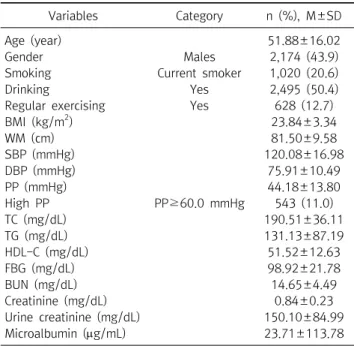
Table 1. General characteristics of research subjects (n=4,948)
Variables Category n (%), M±SD
Age (year) 51.88±16.02
Gender Males 2,174 (43.9)
Smoking Current smoker 1,020 (20.6)
Drinking Yes 2,495 (50.4)
Regular exercising Yes 628 (12.7)
BMI (kg/m
2) 23.84±3.34
WM (cm) 81.50±9.58
SBP (mmHg) 120.08±16.98
DBP (mmHg) 75.91±10.49
PP (mmHg) 44.18±13.80
High PP PP≥60.0 mmHg 543 (11.0)
TC (mg/dL) 190.51±36.11
TG (mg/dL) 131.13±87.19
HDL-C (mg/dL) 51.52±12.63
FBG (mg/dL) 98.92±21.78
BUN (mg/dL) 14.65±4.49
Creatinine (mg/dL) 0.84±0.23
Urine creatinine (mg/dL) 150.10±84.99
Microalbumin (g/mL) 23.71±113.78
Abbreviation: BMI, body mass index; WM, waist measurement;
SBP, systolic blood pressure; DBP, diastolic blood pressure; PP, pulse pressure; TC, total Cholesterol; TG, triglyceride; HDL-C, High density lipoprotein cholesterol; FBG, fasting blood glucose; BUN, blood urea nitrogen.
6,221명 중 건강 설문에서 불충분한 응답(362명)과 혈압, 혈액 및 뇨 중 microalbumin 등의 검사결과가 누락(911명)이 되어있는 대 상자 1,273명을 제외한 총 4,948명을 최종 분석 대상자로 하였다. 제 5기 3차년도 국민건강영양조사 자료는 질병관리본부 연구윤리심의 위원회의 심의 및 승인을 받았다(승인번호; 2012-01EXP-01-2C).
2. 자료수집
본 연구는 2012년도부터 1월부터 12월까지 12개월 동안 시행 된 제 5기 국민건강영양조사 자료를 이용하였다. 조사항목으로는 대상자들의 성별, 연령, WM, BMI, 안정 시 혈압 및 맥압, 아침공복 시의 혈액검사, 뇨 중 creatinine과 microalbumin 등이었다.
3. 대상자의 특성
1) 일반적 특성 및 혈액화학검사
대상자 중 연령은 평균값으로, 성별은 남녀로 구분하였다. 신체 계측은 체질량지수(body mass index, BMI), 허리둘레(waist measurement, WM), SBP, DBP의 측정값을 사용하였다. 혈액화 학검사는 총 콜레스테롤(total cholesterol, TC), 중성지방(trigly- ceride, TG), 고밀도 콜레스테롤(HDL-cholesterol, HDL-C), 공 복 시 혈당(fasting blood glucose, FBG), 혈중 요소질소(blood urea nitrogen, BUN) 및 creatinine의 측정값을 사용하였고, 뇨 중 creatinine과 microalbumin의 측정값을 사용하였다.
2) 맥압 및 microalbumin
맥압은 SBP에서 DBP를 차감하여 계산하였고, PP≤60.0 mmHg를 Normal PP로, PP>60.0 mmHg를 High PP로 구분하였 다[10]. 뇨 중 microalbumin의 사분위는 1사분위(<2.60 g/mL), 2사분위(2.60∼5.99 g/mL), 3사분위(6.00∼13.79 g/mL), 4사 분위(≥13.80 g/mL)로 구분하였다.
4. 자료처리 및 분석
자료의 통계처리는 SPSS WIN version 18.0 (SPSS Inc., Chicago, IL, USA) 통계프로그램을 이용하였다. 대상자의 특성에 대한 분포는 빈도와 백분율로 나타내었고 연속형 자료는 평균과 표 준편차로 표시하였다. 뇨 중 microalbumin의 사분위에 따른 특성 은 교차분석과 ANOVA test를 이용하여 분석하였고, ANCOVA test에서 네 가지의 Model을 실시하여 PP가 뇨 중 microalbumin 에 독립적으로 영향을 주는지를 알아보았다. Model 1은 연령과 성 별을 보정하였고, Model 2는 Model 1에 추가적으로 흡연, 음주, 규 칙적인 운동을 보정하였다. Model 3은 Model 2에 추가적으로 WM, BMI, TC, TG, HDL-C를 보정하였고, Model 4는 Model 3에
추가적으로 FBG, creatinine, 요 중 creatinine을 보정하였다. 모 든 통계량의 유의수준은
p
<0.05로 판정하였다.결 과
1. 연구대상자의 일반적 특성
연구대상자의 일반적 특성은 Table 1과 같다. 본 연구의 총 연구대 상자는 4,948명이었고, 남성은 2,174명(43.9%), 여성은 2,754명 (56.1%)이었다. 전체 대상자 중, High PP에 해당되는 대상자는 543 명(11.0%)이었고, 뇨 중 microalbumin의 평균값은 23.71±113.78
g/mL 이었다.
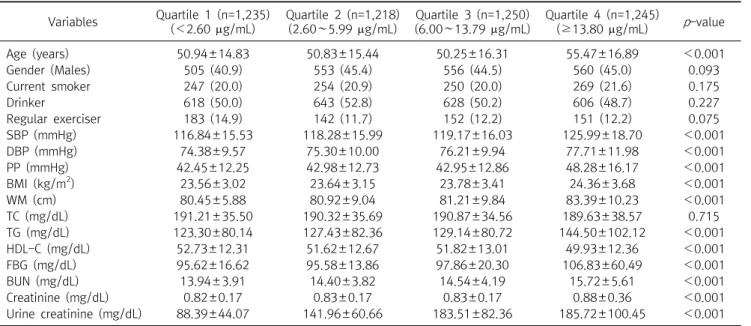
2. 뇨 중 microalbumin의 사분위에 따른 대상자들의 임상적 특성 뇨 중 microalbumin의 사분위에 따른 대상자들의 임상적 특성은 Table 2와 같다. 뇨 중 microalbumin의 사분위에서 유의한 차이를 보이는 변수는 연령(
p
<0.001), SBP (p
<0.001), DBP (p
<0.001), PP (p
<0.001), BMI (p
<0.001), WM (p
<0.001), TG (p
<0.001), HDL-C (p
<0.001), FBG (p<0.001), BUN (p
<0.001), creatinine (p
<0.001) 및 뇨 중 creatinine (p
<0.001) 등이었고, 성별 (p
=0.093), 흡연습관(p
=0.175), 음주습관(p
=0.227), 운동습관 (p
=0.075), TC (p
=0.715) 등은 유의한 차이를 보이지 않았다.Table 2. Clinical characteristics of subjects in relation for microalbumin quartile
Variables Quartile 1 (n=1,235) (<2.60 g/mL)
Quartile 2 (n=1,218) (2.60∼5.99 g/mL)
Quartile 3 (n=1,250) (6.00∼13.79 g/mL)
Quartile 4 (n=1,245)
(≥13.80 g/mL) p -value
Age (years) 50.94±14.83 50.83±15.44 50.25±16.31 55.47±16.89 <0.001
Gender (Males) 505 (40.9) 553 (45.4) 556 (44.5) 560 (45.0) 0.093
Current smoker 247 (20.0) 254 (20.9) 250 (20.0) 269 (21.6) 0.175
Drinker 618 (50.0) 643 (52.8) 628 (50.2) 606 (48.7) 0.227
Regular exerciser 183 (14.9) 142 (11.7) 152 (12.2) 151 (12.2) 0.075
SBP (mmHg) 116.84±15.53 118.28±15.99 119.17±16.03 125.99±18.70 <0.001
DBP (mmHg) 74.38±9.57 75.30±10.00 76.21±9.94 77.71±11.98 <0.001
PP (mmHg) 42.45±12.25 42.98±12.73 42.95±12.86 48.28±16.17 <0.001
BMI (kg/m
2) 23.56±3.02 23.64±3.15 23.78±3.41 24.36±3.68 <0.001
WM (cm) 80.45±5.88 80.92±9.04 81.21±9.84 83.39±10.23 <0.001
TC (mg/dL) 191.21±35.50 190.32±35.69 190.87±34.56 189.63±38.57 0.715
TG (mg/dL) 123.30±80.14 127.43±82.36 129.14±80.72 144.50±102.12 <0.001
HDL-C (mg/dL) 52.73±12.31 51.62±12.67 51.82±13.01 49.93±12.36 <0.001
FBG (mg/dL) 95.62±16.62 95.58±13.86 97.86±20.30 106.83±60.49 <0.001
BUN (mg/dL) 13.94±3.91 14.40±3.82 14.54±4.19 15.72±5.61 <0.001
Creatinine (mg/dL) 0.82±0.17 0.83±0.17 0.83±0.17 0.88±0.36 <0.001
Urine creatinine (mg/dL) 88.39±44.07 141.96±60.66 183.51±82.36 185.72±100.45 <0.001 n (%), M±SD, (n=4,948).
Abbreviation: ‘See Table 1.’
Table 3. Multiple linear regression analysis evaluating the independent determinants of microalbumin (n=4,948)
B SE p -value
Microalbumin (g/mL)
Intercept −287.01 26.73 <0.001
Age −0.249 0.133 0.060
Males 41.036 4.661 <0.001
Current smoker 0.342 2.163 0.847
Drinker −3.442 3.411 0.313
Regular exerciser −10.325 6.295 0.101
BMI 0.558 1.000 0.557
WM −0.207 0.374 0.581
SBP 0.520 0.131 <0.001
DBP 0.084 0.197 0.669
TC −0.078 0.048 0.211
TG 0.072 0.022 0.001
HDL-C 0.186 0.148 0.211
FBG 0.463 0.075 <0.001
BUN 1.404 0.414 0.001
Creatinine 155.954 8.498 <0.001
Urine creatinine 0.054 0.020 0.014 Abbreviation: ‘See Table 1.’
3. 뇨 중 microalbuminn에 영향을 미치는 요인
뇨 중 microalbumin에 영향을 미치는 요인은 Table 3과 같다.
뇨 중 microalbumin의 평균값에 독립적으로 영향을 미치는 변수 는 성별(
p
<0.001), SBP (p
<0.001), TG (p
=0.001), FBG (p
<0.001), BUN (p
=0.001), creatinine (p
<0.001) 및 뇨 중 creatinine (p
=0.014) 등이었고, 연령(p
=0.060), 흡연습관(p
=0.847), 음주습 관(p
=0.313), 운동습관(p
=0.101), BMI (p
=0.557), WM (p
=0.581),DBP (
p
=0.669), TC (p
=0.211), HDL-C (p
=0.211) 등은 독립적으 로 유의한 변수가 아니었다.4. PP에 따른 뇨 중 microalbumin의 평균값 비교
PP에 따른 뇨 중 microalbumin의 평균값 비교는 Table 4와 같 다. PP를 Normal PP와 High PP로 나누었을 때, 연령, 성별, 흡연습 관, 음주습관, 운동습관, WM, BMI, TC, TG, HDL-C, FBG, BUN, creatinine 및 뇨 중 creatinine등을 보정한 후의 결과에서 High PP의 뇨 중 microalbumin평균값(M±SE)은 33.02±4.93 g/mL (23.37∼42.68), Normal PP의 뇨 중 microalbumin평균값(M±SE) 은 22.57±1.63 g/mL (19.36∼25.77)로 High PP에서 유의하게 높았다(
p
=0.047).고 찰
본 연구는 2012년도에 시행된 국민건강영양조사 제 5기 3차년 도 자료를 이용하여 실시한 뇨 중 microalbumin과 맥압의 관련성 에 대한 연구이다. 본 연구의 주요결과는 뇨 중 microalbumin와 관 련된 변수를 보정한 후에 High PP의 뇨 중 microalbumin평균값이 Normal PP의 뇨 중 microalbumin평균값보다 높았다.
PP는 단순히 SBP과 DBP의 차로 환산된 수치지만, PP의 증가는 동맥경화, 고지혈증, 당뇨, 죽상경화 및 이로 인한 심ㆍ뇌혈관질환 등을 예측하는 중요인자로 알려져 있다[9,11-13]. 맥압이 증가하 는 경우는 첫째, DBP가 SBP보다 상대적으로 많이 감소하는 경우로
Table 4. Comparisons of serum microalbumin levels for PP (n=4,948)
Variables Normal PP
(PP <60.0 mmHg)
High PP
(PP ≥60.0 mmHg) p -value
Microalbumin (g/mL) Model 1 21.99±1.72 (18.62∼25.38) 37.62±5.17 (27.49∼47.75) 0.005 Model 2 21.96±1.72 (18.58∼25.34) 37.94±5.17 (27.80∼48.09) 0.004 Model 2 22.04±1.72 (18.67∼25.41) 37.28±5.18 (27.14∼47.43) 0.006 Model 4 22.57±1.63 (19.36∼25.77) 33.02±4.93 (23.37∼42.68) 0.047
Model 1 [M±SE (95% CI)]: adjusted for age and gender. Model 2 [M±SE (95% CI)]: adjusted for age, gender, smoking, drinking, and regular exercising. Model 3 [M±SE (95% CI)]: adjusted for age, gender, smoking, drinking, regular exercising, WM, BMI, TC, TG, and HDL-C. Model 4 [M±SE (95% CI)]: adjusted for age, gender, smoking, drinking, regular exercising, WM, BMI, TC, TG, HDL-C, FBG, BUN, creatinine, and urine creatinine.
Abbreviation: ‘See Table 1.’
큰 동맥의 경직도가 증가함으로써 발생한다고 알려져 있다[14]. 둘 째, SBP가 DBP보다 상대적으로 많이 증가하는 경우로 1회 심박출 량 또는 심실박출률(ventricular ejection rate)이 증가하여 심장기 능에 상당한 부담으로 작용할 수 있다[15]. Franklin 등은 PP가 10 mmHg 상승하면 22%, SBP가 10 mmHg 상승하면 16%, DBP가 10 mmHg 상승하면 14% 정도 관상동맥질환이 증가한다고 하였고, SBP의 상승에 의한 관상동맥질환 환자 중에서 DBP가 낮을수록, PP가 높을수록 사망률이 높아진다고 하였다[16]. 또한, Staessen 등은 SBP가 160 mmHg 이상인 대상자 중에서 SBP가 10 mmHg 증가했을 때 사망률은 1.22 (
p
<0.05)배, 뇌졸중은 1.22 (p
<0.05) 배 증가하고, SBP의 증가로 인한 고혈압의 합병증에서도 SBP의 증 가에 대하여 DBP가 높으면 합병증도 낮아진다는 연구결과로 고혈 압환자에서는 SBP와 DBP수치도 중요하지만, PP수치가 더욱 중요 하다고 기술하였다[17].뇨 중 microalbumin의 증가는 당뇨병성 신증의 예측인자이며 [2,3], 심ㆍ뇌혈관질환 및 고혈압에 영향을 미치는 주요한 영향인 자이다[18,19]. Yudkin 등은 심혈관질환이 없는 대상자 중 뇨 중 microalbumin가 증가된 대상자에서 동맥의 경직도가 증가하였기 때문에 뇨 중 microalbumin의 증가는 동맥경화의 위험인자라고 하였다[20].
현재, 뇨 중 microalbumin과 PP의 관련성에 대한 연구는 거의 없다. Pedrinelli 등은 211명의 이탈리아인을 대상으로 실시한 연 구에서 microalbuminuria (urine microalbumin ≥15 g/mL)는 심혈관질환의 강력한 위험인자이며, 특히 PP의 증가와 관련이 있 다고 하였다(
p
<0.001) [21]. 또한, Cirillo 등은 1,567명(남성, 677 명; 여성, 890명)의 이탈리아인을 대상으로 실시한 연구에서 microalbuminuria (urine microalbumin ≥20 g/mL)의 위험비 (Odds ratios)가 PP가 15 mmHg증가할수록 1.71배(1.31∼2.22) 가 증가한다고 하였다[22]. 본 연구의 선형회귀분석결과에서 SBP, TG 및 FBG는 뇨 중 microalbumin의 평균값을 증가시키는 유의한 변수였지만, DBP는 유의한 변수가 아니었다. TG와 FBG는 PP를증가시키는 강력한 위험인자이며[23], PP는 SBP에서 DBP를 차감 한 수치이기 때문에 PP의 증가가 일어나는 첫 번째 경우인 SBP의 증가로 인한 PP가 증가하였기 때문으로 사료된다.
결론적으로, 대한민국 성인에서 PP의 증가는 뇨 중 microalbumin 의 증가와 유의한 관련성이 있었다. 뇨 중 microalbumin과 SBP 및 DBP는 인종마다 다르기 때문에[24], 뇨 중 microalbumin과 PP의 관련성도 인종과 나라마다 다를 수 있다. 또한, 본 연구는 단면연구 이기 때문에 PP의 증가가 뇨 중 microalbumin의 증가에 영향을 주 는지, 아니면 뇨 중 microalbumin의 증가가 PP의 증가에 영향을 주는지는 알 수 없다. 따라서 이에 대한 코호트 연구를 시행할 수 있 다면 정확한 인과관계를 확인하기 위한 더욱더 정확한 결과를 얻을 수 있을 것으로 기대된다.
요 약
본 연구는 국가자료인 2012년도 국민건강영양조사 자료를 이 용하여 20세 이상 성인(n=4,948)에서 뇨 중 microalbumin과 맥압 (Pulse pressure, PP)의 관련성을 평가하고자 실시하였다. 연구결 과에서 연령, 성별, 흡연습관, 음주습관, 운동습관, WM, BMI, TC, TG, HDL-C, FBG, BUN, creatinine, 및 요 중 creatinine 등을 보 정하였을 때, 뇨 중 microalbumin평균값에서, High PP (PP>60.0 mmHg) [33.02±4.93 g/mL (95% confidence interval (CI), 23.37∼42.68)]가 Normal PP (PP≤60.0 mmHg) [22.57±1.63
g/mL (95% CI, 19.36∼25.77)]에 비하여 유의하게 높았다 (
p
=0.047). 결론적으로 대한민국 성인에서 PP의 증가는 뇨 중 microalbumin의 증가와 유의한 관련성이 있었다.Acknowledgements: None Funding: None
Conflict of interest: None
References