I. Introduction
Most hospitals have adopted an Electronic Health Record (EHR) system, also known as a hospital information system (HIS). Such systems are generally installed and operated as standalone systems in each hospital site, leading to the adop- tion of many systems and high maintenance costs. However, many small- and mid-sized hospitals as well as rural hos- pitals can no longer afford to invest in EHR systems or ad- vanced healthcare information services, such as clinical deci- sion support (CDS), which improve the quality of care and patient safety [1,2]. According to a survey on the adoption of EHR systems in South Korea in 2010 [3], the adoption rates
Architecture Design of Healthcare Software-as-a- Service Platform for Cloud-Based Clinical Decision Support Service
Sungyoung Oh, BS1, Jieun Cha, BS1, Myungkyu Ji, MS1, Hyekyung Kang, BS1, Seok Kim, MS2,
Eunyoung Heo, MS2, Jong Soo Han, MS3, Hyunggoo Kang, MS4, Hoseok Chae, MS1, Hee Hwang, PhD2, Sooyoung Yoo, PhD2
1R&D Institute, ezCaretech Co. Ltd., Seoul; 2Center for Medical Informatics, 3Health Promotion Center & Department of Family Medicine, Seoul National University Bundang Hospital, Seongnam; 4OnSecurity Co. Ltd., Seoul, Korea
Objectives: To design a cloud computing-based Healthcare Software-as-a-Service (SaaS) Platform (HSP) for delivering healthcare information services with low cost, high clinical value, and high usability. Methods: We analyzed the architecture requirements of an HSP, including the interface, business services, cloud SaaS, quality attributes, privacy and security, and multi-lingual capacity. For cloud-based SaaS services, we focused on Clinical Decision Service (CDS) content services, basic functional services, and mobile services. Microsoft’s Azure cloud computing for Infrastructure-as-a-Service (IaaS) and Plat- form-as-a-Service (PaaS) was used. Results: The functional and software views of an HSP were designed in a layered archi- tecture. External systems can be interfaced with the HSP using SOAP and REST/JSON. The multi-tenancy model of the HSP was designed as a shared database, with a separate schema for each tenant through a single application, although healthcare data can be physically located on a cloud or in a hospital, depending on regulations. The CDS services were categorized into rule-based services for medications, alert registration services, and knowledge services. Conclusions: We expect that cloud- based HSPs will allow small and mid-sized hospitals, in addition to large-sized hospitals, to adopt information infrastructures and health information technology with low system operation and maintenance costs.
Keywords: Clinical Decision Support Systems, Electronic Health Records, Computer Systems, Medical Order Entry Systems
Healthc Inform Res. 2015 April;21(2):102-110.
http://dx.doi.org/10.4258/hir.2015.21.2.102 pISSN 2093-3681 • eISSN 2093-369X
Submitted: January 10, 2015
Revised: 1st, March 11, 2015; 2nd, April 14, 2015 Accepted: April 25, 2015
Corresponding Author Sooyoung Yoo, PhD
Center for Medical Informatics, Seoul National University Bundang Hospital, 82 Gumi-ro 173beon-gil, Bundang-gu, Seongnam 463- 707, Korea. Tel: +82-31-787-1151, Fax: +82-31-787-4004, E-mail:
This is an Open Access article distributed under the terms of the Creative Com- mons Attribution Non-Commercial License (http://creativecommons.org/licenses/by- nc/4.0/) which permits unrestricted non-commercial use, distribution, and reproduc- tion in any medium, provided the original work is properly cited.
ⓒ 2015 The Korean Society of Medical Informatics
of EHR systems in Korean tertiary teaching and general hospitals were 50.2% and 35.0%, respectively, due to barriers such as capital requirements and high maintenance costs.
As one of the emerging strategic information technolo- gies, cloud computing is promising for its cost efficiency and its potential to provide quality information services in the healthcare industry [4]. Cloud computing is the use of com- puting resources (hardware and software) that are delivered as a service over a network. Also, cloud computing features three main types of service: Infrastructure-as-a- Service (IaaS), which uses virtualization technology; Platform-as- a-Service (PaaS), which includes an OS, development tools, and runtime tools; and Software-as-a-Service (SaaS), which provides software applications and data [5]. SaaS allows cloud providers to install, manage, and operate software ap- plications, leading to lower operation cost and high provi- sioning to the end-user [5].
There are various aspects of cloud-based medical health- care systems, such as infrastructure and dynamic scalability, information sharing, availability, and cloud monitoring tools [6]. Kuo [7] summarized the uses of adopting cloud comput- ing in healthcare, which range from the cloud-based moni- toring of patient’s vital data, emergency medical systems, and home healthcare services, to bioinformatics research, such as colorectal cancer imaging analyses, and genetic test- ing models, highlighting the opportunities and challenges of cloud computing in healthcare regarding its management, technology, security, and legality.
This study sought to design a cloud computing-based Healthcare SaaS Platform (HSP) to deliver healthcare in- formation services with low cost, high clinical value, and high usability. Regarding SaaS-based healthcare services, we focused on the sharing of Clinical Decision Service (CDS) content services, basic order entry services, and mobile services for multi-platform and multi-device support in an EHR system.
II. Methods
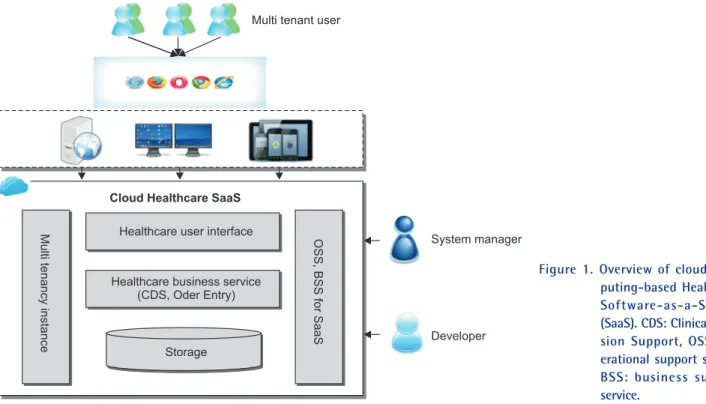
We defined HSP as a healthcare SaaS platform to provide a mobile, cloud-based modular EHR system. Figure 1 shows an overview of an HSP that utilizes cloud technology and in- frastructures. We analyzed the architecture requirements of HSPs, including the interface, business services, cloud SaaS, quality attributes, privacy and security, as well as multi- lingual capacity. The requirements for a cloud SaaS platform include operational support services (OSS), business support services (BSS), a service consumer portal, a service provider portal, a service development portal, and a cross platform framework for implementing cloud SaaS. The required qual- ity attributes include availability, performance, standardiza- tion, productivity, maintainability, and flexibility.
From the requirements, we selected the following factors that affect the system configuration, performance, and qual- ity as the major architecture drivers for HSP.
• It should support multi-tenant SaaS.
Figure 1. Overview of cloud com- puting-based Healthcare Software-as-a-Service (SaaS). CDS: Clinical Deci- sion Support, OSS: op- erational support service, BSS: business support service.
Multi tenant user
Cloud Healthcare SaaS
Healthcare user interface
Healthcare business service (CDS, Oder Entry)
Storage
Multitenancyinstance OSS,BSSforSaaS
System manager
Developer
• Only authorized users should be able to access the SaaS service.
• It should support accessibility by over three different mo- bile devices and platforms.
• It should support resource sharing based on cloud com- puting.
• It should provide functions to quickly catch errors and identify the causes of the errors.
• It should protect against system errors with comprehen- sive logging and monitoring.
• It should be easy to use.
• It should provide a stable service environment.
The user requirements of HSP include CDS services, order entry and display, immunization management, service avail- ability checking, host manger account, tenant account, host account, CDA master management, patient information management, and appointments/admission scheduling for small- and mid-sized hospitals.
1. Scope of Cloud-Based SaaS Healthcare Services For cloud-based SaaS services, we aimed to provide CDS content services, basic functional services, and mobile ser- vices as a cloud service to improve patient safety and quality of care in a hospital setting.
The CDS content service included tools and knowledge to aid medical staff in making clinical decisions and preventing medication-related errors, such as preventing the admin- istration of duplicate medications, preventing drug-allergy interactions, adhering to clinical guidelines, providing stan-
dard order sets, and linking to clinical knowledge resources.
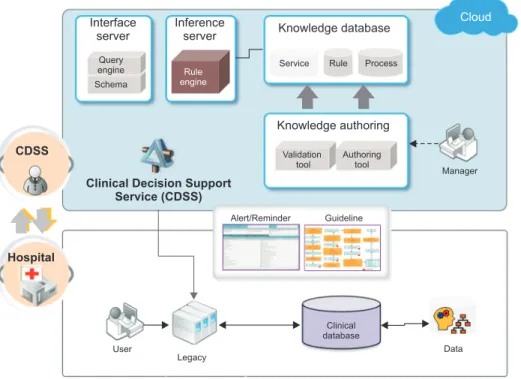
For the collecting and driving requirements of the CDS con- tent services, we analyzed required CDS functionalities of the HIMSS Analytics Electronic Medical Record Adoption Model (EMRAM) [8], Stage 2 Meaningful Use [9], and a Ko- rean tertiary general university hospital. Figure 2 shows how a Clinical Decision Support Service (CDSS) can be provided as a cloud-based SaaS. The system was designed to integrate the patient management or order entry legacy systems with the CDSS in the form of an SaaS that includes modules of knowledge authoring tools, knowledge and content databas- es, interface servers for advanced CDS, and interface servers for retrieving knowledge and contents.
Regarding basic functional services, we also incorporated fundamental services for patient management, appoint- ment management, and physician order entry into our cloud service for hospitals that do not have an electronic ordering system. These services are needed by non-digitalized hospi- tals to bring them up to date with CDS content services with low-cost maintenance.
Regarding mobile services, the CDS content services and basic functional services must be accessible via smart mobile devices, such as tablet PCs, smart phones, and PCs.
We considered international standards in the architecture design of the cloud-based HSP to achieve interoperability with heterogeneous legacy systems. We adopted the Health Level 7 (HL7) Infobutton standard and decision support ser- vice standard to provide context-aware knowledge retrieval services [10,11].
Figure 2. Overview of a cloud-based Clinical Decision Support Service (CDSS).
Interface server
Inference server Query
engine Schema
Rule engine
Knowledge database
Service Rule Process
Cloud
CDSS
Clinical Decision Support Service (CDSS)
Knowledge authoring
Validation tool
Authoring
tool Manager
Hospital
User
Legacy
Clinical database
Data Alert/Reminder Guideline
2. Cloud Computing Platform
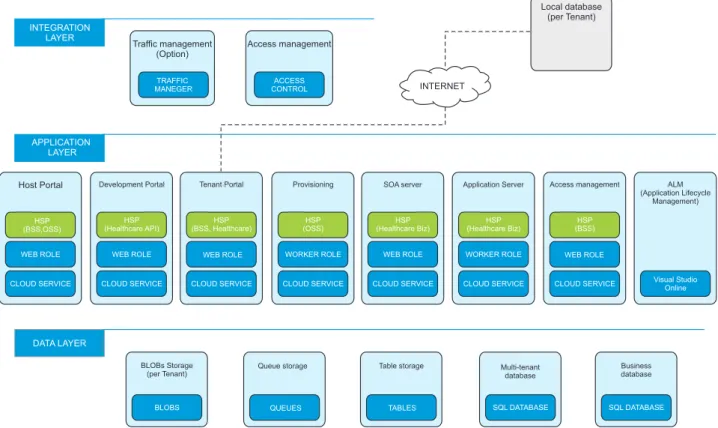
Because we focused on SaaS cloud computing, we used Microsoft’s Azure cloud computing for IaaS and PaaS. Mi- crosoft’s Azure was adopted because it has been evaluated as a leading cloud computing solution in terms of its compre- hensive features for application development and delivery and strategies [12]. We utilized platform & framework, man- agement, and SDK for PaaS, and we utilized virtualization, server, networking, and storage for IaaS. The Azure services that we utilized were the following: BLOB storage, Queue storage, Table storage, Database service, Cloud service-web role, Cloud service-worker role, Visual studio online, and Traffic manager. Thus, the HSP consisted of healthcare ser- vices for CDS and for basic functional services; data services for multi-tenancy and healthcare areas; cloud management services for cloud SaaS, such as OSS and BSS; and technical services for a cloud SaaS application development frame- work.
Mobile services were designed to provide high usability and availability of healthcare information services to medical staff through interactive web technology based on the Mo- bile Enterprise Application Platform (MEAP). This platform enables one source and multiple services for various mobile operating systems, such as iOS, Android, and Windows Mobile. The cross platform open-source .Net development framework MonoCross was utilized to develop a multi-
platform application.
3. Privacy and Security for Cloud-based Healthcare Services To provide reliable and secure access services to sensitive healthcare data, we reviewed governmental security and privacy regulations and security threats on cloud computing services, such as privileged user access, data location, data segregation, data sharing, account hijacking, and abuse of cloud services [13-16].
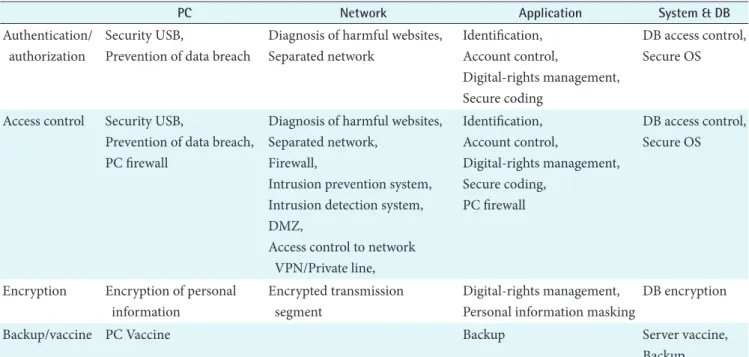
We then defined the security requirements for the develop- ment of a healthcare SaaS in terms of technical, administra- tive, and physical aspects, as shown in Table 1.
III. Results
1. Architecture of the Healthcare SaaS Platform (HSP) Figure 3 shows the architecture of the HSP based on the functional view of Microsoft’s Azure cloud computing ser- vice. It consists of a cloud service consumer (hospital), a cloud service provider, and a cloud service creator. The ser- vice consumer/provider portal and the API provide portals and APIs for the consumers, providers, and developers. Re- garding technical services, we incorporated a cross-platform UI framework for mobile applications, security for cloud computing services, a base framework for the development of business service, and a service-oriented architecture (SOA)
Table 1. Overview of technical security requirements
PC Network Application System & DB
Authentication/
authorization
Security USB,
Prevention of data breach
Diagnosis of harmful websites, Separated network
Identification, Account control,
Digital-rights management, Secure coding
DB access control, Secure OS
Access control Security USB,
Prevention of data breach, PC firewall
Diagnosis of harmful websites, Separated network,
Firewall,
Intrusion prevention system, Intrusion detection system, DMZ,
Access control to network VPN/Private line,
Identification, Account control,
Digital-rights management, Secure coding,
PC firewall
DB access control, Secure OS
Encryption Encryption of personal information
Encrypted transmission segment
Digital-rights management, Personal information masking
DB encryption
Backup/vaccine PC Vaccine Backup Server vaccine,
Backup
Common Password management, Multi-factor authentication, Patch management system, Vulnerability diagnosis and simulation hacking, Integrated log management, Security control
framework for exposing business services to web services.
Figure 4 shows the software view of the implemented HSP.
The HSP was designed with a layered architecture consisting of a data source, a data layer, a business layer, a service layer, a business process layer, and a presentation layer. External systems can be interfaced with the HSP using SOAP and REST/JSON.
2. Healthcare Services based on HSP
The healthcare services for the SaaS that we selected are listed in Table 2. The CDS services were categorized into rule- based services for medications, alert registration services,
and knowledge services. These services can be integrated with the legacy systems of each hospital, or they can be pro- vided with basic functional services on a cloud.
3. Cloud Configuration and Service Model
Because there are regulatory issues regarding the physical location of patients’ medical data, for example, patients’
medical data cannot be stored outside hospitals in South Korea, the multi-tenancy model of the HSP was designed as a shared database with separate schema for each tenant though a single application. Healthcare data can be physi- cally located on a cloud or in a hospital, depending on the
Figure 3. Architecture of the Health- care SaaS Platform (HSP):
functional view.
Cloud service consumer (Hospital)
Cloud service integration
tools
Consumer in-house IT
Cloud service provider Cloud services
BPaaS
Healthcare SaaS Clinical Decision
Support (CDS) Order entry
Patient management Appointment management
Common Cloud management platform Service provider portal & API
Serviceconsumerportal&API
Operational Support Service (OSS)
Provisioning Configuration Monitoring
Logging Service management
Administration
Business Support Service (BSS)
Tenant & User Management Authentication & authorization
Security Billing Metering Report & analytics Contracts & agreement
Customization Servicedevelopmentportal&API
Cloud Service Creator
Service creation tools
Technical services Cross platform
UI framework Securiry Base framework SOA framework Data services
Multi-tenant Master patient index Healthcare
PaaS Platform & framework Management SDK
IaaS Virtualization Server Networking Storage
Figure 4. Architecture of the Health- care SaaS Platform (HSP):
software view.
Healthcare client
IE, Chrome, Safari Windows, Android, iOS
External system SOAP REST/JSON
Development platform
Azure SDK ASP.NET MVC Visual Studio 2012 (MEAP) MonoCross
Windows 7 Healthcare
Cloud
Crosscutting Operationmanagement
Presentation
layer HTML5, CSS3, JavaScript, JQuery ASP.NET Data Modeling
Engine UI Framework
Interface
UI Components Classes Business process
layer Windows Workflow
Foundation (WWF) Service
layer
Healthcare Software Framework (HSF) Business Hosting Service
Windows Communication Foundation (WCF) Business
layer HSF.TechSvc2010.Server.ComBase.HSFBiz
Service .NET System Transaction
Data layer
HSF.TechSvc2010.Server.DAC.IDacBase
ODP.NET Data Helper
Security WindowsIdentityFoundation
Data
sources Oracle Azure storage
.NET Framework 4.0 Later Windows Server 2008 R2 Later
Operation platform
Visual Studio Online
Microsoft Azure
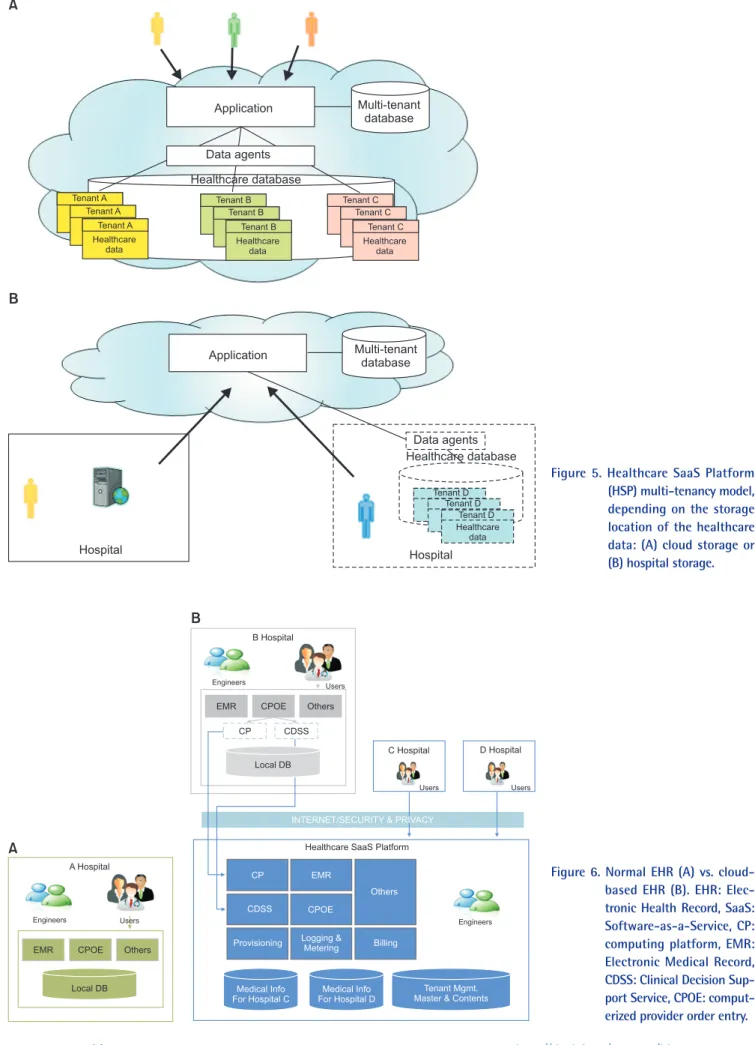
regulations. Figure 5 shows the HSP multi-tenancy model.
It incorporates a single application and a shared database.
Healthcare data can be managed by each tenant. A multi- tenant database is used to manage the tenant IDs for all ta- bles and views, with a shared database and a shared schema.
Figure 6 shows the difference between the system usage en- vironments of normal EHR and cloud-based EHR, indicat- ing that users and hospitals do not need to have knowledge and control of the underlying infrastructure when adopting cloud-based computing platform and CDS services. Cloud- based EHR allows self-provisioning and pay-as-you-use as the HSP provides the functions of provisioning, configura- tion, logging, service management, tenant & user manage- ment, metering, and billing.
The cloud configuration of the HSP using the infrastruc- ture and Microsoft’s Azure cloud computing platform are shown in Figure 7.
IV. Discussion
In light of the increasing demands for low-cost health infor- mation technologies and mobile accessibility in the health- care industry, in this study a cloud computing-based HSP was designed to support the development and integration of basic order entry functions, CDS services, and mobile ser- vices in a scalable and self-provisioning manner.
Regarding cloud-based healthcare information services, previous studies have reported the utilization of cloud computing, such as the development of a palm vein pattern recognition-based medical record system and medical imag- ing processing tools for emergency healthcare treatment in India [17], the development of an ECG tele-monitoring and tele-consultation system with ECG beat analysis [18-20], and the development of a CDS service and healthcare service for the diagnosis and management of chronic diseases [21]. In addition, a cloud-based HIS for exchanging information and medical images among hospitals and for the effective use of resources has been suggested [1,4]. Fernandez-Cardenosa et al. [22] proposed scenarios for the deployment of a cloud computing system for a large hospital and a network of primary care health centers. They proposed a hybrid EHR system that hosts images on hospital servers and the rest of the EHR system in the cloud, with the aim of sharing patient history and imaging processing tools among medical practi- tioners.
These studies have shown various uses of mobile and cloud computing technologies in the healthcare industry in terms of cost reduction and resource utilization, although data security is one of the challenging issues pertaining to cloud computing. This study addressed the technical architecture for a Microsoft Azure cloud computing-based HSP to imple- ment healthcare services as an SaaS, considering the integra- tion of legacy healthcare systems and cloud security issues.
We sought to provide various CDS services, such as rule- based services for medications, alert registration services, and knowledge services. Dixon et al. [23] performed a pilot test of a cloud-based CDS for preventive care reminders, which exchanged CDS knowledge between two healthcare providers, reporting issues regarding governance, semantic interoperability, and usability.
Our study is an ongoing project, and the HSP is in the stage of implementation. However, the HSP would be useful for small and mid-sized hospitals to adopt an information Table 2. Healthcare services based on the Healthcare SaaS
Platform (HSP)
Categorization Service
Clinical Decision Support services
Rule-based services for medications Overlapping prescriptions Drug-drug interactions Renal dosing guidelines Overdose prevention
Age contraindications (child, elderly) Pregnancy contraindications Breast feeding contraindications Drug-disease interactions Alert registration service Drug allergies Age
Pregnancy Breast feeding Knowledge service Drug information Order sets
Clinical pathway order sets Antibiotics guidelines Transfusion guidelines
Link to external knowledge resources Medication dose calculator
Basic functional services
Order entry Patient management Appointment management Order set management
Mobile services Access to all of the above healthcare services via various smart devices SaaS: Software-as-a-Service.
Figure 5. Healthcare SaaS Platform (HSP) multi-tenancy model, depending on the storage location of the healthcare data: (A) cloud storage or (B) hospital sto rage.
Application
Tenant A Healthcare
data
Application Multi-tenant database
Hospital
Data agents
Hospital
Healthcare database Tenant B
Healthcare data
Tenant C Healthcare
data
Tenant D Healthcare
data Tenant A
Tenant A
Tenant B Tenant B
Tenant C Tenant C
Tenant D Tenant D
A
B
Multi-tenant database
Data agents Healthcare database
Figure 6. Normal EHR (A) vs. cloud- based EHR (B). EHR: Elec- tronic Health Record, SaaS:
Software-as-a-Service, CP:
computing platform, EMR:
Electronic Medical Record, CDSS: Clinical Decision Sup- port Service, CPOE: comput- erized provider order entry.
A
B
B Hospital
Engineers Users
EMR CPOE Others
CP CDSS
C Hospital D Hospital
Healthcare SaaS Platform
CP
EMR
Logging &
Metering Billing
Medical Info For Hospital C
Tenant Mgmt.
Master & Contents
Users Users
A Hospital
Engineers
Engineers Users
CPOE Others
Local DB
EMR
CPOE CDSS
Others
Provisioning
Medical Info For Hospital D
INTERNET/SECURITY & PRIVACY Local DB
infrastructure and health information technology with low system operational and maintenance costs. By integrating the HSP with legacy systems, we expect that hospitals will be able to utilize up-to-date knowledge and various contents for CDS to improve patient safety and quality of care. Dur- ing implementation of the HSP-based CDS service and other healthcare services, challenges concerning performance, semantics interoperability, usability, and security should be further addressed in future work. In addition, the evaluation of HSP-based clouding healthcare services will be performed in terms of the cost-benefit analysis and usability of the CDS services.
Conflict of Interest
No potential conflict of interest relevant to this article was reported.
Acknowledgments
This work was supported by the Global Creative Software Program (14-824-10-018, Healthcare SaaS Development for Mid-sized Hospital Information System) funded by the Min- istry of Science, ICT and Future Planning (MSIP, Korea).
References
1. Kanagaraj G, Sumathi AC. Proposal of an open-source cloud computing system for exchanging medical images of a hospital information system. In: Proceedings of 2011 3rd International Conference on Trendz in Infor- mation Sciences and Computing (TISC); 2011 Dec 8-9;
Chennai, India. pp. 144-9.
2. Padhy RP, Patra MR, Satapathy SC. (2012). Design and implementation of a cloud based rural healthcare infor- mation system model. Univers J Appl Comput Sci Tech- nol 2012;2(1):149-57.
3. Yoon D, Chang BC, Kang SW, Bae H, Park RW. Adop- tion of electronic health records in Korean tertiary teaching and general hospitals. Int J Med Inform 2012;
81(3):196-203.
4. He C, Jin X, Zhao Z, Xiang T. A cloud computing solu- tion for hospital information system. In: Proceedings of 2010 IEEE International Conference on Intelligent Computing and Intelligent Systems (ICIS); 2010 Oct 29- 31; Xiamen, China. pp. 517-20.
5. Kagadis GC, Kloukinas C, Moore K, Philbin J, Papad- imitroulas P, Alexakos C, et al. Cloud computing in medical imaging. Med Phys 2013;40(7):070901.
6. Kaushal DS, Khan Y. Cloud computing services in med-
INTEGRATION LAYER
Traffic management (Option)
TRAFFIC MANEGER
Access management
ACCESS
CONTROL INTERNET
Local database (per Tenant)
APPLICATION LAYER
Host Portal
HSP (BSS,OSS)
WEB ROLE
CLOUD SERVICE
Development Portal
HSP (Healthcare API)
Tenant Portal
HSP (BSS, Healthcare)
Provisioning
HSP (OSS)
WORKER ROLE
SOA server
HSP (Healthcare Biz)
Application Server
HSP (Healthcare Biz)
Access management
HSP (BSS)
ALM (Application Lifecycle
Management)
Visual Studio Online
DATA LAYER
BLOBs Storage (per Tenant)
BLOBS
Queue storage
QUEUES
Table storage
TABLES
Multi-tenant database
SQL DATABASE
Business database
SQL DATABASE WEB ROLE
CLOUD SERVICE
WEB ROLE
CLOUD SERVICE
WEB ROLE
CLOUD SERVICE
WEB ROLE
CLOUD SERVICE CLOUD SERVICE
WORKER ROLE
CLOUD SERVICE
Figure 7. Cloud configuration using Microsoft’s Azure cloud computing platform and the Healthcare SaaS Platform (HSP).
ical healthcare solutions. Int J Res 2014;1(4):312-24.
7. Kuo AM. Opportunities and challenges of cloud com- puting to improve health care services. J Med Internet Res 2011;13(3):e67.
8. HIMSS Analytics. EMR Adoption Model 2014 [Inter- net]. Chicago (IL): HIMSS Analytics; 2014 [cited 2015 Apr 15]. Available from: http://www.himssanalytics.org/
emram/scoreTrends.aspx.
9. Centers for Medicare & Medicaid Services. Clinical de- cision support: more than just ‘Alerts’ tipsheet [Internet].
Baltimore (MD): Centers for Medicare & Medicaid Ser- vices; 2014 [cited 2015 Apr 15]. Available from: http://
www.healthit.gov/sites/default/files/clinicaldecisionsup- port_tipsheet.pdf.
10. Del Fiol G, Kawamoto K, Strasberg H, Cimino J, Mavi- glia S, Barr P, et al. Context-aware knowledge retrieval (infobutton) decision support service implementation guide [Internet]. Ann Arbor (MI): Health Level Seven International; 2010 [cited at 2015 Apr 15]. Available from: http://www.hl7.org/documentcenter/public/wg/
dss/Infobutton - DSS IG - 08-12-2010.docx.
11. Health Level Seven International. HL7 Version 3 Stan- dard: Decision Support Service (DSS), Release 1. Ann Arbor (MI): Health Level Seven International; 2011 [cited 2015 Apr 15]. Available from: http://www.hl7.
org/implement/standards/product_brief.cfm?product_
id=12.
12. Ried S, Rymer JR, Gilpin M, Magarie A, Anderson A.
The Forrester WaveTM: platform-as-a-service for app dev and delivery professionals, Q2 2011 [Internet]. Cam- bridge (MA): Forrester Research Inc.; 2011 [cited 2015 Apr 15]. Available from: https://www.forrester.com/The +Forrester+Wave+PlatformAsAService+For+App+De v+And+Delivery+Professionals+Q2+2011/fulltext/-/E- RES56710?objectid=RES56710.
13. Heiser J, Nicolett M. Assessing the security risks of cloud computing. Stamford (CT): Gartner Inc.; 2008.
14. Could Security Alliance. The Notorious nine: cloud computing top threats in 2013. [place unknown]: Cloud Security Alliance; 2013.
15. Catteddu D, Hogben G. Cloud computing: benefits, risks and recommendations for information security.
Heraklion: European Network and Information Security Agency; 2009.
16. Armbrust M, Fox A, Griffith R, Joseph AD, Katz RH, Konwinski A, et al. Above the clouds: a Berkeley view of cloud computing. Berkeley (CA): Department of Elec- trical Engineering and Computer Sciences, University of California at Berkeley; 2009.
17. Karthikeyan N, Sukanesh R. Cloud based emergency health care information service in India. J Med Syst 2012;36(6):4031-6.
18. Pandey S, Voorsluys W, Niu S, Khandoker A, Buyya R.
An autonomic cloud environment for hosting ECG data analysis services. Future Gener Comput Syst 2012;28(1):
147-54.
19. Hsieh JC, Hsu MW. A cloud computing based 12-lead ECG telemedicine service. BMC Med Inform Decis Mak 2012;12:77.
20. Fong EM, Chung WY. Mobile cloud-computing-based healthcare service by noncontact ECG monitoring. Sen- sors (Basel) 2013;13(12):16451-73.
21. Hussain M, Khattak AM, Khan WA, Fatima I, Amin MB, Pervez Z, et al. Cloud-based smart CDSS for chron- ic diseases. Health Technol 2013;3(2):153-75.
22. Fernandez-Cardenosa G, de la Torre-Diez I, Lopez- Coronado M, Rodrigues JJ. Analysis of cloud-based solutions on EHRs systems in different scenarios. J Med Syst 2012;36(6):3777-82.
23. Dixon BE, Simonaitis L, Goldberg HS, Paterno MD, Schaeffer M, Hongsermeier T, et al. A pilot study of dis- tributed knowledge management and clinical decision support in the cloud. Artif Intell Med 2013;59(1):45-53.