Printed in the Republic of Korea http://dx.doi.org/10.5012/jkcs.2014.58.1.85
Inhibiting Effect of Nicotinic Acid Hydrazide on Corrosion of Aluminum and Mild Steel in Acidic Medium
J. Ishwara Bhat* and Vijaya D. P. Alva†
Department of Chemistry, Mangalore University, Mangalagangotri, Karnataka, India. *E-mail: [email protected]
†Department of Chemistry, Shree Devi Institute of Technology, Karnataka, India (Received December 12, 2013; Accepted January 8, 2014)
ABSTRACT. The corrosion behavior of aluminum and mild steel in hydrochloric acid medium was studied using a nicotinic acid hydrazide as inhibitor by potentiodynamic polarization, electrochemical impedance spectroscopy technique and gravimetric methods. The effects of inhibitor concentration and temperature were investigated. The experimental results suggested, nico- tinic acid hydrazide is a good corrosion inhibitor for both aluminum and mild steel in hydrochloric acid medium and the inhi- bition efficiency increased with increase in the inhibitor concentration. The polarization studies revealed that nicotinic acid hydrazide exhibits mixed type of inhibition. The inhibition was assumed to occur via adsorption of the inhibitor molecules on the aluminum and mild steel surface and inhibits corrosion by blocking the reaction sites on the surface of aluminum.
Key words: Nicotinic acid hydrazide, Aluminum, Mild steel, Corrosion
INTRODUCTION
The subject of material corrosion has gained consider- able importance during the last few decades because of the increasing awareness of the enormous losses caused by corrosion damage. Many of the corrosion problems existing in the industries are due to the aggressive acid environment present which lead to the corrosion of respec- tive metals of constructions. Development of methods to control such corrosion is a challenge to chemists and sci- entists, working in this area.1
Corrosion of aluminum and mild steel in acidic aque- ous solutions is one of the major areas of concern in many industries where acids are widely used for applications such as acid pickling, acid cleaning, acid descaling and oil well acidizing. Due to the general aggressiveness of acid solu- tion the materials of construction are getting corroded easily.
A large number of methods have been employed to under- stand the practical problem of corrosion and its control.2−12 Among several methods devised to control metallic cor- rosion, the uses of inhibitors often remain the most prac- tical and cost effective means.13 It is possible to reduce the corrosion rate to a safe level by adding inhibitors which influence the kinetics of the electrochemical reactions and thereby modify the metal dissolution in acids. The corrosion inhibitors bring down the rate of corrosion to a greater extent, even when added in small quantities to the corrosive environment. The use of organic compounds to inhibit corrosion of metals in acidic environments is well estab-
lished.14−18 Most of the effective and efficient organic inhib- itors are those compounds that have π bonds and contain hetero atoms such as O, N, S and P which allow adsorp- tion on the metal surface.19,20 The organic inhibitors func- tion through adsorption on the metal surface blocking the active sites of metal dissolution and/or hydrogen evolu- tion, thus retarding overall rate of corrosion in aggressive environment.21
Although existing data show that, many organic inhibitors have good anticorrosive ability, some of them are highly toxic to both human beings and environment. The safety and environmental issues of corrosion inhibitors arisen in industries has always been of global concern. Due to this interest is still growing to exploit environmentally accept- able corrosion inhibitors. Hence the investigation of non- hazardous corrosion inhibitors is of great importance.
Nicotinic acid hydrazide is an important intermediate for the synthesis of organic and pharmaceuticals compounds and also useful as an antitubercular, antimicrobial and antimycobacterial agent. The aim of the present investi- gation is to study the effect of nicotinic acid hydrazide as a potential corrosion inhibitor for aluminum and mild steel in HCl medium.
EXPERIMENTAL
The A-63400 aluminum samples and IS-2062 mild steel samples were used for the corrosion study, whose chemical composition is as given in Table 1 and Table 2. Samples
were cut into an overall apparent size with dimensions 1×0.5×0.06 inch for aluminum and 1×0.3×0.06 inch for mild steel. Test materials were polished with different emery papers up to 1000 grade, cleaned with acetone, washed with double distilled water and properly dried prior to exposure. Analar grade HCl and double distilled water were used to prepare all solutions. Nicotinic acid hydrazide (F.W.
137.14) from Sigma Aldrich Corporation was used for the study.
Weight loss measurements were performed on alumi- num and mild steel coupons in 1 M hydrochloric acid solu- tion with different concentrations of the inhibitor. Weight loss of the aluminum and mild steel coupons was noted after an immersing period of 4 hours and 24 hours respec- tively.
Electrochemical tests were carried out with a CH-anal- yser model-CH1660D. The cell arrangement used was a conventional three electrode cell with platinum counter electrode, saturated calomel electrode as reference elec- trode and test material (Al/mild steel) as working elec- trode. The test material was covered by epoxy adhesive- araldite, so that only 1 cm2 area was in contact with the solution. Polarisation curves were recorded potentiody- namically at the scan rate of 1 mV/s, in the range of +250 mV
to −250 mV versus Open Circuit Potential (OCP). Imped- ance was measured over a frequency range of 1 MHz to 0.05 Hz using an amplitude of 10 mV peak to peak using AC signal. The surface of the aluminum and mild steel were analysed after the corrosion tests by an optical micro- scope and scanning electron microscope respectively.
RESULTS AND DISCUSSION
Polarisation Measurements
The electrochemical parameters like corrosion current density (icorr), corrosion potential (Ecorr), corrosion rate (C.R) and inhibition efficiency (I.E%) values calculated from potentiodynamic polarization measurements of alu- minum and mild steel in 1M HCl containing various con- centrations of the nicotinic acid hydrazide at 303 K are given in Table 3 and Table 4 respectively.
The inhibition efficiency (I.E%) is calculated by the fol- lowing equation:22
I.E (%) = (1− ) × 100 (1)
where, where i'corr and icorr are the corrosion currents in the presence and absence of the inhibitor respectively.
icorr′ icorr --- Table 1. Chemical composition of A-63400
Element Cu Mg Si Fe Mn Zn Cr Tl Al
wt% 0.1 0.4−0.9 0.3−0.7 0.6 0.3 0.2 0.2 0.1 Remainder (96.9−97.8%)
Table 2. Chemical composition of IS-2062
Element C Mn S P Si Fe
wt% 0.18 0.6 0.05 0.04 0.1 Remainder (99.03%)
Table 3. Experimental electrochemical parameters for corrosion of aluminum in 1 M HCl solution in the presence of at 303 K by polar- ization method
Inhibitor (ppm) icorr × 10−3 (A) CR ×103 (mil/year) Ecorr (mV) βa (V/dec) βc (V/dec) I.E (%)
0 41.97 17.99 −760 0.196 0.215 −
10 7.179 3.077 −762 0.183 0.176 82.89
50 3.18 1.363 −757 0.165 0.165 92.42
100 2.79 1.196 −762 0.162 0.180 93.35
250 1.406 0.6026 −768 0.140 0.161 96.64
Table 4. Experimental electrochemical parameters for corrosion of mild steel in 1 M HCl solution in the presence of inhibitor at 303 K by polarization method
Inhibitor (ppm) icorr (mA) CR ×102 (mil/year) Ecorr (mV) βa (V/dec) βc (V/dec) I.E (%)
0 2.81 13.2 −511 0.196 0.136 −
50 0.92 4.19 −501 0.143 0.130 67.29
100 0.73 3.31 −505 0.141 0.116 74.19
250 0.55 2.49 −501 0.127 0.115 80.56
500 0.24 1.08 −504 0.128 0.134 91.59
Corrosion Rate (C.R) in MPY (mils penetration per year) is calculated using:23
C.R = K (2)
where, a is the atomic weight of the metal, i is the current density in A/cm2, n is the number of electrons lost, D is the density in g/cm3 and K is a corrosion constant depending on the unit of corrosion rate( for MPY, K = 1.288×10⁵).
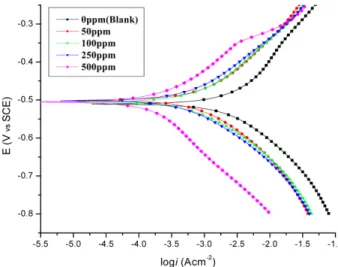
Fig. 1 and Fig. 2 show the potentiodynamic polariza- tion curves for aluminum and mild steel respectively, in 1 M HCl containing various concentrations of the inhib- itor at 303 K. The addition of the inhibitor to the acid solu- tion shifts anodic polarization curves to more positive
values and cathodic polarization curves to more negative values. The increase in the concentration of the inhibitor increased the polarization shift. The corrosion current (icorr) was found to decrease with increase in inhibitor concen- tration indicating, the increased inhibition efficiency with the increase in the concentration of the inhibitor. In the present study, the displacement in the corrosion potential (Ecorr) in the presence of the inhibitor is only around 10 mV than in its absence, which indicates that the inhib- itor under consideration is a mixed type inhibitor. It means that the addition of the inhibitor reduced anodic dissolution of the metal as well as hydrogen evolution. Tafel slopes of both anodic and cathodic (βa and βc) reaction also varied on adding inhibitor to the solution indicating inhibitor worked as mixed type inhibitor and inhibiting action of the compound is merely blocking adsorption mechanism.24
Electrochemical Impedance Spectroscopic Measure- ments (EIS)
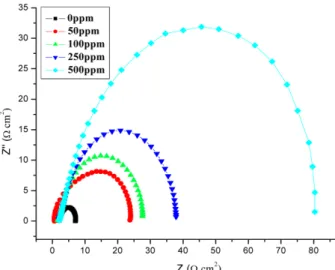
The EIS provides a rapid and convenient way to inves- tigate the performance of the organic-coated metals and has been widely used in corrosion studies. The corrosion of aluminum and mild steel in 1 M HCl was investigated by EIS method. The EIS data obtained are analysed using the equivalent circuit model (Fig. 3) which includes the solution resistance Rs which is placed in parallel to the charge transfer resistance Rt due to the charge transfer reaction and the double layer capacitance Cdl. The Nyquist plot for aluminum and mild steel in the absence and pres- ence of nicotinic acid hydrazide at 303K are presented in Figs. 4 and 5 respectively.
Nyquist plots contain depressed semicircle with centre under real axis. The size of the semicircle increases with the inhibitor concentration, indicating the charge transfer process as the main controlling factor of the corrosion of aluminum.25 It is clear from the figure that shapes of the impedance plots for inhibited specimen are not substantially different from those of uninhibited ones and the imped- ance of the inhibited solution increased with the increase in the concentration of the inhibitor but did not change the other aspect of the behavior.26
ai nD---
Figure 1. Plot of E vs log i for corrosion of aluminium in 1 M HCl solution at 303 K containing various concentrations of inhibitor.
Figure 2. Plot of E vs log i for corrosion of mild steel in 1 M HCl solution at 303 K containing various concentrations of
inhibitor. Figure 3. Electrical equivalent circuit used to fit the EIS data.
The experimental results of EIS measurements for the corrosion of aluminum and mild steel in 1 M HCl in the absence and presence of inhibitor are given in Table 5 and Table 6 respectively. It can be observed that charge transfer resistance (Rt) value increased with increase in the con-
centration of the inhibitor. On the other hand values of the capacitance of the interface (Cdl) started decreasing, with increase in inhibitor concentration, which is most probably due to the decrease in local dielectric constant and/or increase in thickness of the electrical double layer. This suggests that the inhibitor acts via adsorption at interface between metal and solution27 and the decrease in the Cdl values is due to the gradual replacement of water molecules by the adsorption of the inhibitor molecules on the electrode sur- face, which decreases the extent of metal dissolution.28
The inhibition efficiency is given by the following equa- tion:29
I.E (%) = ×100 (3)
where, Rt is charge transfer resistance without inhibitor, and Rt(inhi) is charge transfer resistance with inhibitor.
Cdl value is obtained from the Eq. (4):
Cdl = (4)
where, fmax is the frequency at the top of the semicircle (where, Z" is maximum).
Gravimetric Studies
The weight loss results of aluminum and mild steel in 1 M hydrochloric acid in the absence and presence of var- ious concentrations of the inhibitor are summarized in Table 7 and Table 8 respectively. The inhibition efficiency30 was calculated using equation (5).
Rt inhi( )–Rt Rt inhi( ) ---
1 2πfmaxRt --- Figure 4. Nyquist plots for corrosion of aluminium in 1 M HCl
solution at 303 K containing various concentrations of inhibitor.
Figure 5. Nyquist plots for corrosion of mild steel in 1 M HCl solution at 303 K containing various concentrations of inhibitor.
Table 5. AC impedance data of Al in 1M HCl solution in the pres- ence of inhibitor at 303 K
[Inhibitor]/ppm Rt (Ωcm2) I.E (%) cdl (µFcm2)
0 5.74 − 88.77
10 19.39 70.39 70.07
50 39.09 85.30 42.80
100 74.65 92.30 39.21
250 92.78 93.80 37.25
Table 6. AC impedance data of mild steel in 1 M HCl solution in the presence of inhibitor at 303 K
[Inhibitor]/ppm Rt (Ωcm2) I.E (%) cdl (µFcm2)
0 7.17 − 318.4
50 23.96 70.07 228.3
100 27.78 74.19 218.4
250 37.96 81.11 210.8
500 80.06 91.04 138.5
Table 7. Corrosion parameters for aluminum after 4 hours of immer- sion in 1 M hydrochloric acid in the absence and presence of dif- ferent concentrations of the inhibitor at 303 K
[Inhibitor]/ppm Weight loss (mg cm−2) I.E (%)
0 23.72 −
10 6.52 72.5
50 3.99 83.2
100 2.45 89.7
250 1.89 91.9
I.E (%) = ×100 (5)
where W1 and W2 are weight loss of aluminum or mild steel in the presence and absence of the inhibitor respec- tively. The inhibition efficiency increased with increase in the concentration of the inhibitor. Results obtained from polarization, EIS and weight loss measurements are in good agreement with each other.
Effect of Temperature
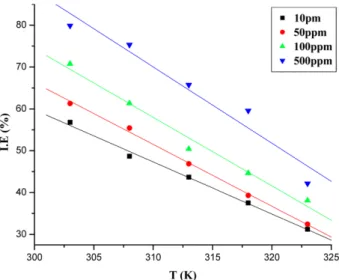
To elucidate the mechanism of inhibition and to deter- mine the thermodynamic parameters of the corrosion pro- cess weight loss measurements were performed at various temperatures. The effect of temperature on the corrosion inhibition of aluminum and mild steel in the presence of the various concentrations of the inhibitor is graphically represented in Fig. 6 and Fig. 7 respectively. The inhibition efficiency decreased with increase in temperature indi- cating physisorption of the inhibitor on the metal surface.
The reduced inhibition efficiencies of the inhibitors with increasing temperature may be due to the desorption of
some adsorbed molecules from the surface of aluminum and mild steel at higher temperature. At higher tempera- ture desorption predominates over adsorption. Therefore less number of inhibiting species are adsorbed on the sur- face of the aluminum and hence higher number H+ ions attacks the surface of aluminum due to the availability of more active centers.
Surface Study by Optical Microscopy and Scanning Electron Microscopy
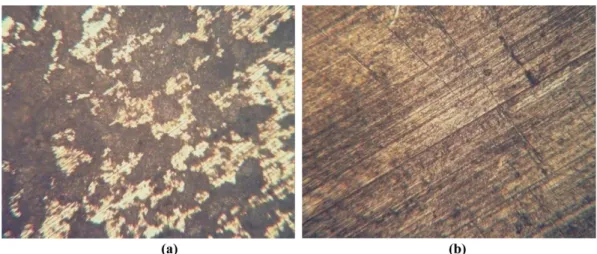
In order to evaluate the conditions of the metal surface in contact with acid solution in the absence and presence of inhibitor, microscopic analysis of the surface was car- ried out immediately after the corrosion tests using optical microscope and scanning electron microscope for alumi- num and mild steel respectively. The aluminum and mild steel samples in 1 M HCl solution with and without opti- mal concentration of the inhibitor were subjected to anal- ysis. Micrographs shown in Fig. 8 and Fig. 9 show that the surface corrosion of aluminum and mild steel decreased remarkably in the presence of the inhibitor. Inspection of the figures reveals that there is severe damage, clear pits and cavities on the surface of aluminum and mild steel in the absence of inhibitor than in its presence. This con- firms that the metal surface is fully covered with adsorbed inhibitor molecules.
Mechanism of Corrosion Inhibition
Aluminum surface is positively charged at pH corre- sponding to 2.0 M HCl and 1.0 M HCl.31 Therefore, Cl anions of hydrochloric acid is specifically adsorbed on W2–W1
W2 ---
Table 8. Corrosion parameters for mild steel after 24 hours of immersion in 1 M hydrochloric acid in the absence and presence of different concentrations of the inhibitor at 303 K
[Inhibitor]/ppm Weight loss (mg cm−2) I.E (%)
0 127.52 −
50 48.10 62.22
100 37.96 70.22
250 30.27 76.26
500 21.85 82.86
Figure 6. Plot of I. E vs T for corrosion of aluminium in 2 M HCl in the presence of different concentrations of inhibitor using weight loss method.
Figure 7. Plot of I.E vs T for corrosion of mild steel in 1 M HCl in the presence of different concentrations of inhibitor using weight loss method.
aluminum and mild steel surface, making it negatively charged as (AlCl−)adsand(FeCl−)ads species respectively.
In hydrochloric acid medium, studied inhibitor nico- tinic acid hydrazide tend to exist in the form of cation, due to the protonation of nitrogen atom of pyridine ring. The protonation may also occur at nitrogen atom of the hydrazide group as shown in Fig. 10.
The protonated inhibitors may be adsorbed on the sur- face of the aluminum and mild steel through electrostatic interaction between positively charged inhibitor and negatively charged aluminum surface. The possible electrostatic inter- action between the metal and the inhibitor is shown in Fig. 11(a).
The adsorption of the inhibitor on the aluminum and mild steel surface may also be due to the interaction of the Figure 8. Optical micrographs of surface of aluminium in (a) only 1 M HCl (b) 1 M HCl with 250 ppm of the inhibitor.
Figure 9. Scanning electron micrographs of surface of mild steel in (a) only 1 M HCl (b) 1 M HCl with 500 ppm of the inhibitor.
Figure 10. Protonation of nicotinic acid hydrazide in HCl (1 M/
2 M) medium.
Figure 11. (a) Adsorption of nicotinic acid hydrazide on metal surface by electrostatic interaction, (b) Adsorption of nicotinic acid hydrazide on metal surface by π-interaction.
π- electrons of the inhibitor with vacant orbitals of the alu- minum and mild steel as shown in Fig. 11(b).
CONCLUSION
The weight loss, potentiodynamic polarization and imped- ance studies of the corrosion behaviour of aluminum and mild steel in the hydrochloric acid medium showed that nicotinic acid hydrazide acted as good inhibitor for the corrosion of aluminum and mild steel. The inhibition efficiency was more pronounced with the increase in the inhibitor concentration. Polarization studies suggested that the inhibitor inhibited both anodic and cathodic reactions of corrosion thus exhibited mixed type of inhibition. Inhibition efficiency for the corrosion of the aluminum and mild steel decreased with the increase in temperature in the studied tempera- ture range indicating physisorption of the inhibitor on the metal surface.
Acknowledgments. The publication cost of this paper was supported by the Korean Chemical Society.
REFERENCES
1. Jones, D. A. Principles and Prevention of Corrosion; Pren- tice Hall: New York, 1996.
2. Jyotsna, S.; Pitre, K. S. Bull. Electrochem. 2004, 20, 309.
3. Bereket, G.; Ogretir, C.; Yurt, A. J. Mol. Struct. 2001, 571, 139.
4. Du, T.; Chen, J.; Cao, D. J. Mater. Sci. 2001, 36, 3903.
5. Branzoi, V.; Florentian, G.; Florina, B. Mater. Chem. Phys.
2003, 78, 122.
6. Obot, I. B.; Obi-Egbedi, N. O.; Umoren, S. A. Corros. Sci.
2009, 51, 1868.
7. Zerfaoui, M.; Oudda, H.; Hammouti, B.; Kertit, S. Prog.
Org. Coat. 2004, 51, 134.
8. Mohamed Awad K., J. Electroanal. Chem. 2004, 567, 219.
9. Ramesh, S. V.; Vasudeva, A. A. Corros. Sci. 2008, 50, 55.
10. Bastidas, J. M.; Polo, J. L.; Cano, E. J. Appl. Electrochem.
2000, 10, 1173.
11. Tamil, S. S.; Raman, V.; Rajendran, N. J. Appl. Electro- chem. 2003, 33, 1175.
12. Solmaz, R.; Kardas, G.; Culha, M.; Yazici, B.; Erbil, M.
Electrochim. Acta 2008, 53, 5941.
13. Schmitt, G. Bri. Corros. J. 1984, 19, 165.
14. Hasanov, R.; Sadikoglu, M.; Bilgic, M. Appl. Surf. Sci.
2007, 253, 3913.
15. Chetouani, A.; Hammouti, B.; Benhadda, T.; Daoudi, M.
Appl. Surf. Sci. 2005, 249, 375.
16. Yildirim, A.; Cetin, M. Corros. Sci. 2008, 50, 155.
17. Obot, I. B.; Obi-Egbedi, N. O. Colloids Surf. A Physio- chem. Eng. Ascepts 2008, 330, 207.
18. Khaled, K. F.; Al-Qahtani, M. M. Matter. Chem. Phys.
2009, 113, 150.
19. Ma, H.; Song, T.; Sun, H.; Li, X. Thin Solid Films 2008, 516, 1020.
20. Ju, H.; Kai, Z. P.; Li, Y. Corros. Sci. 2008, 50, 865.
21. Ebenso, E. E. Mater. Chem. Phys. 2003, 79, 58.
22. Emrgul, K. C.; Akay, A. A.; Atakol, O. Mater. Chem.
Phys. 2005, 93, 325.
23. Zerga, B.; Attayibat, A.; Sfaira, M.; Taleb, M.; Hammouti, B.; Ebn, T. M.; Radi, S.; Rais, Z. J. Appl. Electrochem.
2010, 40, 1575.
24. Xiang-Hong, L.; Shu-Dhuan, D.; Hui, F. J. Appl. Elec- trochem. 2010, 40, 1641.
25. Sekin, I.; Sabongi, M.; Hagiuda, H.; Oshibe, T.; Yuasa, M.; Imahc, T.; Shibata, Y.; Wake, T. J. Electrochem. Soc.
1992, 139, 3167.
26. Poornima, T.; Jagannath, N.; Nityananda, S. A., J. Appl.
Electrochem. 2010, 41, 223.
27. Aljourani, J.; Raeissi, K.; Golozar, M. A. Corros. Sci. 2009, 51, 1836.
28. Khaled, K. F. Electrochim. Acta. 2003, 48, 2493.
29. Cruz, J.; Martinez, R.; Genesca, J.; Garcia-Ochoa, E. J.
Electroanal. Chem. 2004, 566, 111.
30. QiBo, Z.; YiXin, H. Mater. Chem. Phys. 2010, 119, 57;
Khaled K. F. Corros. Sci. 2010, 52, 2905.