Printed in the Republic of Korea
요약. 밀도 함수이론을 사용해 철 부식 방지제로써 메톨(N-메틸-p-아미노페놀 설페이트)에 대한 기하 학적 및 전자구조에 대한 연구가 처음으로 기술되었다. B3LYP/6-31G+(d,p) 기저세트를 사용해 기상 및 액상에서 HOMO, LUMO, 에너지갭 (∆E), 멀리칸하전 (qM), 자연원자하전 (qn)과 같은 양자화학적 변수 들이 계산되었다. 부식방지메카니즘을 이해하기 위해 부식방지효율과 양자화학적 변수들간의 연관성 이 논의되었다.
주제어: 메톨, 부식, 방지, 밀도함수이론
ABSTRACT. Described here for the first time is an investigation on geometrical and electronic molecular structure of metol (N-methyl-p-aminophenol sulphate) as corrosion inhibitor of steel using density functional theory (DFT) calculations. Quantum chemical parameters such as highest occupied molecular orbital energy (EHOMO), lowest unoccupied molecular orbital energy (ELUMO), energy gap (∆E), Mulliken charges (qM) and natural atomic (qn) charge have been calculated both for gas and aqueous phases by using B3LYP/6-31G+(d,p) basis set. The relation between the inhibition efficiency and quantum chemical parameters have been discussed in order to elucidate the inhibition mechanism of the title compound.
Keywords: Metol, Corrosion, Inhibitor, Density functional theory
강철 부식 방지제인 메톨에 대한 이론적 계산
Gökhan Gece*
Department of Physical Chemistry, Faculty of Science, Ankara University, Beşevler 06100 Ankara, Turkey (접수 2009. 9. 1; 수정 2009. 10. 27; 게재확정 2009. 11. 10)
Theoretical Calculations of Metol as Corrosion Inhibitor of Steel
Gökhan Gece*
Department of Physical Chemistry, Faculty of Science, Ankara University, Beşevler 06100 Ankara, Turkey
*E-mail: [email protected]
(Received September 1, 2009; Revised October 27, 2009; Accepted November 10, 2009)
INTRODUCTION
Corrosion is the destructive attack of metal or alloy chemically or electrochemically against its en- vironment which leads to loss of useful properties of materials.1 The protection of metals against corro- sion can be achieved by adding inhibitors in small concentrations to its environment.2
A survey of literature presents the applicability of organic compounds, particularly those containing O, S and/or N atoms in their long carbon chain/aro- matic structure, as corrosion inhibitors for mild steel in acidic media.3 Among these compounds, metol
(N-methyl-p-aminophenol sulphate) has attracted much attention since it has been successfully used as a photographic developer,4,5 analgesic-antipyretic agent,6,7 and corrosion inhibitor.8
Although experimental work9 provide valuable information on the corrosion inhibition efficiency of metol, a deep understanding of the inhibition proper- ty remains unclear. The advancements in computer simulation techniques hold promise that questions regarding the inhibitive properties of such compo- unds can be addressed at the atomic level. Hence, more corrosion studies contain substantial quantum chemical calculations in recent years.10 To date, how-
Fig. 1. The molecular structure of metol.
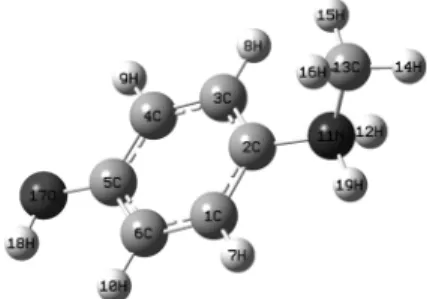
Fig. 2. Optimized structure of metol.
ever, no study has been performed to investigate the corrosion inhibition efficiency of metol by using quantum chemical calculations.
The objective of the present paper is to study the effect of structural parameters of metol on its inhibi- tion efficiency of corrosion of steel by using density functional theory (DFT) methods. Molecular orbital calculations are performed looking for good theore- tical parameters to characterize the inhibition property of inhibitor, which will be helpful to gain insight into the mechanism of the corrosion inhibition.
COMPUTATIONAL METHOD Among quantum chemical methods for evalua- tion of corrosion inhibitors, density functional theory (DFT) has some merits.11 B3LYP, a version of the DFT method that uses Becke’s three-parameter functional (B3) and includes a mixture of HF with DFT exchange terms associated with the gradient corrected correlation functional of Lee, Yang, and Parr (LYP).12
It has been shown that the B3LYP functional correctly reproduces not only the thermochemical properties of atoms and molecules, for which it has been designed, but also the ground state of strongly correlated electronic systems.13,14 Besides, it has much less convergence problems than those co- mmonly found for pure DFT methods. Thus, B3LYP was used in this paper to carry out the calculations.
Full geometry optimization of the title compound was carried out at the B3LYP/6-31G+(d,p) level, both in the gas and aqueous phases, using the Gau- ssian 03 software package.15
In the process of geometry optimization for the fully relaxed method, convergence of all the calcula- tions and the absence of imaginary values in the wavenumbers confirmed the attainment of local minima on the potential energy surface. Some cha- racteristics of the electronic structure were studied using natural bond orbital (NBO)16 and Mulliken17 population analysis. The details of the outermost valance electrons were obtained through the analysis of the highest occupied and lowest unoccupied molecular orbitals (HOMO and LUMO).
RESULTS AND DISCUSSION Metol is a derivative of 4-aminophenol which exists as half-salt complex cation in acidic media.18 Since the free compound is unstable in air and light, it is usually marketed as the sulfate salt. It contains amino and hydroxyl groups attached to a benzene ring (Fig. 1). The benzene ring is strictly planar and the hydroxyl oxygen atom and the amine nitrogen lie in the benzene plane (Fig. 2).
Calculated geometric parameters are listed in Table 1 along with the experimental data. When the X-ray structure of the title compound is compared with its optimized counterpart, no significant confor- mational discrepancies are observed between them.
The bond distances and bond angles concerning the carbon, oxygen and nitrogen atoms calculated by DFT calculation at B3LYP/6-31+G(d,p) level of theory agree satisfactorily with the values found in X-ray cristallographic data.19 The average distances of N(11)-C(2) (1.47 Å) correspond to typical carbon- nitrogen single bonds (1.42 ~ 1.47 Å),20,21 and N(11)- C(13) bond length (1.50 Å) is longer than pure carbon-nitrogen single bond due to the excess po- sitive charge which leads to a repulsion between N and C atoms. The bond angles range from 116o to 123o around the C sites, from 115o to 120o around the N sites, and from 117o to 122o around the O sites.
The bond angle of N(11)-C(2)-C(1) close to 120o
Table 1. Optimized and experimental geometric para- meters of the title compound in the ground state
Calculated (6-31+G(d,p)) Experi- mentalb Gas phase
(ε = 1.0)
Aqueous phase (ε = 78.39) Bond lengths (Å)a
17O-5C 1.38 1.39 1.37
5C-6C 1.41 1.44 1.39
4C-5C 1.40 1.39 1.39
4C-3C 1.39 1.46 1.40
6C-1C 1.39 1.44 1.40
3C-2C 1.42 1.41 1.38
2C-11N 1.46 1.48 1.46
11N-13C 1.49 1.50 1.50
Bond angles (o)a
13C-11N-2C 117 115 117
11N-2C-1C 120 118 118
11N-2C-3C 119 118 120
2C-3C-4C 119 116 119
3C-4C-5C 120 120 119
2C-1C-6C 120 119 119
1C-6C-5C 120 118 119
4C-5C-6C 120 123 122
6C-5C-17O 122 120 121
4C-5C-17O 118 117 117
aFor numeration please see Fig. 2. bValues from Ref. 19.
Table 2. Atomic charges (e) of the title compound Atoms
qM qn
Gas phase Aqueous
phase Gas phase Aqueous phase
C1 0.3734 0.3608 0.2939 0.2723
C2 -2.3625 -0.0049 -0.0543 -0.0515
C3 0.7001 0.4253 0.4184 0.4132
C4 -0.1402 -0.0175 -0.3325 -0.3196 C5 -0.0942 -0.0079 -0.2996 -0.2787 C6 -0.2468 -0.1811 -0.4238 -0.4196
H7 0.1246 0.1373 0.2197 0.2186
H8 0.1323 0.1298 0.2206 0.2192
H9 0.1353 0.1229 0.2422 0.2415
H10 0.1097 0.1237 0.2214 0.2167
N11 0.5398 0.5351 0.6104 0.5958
H12 0.2450 0.4308 0.3483 0.3416
C13 -0.1697 -0.2066 -0.4897 -0.4656
H14 0.1807 0.1881 0.2363 0.2197
H15 0.1779 0.1941 0.2636 0.2628
H16 0.1770 0.1924 0.2575 0.2535
O17 -0.5369 -0.6497 -0.7022 -0.6978
H18 0.3506 0.4219 0.4766 0.4742
H19 0.3038 0.4317 0.4307 0.4209
as well as the bond length of N(11)-C(2) (1.47 Å) confirm the sp2 hybridization of carbon atom. In general, most of the optimized bond lengths are found to be slightly longer than the experimental ones due to the existence of crystal field in the solid state which connects molecules together with the intermolecular interactions.
Although the charge on an atom in a molecule is not a physical observable, the atomic charge concept can offer insights into a variety of phenomena. A number of schemes for assigning charges to atoms within a molecule have been developed. Perhaps the most widely used of these is the Mulliken charge (qM), although the simple design of this measure brings with it potential problems.22 The natural charge (qn) derived from natural population analysis (NPA)23 is a theoretically cleaner approach which avoids many of the potential pitfalls associated with qM. In previous studies,24-26 it is confirmed that in- tense total charge density distribution on a molecule
enhances the possibility of that molecule to adsorb more strongly on the metal surface. Thus, inhibition efficiency of metol can be explained in terms of the atomic charges.
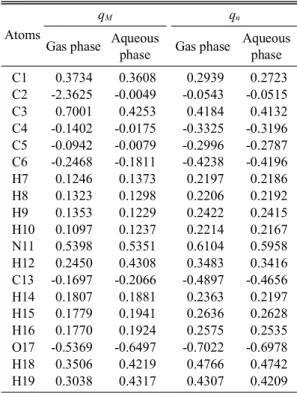
The Mulliken (qM) and natural (qn) atomic charges for the title compound calculated at B3LYP/6-31+G (d,p) level in both gas and aqueous phases are pre- sented in Table 2. It can be seen from this table that the natural charges of the O17 atom and carbon atoms of benzene ring (C4, C5 and C6) have bigger negative atomic charges. The O17 atom possesses a considerable excess of electrons, implying that it is the most favourable site for interaction with the metal surface. Also C13 atom is substantially charg- ed, but it is passivated with H atoms. A high positive charge on the nitrogen atom of amino group appears to be necessary to prevent the excess amount of negative charge from accumulating on the metal atom. Because of this balancing, carbon atoms of benzene ring are negatively charged. Consequently, these positive and negative charges fulfill the opti- mum conditions for interaction of metol with steel surface.
HOMO
LUMO
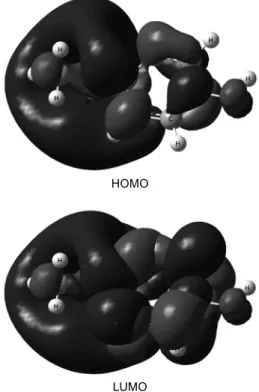
Fig. 3. Molecular orbital surfaces for HOMO and LUMO of metol computed at B3LYP/6-31+G(d,p).
The inhibition effect of inhibitor compound is usually ascribed to adsorption of the molecule on metal surface. There can be physical adsorption (phy- sisorption) and chemical adsorption (chemisorption) depending on the adsorption strength. When chemi- sorption takes place, one of the reacting species acts as an electron pair donor and the other one acts as an electron pair acceptor, so the energies of the frontier molecular orbitals should be considered.
The reactive highest occupied molecular orbital (HOMO) and lowest unoccupied molecular orbital (LUMO) of any molecule are referred to as frontier molecular orbitals, after the pioneering work of Fukui.27
Terms involving the frontier molecular orbitals could provide dominative contribution, because of the inverse dependence of stabilization energy on orbital energy difference.28 Moreover, the gap bet- ween the HOMO and LUMO energy levels of the molecules was another important factor that should be considered. Fig. 3 shows the distributions and energy levels of the HOMO and LUMO orbitals computed at the B3LYP/6-31+G(d,p) level for the title compound. Reportedly, excellent corrosion in- hibitors are usually those organic compounds who not only offer electrons to unoccupied orbital of the metal, but also accept free electrons from the metal.10
High values of EHOMO have a tendency of the molecule to donate electrons to appropriate acceptor molecules with low energy, empty molecular orbi- tals. Increasing values of EHOMO facilitate adsorption and therefore enhance the inhibition efficiency, by influencing the transport process through the adsorb- ed layer.29 Similar relations were found between the corrosion rates and ∆E = ELUMO – EHOMO.30-33 The energy of the lowest unoccupied molecular or- bital indicates the ability of the molecule to accept electrons. The lower the value of ELUMO, the more probable it is that the molecule would accept elec- trons. Consequently, lower values of the energy diffe- rence (∆E) will render good inhibition efficiency, because the energy to remove an electron from the last occupied orbital will be low.
Based on the discussions above, it is useful to compare the electronic properties of metol with
those of 2-aminophenol34 and 3-aminophenol,35 which have been previously reported to act as effec- tive corrosion inhibitors for aluminium and mild steel, respectively. For this purpose, the computa- tional data on aminophenols recently published by Abrahão et al.36 have been used for the sake of comparison.
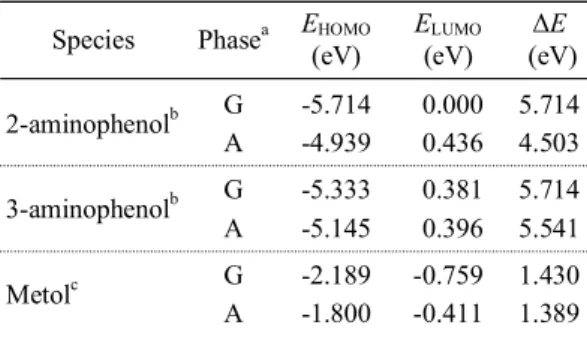
In Table 3, certain quantum chemical parameters related to the molecular electronic structures of 2- aminophenol, 3-aminophenol and metol are pre- sented, such as: EHOMO, ELUMO and ∆E = ELUMO – EHOMO. The calculated data for 2-aminophenol, 3- aminophenol and metol in gas phase and the results of aqueous phase calculations have been compared.
In all cases, higher values of HOMO energy and lower values of energy gap (∆E) have been obtained for aqueous phase calculations of these compounds.
It could be readily seen from Table 3, metol shows a relative higher value of HOMO energy and a lower value of LUMO energy considering the results of both gas and aqueous phase calculations, which is
Table 3. Orbital energies for HOMO and LUMO, the HOMO-LUMO energy gap (∆E) of 2-aminophenol, 3- aminophenol and metol
Species Phasea EHOMO
(eV)
ELUMO
(eV)
∆E (eV) 2-aminophenolb G -5.714 0.000 5.714
A -4.939 0.436 4.503
3-aminophenolb G -5.333 0.381 5.714
A -5.145 0.396 5.541
Metolc G -2.189 -0.759 1.430
A -1.800 -0.411 1.389
aG: gas phase (ε = 1.0), A: aqueous phase (ε = 78.39). bGas phase data calculated at (6-31+G(d) level taken from Ref. 36.
cGas andaqueous phase data calculated at (6-31+G(d,p) level.
Table 4. Second-order perturbation theory analysis of the Fock matrix in natural bond orbital (NBO) basis, calculated at B3LYP/6-31+G(d,p) level
Donor orbital (i)
Acceptor orbital (j)
εj-εi
(a.u.)a Fij
(a.u.)b
E(2) (kcal/mol)c LP(1) O17 BD*(1) 1.13 0.067 2.49
C5-C6
LP(2) O17 BD*(2) 0.36 0.087 11.93 C4-C5
aEnergy difference between donor and acceptor i and j NBO orbitals. bFock matrix element between i and j NBO orbitals.
cEnergy of hyper conjugative interactions.
in favor of bonding with metal surface. The author, therefore, predicted that the adsorption of metol on the steel surface might be achieved by the interaction of frontier orbital between iron atoms and metol molecule. The similar interactions between organic heterocyclic molecules and iron atoms have already been reported in other documents.37,38
The natural bond orbital (NBO) analysis trans- forms molecular orbital wave functions into one- centre (lone pair) and two-centre (bond) represen- tations.16 This kind of categorization represents a chemically appealing point of view, since it high- lights the individual bonds and lone pairs that play a role in the chemical process.39 The diagonal elements of the Fock matrix in an NBO representation re- present the energies of localized bonds, antibonds and lone pair, while the off-diagonal elements repre- sent bond-antibond, lone-pair-antibond and normally small antibond-antibond interactions. The larger the E(2) value, the more intensive is the interaction between electron donors and electron acceptors, i.e., the more donating tendency from electron donors to electron acceptors and the greater the extent of conjugation of the whole system. Delocalization of electron density between occupied Lewis-type (bond or lone pair) NBO orbitals and formally un- occupied (antibond or Rydgberg) non-Lewis NBO orbitals correspond to a stabilizing donor-acceptor interaction. For each donor NBO(i) and acceptor
NBO(j), the stabilization energy E(2) associated with electron delocalization between donor and acceptor is estimated as40
E(2) = –qi (Fij)2 (1)
εj – εi
where qi is the donor orbital occupancy, εi, εj are diagonal elements (orbital energies) and Fij is the off-diagonal NBO Fock matrix element. The results of second-order perturbation theory analysis of the Fock Matrix at B3LYP/6-31+G(d,p) level of theory are presented in Table 4. NBO analysis revealed that the n(O17) → σ(C4-C5) interactions give the strong- est stabilization to the system of the title compound by 12 kcal mol-1.
CONCLUSION
The electronic and geometrical properties of me- tol obtained with the B3LYP exchange-correlation functional, proved to provide an appropriate des- cription of (N-methyl-p-aminophenol sulphate), are consistent with the experimental data. According to the computed quantum chemical parameters, the corrosion inhibition property of the metol can be attributed to the presence of heteroatom and p elec- trons on benzene ring. These factors play the vital role in the adsorption of the inhibitor and the forma- tion of coordinate bond with metal. The adsorption of inhibitor on the steel surface can occur either directly by the interactions between the p electrons
of the inhibitor and the vacant d-orbitals of metal surface atoms. The interaction causes the adsorption of metol on corroding sites of metals and prevents the anodic reaction.
Acknowledgments. The author thanks Prof. Z.
Kantarcı for allowing the use of Gaussian 03 program package for the calculations and Prof. S. Bilgiç for her unfailing counsels.
REFERENCES
1. Uhlig, H. H.; Revie, R. W. Corrosion and Corrosion Control; Wiley & Sons: New York, 1985.
2. Jones, D. A. Principles and Prevention of Corrosion;
Macmillan: New York, 1992.
3. Sanyal, B. Prog. Org. Coat. 1981, 9(2), 165.
4. Henney, K.; Dudley, B. Handbook of Photography;
Whittlesey House: New York, 1939.
5. Lunar, L.; Sicilia, D.; Rubio, S.; Pérez-Bendito, D.;
Nickel, U. Water Res. 2000, 34, 1791.
6. Cekic, S. D.; Filik, H.; Apak, R. J. Analytical Chem.
2005, 60, 1019.
7. Chu, Q.; Jiang, L.; Tian, X.; Ye, J. Anal. Chim. Acta 2008, 606, 246.
8. Kirk, R.; Othmer, D. Encyclopedia of Chemical Tech- nology; Wiley & Sons: New York, 1994.
9. Praveen, B. M.; Venkatesha, T. V. Int. J. Electrochem.
Sci. 2009, 4, 267.
10. Gece, G. Corros. Sci. 2008, 50, 2981.
11. Lopez, N.; Illas, F. Phys. J. Chem. B 1998, 102, 1430.
12. Lee, C.; Yang, W.; Parr, R. G. Phys. Rev. B 1988, 37, 785.
13. Feng, X. B. Phys. Rev. B 2004, 69, 155107.
14. Mackrodt, W. C.; Middlemiss, D. S.; Owens, T. G.
Phys. Rev. B 2004, 69, 115119.
15. Frisch, M. J., et al. Gaussian 03; Gaussian Inc.: Wal- lingford CT, 2004.
16. Reed, A. E.; Weinhold, F. J. Chem. Phys. 1983, 78, 4066.
17. Mulliken, R. S. J. Chem. Phys. 1955, 23, 1833.
18. Forester, A. R.; Wardell, J. L. Rodd’s Chemistry of Carbon Compounds; Elsevier Publishing Co.: Ams- terdam, 1971.
19. Cavalca, L.; Gasparri, G. F.; Mangia, A.; Pelizzi, G.
Acta Cryst. 1970, B26, 498.
20. Yang, J. G.; Pan, F. Y.; Yan, H. Chinese J. Struct.
Chem. 2006, 25, 1435.
21. Allen, F. H.; Kennard, O.; Watson, D. G.; Brammer, L.; Orpen, A. G.; Taylor, R. J. Chem. Soc. Perkin Trans. II 1987, S1.
22. Bachrach, S. M. Reviews in Computational Chemi- stry; VCH: New York, 1994.
23. Reed, A. E.; Weinstock, R. B.; Weinhold, F. A. J.
Chem. Phys. 1985, 83, 735.
24. Zhang, D. Q.; Cai, Q. R.; Gao, L. X.; Lee, K. Y.
Corros. Sci. 2008, 50, 3615.
25. Eddy, N. O.; Ibok, U. J.; Ebenso, E. E.; El Nemr, A.;
El Ashry, E. H. J. Mol. Model. 2009, 15, 1085.
26. Cruz, J.; Pandiyan, T.; García-Ochoa, E. J. Electro- anal. Chem. 2005, 583, 8.
27. Fukui, K.; Yonezawa, T.; Nagata, C.; Shingu, H. J.
Chem. Phys. 1954, 22, 1433.
28. Fang, J.; Li, J. J. Mol. Struct. (Theochem) 2002, 593, 179.
29. Fouda, A. S.; Abu-Elnader, H. M.; Soliman, M. S.
Bull. Korean Chem. Soc. 1986, 7(2), 97.
30. Pang, X.; Hou, B.; Li, W.; Liu, F.; Yu, Z. Chin. J.
Chem. Eng. 2007, 15, 909.
31. Bouklah, M.; Hammouti, B.; Benkaddour, M.; Ben- hadda, T. J. Appl. Electrochem. 2005, 35, 1095.
32. Martinez, S.; Valek, L.; Stipanović Oslaković, I. J.
Electrochem. Soc. 2007, 154, C671.
33. Şahin, M.; Gece, G.; Karcı, F.; Bilgiç, S. J. Appl.
Electrochem. 2008, 38, 809.
34. Müller, B.; Shadid, M.; Kinet, G. Corros. Sci. 1999, 30, 1323.
35. Hür, E.; Bereket, G.; Duran, B.; Özdemir, D.; Şahin, Y. Prog. Org. Coat. 2007, 60, 153.
36. Abrahão O. Jr.; Pançonato Teixeira, T. S.; Madurro, J. M.; da Hora Machado, A. E.; Brito-Madurro, A.
G. J. Mol. Struct. (Theochem) 2009, 913, 28.
37. Li, Y.; Zhao, P.; Liang, Q.; Hou, B. Appl. Surf. Sci.
2005, 252, 1245.
38. Zhao, P.; Liang, Q.; Li, Y. Appl. Surf. Sci. 2005, 252, 1596.
39. Reed, A. E.; Curtiss, L. A.; Weinhold, F. Chem. Rev.
1988, 88, 899.
40. Gutowski, M.; Chalasinski, G. J. Chem. Phys. 1993, 98, 4728.