
.Journdoj’tknwnk Chmihl S’0(ic,ry 2000. V(IL 44, A?).4
Printcti in the Republic oi Korea
Pulsed-DeIayed Extraction for Resolution Enhancement of Linear Time-of-Flight Mass Spectrometer in Surface-Assisted Laser
Resorption/Ionization of Polypropyleneglycol
Junghwan Kim and Weekyung Kang*
Deparfrmwtqf(%ernistty Soongsii University, Stwul 156-743, Koret]
(Received March 14. 2003)
(a) Resorption and ionization
1
Field free=CJ.---laser ~j II
Drift tube ILI
r!icfGO=Va Gl=Va G2=GND GND
(b) Delayed extraction
[
ii I
●.k:
I ) Z,
.-T11
GO= Va+Vp Gl=Va High voltage pulse
(c) Flight
to
detectorL
A + B +. L.. ~JGO= Ve G1 =Ve
Fig. 1.Schematic of a puked-cleltyd exmaction.
(3,1
,.
ectrum
1G.S/s
7
_JJ
8#uI n
Ionu signal
I 4
0 0 ~
1-1 BMCP
GO ~S~ G2 G3 D
1 %%
v
% +
‘, . >
J/
s. \ -3
\ --. =.
FHGI Nd:YAG Laser ‘DP TMP
Fi<y.2. Block diagrdm of laser dcso~liotilonizati<)r] time-of-flight mass spectrornewr.
Journalf~fthe Koreun(’heroical .Socic@
Initial velocity (mk3) Delay time (IIS)
Mass (mkl
Fig, 3. Numerically predicted broadening of TOF. (a) and (b) m=z~ accordingIO variation of initial velocity and delay time, respectively; (c) comparison or continuous (V,=20 kV) and PDE mode(’td=z.ss w). The imtrumen~al con~uons ar’c as follows.A=2.2 cm. 0=2.6 cm, 1F 100cm, V,=8kV, VF=2kV.
332 Wm. “+%wik
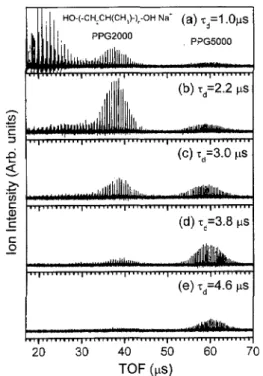
~1],11Ho-(-cH,CH(CH,)-),-oHNa+ (a) Td=l.Ops
I
P?G5000
20 30 40 50 60 70
TOF (ILS)
Fig. 4. Effect of wrying delay time on tie SALDI TOF spw- Wd ut’ amixture of PPG 2000 and PPC 5003in ME mcde.
Jcwmal of tlw Korean Cikmicul Sociery
I 2010 2015 2020 2025
1600
15CUI
2000 2500 3C Mass (amu)333
00
Fig. 5. Mass spectra of (t) PPC 2000 and (c) PPG 5000 obtained at optimized condition in PDE mode. (lJ) and (d) show the expanded ion signal profiles of (a) and (.c), respec- tively. Spectra are obtained at PDE condition 01 (a) V,=6 kV.
V,=2 kV and %,=1.7,US;and (c) V,+ kV, 17,=2kV and 1=3.6 I.IS.
‘
(t-T,)2’
1(() =~Aiexp~ -—
I
. 2m1
(6)
‘- ?
.J@sh ;: +; :i:0.$5 ?,+
1+;
,, ~i$ + +$ .sns ‘,~, , j
:! ~!
;; :,: :1 !;
,!, ,,!
J-’ “‘
,, ;,
.,.-’ . ;i ;: ,]
563CX3 +,;;
,---’ .? ; 7y_.
-/..-: ,, ,,~
-,, ; ,\ ’, .-
‘6 ~,,,,,,,,,,,J ,.:!
!, ; ~,,.& )::;.:+-rj%
~ ‘m i[ y’> .+&-:~- ‘, ,,
!1: ‘X :--’ ~ >,,
;,Y;..>s-$ ! ‘, ,;’ ,:’ ,,
‘m ~:~<:::.:;:’: ,,.,.<”’..:-,:“- ... “’ -....
----.--:..:=---.+ ...-....,...:...........,--....._.
~ ~=,z,....:?’: s.------- . ............--
: 1QC3 20C0 3000 4W0 WJO 6fJIX 7030 SQCo WCC
Maas [J?VZ)
Fig. 6,Cakukd mass msohnion as o function of mass:
(dash dotted Iinc) tit given dcluy time in ideal PDE mode;
and (solid line) by instnrmcrurdbroadening. Dashed k rep- resent the minimum rwohnion required for isotopical sepam- tion. The instrumental conti[tions are the same as in Fig. S(a).
.lournul of the Korean Ch#micd .Sociefy
:3.- :
e~
*.-: : f!
l~oo 20C0 3200 4000 50C0 6300 7000
Maas (m/z)
Fig. 7.Comparison of SALD1 mass specma of PPG SO(M) obrainedIron] (a)PDE and (b) continuous extraction al same laser fluence of (L4[ MW/cm~.
2(N)O.vol.44,w. 4
(a) Fragmentation pattern for B and Cseries
~o_xn_ocH_~ ‘1 , ’5
2 ,j i,,> ~y(CH3)-X.-0-OH H3C 0-CH2
c ! a
o
~H3HWWI–0 CH2–C—C H3 ~ H2 + CH2=C–X n–O–O H
sommaddud 5en+37 Scdiurn awduct 58n+61
(b) Homolytic cleavage for (B+H) and (C+H) series
CH3 CH3
Rf-Xn-0CH2CSt\– O- CH2CH—X n-O– R2
B+++ { \
% O~H3 C+H
Rj–X n–0 CH2–C W-CH3 H2C– CS--Xn–O -R2
Scdum addd: 58Q+62 .%dium addw 5Sn+9B
F-ig. 8.Possible mechanisms to explain the origin of’the 1iag- ment ions ubscrvcd in Fi,q.5: (a) for B and C series, see the refe~nces formore details; ( tr)homolytic cleavage for (B+H) and (C+H) series,
1. Karas,M: Hillenkasnp, F. And, Chem. 1988, 60, 2299.
2. Price P.; Milnes G. J. lnt. J. Muss S@wwn. Ion Pm- ,.~,q,s~,,1(~, y), I .
3,Stephens, W. E. Phys. Rev. 1946.69, 691.
4. Wiley W, C.; McLmen, 1. H., Rev Sci. Irrsfrum. 1955, 26. 1150.
5,(]psd, R, B.: C)wens. K. G.; Reilly, J, f? Anal. Chcrn.
1985, 57, 1884.
6. Bcavis, R. C.; Clsait.B. T. Clrem.P@. Lat. 1991. 16’/,479.
7. Zhou, J.; Ens, W.; Standing K.; Vcrcntchikov, A. Rapid Commun. Mass $pecmxn, 1992, 6, 671.
8. Mamyrin, B. A.; Karataev V. L; Shmikk, D. V.; 7agu- lin, V. A. Ser. Phjs.-.IEW 1973, 37, 45.
9. Boesl, B. A.; Weinkauf, R.; Schlag, E. W, Jm. J. M-Ms Sp.xtrom, km Processes 1992, 112, 121.
10. Cotter, R. J. 7ime-o~F/ight MU.MSpectronretty A C.
S, Symposium Series 549: American Chemical Soci- ety Washington IX. 1994; pp 16-48.
11. Vestal M. L.; Juhasz, D; Martin S. A. Rapid @nmun.
Mass Spectrom. 1995.9, 1044.
1‘2.Brown R. S.; Lenrmn, J. .I.And. Chem. 1995,67, 1998.
13. (’olby. S. M.; King, T. B.: Reilly. J. P. Rupd Commun.
Mass Specvvrn, 1994, 8. 865.
14. Whirtaf, R. M,; Li, L. AnaL Chern. 1995.67. 1950.
IS.Kovroun, S, V.J?apd (Yommun. Mass Speclrvm. 1997.
11, 810.
16. Ioanoviciu, D. h. J. Mass Specrronr. ]on Processes 1994, 4.3, 13).
17. Yefchak. G. E.; Enke. C. G.: Holland, J. F. fnt. J. Mass Spectrorn. ion Prore.sses 1989, 87, 313.
IX. Erickson. E. D.: Yefchak. G. E.; Enkc. C. G.; Holland, J. F. Im. J. Mass .Ypectrom. km Processes 1990, 97,87 19. .Iuhasz, D; Vestal M. L.; Martin S. A. J. Am. SOC.Maw
Spectrom. 1997, & 209.
20. Kim, J. H.; Kang. iv, K. Bull. Kwwr~ Chem. Sot. 2000, 21.401.
21. Mowat, [. A.; Donovan, R. J.; Mahx, R. R. J.: Rapid C.xmnun. Musx .Ypertrom. 1997. 1[. 89.
.loumd (!fthe Korean Chrmicd Society



![Fig. 7. Comparison of SALD1 mass specma of PPG SO(M) obrained Iron] (a) PDE and (b) continuous extraction al same laser fluence of (L4[ MW/cm~.](https://thumb-ap.123doks.com/thumbv2/123dokinfo/5301018.155567/8.793.394.696.134.356/comparison-sald-specma-obrained-iron-continuous-extraction-fluence.webp)
