Original Article
Received: Nov 24, 2020 Revised: Jan 28, 2021 Accepted: Feb 23, 2021 Correspondence to Joon Jeong
Department of Surgery, Gangnam Severance Hospital, 211 Eonju-ro, Gangnam-gu, Seoul 06273, Korea.
E-mail: [email protected]
© 2021 Korean Breast Cancer Society This is an Open Access article distributed under the terms of the Creative Commons Attribution Non-Commercial License (https://
creativecommons.org/licenses/by-nc/4.0/) which permits unrestricted non-commercial use, distribution, and reproduction in any medium, provided the original work is properly cited.
ORCID iDs Sung Gwe Ahn
https://orcid.org/0000-0002-8778-9686 Seok Jin Nam
https://orcid.org/0000-0003-1072-8954 Sei Hyun Ahn
https://orcid.org/0000-0002-6705-7867 Yongsik Jung
https://orcid.org/0000-0002-2011-1459 Heung Kyu Park
https://orcid.org/0000-0003-1897-4228 Soo Jung Lee
https://orcid.org/0000-0003-0066-4109 Sung Soo Kang
https://orcid.org/0000-0001-8316-8631 Wonshik Han
https://orcid.org/0000-0001-7310-0764 Kyong Hwa Park
https://orcid.org/0000-0002-2464-7920 Yong Lai Park
https://orcid.org/0000-0002-2491-2114
Sung Gwe Ahn
1, Seok Jin Nam
2, Sei Hyun Ahn
3, Yongsik Jung
4, Heung Kyu Park
5, Soo Jung Lee
6, Sung Soo Kang
7, Wonshik Han
8, Kyong Hwa Park
9, Yong Lai Park
10, Jihyoun Lee
11, Hyun Jo Youn
12, Jun Hyun Kim
13, Youngbum Yoo
14, Jeong-Yoon Song
15, Byung Kyun Ko
16, Geumhee Gwak
17, Min Sung Chung
18, Sung Yong Kim
19, Seo Heon Cho
20, Doyil Kim
21, Myung-Chul Chang
22, Byung In Moon
23, Lee Su Kim
24, Sei Joong Kim
25, Min Ho Park
26, Tae Hyun Kim
27, Jihyoung Cho
28, Cheol Wan Lim
29, Young Tae Bae
30, Gyungyub Gong
31, Young Kyung Bae
32, Ahwon Lee
33, Joon Jeong
11Department of Surgery, Gangnam Severance Hospital, Seoul, Korea
2Department of Surgery, Samsung Medical Center, Seoul, Korea
3Department of Surgery, Asan Medical Center, Seoul, Korea
4Department of Surgery, Ajou University School of Medicine, Suwon, Korea
5Department of Surgery, Gachon University Gil Hospital, Incheon, Korea
6Department of Surgery, Yeungnam University College of Medicine, Daegu, Korea
7Department of Surgery, CHA University Ilsan Medical Center, Goyang, Korea
8Department of Surgery, Seoul National University College of Medicine, Seoul, Korea
9 Division of Oncology/Hematology, Department of Internal Medicine, Korea University College of Medicine, Seoul, Korea
10Department of Surgery, Kangbuk Samsung Hospital, Seoul, Korea
11Department of Surgery, Soonchunhyang University Seoul Hospital, Seoul, Korea
12Department of Surgery, Jeonbuk National University Medical School, Jeonju, Korea
13Department of Surgery, Busan St. Mary's Hospital, Busan, Korea
14Department of Surgery, Konkuk University Medical Center, Choongju, Korea
15Department of Surgery, Kyung Hee University Hospital, Seoul, Korea
16Department of Surgery, Ulsan University Hospital, Ulsan, Korea
17Department of Surgery, Inje University Sanggye Paik Hospital, Seoul, Korea
18Department of Surgery, Hanyang University Hospital, Seoul, Korea
19Department of Surgery, Soonchunhyang University Cheonan Hospital, Cheonan, Korea
20Department of Surgery, Dong-A University Hospital, Busan, Korea
21Department of Surgery, Kangseo MizMedi Hospital, Seoul, Korea
22Department of Surgery, Dankook University Hospital, Cheonan, Korea
23Department of Surgery, Ewha Woman's University Mokdong Hospital, Seoul, Korea
24Department of Surgery, Hallym University Sacred Heart Hospital, Anyang, Korea
25Department of Surgery, Gangseo Mizmedi Hospital, Seoul, Korea
26Department of Surgery, Chonnam National University Medical School, Gwangju, Korea
27Department of Surgery, Inje University Busan Paik Hospital, Busan, Korea
28Department of Surgery, Keimyung University School of Medicine, Daegu, Korea
29Department of Surgery, Soonchunhyang University Bucheon Hospital, Bucheon, Korea
30Department of Surgery, Pusan National University Hospital, Busan, Korea
31Department of Pathology, Asan Medical Center, Seoul, Korea
32Department of Pathology, Yeungnam University College of Medicine, Daegu, Korea
33Department of Pathology, Seoul St. Mary's Hospital, The Catholic University of Korea, Seoul, Korea
Clinical Outcomes Following
Letrozole Treatment according to Estrogen Receptor Expression in Postmenopausal Women:
LETTER Study (KBCSG-006)
Jihyoun Lee
https://orcid.org/0000-0003-0041-8717 Hyun Jo Youn
https://orcid.org/0000-0002-2407-8537 Jun Hyun Kim
https://orcid.org/0000-0003-1615-8219 Youngbum Yoo
https://orcid.org/0000-0002-6910-5076 Jeong-Yoon Song
https://orcid.org/0000-0003-4992-1065 Byung Kyun Ko
https://orcid.org/0000-0002-6085-4839 Geumhee Gwak
https://orcid.org/0000-0002-7910-1052 Min Sung Chung
https://orcid.org/0000-0001-5086-3718 Sung Yong Kim
https://orcid.org/0000-0002-2070-0915 Seo Heon Cho
https://orcid.org/0000-0003-3272-4743 Doyil Kim
https://orcid.org/0000-0002-2452-0591 Myung-Chul Chang
https://orcid.org/0000-0001-7712-7497 Byung In Moon
https://orcid.org/0000-0002-7441-8472 Lee Su Kim
https://orcid.org/0000-0002-9965-0032 Sei Joong Kim
https://orcid.org/0000-0001-8451-6298 Min Ho Park
https://orcid.org/0000-0003-1504-3815 Tae Hyun Kim
https://orcid.org/0000-0001-6935-5801 Jihyoung Cho
https://orcid.org/0000-0002-1680-2919 Cheol Wan Lim
https://orcid.org/0000-0001-9490-4964 Young Tae Bae
https://orcid.org/0000-0003-3390-6098 Gyungyub Gong
https://orcid.org/0000-0001-5743-0712 Young Kyung Bae
https://orcid.org/0000-0002-6689-9413 Ahwon Lee
https://orcid.org/0000-0002-2523-9531 Joon Jeong
https://orcid.org/0000-0003-0397-0005 Trial Registration
ClinicalTrials.gov Identifier: NCT01069211 Funding
This study was funded by Novartis Korea.
Conflict of Interest
This study was funded by Novartis Korea. The funders provided the study drug (letrozole)
ABSTRACT
Purpose: In this trial, we investigated the efficacy and safety of adjuvant letrozole for
hormone receptor (HR)-positive breast cancer. Here, we report the clinical outcome in postmenopausal women with HR-positive breast cancer treated with adjuvant letrozole according to estrogen receptor (ER) expression levels.
Methods: In this multi-institutional, open-label, observational study, postmenopausal
patients with HR-positive breast cancer received adjuvant letrozole (2.5 mg/daily) for 5 years unless they experienced disease progression or unacceptable toxicity or withdrew their consent. The patients were stratified into the following 3 groups according to ER expression levels using a modified Allred score (AS): low, intermediate, and high (AS 3–4, 5–6, and 7–8, respectively). ER expression was centrally reviewed. The primary objective was the 5-year disease-free survival (DFS) rate.
Results: Between April 25, 2010, and February 5, 2014, 440 patients were enrolled. With
a median follow-up of 62.0 months, the 5-year DFS rate in all patients was 94.2% (95%
confidence interval [CI], 91.8–96.6). The 5-year DFS and recurrence-free survival (RFS) rates did not differ according to ER expression; the 5-year DFS rates were 94.3% and 94.1%in the low-to-intermediate and high expression groups, respectively (p = 0.6), and the corresponding 5-year RFS rates were 95.7% and 95.4%, respectively (p = 0.7). Furthermore, 25 patients discontinued letrozole because of drug toxicity.
Conclusion: Treatment with adjuvant letrozole showed very favorable treatment outcomes
and good tolerability among Korean postmenopausal women with ER-positive breast cancer, independent of ER expression.
Trial Registration: ClinicalTrials.gov Identifier: NCT01069211
Keywords: Breast neoplasms; Letrozole; Postmenopause; Receptors, estrogen
INTRODUCTION
Approximately 75% of breast cancers express the estrogen receptor (ER) [1], and anti- estrogen treatment is the standard-of-care for patients with these tumors [2]. For postmenopausal patients with ER-positive breast cancer, either tamoxifen or aromatase inhibitors are prescribed for 5 to 10 years, taking into account drug tolerability and patient risk factors, such as tumor stage and genomic profile [3,4]. Aromatase inhibitors, such as letrozole and anastrozole, have been used in clinical practice and are preferred over tamoxifen for postmenopausal women with ER-positive tumors because they induce superior survival outcomes [5-7].
Factors predicting patient responses to endocrine therapy have been investigated to evaluate the risk of endocrine therapy failure and tailor anti-estrogen therapy [8-10]. Several lines of evidence suggest that the ER expression level is associated with the response to endocrine therapy [11,12]. In addition, a high ESR1 messenger RNA level has been shown to be
associated with the benefit of tamoxifen [13]. Thus, using a prospective study, it is important to investigate whether survival outcomes vary according to ER expression levels.
In this present study, we aimed to compare clinical outcomes according to ER expression
level in postmenopausal women with ER-positive breast cancer who were treated with
and collaborated with the authors on the study design and data collection methods.
Author Contributions
Conceptualization: Jeong J; Data curation:
Ahn SG, Jeong J; Formal analysis: Ahn SG;
Funding acquisition: Jeong J; Investigation:
Nam SJ, Park HK, Lee SJ, Kang SS, Han W, Park KH, Jeong J; Methodology: Nam SJ, Bae YK; Resources: Nam SJ, Ahn SH, Jung Y, Park HK, Lee SJ, Kang SS, Han W, Park KH, Park YL, Lee J, Youn HJ, Kim JH, Yoo Y, Song JY, Ko BK, Gwak G, Chung MS, Kim SY, Cho SH, Kim D, Chang MC, Moon BI, Kim LS, Kim SJ, Park MH, Kim TH, Cho J, Lim CW, Bae YT, Gong G, Bae YK, Lee A; Supervision: Jeong J; Writing - original draft: Ahn SG, Jeong J; Writing - review & editing: Ahn SG, Han W, Jeong J.
letrozole as an adjuvant endocrine therapy. We analyzed the survival outcomes and toxicity of letrozole in the intention-to-treat (ITT) population.
METHODS
Study design and participants
This was a multi-institutional, open-label, observational trial that evaluated the clinical outcomes of Korean postmenopausal women with ER-positive breast cancer receiving adjuvant letrozole after surgical intervention. Women from 44 institutes participated in this study. Women who were ≥ 55 years old or < 55 years old but had postmenopausal levels of follicle-stimulating hormone (i.e., ≥ 30 mIU/mL) and were amenorrheic for at least 12 consecutive months before letrozole treatment or had undergone a bilateral oophorectomy were considered eligible for this trial. Eligible patients underwent either breast-conserving therapy or mastectomy with axillary staging. All patients had operable, ER-positive, invasive breast cancer, which was confirmed using histology. Systemic chemotherapy was administered to patients who were at risk of recurrence based on the treatment principles of the individual institutes. The tumor, nodes, and metastases (TNM) staging was performed according to the 7th edition of the American Joint Committee on Cancer system [14]. ER expression was reviewed centrally using the following modified Allred score (AS): low (AS 3–4), intermediate (AS 5–6), and high (AS 7–8) [15].
Procedures
Enrolled patients received letrozole (2.5 mg) as an oral tablet once daily until they experienced disease progression or unacceptable toxicity, or withdrew consent, and the treatment ended 5 years from the date of the first dose, regardless of any missed doses.
Patients were required to have an annual physical examination during the study period.
Moreover, they were followed up with physical examinations every 6 months during the study period and every 12 months thereafter. A bilateral mammogram was required every 12 months, and bone mineral density tests were required every 1 or 2 years during the study period. Additional radiological studies were allowed based on the protocols of each institute.
Serum lipid tests were conducted every 6 months during therapy. Adverse events (AEs) were assessed based on the Common Terminology Criteria for Adverse Events (version 3.0) every 6 months during treatment. All procedures were performed in accordance with the guidelines for Good Clinical Practice and the Declaration of Helsinki, and the study was approved by the institutional ethics committees of each hospital and the Institutional Review Board (IRB) of the Korean Breast Cancer Society. Written informed consent was obtained from each participant. The local IRB number of **** hospital is 3-2010-0042, and this trial is registered with ClinicalTrials.gov (number NCT01069211).
Outcomes
The primary endpoint was disease-free survival (DFS), which was defined as the time from
the operation to breast cancer recurrence, second primary malignancy, or death. Secondary
endpoints were drug toxicity, overall survival (OS), invasive cancer recurrence-free survival
(RFS; time from the operation to local, regional, or distant metastasis of breast cancer or
contralateral breast cancer as a first event), and distant metastasis-free survival (DMFS; time
from the operation to distant metastasis of breast cancer).
Statistical analysis
The primary end-point, DFS, was evaluated according to ER expression status. We
hypothesized that the DFS of the high expression group (AS 7–8) would be longer than that of the intermediate (AS 5–6) and low (AS 3–4) expression groups. Based on historical data, the DFS rates were expected to be 70.4%, 84.0%, and 93.6 for the low, intermediate, and high expression groups, respectively [15,16]. A sample size of 174 for each group would achieve 80% power to detect a DFS superiority of 9.6% between the high and intermediate groups with a two-sided type I error rate of 1.67% and a drop rate of 20%. In December 2013, the protocol was amended to compare survival outcomes between the high expression (AS 7–8) and a combined low-to-intermediate (AS 3–6) group because the number of patients in the low expression (AS 3–4) group was much lower than anticipated. Recruitment was closed in February 2014, and 440 patients were included.
The Kaplan-Meier method was used to estimate DFS, RFS, DMFS, and OS, and the estimated survival curves were compared using the log-rank test. Cox proportional hazard-regression model was used to calculate hazard ratios and 95% confidence intervals (CIs). All statistical analyses were performed using R (http://www.r-project.org) software and a p-value < 0.05 was considered statistically significant.
Role of the funding sources
The funders provided the study drug (letrozole) and collaborated with the authors on the study design and data collection methods. All authors contributed to drafting the manuscript, provided final approval to publish, and agreed to be accountable for all aspects of the manuscript.
RESULTS
Between April 25, 2010, and February 5, 2014, 440 patients were enrolled and their data were available for the ITT analysis. Of the 440 patients, 314 (71.3%) completed the study, whereas 126 (28.7%) discontinued letrozole. The main reasons for discontinuation of the study drug were loss to follow-up (28.6%), AEs (20.6%), and tumor recurrence (17.5%). Other reasons for discontinuation are presented in Table 1.
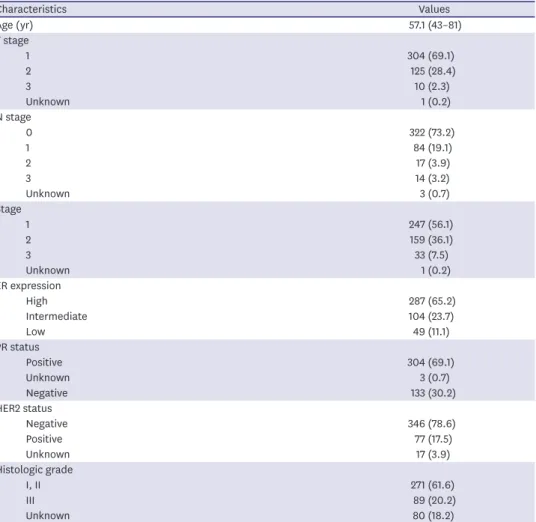
The demographic characteristics of the study patients are listed in Table 2. The median age of the enrolled patients was 57 (range, 43–81) years. Approximately 70% of the patients had a T1 tumor or node-negative disease. Furthermore, 247 and 159 of the 440 (56.1% and
Table 1. Reasons for discontinuation of study drug in intention-to-treat population
Category Values
Enrolled subjects 440 (100.0)
Completed study 314 (71.3)
Discontinued letrozole 126 (28.7)
Reasons for letrozole discontinuation
Follow-up loss 36 (28.6)
Adverse event 25 (19.8)
Tumor recurrence 22 (17.5)
Consent withdrawal 17 (13.5)
Protocol violation 16 (12.7)
Unknown 10 (7.9)
Values are presented as number (%).
36.1%) patients had stage I and stage II disease, respectively, whereas 33 (7.5%) had stage III disease. The percentages of patients categorized as exhibiting low, intermediate, or high ER expression by AS were 11.1%, 23.7%, and 65.2%, respectively. Most (304, 69.1%) patients were progesterone receptor (PR) positive, whereas 77 (17.5%) patients had human epidermal growth factor receptor-2 (HER2)-positive breast cancer. Approximately 60% of patients underwent breast-conserving surgery and 54.8% received chemotherapy.
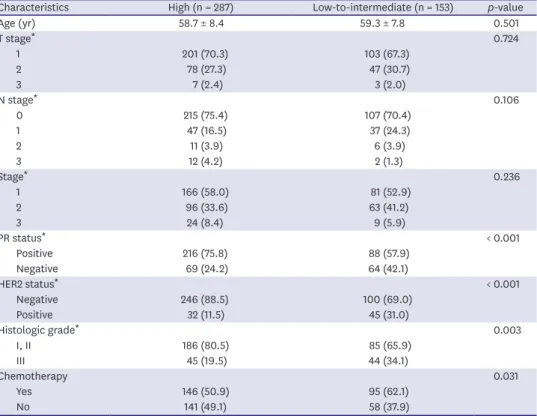
When we compared the clinical characteristics according to ER expression, the low-to- intermediate ER group showed a higher rate of PR-negative, HER2-positive, and high histologic grade than the high ER group, whereas the anatomical stage was not different between both groups (Table 3). More patients in the ER low-to-intermediate group received adjuvant chemotherapy (62.1% vs. 50.9%; p = 0.031) than those in the ER high group. The median follow-up was 62.0 months and there were 3 mortalities, whereas 22, 17, 1, and 5 patients experienced breast cancer recurrences, metastases, contralateral breast cancer, and other primary malignancies, respectively. One and two patients died because of acute subarachnoid hemorrhage and breast cancer progression, respectively.
Table 2. Baseline characteristics of study participants (n = 440)
Characteristics Values
Age (yr) 57.1 (43–81)
T stage
1 304 (69.1)
2 125 (28.4)
3 10 (2.3)
Unknown 1 (0.2)
N stage
0 322 (73.2)
1 84 (19.1)
2 17 (3.9)
3 14 (3.2)
Unknown 3 (0.7)
Stage
1 247 (56.1)
2 159 (36.1)
3 33 (7.5)
Unknown 1 (0.2)
ER expression
High 287 (65.2)
Intermediate 104 (23.7)
Low 49 (11.1)
PR status
Positive 304 (69.1)
Unknown 3 (0.7)
Negative 133 (30.2)
HER2 status
Negative 346 (78.6)
Positive 77 (17.5)
Unknown 17 (3.9)
Histologic grade
I, II 271 (61.6)
III 89 (20.2)
Unknown 80 (18.2)
Values are presented as median (range) or number (%).
ER = estrogen receptor; PR = progesterone receptor; HER2 = human epidermal growth factor receptor 2.
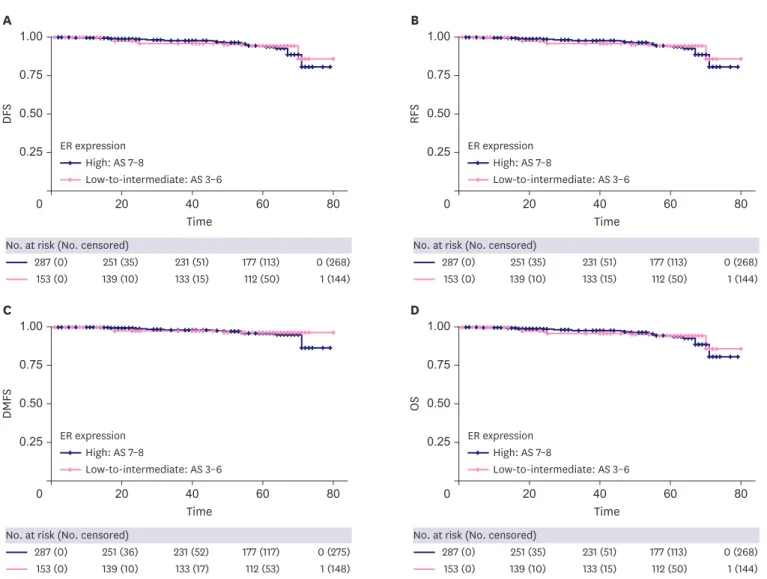
Furthermore, the 5-year DFS rate of all the patients was 94.2% (95% CI, 91.8–96.6). The 5-year DFS and RFS rates did not differ according to ER expression (5-year DFS, 94.3%
and 94.1% in the low-to-intermediate and high groups, respectively, p = 0.6; 5-year RFS, 95.7% and 95.4% in the low-to-intermediate and high groups, p = 0.7; Figure 1A and B). The DMFS and OS rates also did not differ according to ER expression (Figure 1C and D), and clinical outcomes did not differ among the three groups categorized based on ER expression (Supplementary Figure 1). However, all survival outcomes differed significantly based on TNM staging (Figure 2).
Chemotherapy was administered more frequently in the low-to-intermediate group than in the high group; therefore, we performed multivariable survival analyses using chemotherapy administration, ER expression, and stage as factors. Multivariable analyses showed that stage was the only significant prognostic factor for DFS and RFS (Supplementary Table 1).
The AEs associated with letrozole were investigated and 25 patients discontinued the drug because of toxicity (Figure 3). The AE most commonly associated with drug discontinuation was arthralgia (18, 4%). Other AEs leading to drug discontinuation were hot flushes (n = 1), skin rash (n = 1), headache (n = 1), dyspnea (n = 1), liver function abnormality (n = 1), gastrointestinal disorder (n = 1), subarachnoid hemorrhage, and unknown (n = 1).
Table 3. Baseline characteristics of study participants (n = 440) by estrogen receptor expression level
Characteristics High (n = 287) Low-to-intermediate (n = 153) p-value
Age (yr) 58.7 ± 8.4 59.3 ± 7.8 0.501
T stage* 0.724
1 201 (70.3) 103 (67.3)
2 78 (27.3) 47 (30.7)
3 7 (2.4) 3 (2.0)
N stage* 0.106
0 215 (75.4) 107 (70.4)
1 47 (16.5) 37 (24.3)
2 11 (3.9) 6 (3.9)
3 12 (4.2) 2 (1.3)
Stage* 0.236
1 166 (58.0) 81 (52.9)
2 96 (33.6) 63 (41.2)
3 24 (8.4) 9 (5.9)
PR status* < 0.001
Positive 216 (75.8) 88 (57.9)
Negative 69 (24.2) 64 (42.1)
HER2 status* < 0.001
Negative 246 (88.5) 100 (69.0)
Positive 32 (11.5) 45 (31.0)
Histologic grade* 0.003
I, II 186 (80.5) 85 (65.9)
III 45 (19.5) 44 (34.1)
Chemotherapy 0.031
Yes 146 (50.9) 95 (62.1)
No 141 (49.1) 58 (37.9)
Data are shown as mean ± standard deviation or number (%).
PR = progesterone receptor; HER2 = human epidermal growth factor receptor 2.
*Missing values are included.
DISCUSSION
Our study did not demonstrate different clinical outcomes in the investigated study population based on ER expression levels. Several factors might have contributed to this negative finding. First, we assumed that the clinical benefit of endocrine therapy might be biologically correlated with the ER expression level, and a few studies in the adjuvant setting have demonstrated this relationship using either the ER H-score [17] or ESR1 expression level [13]. These studies uniformly included cohorts treated with tamoxifen or no systemic therapy. However, modern systemic chemotherapy is guided by clinical and biological risk stratification. Therefore, in this trial, more than half of the patients (54.8%) received adjuvant chemotherapy, which did not affect survival among groups with different ER expression levels.
Our study population showed very favorable outcomes with a 5-year DFS of 96.0%. This excellent outcome made it difficult to discriminate survival outcomes according to ER expression. Because a linear relationship between the response to neoadjuvant letrozole and
TimeA
DFS
0 20 40 60 80
0.50 1.00
0.75
0.25 High: AS 7–8
Low-to-intermediate: AS 3–6
287 (0) 251 (35) 231 (51) 177 (113) 0 (268) 153 (0) 139 (10) 133 (15) 112 (50) 1 (144) No. at risk (No. censored)
ER expression
Time
B
RFS
0 20 40 60 80
0.50 1.00
0.75
0.25 High: AS 7–8
Low-to-intermediate: AS 3–6
287 (0) 251 (35) 231 (51) 177 (113) 0 (268) 153 (0) 139 (10) 133 (15) 112 (50) 1 (144) No. at risk (No. censored)
ER expression
Time
C
DMFS
0 20 40 60 80
0.50 1.00
0.75
0.25 High: AS 7–8
Low-to-intermediate: AS 3–6
287 (0) 251 (36) 231 (52) 177 (117) 0 (275) 153 (0) 139 (10) 133 (17) 112 (53) 1 (148) No. at risk (No. censored)
ER expression
Time
D
OS
0 20 40 60 80
0.50 1.00
0.75
0.25 High: AS 7–8
Low-to-intermediate: AS 3–6
287 (0) 251 (35) 231 (51) 177 (113) 0 (268) 153 (0) 139 (10) 133 (15) 112 (50) 1 (144) No. at risk (No. censored)
ER expression
Figure 1. Clinical outcomes according to ER expression level (high, AS 7–8; low-to-intermediate, AS 3–6). Survival curves were generated using the Kaplan-Meier method. All p values were calculated using the log-rank test. (A) DFS (p = 0.6), (B) RFS (p = 0.7), (C) DMFS (p = 0.5), and (D) OS (p = 0.3).
ER = estrogen receptor; AS = Allred score; DFS = disease-free survival; RFS = recurrence-free survival; DMFS = distant metastasis-free survival; OS = overall survival.
18
1 1 1 1 1 1 1
AEs for letrozole discontinuation
Arthralgia Hot flush
Gastro-intestinal trouble Liver enzyme abnormality
Dyspnea Headache
Subarachnoid hemorrhage Unknown 0
10 5 15 20
Figure 3. AEs leading to drug discontinuation.
AE = adverse event.
Time
A
DFS
0 20 40 60 80
0.50 1.00
0.75
0.25
247 (0) 220 (26) 204 (38) 157 (110) 1 (236) 159 (0) 140 (16) 133 (24) 112 (44) 0 (148)
33 (0) 29 (3) 26 (4) 20 (8) 0 (27)
No. at risk (No. censored) II III Stage
I
Time
B
RFS
0 20 40 60 80
0.50 1.00
0.75
0.25
247 (0) 220 (26) 204 (38) 157 (111) 1 (240) 159 (0) 140 (16) 133 (24) 112 (45) 0 (120)
33 (0) 29 (3) 26 (4) 20 (8) 0 (27)
No. at risk (No. censored) II III Stage
I
Time
C
DMFS
0 20 40 60 80
0.50 1.00
0.75
0.25
247 (0) 220 (27) 204 (41) 157 (114) 1 (243) 159 (0) 140 (16) 133 (24) 112 (46) 0 (151)
33 (0) 29 (3) 26 (4) 20 (9) 0 (28)
No. at risk (No. censored) II III Stage
I
Time
D
OS
0 20 40 60 80
0.50 1.00
0.75
0.25
247 (0) 220 (27) 204 (42) 157 (117) 1 (246) 159 (0) 140 (19) 133 (28) 112 (53) 0 (159)
33 (0) 29 (3) 26 (5) 20 (11) 0 (31)
No. at risk (No. censored) II III Stage
I
Figure 2. Clinical outcome according to tumor, nodes, and metastases stage. Survival curves were generated using the Kaplan-Meier method. All p-values were calculated using the log-rank test. (A) DFS (p = 0.04), (B) RFS (p = 0.001), (C) DMFS (p = 0.001), and (D) OS (p < 0.001).
DFS = disease-free survival; RFS = recurrence-free survival; DMFS = distant metastasis-free survival; OS = overall survival.
ER expression was observed in the letrozole 024 trial [18], a much larger number of patients would be needed to demonstrate a survival difference according to ER expression status.
The very good outcomes observed in our study were comparable to those observed in two other large trials of adjuvant aromatase inhibitors; where the 5-year DFS was 87.9% in the Breast International Group (BIG) 1-98 study [19] and the 4-year DFS was 86.9% in the Arimidex, Tamoxifen Alone or in Combination (ATAC) study [20]. Approximately 30% of our patients had node-positive and T2-3 tumors, whereas approximately 40% of the study population in the BIG 1-98 and ATAC studies had nodal involvement [16,21]. This observation indicates that our results might not be exceptional.
In addition, our study population showed good drug compliance and 71.3% of patients completed 5 years of letrozole treatment (Table 1). This completion rate is very similar to that observed in the BIG 1-98 study (71.1%) [22]. Because the survival of patients with good drug adherence is superior to that of patients with poor drug adherence [22-24], encouraging drug compliance is an effective strategy for improving outcomes.
Arthralgia is a well-known AE associated with aromatase inhibitors [25,26] and the most common cause of treatment discontinuation. Eighteen patients stopped taking the study drug because of arthralgia. Recent clinical trials and meta-analyses suggest that acupuncture could reduce aromatase inhibitor-induced arthralgia [27,28]. In addition, previous trials also showed that exercise can mitigate the joint pain induced by aromatase inhibitors [29,30].
Therefore, endorsement of interventional strategies such as acupuncture and exercise could relieve drug-induced arthralgia and increase drug compliance.
Our study has one major limitation of having enrolled fewer patients than expected. In addition, the low number of disease events made it difficult to estimate the predictive value of ER expression level and identify other prognostic factors. Moreover, adjuvant chemotherapy was administered more frequently in the low-to-intermediate group than it was in the high group, which could potentially affect survival outcomes. Despite these limitations, our study supports the current efficacy and safety of the use of letrozole and provides reassuring evidence that might increase drug compliance in patients. Because ER-positive breast cancer has the risk of late recurrence after 5 years, further studies with a longer follow-up are warranted.
In conclusion, our study findings revealed that treatment with adjuvant letrozole provided a very favorable treatment outcome and showed good tolerability in Korean postmenopausal women with ER-positive breast cancer, independent of ER expression status.
ACKNOWLEDGMENTS
We would like to thank Editage (https://www.editage.co.kr) for English language editing.
SUPPLEMENTARY MATERIALS
Supplementary Table 1
Multivariable analysis of DFS and RFS
Click here to viewSupplementary Figure 1
Clinical outcomes in three groups divided according to ER expression levels (high, AS 7–8;
intermediate, AS 5–6; low, AS 3–4). Survival curves were generated using the Kaplan-Meier method. All p-values were calculated using the log-rank test. (A) DFS (p = 0.4), (B) RFS (p = 0.5), (C) DMFS (p = 0.4), and (D) OS (p = 0.4).
Click here to view
REFERENCES
1. Clark GM, Osborne CK, McGuire WL. Correlations between estrogen receptor, progesterone receptor, and patient characteristics in human breast cancer. J Clin Oncol 1984;2:1102-9.
PUBMED | CROSSREF
2. Osborne CK, Schiff R. Mechanisms of endocrine resistance in breast cancer. Annu Rev Med 2011;62:233-47.
PUBMED | CROSSREF
3. Burstein HJ, Curigliano G, Loibl S, Dubsky P, Gnant M, Poortmans P, et al. Estimating the benefits of therapy for early-stage breast cancer: the St. Gallen International Consensus Guidelines for the primary therapy of early breast cancer 2019. Ann Oncol 2019;30:1541-57.
PUBMED | CROSSREF
4. Burstein HJ, Lacchetti C, Anderson H, Buchholz TA, Davidson NE, Gelmon KA, et al. Adjuvant endocrine therapy for women with hormone receptor-positive breast cancer: ASCO clinical practice guideline focused update. J Clin Oncol 2019;37:423-38.
PUBMED | CROSSREF
5. Cuzick J, Sestak I, Baum M, Buzdar A, Howell A, Dowsett M, et al. Effect of anastrozole and tamoxifen as adjuvant treatment for early-stage breast cancer: 10-year analysis of the ATAC trial. Lancet Oncol 2010;11:1135-41.
PUBMED | CROSSREF
6. Early Breast Cancer Trialists' Collaborative Group (EBCTCG). Aromatase inhibitors versus tamoxifen in early breast cancer: patient-level meta-analysis of the randomised trials. Lancet 2015;386:1341-52.
PUBMED | CROSSREF
7. Ruhstaller T, Giobbie-Hurder A, Colleoni M, Jensen MB, Ejlertsen B, de Azambuja E, et al. Adjuvant letrozole and tamoxifen alone or sequentially for postmenopausal women with hormone receptor- positive breast cancer: long-term follow-up of the BIG 1-98 trial. J Clin Oncol 2019;37:105-14.
PUBMED | CROSSREF
8. Nicholson RI, McClelland RA, Gee JM, Manning DL, Cannon P, Robertson JF, et al. Epidermal growth factor receptor expression in breast cancer: association with response to endocrine therapy. Breast Cancer Res Treat 1994;29:117-25.
PUBMED | CROSSREF
9. Lei JT, Anurag M, Haricharan S, Gou X, Ellis MJ. Endocrine therapy resistance: new insights. Breast 2019;48 Suppl 1:S26-30.
PUBMED | CROSSREF
10. Rani A, Stebbing J, Giamas G, Murphy J. Endocrine resistance in hormone receptor positive breast cancer- from mechanism to therapy. Front Endocrinol (Lausanne) 2019;10:245.
PUBMED | CROSSREF
11. Kuukasjärvi T, Kononen J, Helin H, Holli K, Isola J. Loss of estrogen receptor in recurrent breast cancer is associated with poor response to endocrine therapy. J Clin Oncol 1996;14:2584-9.
PUBMED | CROSSREF
12. Endo Y, Toyama T, Takahashi S, Sugiura H, Yoshimoto N, Iwasa M, et al. High estrogen receptor expression and low Ki67 expression are associated with improved time to progression during first-line endocrine therapy with aromatase inhibitors in breast cancer. Int J Clin Oncol 2011;16:512-8.
PUBMED | CROSSREF
13. Kim C, Tang G, Pogue-Geile KL, Costantino JP, Baehner FL, Baker J, et al. Estrogen receptor (ESR1) mRNA expression and benefit from tamoxifen in the treatment and prevention of estrogen receptor- positive breast cancer. J Clin Oncol 2011;29:4160-7.
PUBMED | CROSSREF
14. Edge SB, Compton CC. The American Joint Committee on Cancer: the 7th edition of the AJCC cancer staging manual and the future of TNM. Ann Surg Oncol 2010;17:1471-4.
PUBMED | CROSSREF
15. Harvey JM, Clark GM, Osborne CK, Allred DC. Estrogen receptor status by immunohistochemistry is superior to the ligand-binding assay for predicting response to adjuvant endocrine therapy in breast cancer. J Clin Oncol 1999;17:1474-81.
PUBMED | CROSSREF
16. Breast International Group (BIG) 1-98 Collaborative GroupThürlimann B, Keshaviah A, Coates AS, Mouridsen H, Mauriac L, et al. A comparison of letrozole and tamoxifen in postmenopausal women with early breast cancer. N Engl J Med 2005;353:2747-57.
PUBMED | CROSSREF
17. Morgan DA, Refalo NA, Cheung KL. Strength of ER-positivity in relation to survival in ER-positive breast cancer treated by adjuvant tamoxifen as sole systemic therapy. Breast 2011;20:215-9.
PUBMED | CROSSREF
18. Ellis MJ, Coop A, Singh B, Mauriac L, Llombert-Cussac A, Jänicke F, et al. Letrozole is more effective neoadjuvant endocrine therapy than tamoxifen for ErbB-1- and/or ErbB-2-positive, estrogen receptor- positive primary breast cancer: evidence from a phase III randomized trial. J Clin Oncol 2001;19:3808-16.
PUBMED | CROSSREF
19. BIG 1-98 Collaborative GroupMouridsen H, Giobbie-Hurder A, Goldhirsch A, Thürlimann B, Paridaens R, et al. Letrozole therapy alone or in sequence with tamoxifen in women with breast cancer. N Engl J Med 2009;361:766-76.
PUBMED | CROSSREF
20. Baum M, Buzdar A, Cuzick J, Forbes J, Houghton J, Howell A, et al. Anastrozole alone or in combination with tamoxifen versus tamoxifen alone for adjuvant treatment of postmenopausal women with early-stage breast cancer: results of the ATAC (Arimidex, Tamoxifen Alone or in Combination) trial efficacy and safety update analyses. Cancer 2003;98:1802-10.
PUBMED | CROSSREF
21. Baum M, Budzar AU, Cuzick J, Forbes J, Houghton JH, Klijn JG, et al. Anastrozole alone or in combination with tamoxifen versus tamoxifen alone for adjuvant treatment of postmenopausal women with early breast cancer: first results of the ATAC randomised trial. Lancet 2002;359:2131-9.
PUBMED | CROSSREF
22. Chirgwin JH, Giobbie-Hurder A, Coates AS, Price KN, Ejlertsen B, Debled M, et al. Treatment adherence and its impact on disease-free survival in the breast international group 1-98 trial of tamoxifen and letrozole, alone and in sequence. J Clin Oncol 2016;34:2452-9.
PUBMED | CROSSREF
23. McCowan C, Shearer J, Donnan PT, Dewar JA, Crilly M, Thompson AM, et al. Cohort study examining tamoxifen adherence and its relationship to mortality in women with breast cancer. Br J Cancer 2008;99:1763-8.
PUBMED | CROSSREF
24. Hershman DL, Shao T, Kushi LH, Buono D, Tsai WY, Fehrenbacher L, et al. Early discontinuation and non-adherence to adjuvant hormonal therapy are associated with increased mortality in women with breast cancer. Breast Cancer Res Treat 2011;126:529-37.
PUBMED | CROSSREF
25. Burstein HJ. Aromatase inhibitor-associated arthralgia syndrome. Breast 2007;16:223-34.
PUBMED | CROSSREF
26. Niravath P. Aromatase inhibitor-induced arthralgia: a review. Ann Oncol 2013;24:1443-9.
PUBMED | CROSSREF
27. Chen L, Lin CC, Huang TW, Kuan YC, Huang YH, Chen HC, et al. Effect of acupuncture on aromatase inhibitor-induced arthralgia in patients with breast cancer: A meta-analysis of randomized controlled trials. Breast 2017;33:132-8.
PUBMED | CROSSREF
28. Hershman DL, Unger JM, Greenlee H, Capodice JL, Lew DL, Darke AK, et al. Effect of acupuncture vs sham acupuncture or waitlist control on joint pain related to aromatase inhibitors among women with early-stage breast cancer: a randomized clinical trial. JAMA 2018;320:167-76.
PUBMED | CROSSREF
29. Irwin ML, Cartmel B, Gross CP, Ercolano E, Li F, Yao X, et al. Randomized exercise trial of aromatase inhibitor-induced arthralgia in breast cancer survivors. J Clin Oncol 2015;33:1104-11.
PUBMED | CROSSREF
30. Nyrop KA, Callahan LF, Cleveland RJ, Arbeeva LL, Hackney BS, Muss HB. Randomized controlled trial of a home-based walking program to reduce moderate to severe aromatase inhibitor-associated arthralgia in breast cancer survivors. Oncologist 2017;22:1238-49.
PUBMED | CROSSREF