INTRODUCTION
The incidence of asthma has been increasing globally, though mainly in Westernized and industrialized nations, and there is a trend of higher prevalence farther away from the equator. Asth- ma chronicity, morbidity, and mortality represent a major pub- lic issue in several regions due to their high prevalence.1 More- over, recent epidemiological studies suggest that the prevalence of vitamin D insufficiency is also increasing in some countries due to dietary and behavioral changes over the last few de- cades.2
It has been suggested that there is a link between this high prevalence of asthma and vitamin D deficiency. In support of this hypothesis, two studies have shown that vitamin D supple- mentation might prevent the development of asthma and im- prove the clinical response to steroids.3,4 Vitamin D deficiency has been associated with increased airway hyperresponsive- ness, lower pulmonary function, worse asthma control, and
Vitamin D Insufficiency and Asthma Severity in Adults From Costa Rica
Felicia Montero-Arias,
1Giovanni Sedó-Mejía,
2Allan Ramos-Esquivel
3*
1Department of Pneumology, Hospital San Juan de Dios, San José, Costa Rica
2Department of Internal Medicine and Allergology, Hospital San Juan de Dios, San José, Costa Rica
3Department of Pharmacology, University of Costa Rica, San José, Costa Rica
steroid resistance.5 It has been demonstrated that insufficient vitamin D levels (defined by serum concentrations <30 ng/mL) were associated with an increased risk of severe asthma during childhood.6 Furthermore, a study carried out in asthmatic chil- dren from Costa Rica showed that high serum vitamin D levels were associated with reduced risk of any hospitalization in the previous year, lower use of anti-inflammatory medications for asthma, and less airway hyperresponsiveness.7
Vitamin D has been shown to have a role in both innate and Allergy Asthma Immunol Res. 2013 September;5(5):283-288.
http://dx.doi.org/10.4168/aair.2013.5.5.283 pISSN 2092-7355 • eISSN 2092-7363
Purpose: Non-classical actions of vitamin D as a cytokine are related to the immunopathology of asthma. Few studies have examined vitamin D levels and asthma severity in adults. The aim of this research was to assess the relationship between vitamin D levels, atopy markers, pulmonary function, and asthma severity. Methods: We analyzed 25-hydroxyvitamin D levels in serum collected from 121 asthmatic adults from Costa Rica to investigate the association between vitamin D levels (categorized as sufficient, ≥30 ng/mL, or insufficient, <30 ng/mL), allergic rhinitis, total IgE and peripheral blood eosinophils (as markers of atopy), asthma severity, baseline forced expiratory volume in 1 second (FEV1), and forced vital capacity (FVC). Univariate and multivariate analyses were performed to assess these relationships. Results: When the population was stratified by vitamin D status, 91% of asthmatic patients with vitamin D levels below 20 ng/mL (n=36) and 74% of patients with vitamin D levels between 20 and 30 ng/mL (n=73) had severe asthma versus 50% of those with vitamin D sufficiency (n=12; P=0.02). Vitamin D insufficiency was associated with a higher risk of severe asthma (odds ratio [OR], 5.04; 95% Confidence interval [CI], 1.23-20.72; P=0.02). High vitamin D levels were associated with a lower risk of hospitalization or emergency department visit during the last year (OR, 0.90; 95% CI, 0.84-0.98; P=0.04). Although there appeared to be a direct relationship between vitamin D levels and FEV1 (regression coefficient=0.48; r2=0.03), it did not reach statistical significance (P=0.07).
Conclusions: Our findings suggest that vitamin D insufficiency is common among our cohort of asthmatic adults. Lower vitamin D levels are asso- ciated with asthma severity.
Key Words: Adult; asthma; vitamin D
This is an Open Access article distributed under the terms of the Creative Commons Attribution Non-Commercial License (http://creativecommons.org/licenses/by-nc/3.0/) which permits unrestricted non-commercial use, distribution, and reproduction in any medium, provided the original work is properly cited.
Correspondence to: Allan Ramos-Esquivel, MD, Sede Rodrigo Facio, Department of Pharmacology, Faculty of Medicine, University of Costa Rica, PO BOX 2060, San José, Costa Rica.
Tel: +506-88448187; Fax: +506-22373930; E-mail: [email protected] Received: August 7, 2012; Revised: November 12, 2012
Accepted: November 20, 2012
•There are no financial or other issues that might lead to conflict of interest.
•All the authors contributed equally to this work.
adaptive immunity, by promoting phagocytosis and modulat- ing the effects of Th1, Th2, and regulatory T cells.8,9 Further evi- dence suggests that vitamin D alters human airway smooth muscle expression of chemokines and inhibits the expression of a steroid resistant gene.10
The majority of these studies were carried out in children, and this association has not been well-studied in adults. Moreover, the prevalence of vitamin D insufficiency is unknown in Costa Rica, a tropical country located 11º 13´ north and 08º 02´ south with abundant sun exposure throughout the year, resulting in a lack of seasons and high ultraviolet index.
The aim of the current study was to assess the relationship be- tween 25-hydroxyvitamin D, atopy markers (total IgE, eosino- phil count, allergic rhinitis), the risk of severe asthma, hospital- ization or Emergency Department (ED) visit due to asthma dur- ing the last year, and pulmonary function (through the assess- ment of forced expiratory volume in 1 second [FEV1], and forced vital capacity [FVC]) in 121 asthmatic adults from Costa Rica.
MATERIALS AND METHODS Study subjects
One-hundred and twenty-one consecutive patients older than 18 years from the Pneumology Department of the San Juan de Dios Hospital (San José, Costa Rica) were included in the study if they had a pneumologist-confirmed diagnosis of asthma ac- cording to the Global Initiative for Asthma (GINA) criteria. Def- inition of severe asthma was done by the pneumologist in charge if the patient had partly controlled or uncontrolled asthma (ac- cording to the level of control proposed by GINA) during the last 4 weeks before serum vitamin D was determined, without re- gard to optimal treatment, adherence, or inhalation technique.11
A high steroid dose was defined as a patient having received more than 1,000 µg per day of inhaled beclomethasone dipro- pionate (chlorofluorocarbon) or any oral glucocorticoid.
Data and blood samples were collected between July 1, 2011 and August 30, 2011. Patient medical information was obtained via the medical record. Patients were excluded if they had used vitamin D or calcium supplements in their diet. Approval of this protocol was received from the Institutional Review Board, and written informed consent was obtained from all participants.
Serum 25-Hydroxyvitamin D3
Blood samples were collected during the examination. Serum levels of 25-hydroxyvitamin D3 (hereafter referred to as vitamin D) were assayed using an enzyme immunoassay kit (Immuno- diagnostic Systems, Scottsdale, AZ, USA). This is considered the best circulating biomarker of vitamin D metabolic status because it reflects total vitamin D from dietary intake and sunlight expo- sure as well as the conversion of vitamin D from adipose tissue in the liver.11,12 We categorized vitamin D levels as sufficient (≥
30 ng/mL) or insufficient (<30 ng/mL) based on previous rec- ommendations.13
Total IgE and eosinophil count
Total serum IgE levels were determined using an automated chemiluminescent immunometric assay (Immulite Total IgE 1000; Siemens, Erlangen, Germany). Peripheral blood eosino- phil counts were conducted using fluorescent flow cytometry using an automated hematology analyzer (XT-1800i; Sysmex, Mundelein, IL, USA). All analyses were performed by the Nu- clear Medicine and Clinical Laboratories at San Juan de Dios Hospital.
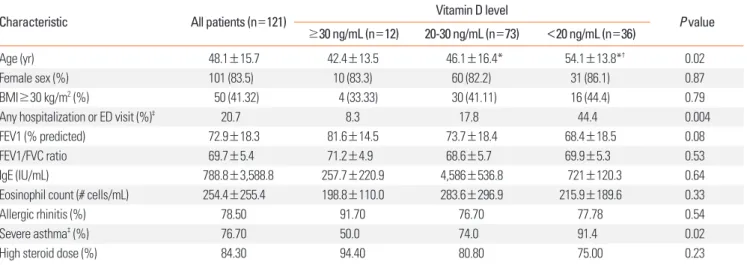
Table 1. Patients’ characteristics.
Characteristic All patients (n=121) Vitamin D level
P value
≥30 ng/mL (n=12) 20-30 ng/mL (n=73) <20 ng/mL (n=36)
Age (yr) 48.1±15.7 42.4±13.5 46.1±16.4* 54.1±13.8*† 0.02
Female sex (%) 101 (83.5) 10 (83.3) 60 (82.2) 31 (86.1) 0.87
BMI≥30 kg/m2 (%) 50 (41.32) 4 (33.33) 30 (41.11) 16 (44.4) 0.79
Any hospitalization or ED visit (%)‡ 20.7 8.3 17.8 44.4 0.004
FEV1 (% predicted) 72.9±18.3 81.6±14.5 73.7±18.4 68.4±18.5 0.08
FEV1/FVC ratio 69.7±5.4 71.2±4.9 68.6±5.7 69.9±5.3 0.53
IgE (IU/mL) 788.8±3,588.8 257.7±220.9 4,586±536.8 721±120.3 0.64
Eosinophil count (# cells/mL) 254.4±255.4 198.8±110.0 283.6±296.9 215.9±189.6 0.33
Allergic rhinitis (%) 78.50 91.70 76.70 77.78 0.54
Severe asthma‡ (%) 76.70 50.0 74.0 91.4 0.02
High steroid dose (%) 84.30 94.40 80.80 75.00 0.23
*P<0.05, compared to ≥30 ng/mL.
†P<0.05, compared to 20-30 ng/mL.
‡P<0.05, chi-square test.
BMI, body mass index; FEV1, forced expiratory volume in 1 second; FVC, forced vital capacity.
Spirometry
Spirometry was conducted in accordance with the American Thoracic Society (ATS) recommendations14 using a Cardinal Health flow-screen spirometer (Dublin, OH, USA). The best predicted FEV1 and FEV1/FVC values were selected for our analysis. Reference values were obtained from the NHANES III (Third National Health and Nutrition Examination Survey) reg- istry according to weight, height, ethnicity, age, and gender, as recommended by the ATS. All analyses were performed in the morning.
Statistical analysis
Descriptive analyses and unadjusted between-group com- parisons were performed using one-way ANOVA and post hoc tests when the variables were continuous and had equal vari- ances or using Chi-square (linear by linear correlation) when they were categorical. Univariate relationships are presented in Table 1. Variables were considered statistically significant at P values of less than 0.05 using two-sided tests.
Two multivariate models were constructed by logistic regres- sion analysis. A stepwise approach was performed to build these models. We summarized overall calibration using a Hosmer- Lemeshow goodness-of-fit test.
We conducted a retrospective analysis relating asthma severi- ty as a binary outcome and baseline vitamin D levels categorized as sufficient or insufficient. We adjusted for potential confound- ers, including age, sex, body mass index (BMI), total IgE, high
steroid use, and FEV1. Another retrospective analysis was car- ried out with a logistic regression procedure relating any hospi- talization or ED visit during the last year and vitamin D levels (as a continuous variable) adjusted for potential pre-established confounders including age, sex, BMI, high steroid dose, and FEV1. We also studied the relationship between vitamin D lev- els and FEV1 (as continuous variables) using a simple linear re- gression model. All analyses were performed using SPSS version 19.0 for Windows (SPSS Inc., Chicago, IL, USA).
RESULTS
Subject characteristics
The baseline characteristics of the overall population stratified by vitamin D sufficiency status are shown in Table 1. A statisti- cally significant relationship was found between asthma severi- ty and vitamin D sufficiency status: 91.4% of the patients with vitamin D levels below 20 ng/mL and 74.0% of the patients with vitamin D levels between 20 and 30 ng/mL had severe asthma in comparison with 50% of the patients with vitamin D suffi- ciency (P=0.02). There was also a non-significant trend towards lower FEV1 in patients with insufficient vitamin D levels (P=
0.08). We did not observe any association between FEV1/FVC and vitamin D status.
Vitamin D insufficiency as a predictor of the risk of severe asthma and any hospitalization or visit to the ED
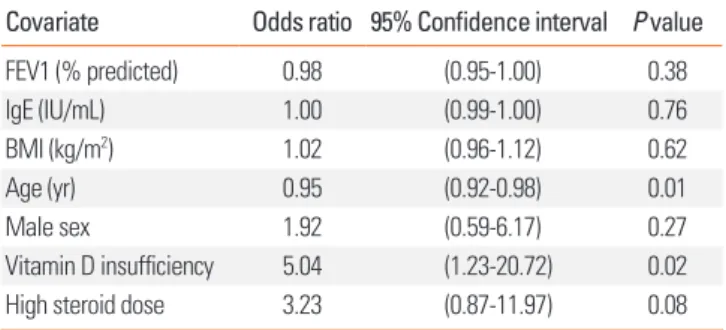
Multivariate analysis of risk factors for severe asthma is shown in Table 2. The odds of having severe asthma were 5.04 times higher in patients with insufficient vitamin D levels than in those who had sufficient vitamin D levels (P=0.02). We also observed in this model that aging was associated with a lower risk of se- vere asthma (P=0.01). As it is depicted in Table 3 and Figure, Table 2. Multivariate analysis of potential risk factors for severe asthma.
Covariate Odds ratio 95% Confidence interval P value
FEV1 (% predicted) 0.98 (0.95-1.00) 0.38
IgE (IU/mL) 1.00 (0.99-1.00) 0.76
BMI (kg/m2) 1.02 (0.96-1.12) 0.62
Age (yr) 0.95 (0.92-0.98) 0.01
Male sex 1.92 (0.59-6.17) 0.27
Vitamin D insufficiency 5.04 (1.23-20.72) 0.02
High steroid dose 3.23 (0.87-11.97) 0.08
FEV1, forced expiratory volume in 1 sec; BMI, body mass index.
Table 3. Multivariate analysis of potential risk factors for hospitalization or ED visit due to asthma during the past year.
Covariate Odds ratio 95% Confidence interval P value
FEV1 (% predicted) 0.99 (0.97-1.02) 0.98
Vitamin D (ng/mL) 0.90 (0.84-0.98) 0.04
BMI (kg/m2) 1.05 (0.98-1.13) 0.38
Age (yr) 0.99 (0.96-1.03) 0.69
High steroid dose 3.72 (0.47-29.90) 0.21
Male sex 1.57 (0.40-6.15) 0.52
FEV1, forced expiratory volume in 1 sec; BMI, body mass index.
Figure. Proportion of patients (bars) and odds ratio, compared to subjects with vitamin D levels ≥30 ng/mL (line), for any hospitalization or ED visit due to asth- ma during the previous year according to vitamin D level.
Proportion of patients hospitalizaed or attending the ED due to asthma in the last year (%) Odds ratio for the risk of hospitalization or ED visit due to asthma in the last year
50.00 40.00 30.00 20.00 10.00 0.00
4.0
3.0
2.0
1.0
<20 ng/mL 20-30 ng/mL ≥30 ng/mL 0.0 Vitamin D levels
P<0.05 P<0.05
multivariate analysis showed a 10% reduction in the odds of any hospitalization or ED visit due to asthma during the last year for each 1 ng/mL increase in vitamin D level (P=0.04).
Vitamin D level and lung function
Serum vitamin D levels were not significantly correlated with FEV1 in the linear regression analysis. According to this model, there was an increase of 0.49% in the predicted FEV1 for each 1 ng/mL increase in vitamin D (regression coefficient=0.49; r2= 0.028; P=0.07).
DISCUSSION
In this report we demonstrate a high prevalence of vitamin D insufficiency among asthmatic adults in Costa Rica (latitude, 10°N). This percentage (90%) is higher than that reported in an- other study of Costa Rican asthmatic children, in which 28% had vitamin D insufficiency,7 and much higher than the 20% report- ed by Alyasin et al.15 in Iranian children. However, this high per- centage is similar to that reported by Li et al.16 in asthmatic adults from China and is consistent with the epidemics of hypo- vitaminosis D in developing countries reported by Arabi et al.17
Besides, it has been reported that in a sunny region, dress habits, sunscreen use, sunlight avoidance, and other behavioral factors can provoke hypovitaminosis D, even in otherwise healthy individuals.18 Indeed, a previous study carried out in Puerto Rico, located on a similar geographical latitude as Costa Rica (18º 15´ north), reported a high prevalence of vitamin D insufficiency in children with (44%) and without (47%) asth- ma.19
The discrepancies between our findings, reporting such a high prevalence of vitamin D insufficiency, and other studies,14,20 can be attributed mainly to behavioral variables. Female sex and being overweight are well-known risk factors for a low level of vitamin D,21 although we did not find any relationship between these two variables and vitamin D level in our cohort. Further- more, inherited factors may explain why some populations liv- ing at the same latitude but with a distinct genetic background exhibit different vitamin D levels, for example, as a consequence of genetic polymorphisms involved in cholesterol synthesis, hy- droxylation, and vitamin D transport.22
We did not find any association between vitamin D levels and some allergy markers (eosinophil count, total IgE, allergic rhini- tis). Such associations have been reported by others only in- consistently. Some studies have revealed a clear association be- tween vitamin D level and these markers of atopy,4,7 while oth- ers reported no relationship.6,22 These contradictory results can be explained in part by the different populations, the variability of ultraviolet exposure and vitamin D level throughout the year in other latitudes, and the different exposure to allergens in oth- er regions. Therefore, these findings must be regarded cautious- ly because the small sample size, the experimental design, and
some other confounding variables could bias our results. More- over, it has been demonstrated that the relationship between vitamin D and IgE is nonlinear,23 and this marker of atopy can lead to misleading interpretations in settings of very low vita- min D levels. Besides, we did not assay some factors (such as allergen-specific IgE antibodies, IL-4, or IL-5), which can be more specific for assessment of atopy in asthmatic patients.24
Overall, the main finding of this study was the significant as- sociation between vitamin D levels, the risk of severe asthma, and the risk of hospitalization or visit to the ED due to asthma.
These findings are consistent with prior evidence that children with low vitamin D levels have increased asthma severity, more exacerbations, and a concomitant need for escalating pharma- cologic intervention.4,6
Vitamin D can affect the physiopathology of asthma through several mechanisms. Vitamin D plays a critical role in innate and adaptive immunity by activating antimicrobial peptides, like cathelicidin.8,25 This peptide is known to be active against a wide range of bacteria, viruses, mycobacteria, and fungi, and its deficiency is related to a higher susceptibility to infection and asthma exacerbations.25 Vitamin D also inhibits the synthesis and release of Th1-associated cytokines and some other mole- cules, like IL-17, thereby leading to decreased inflammation and smooth muscle cell proliferation.5,9 Furthermore, recent studies have shown that reduced vitamin D levels are associat- ed with increased expression of the pro-inflammatory cytokine- TNF-α, enhancing a pro-inflammatory effect in asthmatic pa- tients.26 This vitamin promotes regulatory T cells and also in- creases synthesis of IL-10, leading to an inhibition of Th2 re- sponses as well as airway inflammation and airway hyper-re- sponsiveness.27
Also, even if we did not categorize vitamin D levels according to the cutoff of 30 ng/mL, we still found a significant relation- ship between vitamin D level as a continuous variable and the risk of hospitalization or ED visit as an indicator of asthma se- verity. This finding further supports the concept that there re- mains insufficient data to determine an optimal vitamin D lev- el for all the effects of this hormone besides calcium homeosta- sis. Although previous reports have demonstrated an associa- tion between inhaled corticosteroid, oral corticosteroid use, and total steroid dose with lower vitamin D levels,4 we did not find any relationship between these two variables, mainly be- cause there was a high prevalence of high steroid dose among all the participants.
In our study, linear association analysis of serum vitamin D levels and FEV1 revealed a trend towards a linear relationship between these two variables. This finding suggests the involve- ment of vitamin D in lung function, as previously reported by others.4,18,28 Vitamin D inhibits the formation of matrix metallo- proteinases as well as fibroblast and smooth muscle cell prolif- eration.29
There are some biases that may have influenced the interpre-
tation of our results. Firstly, reverse causation (severe asthma leading to vitamin D insufficiency because of limited physical activity and time outdoors) cannot be adequately excluded in a cross-sectional study such as this. Selection bias is likely to oc- cur if there was differential entry into the study for reasons re- lated to the exposure (vitamin D) and the outcome (severe asthma). Moreover, there was an unbalanced female-to-male ratio in our study, and for this reason our findings are not nec- essarily representative of Costa Rican adults with asthma.
In conclusion, we demonstrated that vitamin D insufficiency is frequent in asthmatic adults and that it is predictive of the risk of severe asthma. Low vitamin D levels also predict the odds of hospitalization or ED visit due to asthma, and it seems to be as- sociated with decreased lung function. We suggest a random- ized clinical trial to determine whether supplementation with vitamin D can reduce or modify asthma severity in adults.
REFERENCES
1. Searing DA, Zhang Y, Murphy JR, Hauk PJ, Goleva E, Leung DY.
Decreased serum vitamin D levels in children with asthma are as- sociated with increased corticosteroid use. J Allergy Clin Immunol 2010;125:995-1000.
2. Masoli M, Fabian D, Holt S, Beasley R; Global Initiative for Asthma (GINA) Program. The global burden of asthma: executive summa- ry of the GINA Dissemination Committee report. Allergy 2004;59:
469-78.
3. Ginde AA, Sutherland ER. Vitamin D in asthma: panacea or true promise? J Allergy Clin Immunol 2010;126:59-60.
4. Majak P, Olszowiec-Chlebna M, Smejda K, Stelmach I. Vitamin D supplementation in children may prevent asthma exacerbation triggered by acute respiratory infection. J Allergy Clin Immunol 2011;127:1294-6.
5. Sandhu MS, Casale TB. The role of vitamin D in asthma. Ann Aller- gy Asthma Immunol 2010;105:191-9.
6. Brehm JM, Schuemann B, Fuhlbrigge AL, Hollis BW, Strunk RC, Zeiger RS, Weiss ST, Litonjua AA; Childhood Asthma Management Program Research Group. Serum vitamin D levels and severe asth- ma exacerbations in the Childhood Asthma Management Program study. J Allergy Clin Immunol 2010;126:52-8.e5.
7. Brehm JM, Celedón JC, Soto-Quiros ME, Avila L, Hunninghake GM, Forno E, Laskey D, Sylvia JS, Hollis BW, Weiss ST, Litonjua AA.
Serum vitamin D levels and markers of severity of childhood asth- ma in Costa Rica. Am J Respir Crit Care Med 2009;179:765-71.
8. Gombart AF, Borregaard N, Koeffler HP. Human cathelicidin anti- microbial peptide (CAMP) gene is a direct target of the vitamin D receptor and is strongly up-regulated in myeloid cells by 1,25-dihy- droxyvitamin D3. FASEB J 2005;19:1067-77.
9. Matheu V, Bäck O, Mondoc E, Issazadeh-Navikas S. Dual effects of vitamin D-induced alteration of TH1/TH2 cytokine expression: en- hancing IgE production and decreasing airway eosinophilia in mu- rine allergic airway disease. J Allergy Clin Immunol 2003;112:585-92.
10. Banerjee A, Damera G, Bhandare R, Gu S, Lopez-Boado Y, Panett- ieri R Jr, Tliba O. Vitamin D and glucocorticoids differentially mod- ulate chemokine expression in human airway smooth muscle cells.
Br J Pharmacol 2008;155:84-92.
11. Bousquet J, Mantzouranis E, Cruz AA, Aït-Khaled N, Baena-Cag- nani CE, Bleecker ER, Brightling CE, Burney P, Bush A, Busse WW, Casale TB, Chan-Yeung M, Chen R, Chowdhury B, Chung KF, Dahl R, Drazen JM, Fabbri LM, Holgate ST, Kauffmann F, Haahtela T, Khaltaev N, Kiley JP, Masjedi MR, Mohammad Y, O’Byrne P, Par- tridge MR, Rabe KF, Togias A, van Weel C, Wenzel S, Zhong N, Zu- berbier T. Uniform definition of asthma severity, control, and exac- erbations: document presented for the World Health Organization Consultation on Severe Asthma. J Allergy Clin Immunol 2010;126:
926-38.
12. Hollis BW. Circulating 25-hydroxyvitamin D levels indicative of vi- tamin D sufficiency: implications for establishing a new effective dietary intake recommendation for vitamin D. J Nutr 2005;135:317- 22.
13. Rosen CJ. Clinical practice. Vitamin D insufficiency. N Engl J Med 2011;364:248-54.
14. American Thoracic Society. Standardization of spirometry, 1994 update. Am J Respir Crit Care Med 1995;152:1107-36.
15. Alyasin S, Momen T, Kashef S, Alipour A, Amin R. The relationship between serum 25 hydroxy vitamin D levels and asthma in children.
Allergy Asthma Immunol Res 2011;3:251-5.
16. Li F, Peng M, Jiang L, Sun Q, Zhang K, Lian F, Litonjua AA, Gao J, Gao X. Vitamin D deficiency is associated with decreased lung func- tion in Chinese adults with asthma. Respiration 2011;81:469-75.
17. Arabi A, El Rassi R, El-Hajj Fuleihan G. Hypovitaminosis D in de- veloping countries-prevalence, risk factors and outcomes. Nat Rev Endocrinol 2010;6:550-61.
18. Binkley N, Novotny R, Krueger D, Kawahara T, Daida YG, Lens- meyer G, Hollis BW, Drezner MK. Low vitamin D status despite abundant sun exposure. J Clin Endocrinol Metab 2007;92:2130-5.
19. Brehm JM, Acosta-Pérez E, Klei L, Roeder K, Barmada M, Boutaoui N, Forno E, Kelly R, Paul K, Sylvia J, Litonjua AA, Cabana M, Alva- rez M, Colón-Semidey A, Canino G, Celedón JC. Vitamin D insuffi- ciency and severe asthma exacerbations in Puerto Rican children.
Am J Respir Crit Care Med 2012;186:140-6.
20. Wortsman J, Matsuoka LY, Chen TC, Lu Z, Holick MF. Decreased bioavailability of vitamin D in obesity. Am J Clin Nutr 2000;72:690-3.
21. Wang TJ, Zhang F, Richards JB, Kestenbaum B, van Meurs JB, Berry D, Kiel DP, Streeten EA, Ohlsson C, Koller DL, Peltonen L, Cooper JD, O’Reilly PF, Houston DK, Glazer NL, Vandenput L, Peacock M, Shi J, Rivadeneira F, McCarthy MI, Anneli P, de Boer IH, Mangino M, Kato B, Smyth DJ, Booth SL, Jacques PF, Burke GL, Goodarzi M, Cheung CL, Wolf M, Rice K, Goltzman D, Hidiroglou N, Ladouceur M, Wareham NJ, Hocking LJ, Hart D, Arden NK, Cooper C, Malik S, Fraser WD, Hartikainen AL, Zhai G, Macdonald HM, Forouhi NG, Loos RJ, Reid DM, Hakim A, Dennison E, Liu Y, Power C, Stevens HE, Jaana L, Vasan RS, Soranzo N, Bojunga J, Psaty BM, Lorentzon M, Foroud T, Harris TB, Hofman A, Jansson JO, Cauley JA, Uitter- linden AG, Gibson Q, Järvelin MR, Karasik D, Siscovick DS, Econs MJ, Kritchevsky SB, Florez JC, Todd JA, Dupuis J, Hyppönen E, Spector TD. Common genetic determinants of vitamin D insuffi- ciency: a genome-wide association study. Lancet 2010;376:180-8.
22. Ginde AA, Mansbach JM, Camargo CA Jr. Vitamin D, respiratory infections, and asthma. Curr Allergy Asthma Rep 2009;9:81-7.
23. Hyppönen E, Berry DJ, Wjst M, Power C. Serum 25-hydroxyvita- min D and IgE - a significant but nonlinear relationship. Allergy 2009;64:613-20.
24. Szefler SJ, Wenzel S, Brown R, Erzurum SC, Fahy JV, Hamilton RG, Hunt JF, Kita H, Liu AH, Panettieri RA Jr, Schleimer RP, Minnicozzi
M. Asthma outcomes: biomarkers. J Allergy Clin Immunol 2012;
129:S9-23.
25. Herr C, Shaykhiev R, Bals R. The role of cathelicidin and defensins in pulmonary inflammatory diseases. Expert Opin Biol Ther 2007;
7:1449-61.
26. Sutherland ER, Goleva E, Jackson LP, Stevens AD, Leung DY. Vita- min D levels, lung function, and steroid response in adult asthma.
Am J Respir Crit Care Med 2010;181:699-704.
27. Lange NE, Litonjua A, Hawrylowicz CM, Weiss S. Vitamin D, the
immune system and asthma. Expert Rev Clin Immunol 2009;5:693- 702.
28. Gupta A, Sjoukes A, Richards D, Banya W, Hawrylowicz C, Bush A, Saglani S. Relationship between serum vitamin D, disease severity, and airway remodeling in children with asthma. Am J Respir Crit Care Med 2011;184:1342-9.
29. Song Y, Qi H, Wu C. Effect of 1,25-(OH)2D3 (a vitamin D analogue) on passively sensitized human airway smooth muscle cells. Respi- rology 2007;12:486-94.