ISSN 2234-3806 • eISSN 2234-3814
http://dx.doi.org/10.3343/alm.2015.35.3.288
Incidences and Prognostic Impact of c-KIT, WT1,
CEBPA, and CBL Mutations, and Mutations Associated With Epigenetic Modification in Core Binding Factor Acute Myeloid Leukemia: A Multicenter Study in a Korean Population
Sang Hyuk Park, M.D.1,*, Hyun Ji Lee, M.D.2,*, In-Suk Kim, M.D.3, Jeong-Eun Kang, M.D.4, Eun Yup Lee, M.D.1, Hyeoung-Joon Kim, M.D.5, Yeo-Kyeoung Kim, M.D.5, Jong-Ho Won, M.D.6, Soo Mee Bang, M.D.7, Hawk Kim, M.D.8, Moo-Kon Song, M.D.9, Joo Seop Chung, M.D.9, and Ho-Jin Shin, M.D.9
Department of Laboratory Medicine1, Pusan National University School of Medicine, Pusan National University Hospital, Biomedical Research Institute, Pusan National University Hospital, Busan; Department of Laboratory Medicine2, Korean Red cross, Changwon; Department of Laboratory Medicine3, Pusan National University School of Medicine, Pusan National University Yangsan Hospital, Yangsan; Department of Laboratory Medicine4, Jinhae Yonsei Hospital, Changwon; Department of Hematology-Oncology5, Chonnam National University Hwasun Hospital, Hwasun; Department of Hematology-Oncology6, Soonchunhyang University Hospital, Seoul; Department of Hematology-Oncology7, Seoul National University Bundang Hospital, Seongnam; Department of Hematology-Oncology8, Ulsan University Hospital, Ulsan; Division of Hematology-Oncology9, Department of Internal Medicine, Pusan National University School of Medicine, Biomedical Research Institute, Pusan National University Hospital, Busan, Korea
Background: To identify potential molecular prognostic markers in core binding factor (CBF) AML, we analyzed incidences and prognostic impacts of mutations in c-KIT, WT1, CEBPA, CBL, and a number of epigenetic genes in CBF AML.
Methods: Seventy one and 21 AML patients with t(8;21) and inv(16) were enrolled in this study, respectively. NPM1, CEBPA, c-KIT, IDH1/2, DNMT3A, EZH2, WT1, and CBL muta- tions were analyzed by direct sequencing. Patients were categorized with respect to c-KIT and WT1 mutation status, and both clinical features and prognoses were compared.
Results: The incidences of FLT3 internal tandem duplication (ITD), NPM1, CEBPA, IDH1/2, DNMT3A, EZH2, and CBL mutations were low (≤5%) in CBF AML patients. How- ever, c-KIT and WT1 mutations occurred frequently (10.9% and 13.8%, respectively).
t(8;21) patients with c-KIT mutations showed significantly shorter overall survival (OS) and disease free survival (DFS) periods than those without mutations (P <0.001, for both); how- ever, although the limited number of t(8;21) patients were analyzed, WT1 mutation status did not affect prognosis significantly. Relapse or death during follow-up occurred more fre- quently in t(8;21) patients carrying c-KIT mutations than in those without the mutation, al- though the difference was significant only in a specific patient subgroup with no WT1 mu- tations (P =0.014).
Conclusions: The incidences of mutations in epigenetic genes are very low in CBF AML;
however, c-KIT and WT1 mutations occur more frequently than others. The poor prognostic impact of c-KIT mutation in t(8;21) AML patients only applies in a specific patient subgroup without WT1 mutations. The prognostic impact of WT1 mutation in CBF AML is not evident and further investigation is required.
Key Words: Acute myeloid leukemia, Core binding factor, c-KIT, Epigenetic modification, Incidence, Prognosis, WT1
Received: September 1, 2014 Revision received: November 24, 2014 Accepted: February 13, 2015 Corresponding author: Ho-Jin Shin Division of Hematology-Oncology, Department of Internal Medicine, Pusan National University School of Medicine, Pusan National University Hospital, 179 Gudeok-ro, Seo-gu, Busan 602-739, Korea
Tel: +82-51-240-7839 Fax: +82-51-247-6560 E-mail: [email protected]
*These two authors contributed equally to this work as first authors.
© The Korean Society for Laboratory Medicine This is an Open Access article distributed under the terms of the Creative Commons Attribution Non-Commercial License (http://creativecom- mons.org/licenses/by-nc/3.0) which permits unrestricted non-commercial use, distribution, and reproduction in any medium, provided the original work is properly cited.
INTRODUCTION
Mutations related to the development of myeloid malignancy are categorized into five classes, namely those in genes related to sig- naling pathways (e.g. fms-related tyrosine kinase 3 [FLT3], c-KIT, and casitas b-lineage lymphoma [CBL]; class I), genes encoding transcription factors (e.g. CCAAT/enhancer-binding protein alpha [CEBPA] and nucleophosmin1 [NPM1]; class II), genes related to epigenetic modification (e.g. enhancer of zeste homolog 2 [EZH2], DNA-methyltransferase 3 alpha [DNMT3A], and isocitrate dehy- drogenase 1/2 [IDH1/2]; class III), tumor suppressor genes (e.g.
Wilms’ tumor 1 [WT1]; class IV), and genes associated with RNA maturation (e.g. subunit 1 of splicing factor 3b protein complex [SF3B1], serine/arginine-rich splicing factor 2 [SRSF2], and U2 small nuclear RNA auxiliary factor 1 [U2AF1]; class V) [1, 2].
Of these mutations, FLT3 internal tandem duplication (ITD) is a commonly observed aberration associated with poor prognosis in AML [3]. NPM1 and CEBPA mutations, associated with a fa- vorable prognosis in normal karyotype (NK) AML, are also used for risk classification [4]. In addition, both DNMT3A and IDH1/2 mutations were recently introduced as potential adverse and fa- vorable prognosis indicators in NK AML, respectively [5-8]. How- ever, both EZH2 and CBL mutations were reported to occur very rarely and offer no prognostic impact for AML [9-11]; in addition, WT1 mutation was reported to occur only rarely in AML [12].
Despite the low incidence of WT1 mutation, its prognostic impact in AML cases still needs to be investigated since several studies have shown that WT1 overexpression, possibly due to WT1 mu- tation, may constitute an unfavorable [13-15] or favorable [16]
prognostic indicator.
Although a recent study reported that CBL mutation occurs in core binding factor (CBF) AML at a frequency of 6% and was associated with a favorable prognosis in CBF AML patients with a CBL mutant level of 25% or higher, there have been fewer stud- ies on the identification of prognostic markers for AML when compared with the number of studies concerning NK AML, and a reliable marker other than c-KIT mutation has not been identi- fied [17-21]. Given that the five-year survival rate for CBF AML is only 50% and the incidence of FLT3 ITD mutation in this disease is low, occurring in 5 to 6% of patients [19, 21], an investigation into the identification of potential molecular prognostic markers in CBF AML needs to be performed.
Therefore, we aimed to compare clinical features between pa- tients with t(8;21) and those with inv(16), and to evaluate the in- cidence and prognostic impact of genetic mutations associated with epigenetic modifications, such as IDH1/2, DNMT3A, and
EZH2 mutations, as well as tumor suppressor WT1 mutation, and CBL mutation in CBF AML patients, while including FLT3 ITD, NPM1, CEBPA, and c-KIT mutations in a multicenter study on the Korean population.
METHODS
1. Patient selection and treatment
A total of 92 patients diagnosed with CBF AML at four tertiary hospitals in Korea from January 2002 to December 2010 were retrospectively enrolled in this study, including 71 patients with t(8;21)(q22;q22) and 21 patients with inv(16)(p31.1;q22)/
t(16;16)(p13.1;q22). All patients received induction chemother- apy with cytarabine at 100 mg/m2 per day for seven days plus daunorubicin at 45 mg/m2 per day for three days (the AD regi- men), or cytarabine at 100 mg/m2 per day for seven days plus idarubicin 12 mg/m2 per day for three days (the AI regimen).
Complete remission (CR) was defined as the presence of<5%
blasts on bone marrow (BM) aspirates and ≥20% cellularity in BM biopsy after induction chemotherapy. In total, 67 (72.8%) patients reached CR. Relapse was defined as the presence of ≥ 5% leukemic blasts on BM aspirates for patients who had previ- ously achieved CR. In total, 33 (35.9%) patients experienced re- lapse or died during follow-up periods (median: 18.5 months, range: 0-150 months). Patients underwent stem cell transplanta- tion (SCT) depending on the patient’s age and the availability of a suitable donor. In total, 35 (38.0%) patients received SCT during follow-up period. This study was approved by the institutional re- view board of each institution.
2. Analyses of FLT3 ITD, NPM1, c-KIT, and CEBPA mutations
FLT3 ITD, NPM1, c-KIT, and CEBPA mutations were analyzed on DNA samples obtained from each patient at initial diagnosis.FLT3 ITD mutation was analyzed by multiplex PCR using a See- plex FLT3 Genotyping Kit (Seegene, Seoul, Korea). NPM1 muta- tion was analyzed using a primer set designed in-house and PCR conditions as described previously [22]. The size of PCR products was determined by capillary electrophoresis using ABI 3130 genetic analyzer and GeneScan Analysis software (Applied Biosystems Inc., Foster City, CA, USA). For samples with an addi- tional peak in their profile, direct sequencing was performed to confirm the mutation. For analysis of mutations in exons 8 and 17 of c-KIT, PCR and direct sequencing were also performed with a primer set designed in-house, using the PCR conditions and analysis strategy described previously [18]. For CEBPA mu- tation analysis, four primer sets were used for PCR and direct
sequencing, using a detection strategy and PCR conditions iden- tical to those applied in a previous study [23]. All information re- garding the sequences and melting temperatures of primers used to amplify c-KIT, NPM1, and CEBPA genes, and the size of PCR products, is provided in Supplemental Data Table S1.
3. Analyses of IDH1, IDH2, DNMT3A, EZH2, WT1, and CBL mutations
WT1, CBL, and four genes associated with epigenetic modifica- tion (IDH1, IDH2, DNMT3A, and EZH2) were analyzed by PCR and direct sequencing. Since the quantity of DNA in samples from 11 patients with t(8;21) and one patient with inv(16) was not sufficient for analysis, a total of 80 CBF AML patients were fi- nally included in these analyses. Mutation hotspots in IDH1 (co- don 123 and 132 in exon 4), IDH2 (codon 140 and 172 in exon 4), DNMT3A (codon 882 in exon 23), EZH2 (exons 17 to 19),
WT1 (exons 7 and 9), and CBL (exons 8 and 9) genes were de- termined as amplification targets to be analyzed. The following PCR conditions were used to amplify a total of 10 exons from six genes: 5 min at 95°C, followed by 35 cycles of 30 sec at 95°C (denaturation), 45 sec at 55°C (annealing) and 30 sec at 72°C (extension), and a final 10 min extension at 72°C. All information regarding the sequences and melting temperatures of primers used to amplify each gene, and the size of PCR products, is pro- vided in Supplemental Data Table S1.
4. Comparison of clinical features and incidences of genetic mutations between AML patients with t(8;21) and those with inv(16)
Both clinical features and incidences of genetic mutations were compared between patients with t(8;21) and those with inv(16).
The clinical features compared included gender, age, percentage Table 1. Comparison of clinical features and incidences of genetic mutations between acute myeloid leukemia patients with t(8;21) and acute myeloid leukemia patients with inv(16)
Variables AML with t(8;21),
71 patients (% of total patients) AML with inv(16),
21 patients (% of total patients) Total, 92 patients P
Sex (M:F)* 38 : 33 13 : 8 51 : 41 0.497
Age, yr, median (range)† 41.0 (5.0-78.0) 47.0 (16.0-82.0) 43.0 (5.0-82.0) 0.126
Additional chromosomal abnormalities* 17/71 (23.9%) 5/21 (23.8%) 22/92 (23.9%) 0.990
SCT during follow-up* 24/71 (33.8%) 11/21 (52.4%) 35/92 (38.0%) 0.123
Relapse or death during follow-up* 22/71 (31.0%) 11/21 (52.4%) 33/92 (35.9%) 0.073
Follow-up period, months, median (range)† 22.0 (0.0-150.0) 17.0 (0.0-119.0) 18.5 (0.0-150.0) 0.955 Laboratory findings at diagnosis†
WBC (×109/L), median (range) 8.34 (1.2-192.9) 54.4 (2.7-277.6) 10.3 (1.2-277.6) <0.001
Hemoglobin (g/dL), median (range) 7.8 (1.5-13.2) 8.1 (4.6-12.4) 7.9 (1.5-13.2) 0.488
Platelets (×109/L), median (range) 31.0 (3.0-155.0) 33.0 (6.0-307.0) 31.0 (3.0-307.0) 0.551
PB blasts (%), median (range) 27.0 (0.0-92.0) 63.0 (7.0-87.0) 37.5 (0.0 -92.0) 0.002
BM blasts (%), median (range) 48.0 (21.0-90.0) 65.0 (21.0-91.0) 57.0 (21.0-91.0) 0.003
Mutation analysis results*
FLT3 ITD 1/71 (1.4%) 2/21 (9.5%) 3/92 (3.3%) 0.129
NPM1 1/71 (1.4%) 0/21 (0.0%) 1/92 (1.1%) 0.584
c-KIT 7/71 (9.9%) 3/21 (14.3%) 10/92 (10.9%) 0.690
CEBPA 0/71 (0.0%) 0/21 (0.0%) 0/92 (0.0%) NC
IDH1 0/60 (0.0%) 0/20 (0.0%) 0/80 (0.0%) NC
IDH2 2/60 (3.3%) 0/20 (0.0%) 2/80 (2.5%) 0.408
DNMT3A 1/60 (1.7%) 3/20 (15.0%) 4/80 (5.0%) 0.046
EZH2 2/60 (3.3%) 2/20 (10.0%) 4/80 (5.0%) 0.259
WT1 7/60 (11.7%) 4/20 (20.0%) 11/80 (13.8%) 0.454
CBL 1/60 (1.7%) 0/20 (0.0%) 1/80 (1.3%) 0.561
P values were obtained using Chi-square or Fisher’s exact tests (for numbers less than five in each group)* and Mann-Whitney U test†.
Abbreviations: SCT, stem cell transplantation; WBC, white blood cell; PB, peripheral blood; BM, bone marrow; FLT3, fms-related tyrosine kinase 3; NPM, nucleophosmin; CEBPA, CCAAT/enhancer binding protein alpha; WT, Wilms’ tumor; IDH, isocitrate dehydrogenase; DNMT3A, DNA (cytosine-5-)-methyl- transferase 3 alpha; EZH, enhancer of zeste homolog; CBL, casitas b-lineage lymphoma; NC, not calculated.
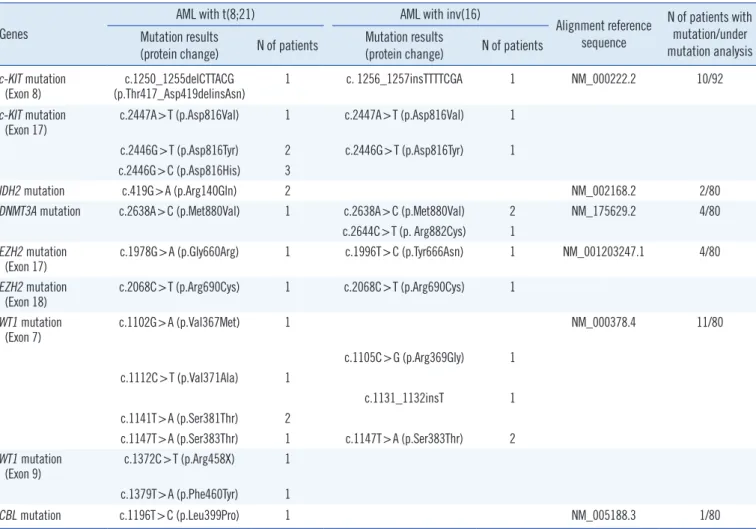
of patients with additional chromosomal abnormalities, SCT per- formance, relapse and death rates, length of follow-up periods, complete blood cell count data at diagnosis, and peripheral blood (PB) and BM blast counts as percentages at diagnosis. In addi- tion, all genetic mutations detected were aligned against refer- ence sequences (NM_004119.2 for FLT3 ITD, NM_002520.6 for NPM1, NM_000222.2 for c-KIT, NM_004364.3 for CEBPA, NM_005896.2 for IDH1, NM_002168.2 for IDH2, NM_175629.2 for DNMT3A, NM_001203247.1 for EZH2, NM_000378.4 for WT1 and NM_005188.3 for CBL) and any resulting protein changes were analyzed. These results are represented in Tables 1 and 2.
5. Comparison of clinical features and prognoses between patients with or without c-KIT or WT1 mutations
Patients with t(8;21) for whom c-KIT and WT1 mutation data were available (71 and 60 patients, respectively) were catego-
rized into two subgroups based on their c-KIT and WT1 mutation status, and their clinical features were compared. c-KIT and WT1 were selected because they showed higher mutation fre- quencies than other genes. To evaluate the prognostic impact of both c-KIT and WT1 mutations, both overall survival (OS) and disease free survival (DFS) were compared between the two pa- tient subgroups. Since two patients showed FLT3 ITD or NPM1 mutations, they were excluded from the survival analysis to ex- clude the prognostic impact of these mutations. OS was defined as the time from diagnosis to death or last follow-up. DFS was defined as the time from CR to relapse (for patients who experi- enced relapse), death (for non-relapsed patients who did not survive), or last follow-up (for non-relapsed patients who sur- vived). Patients who underwent SCT were censored at the time of transplantation. In addition, identical comparisons were per- formed for 21 patients with inv(16). These results are summa- rized in Table 3 and Fig. 1.
Table 2. Summary of detected mutations in patients with core binding factor acute myeloid leukemia Genes
AML with t(8;21) AML with inv(16)
Alignment reference sequence
N of patients with mutation/under mutation analysis Mutation results
(protein change) N of patients Mutation results
(protein change) N of patients c-KIT mutation
(Exon 8) c.1250_1255delCTTACG
(p.Thr417_Asp419delinsAsn) 1 c. 1256_1257insTTTTCGA 1 NM_000222.2 10/92
c-KIT mutation
(Exon 17) c.2447A>T (p.Asp816Val) 1 c.2447A>T (p.Asp816Val) 1 c.2446G>T (p.Asp816Tyr) 2 c.2446G>T (p.Asp816Tyr) 1 c.2446G>C (p.Asp816His) 3
IDH2 mutation c.419G>A (p.Arg140Gln) 2 NM_002168.2 2/80
DNMT3A mutation c.2638A>C (p.Met880Val) 1 c.2638A>C (p.Met880Val) 2 NM_175629.2 4/80
c.2644C>T (p. Arg882Cys) 1 EZH2 mutation
(Exon 17) c.1978G>A (p.Gly660Arg) 1 c.1996T>C (p.Tyr666Asn) 1 NM_001203247.1 4/80
EZH2 mutation
(Exon 18) c.2068C>T (p.Arg690Cys) 1 c.2068C>T (p.Arg690Cys) 1 WT1 mutation
(Exon 7) c.1102G>A (p.Val367Met) 1 NM_000378.4 11/80
c.1105C>G (p.Arg369Gly) 1 c.1112C>T (p.Val371Ala) 1
c.1131_1132insT 1
c.1141T>A (p.Ser381Thr) 2
c.1147T>A (p.Ser383Thr) 1 c.1147T>A (p.Ser383Thr) 2 WT1 mutation
(Exon 9) c.1372C>T (p.Arg458X) 1
c.1379T>A (p.Phe460Tyr) 1
CBL mutation c.1196T>C (p.Leu399Pro) 1 NM_005188.3 1/80
Abbreviations: WT, Wilms’ tumor; IDH, isocitrate dehydrogenase; DNMT3A, DNA (cytosine-5-)-methyltransferase 3 alpha; EZH, enhancer of zeste homolog;
CBL, casitas b-lineage lymphoma; del, deletion; ins, insertion; X, stop codon.
6. Comparison of clinical features and prognoses in patients with t(8;21) among 4 patient subgroups categorized by c-KIT and WT1 mutation status
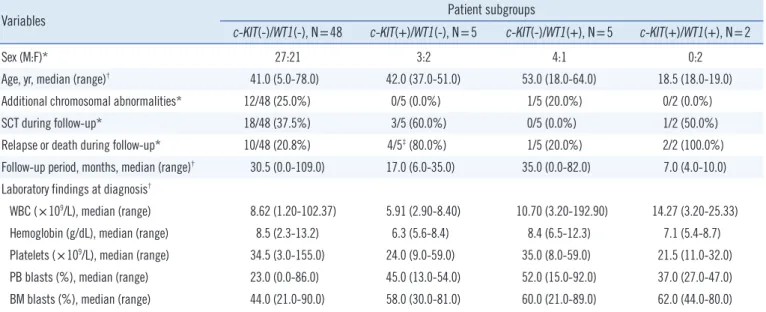
The 60 patients with t(8;21) for whom both c-KIT and WT1 mu- tation data were available were categorized into four patient sub- groups: 1) c-KIT(-)/WT1(-), N=48; 2) c-KIT(+)/WT1(-), N=5; 3) c-KIT(-)/WT1(+), N =5; and 4) c-KIT(+)/WT1(+), N =2. Both clinical features and survival rates were compared between pa- tient subgroups. As mentioned above, two patients with FLT3
ITD or NPM1 mutations were excluded from the survival analy- sis. These results are summarized in Table 4 and Fig. 2.
7. Statistical analysis
Pearson chi-square or Fisher’s exact tests were performed to compare categorical variables. The Mann-Whitney U test was used to compare continuous variables. The log-rank test was ap- plied for the comparison of OS and DFS, and Kaplan-Meier sur- vival curves were generated. All tests were two-tailed, and P val- Table 3. Comparison of clinical features between patients with c-KIT or WT1 mutations and those without c-KIT or WT1 mutations
71 patients with t(8;21) Patient subgroups
c-KIT(-), N=64 c-KIT(+), N=7 WT1(-), N=53 WT1(+), N=7
Sex (M:F)* 35:29 3:4 30:23 4:3
Age, yr, median (range)† 41.5 (5.0-78.0) 37 (18.0-51.0) 41 (5.0-78.0) 36 (18.0-64.0)
Additional chromosomal abnormalities* 17/64 (26.6%) 0/7 (0.0%) 12/53 (22.6%) 1/7 (14.3%)
SCT during follow-up* 20/64 (31.3%) 4/7 (57.1%) 21/53 (39.6%) 1/7 (14.3%)
Relapse or death during follow-up* 16/64 (25.0%) 6/7‡ (85.7%) 14/53 (26.4%) 3/7 (42.9%)
Follow-up period, months, median (range)† 29 (0.0-150.0) 10 (4.0-35.0) 29 (0.0-109.0) 15 (0.0-82.0) Laboratory findings at diagnosis†
WBC (×109/L), median (range) 8.62 (1.20-192.90) 5.91 (2.90-25.33) 8.34 (1.20-102.37) 10.7 (3.20-192.90)
Hemoglobin (g/dL), median (range) 8 (1.5-13.2) 6.3 (5.4-8.7) 8.3 (2.3-13.2) 8.4 (5.4-12.3)
Platelets (×109/L), median (range) 32 (3.0-155.0) 24 (9.0-59.0) 34 (3.0-155.0) 32 (8.0-59.0)
PB blasts (%), median (range) 24 (0.0-92.0) 45 (13.0-54.0) 26 (0.0-86.0) 47 (15.0-92.0)
BM blasts (%), median (range) 47 (21.0-90.0) 58 (30.0-81.0) 44 (21.0-90.0) 60 (21.0-89.0)
21 patients with inv(16) Patient subgroups
c-KIT(-), N=18 c-KIT(+), N=3 WT1(-), N=16 WT1(+), N=4
Sex (M:F)* 11:7 2:1 10:6 3:1
Age, yr, median (range)† 46.5 (16.0-82.0) 58 (47.0-58.0) 46.5 (23.0-69.0) 61.0§ (49.0-82.0)
Additional chromosomal abnormalities* 4/18 (22.2%) 1/3 (33.3%) 4/16 (25.0%) 1/4 (25.0%)
SCT during follow-up* 9/18 (50.0%) 2/3 (66.7%) 9/16 (56.3%) 1/4 (25.0%)
Relapse or death during follow-up* 9/18 (50.0%) 2/3 (66.7%) 7/16 (43.7%) 3/4 (75.0%)
Follow-up period, months, median (range)† 17 (0.0-119.0) 10 (5.0-46.0) 26.5 (1.0-119.0) 6 (0.0-17.0) Laboratory findings at diagnosis†
WBC (×109/L), median (range) 51.2 (2.70-277.62) 106.8 (40.06-160.10) 76.5 (11.10-277.62) 28.97 (2.70-181.35)
Hemoglobin (g/dL), median (range) 8.5 (4.6-12.4) 7.1 (6.4-8.1) 7.7 (4.6-11.4) 8.1 (5.8-12.4)
Platelets (×109/L), median (range) 34.5 (13.0-307.0) 15.0‡ (6.0-25.0) 33.5 (13.0-78.0) 21.5 (6.0-307.0)
PB blasts (%), median (range) 60 (7.0-86.0) 74 (71.0-87.0) 63.5 (25.0-87.0) 44 (7.0-71.0)
BM blasts (%), median (range) 62 (21.0-87.0) 85.0‡ (80.0-91.0) 67.5 (43.0-91.0) 57.5 (21.0-87.0) P values were obtained using Chi-square or Fisher’s exact tests (for numbers less than five in each group)* and Mann-Whitney U test†. In t(8;21), the pa- tients with c-KIT mutation experienced relapse or died during follow-up more frequently than those without c-KIT mutation (P =0.003). In inv(16), the pa- tients with c-KIT mutation showed lower platelet counts (P =0.024) and higher BM blasts (P =0.017) than those without c-KIT mutation, and the patients with WT1 mutation were older than those without WT1 mutation (P =0.029). Comparison items which showed statistically significant differences with respect to c-KIT and WT1 mutation status were indicated with superscripts (‡) and (§), respectively.
Abbreviations: SCT, stem cell transplantation; WBC, white blood cell; PB, peripheral blood; BM, bone marrow; WT, Wilms’ tumor.
ues <0.05 were considered statistically significant. SPSS 13.0.1 for Windows (SPSS Inc, Chicago, IL, USA) was used for statisti- cal analysis.
RESULTS
1. Comparison of clinical features and incidences of genetic mutations between AML patients with t(8;21) and those with inv(16)
Patients with inv(16) showed significantly higher white blood cell (WBC) counts (median 54.4 ×10⁹/L vs. 8.34 ×10⁹/L, P <
0.001), and levels of PB blasts (median 63.0% vs. 27.0%, P =0.002) and BM blasts (median 65.0% vs. 48.0%, P =0.003) than those with t(8;21). Other clinical features were not signifi-
cantly different between the two patient subgroups.
Among the total of 92 patients, incidences of FLT3 ITD, NPM1, CEBPA, CBL, IDH1, IDH2, EZH2, and DNMT3A muta- tions were 3.3%, 1.1%, 0%, 1.3%, 0%, 2.5%, 5.0%, and 5.0%, respectively. The incidences of both c-KIT mutations (10.9%) and WT1 mutations (13.8%) were relatively higher than those of the other gene mutations analyzed. Mutation frequencies in pa- tients with t(8;21) and inv(16) were not significantly different, except for that of DNMT3A, which showed significantly higher incidence in patients with inv(16) than in those with t(8;21) (15.0% vs. 1.7%, P =0.046; Table 1).
2. Summary of detected mutations in 92 CBF AML patients
In total, two and eight patients showed c-KIT mutations in exons 8 Fig. 1. Comparisons of overall survival and disease free survival lengths in core binding factor acute leukemia patients with t(8;21) and no FLT3 ITD or NPM1 mutations, between patients with c-KIT mutations and those without c-KIT mutations (N=69, A, overall survival; B, dis- ease free survival). Identical comparisons between patients with WT1 mutations and those without WT1 mutations (N=58, C, overall sur- vival; D, disease free survival) are also given in this figure.Abbreviation: WT, Wilms’ tumor.
1.0
0.8
0.6
0.4
0.2
0
1.0
0.8
0.6
0.4
0.2
0
1.0
0.8
0.6
0.4
0.2
0
1.0
0.8
0.6
0.4
0.2
0
0 20 40 60 80 100 120
0 20 40 60 80 100 120
0 20 40 60 80 100 120
0 20 40 60 80 100 120
Overall survival date (mo)
Overall survival date (mo)
Disease free survival date (mo)
Disease free survival date (mo) P <0.001
P =0.793
P <0.001
P =0.652 c-KIT mutation status
WT1 mutation status
c-KIT mutation status
WT1 mutation status Negative (N=62)
Negative (N=52)
Negative (N=62)
Negative (N=52) Positive (N=7)
Positive (N=6)
Positive (N=7)
Positive (N=6)
Cumulative survivalCumulative survival Cumulative survivalCumulative survival
A
C
B
D
and 17, respectively. The mutations detected included four previ- ously reported (c.1250_1255delCTTACG, c.2447A >T, c.2446G>T, and c.2446G>C), and one novel mutation (c.1256_
1257insTTTTCGA). In the CEBPA gene, no mutations were de- tected but a known polymorphism (c.584_589dup ACCCGC) [23]
was observed in 26 (28.3%) patients. In the case of IDH2, only two patients harbored a mutation, which was previously reported (c.419G>A), and for DNMT3A, four patients showed mutations,
both of which were reported previously (c.2638A>C and c.2644C
>T). Regarding EZH2, three previously reported mutations (c.1978G>A, c.1996T>C, and c.2068C>T) were found in four patients, and one previously reported intronic variant (c.2110 +6T >G), predicted as being benign in the ClinVar database (http://www.ncbi.nlm.nih.gov/clinvar/variation/137273/, last re- viewed on 14 Mar 2014), was detected in one patient. One previ- ously reported CBL mutation (c.1196T>C) was detected in one Table 4. Comparison of clinical features in 60 patients with t(8;21) according to c-KIT and WT1 mutation status
Variables Patient subgroups
c-KIT(-)/WT1(-), N=48 c-KIT(+)/WT1(-), N=5 c-KIT(-)/WT1(+), N=5 c-KIT(+)/WT1(+), N=2
Sex (M:F)* 27:21 3:2 4:1 0:2
Age, yr, median (range)† 41.0 (5.0-78.0) 42.0 (37.0-51.0) 53.0 (18.0-64.0) 18.5 (18.0-19.0)
Additional chromosomal abnormalities* 12/48 (25.0%) 0/5 (0.0%) 1/5 (20.0%) 0/2 (0.0%)
SCT during follow-up* 18/48 (37.5%) 3/5 (60.0%) 0/5 (0.0%) 1/2 (50.0%)
Relapse or death during follow-up* 10/48 (20.8%) 4/5‡ (80.0%) 1/5 (20.0%) 2/2 (100.0%)
Follow-up period, months, median (range)† 30.5 (0.0-109.0) 17.0 (6.0-35.0) 35.0 (0.0-82.0) 7.0 (4.0-10.0) Laboratory findings at diagnosis†
WBC (×109/L), median (range) 8.62 (1.20-102.37) 5.91 (2.90-8.40) 10.70 (3.20-192.90) 14.27 (3.20-25.33)
Hemoglobin (g/dL), median (range) 8.5 (2.3-13.2) 6.3 (5.6-8.4) 8.4 (6.5-12.3) 7.1 (5.4-8.7)
Platelets (×109/L), median (range) 34.5 (3.0-155.0) 24.0 (9.0-59.0) 35.0 (8.0-59.0) 21.5 (11.0-32.0) PB blasts (%), median (range) 23.0 (0.0-86.0) 45.0 (13.0-54.0) 52.0 (15.0-92.0) 37.0 (27.0-47.0) BM blasts (%), median (range) 44.0 (21.0-90.0) 58.0 (30.0-81.0) 60.0 (21.0-89.0) 62.0 (44.0-80.0) P values were obtained using Chi-square or Fisher’s exact tests (for numbers less than five in each group)* and Mann-Whitney U test†. In patients without WT1 mutation, those with c-KIT mutation experienced relapse or died during follow-up more frequently than those without c-KIT mutation (P =0.014). Com- parison items which showed statistically significant differences between two patient subgroups were indicated with superscript (‡).
Abbreviations: SCT, stem cell transplantation; WBC, white blood cell; PB, peripheral blood; BM, bone marrow; WT, Wilms’ tumor.
Fig. 2. Comparisons of overall survival and disease free survival in core binding factor acute leukemia patients with t(8;21) and no FLT3 ITD or NPM1 mutations, among four patient subgroups categorized by c-KIT and WT1 mutation status (N=58, A, overall survival; B, dis- ease free survival).
Abbreviation: WT, Wilms’ tumor.
1.0
0.8
0.6
0.4
0.2
0
1.0
0.8
0.6
0.4
0.2
0
0 20 40 60 80 100 120 0 20 40 60 80 100 120
Overall survival date (mo) Disease free survival date (mo)
(1) vs. (3) P =0.298 (2) vs. (4) P =0.049 c-KIT and WT1 mutation status
(1) c-KIT- /WT1- (N=47) (3) c-KIT- /WT1+ (N=4) (2) c-KIT+/WT1- (N=5) (4) c-KIT+/WT1+ (N=2)
Cumulative survival Cumulative survival
A B
(1) vs. (3) P =0.323 (2) vs. (4) P =0.049 c-KIT and WT1 mutation status
(1) c-KIT- /WT1- (N=47) (3) c-KIT- /WT1+ (N=4) (2) c-KIT+/WT1- (N=5) (4) c-KIT+/WT1+ (N=2)
patient. Analysis of WT1 revealed six previously reported mutations (c.1102G>A, c.1105C>G, c.1141T>A, c.1147T>A, c.1372C>T, and c.1379T >A) and two novel mutations (c.1112C >T and c.1131_1132insT) in 11 patients.
In summary, the present study identified 20 mutations (17 known and three novel mutations) in 32 patients, one intronic variation of the EZH2 gene from one patient, and one polymor- phism of the CEBPA gene in 26 patients (Table 2).
3. Comparison of clinical features and prognoses between patients with or without c-KIT or WT1 mutations
With regard to patients with t(8;21), clinical features did not dif- fer significantly between patients with c-KIT mutations and those without. However, those with such mutations experienced relapse or died during follow-up more frequently than those without (85.7% vs. 25.0%, P =0.003), and both OS and DFS lengths were significantly shorter in patients with c-KIT muta- tions than in those without (P <0.001 for both). Neither clinical features nor prognoses differed significantly with respect to WT1 mutation status.
As for patients with inv(16), neither c-KIT nor WT1 mutation status significantly affected clinical features and prognoses, with the exception of significantly lower platelet counts in patients with c-KIT mutations than in those without (median 15.0×10⁹/L vs. 34.5×10⁹/L, P =0.024; Table 3 and Fig. 1).
4. Comparison of clinical features and prognoses in patients with t(8;21) among four patient subgroups categorized by c-KIT and WT1 mutation status
Within the subgroup showing no WT1 mutation, the patients harboring c-KIT mutations were more likely to experience re- lapse or die during follow-up than those without c-KIT mutations (80.8% vs. 20.8%, P =0.014). However, this difference was not statistically significant (100.0% vs. 20.0%, P =0.143) for the patient subgroup with WT1 mutations, which suggests that the poor prognostic impact of c-KIT mutation in AML patients with t(8;21) may apply only in patients with wild type WT1.
Regarding the subgroup showing c-KIT mutations, patients with WT1 mutations did not show significant differences in clini- cal outcomes, including relapse or death during follow-up (100.0% vs. 80.0%, P =0.495), compared with those without WT1 mutation. In the patient subgroup harboring c-KIT muta- tions, although the survival analysis showed significantly shorter OS and DFS in patients with WT1 mutations than in those with- out WT1 mutations (P =0.049 in both), the statistical power of this analysis was seriously limited due to the very low number of
patients in each group. In the subgroup without c-KIT muta- tions, the patients with WT1 mutations also showed no differ- ences in clinical outcomes, including rate of relapse or death during follow-up (20.0% vs. 20.8%, P =0.965), and prognosis (P =0.298 for OS and P =0.323 for DFS), compared with those without WT1 mutation (Table 4 and Fig. 2).
DISCUSSION
The present study found that the incidences of FLT3 ITD and NPM1 mutations were extremely low, representing 3.3% and 1.1% respectively of the CBF AML patients evaluated, and these results are consistent with previous studies, which re- ported similarly low frequencies of FLT3 ITD mutation (5 to 6%) and NPM1 mutation (0%) in cases of CBF AML [19, 21, 24].
Our study also demonstrated that patients with this disease are unlikely to harbor CEBPA mutations. These results indicate that FLT3 ITD, NPM1, and CEBPA mutations are not involved in leu- kemogenesis and imply no prognostic impact for CBF AML. Our data also support previous studies that have implicated muta- tions in both RAS and c-KIT as major leukemogenic factors in CBF AML [21, 25].
In addition, our study suggests that the frequencies of muta- tion in CBL and in genes associated with epigenetic modifica- tion, such as IDH1, IDH2, DNMT3A, and EZH2, are low in this disease, present in 1.3%, 0%, 2.5%, 5.0%, and 5.0% of the to- tal number of patients, respectively. These results may support the idea that mutations involved in epigenetic modification do not contribute to leukemogenesis and have no significant prog- nostic value in CBF AML, since IDH2, DNMT3A, EZH2, and CBL mutation status did not significantly affect prognosis in our study (data not shown). In contrast, the present study showed that incidences of c-KIT and WT1 mutation in CBF AML were relatively higher than the mutations in other genes, being found in 10.9% and 13.8% of patients, respectively. Our results con- firm the consistency of c-KIT mutation frequency in CBF AML between previous publications (6 to 48%) and Korean popula- tion [17-21].
The present work demonstrated that the poor prognostic im- pact of c-KIT mutation in patients carrying t(8;21) was evident only in the subgroup lacking WT1 mutations. Although this trend was also evident in the patient subgroup with WT1 muta- tions, the difference was not statistically significant. We also found that WT1 mutation status does not affect clinical features and prognosis, regardless of c-KIT mutation status, in patients with t(8;21). Within the subgroup harboring c-KIT mutations, a
worse prognosis was identified for patients with WT1 mutations compared with those without WT1 mutations, but the statistical power of this result is seriously limited owing to the fact that only seven patients were included in the survival analysis.
On the basis of these results, we can speculate that both c- KIT and WT1 mutations constitute important genetic aberrations involved in leukemogenesis of CBF AML and show relatively high incidences in these patients. In addition, c-KIT mutation is a significant indicator of poor prognosis in CBF AML patients carrying t(8;21), but this prognostic value may exist only for a specific patient subgroup without WT1 mutations. It may be suggested that the presence of WT1 mutations does not affect clinical features and prognosis significantly, but further analysis involving a larger number of patients is required to address this point more conclusively.
The present study has two major limitations. First, since only 21 patients with inv(16) were included, comparisons of clinical features and prognoses for inv(16) patients with respect to c- KIT and WT1 mutation status could not be performed with suffi- cient statistical power. Given that there were also only 71 pa- tients carrying t(8;21) in our study, suggestions and specula- tions based on this work should be interpreted with much cau- tion. Second, we were unable to evaluate the effect of WT1 mu- tation on the expression of the corresponding WT1 protein, which is necessary to interpret our results at the protein expres- sion level. Since previous studies involved evaluation of protein expression, stratification of patients based only on WT1 muta- tion status, as performed in the present study, our results need to be interpreted carefully. More focused analysis on this point is required in future studies.
In conclusion, our study demonstrates that the incidences of genetic mutations associated with epigenetic modification are very low and that both c-KIT and WT1 mutations occur more frequently than other mutations in CBF AML. In addition, our results suggest that the poor prognostic impact of c-KIT muta- tion in t(8;21)-positive CBF AML patients may apply only to a specific patient subgroup without WT1 mutations. The poor prognostic impact of WT1 mutation was not evident in t(8;21)- positive CBF AML patients owing to the small number of pa- tients in this study; further study will be required to confirm this speculation in a large number of patients.
Authors’ Disclosures of Potential Conflicts of Interest
No potential conflicts of interest relevant to this article were re-
ported.
Acknowledgments
This study was supported by a Biomedical Research Institute Grant (2011-00), Pusan National University Hospital.
REFERENCES
1. Conway O’Brien E, Prideaux S, Chevassut T. The epigenetic landscape of acute myeloid leukemia. Adv Hematol 2014;2014:103175.
2. Murati A, Brecqueville M, Devillier R, Mozziconacci MJ, Gelsi-Boyer V, Birnbaum D. Myeloid malignancies: mutations, models and manage- ment. BMC Cancer 2012;12:304.
3. Kiyoi H, Naoe T, Nakano Y, Yokota S, Minami S, Miyawaki S, et al. Prog- nostic implication of FLT3 and N-RAS gene mutations in acute myeloid leukemia. Blood 1999;93:3074-80.
4. Port M, Böttcher M, Thol F, Ganser A, Schlenk R, Wasem J, et al. Prog- nostic significance of FLT3 internal tandem duplication, nucleophosmin 1, and CEBPA gene mutations for acute myeloid leukemia patients with normal karyotype and younger than 60 yr: a systematic review and me- ta-analysis. Ann Hematol 2014;93:1279-86.
5. Thol F, Damm F, Lüdeking A, Winschel C, Wagner K, Morgan M, et al.
Incidence and prognostic influence of DNMT3A mutations in acute my- eloid leukemia. J Clin Oncol 2011;29:2889-96.
6. Yan XJ, Xu J, Gu ZH, Pan CM, Lu G, Shen Y, et al. Exome sequencing identifies somatic mutations of DNA methyltransferase gene DNMT3A in acute monocytic leukemia. Nat Genet 2011;43:309-15.
7. Fried I, Bodner C, Pichler MM, Lind K, Beham-Schmid C, Quehenberg- er F, et al. Frequency, onset and clinical impact of somatic DNMT3A mutations in therapy-related and secondary acute myeloid leukemia.
Haematologica 2012;97:246-50.
8. Marcucci G, Maharry K, Wu YZ, Radmacher MD, Mrózek K, Margeson D, et al. IDH1 and IDH2 gene mutations identify novel molecular sub- sets within de novo cytogenetically normal acute myeloid leukemia: a Cancer and Leukemia Group B study. J Clin Oncol 2010;28:2348-55.
9. Wang X, Dai H, Wang Q, Wang Q, Xu Y, Wang Y, et al. EZH2 mutations are related to low blast percentage in bone marrow and -7/del(7q) in de novo acute myeloid leukemia. PLoS One 2013;8:e61341.
10. Naoe T and Kiyoi H. Gene mutations of acute myeloid leukemia in the genome era. Int J Hematol 2013;97:165-74.
11. Abdel-Wahab O, Pardanani A, Patel J, Wadleigh M, Lasho T, Heguy A, et al. Concomitant analysis of EZH2 and ASXL1 mutations in myelofibro- sis, chronic myelomonocytic leukemia and blast-phase myeloprolifera- tive neoplasms. Leukemia 2011;25:1200-2.
12. Rocquain J, Carbuccia N, Trouplin V, Raynaud S, Murati A, Nezri M, et al. Combined mutations of ASXL1, CBL, FLT3, IDH1, IDH2, JAK2, KRAS, NPM1, NRAS, RUNX1, TET2 and WT1 genes in myelodysplas- tic syndromes and acute myeloid leukemias. BMC Cancer 2010;10:
401.
13. Inoue K, Sugiyama H, Ogawa H, Nakagawa M, Yamagami T, Miwa H, et al. WT1 as a new prognostic factor and a new marker for the detection of minimal residual disease in acute leukemia. Blood 1994;84:3071-9.
14. Schmid D, Heinze G, Linnerth B, Tisljar K, Kusec R, Geissler K, et al.
Prognostic significance of WT1 gene expression at diagnosis in adult de novo acute myeloid leukemia. Leukemia 1997;11:639-43.
15. Bergmann L, Maurer U, Weidmann E. Wilms tumor gene expression in
acute myeloid leukemias. Leuk Lymphoma 1997;25:435-43.
16. Miglino M, Colombo N, Pica G, Grasso R, Clavio M, Bergamaschi M, et al. WT1 overexpression at diagnosis may predict favorable outcome in patients with de novo non-M3 acute myeloid leukemia. Leuk Lympho- ma 2011;52:1961-9.
17. Kim HJ, Ahn HK, Jung CW, Moon JH, Park CH, Lee KO, et al. KIT D816 mutation associates with adverse outcomes in core binding factor acute myeloid leukemia, especially in the subgroup with RUNX1/RUNX1T1 rearrangement. Ann Hematol 2013;92:163-71.
18. Park SH, Chi HS, Min SK, Park BG, Jang S, Park CJ. Prognostic impact of c-KIT mutations in core binding factor acute myeloid leukemia. Leuk Res 2011;35:1376-83.
19. Boissel N, Leroy H, Brethon B, Philippe N, de Botton S, Auvrignon A, et al. Incidence and prognostic impact of c-Kit, FLT3, and Ras gene muta- tions in core binding factor acute myeloid leukemia (CBF-AML). Leuke- mia 2006;20:965-70.
20. Paschka P, Marcucci G, Ruppert AS, Mrózek K, Chen H, Kittles RA, et al. Adverse prognostic significance of KIT mutations in adult acute my- eloid leukemia with inv(16) and t(8;21): a Cancer and Leukemia Group B Study. J Clin Oncol 2006;24:3904-11.
21. Allen C, Hills RK, Lamb K, Evans C, Tinsley S, Sellar R, et al. The impor- tance of relative mutant level for evaluating impact on outcome of KIT, FLT3 and CBL mutations in core-binding factor acute myeloid leuke- mia. Leukemia 2013;27:1891-901.
22. Park SH, Min SK, Park BG, Jang S, Park CJ, Chi HS. Clinical usefulness of plasma specimens for detection of nucleophosmin 1 gene mutations in patients with normal karyotype acute myeloid leukemia. Leuk Res 2011;35:e159-60.
23. Park SH, Chi HS, Cho YU, Jang S, Park CJ. CEBPA single mutation can be a possible favorable prognostic indicator in NPM1 and FLT3-ITD wild-type acute myeloid leukemia patients with intermediate cytogenetic risk. Leuk Res 2013;37:1488-94.
24. Verhaak RG, Goudswaard CS, van Putten W, Bijl MA, Sanders MA, Hu- gens W, et al. Mutations in nucleophosmin (NPM1) in acute myeloid leukemia (AML): association with other gene abnormalities and previ- ously established gene expression signatures and their favorable prog- nostic significance. Blood 2005;106:3747-54.
25. Mrózek K, Marcucci G, Paschka P, Bloomfield CD. Advances in molec- ular genetics and treatment of core-binding factor acute myeloid leuke- mia. Curr Opin Oncol 2008;20:711-8.