Effects of Two Music Therapy Methods on Agitation and Anxiety among Patients Weaning off Mechanical Ventilation: A Pilot Study
Park, Jong Yoen
1)· Park, Soohyun
2)1) Nurse Manager, Ewha Womans University Medical Center, Seoul 2) Assistant Professor, Department of Nursing, Eulji University, Seongnam, Korea
Purpose: The feasibility and differential effects of two music therapy methods (interventions with preferred music vs. classical relaxation music) were done to examine the effects on agitation and anxiety in patients weaning off mechanical ventilation. Methods: This pilot study was conducted using a crossover design. Six patients listened to preferred music choices and classical relaxation music. Anxiety scores were measured using the Richmond Agitation Sedation Scale (RASS), State-Trait Anxiety Inventory (STAI), and visual analog scale (VAS). Results:
Patients showed a significant decrease in agitation and anxiety after both the preferred and classical relaxation music interventions. The difference in the effects of preferred music and that of classical relaxation music was not significant. As for feasibility, patients exhibited a change in agitated behaviors after the music interventions by not trying to take off medical devices and quietly listening to the music, and by smiling and moving lips along with the lyrics while listening. Conclusion: Music interventions which centered on either patients’ preferences or classical relaxation music to enhance relaxation, helped reduce agitation and anxiety during the mechanical ven- tilation weaning process.
Key Words: Music; Agitation; Anxiety; Ventilation
*This article was supported by Eulji University in 2016.
Received Mar 22, 2019 Revised May 10, 2019 Accepted May 14, 2019 Corresponding author: Park, Soohyun
Department of Nursing, Eulji University
553 Sanseong-daero, Sujeong-gu, Seongnam 13135, Korea
Tel: +82-31-740-7184, Fax: +82-31-740-7359, E-mail: [email protected]
INTRODUCTION
Mechanical ventilation (MV) is typically used to treat acute respiratory failure. More than 20% of patients in in- tensive care units (ICUs) undergo MV [1]. Weaning off MV refers to the transition period of progressively reducing ventilator support [2]. During the weaning process, pa- tients can experience severe anxiety, stress, fear, agitation, and lack of sleep [3-5]. These distressing experiences can increase the breathing workload and fatigue by stimulat- ing the sympathetic nervous system, which can lengthen the weaning period [4,6]. Longer weaning periods can lead to longer hospitalizations and increased hospital costs [7]. To reduce costs and stays, healthcare providers should help patients successfully wean off MV in order to better recover spontaneous breathing after extubation [8].
In general, clinicians use pharmacological treatments to manage distressing experiences during MV weaning, such as analgesics and sedatives [7]. However, during the weaning period, the clinician also strives to keep pa- tients alert by decreasing medication dosages of sedative medications in order to stimulate patients’ spontaneous breathing. Since certain analgesics have side effects that include respiratory depression and weakening of the respiratory muscles, clinicians have been searching for effective non-pharmacological interventions [4]. Nonphar- macological approaches such as cognitive behavior ther- apy and respiratory muscle training have been used; how- ever, these techniques require a trained professional [8,9].
Therefore, music therapy is used because it is inexpensive compared to sedative and analgesic medication and can be applied without any specialized training [10]. A study showed that ventilated patients are more likely to experi- ence a successful weaning process when awake and aware of their surroundings [11]. Because music can increase pa- tients’ awareness of their surroundings through physio- logical and psychological stimulation, music therapy has been proposed as an environmental intervention [10].
Music therapy is a non-pharmacological, environment- al intervention that has been effective for decreasing anxi- ety, stress, and agitation as well as increasing relaxation [12,13]. Specifically, music interventions have been shown to be effective for lowering ventilated patients’ stress, anxiety, and agitation [14,15]. This is also true during the MV weaning process-many patients report decreases in stress and anxiety after music interventions [16-18]. How- ever, thus far, no prior research has been conducted on the effect of music interventions on agitation for patients while weaning off MV. There is some evidence that sound-based therapies can help agitation. For instance, in a study using
nature-based sound therapy-such as birdsongs, soothing rain sounds, river or waterfall sounds, or sounds of walk- ing through the forest-patients reported significantly de- creased agitation [19].
Furthermore, a music intervention was effective for de- creasing patients’ agitation during the MV period [15].
Thus, music interventions may help with managing agi- tation during the weaning process. In order to confirm this, we explored the feasibility of two types of music in- terventions (preferred and classical relaxation music) for improving patients’ agitation in the present study.
The music utilized in most previous studies investigat- ing the MV weaning process was selected by healthcare professionals and included classical music, relaxing mu- sic, or Korean traditional music [16,17]. While such music is intended to have a soothing effect, this might not be the case for all patients [14]. Therefore, it is necessary to ex- plore whether music that better reflects patients’ prefer- ences is also suitable for music therapy. The findings from the previous study, which was the only study with pa- tients’ preferred music, indicated that preferred music was related to a decrease in anxiety and dyspnea com- pared to a no music condition [18]. Another notable gap in the literature is that no study has compared the inter- vention effects of patients’ preferred music and healthcare providers’ selected music (e.g., soothing music). There- fore, the present study also compared the effectiveness of preferred music and classical relaxation music in decreas- ing anxiety and agitation. In summary, the goals of the present pilot study were to identify the feasibility of pre- ferred music and classical relaxation music interventions for reducing agitation and anxiety among patients who are weaning off MV and to compare any differences in the effectiveness of these two interventions.
METHODS 1. Study Design
This pilot study was conducted with a single group uti- lizing a crossover design. Patients were recruited from a surgical intensive care unit at a general hospital in Seoul, South Korea, from September 2017 to February 2018. Two different interventions-a preferred music intervention vs.
a classical relaxation music intervention-were provided in a different sequence. Patients acted as their own controls in this study, as it is difficult to randomize individuals un- dergoing ventilation weaning into cross-matched groups.
As there were likely to be some cumulative carryover ef- fects from the first intervention to the second, patients
were randomized into an intervention order-preferred music or classical relaxation music first-using a computer random number generator.
2. Setting and Sample
Patients’ eligibility was identified by the ICU manager in the selected setting. To be eligible for this study, partic- ipants had to be (1) aged 19 years or older; (2) undergoing the pressure support ventilation (PSV) mode of MV; (3) alert; (4) capable of nonverbal communication; (5) hemo- dynamically stable during the weaning process, including having a partial pressure of oxygen (PaO2)/fraction of in- spired oxygen (FiO2) ratio over 200, a heart rate of less than 140 bpm, and a mean blood pressure of more than 60mmHg [20]; and (6) able to listen to music via head- phones without problems. Patients with a history of psy- chiatric illness, cognitive disorders, receiving continuous intravenous sedation, and neurological disorders were excluded. Applying the inclusion and exclusion criteria, six patients were included in the study.
3. Measurements
1) Music Assessment Tool (MAT)
The MAT, developed by Chlan and Heiderscheit [21], was used as a guide to select patients’ preferred music in this study. This tool gathers comprehensive information about music preferences through five questions as fol- lows: (1) whether a patient likes music or not; (2) whether a patient is professional music or not musician; (3) pa- tients’ preferences music types among 14 different genres of music; (4) specific artists or groups that a patient likes;
and (5) genres of music that the patients do not like.
2) Agitation
Agitation was assessed using the Richmond Agitation Sedation Scale (RASS). The RASS is a single-item measure that uses a 10-point scale ranging from -5 to +4. The RASS comprises four levels of anxiety or agitation (1-4), one lev- el of a calm and alert state (0), and five levels of sedation (-1 to -5). Higher scores indicate a more agitated state. Validi- ty of the RASS has been reported in previous studies, and the RASS is strongly correlated with the Sedation Agitation Scale score (r=.78, p<.001), Ramsay Sedation Scale (r=.78,
p<.001), and Glasgow Coma Scale (r=.79, p<.001) [22].
3) Anxiety
Anxiety was assessed using the State-Trait Anxiety In- ventory (STAI) [23]. The scale comprises 20 items rated on
a 4-point Likert scale ranging from 1 (“strongly disagree”) to 4 (“strongly agree”). The reverse-scored items are 1, 2, 5, 8, 10, 11, 15, 16, 19, and 20. Total scores range from 20 to 80, with higher scores indicating higher anxiety levels. The STAI shows good reliability-it had a Cronbach’s ⍺ of 0.89 in a previous study [24] and 0.96 in the present study.
Furthermore, the test-retest reliability coefficients for this scale range from .69 to .89 based on intervals ranging from 1 hour to 104 days [25].
Anxiety was also measured using a self-reported 10-mm visual analog scale (VAS). The VAS comprised a 10-cm horizontal line, the ends of which reflected the ex- tremes of anxiety severity (the left end indicated no anxi- ety, and the right end indicated the highest anxiety).
4. Interventions
Preferred music was selected using the MAT, and ques- tions were verbally delivered to patients by the researcher.
Since the patients could not speak, the researcher had pa- tients communicate their answers by writing on paper or using body language (e.g., head nods). Based on answers to the MAT, a list of each patient’s favorite songs was created. The researcher then downloaded each of these songs from an online music streaming service.
For the classical relaxation music, an album called “Me- ditation: Classical Relaxation Vol. 3” was selected. This anthology includes a variety of composers, and most of the songs have a slow tempo and beat. The songs have been demonstrated to have a soothing effect [26].
When weaning trials first began, participants listened to their preferred music or the classical relaxation music for 30 minutes. Thirty minutes was selected in this study be- cause 30 minutes has been employed in most studies on the effect of music therapy [14,23,25]. However, there is currently no consensus regarding the most effective dura- tion. All patients listened to music via headphones con- nected to an MP3 player. The music volume was set to pa- tients’ preference. The researcher asked patients whether he/she wanted to change the volume, and then the pa- tients answered this question by nodding (yes) or shaking (no) his/her head. For those responding “yes,” the re- searcher changed the volume and asked if the changed volume was acceptable. All music interventions were per- formed between nursing procedures to prevent the inter- ventions from being interrupted.
5. Data Collection
The researcher recorded the patients’ general character-
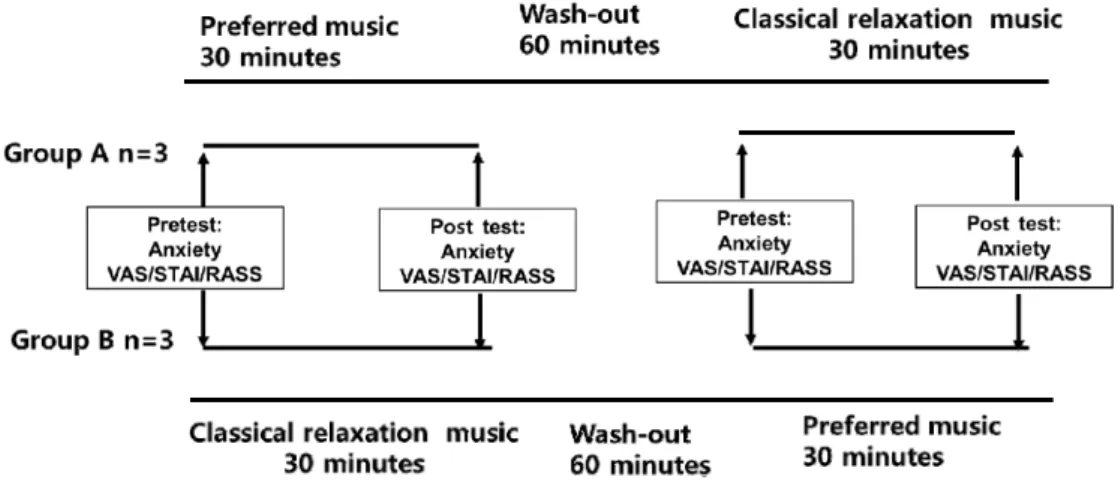
STAI=State-Trait Anxiety Inventory; VAS=Visual Analog Scale; RASS=Richmond Agitation Sedation Scale.
Figure 1. Flow chart of study design.
istics, such as age, education, and medical diagnosis, using medical records. Before music intervention, patients were administered the self-reported STAI and VAS anxiety scale. If a patient could not complete the STAI question- naires, the researcher read the questions and patients an- swered by nodding their head when the researcher point- ed to the corresponding number on the rating scale (1 to 4).
For the VAS scale, patients pointed to a spot on the 10-cm horizontal line with their finger. The RASS was completed by the researcher while observing the patient’s status be- fore the music intervention began. After completing each music intervention, the anxiety VAS scale, the STAI, and the RASS was completed according to the same methods that performed before the intervention.
The entire experiment lasted for 120 minutes. Three pa- tients underwent the classical relaxation music inter- vention for the first 30 minutes, followed by the preferred music intervention for another 30 minutes. The other three patients received the preferred music intervention first, followed by the classical relaxation music, for the same length of time. There was a 60 minute washout period be- tween the two music interventions. During the washout period, patients did not participate in any other research procedures (Figure 1).
During data collection, other sources of simulations, such as light in the room, were minimized (e.g., lights were dimmed), and healthcare providers were instructed not to interrupt patients during the music listening periods. Pati- ents were lying quietly with their eyes closed during the interventions. The intervention was stopped if patients ex- perienced any of the following: heart rate < 140 bpm and mean blood pressure > 60 mmHg. No patients experi-
enced these conditions during the intervention period.
6. Data Analyses
Statistical analyses were conducted using SPSS/WIN Statistics 21.0 for Windows. Demographic characteristics were analyzed using descriptive statistics. To compare medians of agitation and anxiety scores between the inter- ventions, Mann-Whitney U tests and Wilcoxon signed rank tests were used.
7. Ethical Considerations
The study was approved by the Institutional Review Board (IRB: 2016-08-059) of the general hospital where we collected the data. The researcher explained the benefits and risks of this study to both the patients and family members. If patients and their family members agreed to participate, informed consent was obtained from both the patient and the family members. Patients were informed of their anonymity and confidentiality, and patients could withdraw from the study at any time.
RESULTS 1. Demographic Information
More than half of the patients were female, and mean age was 45.33 years (Table 1). The mean number of days of MV was 10.67. All patients were taking pain medication.
Most participants preferred either trendy Korean pop mu- sic or Korean oldies music; classical music was not selec-
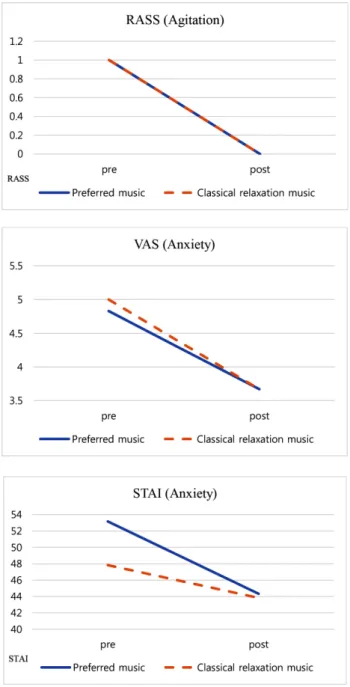
Figure 2. Pre-post comparisons of agitation and anxiety scores.
Table 1. Patient Demographics
(N=6)Variables Categories n (%) or M±SD
Gender Male
Female
2 (33.3) 4 (66.7)
Age Range (20~60) 45.33±16.49
Education Bachelor's degree High school graduate
4 (66.7) 2 (33.3)
Job Office worker
Housewife None
3 (50.0) 1 (16.7) 2 (33.3) Religion Catholic
Buddhist None
1 (16.7) 1 (16.7) 4 (66.6)
ted by any participant as his/her preferred music (Table 2).
2. Pre/Post Comparison of Agitation and Anxiety
Comparisons on anxiety and agitation between the pre- ferred music intervention and classical relaxation music in- tervention are presented in Figure 2. Median RASS scores were significantly lower after both the preferred music in- tervention (Z=-2.24, p=.025) and classical relaxation music intervention (Z=-2, p=.046) compared to before. Patients showed moderate anxiety on the VAS and borderline anxi- ety on the STAI before the music interventions. Both the VAS and STAI scores decreased significantly after the pre- ferred music intervention (Z=-2.07, p=.038; Z=-2.21, p=.027). Differences in median VAS and STAI scores were also statistically significant after the classical relaxation music intervention compared to before music intervention (Z=-2.27, p=.023; Z=-2.21, p=.024). There was no signifi- cant difference in the decrease in median anxiety scores (either VAS or STAI) between the two music interventions (U=15, p=.589; U=9, p=.145) and in median RASS scores (U=15, p=.523)(Table 3).
Furthermore, 83% of patients after the preferred music intervention and 67% after the classical relaxation music were alert and calm (i.e., had a score of zero on the RASS).
Regarding the STAI, 50% and 67% of patients after the pre- ferred and classical relaxation music interventions, re- spectively, showed decreased anxiety.
3. Feasibility: Patients' Responses during the Music Interventions
One of the patients demonstrated a change in agitated behaviors after music interventions. She tried to take off a medical device before listening to the music, but she stop-
ped and quietly listened to the preferred music. She was very calm for the rest of the protocol. Another patient was smiling and moving his lips along with the lyrics while listening.
DISCUSSION
Both preferred music and classical relaxation music were used to relieve agitation and anxiety among patients during MV weaning. Results revealed that both types of
Table 2. Clinical Characteristics and Preferred Music List
Patient Age Gender Medical diagnosis Days of MV Preferred music genre: song title
1 44 Female Hemoperitoneum 4 K-pop song: "Some" and "Travel" by BOL4
2 32 Female Gestational hypertension 2 K-pop songs: "Let it rain", "Drifting apart," and
"Loop" by NELL
3 60 Male Obstructive ileus 17 Korean oldies music: "A woman out of a
window" and "Bounce" by Jo Yong-Pil 4 20 Female Fracture of distal femur and
knee (left)
35 K-pop song: "Galaxy" by BOL4
5 57 Female Advanced gastric cancer 4 Korean oldies music: "Mona Lisa" and "The dreams" by Jo Yong-Pil
6 59 Male Coronary artery obstructive
disease
2 Pop music: "You raise me up" by Josh Groban
MV=mechanical ventilation.
Table 3. Medians of Agitation and Anxiety before and after Classical Relaxation Music and Preferred Music Intervention (N=6)
Variables Categories
Classical relaxation music Preferred music
Pretest Posttest Pretest Posttest
Median Median Median Median
Anxiety VAS
STAI
5 47.5
4 45
4.5 54.5
4 46
Agitation RASS 1 0 1 0
music were effective for improving agitation and anxiety.
It is difficult to compare these findings with previous work, as no prior studies have assessed the effect of music therapy on agitation during the weaning process. How- ever, similar results have been found in previous stud- ies-for example, relaxing music therapy led to a reduction in agitation among intubated patients [27], and nature- based sound therapy decreased agitation during MV wean- ing [19]. Music stimulation might suppress agitated be- havior by influencing the gamma aminobutyric acid (GABA) receptor pathway. GABA is one of the major in- hibitory neurotransmitter receptors in the brain [28], and GABA can become synchronized to music stimuli, result- ing in a calming effect [29]. Overall, our results could be used as a foundation for future research on the effect of music interventions on agitation.
Patients’ anxiety also significantly decreased after both music interventions. This finding is consistent with pre- vious studies showing that patients participating in pa- tient-directed music interventions [18] and classical music interventions [16,17] have lower anxiety levels. This could perhaps be due to preferred music being a positive envi-
ronmental stimulus that can elicit pleasing memories and positive emotions through integration with individuals’
personal lives [30]. Classical music, on the other hand, can facilitate a relaxation response, making classical music ef- fective for reducing anxiety among patients weaning from MV [8].
The intervention effects for agitation and anxiety did not significantly differ between the preferred music and classical relaxation music interventions. Potentially, the lack of a significant difference was related to the small sample size. Therefore, it is recommended that the effect of preferred music on agitation and anxiety during the wean- ing process of MV is examined in a larger sample in the future.
Results regarding patients’ responses during the music interventions suggest that music can have a calming effect on behavior, as well. Patients were much quieter and cal- mer before listening to the music, and some patients were quite immersed in the activity. This is consistent with a previous study demonstrating that patients listening to preferred music displayed a positive response by keeping time with the music and singing along [13].
Study limitations and suggestions for future research
Limitations should be noted. First, the study was con- ducted in one ICU in South Korea with a small patient sample. Therefore, the results cannot be generalized to all patients dealing with the MV weaning process. Future studies should attempt to replicate our findings in a suffi- ciently larger sample across various hospitals in South Korea.Second, the music intervention was provided to pa- tients only one time, which might have obscured any pos- sible differences between the preferred music and classical relaxation music interventions. Participants also expres- sed that it was fun to listen to the preferred music, but they were disappointed that they could only listen to the pre- ferred music once. Therefore, conducting the music inter- ventions repeatedly over a longer duration, to determine whether patients will respond differently to these types of music, may be necessary.
Despite these limitations, the present findings provide practical evidence that both preferred music and classical relaxation music may be effective for decreasing agitation and anxiety during the weaning process. Up until now, there was no compelling evidence of an
advantage to music therapy in reducing agitation, and no prior study compared the effectiveness of different mu- sic types. Therefore, music that either considers a patient’s preferences or has a calming effect should be provided for patients struggling with the MV weaning process. Fur- thermore, reducing patient anxiety and agitation is also beneficial for nurses who are trying to perform challeng- ing procedures. To better apply similar interventions in a clinical setting, helping patients select preferred music and creating an ICU environment that is suitable for music listening is necessary. Given that general ICU, environ- ments are quite noisy and stimulating, patients may find it difficult to concentrate on the music. Therefore, nurses should consider a patient’s daily schedule as to what would be appropriate for listening to music and means for miti- gating noise.
CONCLUSION
The present study revealed that music interventions resulted in a reduction in agitation and anxiety during the MV weaning process. All patients were extubated suc- cessfully; thus, music appears to be a safe, easy, and inex- pensive intervention for healthcare providers to employ.
Therefore, music might be useful as a non-pharmacologi- cal agent for MV patients. This feasibility study is mean- ingful in that it showed, for the first time, that music inter-
ventions during the weaning process could lead to de- creased agitation. Future studies are needed to identify whether there is, in fact, a difference between preferred music and other types of music, as well as extending these findings to larger and more diverse sample pools.