for Marine Environmental Engineering
Vol. 12, No. 4. pp. 279-283, November 2009279
서남해역에서 허베이스피리트호 원유유출 사고에 의해 생성된 타르볼 방제작업
조현진†·김정엽·양문철·서광열·민남기·임승혁·전성근·김희식·김영화·김지훈·장선희 목포해양경찰서 해양오염방제과
Response Activities for Tar Ball Pollution from the ‘Hebei Spirit’ Oil Spill in the Southwestern Sea of Korea
Hyun Jin Cho†, Jeong Yeop Kim, Mun Chul Yang, Kang Ryul Seo, Nam Gi Min, Sung Huk Im, Sung Gun Jeon, Hee Sik Kim, Young Hwa Kim, Gi Hun Kim and SunHee Chang
Pollution Response Department, Mokpo Coast Guard, 1110-7 Sanjeong-dong, Mokpo, 530-350 Jeollanamdo, South Korea
요 약
2007년 12월 7일 발생한 허베이스피리트호 원유유출 사고로 약 12,547 kL의 기름이 해상으로 유출되어 서해안의 해안선이 광범위하게 기름으로 뒤덮이는 결과가 초래되었다. 사고발생 며칠 후부터 타르볼이 서남해안에서 관측되 었으며, 이에 대한 방제를 위해 해양경찰(KCG)은 해상에서는 뜰채 및 그물끌기 방법을 이용하였고, 해안에서는 그 물치기, 주워내기, 쓸어 담기 등 3가지 방제방법을 이용하였다. 그물막 치기 방법은 해안이 타르볼로 오염되는 것을 예방하는데 효과적이었으며, 사고당시의 계절이 겨울이었던 점은 타르볼이 쉽게 굳어 자원봉사자나 주민들이 주워 내거나 쓸어 담는데 큰 이점이 될 수 있었다.
Abstract − Approximately 12,547 kL of oil from the tanker ‘Hebei Spirit’ released into the western sea of Korea, which subsequently reached and covered extensive areas of the western coastlines of Korea. In the fol- lowing days great numbers of tar balls hit the southwestern coast. Three different cleanup methods were used to mediate the southwestern coastline tar ball pollution by Korea Coast Guard (KCG) net setting, manual pick up, and sweeping them up. Net setting was useful in protecting coastlines from being hit by tar balls. The cold weather in winter conditions helped the tar ball response efforts because it caused them to harden, allowing them to be swept up from beaches and to be gathered up by hand.
Keywords: Oil spill(기름유출), Tanker ship(유조선), Tar balls(타르볼), Pollution(오염), Korea Coast Guard(해양경찰)
1. INTRODUCTION
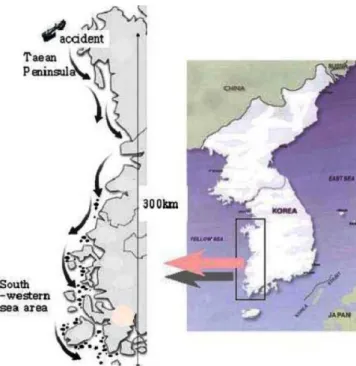
The worst oil spill accident in Korean history occurred on the 7th of December 2007. The 'Hebei Spirit' oil tanker crashed against crane-towing tug vessels under inclement weather conditions, about 10 km from the coastline (Fig. 1).
After the collision, the Hebei Spirit realease approximately
12,547 kL of its more than 302,000 kL of mixed crude oil cargo into the surrounding waters, where the spill was then carried by prevailing winds and tidal currents until it reached and covered extensive areas of the Taean Peninsula on the western coastline of Korea. The spilled oil polluted surrounding marine environments including beaches, sand dunes, and rocky shores, even covering many sea birds.
Among the most visible manifestations of marine oil in the environment is the formation and beach stranding of tar,
†
Corresponding author: [email protected]
which is the physically and chemically weathered remnant of oil slick (Del Sontro et al. 2007). Twenty days later, great numbers of tar balls were found in the southwestern sea of Korea, 300 km far from the spilled area. In total, the tar balls affected more than 1,000 islands and 18 beaches in there. Despite two aviation searches being carried out each day in addition to frequent observation by many ocean ves- sels, the large-scale movement of tar balls on the sea sur- face was never observed. This lack of detection in particular piqued our research interest.
The sudden appearance of tar balls in the southwestern sea far from the spilled area, on the islands, and the coastline, offered the opportunity to investigate their characteristics and the movement in the sea. These studies are presented here along with the response activities, which were completely unique to tar balls and differ from responses of spilled par- ent oil.
2. PHYSICAL CHARACTERISTICS OF THE TAR BALLS
Oil spilled in water undergoes a variety of physical- chemical process, such as spreading, vertical mixing, evap- oration, dissolution, emulsification, photo-oxidation, oil-sed- iment interaction, sedimentation, and biodegradation (Dutta
balls. Xie et al. [2007] reported that oil takes up water to form an emulsion during emulsification, of which the resulting density can reach 1.03 g/ml compared to a starting density as low as 0.80 g/ml, a little higher than that of sea- water (approximately 1.025 g/ml, ITOPF [1998]). This emul- sion eventually breaks down into tar balls, either through weathering or by adhering to particles to form heavy tar lumps.
Weathering processes can change the appearance of these residual spilled oils to varying degrees, from black sticky res- idues with strong petroliferous odors to black solids (Hegazi et al. [2004]). Goodman 2003 also provides summaries of var- ious tar ball descriptions as cited from previous reports.
The physical characteristics of tar balls may be depend on several factors, such as the adhering particle type (eg., sand, debris, shell fragments etc.), amount of particles, and temperature. The particle content in tar balls was different depending on whether or not they reached land, which showed higher particle to water ratio. Korea Research Institute of Chemical Technology (KRICT [2008]) analyzed two sam- ples of tar balls that were collected from the sea and on shore, 10 days after the Hebei Spirit oil spill; the former showed 59.8% water content and 3.2% of particle content, while the latter had 23.7% and 56.8%, respectively (Table 1).
The tar balls from the shore were loaded with variable amounts of sand and debris, which must have adhered to them upon their arrival at the shoreline.
ITOPF 1998showed temperature change also affects the density of tar balls: if temperature changes 10 the density
Fig. 1. Accident area and tar balls moving from the Taean Peninsula
to the southwestern sea area of Korea (the illustration modified from dongA.com, Jan. 4, 2008).
Table 1. Particle Content in Tar Balls Collected from the Sea (Sample A) and on Shore (Sample B)
Tar Ball Non-oil, Wt% Oil, Wt%
Particle Water
Sample A 3.20.1 59.83.9 37
Sample B 56.81.2 23.72.8 19.5
*Data cited from KRICT2008
of seawater changes 0.25%, but that of oil changes two times more, 0.5%. Surface water mean temperature of the parent oil spilled area and the tar ball appeared area after 20 days differed 2.3oC, the former was 8.4oC and the latter 10.7oC (NORI [2007]). The tar balls found in the south- western sea and coastline were not in fluid form, instead, they were hard distinct balls (Fig. 2). These tar balls may float if their density is less than the surrounding water or sink beneath the sea surface if they have a higher density than seawater. We explain why we suddenly found massive tar balls in the southwestern sea of Korea after they had reached the beach, rather than continuous detection from the accident location to the south, may be that the higher densities of tar balls which would be a result of emulsifi- cation and particle adhering made tar balls submerged, and over moving to south direction the surface water tempera- ture became higher and the submerged tar balls emerged to the sea surface in the southwestern sea.
3. RESPONSE ACTIVITIES FOR THE TAR BALLS
The initial detection of tar balls in the southwestern sea was made by a fisherman, who collected 20 kg of floating tar balls and reported them to Korea Coast Guard (KCG).
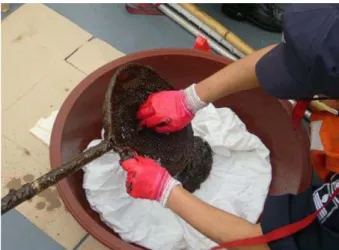
On the sea surface we used two methods to remove tar balls. One method was using a mesh scoop (Fig. 3), which is a very slow removal process because the balls had to be scooped out one by one, but is simple and effective. After many aviation searches were carried out to detect the wide distribution of tar balls on the sea, KCG removed 369 kg of tar balls and with the mesh scoop method (KCG [2008]).
For a more massive cleanup effort, we used two vessels
dragging fishing net to collect tar balls floating on the sea, much like catching fish (Fig. 4). The net was 100 m in length and 2.3 m in width with a 2 mm mesh size. We used 2.5 m intervals between buoy placement on the top of the net and 30 cm intervals between lead weights on the bot- tom. Unfortunately, the amount of tar balls caught by fish- ing nets was insignificant because the tar balls, harder and less sticky under the winter conditions, slid down and avoided entrapment in the nets.
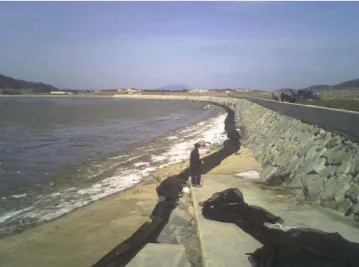
Three different approaches were used for tar ball cleanup on the coast: one was net setting, another was a manual pick-up, while the third involved sweeping them up. Net setting was carried out to protect long coastlines from being hit by tar ball. A 5,100 m length of net was set along the shore and covered 24 different places of beaches and coasts (Fig. 5).
The cold weather of the winter season helped us respond to the tar balls because it made them hard, not sticky,
Fig. 2. Tar balls hitting along the southwestern coastline. Fig. 3. A mesh scoop and the collected tar balls on the sea.
Fig. 4. Net dragging with two vessels.
allowing us to sweep beaches clean or to gather up the scat- tered ones by hand (Fig. 6). The total volume of tar balls we removed from the polluted area was 1,737 m3, and the number of people participating in response activities was 97,078, and 25.6% of them (24,809) were volunteers (KCG [2008]). We determined that the spilled oil quickly turned into hard tar balls in the winter conditions, and manual response activities, even primitive ones and non-aggressive cleanup method, were effective to remove them.
The cold weather of the winter season helped us respond to the tar balls because it made them hard, not sticky, allowing us to sweep beaches clean or to gather up the scat- tered ones by hand.
4. CONCLUSION
On the sea surface we used two methods to remove tar balls. One was using a mesh scoop, which was a very slow
REFERENCES