메타카올린을 혼합한 재생골재 콘크리트의 역학적 특성 및 동결융해 저항성
Mechanical Properties and Resistance to Freezing and Thawing of the Recycled Aggregate Concrete with Metakaolin
문 한 영* 김 양 배** 문 대 중***
Moon, Han-Young Kim, Yang-Bae Moon, Dae-Joong
Abstract
Recycled aggregate concrete has lower strength and durability compared to concrete with natural aggregate. Therefore, metakaolin is used to improve the properties of recycled aggregate concrete.
Main components of metakaolin are SiO2 and Al2O3. and specific surface area is 9 times larger than that of ordinary portland cement. Quality of demolished-recycled aggregate(DRA) satisfies the type 1 of KS F 2573, but quality of source-recycled aggregate(SRA) does not satisfy with the type 2 of KS F 2573. When metakaolin was replaced with 20% of cement, compressive strength of concrete with SRA and DRA develops about 40~64% of control concrete. Water absorption ratio was reduced about 2% by replacing 20% metakaolin and it represents low compared to the natural aggregate concrete without metakaolin. In addition, the resistance to freezing and thawing, of con- crete with DRA is indicated to remarkably enhanced due to the contribution of metakaolin.
However, when metakaolin is replaced with 20% of cement, relative dynamic modulus of elasticity of concrete with SRA was below 60% at 210 freezing and thawing cycles.
요 지
재생골재 콘크리트의 강도 및 내구성은 천연골재를 사용한 콘크리트에 비하여 저하되므로 메타카올린을 사용하여 재생골재 콘크리트의 성질을 개선하였다.메타카올린의 주성분은 SiO2 및 Al2O3이며, 비표면적은 보통시멘트보다 약 9배 정도 크다. 실콘크리트 구조물에서 얻어진 재생골재(DRA)는 KS F 2573의 1종을 만족하였으나, 콘크리트를 제작하여 얻어진 재생골재(SRA)는 KS F 2573의 2종을 만족하지 않았다. 메타 카올린을 시멘트 중량에 20% 대체한 경우, SRA 및 DRA를 사용한 콘크리트의 압축강도는 기준콘크리트에 비하여 약 40~64% 정도 크게 나타났다. 메타카올린을 20% 혼합하므로써 재생골재 콘크리트의 흡수율은 메타카올린을 혼합하지 않은 콘크리트에 비하여 약 2% 감소하였다. 또한, DRA를 사용한 콘크리트의 동결 융해 저항성은 메타카올린의 역할로 현저히 향상되었다. 그러나, 메타카올린을 20% 혼합하고 SRA를 사용 한 콘크리트의 상대동탄성계수는 동결융해 싸이클 수 210에서 60% 이하로 나타났다.
Keywords : Recycled Aggregate, Metakaolin, Compressive Strength, Water Absorption, Resistance to Freezing and Thawing, Recycled Aggregate Concrete
핵심 용어 : 재생골재, 메타카올린, 압축강도, 흡수율, 동결융해 저항성, 재생골재 콘크리트
1)
* 정회원, 한양대학교 토목공학과 명예교수 ** 학생회원, 한양대학교 토목공학과 박사과정
*** 정회원, (주) 넥트 기술이사
2)
E-mail: [email protected], 016-726-7302
•본 논문에 대한 토의를 2005년 12월 31일까지 학회로 보내 주시면 2006년 4월호에 토론결과를 게재하겠습니다.
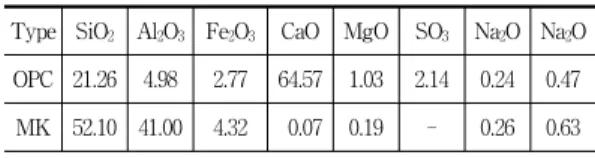
Table 1 Chemical component of cement and MK (%)
Type SiO2 Al2O3 Fe2O3 CaO MgO SO3 Na2O Na2O OPC 21.26 4.98 2.77 64.57 1.03 2.14 0.24 0.47
MK 52.10 41.00 4.32 0.07 0.19 - 0.26 0.63
1. Introduction
The waste concretes demolished from old build- ings and constructions are being annually in- creased in the world, especially in developed countries. The amount of demolished concretes has become a particular problem because of usage al- teration and deterioration of concrete structures.(1)
In particular, construction waste of the Cheong- gyecheon Restoration Project started since July 2003 in Korea, is said to generate more than 1 mil- lion tons, coming from the demolition of the exist- ing elevated road, thus demanding immediate yet efficient ways in disposal and recycling technology.
According to the study conducted by the Ministry of Environment in 2003, the annual amount of waste concrete was approximately 26million tons, while projecting its amount to increase 5 times in 10 years coming from the new construction of apartment buildings and the development of new cities.(2),(3)
Therefore, the utilization of demolished-concrete as recycled aggregate has been researched for the purpose of efficient utilization of resources and protection of environment in some advanced na- tions.(4)-(6) Technical researchers of concrete have been concerned about reusing demolished-con- crete for the purpose of substituting for in- sufficient natural aggregate, saving resources and sustaining the natural ecosystem, in Korea as well.(7),(8)
However, there are some problems: the large difference of qualities in recycled aggregates and a minor deterioration of mechanical properties in recycled aggregate concrete in comparison with that of natural aggregate concrete. 9,10) Therefore, some research has been conducted for improving the qualities of recycled aggregate concrete by using mineral admixtures and progressing the
qualities of recycled aggregate.
On the other hand, metakaolin is a fine pozzo- lanic material and it gives significantly enhanced strength because it acts as filler similar to silica fume. Metakaolin accelerates initial cement hy- dration, and it rapidly consumes the hydrated lime produced by cement hydration reaction.
Porosity and pore size distribution measurements have demonstrated that the early strength en- hancement is associated with substantial pore refinement.(11),(12)
In this paper, quality of metakaolin was ana- lyzed and physical properties of recycled ag- gregate was examined. Properties of recycled ag- gregate concrete were investigated regarding compressive strength, absorption and resistance to freezing and thawing. Furthermore, an inves- tigation to improve the properties of recycled ag- gregate concrete for containing metakaolin, was performed.
2. Experimental procedure
2.1 Material2.1.1 Cement and mineral admixtures
The cement used was ordinary portland ce- ment (OPC, density of 3.15 g/cm3, specific sur- face area of 3,200 cm2/g). The mineral admix- tures used were metakaolin (MK, density of 2.50 g/cm3, specific surface area of 120,000 cm2/g).
The chemical component and physical properties of cement and metakaolin are shown in table 1.
Table 2 Physical properties of coarse aggregate
Type of aggregate
Density in SSD*
(g/cm3)
Density in AD**
(g/cm3)
Absorption (%)
Adhered mortar (%)
Crushing value in 10kN (%)
Soundness (%)
VA 2.66 2.64 0.69 0.0 1.79 9.4
SRA 2.48 2.35 5.45 45.5 - 36.8
DRA 2.55 2.49 2.74 13.9 4.47 16.3
* SSD : saturated surface dry condition, ** AD : absolute dry condition
2.1.2 Fine and coarse aggregate
The fine aggregate was river sand with density of 2.60g/cm3, absorption of 0.90. The coarse ag- gregates were a crushed stone (VA) and 2 kinds of recycled aggregates.
2.1.3 Recycled aggregates
The recycled aggregates were source-recycled aggregates (SRA) and demolished-recycled ag- gregates (DRA). First, Source concrete was made with 30×30×30cm cubic specimen for the purpose of acquiring the SRA. The source concrete was made without air entraining agent and was de- signed with 50MPa at 28days. Second, DRA was acquired at dismantling the real concrete structures.
SRA was crushed 2 times by prouder after crushed with jaw crusher and impact crusher.
DRA was crushed by screw machine after crushed by jaw crusher and impact crusher. Physical properties of coarse aggregate are shown in ta- ble 2.
2.2 Specimens' size and test procedures
2.2.1 Quality test of cement and metakaolin Chemical composition of cement and meta- kaolin were analyzed by using of XRF(Phillips company, PW1400). Texture of cement and met- akaolin were analyzed by using of SEM(JEOUL Ltd, JSM-6400).
2.2.2 Quality test of aggregate
Density and absorption test of aggregate were performed in accordance with KS F 2503. Grading and crushing test were performed in accordance with KS F 2502 and KS F 2541 respectively.
For the purpose of investing the adhered mortar on recycled aggregate, recycled ag- gregate was dried in electric furnace on 105±
5℃. Adhered mortar of recycled aggregate was removed by using of 10% hydrochloric acid aqueous solution. Soundness test was per- formed in accordance with KS F 2507.
2.2.3 Compressive strength
Compressive strength was measured in accord- ance with KS F 2405. The specimens were cured in water at 20±2℃ for 28 days before strength testing after demolding.
2.2.4 Absorption of concrete
The samples of a dimension of 100×100×30mm which was cut from concrete specimens in water curing until 28days, were prepared in absolute drying condition after oven dry for 24hours. One side of sample(100×100) was contacted on water.
Mass of sample was measured for 120 minute.
2.2.5 Resistance to freezing and thawing
Resistance to freezing and thawing was tested at the age of 28days and carried out in accord-
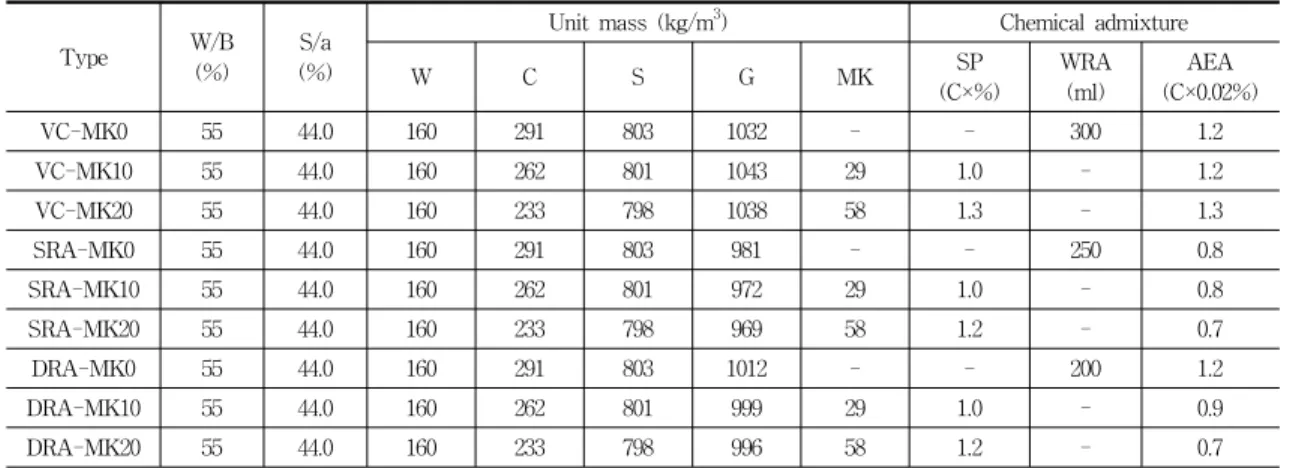
Table 3 Mixture proportions of concrete
Type W/B
(%)
S/a (%)
Unit mass (kg/m3) Chemical admixture
W C S G MK SP
(C×%)
WRA (ml)
AEA (C×0.02%)
VC-MK0 55 44.0 160 291 803 1032 - - 300 1.2
VC-MK10 55 44.0 160 262 801 1043 29 1.0 - 1.2
VC-MK20 55 44.0 160 233 798 1038 58 1.3 - 1.3
SRA-MK0 55 44.0 160 291 803 981 - - 250 0.8
SRA-MK10 55 44.0 160 262 801 972 29 1.0 - 0.8
SRA-MK20 55 44.0 160 233 798 969 58 1.2 - 0.7
DRA-MK0 55 44.0 160 291 803 1012 - - 200 1.2
DRA-MK10 55 44.0 160 262 801 999 29 1.0 - 0.9
DRA-MK20 55 44.0 160 233 798 996 58 1.2 - 0.7
Photo. 1 SEM photograph of OPC for morphology analysis. (×1,000)
Photo 2 SEM photograph of MK for morphology analysis (×10,000)
ance with ASTM C 666 procedure A on 100×
100×400mm prismatic specimens.
2.3 Mixture proportions
Mixture proportions of concrete are shown in table 3. Water-binder ratio(W/B) was 55%. met- akaolin was replaced with 10% of portland ce- ment in concrete mixture with DRA and SRA.
Slump value and air content was 8±2cm, 4±0.5%
respectively in each mixture proportion.
3. Results and discussion
3.1 Quality of metakaolinSiO2 and Al2O3 are main component in meta- kaolin and charged above 90% on Table 1. Specific sur- face area of metakaoin is about 120,000cm2/g.
Metakaolin is very small particle in comparison with cement. Photo. 1 and photo. 2 were SEM photo- graph of the texture of cement and metakaolin.
Texture of cement showed the square shape in
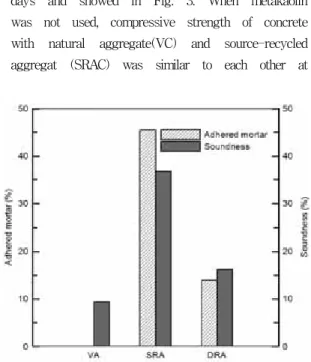
Fig. 1 Density and absorption of coarse aggregate Fig. 2 Adhered mortar and soundness of coarse aggregate photo.1. On the other hand, texture of metakaolin
showed the flock shape of small fiber in photo.2.
Metakkaolin has the potential hydraulicity and pozzolanic reaction. Then, when metakaolin will be mixed in concrete, long term compressive strength and durability will be increased due to pozzolanic reaction and micro-filler effect.
3.2 Quality of recycled aggregate
Fig. 1 showed the density of surface satu- ration drying condition and absorption of coarse aggregate. Density and absorption of natural ag- gregate are 2.66g/cm3 and 0.69% respectively.
However, density of SRA and DRA are 2.48g/
cm3 and 2.55g/cm3 that indicate smaller than that of natural aggregate. Absorption of SRA and DRA are 5.45% and 2.74% that indicate larger than that of natural aggregate. Namely, quality of DRA was satisfied with the type 1 of KS F 2573, but quality of SRA was not satisfied with the type 2 of KS F 2573.
As the above results, the reason that quality of recycled aggregate was not good in comparison
with natural aggregate, caused the adhered mor- tar on recycled aggregate. Density of recycled aggregate was smaller and absorption was larger because the adhered mortar was increased.
Fig. 2 showed the adhered mortar and sound- ness of natural and recycled aggregate.
Source concrete was the concrete without AE agent for manufacturing the SRA, and developed about 50MPa at 28days. Therefore, it was very difficult the crushing of source concrete and the adhered mortar of SRA was a lot. Soundness was 36.8% and was not satisfied with KS F 2507. Futhermore, adhered mortar and sound- ness of DRA was smaller than that of SRA.
3.3 Properties of concrete
3.3.1 Compressive strength of concrete
Compressive strength of concrete with re- cycled aggregate was measured at the age of 28 days and showed in Fig. 3. When metakaolin was not used, compressive strength of concrete with natural aggregate(VC) and source-recycled aggregat (SRAC) was similar to each other at
Fig.3 Compressive strength
Fig. 5 Absorption of concrete with SRA Fig. 4 Absorption of concrete with VA
about 45MPa. Compressive strength of concrete with demolished-recycled aggregate(DRAC) was low than other mixtures. However, when meta- kaolin was contained, compressive strength of con- crete was highly developed. When metakaoolin was replaced with 20% of cement, compressive strength of recycled aggregate concrete was im- proved about 40~64%.
As the above results represent, compressive strength of concrete with metakolin is increased because metakaolin rapidly removed calcium hydroxide from the system and accelerated the ordinary portland cement. Furthermore, the strength devel- opment is associated with substantial pore re- finement due to the contribution of metakaolin.
3.3.2 Water absorption of concrete
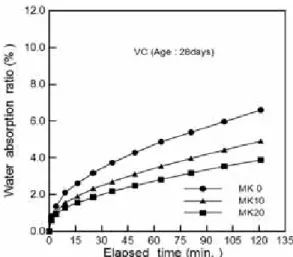
Water absorption of VC was measured for 120 minute at the age of 28days and represented in Fig.4. Absorption was sharply increased at the initial time until about 10 minute and linearly increased after 10 minute. When metakaolin was not replaced, water absorption ratio was about 6.5% at 120 minutes. Water absorption ratio of concrete with metakaolin was about 4.9% and
3.9% respectively at 120 minutes.
Fig. 5 shows the water absorption of SRAC for 120minutes. Water absorption ratio was about 8.1%
for concrete without metakaolin. Water absorption ratio was reduced about 2% for replacing 20% meta- kaolin and lower than that of VC without metakaolin.
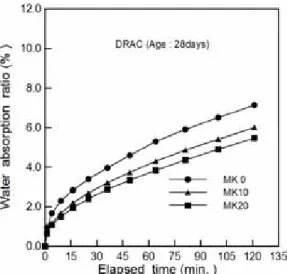
Fig. 6 shows the water absorption of DRAC for 120minutes. When metakaolin was not used, wa- ter absorption ratio was about 7.1%. However, water absorption ratio of SRAC with metakaolin was decreased below 6.0%.
Fig. 6 Water Absorption of concrete with DRA
Fig. 8 Relative dynamic modulus of elasticity of concrete with SRA
Water absorption of recycled aggregate con- crete was higher than that of natural aggregate concrete due to adhered mortar of recycled aggregate. Concrete with source recycled ag- gregate represented to the highest water absorp- tion in another mixtures. On the other hand, when metakaolin was replaceed, water absorp- tion was improved because the microstructure of new mortar in concrete was densely composed of pore structure. Furthermore, metakaolin reduced the water absorption of concrete also because that metakaolin effects to initial transition zone microstructure and a narrower transition zone.
3.3.3 Resistance to freezing and thawing
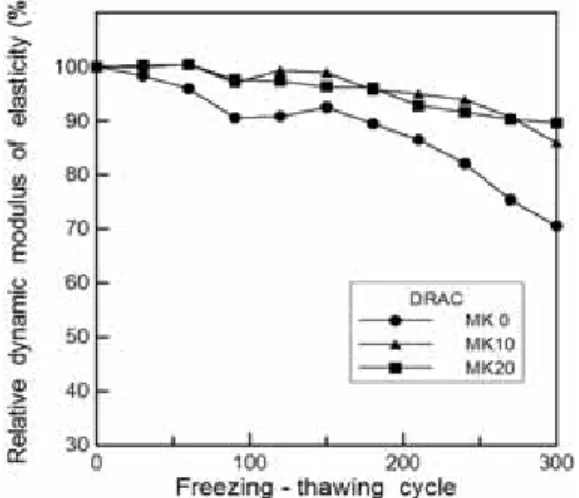
Resistance to freezing and thawing of concrete with natural aggregate and recycled aggregate was investigated in accordance with ASTM C 666 procedure A at the age of 28days. Relative dy- namic modulus of elasticity for VC was showed in Fig. 7. Relative dynamic modulus of elasticity was more than 90% at 300 freezing and thaw- ing cycles regardless containing metakaolin.
Fig. 7 Relative dynamic modulus of elasticity of concrete with VA
Fig. 8 represents the relative dynamic mod- ulus of elasticity for SRAC. When metakaolin was not replaceed, relative dynamic modulus of elasticity was less than 60 % at 120 freezing and thawing cycles. When metakaolin was re- placed with 20% of cement, relative dynamic modulus of elasticity was represented less than
Fig. 9 Relative dynamic modulus of elasticity of concrete with DRA
60 % at 210 freezing and thawing cycles. However, when metakaolin was replaced with 10% of ce- ment, relative dynamic modulus of elasticity was less than 60% at 120 freezing and thawing cycles.
Namely, the resistance to freezing and thaw- ing of SRAC was not good because that the en- trained air was not in adhered mortar of SRAC.
Therefore, the investigation on the freezing and thawing property of the recycled aggregate concrete should be continuously performed for the purpose of improving the resistance to freez- ing and thawing of SRAC.
Fig. 9 expresses the relative dynamic modulus of elasticity for DRAC. Relative dynamic mod- ulus of elasticity of DRAC without metakaolin was about 65% at 300 freezing and thawing cycles. When metakaolin was replaced, resist- ance to freezing and thawing was improved and relative dynamic modulus of elasticity was more than 80% at 300 freezing and thawing cycles.
As the above results express, if metakaolin is replaced, mortar consists of dense microstructure because that metakaolin rapidly removes cal- cium hydroxide of cement hydrate. Therefore, it
would be expected that metakaolin effects the improvement of the mechanical property and du- rability of recycled aggregate concrete.
4. Conclusions
1) Quality of recycled aggregate was not better than that of natural aggregate. Density and absorption of SRA were lower and higher than that of DRA, because adhered mortar of SRA was higher than DRA.
2) When metakaolin was to 20% of cement con- tent, concrete with VA was represented to strength development of about 20%. Concrete with SRA and DRA was expressed to strength enhancement of about 40% and 64% res- pectively.
3) Water absorption ratio of concrete with re- cycled aggregate was higher than that of concrete with natural aggregate. Water ab- sorption of recycled aggregate concrete with metakaolin of 20% was similar to that of concrete with natural aggregate.
4) When metakaolin was contained, resistance to freezing and thawing of DRAC was improved.
However, relative dynamic modulus of elas- ticity of SRAC with 10% metakaolin was less than 60% at 120 freezing and thawing cycles.
References
1. Kim, Mu Han, Present Status and Recycling Policies for Recycled Aggregates, Journal of Korea Concrete Institute, Vol.9, No. 6, 1997.12, pp.11-17.
2. Seong Cheol Chun, Recycling Policy of Construction Waste, Technology and Policy Forum for the Resource of Construction Waste, Environment Forum of Congress and Construction Technical Institue of Chungang University, Seoul, 2004.4, pp.137-147.
3. Nag Bin Kim, Policy Improvement for Estimation on the Recycling Counterplan of Construction Waste, Technology and Policy Forum for the Resource of Construction Waste, Environment Forum of Congress and Construction Technical Institue of Chungang University, Seoul, 2004.4, pp.148-157.
4. Nagataki, S., Gokce, A., Saeki, T. and Hisada, M., Durability of Recycled Aggregate Concretes Subjected to Freezing and Thawing: Impact of Crushed Concrete Characteristics, Proceedings of 2nd International Symposium Cement and Concrete Technology in the 2000s, Istanbul, Turkey, 2000, pp.311-321.
5. Anders Henrichsen, Use of Recycled Aggregates in Europe, International Workshop on Recycled Concrete, JSPS 76 Committee on Construction Materials, 2000.9, pp.1-8.
6. Enric Vazquez, Recycling of Aggregates in Spain, International Workshop on Recycled Concrete, JSPS 76 Committee on Construction Materials, 2000.9, pp.27-41.
7. Moon, Dae Joong and Moon, Han Young, Resistance to Freezing and Thawing on Concrete with Recycled Aggregate, Proceedings of the Korea Concrete Institute, Vol.13, No.2, 2001.11, pp.85-88.
8. S. Wild, J.M. Khatib and A. Jones, Relative Strength, Pozzolanic Activity and Cement Hydration in Superplasticised Metakaolin Concrete, Cement and Concrete Research, Vol.26, No.10, 1996, pp.1537- 1544.
9. Moon, Dae Joong and Moon, Han Young, Resistance to Freezing and Thawing on Concrete with Recycled Aggregate, Proceedings of the Korea Concrete Institute, Vol.13, No.2, 2001.11, pp.85-88.
10. Rohi M. Salem, Edwin G. Burdette, and N. Mike Jackson, Resistance to Freezing and Thawing of Recycled Aggregate Concrete, Material Journal of ACI, Vol. 100, No.3, May 1, 2003, pp.216-221
11. S Wild, J.M. Khatib and A.Jones, Relative Strength, Pozzolanic Activity and Cement Hydration in Superplasticised metakaolin Concrete, Cement and Concrete Research, Vol.26, No.10, 1996, pp.1537- 1544.
12. F. Curcio, B.A. DeAngelis, and S. Pagliolico, Metakaoline as a Pozzolanic Microfiller for High- Performance Mortars, Cement and Concrete Research, Vol.28, No.6, 1998, pp.803-809.
(접수일자:2005년 5월 25일)