Vol. 19, No. 7 pp. 183-191, 2018
1. 서론
공학교육인증제에서 프로그램 학습성과는 프로그램 의 재학생이 교육과정을 통해 졸업 시점에 갖추어야 할
능력이나 자질로서 국가나 사회의 요구를 수렴하고 국제 적인 교육의 등가성에 부합하는 능력을 의미한다[1-2].
이러한 학습성과 기반의 교육을 위해서는 프로그램 교육 목표에 합치되는 프로그램 학습성과를 설정하고, 이러한
공학교육인증을 위한 정보보호학 프로그램의 교과 기반 학습성과 평가에 관한 연구
정원일
호서대학교 컴퓨터정보공학부
A Study on Course-Embedded Assessment for Program Outcomes of Information Security Program for Engineering Education Accreditation
Weonil Jeong
Division of Computer and Information Engineering, Hoseo Univ.
요 약 본 논문에서는 공학교육인증제를 운영하는 정보보호학 프로그램에서 교과 기반의 학습성과 평가 체계를 활용하여 프로그램의 재학생들이 졸업 시점에 갖추어야 하는 핵심 성과인 프로그램 학습 성과에 대한 달성도를 평가하는 방안을 제안 한다. 본 논문의 교과 기반 학습 성과 평가 사례에서는 프로그램의 교육 목표에 부합하는 프로그램 학습 성과를 설정하고, 교과 기반 평가 자료를 포함한 직간접 평가 도구를 이용하여 프로그램 학습 성과 평가 체계를 기술한다. 그리고 교과기반 프로그램 학습 성과 평가를 위한 루브릭 및 평가 절차, 수행 준거의 설정, 이수 체계에 따른 프로그램 학습 성과에 대한 기여 도가 높은 탐침(Probe) 교과목의 선정, 탐침 교과목에 대한 교과목 학습 목표의 설정 및 성취 수준을 측정하기 위한 평가 도구별 루브릭을 설명한다. 이어 탐침 교과목의 학습목표별 필기시험 및 프로젝트 평가 도구의 문항을 기초로 교과기반 학습 성과 평가를 수행하고, 평가 결과로부터 성취도 수준의 분석과 개선 사항 도출하는 과정을 보임으로써 제안하는 교과 기반 학습 성과 평가 방안의 효용성을 입증한다.
Abstract This paper evaluates the achievement of program outcomes using course-embedded assessment for information security programs. In the case study concerning the development of course-embedded assessment used in this paper, we evaluate program outcomes using various evaluation tools including the course evaluation data. In addition, we consider the evaluation rubric and evaluation procedure for course-embedded program outcomes, set performance criteria, select the probe course with high contribution to the program outcomes according to curriculum flowchart, set course objectives for the probe course, and explain the rubric for each assessment tool to measure achievement level. Subsequently, we perform course-embedded program outcomes assessment, based on tests and projectevaluation tool for each program objectives, and present the achievement levels based analysis results. These results prove the effectiveness of the proposed course-embedded assessment for program outcomes.
Keywords : Assessment system, Course-embedded assessment, Engineering education, Performance criteria, Program outcomes, Rubric
*
Corresponding Author : Weonil Jeong(Hoseo Univ.) Tel: +82-41-540-5984 email: [email protected]
Received April 30, 2018 Revised (1st June 4, 2018, 2nd June 18, 2018)
Accepted July 6, 2018 Published July 31, 2018
학습성과를 달성하기 위한 교육과정을 개설하고 학생들 을 교육하며 적합한 절차에 따라 성취도 평가를 수행해 야 한다[3-6].
한국공학교육인증원에서는 종합적인 프로그램 학습 성과에 대한 성취도 평가를 위해 측정 자료의 수집하고 분석하는 절차와 방법으로 평가 도구, 수행 준거, 평가 기준, 성취도 수준 및 목표치에 대한 평가가 수행될 수 있는 학습성과 평가체계를 공학교육인증기준(KCC 2015)을 통해 제시하고 있다. 이러한 학습성과 평가체계 에서는 종합설계 보고서 및 발표, 학생 포트폴리오, 인터 뷰, 시험 등 학생들의 역량을 측정할 수 있는 다양한 평 가도구를 활용할 수 있다. 정기적인 평가를 위해 측정을 위한 주체, 대상, 시기 및 주기, 분석, 개선활동 등에 대 한 내용의 포함을 요구하고 있다. 또한 공학교육인증제 도의 운영에 따른 효용성 증대를 위해 프로그램의 재학 생이 교육과정을 통해 졸업 시점에서 프로그램의 학습 성과를 만족할 수 있도록 하는 기존의 평가 방식에 더해 교과기반 평가(Course-Embedded Assessment)를 통해 학생들이 수강하는 교과목의 학습 목표에 대한 성취도 평가 결과가 프로그램 학습성과 달성도의 평가로 연계되 도록 권고하고 있다[3-4].
프로그램 학습성과 평가를 위한 방법이나 체계의 논 리적 타당성을 높이기 위해 다양한 교과기반 평가연구가 수행되어 왔다. 교과 기반의 프로그램 학습성과 평가를 위해 평가 대상 교과목을 선정하고 교수자에 의해 직접 평가를 실행하고, 그 분석 결과로부터 교과목 수준에서 의 학습성과 평가 결과를 통해 졸업 시점에서 인증 기준 을 만족하지 못하는 학생들을 사전에 관리하고, 교과목 수준의 개선 및 교육과정 수준에서의 개선 방안에 대해 기술하고 있다[6-7]. 교과기반평가를 위한 성과중심 교 과목 평가설계모형 연구에서는 교과기반평가 대상 교과 목에 대한 학습성과 평가 적절성 및 프로그램 학습성과 목표치의 신뢰성을 확보하기 위해 교과목에 대한 학습성 과 기반의 목표 설정, 교과목 평가를 위한 설계, 교과목 에 대한 성과 분석 절차에 따른 모형을 제시하고 있다 [8]. 미국 공학교육인증제를 운영하는 5개 대학의 프로 그램 학습성과 평가체계에서는 개설 교과목 달성도를 평 가하는 교과목 수준의 평가를 시행하고 있으며, 개별 학 습성과의 결과가 교육과정 및 교과목 운영의 개선 활동 으로 이어지도록 하는 내용을 제시하고 있다[9]. 이러한 연구들에서는 교과기반 학습성과 평가를 위해 적절한 탐
침(Probe) 교과목 선정 과정 및 프로그램 학습성과와 탐 침 교과목의 학습목표와의 연관성에 따른 평가 반영에 대한 적절한 명세가 필요하다.
본 논문에서는 공학교육인증을 위한 정보보호학 프로 그램에서의 교과기반 학습성과 평가를 위한 평가 체계, 성취도 평가, 분석 및 개선에 대한 사례를 논의한다. 제 안 논문은2018년 1월 한국공학교육인증원에 제출한 정 보보호학 프로그램 자체평가보고서를 기준으로 한다.
2. 교과기반 평가를 위한 연구 절차
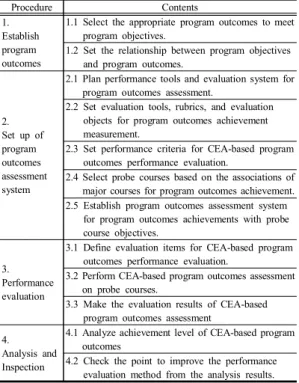
제안하는 교과기반 프로그램 학습성과 평가 절차는 Table 1과 같으며, 프로그램 학습성과 설정, 교과기반 학 습성과 평가 체계, 교과기반 학습성과 성취도 평가 수행, 성취도 평가 결과 분석 및 개선에 이르는4단계로 진행 된다.
Procedure Contents
1.
Establish program outcomes
1.1 Select the appropriate program outcomes to meet program objectives.
1.2 Set the relationship between program objectives and program outcomes.
2.
Set up of program outcomes assessment system
2.1 Plan performance tools and evaluation system for program outcomes assessment.
2.2 Set evaluation tools, rubrics, and evaluation objects for program outcomes achievement measurement.
2.3 Set performance criteria for CEA-based program outcomes performance evaluation.
2.4 Select probe courses based on the associations of major courses for program outcomes achievement.
2.5 Establish program outcomes assessment system for program outcomes achievements with probe course objectives.
3.
Performance evaluation
3.1 Define evaluation items for CEA-based program outcomes performance evaluation.
3.2 Perform CEA-based program outcomes assessment on probe courses.
3.3 Make the evaluation results of CEA-based program outcomes assessment
4.
Analysis and Inspection
4.1 Analyze achievement level of CEA-based program outcomes
4.2 Check the point to improve the performance evaluation method from the analysis results.
Table 1. Research Procedures of CEA
3. 프로그램 학습성과
프로그램에서는 한국공학교육인증원 인증기준[3]의
학습성과에 부합하는 10개의 프로그램 학습성과를 Table 2와 같이 설정하였다.
PO Objectives
PO 1
An ability to apply knowledge of mathematics, basic science, humanities and computer information engineering to problem solving in information security
PO 2
An ability to validate theory or algorithms through formulas or programming
PO 3
An ability to define problems in the field of information protection and to plan and conduct experiments to solve problems
PO 4
An ability to utilize the latest information, research findings, and appropriate tools, including programming languages, to address issues of information protection.
PO 5
An ability to design hardware or software systems with user requirements and realistic constraints taken into account.
PO 6
An ability to contribute to team performance as a team member in solving information security issues PO
7
An ability to communicate effectively in diverse environments
PO 8
An ability to understand the impacts of information security solutions on safety, economy, society and environment
PO 9
An ability to understand professional ethics and social responsibility as an information security professional
PO 10
An ability to recognize the necessity of self-development according to technological environment change and to learn continuously and self-directedly.
Table 2. Program outcomes
프로그램의 학습성과는 교육목표를 달성하기에 적합 해야 하며 이들 사이의 연관성은Table 3에서 나타낸다.
Table 3에서 연관성 정도는 강(S)/중(M)/약(W)으로 설 정한다.
Program Objectives
Program Outcomes
1 2 3 4 5 6 7 8 9 10
Basic Learning S S S M M M W W W M
Major Design S S S S S S W W W M
Communiation
Skill W W W W W S S M S M
Comprehensive
Thinking M M M M S W M S M S
Table 3. Correlation between program objectives and program outcomes
프로그램에서는 프로그램의 학습성과의 달성을 위해 정규 교과과정 및 교과 외 교육과정으로 구분하여 학습 성과 기여도를 설정한다.
4. 교과기반 학습성과 평가체계
4.1 학습성과 평가
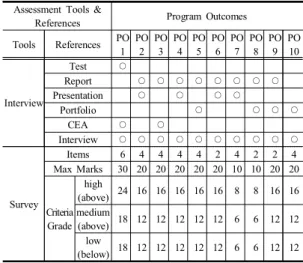
정보보호학 프로그램에서는 프로그램 학습성과 평가 를 시험, 종합프로젝트 보고서 및 발표, 학생 포트폴리 오, 교과기반 평가 자료 등을 바탕으로 인터뷰를 통한 직 접 평가와 설문 문항 수 및 만점, 수행 수준 기준 점수 및 수행수준에 따른 채점 기준 등을 이용하여 정량적인 점수화가 가능한 설문조사를 간접 평가로 시행하고 있 다. Table 4에서는 평가 도구와 참고 자료 목록 및 학습 성과와의 관련성을 나타낸다. Table 5는 프로그램 학습 성과1(PO1)을 측정하기 위해 인터뷰 과정에서 사용되 는 기초 수학 및 과학 능력 테스트와 교과기반의 평가와 함께 간접 설문 조사에 대한 루브릭을 보이고, 평가 수행 을 위한 대상, 주체, 시행 시기 등에 대해 설명하고 있다.
Assessment Tools &
References Program Outcomes
Tools References PO 1
PO 2
PO 3
PO 4
PO 5
PO 6
PO 7
PO 8
PO 9
PO 10
Interview
Test ○
Report ○ ○ ○ ○ ○ ○ ○ ○
Presentation ○ ○ ○ ○
Portfolio ○ ○ ○ ○
CEA ○ ○
Interview ○ ○ ○ ○ ○ ○ ○ ○ ○ ○
Survey
Items 6 4 4 4 4 2 4 2 2 4
Max Marks 30 20 20 20 20 20 10 10 20 20
Criteria Grade
high
(above) 24 16 16 16 16 16 8 8 16 16 medium
(above) 18 12 12 12 12 12 6 6 12 12 low
(below) 18 12 12 12 12 12 6 6 12 12 Table 4. Assessment system for program outcomes
Tools Interview
Survery
Test CEA
Rubrics
(H):80 or above (M):50 or above (L):50 below
(H):70 or above (M):40 or above
(L):40 below
(H):24 or above (M):18 or above (L):18 below Evaluate solving
skills of each level
Course exam and result attachment
Survey material attachment Objects All Graduate-to-be
Subjects 3 evaluation staffs of the committee Execution Annual November
Note
The program management committee prepares the problem by performance level, and evaluates it using the scoring solution by question and answer in the interview.
Table 5. Assessment and evaluation process of PO 1
Table 6은 프로그램 학습성과 3(PO3)을 측정하기 위 해 종합프로젝트 보고서와 교과기반의 평가를 포함한 직 접 인터뷰와 간접 설문 조사에 대한 루브릭, 평가 대상, 평가 주체, 시행 시기 등을 나타낸다.
Tools Interview
Survery
Report CEA
Rubrics
(H):80 or above (M):50 or above (L):50 below
(H):70 or above (M):40 or above (L):40 below
(H):16 or above (M):12 or above (L):12 below Evaluate solving
ability of each level
Course exam and result attachment
Survey material attachment Objects All Graduate-to-be
Subjects 3 evaluation staffs of the committee Execution Annual November
Note
The program management committee prepares the problem by performance level, and evaluates it using the scoring solution by question and answer in the interview.
Table 6. Assessment and evaluation process of PO 3
4.2 교과기반 평가체계
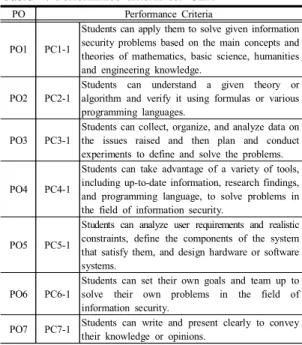
프로그램에서는 교과기반 학습성과 성취도 평가의 체 계 정립을 위해2017년 개설 교과목을 대상으로 교과목 기반 학습성과 성취도 평가를 시행하였다. 수행 결과를 바탕으로 추후 교과기반 학습성과평가에 대한 시행 체계 를 규정하고자 한다. 교과 기반 평가를 위한 대상 프로그 램 학습성과별 수행 준거는 Table 7과 같다.
교과기반 평가를 위한 학습성과별 수행준거에 따라 평가를 위한 탐침 교과목을 선정해야 한다. 이를 위한 프 로그램 학습성과별 주요 필수 전공주제 교과목의 연관성 에 대한 내용은 Table 8과 같다.
Course
Program outcomes PO
1 PO
2 PO
3 PO
4 PO
5 PO
6 PO
7 PO
8 PO
9 PO
10
Data Structure M S S M M M M
Network Security I M W S M W M W
System Security M M M S M S W W
Database Security M M S S M S M W
Table 8. Contribution informations in major curriculum
프로그램에서는Table 8의 교과목별 학습성과 기여도 를 기반으로 모든 교과목에 공통으로 적용되는 학습성과 1과 기여도가 가장 높은 학습성과 3을 측정 및 평가하는 프로그램 학습성과로 선정한다. 탐침 교과목으로는 이수 체계도 및 학습성과 기여도를 평가하여2학년 1학기에 개설되는 교과목인 자료구조(Data Structure)와 3학년 2 학기에 개설되는 교과목인 데이터베이스 보안(Database Security) 교과목을 선정하였다. 아래 Table 9에서는 선 정된 프로그램 학습성과와 탐침 교과목에 대한 내용을 정리하였다.
Probe course PO
1
To integrate the program outcomes level on basic knowledge application ability with the curriculum and reflect it in the improvement of education.
PO 3
To integrate the program outcomes level on design ability with the curriculum and reflect it in the improvement of education course
name type gra. term hour credit theory design exper. req. assoc.
Data
Structure Eng. 2 1 4 3 1 1 1 requi
red M
Database
Security Eng. 3 2 3 3 1 1 1 requi
red S Table 9. Probe courses and program outcomes for CEA
PO Performance Criteria
PO1 PC1-1
Students can apply them to solve given information security problems based on the main concepts and theories of mathematics, basic science, humanities and engineering knowledge.
PO2 PC2-1
Students can understand a given theory or algorithm and verify it using formulas or various programming languages.
PO3 PC3-1
Students can collect, organize, and analyze data on the issues raised and then plan and conduct experiments to define and solve the problems.
PO4 PC4-1
Students can take advantage of a variety of tools, including up-to-date information, research findings, and programming language, to solve problems in the field of information security.
PO5 PC5-1
Students can analyze user requirements and realistic constraints, define the components of the system that satisfy them, and design hardware or software systems.
PO6 PC6-1
Students can set their own goals and team up to solve their own problems in the field of information security.
PO7 PC7-1 Students can write and present clearly to convey their knowledge or opinions.
Table 7. Performance criteria for CEA
PO Performance Criteria
PO8 PC8-1 Students can understand and explain the impact of information technology on society at large.
PO9 PC9-1
Students are able to understand the various jobs related to the field of information protection and understand the ethical and social responsibilities of their occupations.
PO10 PC10-1
Students have a strong willingness to understand
and adapt to changes in the technology
environment in the field of information protection,
and are able to conduct self-directed learning in
order to continuously acquire new knowledge.
Table 9에서 교과기반 평가를 위해 각 학습성과의 선 정 사유와 선정 탐침 교과목의 교과구분, 개설 정보 및 연관 기여도를 나타낸다.
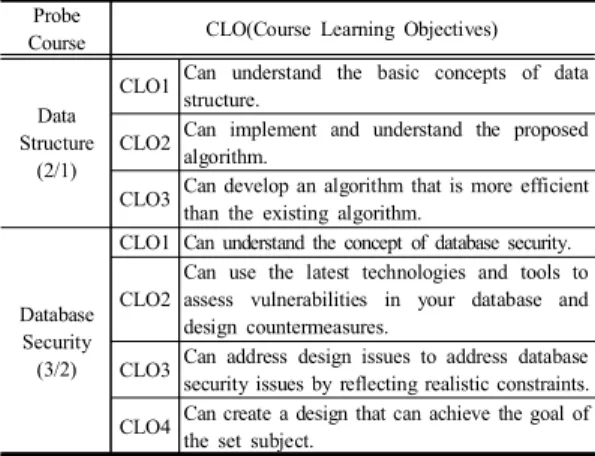
탐침 교과목으로 선정된 자료구조과 데이터베이스보 안 교과목의 교과목 학습목표의 내용은Table 10과 같다.
Probe
Course CLO(Course Learning Objectives)
Data Structure
(2/1)
CLO1 Can understand the basic concepts of data structure.
CLO2 Can implement and understand the proposed algorithm.
CLO3 Can develop an algorithm that is more efficient than the existing algorithm.
Database Security
(3/2)
CLO1 Can understand the concept of database security.
CLO2
Can use the latest technologies and tools to assess vulnerabilities in your database and design countermeasures.
CLO3 Can address design issues to address database security issues by reflecting realistic constraints.
CLO4 Can create a design that can achieve the goal of the set subject.
Table 10. Course learning objectives of probe courses
교과목 학습성과를 기반으로 프로그램 학습성과 달성 도를 평가하기 위한 체계는Table 11에 나타낸다. 제시 된 평가 체계에서는 교과목별로 연관된 프로그램 학습성 과에 이어 관련 교과목의 학습목표, 평가도구, 그리고 성 취도 측정 결과를 평가하기 위한 기준을 포함한다.
Probe
Course PO CLO tools Achievement rubrics
Data Structure
PO1 CLO1 test medium level: 60% or above (high:70%~, medium:40%~70%, low:~40%)
CLO2 test
PO3 CLO3 report
medium level: 60% or above (high:80%~, medium:50%~80%, low:~50%)
Database Security
PO1
CLO1 test medium level: 60% or above (high:70%~, medium:40%~70%, low:~40%)
CLO2 test CLO3 test
PO3 CLO4 report
medium level: 60% or above (high:80%~, medium:50%~80%, low:~50%)
Table 11. Program outcomes achievement evaluation system based on CEA
5. 교과기반 학습성과 성취도 평가
본 절에서는 교과기반의 학습성과 평가체계에서 선정
한 탐침 교과목을 대상으로 프로그램 학습성과 달성도를 측정한 사례를 기술한다.
Table 12에서는 탐침 교과목 가운데 자료구조 교과목 에 대한 평가 문항을 나타낸다.
Probe
Course PO CLO Evaluation items
Data Structure
PO1 CLO1
1) midterm 3
We use the Big Oh notation to express the time complexity of the algorithm. Find the Big Oh for each of the following algorithms(MM 15).
CLO2 2) final 2
We want to search for 11 through binary search(interpolated search) for sorted (1, 2, 8, 9, 11, 19, 29). Describe the process step by step(MM 15).
PO3 CLO3 3) Report
The design task is to create a program that allows students to play cards using the stack they have learned. Participants perform tasks on a team-by-team basis and present the results with presentations and reports(MM 30).
Table 12. Evaluation items of data structure for CEA
자료구조 교과목에 대한 학습성과 평가 결과의 샘플 을 Table 13에서 나타낸다. 학생들이 공학지식의 주요 개념 및 이론을 기반으로 주어진 정보보호 문제를 해결 하기 위해 접목하여 활용할 수 있는지를 측정하기 위해 프로그램 학습성과(PO) 1에서는 자료구조 교과목의 학 습목표 1(CLO1) “자료구조의 기본적인 개념을 이해할 수 있다.”와 교과목 학습목표 2(CLO2) “제시된 알고리 즘을 구현하고, 이해할 수 있다.”를 관련 대상으로 학습 성과 성취도를 측정하였다. 프로그램 학습성과1은 중간 고사3번 문항과 기말고사 2번 문항을 합산하여 100점 으로 환산하여PO1(%)로 나타내었고, 이를 상(H, 70이 상)/중(M, 40이상 70미만)/하(L, 40미만) 3단계로 성취 수준을 분류하였다. 프로그램 학습성과3은 팀과제의 결 과물인 보고서를 기준으로 100점 만점으로 환산하여 PO3(%)로 제시하고 성취도 수준에 대한 평가를 진행하 였다. 팀 과제를 수행함에 있어 제기된 문제에 대해 자료 를 수집, 정리 및 분석하여 문제를 정의하고 이를 해결하 기 위해 실험을 계획하고 수행할 수 있는지를 측정하기 위해 교과목 학습목표3(CLO3) “기존 알고리즘보다 효 율적인 알고리즘을 개발할 수 있다.”와 연관하여 학습성 과 성취도를 분석하였고, 성취 수준은 상(H)/중(M)/하 (L)로 표기한다.
Student No.
PO1 (MM15)
PO1 (MM15)
PO3
(MM30) PO(%) Achieved
level midterm3 final
2 report PO1
(%) PO3
(%) PO1 PO3
20xxxx00 5 15 24 67 80 (M) (H)
20xxxx97 0 0 12 0 40 (L) (L)
20xxxx01 15 0 21 50 70 (M) (M)
...
20xxxx74 0 0 21 0 70 (L) (M)
Table 13. Evaluation result of data structure by CEA
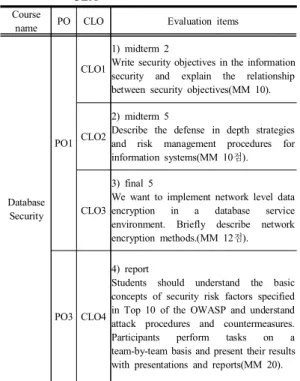
Table 14에서는 교과기반 학습성과 평가를 위한 평가 대상 탐침 교과목 가운데 데이터베이스보안 교과목에 대 한 평가 문항을 나타낸다.
Course
name PO CLO Evaluation items
Database Security
PO1 CLO1
1) midterm 2
Write security objectives in the information security and explain the relationship between security objectives(MM 10).
CLO2
2) midterm 5
Describe the defense in depth strategies and risk management procedures for information systems(MM 10점).
CLO3 3) final 5
We want to implement network level data encryption in a database service environment. Briefly describe network encryption methods.(MM 12점).
PO3 CLO4 4) report
Students should understand the basic concepts of security risk factors specified in Top 10 of the OWASP and understand attack procedures and countermeasures.
Participants perform tasks on a team-by-team basis and present their results with presentations and reports(MM 20).
Table 14. Evaluation item of database security for CEA
Table 15의 데이터베이스 교과목에 대한 교과기반 학 습성과 평가표에서 전체 학생들의 일부를 나타낸다. 학 생들이 공학지식의 주요 개념 및 이론을 기반으로 주어 진 정보보호 문제를 해결하기 위해 접목하여 활용할 수 있는지를 측정하기 위해 프로그램 학습성과(PO) 1에서 는 데이터베이스보안 교과목의 학습목표1(CLO1), 학습 목표2(CLO2), 그리고 학습목표3(CLO3)을 관련 대상으 로 학습성과 성취도를 측정하였다. 프로그램 학습성과
1(PO1)은 중간고사 2번 문항, 중간고사 5번 문항, 기말 고사5번 문항을 합산하여 100점으로 환산하여 PO1(%) 로 나타내었고, 이를 상(H, 70이상)/중(M, 40이상 70미 만)/하(L, 40미만) 3단계로 성취수준을 분류하였다. 프로 그램 학습성과3(PO3)은 팀과제의 결과물인 보고서를 기 준으로 100점 만점으로 환산하여 PO3(%)로 제시하고 성취도 수준에 대한 평가를 진행하였다. PO3에서는 팀 과제를 수행함에 있어 제기된 문제에 대해 자료를 수집, 정리 및 분석하여 문제를 정의하고 이를 해결하기 위해 실험을 계획하고 수행할 수 있는지를 측정하기 위해 교 과목 학습목표3(CLO3)과 연관하여 학습성과 성취도를 분석하였다.
Student No.
PO1 (MM10)
PO1 (MM12)
PO1 (MM10)
PO3
(MM20) PO(%) Achieved level mid 2 mid 5 final 5 report PO1 PO3 PO1 PO3
20xxxx32 8 10 12 17 94 85 (H) (H)
20xxxx72 0 3 0 14 9 70 (L) (M)
20xxxx21 10 6 9 13 78 65 (H) (M)
...
20xxxx15 10 0 12 10 69 50 (M) (M)
Table 15. Evaluation result of database security by CEA
6. 성취도 평가 결과 분석 및 개선
본 장은 교과기반 학습성과 성취도 평가 수행 결과를 분석하고 개선 방안에 대해 논의한다.
Table 13의 측정 결과로부터 자료구조 교과목에 대한 PO1 및 PO3 프로그램 학습성과에 대한 성취 수준의 분 포는Fig. 1, Fig. 2에 나타낸다.
Fig. 1. Achievement histogram of data structure(PO1)
Fig. 2. Achievement histogram of data structure(PO3)
자료구조 교과의 프로그램 학습성과별 학습성과 성취 수준을 요약한 결과는Table 16과 같다.
Score No. of
Students
proportion (%)
PO1
(H) 70 or above 23 2
(M) 40 or above 10 32
(L) 40 below 15 66
PO2
(H) 80 or above 32 73
(M) 50 or above 9 20
(L) 50 below 3 7
Table 16. Summary of data structure achievement
Table 16에서 PO1에 대한 학습성과 성취수준의 평균 은33점이었으며, 성취도가 “중” 이상의 성취도를 보인 비율이34%인 반면 성취도가 “하”인 학생들은 66%를 보였다. “중” 이상의 성취도수준을 60% 이상으로 유지 한다는 목표 수치에 비해 학습성과 성취도가 저조한 결 과를 보이고 있는데, 이는 PO1에 대한 성취도 측정을 위 해 매우 제한적인2개의 시험 문항만을 적용했다는 점과 문항 자체의 난이도 조절의 문제 등에서 기인한 것으로 분석된다. PO3에 대한 학습성과 성취 수준은 100점 만 점을 기준으로 평균84점을 보였으며, “중” 이상의 성취 도를 보인 비율이 84%를 나타내고 있다. 성취수준이
“하”인 학생의 경우 7%로 시험 문항을 기반으로 평가한 PO1에 대한 성취수준에 비해 학습성과 성취도가 전체적 으로 높게 나타났다. 이는 PO3 평가에 소수의 시험 문항 으로 평가하는 것이 아니라 팀 과제를 수행하는 전반적 인 내용을 종합 평가하였기 때문으로PO1 평가 결과에 비해서는 학생들 간의 편차는 크지 않음을 알 수 있다.
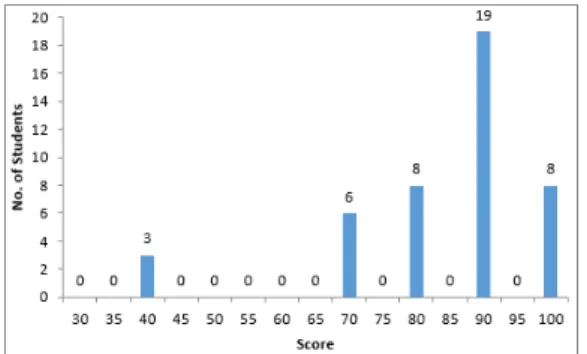
데이터베이스보안 탐침 교과목에 대한 측정 결과를 나타낸Table 15로부터 관련된 PO1 및 PO3 프로그램
학습성과에 대한 학습성과 성취 수준의 결과는Fig. 3, Fig. 4와 같다.
Fig. 3. Achievement histogram of database security(PO1)
Fig. 4. Achievement histogram of database security(PO3)
데이터베이스보안 교과목에 대한 학습성과 성취 수준 을 프로그램 학습성과 별로 요약한 결과는Table 17과 같다.
Score No. of
Students
proportion (%)
PO1
(H) 70 or above 18 39
(M) 40 or above 12 35
(L) 40 below 12 26
PO2
(H) 80 or above 18 39
(M) 50 or above 28 61
(L) 50 below - -
Table 17. Summary of database security achievement
데이터베이스보안 교과목에 대한 교과기반 학습성과 성취도를 평가한 결과를 분석한 내용은 다음과 같다.
PO1에 대한 학습성과 성취수준의 평균은 60점이었으며, 학습성과 성취도가 “중” 이상의 성취도를 보인 비율이 74%, 학습성과 성취도가 “하”인 학생들은 26%를 보였
다. “중” 이상의 성취도수준을 60% 이상으로 유지한다 는 목표 수치에 비교하면 적절한 수준을 보이고 있음을 알 수 있다. 다만, PO1에 대한 성취도 수준을 평가함에 있어3개의 문항만으로 시행하는 것이 적절한지에 대한 지속적인 관리가 필요할 것으로 판단된다. PO3에 대한 학습성과 성취 수준은100점 만점을 기준으로 평균 71 점을 보였으며, “중” 이상의 성취도를 보인 비율이 100%를 나타내고 있다. 데이터베이스보안 교과목에 대 한PO3의 평가를 위해 보고서를 평가 도구로 활용한 경 우에도 자료구조 교과목의 경우와 마찬가지로 소수의 시 험 문항으로 평가하는 것이 아니라 팀 과제를 수행하는 전반적인 내용을 종합적으로 평가함으로써PO1의 성취 수준에 비해 학습성과 성취도가 높음을 알 수 있다.
이러한 교과기반 학습성과 운영 결과로부터 학습성과 성취도 평가 방법에 대한 개선 방안은 아래와 같이 논의 되었다. 탐침 교과목에 대한 교과기반 학습성과 성취도 를 평가한 결과에서 첫째, 학습성과 성취도가 낮게 나타 난 경우에 성취도 측정을 위해 제한적인 시험 문항을 적 용하였다는 한계가 있으므로, 학습성과 성취도 수준 평 가를 위해 사용한 시험 문항수의 확대와 문항 선정의 적 절성에 대한 추가적인 보완이 필요하다. 둘째로, 시험 문 항이 아닌 팀 과제를 기반으로 학습성과 성취도를 평가 한 경우에 학습성과 성취도가 상대적으로 높게 나타나고 있으며 학생들 간의 편차가 크지 않으므로 팀 과제를 기 반으로 학습성과 성취도를 평가하는 경우에도 학생 개별 적 성취도를 반영할 수 있는 방안에 대한 추가적인 보완 이 필요하다. 향후 본 프로그램 교과목의 학습성과 성취 도에 대한 효용적인 평가를 위해 탐침 교과목을 계속 확 대하여 적용하고, 교과기반 학습성과 분석 결과에 대한 정확도를 향상시킬 수 있도록 계속적인 자료의 축적과 개선활동이 필요하다.
7. 결론
본 논문은 정보보호학 프로그램에서 2017학년도 졸 업 예정자를 대상으로 교과기반 학습성과 평가 체계에 따라 프로그램 학습성과 성취도를 평가한 사례에 대해 논의하였다.
사례 연구에서 프로그램 학습성과는 한국공학교육인 증원의 인증 기준을 만족하는10개의 항목으로 구성되 었으며, 교육목표와의 연관성을 통해 교육목표 달성에
적합함을 보였다. 제안 학습성과 평가체계는 교과기반 평가가 수행될 수 있는 체계를 제시하고, 각 프로그램 학 습성과별로 교과기반의 평가와 절차에 대해 기술하였다.
이어 교과목 기반 학습성과 성취도 평가를 위해 프로그 램 학습성과별 수행준거를 설정하고, 평가 대상이 되는 탐침 교과목의 선정 기준과 결과, 그리고 해당 탐침 교과 목의 학습목표로부터 학습성과를 도출하는 과정을 기술 하였다. 이러한 일련의 평가 흐름은 탐침 교과목의 성취 도 결과가 프로그램 학습성과 달성도를 측정할 수 있는 체계로 적절함을 보였다. 학습성과 평가에서는 탐침 교 과목으로 선정된 자료구조와 데이터베이스보안 교과목 의 학습목표를 달성할 수 있는 평가 문항을 도출하고 성 취도 평가를 진행하였고, 그 결과 프로그램 교육목표를 달성한 것으로 분석되었다. 개선 사항으로 성취도 수준 평가의 정확도 향상을 위해 탐침 교과목 및 평가 문항의 확대와 팀 과제의 개별 학생 성취도 측정 방안 등이 고 려되었다. 이러한 분석 및 개선 활동은 제안 교과기반 평 가제도의 효율성 증대와 품질 개선을 위해 지속적으로 수행될 필요가 있다.
본 연구의 교과기반 학습성과 평가 방안은 재학생에 대한 졸업 시점에서의 프로그램 학습성과 평가 뿐 아니 라 졸업에 이르는 시점까지 재학생에 대한 학습 역량 관 리에 기여할 수 있다. 또한 정보보호학 분야에서 공학교 육인증 프로그램을 운영하는 교육 단위에서 참고 자료로 활용할 수 있을 것으로 기대한다.
References
[1] ABET, “Criteria for accrediting engineering programs:
Effective for Reviews During the 2016-2017 Accreditation Cycle”, 2015.
[2] D. Park, C. Sim, and C. Kim, “KEC2005 Program Outcomes: Sound Interpretation and Understanding”, Journal of Engineering Education Research, Vol. 18, No.
3, pp. 33-38, May 2015.
[3] ABEEK, “ABEEK Criteria for Accrediting Computing Programs2015(KCC2015)”, 2015.
[4] ABEEK, “KCC2015 Decision Guide for Accreditation Evaluation”, 2016.
[5] W. Chung, S. Oh and H. Kim, “A Case Study on Program Outcomes Assessment of Information SecurityProgram for Engineering Education Accreditation”, Journal of The Korea Institute of Information Security and Cryptology, Vol. 26, No. 3, pp.
777-785, 2016.
[6] S. Cho, “A Case Study of Course-Embedded Assessment for Program Outcomes in Computer Science &
Information Engineering”, Journal of Internet Computing and Services(JICS), Vol. 17, No. 1, pp. 73-81, 2016.
[7] H. Gerretson and E. Golson, "Synopsis of the Use of Course-Embedded Assessment in a Medium Sized Public University’s General Education Program", The Journal of general education, Vol. 54, No. 2, pp.
139-146, 2005.
[8] H. Kim, “Development on the model of outcome-based course evaluation design for Course-Embedded Assessment”, Journal of Engineering Education Research, Vol. 18, No. 6, pp. 24-31, 2015.
[9] S. Jin and W. Cho, “A Case Analysis of Program Outcomes Assessment Systems for Engineering Education Accreditation of South Korea and USA”, Journal of Engineering Education Research, Vol. 14, No.
2, pp. 13-20, 2011.
정 원 일(Weonil Jeong) [정회원]