빅데이터를 활용한 시니어 행동분석 돌봄 시스템 연구
장재열
*
ㆍ최진일**
ㆍ어재선***
ㆍ최철재****
A Study on Senior Behavioral Analysis and Care System Using Big Data
Jae-Youl Jang
*ㆍJin-Il Choi
**ㆍJe-Sun Uh
***ㆍChul-Jae Choi
****요 약
4차 산업혁명의 기술을 활용한 다양한 응용 솔루션들이 보건 복지 분야에 적용되어지고 있다. 제안한 논문에 서는 빅데이터 기반의 시니어 돌봄 시스템 솔루션을 설계한다. 제안 시스템의 작동원리는 시니어의 행동분석을 스마트기기의 API정보를 통하여 수집한 후, 기존의 기준치와 다른 반응을 보일 경우에 시니어 당사자에게 1차적 으로 알림을 보낸다. 만일 응답이 없을 경우에는 2차적으로 동료시니어와 가족구성원 및 응급상황센터에 정보를 제공함으로써 위험상황을 미연에 방지할 수 있는 시스템을 제안한다.
ABSTRACT
Various applied solutions utilizing the technology of the 4th Industrial Revolution are being applied to the health and welfare sector. In the proposed paper, the senior care system solution based on big data is designed. The principles of operation of the proposed system are collecting senior behavioral analyses through API information of smart devices, and sending a primary notification to the relevant senior in cases where a senior reacts differently from the existing standards. A system is proposed to prevent dangerous situations by providing information to peer seniors, family members, and the emergency center in cases where there is no response.
키워드
Senior Care, Big Data, Cloud, Artificial Intelligence, Block Chain 시니어 돌봄, 빅 데이터, 클라우드, 인공 지능, 블록 체인
*경동대학교 의료생명보건대학([email protected])
**경동대학교 소프트웨어학과([email protected])
***경동대학교 해양심층수학과([email protected])
****교신저자 : 경동대학교 소프트웨어학과 ㆍ접 수 일 : 2020. 09. 01
ㆍ수정완료일 : 2020. 09. 23 ㆍ게재확정일 : 2020. 10. 15
ㆍReceived : Sep. 01, 2020, Revised : Sep. 23, 2020, Accepted : Oct. 15, 2020 ㆍCorresponding Author : Chul-Jae Choi
Dept. of Computer Software, Kyungdong University, Email : [email protected]
Ⅰ. Introduction
The steady increase in the senior population indicates that our society aged society and is becoming a super-aged society [1]. The technologies of the fourth industrial revolution are discovering diverse solutions necessary to be
prepared for an aging society, and the government has been concentrating on the commercialization of solutions developed ranging from IoT (Internet of Things)-based systems installed in the houses of seniors to solutions that apply sensors to dolls, and applied solutions usable through smartphone apps in tandem with the relevant companies.
http://dx.doi.org/10.13067/JKIECS.2020.15.5.973
In particular, among senior citizens, those who live alone act in their houses for more than 60% of their time, and their fatal dangerous situations due to fracture cannot be smoothly dealt with in their houses[2].
The purpose of the proposed paper is to develop a system that will continuously collect daily activity information from the elderly living alone among those senior members who use smart devices, notify the relevant elderly living alone in cases where any abnormal symptom different from conditions at normal times was detected, notify peer senior members in the surroundings in cases where the symptom is not resolved, and finally notify the risk element to family members and emergency relief facilities.
In Chapter 2, information on senior citizens living alone and similar solutions are defined based on related studies, and in Chapter 3, the design of solutions for care services for senior citizens living alone is defined. Finally, in Chapter 4, measures to implement and commercialize the design are defined through conclusions.
Ⅱ. Related Works
2.1 Analysis of the environment of the elderly living alone
The number of the elderly living alone is continuously increasing due to the deepening of aging and changes in the attitudes toward parent caregiving[3]. In particular, given the trend of increasing single-person households due to changes in living culture such as late marriage and non-marriage, the number of the elderly living alone is expected to continue to increase in the future[4]. In addition, the increase in alcoholic patients and suicide problems in the elderly due to drinking are also magnified [5,6].
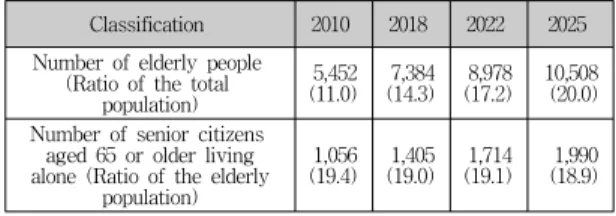
Table 1. Estimation of the elderly living alone (Unit : Thousand people)
Classification 2010 2018 2022 2025
Number of elderly people (Ratio of the total
population)
5,452 (11.0) 7,384
(14.3) 8,978 (17.2) 10,508
(20.0) Number of senior citizens
aged 65 or older living alone (Ratio of the elderly
population)
1,056 (19.4) 1,405
(19.0) 1,714 (19.1) 1,990
(18.9)
As of 2018, the number of the elderly living alone reached 1,405 thousand out of the entire elderly population of 7,384 thousand, and is expected to increase to 1,990 thousand out of 10,508 thousand by 2025. This prediction means that as of 2025, 20% of the total population will be the elderly population and that 18.9% of them are the elderly living alone, who need help from surrounding people.
However, while the number of accidents occurring in the houses of the elderly living alone is constantly increasing, the recognition and measures to respond to accidents are significantly inferior to those of the general elderly population.
The proposed paper aims to investigate the continuously increasing activity areas of seniors in advance with a view to preventing dangerous situations with solutions as countermeasures, and provide information on the activities of seniors to the academia and technology developing companies.
(Unit : Number) Fig. 1 Trend of elderly damage caused by fire
accidents
In Figure 1, the top two lines of the chart represent the numbers of injured persons by age, and the bottom two lines of the charts represent the numbers of deaths by age. In the analysis of accident cases, the accidents can be classified into safety accidents such as smoke or toxic gas inhalation and burns, toppled or slipped, building collapse, and lacerations. Among the places of occurrence of safety accidents, houses were shown to be the most frequent at 60.5% and among the causes of accidents, falling was shown to be the most frequent at 47.4%. Among the places of accidents in the house, bedrooms and rooms were the most frequent at 15.0%, followed by toilets and bathrooms at 11.0%, and living rooms at 8.4% [7].
2.2 Present situation of domestic development
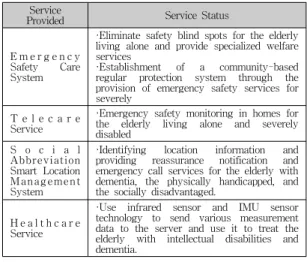
Table 2. Domestic care system project
Service
Provided Service Status
E m e r g e n c y Safety Care System
·Eliminate safety blind spots for the elderly living alone and provide specialized welfare services
·Establishment of a community-based regular protection system through the provision of emergency safety services for severely
T e l e c a r e Service
·Emergency safety monitoring in homes for the elderly living alone and severely disabled
S o c i a l Abbr evi at i on Smart Location M a n a g e m e n t System
·Identifying location information and providing reassurance notification and emergency call services for the elderly with dementia, the physically handicapped, and the socially disadvantaged.
H e a l t h c a r e Service
·Use infrared sensor and IMU sensor technology to send various measurement data to the server and use it to treat the elderly with intellectual disabilities and dementia.
In line with the continuous increase in the elderly population, domestic core related technologies are developed in various fields. To date, research and development has been activated centering on exercise and rehabilitation for the elderly [8], the severely handicapped, and the elderly with dementia, who are specific subjects, but no technology has been developed for the entire elderly population.
2.3 Present situation of overseas development Solutions for dying alone and disabled and aged populations, which are problems in a super-aged society, are being developed and released centering on Japan. Products developed thus far are hardware-based solutions, and have problems such as difficulties in operation and maintenance.
Table 3. Overseas care system project
Service
Provided Service Status
Silver watch
· It is a product exclusively for the deaf. Connect the intercom or phone at the front door to the transmitter, and if there is a customer or call, the information is transmitted to the device around the arm to inform you by vibration, light, text, etc.
Wander i ng s e n i l e surveillance system
· A system that detects elderly dementia patients who want to go out with sensors and notifies their guardians, such as their families, amid the growing number of accidents caused by elderly people with dementia, such as traffic accidents caused by elderly people with dementia.
Net service for protection of living rhythm
· A system to check the use of electricity, temperature changes, and the opening and closing of windows, and to check their safety through the Internet.
Nintendo DSi LL
· It is a product for the elderly. Compared to existing products, it is easy to catch liquid crystal display by making it twice the size of a touch pen.
PARO
· It was first listed in the Guinness Book of World Records as a healing robot. A robot capable of interacting with humans physically, mentally and socially (sensitive to light, temperature, hearing, touch, facial expression).
Ⅲ. Studies of senior behavioral analysis and care systems using big data
3.1 Design of scenarios for caring for the elderly living alone
The behavioral analysis and care system for the
elderly living alone that will be designed in the
proposed paper, is a solution that enables coping
with dangerous situations in advance by enabling
family members, colleagues, and the members of
the life managers to share the activity information
of the relevant elderly living alone through a
smartphone application within the privacy
environment.
Fig. 2 Service provision
Figure 2 shows the design of a service in which life managers, family members, and emergency relief facilities, who are application users, analyze sleep and non-sleep information, corresponding to daily life, and location information, focusing on the elderly living alone [9] and provide danger notice information to the elderly living alone and the members in sequence in cases where the solution recognizes quantitative information different from that at certain time, and the emergency relief facilities collect the danger notice information and visit the relevant elderly living alone.
3.2 Service flow diagram design
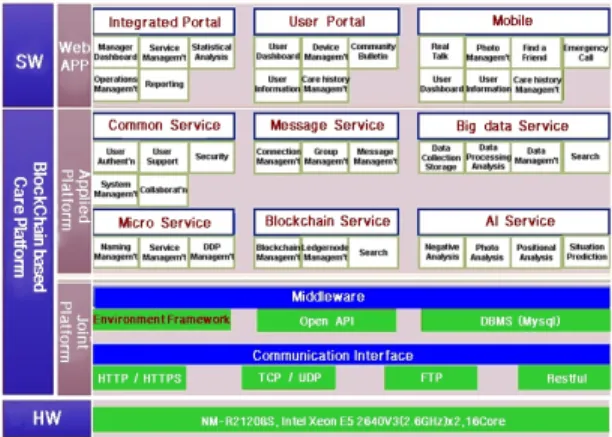
The design of senior behavioral analysis and care systems using big data [10] consists of a service architecture, big data collection for voice and face photo analysis, artificial intelligence analysis, and a blockchain service for sharing information among emergency relief facilities.
3.2.1 Service architecture
After signing up for membership, the relevant elderly living alone registers daily information as meta-information and based on pattern analysis through continuous self-learning, the relevant elderly living alone is notified first when any abnormal symptom has occurred. In cases where there is no response to the abnormal symptom, the
information is notified to colleagues and life managers, and emergency relief facilities are connected depending on the presence or absence of an abnormality at the time of the visit.
Table 4 shows the system construction environment based on the e-government framework considering scalability.
Table 4. System construction environment
Classification Contents
Framework E-government framework 3.8
UI bootstrap
Application JAVA (jdk-8u73) Data Base Maria DB 10.4 WAS / OS Tomcat 8 / Ubuntu 16.04
The proposed solution in Figure 3 provides Real Talk and photo-taking menus. The elderly living alone can focus on conversation and photo-taking through the menus, and since the information is shared with the life manager, base data are provided so that the situation of the elderly living alone can be recognized at normal times.
Fig. 3 Service architecture 3.2.2 Big data scenario
To analyze big data of the elderly living alone,
the activity information is analyzed using the
acceleration sensor (Type_Accelerometer), the user
location change detection sensor
(Type_Significant_Motion), the user step recognition
sensor (Type_Step_Detector), and the step count (Type_Stem_Counter) after booting the terminal provided by the smartphone, the voice information and photo information are organized into event information corresponding to individual personal information, visualized, and systematized into the form of a dashboard. Thereafter, the relevant information is provided to the top manager and life manager, who require it.
Fig. 4 Big Data scenario 3.2.3 Artificial intelligence scenario
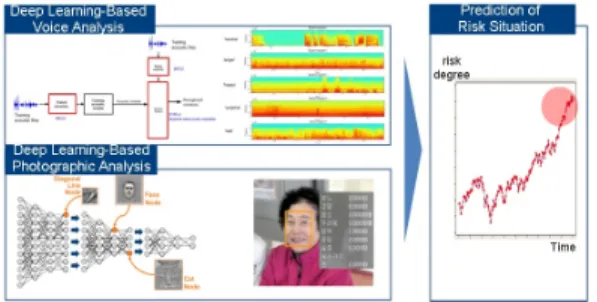
Based on the collected information on the elderly living alone, the highest and lowest values and average information are correlated to make meaningful data on accidents and diseases into rules and models and create an algorithm.
Abnormal situations and dangerous situation are judged through the relevant algorithm. Figure 5 shows the process of artificial intelligence scenarios to analyze abnormal situations by individual and define them as daily and dangerous environments.
Fig. 5 Artificial intelligence application method
3.2.4 Blockchain element technology
The data on the elderly living alone should be connected as blocks to design the technology so that the data in the entire blocks cannot be falsified or stolen. Individual participating nodes should be decentralized so that the data cannot be hacked and since the data ledger is distributed for storage, safety should be ensured so that data can be easily recovered even when problems have occurred in the data of some server nodes in the event of a disaster.
Fig. 6 Confirm patient list
Figure 7 shows the hyperledger composer technology for storing and managing the activity information of the elderly living alone in the server.
To make the health_idx (sequence ID, which stores
the activity information of the relevant elderly
living alone in regular time units), senior ID
(elderly living alone identifying information),
stepCount (Check the number of steps of the
elderly living alone), latitude/longitude (collect
location information through latitudes and
longitudes), and individual servers in the emergency
relief facilities independent from each other, the
hyperledger rest server for blockchain application
has the functions of a full node server
(synchronization among servers using block chains),
and synchronization of all servers and ID based
synchronization.
Fig. 7 Hyperledger composer & rest server 3.2.5 Cloud design
In cases where the number of the elderly living alone to be managed increases or the area where services are introduced expands, a technology is needed to ensure the scalability of the server at a minimum cost.
Fig. 8 Cloud design
Through Figure 8, the introduction of cloud which enables easy and efficient expansion of servers when a new service has been added and system resources are insufficient is designed.
3.2.6 ERD design
In this section, the DB structure for user information (elderly living alone, life manager,
family member) and issue information (activity information and location information of the elderly living alone) applied to the senior behavioral analysis and care system, and notices and operator information of the app solution were designed with ERD.
Fig. 9 ERD design
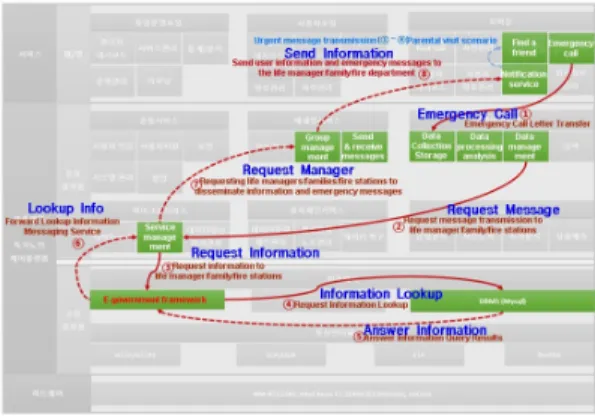
3.2.7 Design of emergency service flow chart The process through which the activity information of an elderly living alone is identified from the elderly living alone in cases where the situation is judged to be urgent because there is no activity information of the elderly living alone and the urgent situation which communicated to the liked members is designed through this menu.
Fig. 10 Emergency call service flow diagram
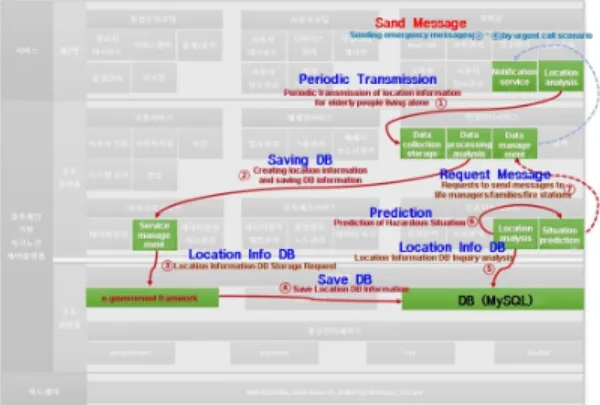
Fig. 11 shows the design of emergency situation
prediction and location information tracking in cases
where the elderly living alone deviated from the daily path based on the relevant location information after periodically collecting activity information and location information of the elderly living alone.
It is a scenario through which operators with authority, such as life managers, can collect motion information of the elderly living alone through the DB in normalized time units, collect the location information as latitude and longitude information in the app menu, and thereafter monitor real-time motion information.
Fig. 11 Emergency situation prediction and location tracking design
Ⅳ. Conclusion
Diverse applied solutions incorporating the core technologies of the fourth industrial revolution are being developed, and the proposed paper aims to design a care solution for the elderly living alone that can monitor dangerous situations in advance after analyzing activity information.
This solution has a scenario through which information at normal times is collected as big data through the sensor of a smart device, a notice is given to the elderly living alone to identify whether there is any abnormality in cases where an abnormal symptom has been identified based on
activity/inactivity information and location information, the information on the dangerous situation is shared with peer senior members, family members, and life managers through messages in cases where there is no response, and the information is finally delivered to emergency relief facilities.
The proposed paper is a step before implementing care system after designing senior behavioral analysis and aims to expand the service to single-person households and children who are in the socially vulnerable class after developing the technology later.
References
[1] C. Cho, “The effect of basic service for elderly care on living satisfaction for the elderly living alone : focusing on Jeong-pyeong County,”
Master's Thesis, Korea National University of Transportation, 2019.
[2] e-Fire Statistics, National Fire Data System, Sejeong, Korea, 2019.
[3] H. Choi, “’Aging in place' experience of older adults living alone in urban areas :a qualitative study based on the grounded theory approach,” Doctor's Thesis, Yonsei University, 2020.
[4] Statistics Korea, Future Population Projections 2016, Daejeon, Korea, 2016.
[5] K. Jin, “The Effect of Alcohol Usage on Suicidal Ideation for the Elderly Living Alone : Staying Single as a Moderator,” Master's Thesis, Myongji University, 2016.
[6] Y. Lee, “Factors Associated with Suicidal Ideation of Elderly People Living Alone: The Public Elderly Care Service with focus on recipients,” Master's Thesis, Soongsil University, 2015.
[7] S. Kim, “The study on the work experience of
the lifestyle managers for senior citizens
living alone,” Master's Thesis, Dankook
University, 2019.
[8] M. Kim, “Scientometric Analysis through Centrality Analysis of Graph for Linkage Relation of Keyword for Elder’s Rehabilitation and Healthcare,” J. of the Korea Institute of Electronic Communication Sciences, vol. 14, no.
2, 2019, pp. 447-452.
[9] H. Kim, “A Study on The Real-Time Data Collection / Analysis / Processing Intelligent IoT,” J. of the Korea Institute of Electronic Communication Sciences, vol. 14, no. 2, 2019, pp. 317-322.
[10] J. Seo and H. Park, “Motion Recognition of Mobile Phone for data sharing based on Google Cloud Message Service,” J. of the Korea Institute of Electronic Communication Sciences, vol. 14, no. 1, 2019, pp. 205-211.
저자 소개
장재열(Jae-Yeol Jang)
1984년 동국대학교 전자계산학과 졸업(공학사)
1995년 경희대학교 교육대학원 전 자계산교육전공 졸업(석사) 2001년 관동대학교 대학원 전자계산공학과 졸업 (공 학박사)
1995년∼현재 (법인)경동대학교 의료생명보건대학
※ 관심분야: 웹서버보안, 컴퓨터교육
최진일(Jin-Il Choi)
1999년 광운대학교 전자공학과 마 이크로파공학 전공(공학박사) 2013년 건양대학교 보건대학원 진 단검사의학전공(보건학석사) 1994년 미국 United SATCOM 연구소 연구원 2000년∼현재 경동대학교 소프트웨어학과 교수 2016년∼2018년 경동대학교 교학처장
※ 관심분야 : 생체전자, IoMT, 의료빅데이터
어재선(Je-Sun Uh)
1997년 Science and Technology of Nihon University(석사)
2000년 Science and Technology of Nihon University(Ph.D)
2000년∼2002년 Tokyo University, Ocean Research Inst itute(Postdoc)
2006년∼현재 경동대학교 해양심층수학과 교수
※ 관심분야 : 해양심층수학, 해양관측, GIS
최철재(Chul-Jae Choi)