INTRODUCTION
Producers of chicken meat have attempted to find a way to produce high-quality meat to satisfy the increased consumer demand. There is a growing interest in the use of native chicken breeds for the production of chicken meat in many countries because native chicken meats have properties such as high protein content, low fat content, unique flavor and texture compared with those of broiler chicken meat (Fana- tico et al., 2007; Jaturasitha et al., 2008; Jayasena et al., 2013;
Jung et al., 2013). In addition, the conservation of native chi- cken breeds is considered important because the increasing use of broiler chickens with rapid growth properties has resulted in the loss of genetic diversity among chicken breeds (Zanetti et al., 2010). For these reasons, the development of a new meat breed by using native chickens is required, based on suitable selection strategies for the production of high-quality meat (Jung et al., 2013).
Meat quality is strongly associated with the decline of mu- scle pH post-mortem. Rapid decline of muscle pH and low ultimate pH values result in pale, soft and exudative (PSE) meat that has a pale appearance, soft texture and exudative traits owing to decreased water holding capacity (WHC); de- naturation of meat chromoproteins, especially myoglobin; and alteration of muscle fiber structure (Owens et al., 2000; Swat- land, 2008). In contrast, high ultimate pH generates dark, firm and dry (DFD) meat with a dark appearance, firm texture, and dry traits, in addition to poor storage stability (Allen et al., 1997). Although PSE and DFD meat are primarily concerns for pork and beef, the incidence of PSE meat has been re- ported for chicken meat (Garcia et al., 2010; Barbut et al., 2008). Therefore, regulating the rate and extent of muscle pH decline after slaughter is crucial to the production of chicken meat. Barut et al. (2008) emphasized the importance of ulti- mate pH, rate of pH decline, WHC and color of meat in the selection process.
Comparison of pH, Water Holding Capacity and Color among Meats from Korean Native Chickens
Samooel Jung
1, Hyun Joo Kim
2, Hyun Jung Lee
2, Dong Won Seo
1, Jun Heon Lee
1, Hee Bok Park
1, Cheorun Jo
2and Ki Chang Nam
3,†1
Department of Animal Science and Biotechnology, Chungnam National University, Daejeon 305-764, Korea
2
Department of Agricultural Biotechnology, Center for Food and Bioconvergence, and Research Institute of Agriculture and Life Sciences, Seoul National University, Seoul 151-921, Korea
3
Department of Animal Science and Technology, Sunchon National University, Suncheon 540-742, Korea
ABSTRACT This study investigated the initial pH measured at 15 min post-mortem, ultimate pH, water holding capacity (WHC), and color of meats obtained from five lines of Korean native chicken (KNC) for the development of breed for high- quality meat. In addition, the effect of sex was examined. In total, 595 F
1progeny (Black [B], Grey-Brown [G], Red-Brown [R], White [W] and Yellow-Brown [Y]) from 70 full-sib families were used. Chickens were slaughtered at 20 wk of age and the measurement traits of all breast and thigh meats from 595 chickens were analyzed. The initial pH at 15 min post-slaughter of the breast and thigh meats was affected by the line and sex of Korean native chicken (P<0.05). However, there was no line and sex effect on ultimate pH and WHC of the breast and thigh meat except that the ultimate pH of thigh meat had line effect. Except for the L* value of breast meat, the meat color was significantly affected by line and sex (P<0.05). The ultimate pH showed consistently negative correlation with the L* value and positive correlation with the a* value in breast and thigh meats. Based on the results, we concluded that the line W in male chickens and the line G and W in female chickens may be good candidates for the selection to develop breed for high-quality meat because these lines showed property of high initial pH or/and ultimate pH.
(Key words: Korean native chicken breeds, pH, water holding capacity, color)
†
To whom correspondence should be addressed : [email protected]
Recently, government agencies in Korea have been engaged in a project to develop a new meat breed of chicken based on Korean native chickens (KNCs), to conserve native chicken breeds while simultaneously satisfying consumer demands. Five KNC lines (i.e., Black, Grey-Brown, Red-Brown, White, and Yellow-Brown) have been proposed as candidates for the se- lection (Jung et al., 2013). The present study was conducted to investigate the pH, WHC and color of breast and thigh meat obtained from the five KNC lines to obtain useful infor- mation for devising selection strategies.
MATERIALS AND METHOD
1. Animals
A two-generation resource pedigree using five lines of KNC was established and managed in this study. Within each line which was established in National Institute of Animal Science (NIAS) of Korea (Cheonan, Korea), three sires were mated with 14 to 15 dams to produce F
1chicks. In total, 595 F
1pro- geny (Black [B]: 90 [male: 45, female: 45], Grey-Brown [G]:
110 [male: 52, female: 58], Red-Brown [R]: 136 [male: 68, female: 68], White [W]: 126 [male: 63, female: 63], Yellow- Brown [Y]: 133 [male: 62, female: 71]) from 70 full-sib fa- milies were used in this study. Chickens were raised at NIAS (Cheonan, Korea) and fed ad libitum commercial-formula feed containing 18.2% concentrated protein and 2859 kcal/kg me- tabolizable energy. Chicken care facilities and the procedures were performed met or exceeded the standards established by the Committee for Accreditation of Laboratory Animal Care at NIAS in Korea. This study was also conducted in accordance with “The Guide for the Care and Use of Laboratory Animals”
published by the institutional Animal Care and Use Commit- tee of NIAS, Korea. Chickens were slaughtered after 4 h of feed withdrawal at 20 wk of age using conventional neck cuts and bleeding for 2 min; the feathers were then removed and the chickens were eviscerated. The carcasses were vacuum- packed after chilling in ice-cold water and stored in refrige- rator at 4℃ for 24 h. And then vacuum-packed carcasses were frozen in a freezer at —20℃ until analysis.
Before analysis, the frozen carcasses were thawed in a re- frigerator at 4 ℃ for 24 h. Breast and thigh muscles were dissected from each thawed carcass. Then, the right and left breast and thigh muscles from each chicken were minced sepa- rately using a food mixer (CH180A, Kenwood Ltd, Hampshire, UK) for 30 sec. Minced meat samples were used for analysis.
3. Measurement of pH
After slaughter, the pH values at 15 min post-slaughter were measured by inserting the probe into the respective breast and thigh muscles of fresh carcass with portable pH meter (SG2- SevenGo, Mettler-Toledo Inti Inc., Schwerzenbach, Switzer- land). To measure ultimate pH values, minced meat (1 g) of respective breast and thigh muscles from frozen-thawed car- casses were homogenized with 9 mL of distilled water using a homogenizer (T25 basic, IKA GmbH & Co. KG, Germany) at 1,130 × g for 30 sec. The homogenates were filtered by filter paper (No. 4, Whatman Ltd. Kent, UK) after centrifugation at 2,090 × g for 15 min (Union 32R, Hanil Co., Ltd., Inchun, Korea). The pH of filtrate was measured using a pH meter (SevenEasy, Mettler-Toledo Inti Inc., Schwerzenbach, Swit- zerland).
4. Measurement of Water Holding Capacity One gram of the minced meat sample was placed on a round filter paper (No.4, Whatman Ltd. Kent,UK). The filter paper with meat was placed into centrifuge tube and the tube was centrifuged (CR 20B2, Hitachi Koki Co., Ltd. Fukuoka, Japan) at 6,710 × g for 10 min. The released water absorbed into the filter paper was weighed and calculated as a percen- tage of the initial moisture of meat. Moisture content of meat was determined by drying 3 g of samples placed in aluminum dishes for 15 h at 104℃.
5. Measurement of Instrumental Color
The CIE lightness (L*), redness (a*) and yellowness (b*)
of the minced meat were measured with a colorimeter (CR-
300, Minolta Inc., Tokyo, Japan). This instrument was cali-
brated with a black and a white reference tile. Measurements
were taken perpendicularly to the sample in quartz cell (3 cm
automatically.
6. Statistical Analysis
All data (pooled data) were analyzed by multifactorial ana- lysis of variance using the general linear model to investigate the effect of meat type (breast and thigh), gender (male and female), and line (five lines of KNC). After grouping the data by each meat type with each gender, the data were analyzed by the general linear model to confirm the line effect in each meat type with each gender. Tukey’s multiple range test was used to compare significant differences between least square mean values (P<0.05). Least square mean values and standard error of the least square means (SEM) are reported. Addition- ally, Pearson's correlation coefficients were calculated (P<0.05).
SAS software (version 9.3, SAS Institute Inc., Cary, NC, USA) was used for all statistical analyses.
RESULTS AND DISCUSSION
1. pH and Water Holding Capacity
Energy production for muscle contraction in postmortem muscle mainly depends on anaerobic glycolytic metabolism that leads to accumulation of lactic acid in the muscle before rigor mortis (Dransfield and Sosnicki, 1999). Therefore, post- mortem muscle undergoes a decrease in pH, and the degree
and rate of pH decline can be affected by not only the en- vironment but also genetic properties (Debut et al., 2003). In the present study, the five KNC lines were raised and slaugh- tered under the same environment to exclude the effect of environment on muscle pH.
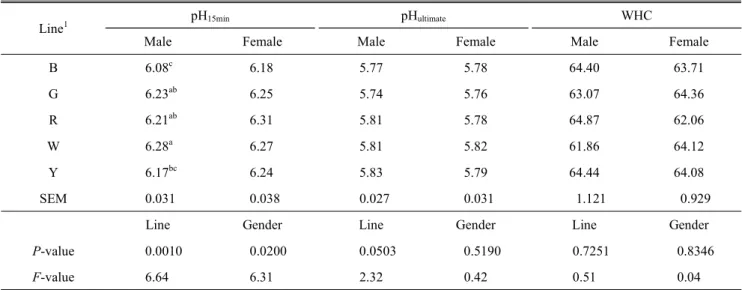
The initial pH at 15 min post-slaughter and the ultimate pH of breast meat obtained from lines B, G, R, W and Y of KNC are presented in Table 1. The initial pH of breast meat from male chickens was significantly higher in line W than in lines B and Y (P<0.05), whereas no significant difference in initial pH was observed in breast meat from female chi- ckens. The low pH value at 15 min post-slaughter in chicken meat indicates a rapid decline in pH. However, the ultimate pH of breast meat from both male and female chickens did not significantly differ among the five KNC lines.
No significant difference in WHC was observed for breast meat from male or female chickens among the five KNC lines, although the initial pH of breast meat from male chickens was significantly different. The WHC of meat reflects the affinity between myofibrillar protein and water molecules, and the space to retain water within the myofibril (Huff-Lonergan and Lonergan, 2005). The decline of pH near the isoelectric point of myofibrillar protein results in low WHC owing to reduction of the net charge of myofibrillar protein, thereby decreasing both water affinity and space (Huff-Lonergan and Lonergan,
Table 1. pH and water holding capacity (%) of the breast meats from five lines of Korean native chicken
Line
1pH
15minpH
ultimateWHC
Male Female Male Female Male Female
B 6.08
c6.18 5.77 5.78 64.40 63.71
G 6.23
ab6.25 5.74 5.76 63.07 64.36
R 6.21
ab6.31 5.81 5.78 64.87 62.06
W 6.28
a6.27 5.81 5.82 61.86 64.12
Y 6.17
bc6.24 5.83 5.79 64.44 64.08
SEM 0.031 0.038 0.027 0.031 1.121 0.929
Line Gender Line Gender Line Gender
P-value 0.0010 0.0200 0.0503 0.5190 0.7251 0.8346
F-value 6.64 6.31 2.32 0.42 0.51 0.04
a∼c
Different letters among breeds differ significantly (P<0.05).
1
B=Black, G=Grey-Brown, R=Red-Brown, W=White and Y=Yellow-Brown.
2005). Debut et al. (2003) reported that both low ultimate pH and accelerated rate of pH decline (low pH at 15 min post- slaughter) could lead to poor WHC of chicken meat. Le Bihan- Duval et al. (2008) found that ultimate pH had higher cor- relation with WHC than did initial pH (measured at 15 min post-slaughter) in broiler chickens. Therefore, no significant difference in WHC of breast meat among the five KNC lines might be consequence of no significant difference of ultimate pH of the breast meats among the five KNC lines
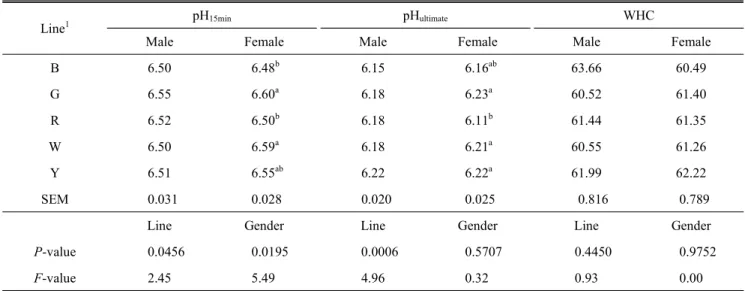
Female chickens of lines G and W had significantly higher initial and ultimate pH values in the thigh meat than did fe- males of line R (P<0.05), whereas no significant difference in initial and ultimate pH values was observed in male chickens among the five KNC lines. However, the WHC of thigh meat did not differ among the five KNC lines for both male and female chickens. The inconsistency of the relationship between ultimate pH and WHC in meat was previously reported in different chicken breeds. Musa et al. (2006) found a signifi- cant difference of up to 0.04 pH units in ultimate pH, with no difference in WHC in chicken breast meat. Jung et al. (2011) found no significant difference in WHC in chicken thigh meat, although a significant difference of 0.17 pH units was obser- ved for ultimate pH. However, a significant difference of 0.20 pH units in ultimate pH resulted in a difference in WHC in chicken thigh meat (Debut et al., 2003). In the present study,
the ultimate pH in thigh meat obtained from male and female KNC ranged from 6.11 to 6.23. Therefore, the difference in ul- timate pH, if any, was likely too small to influence the WHC of thigh meat obtained from both male and female KNC.
In the present study, the effects of sex (male and female) on the pH and WHC of meat obtained from the five KNC lines, from pooled data, were investigated, in addition to investiga- ting the effect of the chicken line. The initial pH of breast meat and thigh meat obtained from male and female chickens was 6.20 and 6.25 and 6.51 and 6.55, respectively, in the KNC lines (data not shown, P<0.05). However, no effects of sex on the ultimate pH and WHC of both breast and thigh meat from the KNC lines was observed. These results agree with those of a previous study. Musa et al. (2006) reported that there was no effect of sex on the ultimate pH and WHC of chicken meat.
2. Instrumental Meat Color
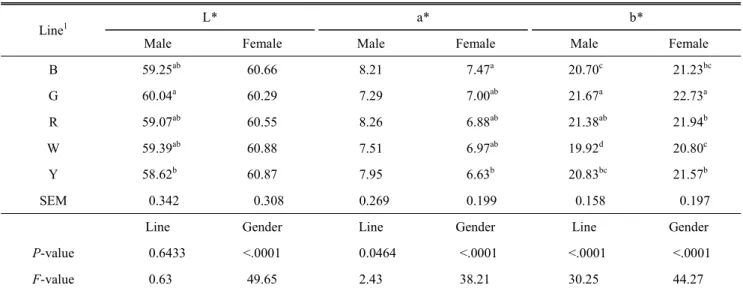
The instrumental color (lightness L*, redness a* and yellow- ness b*) of breast meat obtained from the five KNC lines is presented in Table 3. From the pooled data, an effect of chi- cken line was observed on the a* and b* values. The a* value of breast meat from female chickens was significantly higher in line B than in line Y (P<0.05). However, there was no sig- nificant difference in the a* value for breast meat obtained from male chickens of the five KNC lines. The breast meat
Table 2. pH and water holding capacity (%) of the thigh meats from five lines of Korean native chicken
Line
1pH
15minpH
ultimateWHC
Male Female Male Female Male Female
B 6.50 6.48
b6.15 6.16
ab63.66 60.49
G 6.55 6.60
a6.18 6.23
a60.52 61.40
R 6.52 6.50
b6.18 6.11
b61.44 61.35
W 6.50 6.59
a6.18 6.21
a60.55 61.26
Y 6.51 6.55
ab6.22 6.22
a61.99 62.22
SEM 0.031 0.028 0.020 0.025 0.816 0.789
Line Gender Line Gender Line Gender
P-value 0.0456 0.0195 0.0006 0.5707 0.4450 0.9752
F-value 2.45 5.49 4.96 0.32 0.93 0.00
from male chickens of line B and the breast meat from fe- male chickens of line W showed the lowest b* values (P<0.05).
An effect of chicken line on the L*, a* and b* values of thigh meat was observed (Table 4). The lowest L* and hi- ghest a* values of thigh meat were found in male and female chickens of line Y (P<0.05). Additionally, thigh meat from male chickens of line Y had the lowest b* value (P<0.05).
The lowest b* value for thigh meat from female chickens
was observed in line B (P<0.05).
An effect of sex on the L*, a* and b* values of both breast and thigh meat from the five KNC lines was observed.
The breast and thigh meats of male chickens had lower L*
and b* and higher a* values than those of female chickens (data not shown, P<0.05). Previous studies reported the sex effect on the color of chicken meat. However, the sex effect on color of chicken meat in the present study was not exactly Table 3. Color of the breast meats from five lines of Korean native chicken
Line
1L* a* b*
Male Female Male Female Male Female
B 59.25
ab60.66 8.21 7.47
a20.70
c21.23
bcG 60.04
a60.29 7.29 7.00
ab21.67
a22.73
aR 59.07
ab60.55 8.26 6.88
ab21.38
ab21.94
bW 59.39
ab60.88 7.51 6.97
ab19.92
d20.80
cY 58.62
b60.87 7.95 6.63
b20.83
bc21.57
bSEM 0.342 0.308 0.269 0.199 0.158 0.197
Line Gender Line Gender Line Gender
P-value 0.6433 <.0001 0.0464 <.0001 <.0001 <.0001
F-value 0.63 49.65 2.43 38.21 30.25 44.27
a∼c
Different letters among breeds differ significantly (P<0.05).
1
B=Black, G=Grey-Brown, R=Red-Brown, W=White, and Y=Yellow-Brown.
Table 4. Color of the thigh meats from five lines of Korean native chicken
Line
1L* a* b*
Male Female Male Female Male Female
B 46.08
bc50.38
ab13.98
abc13.41
ab19.29
b20.76
bG 48.90
a52.00
ab13.24
c12.98
b20.36
a21.61
aR 47.13
ab51.28
a13.45
bc13.03
b19.52
b21.17
abW 45.90
bc50.45
ab14.21
ab13.62
ab19.24
b20.97
abY 44.50
c50.37
b14.50
a14.03
a19.06
b21.27
abSEM 0.468 0.404 0.242 0.202 0.195 0.172
Line Gender Line Gender Line Gender
P-value <.0001 <.0001 <.0001 0.0006 <.0001 <.0001
F-value 13.42 261.77 10.38 11.84 7.33 207.84
a∼c
Different letters among breeds differ significantly (P<0.05).
1
B=Black, G=Grey-Brown, R=Red-Brown, W=White and Y=Yellow-Brown.
coincide with that of previous studies. Schneider et al. (2012) reported a lower L* and b* and higher a* values in breast meat from male chickens than in breast meat from female chickens in broiler at deboning. However, they also found no sex effect on a* values of breast meat from broiler after 24 h postmortem. Souza et al. (2011) revealed that breast meat from male chickens had higher a* and lower b* values than did breast meat from female chickens of three broiler strains.
López et al. (2011) reported a lower b* value in breast meat from male chickens than in breast meat from female chickens in two broiler strains. Previous study reported that the difference of meat color between male and female chicken originated from different ultimate pH of meat related to the difference of glycogen content in muscle or regulatory patterns of post- mortem metabolism (Schneider et al., 2012). However, there was no significant difference in ultimate pH and WHC bet- ween meats from male and female chicken in the present study.
Therefore, the sex effect on the color of chicken meat in the present study may be related to the difference of myoglobin content between meats from male and female chicken. Anadón (2002) reported that muscle of male chicken contained higher myoglobin, which was muscle pigment, than that of female chicken.
3. Correlation between the Measurement Traits of Chicken Meat
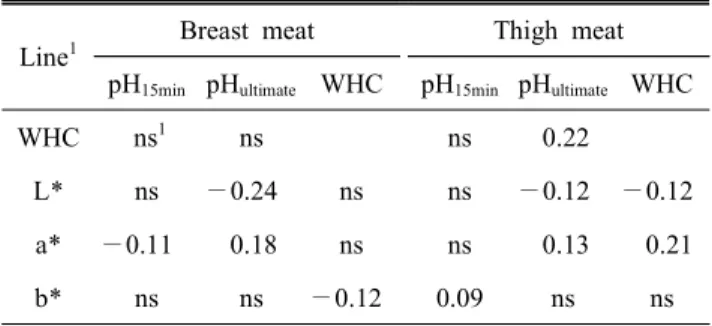
From the data pooled from each breast and thigh meat sample, the correlation between the measurement traits was analyzed (Table 5). The initial pH measured at 15 min post- mortem was negatively correlated (—0.11) with the a* value of breast meat and positively correlated (0.09) with the b*
value of thigh meat. The ultimate pH of the meat was con- sistently correlated with the L* value (negative) and a* value (positive) of both breast and thigh meat. Low ultimate pH of meat is considered to result in pale meat color (Le Bihan- Duval et al. 2001). As explained above, low ultimate pH is strongly related to poor WHC in meat (Huff-Lonergan and Lonergan, 2005). However, a correlation (0.22) between the ultimate pH and WHC was only observed in thigh meat in the present study. It was previously reported that WHC was
Table 5. Correlation coefficient between the measurement traits of meats from five lines of Korean native chicken
Line
1Breast meat Thigh meat
pH
15minpH
ultimateWHC pH
15minpH
ultimateWHC
WHC ns
1ns ns 0.22
L* ns —0.24 ns ns —0.12 —0.12
a* —0.11 0.18 ns ns 0.13 0.21
b* ns ns —0.12 0.09 ns ns
1