Received: February 10, 2020 Revised: March 11, 2020 Accepted: March 16, 2020
school health textbooks
Jung-Eun Park ・Su-Yeon Hwang1 ・Jong-Hwa Jang
Department of Dental Hygiene, College of Health Science, Dankook University
1Department of Public Health Sciences, Graduate School, Korea University
Corresponding Author: Jong-Hwa Jang, Department of Dental Hygiene, College of Health Science, Dankook University, Cheonan-si, Chungnam, 31116, Republic of Korea. Tel: +82-41-550-1495, E-mail:
ABSTRACT
Objectives: This study aimed to analyze the textbook content, specifically that of the oral health units, of Korean elementary health textbooks in order to discuss oral health education in elementary schools through textbooks. Methods: The study analyzed the “oral health”
units of six health textbooks for students in the fifth and sixth grades of elementary school in Korea. It identified the number of pictures, practice contents, and summaries in the textbooks, calculating the proportion of oral health units relative to the total number of pages in the textbook and comparing the learning goals provided by the WHO with the education contents.
In addition, the study also analyzed several keywords from the textbooks in terms of whether they relate to oral health. Results: The comprehensive analysis on the oral health units within the three health textbooks analyzed revealed that all three were similar, except that the textbook from publisher A did not include an introduction. The three textbooks also had differences in terms of the organization of the contents. In terms of the learning goals of the oral health units, there were differences between the WHO standards and the learning goals from the textbooks, with the WHO standards only partially reflected. The analysis also showed that there were more keywords on oral diseases than those related to oral health management and prevention. Conclusions: Improvements should be made regarding the learning goals and education topics of health education in order to ensure that children receive a more systematic oral health education in their earlier years, which will help to develop and correct oral health management habits among elementary school students.
Key Words: Health education, Oral health, School, School-public health, Text book
Introduction
According to the 2018 Korea National Children’s Oral Health Survey, the average number of
dental caries in the adult teeth of children aged 12 in Korea is 1.84 [1]. Although this represents a
decrease compared to 2015, when the average number of dental caries in the adult teeth in the country was 1.9, continuous management of appropriate oral hygiene care and education for Korean children at the national level should aim to reduce this number to under 1.0, which is the average of the advanced OECD countries [2].
Elementary school is a period where adult teeth start to appear, meaning children have a high sensitivity toward dental caries and gingivitis. As this period represents the time in which children's basic habits regarding oral health management are established for a lifetime, oral health education is extremely important both in school and at home.
Under Chapter 4, School Oral Health Projects, Article 12, of the Dental Health Act, children should be provided with dental health education, including how to practice dental hygiene control [3]. Therefore, health institutions and schools should provide systematic oral health education in order to promote correct oral health knowledge, attitudes, and activities among elementary school students. In addition, as children at this stage have not yet established certain attitudes and behaviors towards oral health, it may also be possible to change their behavior and motivations regarding oral health by teaching them appropriate oral health. Thus, regular oral health education and instructions are critical [4,5].
In Korea, health education in school as part of the curriculum began as a school health program in 1951. It was in this year that the Ministry of Education established physical examination requirements, while the subject of “health” was separately provided, as influenced by the US [6,7]. The subject of
“health” included oral health, sexual education, metal health, first aid, and disease control and prevention.
In addition, health textbooks, which were authorized by the superintendent under the Elementary and Secondary Education Act, have been used since 2009 across cities and provinces. Accordingly, health education is provided to 5th and 6th graders in elementary school through health textbooks.
As such, health textbooks are media designed to deliver learning goals and education contents to students while providing guidelines for teachers [8]. Therefore, the learning goals of the units related to health should be standardized, and the contents related to oral health should be made easy for the students to understand and follow.
It has been over 10 years since the introduction of health textbooks in elementary schools, meaning studies on the health textbooks for the qualitative development of oral health education in elementary schools should already exist. Prior studies and analyses regarding textbooks related to health include an analysis of the organizational systems and contents of elementary school health textbooks [6], as well as an analysis regarding environmental health from the perspective of domestic and foreign middle and high school health textbooks [9]. In addition, there was also a study on the changes in the health curriculum following the textbook reforms of 2015 [10]. Furthermore, as there have also been studies on the topics of smoking in physical education textbooks [11] and the contents and proportion of oral health in elementary, middle, and high school textbooks [12], it can be concluded that a wide range of analyses on the health of the students in terms of subjects such as health and physical education, etc.
have already been conducted. Although there have been several studies related to health, no analysis
has been conducted on the “oral health” units of health textbooks.
Various criteria can be used to analyze textbooks, and they can be divided according to their framework and contents. The framework can be further divided into various factors, such as a textbook’s publication, authors, quality, and advertisements, while contents can be further divided into their relationship with class, which includes both elements related to education and their attributes [13].
By analyzing the oral health unit of elementary school health textbooks in Korea in terms of their framework and contents, this study aims to discuss the status of oral health education provided to students in elementary school, as well as how to improve the quality of health textbooks.
Methods
1. Subjects
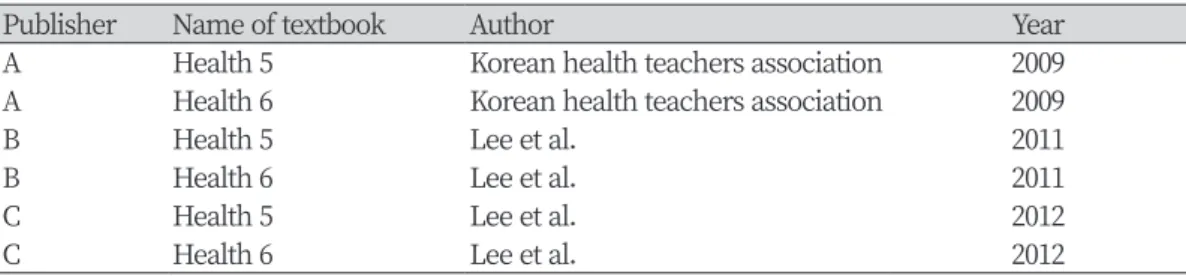
This methodological study analyzed both the organization and the education contents of six elementary school health textbooks designed for fifth and sixth grade students in Korea. The health textbooks for the analysis were acquired in July 2018 from the Korea Authorized and Approved Textbook Association. The publisher and more detailed information regarding the textbooks are listed in <Table 1>.
2. Data analysis
This study focused on the units related to the “oral health” sections of the health textbooks of each publisher. In addition, the study reviewed the number of pictures, contents related to practices and experiences, and summaries included in the units related to oral health. Furthermore, the study calculated the proportion of the oral health unit based on the number of pages or lines relative to the total number of pages.
3. Analysis of learning goals and keywords
This study compared the oral health learning goals and education contents from the Information series on school health provided by the WHO with the learning goals of the elementary school health textbooks in Korea [14]. As spacing between words may be considered as errors or different keywords, spacing was excluded during keyword analysis. The keywords were classified as the definition and causes of oral diseases and the prevention of oral diseases.
Table 1. The target textbooks
Publisher Name of textbook Author Year
A Health 5 Korean health teachers association 2009
A Health 6 Korean health teachers association 2009
B Health 5 Lee et al. 2011
B Health 6 Lee et al. 2011
C Health 5 Lee et al. 2012
C Health 6 Lee et al. 2012
A: Deulsaem, B: Kyohaksa, C: Daehanbooks
Results
1. Holistic analysis of health textbooks
<Table 2> shows the overall results of the analysis of the elementary school health textbooks. All health textbooks included oral health education for fifth grade students.
In addition, the oral health education section consisted of a title page, table of contents, and colored prints. Furthermore, aside from publisher A, all of the health textbooks contained introductions.
2. Organization of oral health units in health textbooks
The organization of the oral health units in the health textbooks by the three publishers are listed in
<Table 3>. There were differences in terms of the contents of the practices described in the textbooks.
The textbook by publisher B had the highest number of pictures (eight pictures), The summary of oral health is featured only in textbooks published by publisher C. In addition, in terms of the proportion of pages and lines on oral health by publishers, the textbook by publisher C had the highest proportion (4.4%) on oral health compared to the textbooks of the other publishers.
Table 2. Holistic analysis of the target textbooks
Publisher Grade Total number of page Cover Table ofcontents Introductory
remarks Color Oral health contents
A 5 129 + + - + +
6 119 + + - + -
B 5 127 + + + + +
6 127 + + + + -
C 5 180 + + + + +
6 177 + + + + -
+=included; -=non-included
A: Deulsaem, B: Kyohaksa, C: Daehanbooks
Table 3. Composition of oral health unit of health textbooks
Publisher Grade Practical contents Numberof figuresa) Summary Number of line Number of page (specific gravity, %) A 5 · Records on the cariogenic
Potential Index 7 - 32 4/129
(3.1)
B 5 · Tooth brushing
· Tooth brushing habit inspection
8 - 45 4/127
(3.2) C 5 · Functions of the teeth
· Diet management
· Checking for cavities
5 + 97 8/180
(4.4)
a) Each topic is regarded as a single figure
3. Topics and learning goals of units related to oral health
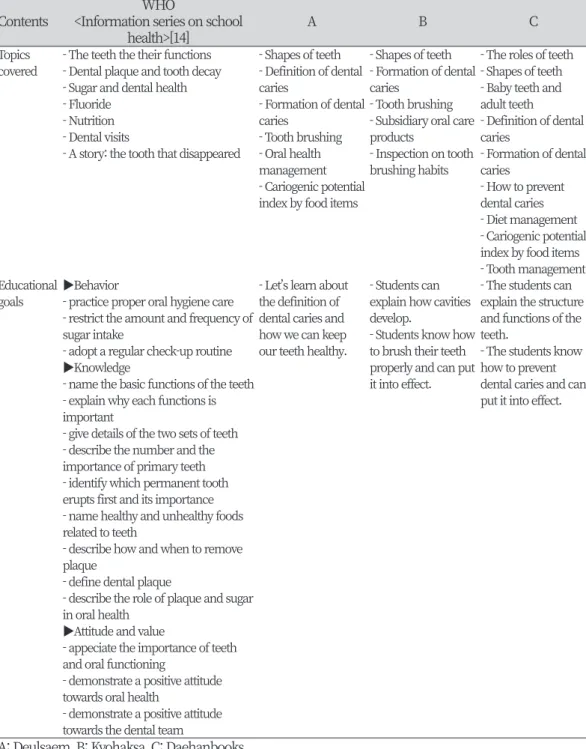
<Table 4> shows the WHO's oral health education curriculum and the subjects and learning goals of oral health education in the three Korean health textbooks. There were differences in topics and learning goals between the WHO and Korean textbooks, as well as differences between Korean health textbooks.
Table 4. Comparison between the oral health curriculum for elementary school students (aged 6-9) from the WHO and the learning goals of Korean elementary school health textbooks
Contents WHO
<Information series on school
health>[14] A B C
Topics
covered - The teeth the their functions - Dental plaque and tooth decay - Sugar and dental health - Fluoride
- Nutrition - Dental visits
- A story: the tooth that disappeared
- Shapes of teeth - Definition of dental caries
- Formation of dental caries
- Tooth brushing - Oral health management - Cariogenic potential index by food items
- Shapes of teeth - Formation of dental caries
- Tooth brushing - Subsidiary oral care products
- Inspection on tooth brushing habits
- The roles of teeth - Shapes of teeth - Baby teeth and adult teeth
- Definition of dental caries
- Formation of dental caries
- How to prevent dental caries - Diet management - Cariogenic potential index by food items - Tooth management Educational
goals ▶Behavior
- practice proper oral hygiene care - restrict the amount and frequency of sugar intake
- adopt a regular check-up routine
▶Knowledge
- name the basic functions of the teeth - explain why each functions is important
- give details of the two sets of teeth - describe the number and the importance of primary teeth - identify which permanent tooth erupts first and its importance - name healthy and unhealthy foods related to teeth
- describe how and when to remove plaque
- define dental plaque
- describe the role of plaque and sugar in oral health
▶Attitude and value
- appeciate the importance of teeth and oral functioning
- demonstrate a positive attitude towards oral health
- demonstrate a positive attitude towards the dental team
- Let’s learn about the definition of dental caries and how we can keep our teeth healthy.
- Students can explain how cavities develop.
- Students know how to brush their teeth properly and can put it into effect.
- The students can explain the structure and functions of the teeth.
- The students know how to prevent dental caries and can put it into effect.
A: Deulsaem, B: Kyohaksa, C: Daehanbooks
4. Analysis of keywords related to oral health by textbooks
<Table 5> shows the results of analyzing the keywords related to the definition of oral diseases, prevention, and oral health management. Keywords related to oral diseases include those related to the definitions, process, and mechanisms of oral diseases. After analyzing a number of example words within the textbook, it was shown that the textbook from Publisher B had the greatest number of keywords related to oral diseases, as well as the most keywords related to prevention and management.
Discussion
The importance of oral health education for elementary school students has already been reported in various studies [15,16], and, according to the results of these studies, greater knowledge regarding oral health leads to more active behavior regarding oral health among children [17]. Thus, it is necessary to secure oral health education in the early stages of childhood. However, Korean elementary school students generally start to learn about oral health in the fifth grade from health textbooks. Although oral health education may be provided via independent classes conducted by health teachers or community oral health programs, there is no systematic oral health education for each grade. Consequently, prior studies have provided evidence regarding the need for the continuous and systematic provision of oral health education for the lower grades [18].
The results of a comprehensive analysis on the three types of health textbooks used in Korea showed that the only difference between them concerned whether there was an introduction. However, differences were identified in terms of the organization of the oral health units, as well as in the oral health contents providing practices or experiences for students, and the number of pictures and summaries. Furthermore, the oral health units of the textbooks each made up different proportions of the overall textbooks. All three oral health units took up less than 5% of the entire textbook, with the proportion ranging from a minimum of 3.1% to a maximum of 4.4%.
Table 5. Keyword analysis related to oral health in health textbooks
Division Definition and causes of oral disease Oral health prevention management Classification criteria Keywords related to the definitions,
process, and mechanisms of oral diseases
Keywords related to the prevention and management of oral diseases
Example word Dental caries; bacteria; sugar; sweetness;
carbohydrate; food debris; carbonated drink; acid; pus; inflammation; mutans;
cavity; biofilm; malocclusion; calculus
Toothbrushing; Rolling method; mouth rinse; massage; toothbrush; dentifrice;
floss; dental clinic; examination;
prevention; oral examination; health;
control; healthy tooth; xylitol; vegetable;
fruit; fluorine; sealant Publisher (grade) Number of keywords(n) Number of keywords(n)
A (5) 29 19
B (5) 42 40
C (5) 35 30
A: Deulsaem, B: Kyohaksa, C: Daehanbooks