강인한 움직임 영역 검출과 화재의 효과적인 텍스처 특징을 이용한 화재 감지 방법
1)트룩 뉘엔*, 강명수*, 김철홍**, 김종면*
Fire Detection Approach using Robust Moving-Region Detection and Effective Texture Features of Fire
Truc Kim Thi Nguyen*, Myeongsu Kang*, Cheol-Hong Kim**, Jong-Myon Kim*
요 약
본 논문은 그레이 레벨 히스토그램을 이용한 움직임 영역 검출, 퍼지 클러스터링을 이용한 칼라 분할, 그레이 레 벨 동시발생 행렬을 이용한 특징 추출 및 서포터 벡터 머신을 이용한 화재 분류 등과 같은 다중 이종 알고리즘을 포함하고 있는 효과적인 화재 감지 방법을 제안한다. 제안한 방법은 움직임 영역을 검출하기 위해 그레이 레벨 히스 토그램에 기초한 최적의 임계값을 결정하고 난 후, CIE LAB 칼라 공간에서 퍼지 클러스터링을 적용하여 칼라 분 할을 수행한다. 이러한 두 단계는 화재의 후보 영역을 기술하는데 도움이 된다. 다음으로 그레이 레벨 동시발생 행 렬을 이용하여 화재의 특징을 추출하고, 이러한 특징들은 화재인지 아닌지를 분류하기 위해 서포터 벡터 머신의 입 력으로 사용된다. 제안한 방법을 평가하기 위해 기존의 두 알고리즘과 화재 검출율 및 오류 화재 검출율에서 비교하 였다. 모의실험결과, 제안한 방법은 97.94%의 화재 검출율 및 4.63%의 오류 화재 검출율을 보임으로써 기존의 화재 감지 알고리즘보다 우수성을 보였다.
▸Keywords : 화재 감지, 움직임 영역 감지, 그레이 레벨 동시발생 행렬, 서포터 벡터 머신
Abstract
This paper proposes an effective fire detection approach that includes the following multiple heterogeneous algorithms: moving region detection using grey level histograms, color segmentation
∙제1저자 : Truc K.T. Nguyen ∙교신저자 : 김종면
∙투고일 : 2012. 11. 13, 심사일 : 2013. 1. 29, 게재확정일 : 2013. 2. 7.
* 울산대학교 전기공학부(School of Electrical Engineering, University of Ulsan)
**전남대학교 전자컴퓨터공학부(School of Computer and Electronics Engineering, Chonnam National University)
※ 본 연구는 중소기업청에서 지원하는 2012년도 산학연공동기술개발사업(No. C0031322)의 연구수행으로 인한 결과물이며, 본 연구는 산업자원통상부의 광역경제권 선도산업 육성사업의 일환인 “동남광역경제권 선도산업 지원단”의 2013년 연구비 지원으로 수행되었으며 (No. R0001220), 또한 이 논문은 2013년도 정부(미래창조과학부)의 재원으로 한국연구재단의 지 원을 받아 수행된 연구임(No. NRF-2013R1A2A2A05004566).
using fuzzy c-means clustering (FCM), feature extraction using a grey level co-occurrence matrix (GLCM), and fire classification using support vector machine (SVM). The proposed approach determines the optimal threshold values based on grey level histograms in order to detect moving regions, and then performs color segmentation in the CIE LAB color space by applying the FCM.
These steps help to specify candidate regions of fire. We then extract features of fire using the GLCM and these features are used as inputs of SVM to classify fire or non-fire. We evaluate the proposed approach by comparing it with two state-of-the-art fire detection algorithms in terms of the fire detection rate (or percentages of true positive, PTP) and the false fire detection rate (or percentages of true negative, PTN). Experimental results indicated that the proposed approach outperformed conventional fire detection algorithms by yielding 97.94% for PTP and 4.63% for PTN, respectively.
▸Keywords : Fire detection, Moving region detection, Grey level co-occurrence matrix, Support vector machine
I. Introduction
With the fast and advanced pace of technology, especially, in video surveillance, a new period of early warning and fire detection is opening.
Compared to traditional fire detection systems which mostly use sensors and make decisions based on them, video-based fire detection systems use digital camera technology and video processing techniques.
These video-based techniques have advantages over traditional methods with respect to response time and space.
Until now, many algorithms based on recognizing color and/or motion were introduced either as decision rules, probability models or as multiple layer filters [1-3]. These algorithms are simple, and real-time, however, they lack robustness.
Consequently, in order to enhance performance, recent algorithms combine analysis techniques with classification techniques to find more specific fire parameters that distinguish between fire and non-fire situations. For instance, Borges and others analyzed frames to extract changing features of fires such as color, boundary, roughness and skewness for a Bayer classifier and made decisions about whether
fires happened or not [4]. In addition, several researchers applied discrete wavelet transforms to extract features for classification [5-7].
To improve the classification performance of fire detection, this paper proposes an effective fire detection approach using heterogeneous image processing techniques: moving-region detection using grey level histograms, color segmentation in the CIE LAB color space using the FCM, feature extraction using the GLCM, and fire classification using SVMs. Experimental results show that the proposed approach outperforms two conventional algorithms with respect to percentages of true positive and true negative.
The rest of this paper is organized as follows.
Section II introduces the proposed fire detection approach and Section III illustrates experimental results and evaluates the classification performance of the proposed approach. Finally, Section IV concludes the paper.
II. Proposed fire detection Approach
The proposed approach is illustrated in Fig. 1. In this paper, we use multiple heterogeneous methods for fire detection.
그림 1. 다중 이미지 처리 알고리즘을 사용한 제안한 화재 감지 방법 Fig. 1. The proposed fire detection approach using
multiple image processing algorithms.
In the first two steps, we detect moving regions and perform color segmentation in the CIE LAB color space to specify candidate regions of fire. Then, we extract features of fire using the grey level co-occurrence matrix (GLCM) and finally determine whether or not there is fire in the current video image frame by using these features as inputs of support vector machine (SVM). More details about this procedure is described in the following sections.
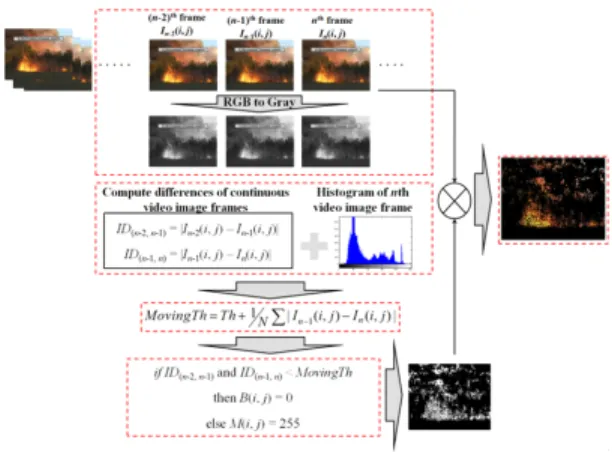
그림 2. 움직임 영역을 검출하기 위한 절차 Fig. 2. The procedure for detecting moving regions
1. Moving Region Detection and Color Segmentation Turbulent flames have a characteristic flicker frequency of around 10 Hz and this stochastic motion behavior of flame is especially useful for
recognizing fires [5]. Thus, this paper first detects moving regions in video image frames, which enables higher performance in detecting fires.
Fig. 2 shows the procedure for detecting moving regions. To detect moving regions, this paper uses three successive video frames [8]. Moving region detection is essentially composed of the following five steps:
Step 1: Convert input video frames in the RGB color space to grey level video frames.
Step 2: Let , and
represent intensity values of the three consecutive video image frames, where and
are the intensity values of the previous video frames, and denotes the intensity values of the current video frame. Then, we can compute grey scale differences between two adjacent video frames as follows:
(1)Step 3: Calculate a moving threshold to distinguish the moving regions from the background using (2):
1 n1( , ) n( , ) ,
MovingTh Th I i j I i j
N -
= +
å
- (2)where MovingTh is the moving threshold for detecting moving regions, 1NåIn-1( , )i j -I i jn( , )
denotes image changes in overall light and N is the number of pixels in the frame, and Th is an additional threshold value depending on the environment. We also investigate the impact of Th for fire detection and more details about Th threshold values are given in Section 3.2.
Step 4: To specify the moving region and background region, we use the following rule:
( ) ( )
( 1, 2 )and ( 1, )
then , 0 else , 255,
n n n n
if ID ID MovingTh
B i j M i j
- - - <
= =
(3)
where B(i, j) and M(i, j) represent the background region and moving region after determining the difference, respectively.
Step 5: Finally, we perform an AND operation between the current RGB video frame and the resulting frame in order to obtain the moving region in the RGB color space as shown in Fig. 2.
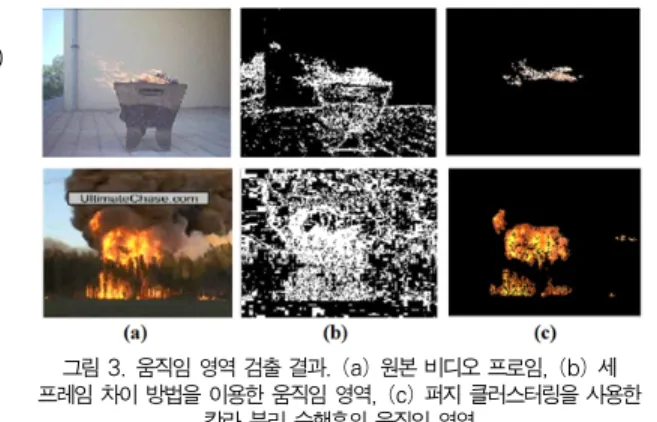
Since the moving region includes the region of several moving objects (e.g., fire, people, vehicle, and cloud) as well as the changing background areas, the proposed approach performs color segmentation to specify more effective candidate regions of fire by applying the fuzzy c-means clustering (FCM) algorithm [9]. To do this, we first convert the RGB color space to the CIE LAB color space which is one of the most effective color spaces for classifying illumination components, where L indicates the lightness of a pixel, and A and B indicate the colors of the pixel [10]. In this paper, we only use the A and B components of the resulting frame as inputs to FCM because environmental light can affect the detection of the moving regions if we use illumination components. To apply FCM to the proposed approach, we set the degree of fuzzification to 2 and the termination threshold to 0.001. This is because Bezdek et al. experimentally determined the optimal intervals for the degree of fuzzification and the termination threshold, and found them to range from 1.1 to 5 and from 0.01 to 0.0001, respectively [11]. Figure 3 depicts the result of moving region detection after these two steps mentioned above.
그림 3. 움직임 영역 검출 결과. (a) 원본 비디오 프로임, (b) 세 프레임 차이 방법을 이용한 움직임 영역, (c) 퍼지 클러스터링을 사용한
칼라 분리 수행후의 움직임 영역
Fig. 3. Results of moving region detection. (a) original video image frames, (b) moving regions using three frame differencing method, and (c) moving regions after performing
color segmentation using fuzzy c-means clustering
2. Feature Extraction and Classification of Fire After the first two steps, a certain number of non-fire pixels can be removed. However, the candidate region still has non-fire pixels because there can be moving reddish objects. Therefore, it is necessary to obtain more information about fires.
The proposed approach utilizes the grey level co-occurrence matrix (GLCM) to extract features of fires, where the properties of fires are specified by calculating energy, contrast, and homogeneity for four directions (e.g., 0°, 45°, 90°, 135°) with 16x16 blocks of the video image frame as follows [12]:
2
, 2 ,
,
( , )
( , ) ( , ) 1 ,
i j
i j
i j
Energy p i j
Contrast i j p i j p i j Homogeneity
i j
=
= -
= + -
å å
å
(4)
where p(i,j) is the (i,j)th entry in a normalized GLCM.
Finally, to determine whether or not the candidate region includes fire, this paper employs a support vector machine (SVM) [13,14]. After the feature extraction step, we select 12 features specifying the characteristic of fire (e.g., energy,
contrast, and homogeneity for four directions) and use them as inputs to the SVM. Due to the similarity between fire and non-fire features, it is difficult to ensure linear separation. Thus, to classify fire from the candidate moving region, we use the non-linear SVM with Gaussian radial basis kernel function which performs better than other kernels [7]:
2
( , ) exp 2 ,
2
i j
i j
x x K x x
s
æ - ö
ç ÷
= ç ÷
è ø
(5)
where is the kernel function, and are the input feature vectors, ands is a parameter to be set by the user, which determines the width of the effective basis kernel function. If small s
values are used, overtraining occurs with the basis function wrapped tightly around the data points. In contrast, if large svalues are used, the basis function draws an oval around the points without defining the shape or pattern. Consequently, s
values can affect the classification performance and we experimentally selected s as 0.1 yielding the highest performance.
Furthermore, we first performed moving region detection and color segmentation with each frame of the video clips to train SVM. We then obtained candidate regions of fire, and divided each candidate region into 16x16 blocks. Finally, we extracted texture parameters from 2,500 fire-containing and 1,500 non-fire-containing blocks, respectively, and trained SVM by utilizing these texture parameters as inputs of it.
III. Experimental Result
1. Experimental Environment
To implement and evaluate the performance of the proposed fire detection approach and two
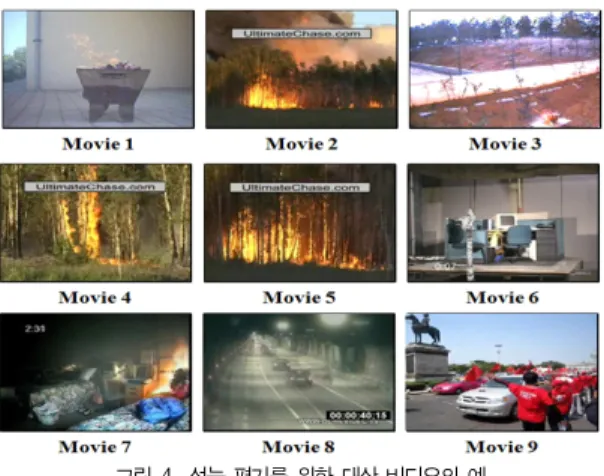
conventional algorithms, we use MATLAB 7.5 on a Pentium Quad-Core 2.8 GHz PC platform. We use nine videos with 320x240 image size in this study as shown in Fig. 4. Movies 1-5 are outdoor fire videos and Movies 6 and 7 are indoor fire videos. Movie 8 shows a car accident in a tunnel without fire and Movie 9 is an outdoor video including reddish moving objects such as red cars and flags.
그림 4. 성능 평가를 위한 대상 비디오의 예 Fig. 4. Examples of target videos for performance
evaluation
2. Selecting Threshold Values for Moving Region Detection
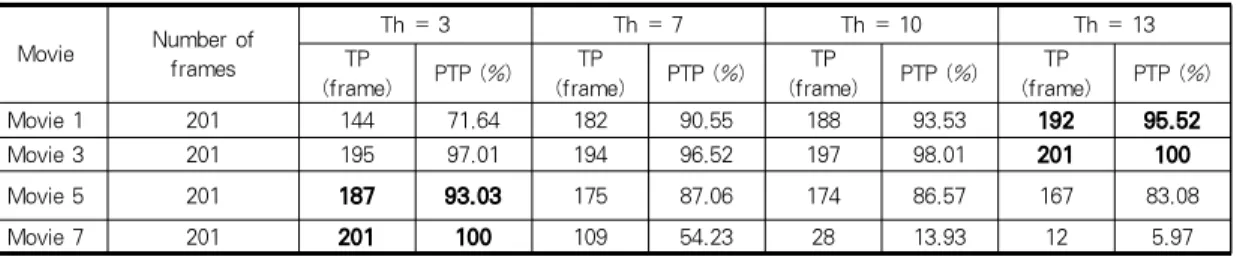
As mentioned in Section 2.1, Th threshold values can affect the performance of moving region detection in video frames. Thus, we investigate the impact of the threshold value by changing the threshold values with Movies 1, 3, 5, and 7 because, regardless of the threshold value, the performance was good enough for Movies 2, 4, and 6. Table 1 shows the experimental results, where TP (or true positive) is the number of frames that accurately recognize a real fire as a fire for all frames that fire candidates are correctly detected in the movie, and the percentage of TP (PTP) is the overall fire detection rate.
As shown in Table 1, we get different results by selecting different threshold values, and observe that the threshold values are closely related to the
Movies Number of frame
Algorithm 1 [5] Algorithm 2 [6] Proposed
TP (frame) PTP (%) TP (frame) PTP (%) TP (frame) PTP (%)
Movie 1 201 185 92.04 184 91.54 188 93.53
Movie 2 201 192 95.52 190 94.53 201 100
Movie 3 201 188 93.53 187 93.03 201 100
Movie 4 201 194 96.52 193 96.02 199 99
Movie 5 201 192 95.52 194 96.52 198 98.51
Movie 6 188 181 96.28 179 95.21 188 100
Movie 7 201 190 94.53 191 95.02 201 100
Average 94.85 94.55 98.74
표 2. 제안한 알고리즘과 기존 알고리즘을 사용한 화재 감지율의 비교
Table. 2. Comparison of the fire detection rate using the proposed and conventional algorithms.
Movie Number of frames
Th = 3 Th = 7 Th = 10 Th = 13
TP
(frame) PTP (%) TP
(frame) PTP (%) TP
(frame) PTP (%) TP
(frame) PTP (%)
Movie 1 201 144 71.64 182 90.55 188 93.53 192 95.52
Movie 3 201 195 97.01 194 96.52 197 98.01 201 100
Movie 5 201 187 93.03 175 87.06 174 86.57 167 83.08
Movie 7 201 201 100 109 54.23 28 13.93 12 5.97
표 1. 움직임 영역 검출을 위한 경계값의 결과
Table 1. The results of the threshold value for detecting moving regions
Movies Number of frame
Algorithm 1 Algorithm 2 Proposed
TN (frame) PTN (%) TN (frame) PTN (%) TN (frame) PTN (%)
Movie 8 188 10 5.39 9 4.79 11 5.85
Movie 9 90 4 4.44 5 5.62 3 3.41
Average 4.88 5.17 4.63
표 3. 제안한 알고리즘과 기존 알고리즘을 사용한 오류 화재 감지율의 비교
Table. 3. Comparison of false fire detection rate using the proposed and conventional algorithms.
light complexity of the background of the video image frames. Consequently, we select threshold values using histogram information of video image frames with the following rules: Th=13 when histograms are distributed in the range from 15 to 80(see Movies 1 and 3) and Th=3 when histograms are distributed in the range from 81 to 167 (see Movies 5 and 7). Furthermore, when we tested other videos, it was reasonable to set the threshold value to 10 when the histogram was distributed in the range from 167 to 245. The threshold value can be automatically set by monitoring the histogram information of the video image frames.
3. Performance Evaluation
To evaluate the performance of the proposed fire detection approach, we compared the proposed approach with two state-of-the-art fire detection algorithms. The comparison results are presented in Tables 2 and 3.
As shown in Table 2, all algorithms resulted in low accuracies for Movie 1. This is because Movie 1 is blurred and flickering. Notwithstanding the flicker of Movie 1, we achieved higher accuracy of fire detection than those of other algorithms by utilizing an adaptive threshold based on histogram information for detecting movement-containing regions. As a result, the proposed approach outperformed the other algorithms in terms of PTP
by giving an average detection rate of 97.94% versus 94.85% and 94.55%, respectively.
Moreover, Table 3 represents an additional experimental result showing the accuracy of fire detection in two non-fire videos, where TN (or true negative) is the number of frames that recognize a non-fire as a fire for all frames that non-fire candidates are correctly detected in the movie, and the percentage of TN (PTN) is the overall false fire detection rate. The non-uniform characteristic of the moving regions in Movie 8 is similar to the color of fire so that the false rate is a bit high when we compare to that of PTN of Movie 9. For Movie 9, the false fire detection rate is small for all algorithms because the uniform characteristic of the moving regions differ from the non-uniform characteristics of fire. Likewise, our analytical results shows that the false fire detection rate increases when many pixels of car brake lights in Movie 8 are included in the 16x16 block for feature extraction.
IV. Conclusions
This paper presented the proposed fire detection approach which includes the following multiple image processing algorithms: grey level histograms for moving region detection, FCM for color segmentation, GLCM for feature extraction, and SVM for fire detection. First, we specified candidate regions of fire by combining moving region detection with color segmentation using the FCM. Then, to obtain more refined candidate regions of fire, we extracted fire features by using the GLCM. Finally, we determined whether or not there is fire in the current video frame by using these features as inputs for support vector machines. To evaluate the performance of fire detection, this paper compared the proposed approach with two state-of-the-art fire detection algorithms based on the fire detection rate (PTP) and false fire detection rate (TPN). The proposed method outperformed these comparison algorithms with results of 97.94% for PTP and
4.63% for PTN, respectively.
참고문헌
[1] T.–H. Chen, P.–H. Wu, and Y.–C. Chiou, “An Early Fire-Detection Method Based on Image Processing,” in International Conference on Image Processing, vol. 3, pp. 1707-1710, Oct.
2004.
[2] T. Celik and H. Demirel, “Fire Detection in Video Sequences Using a Generic Color Model,” Fire Safety Journal, vol. 44, no. 2, pp. 147-158, Feb.
2009.
[3] S.-M. Kang and J.-M. Kim, “Survey for Early Detection Techniques of Smoke and Flame using Camera Images”, Journal of The Korea Society of Computer Information, vol. 16, no. 4, pp. 45-54, April 2011.
[4] P. V. K. Borges and E. Izquierdo, “A Probabilistic Approach for Vision-Based Fire Detection in Videos,” IEEE Trans. Circuits and Systems for Video Technology, vol. 20, no. 1, pp. 721-731, May 2010.
[5] B. U. Toreyin, Y. Dedeoglu, U. Gudukbay, and A. E. Centin, “Computer Vision-Based Method for Real-Time Fire and Flame Detection,” Patt.
Recogn. Lett., vol. 27, no. 1, pp. 49-58, Jan.
2006.
[6] B. C. Ko, K.–H. Cheong, and J.–Y. Nam, “Fire Detection Based on Vision Sensor and Support Vector Machines.” Fire Safety Journal, vol. 44, no. 3, pp. 322- 329, April 2009.
[7] Y.-M. Kim, C.-H. Hwang, C.-H. Kim, and J.-M.
Kim, “Hardware Design and Implementation of a Parallel Processor for High-Performance Multimedia Processing,” Journal of The Korea Society of Computer Information, Vol. 16, No. 5, pp. 1-11, May 2011.
[8] X. Lian, T. Zhang, and Z. Liu, “A Novel Method on Moving-Objects Detection Based on Background Subtraction and Three Frames Differencing,” in International Conference on
Measuring Technology and Mechatronics Automation, vol. 1, pp.252-256, March 2010.
[9] H.–A. Mahdipour, K.–M. Hadi, and S. Y. Hadi,
“Least Mean Square Algorithm Tuned by Fuzzy C-Means for Impulsive Noise Suppression of Gray-level Images,” Int’l J. Sign. Proc. Img.
Proc. Patt. Recogn., vol. 3, no. 4, pp. 55-66, Dec. 2010.
[10] Y. Ohta, T. Kanade, and T. Sakai, “A Study of Efficiency and Accuracy in the Transformation from RGB to CIE LAB Color Space,” IEEE Trans. Image Proc., vol. 6, no. 7, pp. 1046 – 1048, July 1997.
[11] J. C. Bezdek, J. Keller, R. Krisnapuram, and N. R. Pal, Fuzzy Models and Algorithms for Pattern Recognition and Image Processing.
Springer, 1st edition, 2005.
[12] R. M. Haralick, K. Shanmugam, and I. Dinstein,
“Textural Features for Image Classification,”
IEEE Trans. Systems, Man and Cybernetics, vol.3, no.6, pp.610-621, Nov. 1973.
[13] S. Krishna, G. Indra, and G. Sangeeta, “SVM – BDT PNN and Fourier Moment Technique for Classification of Leaf Shape,” Int’1. J. Sign.
Proc. Img. Proc. Patt. Recogn., vol. 3, no. 4, pp. 67-78, Dec. 2010.
[14] T. H. Le and L. Bui, “Face Recognition Based on SVM and 2D PCA,” Int’l. J. Sign. Proc. Img.
Proc. Patt. Recogn., vol. 4, no. 3, pp. 85-94, Oct. 2011.
저 자 소 개
Truc Kim Thi Nguyen 2008: Electrical Engineering,
Danang University of Technology, Vietnam, 공학사.
2011: 울산대학교 컴퓨터정보통신공학부 석사과정 입학.
관심분야 : 영상처리, 워터마킹 Email: [email protected] 강 명 수
2008: 울산대학교 컴퓨터공학과 학사 2010: 울산대학교 컴퓨터공학과
공학석사
2010-현재: 울산대학교 컴퓨터공학과 박사과정
관심분야 : 임베디드 시스템, 음향신호처리, 고장진단 Email: [email protected] 김 철 홍
1998: 서울대학교 컴퓨터공학사.
2000: 서울대학교 컴퓨터공학부 석사.
2006: 서울대학교 전기컴퓨터공학부 박사 2005-2007년: 삼성전자 반도체총괄
책임연구원 2007-현재: 전남대학교
전자컴퓨터공학부 교수 관심분야: 임베디드시스템, 컴퓨터구조,
SoC설계, 저전력 설계 Email: [email protected] 김 종 면
1995: 명지대학교 전기공학사 2000: University of Florida ECE 석사 2005: Georgia Institute of
Technology ECE 박사 2005-2007: 삼성종합기술원 전문연구원 2007-현재: 울산대학교 전기공학부
조교수
관심분야: 프로세서 설계, 임베디드 SoC, 컴퓨터구조, 병렬처리 Email: [email protected]