• 검색 결과가 없습니다.

Immune Responses of BALB/c Mice Administrated via Oral Route to a Combined Salmonella Typhimurium Ghost Vaccine

N/A
N/A
Protected

Academic year: 2021

Share "Immune Responses of BALB/c Mice Administrated via Oral Route to a Combined Salmonella Typhimurium Ghost Vaccine"

Copied!
7
0
0

로드 중.... (전체 텍스트 보기)

전체 글

(1)

Immune Responses of BALB/c Mice Administrated via Oral Route to a Combined Salmonella Typhimurium Ghost Vaccine

Pan Gil Kim

, Yeon Jo Ha

, Su Man Lee, Sam Woong Kim* and Sang Wan Gal*

Department of Pharmaceutical Engineering, Gyeongnam National University of Science and Technology, Jinju 660-758, Korea Received June 15, 2015 /Revised August 27, 2015 /Accepted October 26, 2015

Salmonella Typhimurium (ST) JOL389 and χ3339 are strong virulent strains against mouse. ST χ8554 is derived by deletion of the asd gene from ST χ3339. Plasmid pMMP184 carrying a ghost cassette was transformed into ST χ8554, and ST χ8554 ghost cells were prepared and administrated via the oral route to BALB/c mice. Change in the amount of total IgG was not elicited to boosting of single ST χ8554 ghost cells, but the content was increased from 6 weeks after the 3

rd

administration.

However, when the ST JOL389 ghost cells is administered together with ST χ8554 ghost cells, the con- tent of total IgG was increased in 2 weeks post primary administration. It was found that the content of total IgG of the group mixed with ST JOL389 ghost cells showed an increased value of 8 times or more at 10 weeks when compared with the group of ST χ8554 ghost cells. The content of IgG1, IgG2a, and sIgA in both groups increased from 4 weeks postprimary administration. As a challenge test of virulent ST χ3339, χ8554 (pMMP184) and χ8554 (pMMP184)/JOL389 ghost cell groups showed protection of 50% or more when compared to the control group. These results suggest that the prepa- ration of combined ghost cells from a strong virulent ST increases immunity more than a single strain.

Key words : BALB/c mouse, ghost vaccine, immune, protection, S. Typhimurium, virulence

Authors contributed equally.

*Corresponding authors

*Tel : +82-55-751-3583, Fax : +82-55-759-1893

*E-mail : [email protected] (Sang Wan Gal) [email protected] (Sam Woong Kim)

This is an Open-Access article distributed under the terms of the Creative Commons Attribution Non-Commercial License (http://creativecommons.org/licenses/by-nc/3.0) which permits unrestricted non-commercial use, distribution, and reproduction in any medium, provided the original work is properly cited.

Journal of Life Science 2015 Vol. 25. No. 11. 1197~1203 DOI : http://dx.doi.org/10.5352/JLS.2015.25.11.1197

Introduction

The piglets have frequently occurred in death or sup- pression of promotion as a result of the spread of disease in the digestive organ. The dominant bacteria to cause gas- trointestinal disease have formed a mainstream by Salmonella and pathogenic Escherichia coli (E. coli). Thus, Salmonella ghost cells carrying a pathogenic E. coli antigen have been developed as a means to protect the digestive organ from the bacterial diseases [2, 9]. A polyvalent ghost vaccine for protections against pathogenic E. coli and Salmonella is able to construct through the following process; 1) Antigen of particular interest is selected as a foreign antigen from enter- otoxigenic Escherichia coli (ETEC). 2) The gene of the selected foreign antigen is cloned into a vector which is capable of expressing constitutively a large amount and can be anch-

ored on the cell membrane. 3) The recombinant plasmid car- rying the antigen gene is produced through cloning a cas- sette to induce formation of ghost cells in response to specif- ic conditions including temperature (cI857-λP

R

-E gene) [8, 21]. 4) The recombinant plasmid is transformed into Salmo- nella, and Salmonella ghost cells are produced by specific con- dition(s) such as an elevated incubation temperature. In the case of the production of ghost cell depending on temper- ature, a strain transformed by a plasmid harboring the ghost cassette (cI857-λP

R

-E gene) is cultured in order to obtain a specific amount of cell mass at a temperature less than 30℃, whereas the ghost cells are formed at temperature more than 42℃ [3, 9].

Since bacterial ghost is native state of bacteria in the lysis

process, it is well conserved for all the elements of the major

immune stimulation [15]. These factors are referred to patho-

gen-associated molecular patterns (PAMPs), which include

lipopolysaccharide (LPS), monophosphoryl lipid A (MPL),

peptidoglycan, and flagella. PAMPs elicit an innate immune

response via toll like receptor (TLR), which all bacteria in-

duced to bacterial ghost is capable of eliciting an innate im-

mune response primarily as biological reactions [15]. In ad-

dition, bacterial ghost not only induces humoral and cellular

immune responses in experimental animals, but also has a

characteristic as an effective adjuvant [19].

(2)

Table 1. Bacterial strains and plasmids used in this study

Strains and plasmids Descriptions References

E.coli Top10 DH5α χ6212

F-mcrA (mrr-hsdRMS-mcrBC) Φ80lacZ△M15 △lacX74 nupG recA1 araD139 △(ara-leu)7697 galE15 galK rpsL (Str

R

)endA1 fhuA2 Δ (argF-lacZ)U169 phoA glnV44 Φ 80 Δ (lacZ)M15 gyrA96

recA1 relA1 endA1 thi-1 hsdR17

𝛷 80d lacZ △M15 deoR△(lacZYA-argF)U169 supE44 λ

-

gyrA96 recA1 relA1 endA1 asdA4 △zhf-2::Tn10 hsdR17 (R

-

M

)

Invitrogen Invitrogen [12, 13]

Salmonella

S.Typhimurium x3339 S.Typhimurium χ8554 S.Typhimurium JOL389

wild-type strain SL1344, hisG rpsL χ3339 asdA16

wild-type strain isolated from swine in South Korea

[12, 13]

[12, 13]

Chonbuk National University

Plasmids pMMP99 pMMP184 pMMP300

a derivative of T-vector carrying cI857 P

R

E

a derivative of pYA3342 carrying cI857 PR E ara and P

R

ompA TM

a derivative of pMMP184 carrying LT-B

Gyeongnam National University of Science and Technology Gyeongnam National University

of Science and Technology Gyeongnam National University

of Science and Technology In this study, we evaluated the immune ability by the

mixed ghost cells derived from ST χ8554 and strong virulent ST JOL389. Furthermore, we examined the protective ability of the vaccinated BALB/c mice with the combined ghost cells against ST χ3339.

Materials and Methods

Bacterial strains, plasmids, and reagents

The bacterial strains and plasmids used for this study are listed in Tables 1. S. Typhimurium and Escherichia (E.) coli were grown at 28, 37 or 42°C in Luria-Bertani (LB) or M9 minimal medium supplemented with 1.5% agar [1]. Antibi- otics were added to the culture media at the following con- centrations: ampicillin, 100 μg/ml; streptomycin, 50 μg/ml.

When required, L-arabinose and diaminopimellic acid (DAP, USA) was added to final concentrations of 0.2% and 50 μg/

ml in the medium.

General DNA manipulations

DNA manipulations were done as described by Sambrook et al. [20]. Plasmids were introduced into E. coli competent cells via heat-shock with CaCl

2

treatment and into Salmonella competent cells via electroporation [20].

The ghost cassette was PCR-amplified from pLDR20.

Oligonucleotides used for PCR are as follows; Ghost-F-XbaI;

5′-TCTAGAGACCAGAACACCTTGCCGATC-3′and Ghost-

R-XbaI 5'- TCTAGAACATTAC A TCACTCCTTCCG-3'. Taq DNA polymerase for PCR amplification was employed by EX-Tag (TaKaRa, Japan) or Eco-Tag (Solgent, South Korea), and Pfu DNA polymerase was purchased from invitrogen (USA). Recombinant plasmid carrying target gene was iden- tified by digestion of restriction enzyme, PCR and nucleotide sequencing (Macrogen, South Korea).

Assays of viable cell and formation of ghost cells The ghost cells were inoculated 1% into 100 ml fresh LB medium by grown cells carrying ghost cassette, and then grown at 28℃ above absorbance 1.5 at 600 nm. The grown cells were prepared to ghost cells via shifting temperature from 28℃ to 42℃[6, 7]. When the number of viable cells was reduced to 10

3

CFU/ml or less, the ghost formation was forced to shut down. The ghost cells were washed with dis- tilled water, concentrated to an appropriate cell mass, dried by freeze-dryer, and then stored into a deep freezer until use. The prepared ghost cells were administered into mice by appropriate dilution using BSG buffer (PBS buffer con- taining 0.1% gelatin).

Mouse vaccination by ghost cell

Freeze-dried ghost cells were serially diluted by ten-folds,

and were administered via oral route into BALB/c mice ac-

climatized during 1 week. The inoculated dosages were ad-

justed to 1×10

9

CFU/ml. Food and water were prohibited

(3)

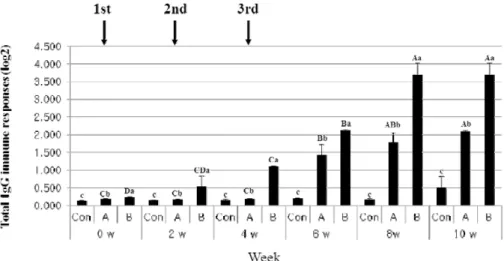
Fig. 1. Total IgG immune responses according to ghost strains via oral route of BALB/c. LPS and IgG conjugated with HRP was treated for 2 hr at room temperature by 2 ug/ml concentration and by 1:2,000 dilution, respectively. The treated solutions were measured at 405 nm by ELISA reader. X- and Y-axes indicate week post injection and immune response by log value, respectively. Con; oral administration by only PBS, A; ST χ8554 [pMMP184], B; ST χ8554 [pMMP184] +JOL389.

A-D

Values are significantly different (p<0.05) between the same sample treated groups.

a-c

Values are significantly different (p<0.05) in the same week from each other.

for four hours before administration of the ghost cells, and supplied at one hour after administration ad libitum. The vac- cinated mice were observed for 10 weeks post admin- istration. The peripheral blood and vaginal lavage or extract of feces to measure IgG and IgA amounts, respectively, were collected for 0 ~ 10 weeks from vaccinated mice by the ghost cells. The cytokines were measured from spleen harvested at 35 days post administration.

ELISA (Enzyme-linked immunosorbent assay) ELISA was performed according to method of Ha et al.

[6, 7]. LPS (0.2 mg/ml) was dissolved in 0.05 M carbonate buffer (pH 9.6), and then coated on microtiter plate for over- night at 4℃. The coating solution was removed from the treated microtiter plate (SPL) and washed 4~6 times with PBS buffer (pH 7.4). The treated plate was blocked for 1 hr at 37℃ by PBS buffer including 0.1% skim milk. The wells were reacted for 2 hr at 37℃ with plasma, fecal extract, and vaginal lavage solution diluted by serially ten folds. The re- actions were followed with goat anti-mouse IgG-, IgG1-, IgG2a-, and IgA-horseradish peroxidase (HRP)-conjugate (Southern Biotech) at 1:5,000 for 2 hr. The bound HRP was reacted for 10~90 min using 2,2'-azino-bis (3-ethylbenzthia- zoline-6-sulphonic acid) (ABTS, Sigma-Aldrich). Antibody titers were determined by 405 nm in wavelength with an ELISA reader (Dynex, USA) after the reaction was stopped with 0.1% SDS.

Protection of mice immunized with ST ghost cells against virulent ST

In order to examine protection against virulent ST to mice which immunized by the ST ghost cells, challenge test was performed as follows. The ghost cells carrying each antigen were administrated by oral route with 1×10

9

CFU/ml dose, and boosting was done by same dose after 2 weeks. The challenge test was performed by oral route with 1.2×10

6

CFU/ml dosage of ST χ3339 at 2 weeks post boosting ghost administration. Food and water was prohibited for four hours before administration of bacteria and supplied at one hour after administration ad libitum. The treated mice were observed for 4 weeks. The animal experiments adapted in this study were conducted under approval from the Gyeongnam National University of Science and Technology Animal Ethics Committee in accordance with the guidelines of the Korean Council on Animal Care (AEC-20100730-0002).

Statistics analysis

Individual comparisons among least squares means

(LSM) for significant differences were made according to the

multiple range test of Duncan. All analyses were performed

within the SAS statistical software package (version 9.1, SAS

Inst., Inc., USA), and differences were considered significant

at p<0.05.

(4)

Fig. 2. IgG1 immune responses according to ghost strains via oral route of BALB/c. LPS and IgG1 conjugated with HRP was treated for 2 hr at room temperature by 2 ug/ml concentration and by 1:2,000 dilution, respectively. The treated solutions were measured at 405 nm by ELISA reader. X- and Y-axes indicate week post injection and immune response by log value, respectively. Con; oral administration by only PBS, A; ST χ8554 [pMMP184], B; ST χ8554 [pMMP184] +JOL389.

A-C

Values are significantly different (p<0.05) between the same sample treated groups.

a-c

Values are significantly different (p<0.05) in the same week from each other.

Fig. 3. IgG2a immune responses according to ghost strains via oral route of BALB/c. LPS and IgG2a conjugated with HRP was treated for 2 hr at room temperature by 2 ug/ml concentration and by 1:2,000 dilution, respectively. The treated solutions were measured at 405 nm by ELISA reader. X- and Y-axes indicate week post injection and immune response by log value, respectively. Con; oral administration by only PBS, A; ST χ8554 [pMMP184], B; ST χ8554 [pMMP184] +JOL389.

A-B

Values are significantly different (p<0.05) between the same sample treated groups.

a-b

Values are significantly different (p<0.05) in the same week from each other.

Results and Discussion

Immune response of total IgG for a combined ST ghost vaccine

To construct a bacterial ghost vaccine, it is often applied by a system that combines bacteriophage lambda cI857 P

R

and ΦX174 E gene [21]. In this study, we induced the for- mation of ST ghost cells by using the cI857 P

R

::E system as previous study [6, 7, 21]. Otherwise, we constructed and ap-

plied pMMP184 through introduction of aspartate semi- aldehyde dehydrogenase (asd) gene used in the host-balanced lethal system [6, 7], instead of the antibiotic marker that was used for the selection of strains in previous studies [10, 14, 17].

Generally, since LT-B is evaluated to have an excellent

effect as an adjuvant, it has been used as an adjuvant for

immune enhancement of target animals [3, 11, 18]. On the

other hand, Bacterial ghost not only induces function of the

(5)

Fig. 4. Vaginal IgA immune responses according to ghost strains via oral route of BALB/c. LPS and IgA conjugated with HRP was treated for 2 hr at room temperature by 2 ug/ml concentration and by 1:2,000 dilution, respectively. The treated solutions were measured at 405 nm by ELISA reader. X- and Y-axes indicate week post injection and immune response by log value, respectively. Con; oral administration by only PBS, A; ST χ8554 [pMMP184], B; ST χ8554 [pMMP184] +JOL389.

A-C

Values are significantly different (p<0.05) between the same sample treated groups.

Fig. 5. Fecal IgA immune responses according to ghost strains via oral route of BALB/c. LPS and IgA conjugated with HRP was treated for 2 hr at room temperature by 2 ug/ml concentration and by 1:2,000 dilution, respectively. The treated solutions were measured at 405 nm by ELISA reader. X- and Y-axes indicate week post injection and immune response by log value, respectively. Con; oral administration by only PBS, A; ST χ8554 [pMMP184], B; ST χ8554 [pMMP184] +JOL389.

immune response, but also play a role as an adjuvant [19].

From previously studies of our laboratory, we revealed abil- ities of immune responses similar to LT-B in the case of ad- ministration of the combined ghost cells via intramuscular route, which the combined groups contain ST MMP13 [pMMP184], MMP13 [pMMP184]/MMP13 [pMMP300], χ 8554 [pMMP184], χ8554 [pMMP184]/χ8554 [pMMP300], χ 8554 [pMMP184]/χ3339, and χ8554 [pMMP184]/JOL389 [6, 7]. In the present study, a group of vaccines selected from intramuscular route of previous study was orally ad- ministered with and without ST JOL389 for analyzing the

immune responses. As a result, the immune response to the

total IgG of ST χ8554 [pMMP184]/JOL389 group from 2

weeks post-vaccination was detected as shown in Fig. 1. The

immune response in single ST χ8554 [pMMP184] group was

delayed up to 6 weeks post third administration. However,

the combined group was elicited at 2 weeks post primary

administration. At 10 weeks, as compared with the case of

using χ8554 [pMMP184], IgG immune response of ST χ8554

[pMMP184]/JOL389 was showed by value of 8 folds more

than that of ST χ8554 [pMMP184].

(6)

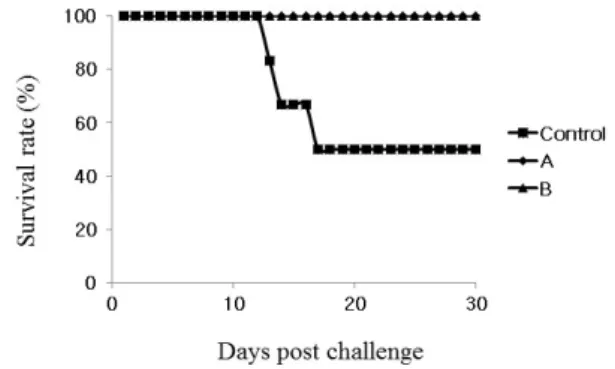
Fig. 6. Challenge test to BALB/c vaccinated via oral route ac- cording to ghost strains. The virulent ST χ3339 was or- ally administrated by 1.2×10

6

CFU at 2 weeks post twice administration by ghost strains. The challenged mice were observed for 4 weeks.

Immune responses of IgG subtypes and secretory IgA for the combined ghost vaccine

Productions of IgG1 and IgG2a subtypes of immun- oglobulin IgG are promoted by Th2 and Th1, respectively, which induce humoral and cell-mediated immune responses [4,5,16]. We analyzed the content of IgG1 and IgG2a to exam- ine the humoral and cell-mediated immune responses. As shown in Fig. 2, IgG1 was difficult of observing the specific difference between the two groups, but both groups were elevated the amount of IgG1 from 4 weeks post-vaccination.

The IgG2a was observed in the differential amount after 4, 6, and 10 weeks (Fig. 3). In comparison to the control group, vaginal sIgA was raised at 4-8 weeks post-vaccination (Fig.

4). ST χ8554 [pMMP184]/JOL389 group was detected gen- erally high amount of vaginal sIgA in comparison with the ST χ8554 [pMMP184] group. Although fecal sIgA was shown a little difference in 8 weeks, it is estimated that the detection of sIgA was not significant difference (Fig. 5).

A protective effect in mice vaccinated with ST ghost cells against virulent ST

To assess the protection for the mice immunized with the ghost cells against virulent ST, wild-type ST χ3339 (1.2×10

6

CFU), which is higher dose of 10-fold than that of LD50 [12, 13], was administered orally at 4 weeks post-immunization.

The results of challenge assay using ST χ3339 showed mor- tality of 50% in the control group, but ST χ8554 [pMMP184]

and χ8554 [pMMP184]/JOL389 groups exhibited a pro- tective effect of 100%(Fig. 6).

In summary, when the combined vaccine composed of ST χ8554 [pMMP184]/S. Typhimurium JOL389 was orally administered in mice, the ability of immune induction was

superior to a single group of ST χ8554 [pMMP184]. Further- more, the protection of mice against virulent S. Typhimu- rium χ3339 increased above 50% when compared with con- trol group. Therefore, we conclude that the vaccine is a pos- sible of application as a ST ghost vaccine

Acknowledgement

This research was supported by Gyeongnam National University of Science and Technology Grant 2014.

References

1. Bertani, G. 1951. Studies on lysogenesis. I. The mode of phage liberation by lysogenic Escherichia coli. J. Bacteriol. 62, 293-300.

2. Chaudhari, A. A., Jawale, C. V., Kim, S. W. and Lee, J. H.

2012. Construction of a Salmonella Gallinarum ghost as a novel inactivated vaccine candidate and its protective effi- cacy against fowl typhoid in chickens. Vet. Res. 43, 44-55.

3. Chaudhari, A. A. and Lee, J. H. 2013. Evaluation of the ad- juvant effect of Salmonella-based Escherichia coli heat-labile toxin B subunits on the efficacy of a live Salmonella-deliv- ered avian pathogenic Escherichia coli vaccine. Avian Pathol.

42, 365-372.

4. DeKruyff, R. H., Rizzo, L. V. and Umetsu, D. T. 1993. Induc- tion of immunoglobulin synthesis by CD4+ T cell clones.

Semin. Immunol. 5, 5421-5430.

5. Gor, D. O., Rose, N. R. and Greenspan, N. S. 2003. Th1-Th2:

a procrustean paradigm. Nat. Immunol. 4, 503-505.

6. Ha, Y. J., Kim, T. W., Kim, S. T., Kang. H. Y., Gal, S. W.

and Kim, S. W. 2014a. Ghost vaccine prepared from strong virulent Salmonella typhimurium does not improve im- mune responses of BALB/c mice. J. Life Sci. 24, 39-45.

7. Ha, Y. J., Kim, S. T., Kang. H. Y., Gal, S. W. and Kim, S.

W. 2014b. The complex Salmonella typhimurium ghost cells play an additional role as an immune adjuvant. J. Life Sci.

24, 154-160.

8. Jalava, K., Hensel, A., Szostak, M., Resch, S. and Lubitz, W. 2002. Bacterial ghosts as vaccine candidates for veteri- nary applications. J. Control. Release 85, 17-25.

9. Jawale, C. V., Chaudhari, A. A., Jeon, B. W., Nandre, R.

M. and Lee, J. H. 2012. Characterization of a novel in- activated Salmonella enterica serovar Enteritidis vaccine can- didate generated using a modified cI857/λ PR/gene E ex- pression system. Infect. Immun. 80, 1502-1509.

10. Jechlinger, W., Haller, C., Resch, S., Hofmann, A., Szostak, M. P. and Lubitz, W. 2005. Comparative immunogenicity of the hepatitis B virus core 149 antigen displayed on the inner and outer membrane of bacterial ghosts. Vaccine 23, 3609-3617.

11. Jeon, B. W., Nandre, R. M. and Lee, J. H. 2013. Oral immuni-

zation with an attenuated Salmonella Gallinarum mutant as

(7)

초록:복합 살모넬라 타이피무리움 고스트 백신의 마우스 구강 투여에 의한 면역 응답

김판길

․하연조

․이수만․김삼웅*․갈상완*

(경남과학기술대학교 제약공학과)

살모넬라 타이피무리움 JOL389와 χ3339는 마우스에 강한 독력을 가진 균주들이며, χ8554는 χ3339로부터 유도 되었다. 고스트 카세트를 운반하는 플라스미드 pMMP184가 제조된 후에, BALB/c 마우스의 구강 경로를 경유하 여 투여되었다. 총 IgG의 함량 변화는 χ8554 고스트 세포의 부스팅으로 발현 함량이 낮게 나타났지만, 3차 접종의 2주 경과 후, 6주차에서 증가되는 양상을 보였다. 그러나, 혼합 백신 그룹인 JOL389/χ8554 그룹에서는 총 IgG의 함량이 일차 접종 후 2주차부터 상승되는 경향을 보였고, 추가접종이 진행되므로써 많은 상승 폭을 나타내었다.

총 IgG의 함량은 백신 접종 후 10주차에서 χ8554그룹에 비교하여 JOL389/χ8554은 8배 이상 높은 것으로 관찰되 었다. IgG1, IgG2a, 분비IgA의 함량은 백신화 후 4주차에서 상승되었다. 독력 살모넬라 타이피무리움 χ3339로 도 전실험결과, χ8554 [pMMP184]과 χ8554 [pMMP184]/JOL389은 대조구에 비교하여 50% 이상의 보호효과가 관찰 되었다. 이들 결과는 χ8554 [pMMP184]/JOL389은 χ8554 [pMMP184]보다 더 높은 면역 응답을 유도하는 것이 가능한 것으로 추정된다.

a fowl typhoid vaccine with a live adjuvant strain secreting the B subunit of Escherichia coli heat-labile enterotoxin. BMC Vet. Res. 6, 96-104.

12. Kim, S. W., Kang, H. Y., Hur, J., Gal, S. W., Bang, W. Y., Cho, K. K., Kim, C. W., Bahk, J. D. and Lee, J. H. 2011.

Construction of a conditional lethal Salmonella mutant via genetic recombination using the ara system and asd gene.

J. Microbiol. Methods 87, 202-207.

13. Kim, S. W., Moon, K. H., Baik, H. S., Kang, H. Y., Kim, S. K., Bahk, J. D., Hur, J. and Lee, J. H. 2009. Changes of physiological and biochemical properties of Salmonella enter- ica serovar Typhimurium by deletion of cpxR and lon genes using allelic exchange method. J. Microbiol. Methods 79, 314-320.

14. Kwon, S. R., Nam, Y. K., Kim, S. K. and Kim, K. H. 2006.

Protection of tilapia (Oreochromis mosambicus) from edward- siellosis by vaccination with Edwardsiella tarda ghosts. Fish Shellfish Immunol. 20, 621-626.

15. Langemann, T., Koller, V. J., Muhammad, A., Kudela, P., Mayr, U. B. and Lubitz, W. 2010. The Bacterial Ghost plat- form system: production and applications. Bioeng. Bugs. 1, 326-336.

16. Li, Y., Wang, S., Xin, W., Scarpellini, G., Shi, Z., Gunn, B., Roland, K. L. and Curtiss, R. 3rd. 2008. A sopB deletion mu-

tation enhances the immunogenicity and protective efficacy of a heterologous antigen delivered by live attenuated Salmonella enterica vaccines. Infect. Immun. 76, 5238-5246.

17. Mayr, U. B., Haller, C., Haidinger, W., Atrasheuskaya, A., Bukin, E., Lubitz, W. and Ignatyev, G. 2005. Bacterial ghosts as an oral vaccine: a single dose of Escherichia coli O157:H7 bacterial ghosts protects mice against lethal challenge. Infect.

Immun. 73, 4810-4817.

18. Nandre, R. M., Jawale, C. V. and Lee, J. H. 2013. Enhanced protective immune responses against Salmonella Enteritidis infection by Salmonella secreting an Escherichia coli heat-la- bile enterotoxin B subunit protein. Comp. Immunol. Microbiol.

Infect. Dis. 36, 537-548.

19. Riedmann, E. M., Kyd, J. M., Cripps, A. W. and Lubitz, W.

2007. Bacterial ghosts as adjuvant particles. Expert. Rev.

Vaccines 6, 241-253.

20. Sambrook, J., Fritsch, E. F. and Maniatis, T. 1989. Molecular Cloning, A Laboratory Manual. 2nd Ed., Cold Spring Harbor Laboratory. Press, Cold Spring Harbor, NY.

21. Tabrizi, C. A., Walcher, P., Mayr, U. B., Stiedl, T., Binder,

M., McGrath, J. and Lubitz, W. 2004. Bacterial ghosts-bio-

logical particles as delivery systems for antigens, nucleic

acids and drugs. Curr. Opin. Biotechnol. 15, 530-537.

수치

Table  1.  Bacterial  strains  and  plasmids  used  in  this  study
Fig.  1.  Total  IgG  immune  responses  according  to  ghost  strains  via  oral  route  of  BALB/c
Fig.  2.  IgG1  immune  responses  according  to  ghost  strains  via  oral  route  of  BALB/c
Fig.  5.  Fecal  IgA  immune  responses  according  to  ghost  strains  via  oral  route  of  BALB/c
+2

참조

관련 문서