• 검색 결과가 없습니다.

A study on the Structural Equation Modeling of Interpersonal problem, Stress coping strategy, Mental health of University students at risk of Smartphone addiction

N/A
N/A
Protected

Academic year: 2021

Share "A study on the Structural Equation Modeling of Interpersonal problem, Stress coping strategy, Mental health of University students at risk of Smartphone addiction"

Copied!
7
0
0

로드 중.... (전체 텍스트 보기)

전체 글

(1)

1. Introduction

University students are the single largest user group of smartphones, with 99% of Korean university students owning a smartphone. According to a 2016 Korean study, 31% of university students used smartphones excessively, higher than middle school

students at 5% and high school students at 29%; it is also reported that 76% of university students experience a type of withdrawal when they are unable to use their smartphones, experiencing anxiety and frustration. As such, it is important to seek an effective approach to assist in the healthy smartphone use of

A study on the Structural Equation Modeling of Interpersonal problem, Stress coping strategy, Mental health of University students

at risk of Smartphone addiction

Yu-ri Lee

1

, Jeong-Sook Park

2*

1

Professor, Dept. of Social Welfare, Nambu University

2

Professor, Dept. of Nursing, Nambu University

스마트폰중독 위험군 대학생의 대인관계문제, 스트레스 대처방식, 정신건강의 구조모형분석

이유리1, 박정숙2*

1남부대학교 사회복지학과 교수, 2남부대학교 간호학과 교수

Abstract This study aimed to analyze the relationship between interpersonal problem, stress coping strategies and mental health for university students at risk of smartphone addiction using a structural equation modeling. Key results of the analysis were as follows. The interpersonal problem increased the severity of mental health. Stress coping strategies had partial mediating effects in the relationship between interpersonal problem and mental health. Passive coping strategy was risk factor and Active coping strategy was protective factor. Based on these results, various interventions for improving mental health for university students at risk of smartphone addiction were suggested.

Key Words : University students at risk of smartphone addiction, Interpersonal problem, Stress coping strategies, Mental health, Structural equation modeling

요 약 본 연구의 목적은 구조방정식모형을 활용하여 스마트폰중독 위험군 대학생의 대인관계문제, 스트레스대처방식, 정신건강의 관계를 분석하는 것이다. 연구 결과, 대인관계문제는 정신건강의 심각성을 악화시키는 직접적 영향력을 미치는 것으로 나타났다. 스트레스대처전략은 대인관계문제와 정신건강 사이의 영향관계에서 부분 매개효과를 갖는 것으로 나타 났고, 소극적 대처는 위험요인, 적극적 대처는 보호요인으로 분석되었다. 이러한 결과를 바탕으로 스마트폰중독 위험군 대 학생의 정신건강 증진을 위한 다양한 실천적·정책적 개입전략을 제시하였다.

주제어 : 스마트폰고위험군 대학생, 대인관계문제, 스트레스대처방식, 정신건강, 구조모형분석

*Corresponding Author : Jeong-Sook Park([email protected]) Received December 31, 2018

Accepted February 20, 2019

Revised January 30, 2019 Published February 28, 2019
(2)

university students, who constitute a high-risk group for smartphone addiction[1,2]. It was reported that 40.2% of Korean university students experienced depression, as well as high levels of social anxiety;

excessive smartphone has been reported to be associated with these mental health problems[3,4].

A quintessential problem that arises from tendencies of excessive smartphone use and smartphone addiction is the interpersonal problem. It has a negative influence on sociability, causing a low degree of interpersonal satisfaction, leading to selective relationships, avoidance of interpersonal conflicts and real-life conversations with acquaintances and resulting in stronger feelings of alienation[5,6]. Ultimately, the interpersonal problems of smartphone addicts induce depression and loneliness, and has a negative effect on mental health[5,7,8].

Moreover, this study focuses on stress coping strategies in the process of worsening mental health in smartphone addiction risk group, caused by interpersonal problems[9]. Stress coping strategies are defined as efforts to escape stress[10]. They are classified into active coping strategies, involving attempts to actively overcoming frustration or inhibiting factors in situations involving stress, and passive coping strategies, where one focuses one’s emotions or thinking to avoid, or defend against issues[11,12]. Existing studies on smartphone addiction for university students indicated that lower levels of active coping strategies that focus on problem solving led to positive correlations with smartphone addiction, and higher levels of passive coping strategies, which are passive and has an emotive orientation, was found to have a positive correlation with smartphone addiction, and increased depression or anxiety[13-15].

The existing research leads to the theoretical foundation of stress coping strategies having a mediating effect in the relationship between interpersonal problems and mental health[16, 17].

Analysis in previous studies were limited as they focused on the linear relationship between the factors

influencing smartphone addiction in university students and mental health. This study aims to utilize structural equation modeling to analyze the relationship between interpersonal problems, stress coping strategies and mental health of university students who are at risk of smartphone addiction; this study will also analyze in depth which stress coping strategies act as risk factors or protective factors. Through such analysis, this study aims to provide useful and practical implications for intervening for university students at risk of smartphone addiction, and provide basic data for strategies differentiated by the severity of addiction.

2. Research Method

2.1 Participants

The present study was carried out after receiving approval from the IRB of N University. The subjects of this study included university students in Gwangju, Jeonnam area. A total of 500 questionnaires were collected from September to November of 2017 and 490 students were used in the smartphone addiction diagnosis, which was excluding 10 questionnaires that contained undependable responses. Based on the smartphone addiction self-diagnosis scale[18], the total score of origin score is 45 points or more, the daily life disability factor is 16 points or more, the withdrawal factor is 13 points or more and the tolerance factor is 14 points or more were classified as high risk group.

And the total score of origin score is 42-22 points, the

daily life disability factor is 14-15 points, the

withdrawal factor is 12 points and the tolerance factor

is 13 points were classified as potential risk group. Of

the 490 students, 55 students were in the high risk

group and 126 students were in the potential risk

group. In this study, those two groups were defined as

the risk group and 181 questionnaires were finally used

for analysis. Male students were 63(34.8%) and female

students were 118(65.2%). The average age of 118

students was 20.8 years(±1.23).

(3)

2.2 Measures

2.2.1 Interpersonal problem

Interpersonal problem was measured using the Short form of the Korean Inventory of interpersonal Problems Circumplex Sacle, which developed by Horowitz et al[19] and validated by Hong et al[20]. This scale consists of 40 items which is categorized as eight sub-factors: assured-dominant, arrogant-calculating, cold-hearted, aloof-introverted, unassured-submissive, unassuming-ingenuous, warm-agreeable and gregarious-extroverted. Respondents were asked to rate the items on a five-point Likert scale, ranging from 1 to 5, with higher scores indicating greater interpersoanl problem. The reliability of the scale was Cronbach's α = 0.920.

2.2.2 Stress coping strategies

Parenting stress was measured using the Stress Coping Scale, which developed by Lazarus &

Folkman[11] and validated by Kim[21]. It consists of active coping(problem-oriented coping, social support seeking) and passive coping(avoiding coping, hopeful thinking).

In the research, out of the twenty four items from the original study, six items that satisfied the criteria of factor analyses[22] were used to measure parenting stress. The respondents were asked to rate the items on a five-point Likert scale, ranging from 1 to 5, with higher scores indicating greater coping tendency. The scale's reliability was Cronbach's α = 0.782.

2.2.3 Mental health

Mental health was measured using the Hospital Anxiety and Depression Scale, which developed by Zigmund & Snaith[23] and validated by Oh et al[24].

This scale consists of 14 items which is categorized as two sub-factors: anxiety and depression. Respondents were asked to rate the items on a four-point Likert scale, ranging from 0 to 3, with higher scores indicating greater anxiety and depression. The reliability of the scale was Cronbach's α = 0.845.

2.3 Statistical Analysis

To analyze the data for this research, SPSS 20.0 and AMOS 20.0 were used. Exploratory and confirmatory factor analyses were conducted. To measure the scales' reliability, Cronbach's α values were consequently produced. Descriptive statistics, such as frequencies, means, standard deviations, and normality analyses, were also derived. To assess the goodness of fit, indices such as χ

2

, comparative fit index (CFI), Tucker Lewis index (TLI), and Root mean square error of approximation (RMSEA) were used.

3. Results

3.1 Descriptive Statistics

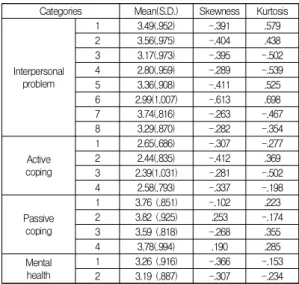
In structural equation modeling(SEM), if measurement variables do not have normal distributions, the assumptions of multivariate normal distributions are not met. The wrong estimates produced prevent proper statistical testing. Considering the conditions of normal distribution (skewness lower than 2, kurtosis lower than 7) in SEM[25], the chosen variables were proven to meet the basic requirement levels.

Table 1. Descriptive Statistics

Categories Mean(S.D.) Skewness Kurtosis

Interpersonal problem

1 3.49(.952) -.391 .579

2 3.56(.975) -.404 .438

3 3.17(.973) -.395 -.502

4 2.80(.959) -.289 -.539

5 3.36(.908) -.411 .525

6 2.99(1.007) -.613 .698

7 3.74(.816) -.263 -.467

8 3.29(.870) -.282 -.354

Active coping

1 2.65(.686) -.307 -.277

2 2.44(.835) -.412 .369

3 2.39(1.031) -.281 -.502

4 2.58(.793) -.337 -.198

Passive coping

1 3.76 (.851) -.102 .223

2 3.82 (.925) .253 -.174

3 3.59 (.818) -.268 .355

4 3.78(.994) .190 .285

Mental health

1 3.26 (.916) -.366 -.153

2 3.19 (.887) -.307 -.234

(4)

3.2 Analysis of Study Model

In the research, we tested goodness of fit based on CFI, TLI, and RMSEA, which are not sensitive to sample size and have established evaluation criteria that consider simplicity[26]. The goodness of fit of the study model was satisfactory for all indices, except for χ

2

.

3.2.1 Direct Effect Analysis

The results indicated that interpersonal problem had a significant direct effect on active coping(t=-2.251, p<.05), passive coping(t=2.986, p<.001), and mental health(t=3.136, p<.001).

Active coping had a significant direct effect on mental health(t=-2.837, p<.01), and passive coping had a significant direct effect on mental health(t=4.632, p<.001) Table 2

Table 2. Estimates & Goodness-of-fit Index

* p<.05, ** p<.01, *** p<.001

3.2.2 Indirect Effect Analysis

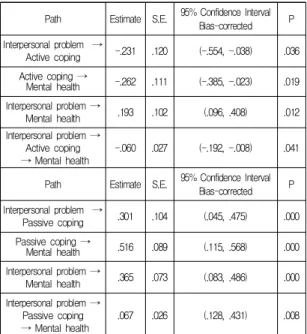
Significance testing on indirect effects was analyzed using the bootstrapping method. The analysis on the mediating effects shows that the partial mediating effect of active coping(β = -.060, p = .041) and passive coping(β = .067, p = .008) were significant Table 3

Table 3. Analysis of Mediating Effect

Path Estimate S.E. 95% Confidence Interval Bias-corrected P Interpersonal problem →

Active coping -.231 .120 (-.554, -.038) .036 Active coping →

Mental health -.262 .111 (-.385, -.023) .019 Interpersonal problem →

Mental health .193 .102 (.096, .408) .012

Interpersonal problem → Active coping

→ Mental health

-.060 .027 (-.192, -.008) .041

Path Estimate S.E. 95% Confidence Interval Bias-corrected P Interpersonal problem →

Passive coping .301 .104 (.045, .475) .000

Passive coping →

Mental health .516 .089 (.115, .568) .000

Interpersonal problem →

Mental health .365 .073 (.083, .486) .000

Interpersonal problem → Passive coping

→ Mental health

.067 .026 (.128, .431) .008

4. Conclusion and Discussion

Purpose of this study is to analyze the relationship between interpersonal problem, stress coping strategies and mental health for university students at high risk

Path Estimates

S.E. C.R.

B β

Interpersonal problem → Active coping -.235 -.214 .103 -2.251

* Active coping → Mental health -.282 -.257 .085 -2.837

**

Interpersonal problem → Mental health .399 .308 .071 3.136

***

Interpersonal problem → Passive coping .296 .273 .056 2.986

***

Passive coping → Mental health .548 .492 .030 4.632

***

Interpersonal problem → Interpersonal

problem 1 1.000 .571 Interpersonal problem → Interpersonal

problem 2 1.007 .587 .112 6.633

***

Interpersonal problem → Interpersonal

problem 3 .787 .498 .096 6.004

***

Interpersonal problem → Interpersonal

problem 4 .613 .385 .092 4.995

***

Interpersonal problem → Interpersonal

problem 5 .929 .570 .125 6.594

***

Interpersonal problem → Interpersonal

problem 6 .697 .426 .115 5.583

***

Interpersonal problem → Interpersonal

problem 7 1.183 .725 .142 8.341

***

Interpersonal problem → Interpersonal

problem 8 .813 .546 .108 6.236

***

Active coping → Active coping 1 1.000 .596

Active coping → Active coping 2 .973 .548 .068 7.075

***

Actve coping → Active coping 3 .882 .493 .051 6.748

***

Actve coping → Active coping 4 1.069 .626 .134 7.951

***

Passive coping → Passive coping 1 1.000 .539

Passive coping → Passive coping 2 1.123 .696 .044 8.153

***

Passive coping → Passive coping 3 .916 .501 .072 6.827

***

Passive coping → Passive coping 4 .853 .489 .085 6.669

***

Mental health → Depression 1.000 .675

Mental health → Anxiety .818 .480 .089 6.413

***

Model fit χ2 p df CFI TLI RMSEA

353.284 .000 130 .923 .901 .042

(5)

of smartphone addiction using a structural equation model, and to identify which stress coping strategies act as risk factors and protective factors in mental health. The results of the study can be concluded as follows.

First, the interpersonal problem of university students with high risk of smartphone addiction increased the severity of mental health. These results support the findings of existing literature[5, 7, 8], which state that mental health may worsen when interpersonal relationships are ineffective. These results suggest that groups at high risk of smartphone addiction generally have lower quality of interpersonal relationships, thereby leading to higher severity of depression and anxiety.

Second, passive coping strategies were found to have a partial mediating effect in the relationship between interpersonal problem and mental health.

These results are also consistent with previous research that report[12, 13] that passive coping strategies, such as avoiding stress inducing factors or wishful thinking, are risk factors that worsen mental health at high risk groups of smartphone addiction.

Third, active coping strategies were found to have a partial mediating effect in the relationship between interpersonal problem and mental health. These results suggest that active coping strategies are protective factors that relieve the severity of mental health at high risk groups of smartphone addiction. These results support research results[14] that suggest when university students, experiencing stress in interpersonal relationships, utilize realistic and problem solving-focused strategies, they experience improved mental health.

Based on the findings of this study, this study proposes the following recommendations.

First, as it was confirmed that university students at high risk of smartphone addiction and experiencing difficulties in interpersonal relationships may be at risk of higher depression and anxiety, it is important to provide an environment based on support within the

colleges and expand operations of group therapy with mentoring program in order to prevent difficulties in a diverse range of interpersonal relationships.

Second, it is important to provide stress coping training to confirm the level of stress and the types of coping strategies used, reduce passive coping strategies as they are risk factors and increase active coping strategies as protective factors; these efforts aim to reduce the depression and anxiety with university students at high risk of smartphone addiction and with high levels of interpersonal problems. To achieve this, it is proposed that a group program be carried out to instill appropriate stress coping strategies for the high-risk group, forming an intervention manual to improve on problem solving and reduce evasive responses.

Third, it is important to continue the efforts of identifying university students at high risk of smartphone addiction, with the counseling center at the core of such efforts. As shown in this study, lower levels of interpersonal relationships, passive coping strategies and deteriorated mental health may result from smartphone addiction; as such, this study proposes the identification of normal, potential and high-risk groups and differentiating intervention strategies depending on the severity of the addiction.

And it is necessary to carry out "outreach consultation" in connection with the university at the Addiction Management Center.

Lastly, this study has limitations in generalizing its

results to the overall population as the participants of

this study were university students in a specific region

who agreed to the research objectives and voluntarily

participated in the study. For follow-on research, this

study proposes the expansion of research methodology

through systematic studies with national-level samples

and the analysis of causal relationships through

longitudinal studies. And psychological characteristics

of the high-risk group of smartphone addiction should

be studied by expanding the study subjects to other

ages (elementary, middle, and high school students).

(6)

REFERENCES

[1] National Information Society Agency. (2016). The Survey for the status of mobile phone addiction, National Information Society Agency, Daegu.

[2] H. S. An.(2017). The effects of personal, environmental, smartphone characteristics factors on the smartphone addiction degrees and daily life of university students, The Journal of Digital Convergence, 15(6): 39-50.

[3] H. S. Jeon. & S. O. Jang. (2014). A Study on the Influence of Depression and Stress on Smartphone addiction among University Students: focused on Moderating Effect of Gender, Korean Journal of Youth Studies, 21(8): 103-129.

[4] H. J. Kim, E. & H. Kim. (2016). The relationship between anxious attachment and smartphone addiction:

The mediating effects of loneliness and college adjustment, Korean Journal of Counseling, 17(2):

157-179.

[5] H. S. Choi, H. K. Lee, J. C. Ha. (2012). The influence of smartphone addiction on mental health, campus life and personal relations -Focusing on K university students, Journal of the Korean Data & Information Science Society, 23(5): .1005-1015.

[6] O. S. Lee & M. J. Kim(2017). The relationship among smartphone addiction, emotional intelligence, critical thinking disposition and communication skill for nursing students, The Journal of Digital Convergence, 15(7):

319-328.

[7] Meena, P. S., Soni, R., Jain, M., Paliwal, S. (2015). Social networking sites addiction and associated psychological problems among young adults: a study from North India, Sri Lanka Journal of Psychiatry, 6(1): 14-16.

[8] Donelly, E. & Kuss, D. J. (2016). Depression among users of social networking sites(SNSs): the role of SNS addiction and increased usage, Journal of Addiction and Preventive Medicine, 1(2): 107

[9] T. E. Choi. & Y. R. Lee. (2015). Latent means analysis among stress of college life, avoidance-oriented coping and mental health according to gender, Journal of Future Social Work Research, 6(2): 63-88.

[10] Coffman. L. I. & Gilligan, T. D. (2002). Social support, stress and self-efficacy: Effect on student’s satisfacation. Journal of College Student Retention, 4(1): 53-66.

[11] Lazarus, R. S. & Folkman, S. (1984). Stress appraisal and coping. New York: Springer.

[12] D. H. Kim. (2016). The Moderating Effects of the Way

of Coping in between Perceived Stress and Smartphone Use in Adolescent, Korean Journal of Stress Research, 24(2): 57-64.

[13] Y. M. Kim. (2015). Impact of parent-child relationship and stress-coping on smartphone addiction in adolescents: mediating effects of self-control, Korean journal of local government and administration studies 29(1): 223-242.

[14] W. O. Oh & H. J. Shin. (2016). Impact of depression, ego-resilience, and active stress coping on internet addiction tendency among college students, Journal of Korean Public Health Nursing, 30(1): 56-69.

[15] Y. M. Baek. (2017). A Study on sense of self-efficacy and stress encountering strategy of smartphone addicted university students, Journal of the Korea Society of Digital Industry and Information Management, 13(1):

173-183.

[16] H. J. Jang. & Y. K. Kwag. (2015). Comparison of factors associated with smartphone overuse: focusing on self-control, mental health and interrelationship, Journal of the Korean Academia-Industrial cooperation Society, 6(1): 146~154.

[17] S. J. Gong. & E. H. Lee. (2006). Mediation Effect of Coping Between Life Stress and Depression in Female College Students, The Korean Journal of Woman Psychology, 11(1): 21-40.

[18] National Information Society Agency. (2011).

Development of Korean Smartphone Addiction Proneness Scale for Youth and Adults, National Information Society Agency, Daegu.

[19] Horowitz, L. M., Rosenberg, S. E., Baer, B. A., Ureno, G.,

& Villasenor, V. S. (1988). Inventory of Interpersonal Problems: Psychometric properties and clinical applications, Journal of Consulting and Clinical Psychology, 56(1): .885-892.

[20] S. H. Hong, E. Y. Park, Y. H. Kim, J. H. Kwan, Y. R.

Cho, Y. K. Jin. (2002). Short form of the Korean Inventory of Interpersonal Problems Circumplex scales(KIIP-SC),  Korean Journal of Clinical Psychology, 21(4): 923-940.

[21] J. H. Kim. (1995). Relationship of the stress appraisal and coping strategies with emotional experiences, The Korean Journal of Counseling and Psychotherapy, 7(1):

44-69.

[22] Mahmut, M. K. & Menictas, C. (2011). Validating the factor structure of the self-report psychopathy scale in a community sample, Psychological Assessment, 23(3):

670-678.

(7)

[23] Zigmond A. S. & Snaith R. P.(1983). The hospital anxiety and depression scale, Acta Psychiatrica Scandinavica, 67(1): 361-370.

[24] Oh S. M. , Min K. J., Park D. B.(1999). A study on the standardization of the hospital anxiety and depression scale for Koreans: A comparison of normal, depressed and anxious groups, Journal of Korean Neuropsychiatric Association, 38(1): 289-296.

[25] Curran, P. J. et al. (1996). The robustness of test statistics to non-normality and specification error in confirmatory factor analysis, Psychological Methods, 1(1): 16-29.

[26] S. H. Hong. (2000). The Criteria for Selecting Appropriate Fit Indices in Structural Equation Modeling and Their Rationales, The Korean Journal of Clinical Psychology, 19(1): 161-177.

이 유 리(Lee, Yu Ri) [정회원]

․1998년 2월 : 이화여자대학교 사 회복지학과(문학사)

․2001년 2월 : 이화여자대학교 사 회복지학과(문학석사)

․2008년 2월 : 이화여자대학교 사 회복지학과(문학박사)

․2010년 3월 ~ 현재 : 남부대학교 사회복지학과 교수

․관심분야 : 정신보건사회복지, 아동청소년정신건강

․E-Mail : [email protected]

박 정 숙(Park, jeong-sook) [정회원]

․1996년 2월 : 원광대학교 약학과 (약학석사)

․2002년 2월 : 원광대학교 약학과 (약학박사)

․2006년 3월 : 남부대학교 대체학 과교수

․2014년 9월 ~ 현재 : 남부대학교 간호학과교수

․관심분야 : 생약학, 대체의학

․E-Mail : [email protected]

수치

Table  1.  Descriptive  Statistics
Table  3.  Analysis  of  Mediating  Effect

참조

관련 문서