접수일자: 2013년 9월 1일 심사(수정)일자: 2013년 9월 7일 게재확정일자 : 2013년 11월 22일
†Corresponding author : [email protected]
본 논문은 2013년 해양수산부 재원으로 한국해양과학기술진흥원의 지원을 받아 수행된 연구임(지능형 해양사고 예방 및 구난기술 개발).
This is an Open-Access article distributed under the terms of the Creative Commons Attribution Non-Commercial License (http://creativecommons.org/licenses/by-nc/3.0) which permits unrestricted non-commercial use, distribution, and reproduction in any medium, provided the original work is properly cited.
State-of-the-art IVEF Service based on e-Navigation System
Bayarmaa Oyunchimeg, Jung Sik Jeong
†, and Gyei-Kark Park Department of Maritime Electronic & Communication Engineering, Mokpo National Maritime University, Mokpo, Jeonnam, 530-729, Korea
Abstract
In this paper, the state-of-the-art IVEF Service based on e-Navigation System was represented. The unification of the data exchange format among maritime-related systems is one of vital user-needs of e-Navigation, advantageous in bringing maritime safety and security. This paper propose the method to exchange marine information in IVEF, as recommended by the IALA, between VTS centers and Korea’s GICOMS as well as the government-related agencies.
To achieve this, a system data flow was designed which it acts as client and server. It enables the sending and re- ceiving of Radar and CCTV images in accordance with the IVEF recommendation document of IALA.
Key Words : VTS, VTSO, Maritime Accident, Maritime Safety, CWA
1. Instruction
The VTS(Vessel Traffic Service) is a shore-side system which delivers all relevant safe related mes- sages to ships, such as position of other traffic or meterological hazard warnings, and manages vessel traffic within a port or a waterway. Following the lo- cal regulations of an authority, ships entering into the portway report to their related VTS, usually by radio, and may be tracked by the VTS control centre.
Mariners must keep sharp lookout under all the navi- gational situations or any other warnings, while they may be directed by the VTS operator if there is a risk of incident. The VTS is regarded as the service implemented by a competent authority, and then de- signed to improve the safety and efficiency of navi- gation, safety of life at sea and the protection of the maritime environments. The VTS is governed by SOLAS(International Convention on the Safety of Life At Sea) Regulation 12 and also Guidelines for Vessel Traffic Services which was adopted by the International Maritime Organization (IMO)[1]. In
Korea, there are 15 VTS Centers to date that covers almost the whole boundaries of the state [2]. Korea government has also operated its own GICOMS(General Information Center on Maritime Safety) that enables a national VMS(Vessel Monitoring System) as well as the exchange of all the vessels information with VTS Centers including Korea Coast Guard.
The IVEF has been introduced by IALA as a recom- mendation in response to the e-Navigation strategy for harmonization of data exchange between shore-based stations, i.e., VTSs and all relevant shore-based sys- tems[3]. Taking into considerations of the objectives of e-Navigation that harmonizes the data exchange format between maritime stakeholders and offers various mar- itime services for maritime safety, it is clear that the information exchange by the IVEF should be regarded as one of important functions of the VTS.
Regardless of importance for information exchange by the IVEF, however, there have not been any re- searches for VTS information exchange based on the IVEF.
This paper proposes the method of information ex-
change based on the IVEF among VTSs in Korea. As a
client and server-based system, the IVEF client makes
a connection to the server by logging-in, running the
IVEF service and then receives traffic image data at a
client request in the VTS. The data requested for in-
formation exchange depends upon the client’s prefer-
ence, such as area of interest, transmit interval, and
type of data. Any IVEF service has a Basic IVEF
Services (BIS). The particular characteristics of the BIS
is that it is only rendered on request of another client,
i.e., a VTS Center, or external agencies[4].
2. The Basic IVEF services
2.1 Concept of IVEF
The IALA recommends the method to design data exchange based on IALA’s format, and then to stand- ardize data exchange and improve situation awareness by system operaters in coastal areas[3]. The IVEF Service is intended to provide a common framework for exchange of vessel traffic image data between shore-based e-Navigation systems, such as VTS sys- tems and all relevant stakeholders.
As a client/server-based system, the IVEF client makes a connection to the server by logging-in to the target server. The server will then validate the account of the requesting client. If the account is valid, the server will then run the IVEF service and return traffic images according to the requesting client’s preferences – area of interest, receiving frequency and type of data. In case the requesting client has not yet con- figured its preferences, the IVEF system shall be al- lowed to input desired areas, receiving frequency and type of data.[5]
2.2 The IVEF services for VTSs and GICOMS Since 1993, the MOF(Ministry of Oceans and Fisheries) of Korea has operated 15 VTSs, which in- stalled along Korean coastal line. The VTS is to im- prove the safety and efficiency of navigation, safety of life at sea and the protection of the marine environment and/or the adjacent shore area, worksites and offshore installations from possible adverse effects of marine traffic. In addition to the VTSs, the MOF has also in- stalled the General Information Center on the Maritime Safety and Security(GICOMS) to manage a national maritime crisis, to prevent maritime accidents, and to respond swifely for the accidents within the jurisdiction of the state. The GICOMS also monitors and protects all Korean flagged vessels in the world.
In fact, the VTS could have a two-way send/receive capability provided that each has an IVEF system com- posed of user client, network-enabled workstation and database storage. Currently, the GICOMS does not pro- vide data back to VTS, rather relays data to the other stakeholders, such as the other related ministry, navy, coast guard, fisheries, ship owners, etc.[6]
Fig. 1. The IVEF Services in operation
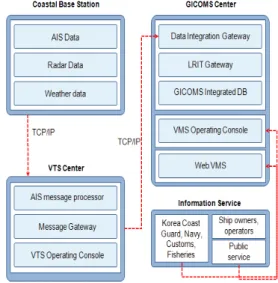
Fig. 1 shows a conceptual configuration for in- formation exchange among VTS Centers and other stakeholders. The VTS centers locally and regionally may share the information regarding ship movements in the area of interest. The data to be exchanged among VTS centers, and between the VTS and the GICOMS center, should be synchronized through interface router by which is inter-connected to both. The TCP/IP pro- tocol is used for data exchange. The GICOMS center has its integrated database, wherein all ship track in- formation is being stored. This integrated database is accessible by authorized agencies and/or users through a common type of gateway, e.g, coast guard, navy, fisheries so on. Fig. 2 shows the GICOMS data ex- change structure.
Fig. 2. GICOMS data exchange structure However, the data to be exchanged between the VTS center and the GICOMS center is obtained from AIS and Radar. It means that all the IVEF data for the VTS center can be transmitted to the GICOMS center.
GICOMS basically provides information to its users through web access. The information received and transmitted by GICOMS Center is acquired through its coastal base stations that are installed the Korean coastal line, as shown in Fig. 2.
The information includes all the data from AIS, Radar, and CCTV. Radar and CCTV images are very useful information for government agencies. It should be noted that it is possible of system operators to be able to acquire from AIS, Radar, and also CCTV which are installed the VTS centers, in term of maritime do- main awareness in Korean coast. The VTS system consists of AIS data processor or router device which filters duplicate and invalid data from AIS base station.
The AIS data router in GICOMS then receives the data
based on TCP/IP from VTS Centers, filtering duplicate
and invalid data acquired from the VTS. All the data
for vessels can be exchanged among VTSs and be-
IVEF Extended NMEA0183 Network
Protocol TCP/IP TCP/IP
Image
transfer Possible Not currently possible Network
transfer XML file Direct
message
Network message protocol
Message Identifier (Header) + Control
Information (XML filename)/Image data (seeSection3.5)
Message ID, etc. (Header) +
Data (IEC 61993-2) + Footer (checksum)
$SND6,VTS1006,4403305,
P,0,20110518114952|!AIVDM,1,1,,B,16SWNe?00093OSv EG=mP00w<2HFa,0*76'$SND6,VTS1006,4403305,P,0,2 0110518114952' is the header part of the message, while the remaining parts on such message is based on NMEA0183, by which it includes IEC 61993-2 part ('16SWNe?00093OSvEG=mP00w<2HFa').
tween the VTS and the GICOMS by the basic IVEF services. Fig. 3 shows the configuration for the IVEF services.[7]
Fig. 3. Configuration for IVEF services
3. Design of IVEF for VTS System
3.1 Characteristics of IVEF data
Among the maritime surveillance systems, AIS is primarily utilized for vessel-tracking and monitoring.
However, it is already been known that using this tool alone is limited to tracking only those vessels that are cooperative; that is why various projects aim to im- prove surveillance systems by integrating more sensors that enables the operating centers to track their coast- lines more accurately. In addition, maritime surveillance could also be improved by enhancing interface commu- nication protocol among its sub-systems. The AIS data is mostly based on the IEC 61993-2[4], while the IVEF protocol is based on the IALA Recommendation V-104[5].
IVEF AIS
ndab Exte ility
Data parameters could be extended with the
use of Tagged_Item element indicated in
the IALA Recommendation
AIS messages could be extended
through binary messages
Servi ce
Using IVEF protocol enables two-way data transmission between
VTS, and multi-agencies by logging-in to the target
VTS to receive data according to individual
preferences.
Data reception preference on area
of interests, time interval and data types can not be
varied on individual requesting clients
in real-time.
Mem ory
usag e
Data are transmitted as XML files through
the network thus consuming greater
memory.
Data is transmitted
directly as encrypted messages, thus reducing memory
consumption.
Table 1. Characteristics of IVEF and AIS data
As described in Table 1, the IVEF and AIS can be extended when it comes to data parameters. In terms of memory usage, the IEC protocol conserves more memo- ry than IVEF protocol, since the latter transmits data through XML files. However, the IVEF protocol has significant advantage with regards to providing in- formation, as more agencies could utilize and customize their received data in terms of area of interest, time in- terval and type of data preferences.
3.2 Comparison of GICOMS data exchange protocol with IVEF
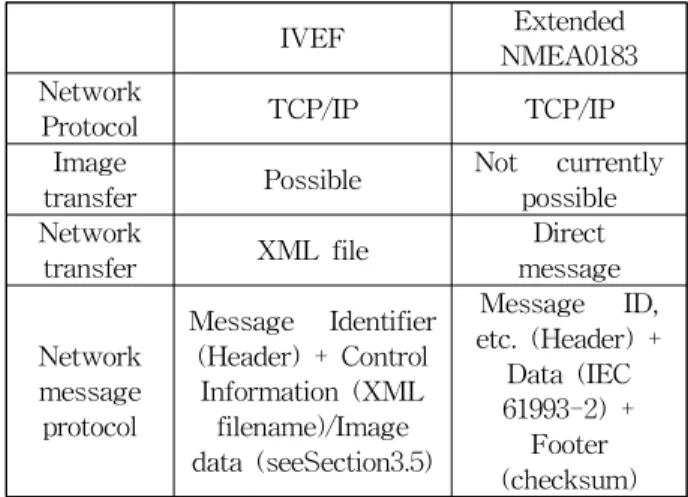
In Table. 2, The IVEF protocol has been compared with its GICOMS which uses a data exchange format, e.g., the extended NMEA0183.
Table 2. Comparison of extended NMEA0183 with IVEF
The IVEF and NMEA0183 are transferred through the network using TCP/IP. With regards to network transfer approach, the IVEF transmits data with XML file, while the extended NMEA0183 transmits data as message sentences. The significant advantage of using the IVEF is that it is possible to transmit images while it is not currently possible in the extended NMEA0183 standard. A sample message of such protocol is illus- trated below:
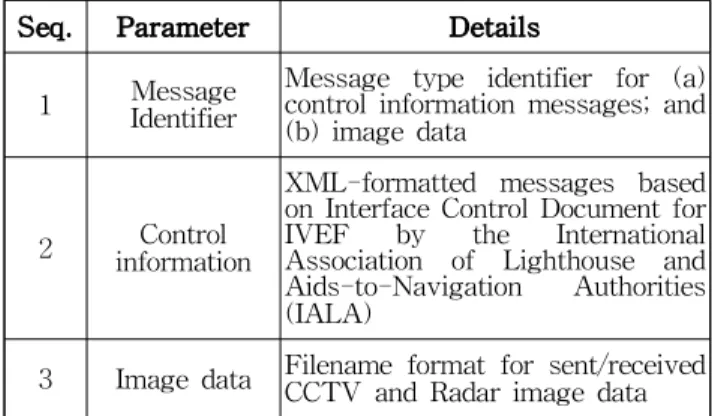
3.3 Design of network message protocol
As shown in Table 3, the packet messages trans-
mitted through TCP/IP are divided into three main
components, i.e., (1) message identifier; (2) control in-
formation messages; and (3) image data.
Seq. Parameter Description Format
1 Message
Type Message
Types
‘CTRLINFO’:
Control Information
message
‘IMGDATAC’:
Image data (CCTV)
‘IMGDATAR’:
Image data (Radar) 2 Pre-set
parameter 1
Pre-set
parameter 0000
3 Pre-set parameter
2
Pre-set
parameter 0000
4 Area
Code
Pre-defined code of an area wherein
'0BSN':
Busan '0ICN':
Seq. Parameter Details
1 Message
Identifier
Message type identifier for (a) control information messages; and (b) image data
2 Control
information
XML-formatted messages based on Interface Control Document for IVEF by the International Association of Lighthouse and Aids-to-Navigation Authorities (IALA)
3 Image data Filename format for sent/received CCTV and Radar image data
MSGTYP_CTRLINFO_IVEF_LoginRequest (Log-in Request)
MSGTYP_CTRLINFO_IVEF_LoginResponse(Log-in Response)
MSGTYP_CTRLINFO_IVEF_ServiceRequest (Service Request)
MSGTYP_CTRLINFO_IVEF_ServiceResponse (Service Response)
MSGTYP_IMGDATAC (CCTV image data) MSGTYP_IMGDATAR (Radar image data)
Table 3. Packet messages to be transmitted by TCP/IP
Message identifiers serves as the header for the en- tire packet message and are used to enable the program to identify the type of message which is either control information or image data. The proponent has formatted the message identifiers as follows:
The data sent to and from a VTS Center are for- matted in XML which is based on the interface control document in the IVEF recommended by IALA. The message contents of these data are divided into two types - image and control information messages. The image messages contain an image data in binary form.
Fig. 4. Illustration of sending control information through TCP/IP
Fig. 4 illustrates the process of sending control in- formation through TCP/IP. The control information messages are client/server transactions which are transmitted and/or received to enable services such as log-in/log-out and service request/response for Radar and CCTV images. According to Interface Control Document in the IVEF by IALA, The XML messages that were sent and received by an IVEF client/server shall have the following layout - XML version tag, main node, header node, body node, and message-spe- cific node(s). Below is a format for XML messages:
The XML format for control information messages
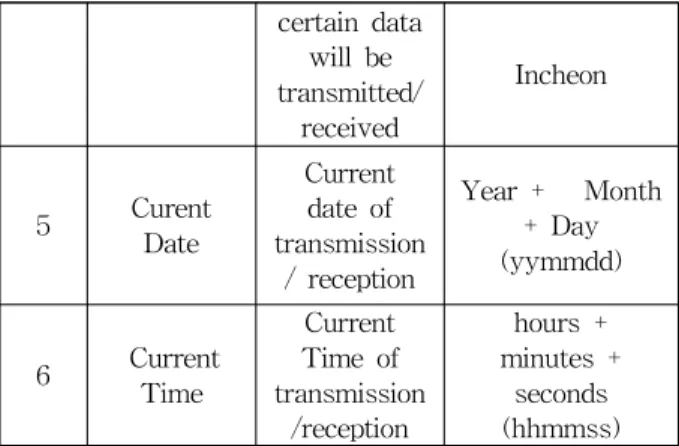
‘Element name’ is an identifier of the type of message to be transmitted. The element names to be used for the IVEF system are LoginRequest, LoginResponse, ServiceRequest, ServiceResponse and TaggedItem. As described in Table 4, ‘MsgRefId’ is a Universally Unique Identifier (UUID) for each message, which consists of 32 hexadecimal digits displayed in 5 groups and separated by hyphens.
Table 4. Data format for UUID
certain data will be transmitted/
received
Incheon
5 Curent
Date
Current date of transmission
/ reception
Year + Month + Day (yymmdd)
6 Current Time
Current Time of transmission
/reception
hours + minutes +
seconds (hhmmss)
X M L
Element XML-formatted message
L o g - i n Request
<LoginRequest Name=" " Password=" "
/>
Attributes:
Name: username
Password: user password
L o g - i n Response
<LoginResponse MsgId=" " Result=" "
Reason=" " />
Attributes:
MsgId: shall be based on the value of MsgRefId
Result: ‘1’: Accepted; or ‘2’: Declined Reason: String that describes the rea- son for declining; only used when result is declined
S e r v i c e Request
<ServiceRequest Area=" "
Transmission=" " Type=”” />
Attributes:
Area: Area-of-Interest set by user;
(for demonstration program, the propo- nent use Busan or Incheon for op- tions)
Transmission: Interval or the receiv- ing frequency that can be set by the user on receiving the preferred images Type: Type of image data to be re- ceived: ‘C’: CCTV; ‘R’: Radar
S e r v i c e response
<ServiceResponse Result=" " />
Attribute:
Result: ‘1’: OK; ‘2’: NOT OK T a g g e d
Item <TaggedItem Key=" " Value=" " />
Attributes:
Key: (fixed) ‘DateTime’
Value: Current date and time (yymmddhhmmss)
The proponent designed a format for generating this UUID as shown in Table 5. An example of generated UUID is: CTRLINFO-0000-0000-0BSN-110819120022.
Message-specific nodes are based on Interface Control Document for IVEF by IALA. The proponent formatted these XML lines as follows:
Table 5. XML attribute description for control information messages
5. Conclusions
Recently, the maritime safety management has been widely recognized as the modern essential services to prevent maritime accidents in active way as well as in proactive way. In this paper, we proposed the method of designing the IVEF Service among VTSs and then be- tween the VTS and GICOMS in the era of of e-Navigation. The network message protocol was de- fined and designed by considering the characteristics of the IVEF data. As a client and server-based system, the IVEF client makes a connection to the server by logging-in, running the IVEF service and then receives traffic image data at a client request in the VTS.
The future improvements can include allowing a user to retrieve traffic images within a more specific posi- tion, such as latitude and longitude coordinates.
References
[1] IMO, Guidelines for Vessel Traffic Services, Resolution A.857(20) , Nov. 1997, IMO.
[2] Korea MOF, “Vessel Traffic Services Center”, Available: http://www.vtskorea.info, 2013.
[Accessed : September 30, 2013]
[3] IALA, The e-Navigation Architecture - the initial Shore-based Perspective , IALA Recommendation e-Nav-101, Dec. 2009, IALA.
[4] IEC, Maritime navigation and radiocommunication equipment and systems - Automatic identification systems(AIS)-Part 2: Class A shipborne equip- ment of the universal automatic identification sys- tem(AIS-Operational and performance require- ments, methods of test and required test results , IEC 61993-2 1st Ed., 2001, IEC.
[5] IALA, IALA Recommendation V-145 on the Inter-VTS Exchange Format(IVEF) Service , Ed.1 June 2011, IALA.
[6] ISO, Open Systems Interconnection Reference Model , International Standards Organization Standard 7498-1, 1994, ISO.
[7] Manipis, Lory Anne P., Dr. Gyei-Kark Park,
Dong-Gyun Kim, "A Study on the Enhancement of
Maritime Surveillance in Korea Using Inter-VTS
Exchange Format (IVEF)", Proceedings of KIIS
Spring Conference, pp. 19-21, 2011.
저 자 소 개