Journal of Internet Computing and Services(JICS) 2014. Aug.: 15(4): 67-79 67
창조경제 활성화를 위한 스마트융합 전략방안☆
A Study of Smart Convergence Strategies
for Enhancing a Creative Economy: Lessons from Korea
김 용 범1 곽 정 호21)
Yong-Beom Kim Jeongho Kwak 요 약
최근 한국에서는 기존의 경제구조에 ICT 기술을 접목하여 새로운 성장 동인과 일자리를 창출할 수 있다는 창조경제(creative
economy)의 도입이 핵심정책으로 추진되고 있으며, 2013년 6월에는 창조경제의 제도적 실행을 위한 법안이 국회를 통과하였다. 창조
경제의 개념은 ICT(Information Communication Technologies) 기술을 중심으로 산업과 산업이 융합되면서, 과거 산업의 범주를 넘어
새로운 가치와 서비스를 창출하는 신 개념의 산업 패러다임을 만들어 낼 수 있다는 것이다. 다시 말해, 창조경제 활성화를 위한 핵심
요소로 ICT 기술과 다양한 산업이 융합되는 스마트융합(smart convergence)이 중요하게 평가되고 있다. 이에 본 논문은 ‘스마트 융합’
의 정의를 기초로 미래 스마트 융합시대가 가져올 경제적 효과 및 사회문화의 변화를 예측하고, 창조경제 활성화를 위한 정책적 제
언을 다각적으로 제시하고 있다. 본 논문에서는 전문가 심층면접, 솔로우모형(Solow Model)을 활용한 계량분석을 수행하였고, 창조경
제 활성화를 위하여 수요 및 공급기반을 고려한 스마트융합, 선택적 집중을 통한 스마트융합, 스마트워크 등 법제도적인 사전정비의
중요성을 정책제언으로 제시하였다. 본 연구는 초기 이론 정립 위주의 선행연구들과 달리 정책적 실행가능성을 고려한 정량적 연구
라는 차별성을 지닌다. 이러한 한국의 선행경험은 새로운 성장동인 및 일자리를 마련하기 위하여 창조경제를 정책적으로 추진하고자
하는 다른 국가들에게 중요한 교훈(lessons)이 될 수 있다.
☞ 주제어 : 스마트융합, ICT 생태계, 창조경제, ICT 정책, 초연결사회 ABSTRACT
One of the core policies recently implemented by the Korean government is the introduction of a creative economy, a concept that integrates ICT with the existing economic structure in order to create new growth factors and jobs. In June of 2013, the National Assembly passed a bill for the institutional practice of a creative economy. The concept of a creative economy is to integrate industries centered on ICT in order to form a new-concept industry paradigm that creates new values and services that exceed past industrial categories. In other words, smart convergence, which integrates ICT with various industries, is evaluated as a core factor for boosting the creative economy. Thus, based on the definition of 'smart convergence', this study predicted the economic effects and sociocultural changes that will ensue due to the future era of smart convergence. Also, this study proposes policies for enhancing the creative economy in various ways. More specifically, in-depth interviews with convergence industry experts were carried out and quantitative analyses were performed employing a Solow Model. Furthermore, as a means to revitalize the creative economy, this study underscores the significance of the preemptive institutionalization of legislations and suggests several policy proposals regarding smart convergence rooted in market supply and the demand chain, smart convergence through selective focus, and smart work. This study is differentiated from previous studies that have only focused in establishing theories in that it offers quantitative research with a consideration of the feasibility of proposed policies. The leading experience of Korea regarding smart convergence can provide important lessons to other countries that hope to promote a creative economy as a means to create new growth factors and jobs.
☞ keyword : Smart Convergence, ICT Ecosystem, Creative Economy, ICT Policy
1. Introduction
1Korea Polytechnic University (KPU) Siheung-si, Gyeonggi-do 429-793 Korea
2Korea Information Communication Industry Institute(KICI), Jongro-gu, Seoul 110-051 - Korea
* Corresponding author ([email protected])
[Received 29 March 2014, Reviewed 11 April 2014, Accepted 03 July 2014]
The social paradigm of the information-oriented age, characterized by the appearance of info-communication in the 1990s and the expansion of info-technology in the 2000s, is now transforming into a convergence society through ICT convergence within the new open ecosystems.
☆ A preliminary version of this paper was presented at ICONI 2013 and was selected as an outstanding paper.
ISSN 2287-1136 (Online) http://www.jksii.or.kr
Industrial Economy Digital Economy Creative Economy y Mechanical engine (power) y Digital technology (information
processing), internet y Internet · mobile revolution
y Progressive y Radical y Radical
y Industrial capital (emerging capitalist)
y Knowledge and information (knowledge worker)
y Creativity, artistic value, social network
y Expansion from economy to politics, society and culture y Expansion from a certain region to
the rest of the world
y Nearly simultaneous effect on politics, economy, society and culture y Simultaneously carried out worldwide
y Simultaneous effect on politics, economy, society and culture y Sporadically carried out worldwide y Labor, capital y Technology, information, knowledge y Creative idea, intelligent property y Manpower
y Lifelong career y Labor for pay
y Simple labor, specialized labor
y Human power
y Jobs for life (lifelong education) y Labor for possession (stock option) y Multi-tasking
y Creative power y Project-type
y Labor for self-satisfaction
y Fixed working hours
y Flexible working system, such as telecommuting, part-time, flexible work
y Meaningless form (unrestricted time
· space)
y Vertical pyramid organization y Functional and specialized
y Horizontal organization, instant organization
y Networking
y Horizontal organization, network organization, TF organization y Command, control
y Top-down communication
y Self-management
y Extensive dispersion y Horizontal communication y Economy of scale
y Cost reduction through mass production
y Broad-line low-volume production, inventory reduction
y Cost reduction through networking
y Broad-line low-volume production, purpose-item production
y Focus on profits than cost reduction y Proximity with large-sized market y 1:1 marketing through e-commerce y Strategy for producing word of
mouth effect y Manufacturing industry-centered
y Producer-centered
y Service industry-centered y Consumer-centered
y Cultural industry-centered y Consumer = producer y Large company-centered y Expand role of small and mid-sized
venture firms
y Expand role of one man businesses, small-sized groups and corporations y Planning (market intervention)
y Regulation
y Present vision (create environment)
y Creation y Environment creation
(Table 1) Comparison of Characteristics According to the Evolution Process of an Economy This new society has recently achieved growth centered on
creative networking [1]. In particular, as platform providers such as Apple and Google acquire a competitive edge in the global ICT industry, countries around the world are implementing various policies in an effort to actualize creative networking.
Against this backdrop, Korea is actively promoting a creative economy based on creative networking in order to secure new growth engines and create new jobs. The creative economy of Korea arises from several difficulties faced by the country's economy. First, Korea remains in a continued state of 'growth without employment', as jobs have not been
created despite increases in the nation's exports and the growth of the manufacturing sector [2] [3]. Second, due to the absence of new growth engines that can invigorate the national economy, Korea's potential growth rate is expected to drop to 2.4% in 2018 and to 1% in 2031 [4]. Third, although the economic paradigm of the ICT industry is now centered on the software of platform providers, Korea still possesses a hardware-focused industrial structure.
More specifically, the Korean government is promoting the introduction of a creative economy as a core policy; the concept focuses on creating new growth factors and jobs by integrating ICT with the existing economic structure [5].
(Figure 1) Definition of Smart Convergence In June of 2013, the National Assembly passed a bill
pertaining to the institutional practice of a creative economy.
The concept of a creative economy involves the integration of industries centered on ICT in order to form a new-concept industry paradigm that creates new values and services that exceed past industrial categories.
In other words, smart convergence, which integrates ICT with various industries, is evaluated as a core factor for boosting the creative economy. In particular, as a country equipped with the world's top ICT infrastructure, Korea is expected to carry out smart convergence more effectively than other nations.
Thus, based on the definition of 'smart convergence', this study predicts the economic effects and sociocultural changes that will be brought about by the future era of smart convergence. Also, this study proposes policies for enhancing a creative economy in various ways. The leading experience of Korea regarding smart convergence can provide important lessons to other countries that hope to promote a creative economy as a means to create new growth factors and jobs.
2. Smart Convergence
2.1 Definition and classification of smart convergence
The advent of the "digital convergence" age broke down barriers between industries and integrated IT with existing sectors to create new values unforeseen in the traditional industrial economy [8]. 'Convergence' was created within such paradigm changes, and concepts such as 'ICT convergence' and 'smart convergence' were formed.
First, the concept of 'ICT convergence' is defined as the provision of all services through the internet network. It refers to the convergence of the internet with communication, broadcasting and media and the convergence that is generated through the innovation in the computing sector and the related evolution of the internet [9]. Thus, ICT convergence can be defined as a new-concept service that uses network resources to make applications.
(Figure 2) Smart Convergence Industrial Ecosystem Second, 'smart convergence' is a concept that adds 'smart'
- meaning high intelligence - to 'convergence'. This concept integrates the 'intelligence' required in modern society with 'network', the core of the internet era, and the 'mobility' of the ubiquitous age [10]. In other words, 'smart convergence' refers to the high intelligence of individuals and industries and thus the convergence phenomenon that creates new industries through industry convergence rather than smart technology [11].
To summarize the precedent studies above, 'ICT convergence' can be defined as a concept for creating new services based on internet technology and refers to the convergence that creates new service markets through the enhancement of existing industries, such as VoIP, IPTV and smart phones. In contrast, 'smart convergence' can be defined as a form of convergence in which new industries are created through the same method - the convergence of existing industries with internet technology - but based on the appearance of intelligent objects and smart services of completely new concepts.
From this perspective, the services created by the 'smart convergence' industry can be classified into intelligent convergence services focused on smart infrastructure and industrial convergence services centered on the product industry. In particular, smart convergence, which is based on an intelligent network, has the following characteristics: it breaks down boundaries between suppliers and consumers, creates value through the network-based organic sharing of information, and mediates related industries through an invisible network.
Thus, as presented in Fig. 1, this study classifies the 'smart convergence' industry into 'convergence' and 'creation' based on an intelligent network. First, the convergence concept refers to the convergence between the digital communication network and industries and thus advanced convergence between industry-industry, industry-object and industry-individual entities. ICT promotes convergence between technologies and industries through networking, intelligence and internalization.
A large amount of information is exchanged instantaneously through the provision of the convergence service, which in turn creates a consumer-centered market environment.
Furthermore, it forms a supply chain in which various related parties are intertwined in a complex form that encompasses
the production and supply stages as convergence is expanded to individual objects.
Next, the concept of creation refers to the formation of a creative ecosystem environment that is characterized by the continuous appearance of new markets as new classes such as application companies are formed through a platform-centered convergence market. This refers to the creation of an economic environment that organically integrates intelligent objects with people, environments and other industries, leading to the advent of new platform, application and middleware service classes within the ecosystem.
2.2 Smart Convergence Industrial Ecosystem As the form of industry changes in an era of cooperation, the economic system is converted from an economy for 'possessing' to an economy for 'sharing'. Whereas large companies became the focus during the first and second industrial revolutions that favored 'economies of scale', cooperative networks and dispersed capitalism have appeared in the third industrial revolution, leading to the creation of an environment characterized by the cooperation of numerous small companies. Thus, the future industry will achieve openness and sharing through the internet and develop through a horizontal cooperative business model that values customized consumption and relations through creative interactions based on bilateral communication [12].
Thus, it is predicted that the future society will provide safe QcS service quickly and accurately in response to consumer demand levels by applying ICT in all sectors and through industrial convergence. This smart convergence industry ecosystem will construct an industrial ecosystem in
which all services and industries are created while being centered on the core ICT infrastructure.
The smart convergence industry ecosystem is expected to achieve rapid growth by replacing the existing broadcasting/
communications market in the short term. The flow of ICT information will be expanded from a unilateral form (human→
machine) to a bilateral form (human↔machine). Also, personalized services will be generalized through accurate sensing and data acquisition.
In the long term, as intellectual services appear endlessly within the smart convergence ecosystem, our economy and living environment will transform into a creative economy that values innovative ideas and creativity [3].
Fig. 2 presents the components of the smart convergence industrial ecosystem. Considering this, the present study composed an industrial ecosystem that integrates core ICT infrastructure which is centered on ICT convergence with existing industries, including the energy, construction, transportation, machinery, health care and education industries.
As an extensive concept that encompasses the ICT ecosystem composed of C(contents)-P(platform)-N(network)-D(device), it refers to a 'smart convergence' industrial ecosystem centered on 'ICT convergence'.
To be specific, the introduction of the ICT intelligent system will facilitate the efficient management of the environment and energy1), and the advent of various devices and operating systems, such as display technology, ICT technology, image technology and motion detection technology, will create new value by converting existing living spaces into sensitive spaces2).
Furthermore, Multi-modal biometrics will replace existing cards3), and the functions of smart cars will be enhanced to a level at which vehicle driving can be controlled through active, integrated, autonomous driving situation-perception technology based on cooperation between information provided by in-vehicle sensors, infrastructure sensors, and the sensors of surrounding vehicles4).
Likewise, the social safety net will evolve into a national safety net through the efficient surveillance of extensive areas 1) Smart Grid
2) Smart Space, Smart Building 3) Smart Card
4) Smart Transportation
achieved by intelligent intrusion surveillance systems and random crime detection systems5). Furthermore, the safety of residents can be improved through the use of GPS and CCTV to provide child services, prevent the disappearance of children and the elderly, and predict crime.
An advanced learning environment will be constructed through the introduction of smart school-related technology, such as the creation of smart schools using ICT, the formation of smart classroom environments, the operation of differentiated o customized educational programs, and the provision of digital-based educational data and digital textbooks6). Moreover, real-time health checkups through smart health care will improve the public quality of life and extend lifespans.
In this sense, various future-oriented services will appear based on ICT infrastructure through the smart convergence industrial ecosystem to lead to the creation of a smart social infrastructure and environment.
2.3 Smart Convergence and Future Society The advent of the smart ecosystem will lead to a 'smart life' that encompasses various issues related to the environment, population and society. In other words, the new era of a creative economy will be one in which machines read people's minds and energy is supplied and used self- sufficiently [7].
To acquire a leading edge amid such changes in the future smart environment, appropriate industrial policies are needed along with a long-term approach for enhancing the core creativity and innovation of the convergence society and economy. The values of the convergence economy are realized from creative assets such as imagination, ideas and experience and creative assets are accumulated through the human capital and cultural capabilities of society.
As the results of creativity are determined by four factors - human capital, social capital, cultural capital and structural o institutional capital - it will lead to the formation of a new smart convergence industrial ecosystem that transcends the simple convergence paradigm between existing ICT industries [13].
5) Smart Security 6) Smart Education
As the convergence economy develops based on ICT infrastructure, the advancement of ICT can lead to the improvement of all related industries. Thus, in order to break from the existing industrial structure and facilitate the simultaneous development of related services through infrastructure renovation, it is important to devise long-term development measures for renovating the ICT infrastructure.
Furthermore, qualitative growth of the smart convergence industry must be achieved through industry promotion policies such as the cultivation of future-oriented creative talent, the development of high-quality smart convergence technology, the renovation of distribution structures and the strengthening of foreign exports and overseas expansion.
3. Precedent Studies and Research Methodology
3.1 Precedent Studies
The ICT industry, which leads the digital revolution, is a major strategic industry in advanced countries and developing nations such as the U.S., several countries in Europe, and Malaysia. In particular, as ICT sets off economic ripple effects in connection with other industries, many nations around the world are providing various policies to ensure the competitiveness of the ICT industry [14]. The European Commission announced the "Digital Agenda for Europe" - a plan for boosting the benefits of the overall society - on May 19, 2010, and provided seven action plans for the digital agenda. The aim of this plan is actively to foster higher value-added industries that are generated by grafting ICT technology onto other industries [15]. Thus, it has become a global trend to select ICT convergence industries as national strategic industries for providing future growth engines.
In an early study conducted on convergence, Rosenberg defined convergence as the creation of new value through the convergence of industries that are related in terms of technology, i.e., a phenomenon in which industries are integrated centered on technology rather than being linked via unrelated businesses [16].
The direction of previous studies conducted on industrial convergence can be classified into the following areas:
technology, industrial structure and customer experience. First, as a type of industrial convergence by academic sector, technology includes homogenous convergence, similar convergence and heterogeneous convergence. Second, the industrial structure refers to the type of industrial convergence by the industrial sector and includes the convergence of industrial units, such as one-to-one and two-to-two industrial convergence instances. Third, customer experience refers to the convergence by user experience factors and includes equipment, space and process convergence [17].
Researchers in Korea also investigated the definition of industrial convergence. Convergence by literature, technology, products/services, value chains, industry and culture were categorized into the five types of the 'convergence of learning technology', 'convergence of product service', 'convergence between the corporate ecosystem and the value system', 'convergence with other industries' and 'IT convergence'. In conclusion, the concept of convergence was defined as a phenomenon of the overall society rather than as a phenomenon between industries [18].
By summarizing the precedent studies above, ICT convergence can be defined as the creation of other values achieved by integrating ICT with the technologies of other industries. Past studies understood convergence industries as the appearance of new industries rather than the development of existing ones. Furthermore, studies verified that strategies for fostering convergence industries were being sought on a national level all around the world. However, as precedent studies define convergence only through cases of technological convergence or by the integration of industries and merely focus on classifying the types of convergence, they are limited in their ability quantitatively to study the effect of the convergence industry by defining the convergence industry and implementing empirical or qualitative analyses based on assumptions.
3.2 Research Method
This study calculated the economic effect of the smart convergence industry on the national economy to determine the economic effect of newly emerging industries and verified - both qualitatively and quantitatively - the importance of establishing national agendas and providing future industrial
(Figure 3) Selection of the Research Method
development strategies to enter the era of smart convergence.
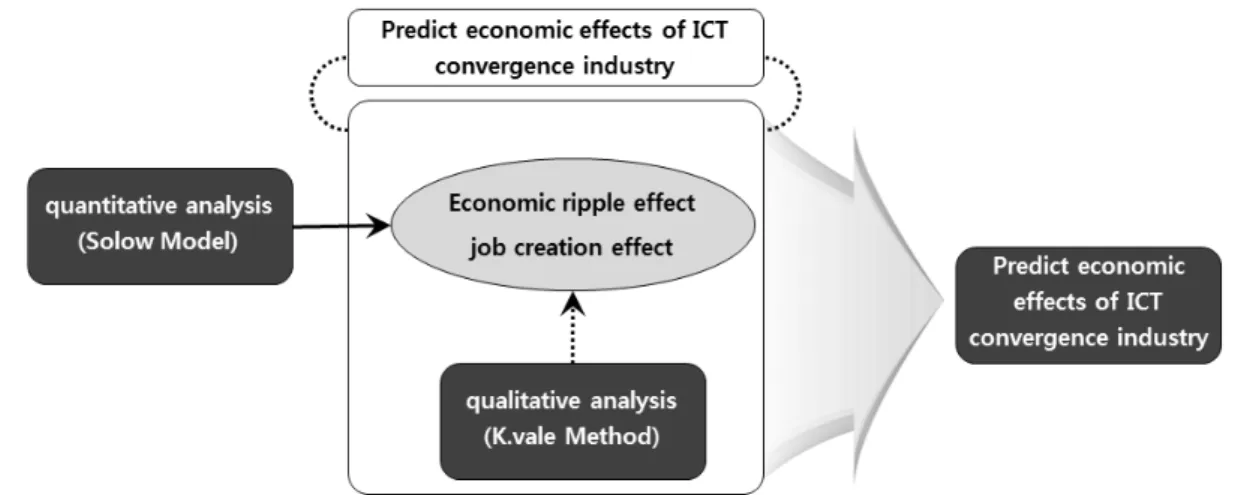
Fig. 3 shows the multilateral research method used to predict the economic effects of the ICT convergence industry assuming the existence of the smart convergence industry has appeared.
As the results of the quantitative calculation based on the assumption may over- or under-estimate the economic effects of the future convergence industry, a qualitative analysis was also conducted with ICT experts to verify how well the quantitatively calculated economic effect matches the intuition of experts.
First, for the quantitative analysis, this study extracted the main industries integrated with ICT and assumed them to be smart convergence industries. The economic effects of the smart convergence industry were predicted through a Solow model based on the presumed convergence industries [19] [20].
Afterward, K-vale seven-step in-depth interviews with ICT experts were conducted to predict the prospects for the future ICT convergence industry [21]. As a method that considers the present industrial structure in which the effects of the smart convergence industry cannot be accurately calculated, this multilateral analysis method simultaneously carries out qualitative and quantitative analyses in consideration of the absence of sub-industrial definitions for the convergence industry and the lack of public opinions about many industries collected through ICT.
4. Analysis of the Quantitative Effects of the Smart Convergence Industry
4.1 Definition of the Smart Convergence Industry
Prior to the quantitative analysis, this study set the range of the economic effects of the smart convergence industry and at the same time assumed the smart convergence industry centered on the top 30 manufacturing businesses and top 20 service businesses. First, the range of the economic effects of the smart convergence industry was judged as the economic effects additionally created by newly emerging industries, rather than the phenomenon of increased economic scales of existing industries. This was done to consider the effects created by the new industries and markets due to the classes newly emerging in the smart convergence ecosystem and because the ICT value chain, which is connected by contents (C) – platform (P) – network (N) – device (D), is expected to expand into new industries as well as the service industry to achieve convergence between the ICT sector and other areas, such as the automobile, shipbuilding, health care and education industries [22]. Thus, the economic effects of the ICT convergence industry were understood as additional economic effects that create the economic effects of the convergence industry.
Name of variable Observed
value Mean Standard
deviation
Minimum value
Maximum value
Output (Y) 20 12.79 12.80 0.26 12.37
Capital input (K) 20 11.56 11.94 0.81 10.30
Number of laborers (L) 20 10.36 10.33 0.13 10.17
Technological import/export (A) 20 6.00 6.32 0.63 4.54
(Table 2) Descriptive Statistics
Sub-industries included in the future convergence industry are predicted to be manufacturing industries, such as the info-communication, semiconductor, content, and software industries, as well as service industries, such as the broadcast communication, finance, information and education industries.
Many experts also expect that the integration of ICT with other industries will lead to the extraction of new services, such as smart cars, smart shipbuilding and smart health care [19] [20].
Thus, this study defined the smart convergence industry by extracting sub-industries from the top 30 manufacturing businesses and top 20 service businesses and assumed the smart convergence industry in consideration of the present domestic situation, which lacks an industrial classification standard of the smart convergence industry.
4.2 Selection of a Prediction Model for the Smart Convergence Industry
This study assumed the effects of the investment, technology and labor input of sub-industries of the smart convergence industry on industry growth based on the Solow model. The Solow model is expressed as , a form of the Cobb-Douglas Function7), and presumes that capital and labor input affects production.
In particular, technical standards are expressed in the labor-combined form to show that high technical standards signify higher efficiency of labor production. Thus, this study uses a production model, as expressed by Equation (1), based on the Solow model. This production model maintains the assumption that production factors - capital, labor and 7) The first-order production function presenting the input and output of production factors was presented in 1928 by Cobb and Douglas. Output was marked as an exponential function of labor and capital.
technology - independently affect production and that the input ratio of each factor is maintained in the Cobb-Douglas form ( ). Afterward, to convert the production function into a function form of a linear combination according to the flow of time, this study devised Equation (2), which applies all log values.
,(st. ) (1)
(2) I’stans data provided by the Korea Institute for Industrial Economics & Trade was used as the independent and dependent variables of the smart convergence industry. Also, this study extracted data on output, capital input and technical standards, the sub-industries of the ICT convergence industry assumed in Figure 4. In particular, the variables for the technical standards were selected based on the Schumpeter hypothesis. Schumpeter largely classified types of technology into innovation and imitation and argued that corporate and industrial R&D investment positively affected technological progress [23]. Based on this assumption, technological exports were assumed as a proxy variable for the level of innovation, whereas technological imports were presumed as a proxy variable for the level of imitation. Thus, technological imports and exports were selected as the variables representing the technology of the smart convergence industry8).
8) R&D is the concept of input required during technology creation and patent rights, which is used as a proxy variable for national technical skills, as the variable of the concept that produces technical development. Thus, the effects of innovation and imitation cannot be considered only through R&D and patent rights. In this sense, technological exports and imports were established as proxy variables presenting ICT convergence technology.
(Fig. 4) In-depth Interview Method
Year ’13 ’14 ’15 ’16 ’17 ’18 ’19 ’20
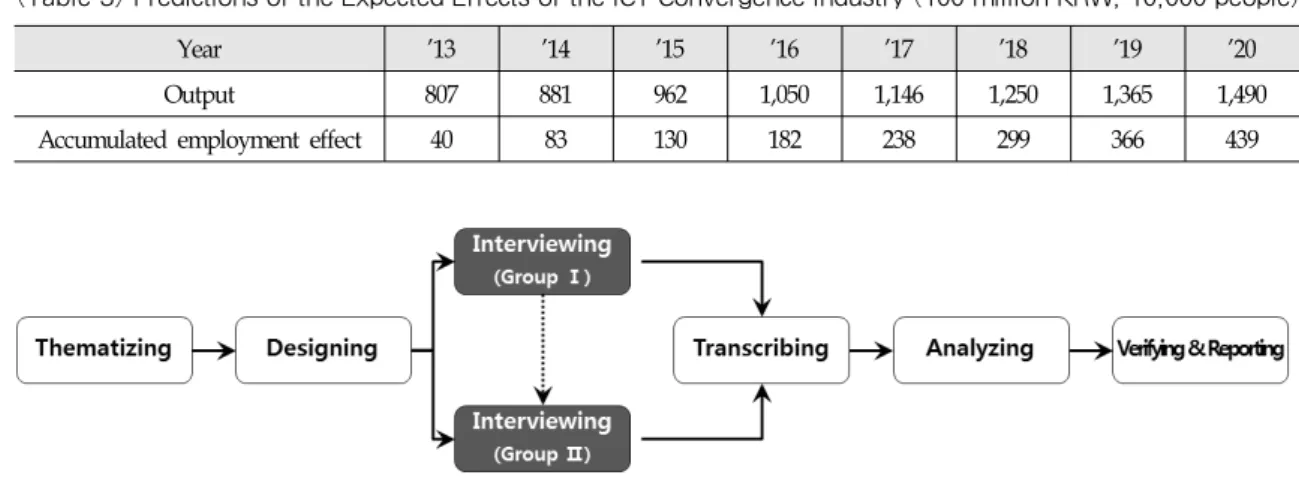
Output 807 881 962 1,050 1,146 1,250 1,365 1,490
Accumulated employment effect 40 83 130 182 238 299 366 439
(Table 3) Predictions of the Expected Effects of the ICT Convergence Industry (100 million KRW, 10,000 people)
4.3 Descriptive Statistics and Correlation Coefficient
Table 2 presents the basic statistics of the variables of the Solow model constructed to predict the economic effect of the smart convergence industry. As each variable has the form of a linear function converted into a log value, the following log result values were deducted. The mean, minimum and maximum output values of the smart convergence industry are recorded as 12.79, 0.26 and 12.37, respectively. The mean, minimum and maximum capital input values were calculated as 11.56, 0.81 and 10.17, respectively. All variables represent an annual average of 20 measurements. As the recent data of I’stans was limited to time series data collected in 2009, this study attempted an analysis using time series data collected from 1990 to 20099).
The correlation of each independent variable was observed as follows: ‘capital-labor, 067’, ‘capital-technology, 0.63’, and
‘labor-technology, 0.57’. The correlation coefficient of capital and labor was largest (0.67), and all independent variables presented positive (+) coefficients. As the correlation coefficient between independent variables was below 0.8 in most cases, it was judged that the problem of multicollinearity existing between independent variables was solved.
9) As there are many limitations in defining the future ICT convergence industry through assumptions and by extracting past and present time-series data of sub-industries, this study used the industrial classification standards and data as defined by KIET I’Stans.
4.4 Prediction of the Economic and Employment Effects of the Smart Convergence Industry
According to Equation (3), which shows the estimated results of the economic effects of the ICT convergence industry, it was verified that capital, labor and technology positively (+) affected the output of the smart convergence industry. was presented as 0.98 and (Durbin-Watson) as 1.723. As the latter value was close to 2, the model was proved to hold statistical credibility. The estimated coefficient value of capital input was significantly estimated as 0.075 at the 95% significance level, and labor was presented as 1.33, showing high explanatory power at the 99% significance level. The technological variable was 0.05, at the 95% significance level, leading to the assumption that an increase in capital, labor and technology input in the ICT convergence industry positively affected the increase in convergence industry output.
(3)
Based on the estimated results, this study established the hypothesis that the “capital, labor and technology invested in the smart convergence industry continuously increases” to predict the economic effects of the smart convergence industry from 2013 to 2020. The assumption that each independent variable – capital, labor and technology –
continues to increase was applied to predict the continuous increase of input factors through the least square method (OLS). This in turn was applied in the coefficient values deducted from Equation (3). If convergence increases in all industries, the smart convergence industry will develop in the form of an increasing function to produce economic effects worth approximately 149 billion KRW by 2020.
5. Strategy for Enhancing Smart Convergence
5.1 K-Vale Seven-step In-depth Interview Method
This study used the K-vale seven-step in-depth interview method to predict the future smart convergence industry. This qualitative analysis method considers not only the present industrial structure in which the effects of the ICT convergence industry cannot be accurately estimated, but also the absence of sub-industrial definitions for the convergence industry and the lack of public opinion for many industries collected through ICT technology.
This study used the seven-step in-depth interview method shown in Fig. 4 Seven key points were designed for the future of the smart convergence industry and one-to-one visits were made according to interview groups to deduct the seven key findings for the future smart convergence industry based on the content gleaned from the in-depth interviews.
5.2 In-depth Interview Process
In-depth interviews were conducted for four weeks from November 26 to December 21, 2012. The interviews were carried out one-to-one with experts of two groups (schools, research centers, and an industrial community). A qualitative narrative method was used to analyze the interview content based on five open-ended questions [24].
Furthermore, individual interviews were carried out to minimize inter-group conflicts that can arise during in-depth interviews conducted by various groups of experts. In-depth interviews were conducted with six industrial community experts and six academic and research experts.
5.3 Results of In-depth Interviews
This study collected and analyzed data through empirical analyses and in-depth interviews in order to find various smart convergence strategies that can be used to determine new growth factors and create jobs within the new economic paradigm of smart convergence. Based on the results of the analyses, this study uncovered the following smart convergence strategies and policy implications for enhancing the creative economy.
First, in order to enhance the creative economy based on smart convergence, it is extremely important to construct an ICT infrastructure that can serve as a physical base. The construction of the ICT infrastructure must sufficiently consider the market demand and supply base rather than government-led operations. In order to actualize the smart convergence industry, it is essential to establish a phased ICT network industry and enhance the related network, as shown in Fig. 5. A smart network requires an advanced network that can actualize technologies such as LTE-A, B4G mobile communication technology, and a packet-optical transport network. The future network must realize technologies such as realistic communication, knowledge communication and 5G mobile communication.
Second, the analysis results showed that it was efficient preferentially to integrate the smart convergence industry with various areas such as construction, health care, education, transportation and agriculture based on the advanced smart ICT network infrastructure, as industrial fields such as construction, health care, education, transportation and agriculture produce high synergy effects when combined with ICT. For example, automobiles are increasingly perceived as a type of ICT device rather than as a means of transportation, and analysis results show that the integration of ICT will affect the competitiveness of the auto industry. In particular, as vehicle services become more personalized, bilateral and operable in real time due to smart roads and connected cars, web connections will facilitate infotainment services such as vehicle management and safe driving services including driving information recording, tele-diagnosis, reduced oil prices, accident prevention and games.
Third, the expansion of smart convergence desperately
(Fig. 5) Construction of the Smart ICT Network
requires preemptive legal and institutional arrangements for finding and commercializing new industry ideas and breaking down entry barriers in addition to the expansion of infrastructure and convergence industries. For example, in the case of smart health care, although the field of telemedicine is already equipped with the basis for infrastructure and industry construction, it is blocked by a certain entry barrier - a medical law that enforces face-to-face treatment. Thus, Korea enacted the creative economy law in June of 2013 and established an interagency strategic committee that identifies and eliminates bottlenecks that hinder smart convergence.
Fourth, in order for the creative economy to succeed based on smart convergence, network accessibility must be improved for the neglected classes of society. In particular, network access will serve as an important factor that determines the quality of life in the era of smart convergence.
Lastly, it is crucial for smart convergence to operate in a way that exceeds infrastructure enhancement and industry cultivation. Most experts judge that it is important to achieve the convergence of existing jobs and living spaces while simultaneously improving the quality of people’s lives and creating new-concept jobs in order to boost smart work.
From this perspective, in order to expand smart work among SMEs and activate the early market, the government is presenting the ‘demonstration smart work model’ and the
‘welfare smart work model’ to support the socially
disadvantaged classes while also searching for various forms of ICT clusters that construct smart work centers focused on regional corporations, universities and research institutes.
6. Conclusions
The economic paradigm is shifting from an era of an industrial and digital economy to an economy of convergence, thus introducing an age characterized by the creation of new industries using an advanced smart ICT infrastructure. The global economy is also quickly transforming to a society of convergence and creation based on intelligence. Korean society is expected to experience various ripple effects of the new economic paradigm, such as improved productivity, the acquisition of new growth engines and the creation of jobs.
Thus, this study conducted qualitative and quantitative research on the smart convergence industry based on the definition of ‘smart convergence’. First, a quantitative analysis was attempted through the Solow model and the economic and employment effects of the industry were predicted. Korea’s smart convergence industry presented a continuous increase of capital, labor, and technology input that will effectively create 4.39 million jobs by 2020.
Next, a K-vale seven-step in-depth interview analysis was carried out with convergence industry experts based on the
qualitative analysis to discover policy plans for boosting smart convergence. The analysis results showed that to enhance smart convergence, it is important to establish a strategic direction of development that sufficiently considers the demand and supply base in the market for improving ICT infrastructure, the physical base. Also, it is efficient to identify and selectively focus on industries with large synergy effects, such as construction, health care, education, transportation and agriculture, based on the enhanced smart ICT network infrastructure. Furthermore, in order to solve problems associated with smart convergence, legal and institutional arrangements must be made preemptively while considering solution to social issues, such as network accessibility for the neglected classes. In particular, measures to improve the quality of life and create new-concept jobs are being sought by integrating existing jobs with living spaces in connection with smart work.
This study quantitatively predicted the effects of smart convergence, which is a concept currently promoted in Korea to enhance the creative economy. This study presents policies that are required to achieve such quantitative effects through expert in-depth interviews. Korea is pursuing a creative economy based on smart convergence in order to provide new growth engines and jobs, and the leading experience of Korea can become important lessons for other countries that are trying to overcome economic crises based on the superiority of their ICT infrastructure.
However, this study has several limitations in that the smart convergence policy measures for boosting Korea’s creative economy is still in its early stage of implementation and that a considerable part of the imperative research relied on limited expert interviews.
Reference
[1] J. Gutierrez, M. Naeve, E. Callaway, M. Bourgeois, V.
Mitter, and B. Heile, "IEEE 802.15.4: a developing standard for low-power low-cost wireless personal area networks," IEEE Network, Vol. 15, no. 5, Sept. 2001, pp. 12-19.
[2] Han, Sungsoo et al. New ICT Service Development Condition & Evolving Direction, ETRI, An outlook on the condition of Present ICT Service and Market, 2010
[2] Lee, Junghoon Korean Creative Economy and Strong nation on Employment, Kyunggi Development Institute, Issues & diagnosis, 2011.
[3] Choi, Joonkyun An outlook on the Future Trends of ICT Convergence and Development, Collection of papers of Academic Conferences for Information and Control, 2013.
[4] OECD, “Economic Survets KOREA”, 2012.
[5] Park, Kyunghye Strengthening the new industrial potential of the Korean IT Convergence, Digital Policy Research, Korean Academy for Digital Policy, 2012.
[6] Korea Communications Commission, Development Plan(scheme) of User based Smart Network, 2012.
[7] J. Hawkins,「Creative Economy」, 2001.
[8] Lee, Sunghoon, Lee, Dongwoo, Smart Convergence:
Green City Trends and Future, Korean Academy for Digital Policy, Digital Policy Research, 2012.
[9] Choi, Kyeyoung et al. The Change of ICT Paradigm and Mid and Long-term Policy Task, KISDI, Premium Report, 2012.
[10] Shin, Yongjin et al, The Provisioning of the U-City Service based on the Cloud Computing, Collection of papers of The Korean Academy for the Information Technology, 2009.
[11] LG CNS, “Smart Technology”, 2010.
[12] Jeremy Rifkin , Third Industrial Revolution, 2012.
[13] UNCTAD, Creative Economy Report, 2010.
[14] Kang, Changdeok The Political Implication and Industry Linked Characteristics of the Korean ICT Cluster based on the Industry Linkage Table, KRIHS, Land Research, 2002.
[15] Shin, Hocheol Blueprint of Europe and Future ICT Industry, Digital Agenda Announcement, KISDI, Broadcasting and Communication Policy, 2010.
[16] Rosenberg, N., “Technology Change in the Machine Tool Industry”, Journal of Economic History, Vol. 23, No. 4, pp.414-443, 1963.
[17] Weaver, B., “Industry Convergence”, the 19th NFF Conference, 2007.
[18] Kim, Deokhyun et al. Convergence Management, Geuloseum, 2011.
[19] Hwang, Joonho Government Role for the Promotion of the Contents Industry in Smart Convergence Era, KISDI Premium Report, 2012.
◐ 저 자 소 개 ◑
김 용 범 (Yong-Beom KIM)
Dr. Yong Beom Kim who is a professor at Dept. of e-Business in Korea Polytechnic University(KPU) since 2012. Dr. Kim received a Bachelor of Business Administration and MBA from Yonsei University in 1991, 1994 respectively, and Ph.D. in Business Administration from the Graduated School of Yonsei University in 2011. Before joining the KPU, He has been the founder and C.E.O. of his own investment business &
incubating company, UTIC Holdings Inc. His research interest covers MOT(Management of Technology), technology investment & commercialization, and business incubating especially in smart businesses in IT industry, and social enterprise models. E-mail: [email protected]
곽 정 호 (Jeongho KWAK)
Dr. Jeongho Kwak who is a research fellow of Korea Information Communication Industry Institute(KICI).
He received his Ph.D degree in Information Systems at Yonsei University. He received his B.A and M.A degree from Sogang University. His current focus is on developing sector-specific competition policy in the new media industry. He also serves as a director of the Industry policy division in KICI. E-mail:
[20] Lee, Junghoon, Kim, Eulsick, Korean Creative Economy and Strong nation on Employment, Kyunggi Development Institute, Trends & Research Reports, 2011.
[21] Kvale, “InterViews – An introduction to qualitative research interviewing”, Thousand Oaks, CA: Sage, 1996.
[22] Fransman, M., “The New ICT Ecosystem: Implication for Policy and Regulation”, CAMBRIDGE University Press, 2009.
[23] Schumpeter, J. A., “The theory of economic development”, Oxford University Press, 3rd. ed., 1969.
[24] Creswell, JW, “Research Design: Qualitative, Quantitative, and Mixed Methods Approaches”, Sage Publications, 2003.