자외선 차단제의 블루라이트 차단효과에 관한 연구
정 상 욱⋅이 시 은⋅최 선 영*⋅문 권 기**⋅임 소 라**⋅김 해 경***⋅박 종 호†
(주)케이씨피부임상연구센터, *인제대학교 서울백병원, **(주)웨이나코리아, ***(주)결고은사람들 (2018년 5월 24일 접수, 2018년 6월 20일 수정, 2018년 6월 26일 채택)
The Blocking Effect of Sunscreen Materials on Blue Light
Jong Ho Park†, Sang Uk Chung, Si Eun Lee, Sun Young Choi*, Kwon Ki Moon**, Sora Lim**, and Hae Kyoung Kim***
KC Skin Research Center Co., Ltd., 93, Yangpyeong-ro, Yeongdeungpo-gu, Seoul 07208, Republic of Korea *Department of Dermatology, Seoul Paik Hospital, Inje University College of Medicine,
Mareunnae-ro 9, Jung-gu, Seoul 04551, Republic of Korea
**Research Center, Weina Korea Co., Ltd., 68, Digital-ro 9-gil, Geumcheon-gu, Seoul 08512, Republic of Korea ***Research Center, Kyulgoun people Co., Ltd., 57, Hwanggeum 3-ro 7beon-gil,
Yangchon-eup, Gimpo-si, Gyeonggi-do 10048, Republic of Korea (Received May 24, 2018; Revised June 20, 2018; Accepted June 26, 2018)
요 약: 블루라이트는 가시광선영역의 파장 중 가장 에너지가 높은 파장으로 피부노화 유발 및 활성산소를 유발 하는 것으로 알려져 있으며, 피부의 유해 기작에 관한 연구가 진행 중이다. 화장품 분야에서의 블루라이트 차단 소재 연구 및 관련 제형연구는 아직 초기 단계에 있으며, 블루라이트 차단 측정과 관련된 시험법 또한 명확하게 정립되어 있지 않다. 블루라이트 차단 효능 평가 시험법은 해외 자외선 차단제의 차단효과 평가 방법을 참고하여 확립하였다. 국내에 고시되어 있는 자외선 차단제 원료 27종 중 17종에 대하여 블루라이트 차단효과를 평가하 였으며, 블루라이트 차단 효과는 징크옥사이드가 14.97%, 비스에칠헥실옥시페놀메톡시페닐트리아진이 16.32%, 메칠렌비스-벤조트리아졸릴테트라메칠부틸페놀이 35.47%, 티타늄디옥사이드가 65.96% 순으로 나타났다. 또 한 동일 함량의 티타늄디옥사이드의 입자크기에 따른 블루라이트 차단효과를 확인한 결과 Nano-티타늄디옥사 이드 보다 Micro-티타늄디옥사이드가 두 배 이상의 차단효과가 높게 나타냈다. 제시된 블루라이트 차단효과 평가 시험법은 블루라이트 차단 소재 탐색 및 화장품 제형 연구에 활용될 수 있을 것이다.
Abstract: Blue light is the highest energy wavelengths in the visible light region and induces skin aging and active oxygen. Studies on harmful mechanism of skin are under way. Research on blue light blocking materials in cosmetics and formulation studies are in the early stage, and the test methods related to blue light blocking measurement are not established. The blue light blocking efficacy was established by referring to the test method of the sunscreen in vitro test(COLIPA guideline, ISO 24443, FDA Final Rule on Sunscreen Testing and Labeling). The blue light blocking effect was evaluated for 17 kinds out of 27 kinds of sunscreen raw materials suggested in KFDA guideline. The Effect was 14.97% for zinc oxide and 16.32% for bishexyloxyphenol methoxyphenyl triazine, 35.47% for methylene bis-benzo- triazolyltetramethylbutylphenol, and 65.96% for titanium dioxide. In addition, the effect of micro-titanium dioxide was twice as high as that of the nano-titanium dioxide. The results suggested that the light blocking effect test method can be used to search for blue light blocking materials and study cosmetic formulations.
Vol. 44, No. 2, June 2018, 183-189 http://dx.doi.org/10.15230/SCSK.2018.44.2.183
1)
† 주 저자 (e-mail: [email protected]) call: 02)6673-1150
1. 서 론
빛을 파장의 길이에 따라 분류하면 400 nm보다 짧 은 자외선, 400 ~ 700 nm 사이의 가시광선, 700 nm보 다 긴파장의 적외선으로 나뉜다[1]. 이 중 400 ~ 500 nm 파장 구간의 푸른색 계열의 빛을 블루라이트라고 하며, 태양 빛 뿐만 아니라 PC나 스마트폰 등의 LED 디스플레이나 LED 조명에서도 방출된다.
블루라이트의 활용은 블루라이트 조사가 여드름 개 선에 효과가 있다는 보고가 있으며, 파장을 이용, 피부 과적인 여드름 치료에 활용하고 있다[2,3].
블루라이트는 사람의 눈으로 볼 수 있는 가시광선 중에서 가장 파장이 짧고, 강한 에너지를 가지고 있어 각막이나 수정체로 흡수되지 않고 망막까지 도달한다.
블루라이트에 오래 노출되면 눈의 피로는 물론 안구건 조증을 유발하며 심한 경우 눈 속의 망막이나 수정체 에 손상을 가져올 우려가 있다[4,5]. 또한 블루라이트 는 태양의 자외선보다 더 깊은 피부 층에 침투하며, 피 부 속 활성산소(ROS)의 생성을 유발하고 생성된 활성산 소(ROS)는 피부노화를 유발하는 Matrix Metalloproteases (MMPs) 효소의 발현을 활성화한다[6].
블루라이트 차단과 관련된 연구는 필름 및 도료 분 야에서 진행되고 있다[7]. 화장품 분야에서는 선크림과 같은 새로운 차단제의 개념으로 개발이 진행되어 관련 소재 및 평가 방법이 제안되고 있다[8-11].
글로벌 화장품 회사들은 블루라이트 차단 관련 화장 품을 출시하였으나, 과학적으로 블루라이트 차단 효과 를 입증하지는 못하였으며, 소비자로부터 외면되어 제 품이 단종되었다. 이는 화장품의 블루라이트 차단 효 능을 평가할 수 있는 과학적인 방법이나 차단 지표도 설정되어 있지 않기 때문이다. 본 연구에서는 자외선 차단제의 차단효과 평가 방법을 참고하여 블루라이트 차단 효능을 평가하는 방법을 설정하였으며[12-16], 설 정된 시험방법을 기초로 하여 식품의약품안전처의 자 외선 차단제 고시 원료 중 17종에 대한 블루라이트 차 단 효과를 확인하였다.
2. 재료 및 방법
2.1. 실험 재료
식품의약품안전처의 자외선 차단제 고시원료 27종 중 17종의 상용원료(디에칠아미노하이드록시벤조일헥 실벤조에이트(95 ~ 100%, BASF, Gernany), 4-메칠벤질 리덴캠퍼(98 ~ 102%, DSM, Taiwan), 부틸메톡시디벤 조일메탄(95 ~ 105%, DSM, China), 비스에칠헥실옥시페 놀메톡시페닐트리아진(97 ~ 100%, BASF, Taiwan), 에칠 헥실트리아존(98 ~ 103%, BASF, Gernany), 옥토크릴렌 (100%, Symrise, USA), 에칠헥실디메칠파바(100%, Ashland, USA), 에칠헥실메톡시신나메이트(95 ~ 105%, BASF, Taiwan), 에칠헥실살리실레이트(100%, Merck, Germany), 이소아밀-p-메톡시신나메이트(100%, Symrise, Singapore), 폴리실리콘(100%, DSM, Taiwan), 호모살레 이트(100%, Symrise, USA), 메칠렌비스-벤조트리아졸릴 테트라메칠부틸페놀(100%, BASF, Gernany), 디소듐페 닐디벤즈이미다졸테트라설포네이트(100%, Symrise, USA), 페닐벤즈이미다졸설포닉애씨드(100%, Symrise, USA), 티타늄디옥사이드(65%, Seil International, Korea), 징크 옥사이드(97%, NFC, Korea))를 블루라이트 차단효과가 없는 로션 제형에 제형을 제조할 수 있는 최대 허용량 으로 첨가하여 시험 재료로 사용하였다.
2.2. 자외선 및 블루라이트 투과율 측정
자외선 및 블루라이트 투과율 측정은 COLIPA (European Cosmetics Association)의 ‘method for the in
vitro determination of UVA protection provided by
sunscreen products’, ISO 24443:2012 ‘Determination of sunscreen UVA photoprotection in vitro’, FDA (Food and Drug Administration)의 ‘Final rule on sunscreen testing and labeling’의 시험 규격을 참고하여 polymethyl meth- acrylate (PMMA、HELIO PLATE HD6) plate에 시료를 도포하고 UV-2000S (LABSPHERE, INC. USA)를 이용 하여 측정하였다. 시료 도포량은 sunscreen in vitro test 규격을 참고하여 COLIPA와 ISO 24443에 언급되어 있 는 1.3 mg/cm2를 참고하여 PMMA plate 도포량을 1.3 mg × 22 cm2 = 28.6 mg으로 설정하여 진행하였다. 투Keywords: blue light, visible light. sunscreen, titanium dioxide, cosmetic
과율 측정 파장 영역은 UV-2000S를 사용하여 290 ~ 450 nm 영역의 투과율을 측정하였다.
2.3. 티타늄디옥사이드 도포량에 따른 블루라이트 투과율 측정
티타늄디옥사이드(25% 함량) 도포량에 따른 블루라 이트 투과율 측정은 각각의 PMMA Plate에 1 cm2당 0.65 mg, 0.91 mg, 1.30 mg, 1.56 mg, 1.95 mg, 2.60 mg 을 도포하고 UV-2000S (Labsphere Inc., USA)를 이용하 여 290 ~ 450 nm 영역의 투과율을 측정하였다. 측정된 데이터 중 블루라이트 영역인 400 ~ 450 nm 투과율 데 이터를 블루라이트 차단율 계산식에 따라 계산하였다.
2.4. 티타늄디옥사이드 입자 크기에 따른 블루라이트 투과율 측정
티타늄디옥사이드의 입자 크기에 따른 블루라이트 투과율 측정은 nano-티타늄디옥사이드(particle size 14
~ 16 nm, Kowa Amerocan Corp. USA)와 Micro-티타늄 디옥사이드(Particle size 0.060 ~ 1.905 µm, EnTOP Material Co., LTD. Korea)를 각각 6% 함유한 제형을 제 조하였으며, PMMA Plate에 1.3 mg × 22 cm2 = 28.6 mg Sunscreen material name Content (%) Transmittance (%)
290 ~ 320 nm 321 ~ 399 nm Diethylamino hydroxybenzoyl hexyl benzoate 10 41.63 ± 4.75 26.39 ± 14.69
4-Methylbenzylidene camphor 4 51.09 ± 4.32 100.14 ± 9.36
Butyl methoxydibenzoylmethane 5 75.10 ± 0.61 77.34 ± 7.71
Bis-ethylhexyloxyphenol methoxyphenyl triazine 10 15.50 ± 1.54 25.82 ± 17.95
Ethylhexyl triazone 5 13.88 ± 1.70 88.36 ± 25.22
Octocrylene 10 23.85 ± 0.70 68.32 ± 28.99
Ethylhexyl dimethyl PABA 8 23.80 ± 1.83 94.03 ± 23.69
EthylHexyl methoxycinnamate 7.5 19.16 ± 0.75 85.13 ± 30.53
Ethylhexyl salicylate 5 65.79 ± 3.94 105.31 ± 10.64
Isoamyl p-methoxycinnamate 10 17.11 ± 0.72 82.07 ± 32.01
Polysilicon-15 10 30.90 ± 1.71 90.62 ± 28.39
Homosalate 10 44.81 ± 4.00 101.51 ± 17.47
Methylene bis-benzotriazolyl Tetramethylbutylphenol 10 29.84 ± 1.30 30.99 ± 7.89 Disodium phenyl dibenzimidazole tetrasulfonate Acid as 10 12.70 ± 1.91 96.34 ± 24.63
Phenylbenzimidazole sulfonic acid 4 38.52 ± 6.88 43.78 ± 29.54
Titanium dioxide 10 29.95 ± 0.15 30.83 ± 2.66
Zinc oxide 13 35.00 ± 0.69 51.07 ± 22.25
Table 1. Gene Name and Assay ID Number in RT PCR
Figure 1. Transmittance of ultraviolet ray and blue light of sunscreen materials.
으로 도포하고 UV-2000S (Labsphere, INC. USA)를 이 용하여 290 ~ 450 nm 영역의 투과율을 측정하였다. 측정 된 데이터 중 블루라이트 영역인 400 ~ 450 nm 투과율 데이터를 블루라이트 차단율 계산식에 따라 계산하였다.
2.5. 블루라이트 차단율 계산
UV-2000S를 사용하여 측정된 290 ~ 450 nm 영역의 투과율 데이터 중 블루라이트 영역인 400 ~ 450 nm 투 과율 데이터를 수집하였다. 수집된 데이터를 블루라이 트 차단율 계산식에 따라 계산하였다.
블루라이트 차단율(%) = 베이스 제형의 블루라이트 영역 의 투과율-시료의 블루라이트 영역의 투과율
3. 결과 및 고찰
3.1. 고시 자외선 차단제의 블루라이트 투과율
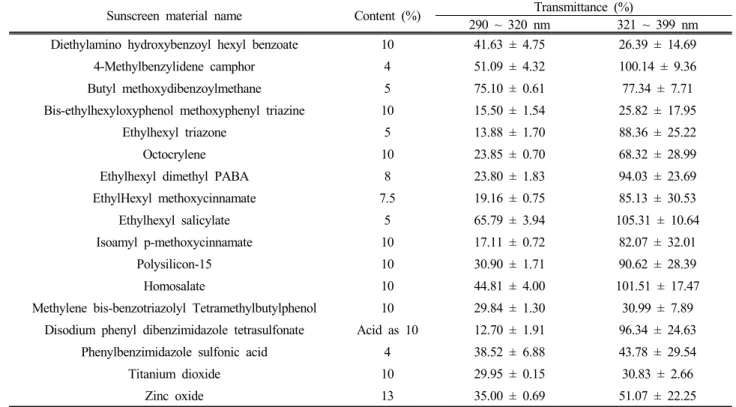
식품의약품안전처 고시 자외선 차단제 원료 17종에 대한 290 ~ 450 nm 영역의 투과율은 Figure 1에 나타내 었으며, 자외선의 영역의 투과율은 Table 1에 나타내었다.
Figure 2. Blue light transmittance of sunscreen material.
Sunscreen material name Content (%) Blue light blocking rate (%) Diethylamino hydroxybenzoyl hexyl benzoate 10 10.52 ± 9.88
4-Methylbenzylidene camphor 4 2.03 ± 0.17
Butyl methoxydibenzoylmethane 5 9.31 ± 0.74
Bis-ethylhexyloxyphenol methoxyphenyl triazine 10 16.32 ± 5.08
Ethylhexyl triazone 5 6.01 ± 0.61
Octocrylene 10 3.15 ± 0.56
Ethylhexyl dimethyl PABA 8 -0.54 ± 0.59
EthylHexyl methoxycinnamate 7.5 1.31 ± 0.46
Ethylhexyl salicylate 5 -1.26 ± 0.49
Isoamyl p-methoxycinnamate 10 1.38 ± 0.62
Polysilicon-15 10 -2.74 ± 0.65
Homosalate 10 -1.75 ± 0.65
Methylene bis-benzotriazolyl Tetramethylbutylphenol 10 35.47 ± 5.13 Disodium phenyl dibenzimidazole tetrasulfonate Acid as 10 1.34 ± 0.67
Phenylbenzimidazole sulfonic acid 4 0.67 ± 5.09
Titanium dioxide 10 65.96 ± 0.93
Zinc oxide 13 14.97 ± 1.45
Table 2. Blue Light Blocking Rate of Sunscreen Material
투과율을 분석한 결과 자외선B 영역인 290 ~ 320 nm에서 는 디소듐페닐디벤즈이미다졸테트라설포네이트가 12.70%, 에칠헥실트리아존이 13.88%, 비스에칠헥실옥시페놀메 톡시페닐트리아진이 15.50%, 이소아밀-p-메톡시신나메 이트가 17.11%, 에칠헥실메톡시신나메이트가 19.16%
순으로 낮은 투과율을 나타냈으며, 자외선A 영역인 321 ~ 400 nm에서는 비스에칠헥실옥시페놀메톡시페 닐트리아진이 25.82%, 디에칠아미노하이드록시벤조일 헥실벤조에이트가 26.39%, 티타늄디옥사이드가 30.83%, 메칠렌비스-벤조트리아졸릴테트라메칠부틸페놀이 30.99%, 페닐벤즈이미다졸설포닉애씨드가 43.78% 순으 로 낮게 나타났다. 디에칠아미노하이드록시벤조일헥 실벤조에이트, 비스에칠헥실옥시페놀메톡시페닐트리아진, 메칠렌비스-벤조트리아졸릴테트라메칠부틸페놀, 페닐 벤즈이미다졸설포닉애씨드, 티타늄디옥사이드는 자외선 290 ~ 400 nm의 모든 영역에서 낮은 투과율을 나타냈다.
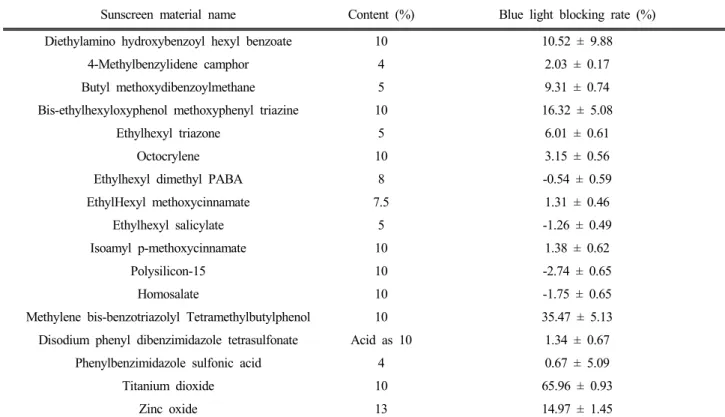
자외선 차단제 17종의 블루라이트 영역인 400 ~ 450 nm 영역의 투과율은 Figure 2에 나타내었으며, 각 차단 제의 블루라이트 차단율은 Table 2에 나타내었다. 디에 칠아미노하이드록시벤조일헥실벤조에이트가 10.52%, 징크옥사이드가 14.97%, 비스에칠헥실옥시페놀메톡시 페닐트리아진이 16.32%, 메칠렌비스-벤조트리아졸릴 테트라메칠부틸페놀이 35.47%, 티타늄디옥사이드가 65.96% 순으로 나타났다. 티타늄디옥사이드 함유 제형 이 가장 높은 블루라이트 차단율을 나타내었다. 이는 티타늄디옥사이드의 자외선 반사 기작과 백탁현상에 의한 차광현상이 블루라이트 차단효과를 높게 나타나 는데 기여한 것으로 사료된다.
3.2. 티타늄디옥사이드 제형의 도포량에 따른 블루라이트 투과율 측정
블루라이트 차단 효과가 있는 티타늄디옥사이드 함 유 제형의 도포량에 따른 블루라이트 차단 효과의 변 화는 Figure 3과 Table 3에 나타내었다. 측정한 결과 도
Figure 4. Ultraviolet and blue light transmittance according to titanium dioxide particle size.
Figure 3. Blue light transmittance according to the application amount of the titanium dioxide containing formulation.
Item Blue light (400 ~ 450 nm) blocking rate (%) Nano-Titanium Dioxide 21.38 ± 2.30 Micro-Titanium Dioxide 73.10 ± 1.06
Table 4. Ultraviolet and Blue Light Blocking Rate according to Titanium Dioxide Particle Size
Application amount (mg/cm2)
Blue light (400 ~ 450 nm) blocking rate (%)
0.65 52.23 ± 0.80
0.91 55.36 ± 0.78
1.30 65.96 ± 0.93
1.56 67.91 ± 1.03
1.95 72.16 ± 1.31
2.60 84.21 ± 2.13
Table 3. Blue Light Blocking Rate According to The Aplication Amount of The Titanium Dioxide Containing Formulation
포량이 0.65 ~ 2.60 mg/cm2로 증가할수록 블루라이트 차단율은 52.23 ~ 84.21%로 증가하는 것을 확인할 수 있었다. 그러나 시료 도포 증가량과 차단율 증가량 간 의 통계학적인 상관관계는 성립되지 않았다.
3.3. 티타늄디옥사이드 입자 크기에 따른 블루라이트 투 과율 측정
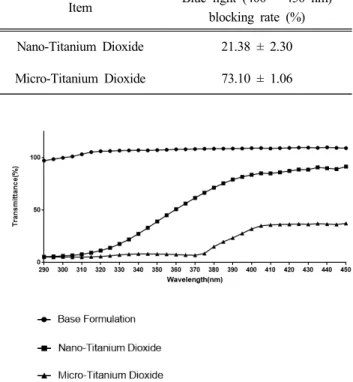
티타늄디옥사이드 입자 크기에 따른 290 ~ 450 nm 영역의 투과율은 Figure 4에 나타내었으며, 티타늄디옥 사이드 입자 크기에 따라 자외선 영역과 블루라이트 영역의 투과율에 차이가 있음을 확인하였다. 블루라이 트 차단 효과를 측정한 결과는 Table 4에 나타내었으 며, nano-티타늄디옥사이드는 21.38%이고 Micro-티타 늄디옥사이드는 73.10%로 나타났다. 본 결과는 티타늄 디옥사이드 입자 크기가 클수록 블루라이트 차단 효과 가 크게 나타남을 제시하고 있다. 따라서 블루라이트 차단 화장품 개발에는 micro-티타늄디옥사이드가 적합 할 것으로 사료된다.
4. 결 론
블루라이트에 관한 유해성에 관한 연구가 보고되어 있으며, 공산품의 경우 블루라이트 차단에 관한 평가 가 이루어지고 있음에도 불구하고, 화장품의 경우 블 루라이트 차단효과를 평가하는 평가법은 제시되지 않 고 있다. 이에 각종 가이드라인의 sunscreen in vitro test 를 기반으로 하여 블루라이트 차단율을 측정하기 위한 시료 도포량, 기질 및 측정방법, 차단율 계산을 도출하 였다. 도출된 시험방법을 근거로하여 식품의약품안전 처 고시 자외선 차단제 원료 17종에 대한 블루라이트 차단율을 조사한 결과 메칠렌비스-벤조트리아졸릴테 트라메칠부틸페놀과 티타늄디옥사이드가 높은 차단율 을 나타냈다. 이 중 티타늄디옥사이드는 65.96%로 가 장 높은 차단율을 나타냈다.
블루라이트 차단 효과가 가장 높은 티타늄디옥사이 드 제형의 도포량에 따른 블루라이트 차단 효과를 측 정한 결과 도포량이 증가할수록 블루라이트 차단율이 증가하는 것을 확인할 수 있었다. 이는 티타늄디옥사 이드의 도포 두께가 증가하여 블루라이트 차단율이 증 가한 것으로 사료 된다. 또한 동일 함량의 티타늄디옥 사이드의 입자크기에 따른 블루라이트 차단효과를 확
인한 결과 nano-티타늄디옥사이드 보다 micro-티타늄 디옥사이드가 두 배 이상의 차단효과를 나타냈다.
제시된 블루라이트 차단 in vitro test를 통하여 블루 라이트 차단 소재 탐색 및 화장품 제형 연구 및 평가가 가능할 것으로 사료된다.
Reference
1. L. Duteil, N. Cardot-Leccia, C. Queille-Roussel, Y.
Maubert, Y. Harmelin, F. Boukari, D. Ambrosetti, J.
P. Lacour, and T. Passeron, Differences in visible light-induced pigmentation according to wavelengths:
a clinical and histological study in comparison with UVB exposure, Pigm Cell Melanoma R, 27, 822 (2014).
2. T. Y. Tzung1, K. H. Wu, and M. L. Huang, Blue light phototherapy in the treatment of acne,
Photodiagn Photodyn, 20, 266 (2004).
3. P. Papageorgiou, A. Katsambas, and A. Chu, Phototherapy with blue (415 nm) and red (660 nm) light in the treatment of acne vulgaris, Brit. J.
Dermatol., 142, 973 (2000).
4. J. B. Lee, S. H. Kim, S. C. Lee, H. G. Kim, H. G.
Ahn, Z. Li, and K. C. Yoon, Blue light-induced oxi- dative stress in human corneal epithelial cells: pro- tective effects of ethanol extracts of various medicinal plant mixtures. Invest. Ophth. Vis. Sci., 55(7), 4119-4127 (2014).
5. J. R. Sparrow, K. Nakanishi, and C. A. Parish, The lipofuscin fluorophore A2E mediates blue light-in- duced damage to retinal pigmented epithelial cells,
Invest. Ophth. Vis. Sci., 41(7), 1981 (2000).
6. Y. Kuse, K. Ogawa, K. Tsuruma, M. Shimazawa, and H. Hara, Damage of photoreceptor-derived cells in culture induced by light emitting diode-derived blue light, Sci. Rep-UK, 4, 5223 (2014).
7. J. K. Hwang, H. K. Shin, and S. M. Chang, Development of blue light cut films using a roll-to-roll nano micro coating system, Trans. Electr.
Electron. Mater., 17(3), 178 (2016).
8. S. Hettwer, E. B. Gyenge, and B. Obermayer, Blue
light protecting cosmetic active ingredients: A Case Report, J Dermat Cosmetol, 1(4), 23 (2017).
9. H. Moseley, H. Cameron, T. Macleod, C. Clark, R.
Dawe, and J. Ferguson, New sunscreens confer im- proved protection for photosensitive patients in the blue light region, Brit. J. Dermatol., 145, 789 (2001).
10. B. L. Dittey and P. M. Farr, Sunscreen protection against UVB, UVA and blue light: an in vivo and in
vitro comparison, Brit. J. Dermatol., 124, 258 (1991).
11. S. Schalka, F. A. S. A. Addor, C. M. Agelune, and V. M. C. Pereira, Sunscreen protection against visible light: a new proposal for evaluation, Surg. Cosmet.
Dermatol., 3(4), 45 (2012).
12. D. Moyal, V. Alard, C. Bertin, F. Boyer, M. W.
Brown, L. Kolbe, P. Matts, and M. Pissavini, The re- vised COLIPA in vitro UVA method, IInt. J. Cosmet.
Sci., 1, (2012).
13. L. Fageon, D. Moyal, J. Coutet, and D. Candau, Importance of sunscreen products spreading protocol and substrate roughness for in vitro sun protection factor assessment, Int. J. Cosmet. Sci., 31, 405 (2009).
14. B. L. Diffey, P. R. Tanner, P. J. Matts, and J. F.
Nash, In vitro assessment of the broad-spectrum ultra- violet protection of sunscreen products, J. AM.
ACAD. DERMATOL., 43(6), 1024 (2000).
15. M. Pelizzo, E. Zattra, P. Nicolosi, A. Peserico, D.
Garoli, and M. Alaibac, In vitro evaluation of sunscreens: An update for the clinicians, International
Scholarly Research Network ISRN Dermatology,
352135, 1 (2012).16. L. Ferrero, M. Pissavini, A. Dehais, S. Marguerie, and L. Zastrow, Importance of substrate roughness for In Vitro sun protection assessment, IFSCC, 9(2), 2 (2006).
17. E. T. Kaye, J. A. Levin, I. H. Blank, K. A. Arndt, and R. R. Anderson, Efficiency of opaque photo- protective agents in the visible light range, Arch.
Dermatol., 127, 351 (1991).
18. A. Salih, O. Hoegh-Guldberg, and G. Cox, Photoprotection of symbiotic dinoflagellates by fluo- rescent pigments in reef corals, Greenwood JG and NJ Hall (eds) Proc. Australian Coral Reef Soc. 75 th
Anniversary Conference, Heron Island, 217 (1998).
19. D. G. Silva, F. D. Sarruf, L. C. D. Oliveira, E. P. G.
Arêas, T. M. Kaneko, V. O. Consiglieri, M. V. R.
Velasco, and A. R. Baby, Influence of particle size on appearance and in vitro efficacy of sunscreens,